www.ann-geophys.net/26/3741/2008/ © European Geosciences Union 2008
Annales
Geophysicae
Foreshock density holes in the context of known upstream
plasma structures
M. Wilber1, G. K. Parks1, K. Meziane2, N. Lin1, E. Lee1, C. Mazelle3, and A. Harris1
1Space Sciences laboratory, University of California, Berkeley, USA 2Department of Physics, University of New Brunswick, Fredericton, Canada 3CESR, CNRS/UPS, Toulouse, France
Received: 9 May 2008 – Revised: 31 July 2008 – Accepted: 31 July 2008 – Published: 26 November 2008
Abstract. We present case examples of foreshock density
holes and results from a statistical survey, which provide ad-ditional characterizations of these recently-described struc-tures. Specific effort is made to place these objects into context with well-studied foreshock phenomena, such as hot flow anomalies (HFAs) and large-amplitude magnetic pulsa-tions (SLAMS). Density holes are observed during higher-than-average solar wind speeds (∼620 km s−1), have well-correlated density and magnetic field intensities, and anti-correlated density and temperature variations. Like HFAs, these structures occur over a wide range of foreshock geome-tries, suggesting that this is not a determining factor. They are embedded within IMF current sheets, but their cross-structure magnetic shears are considerably lower than for HFAs. When the Cluster spacecraft are widely separated, they are able to measure structure time development, with substantial changes occurring over 10s of seconds, confirm-ing an earlier case study, and possibly indicatconfirm-ing short life-times as well. We find that density holes can occur in the ab-sence of strong upstream magnetic pulsations and/or density enhancements, which rules out a “wake effect” as the sole explanation for their formation. Most important is the obser-vation that the observed solar wind motional electric fields tend to have components pointing away from the embedding IMF current sheets. Density holes have no connection with magnetic holes and foreshock cavities, and appear not to be early-stage or weakly-formed HFAs.
Keywords. Interplanetary physics (Planetary bow shocks) –
Magnetospheric physics (Plasma waves and instabilities; So-lar wind-magnetosphere interactions)
Correspondence to: M. Wilber
1 Introduction
Recently, Parks et al. (2006, 2007) reported Cluster and Dou-ble Star observations of sub-minute depletions in density and magnetic field intensity upstream of Earth’s bow shock. These density holes typically exhibit a greatly reduced so-lar wind beam that is partially replaced by isotropic supra-thermal ions, and often have upstream overshoots in density and field intensity. There is increased wave activity, includ-ing enhanced ion cyclotron waves and whistler mode waves in their interiors, along with strong electrostatic (ES) waves near density minima. Although these reports included results from a preliminary survey of events seen during a small num-ber of foreshock transits, no comprehensive characterization has yet been presented. Furthermore, no studies have yet identified specific criteria for when these structures should be observed, nor a mechanism for their production. No-tably, those papers indicated that density holes were associ-ated with backstreaming ions characteristic of the foreshock, as well as with moderate cross-structure shears in the mag-netic field that indicated they were embedded within inter-planetary magnetic field (IMF) current sheets. In addition, strong magnetic pulsations typically have such density holes downstream.
Many shock and foreshock characteristics are strongly de-termined by geometry, with a critical parameter beingθBn, the angle between the average magnetic field direction and the local shock normal. Quasi-parallel (Qk) regions have
θBn.40◦ and are characterized by strong, turbulent,
3742 M. Wilber et al.: Foreshock density holes in context 1986; Meziane et al., 2001). Quasi-perpendicular (Q⊥)
re-gions (45◦
.θBn.70◦) typically have very weak wave
ac-tivity, and coherent, backstreaming field-aligned ion beams (Paschmann et al., 1981; Bonifazi and Moreno, 1981a,b). Strongly perpendicular regions (θBn&70◦) have much more energetic (100 keV–several MeV) backstreaming gyrating ions (Sarris et al., 1976; Anderson, 1981; Meziane et al., 1999).
Various foreshock plasma structures have been studied over the past three decades, and it is important to place den-sity holes into context. Magnetic pulsations of various forms have been observed since the first spacecraft shock crossings, but of particular interest here are the short, large-amplitude magnetic pulsations (SLAMS) (Greenstadt et al., 1970a,b, 1977; Russell and Greenstadt, 1979; Thomsen et al., 1990; Schwartz and Burgess, 1991) that have been associated with density holes. These are magnetic intensity enhancements at least a factor of 2.5×the ambient levels, which have time scales on the order of 10 s in the spacecraft frame, and which are relatively coherent. They are thought to form from steep-ening foreshock ULF waves (Schwartz, 1991), and to play a critical role in processing the solar wind over a distributed shock transition inQkregions (Schwartz and Burgess, 1991;
Lucek et al., 2008). The orientations of their upstream nor-mals are aligned most closely with upstream field directions, while their maximum interior fields are found at large angles relative to model shock surfaces (Mann et al., 1994). The orientations favorQ⊥ geometries for the SLAMS’ interior
fields, with ion behaviors similar to those atQ⊥shocks. This
geometry can lead to some plasma heating.
Lucek et al. (2002, 2004a, 2008) have examined SLAMS using the multi-point capabilities of Cluster and have found that the structures are strongly correlated on spacecraft sepa-ration scales of∼100 km, with magnetic field gradient scale sizes 100–150 km, comparable to a solar wind ion inertial length. At larger separations of∼600 km, the structures ap-pear significantly different at each spacecraft. Previously, density depletions had been reported downstream of SLAMS (Thomsen et al., 1990), and were interpreted as “wake ef-fects” due to solar wind flow being partially diverted around the field enhancements (Behlke et al., 2003).
Other well-studied foreshock plasma structures include hot flow anomalies (HFAs) that are characterized by large flow deviations, which at times have sunward-directedxGSE components, and interior particle temperatures greatly in excess of the ambient solar wind (Schwartz et al., 1985; Schwartz et al., 1988, 2000; Woolliscroft et al., 1986; Thom-sen et al., 1986; ThomThom-sen et al., 1988; ThomThom-sen et al., 1993; Paschmann et al., 1988; Lucek et al., 2004b). These appear to be the result of current sheets, specifically, tangential dis-continuities (Thomsen et al., 1993), in the IMF interacting with Earth’s bow shock. In most cases, the hot interior re-gions exhibit turbulent plasma and field structure, with field intensities and densities that on average range from a half to several times the exterior solar wind values. (Interior
densi-ties tend to remain closer to solar wind values than interior magnetic fields.)
The structure edges are typically enhanced significantly over the ambient solar wind values, and plasma parameters and particle signatures provide evidence that these form fast mode-like shock interfaces with the solar wind (Schwartz et al., 1985; Fuselier et al., 1987; Paschmann et al., 1988; Thomsen et al., 1988). HFAs have magnetosheath manifes-tations and can impact the magnetopause and magnetosphere (Paschmann et al., 1988; Sibeck et al., 1999; ˘Safr´ankov´a et al., 2002; Eastwood et al., 2008). The paradigm adopted by most authors at this time is that heated interior plasma results in an overpressure relative to the solar wind, with explosive expansion in the solar wind frame that drives the formation of edge shocks (e.g. Thomsen et al., 1986).
As proposed by Burgess (1989), and later confirmed in several observational studies referenced above, as well as in simulations (Thomas et al., 1991), HFAs typically have so-lar wind convection electric fields with components directed inward on either or both edges of the structures. These mo-tional fields are thought to be important for channeling ions specularly reflected off of the bow shock into the current sheet along its line of connection. Schwartz et al. (2000) have further argued that reflected ions will not successfully reach the current sheet (and thus fill it) unless their gyration veloc-ities exceed the speed at which the current sheet connection line convects along the shock. This condition is best satisfied for IMF discontinuities that have normal orientations with large components transverse to the solar wind flow direction. Although there is some agreement that the structures de-scribed by Thomsen et al. (1986); Fuselier et al. (1987) are of the same class as those considered by, e.g. Schwartz et al. (1985) and Woolliscroft et al. (1986), the former applied somewhat different selection criteria, which is reflected in their original term: hot diamagnetic cavities. Most notably, they considered cases where the magnetic field formed cav-ities centered on the IMF current sheet, which apparently were the result of the inferred plasma expansion. These hot diamagnetic cavities (HDCs) also exhibited two populations of ions, including a reduced solar wind beam and a back-streaming component. An interpretation is that these rep-resent an early phase of HFA development, with streaming instabilities leading to a single hot interior population later. In a superficial comparison, HDCs resemble the density cav-ities described by (Parks et al., 2006), but the physical scales for HDCs in the literature are larger, their frequency of oc-currence is much lower, and their interior densities and fields do not drop so precipitously.
strong flow deviations. Rather than resulting from a shock-current sheet interaction, these are likely due to pressure dif-ferences between adjacent plasma domains. When foreshock regions connected toQkshocks are embedded withinQ⊥
re-gions, the former can be expected to have moderately higher ion pressures. Particles emerging from quasi-parallel shocks are actively scattered by upstream magnetic structures that are convected Earthward, and subsequent interactions with the shock lead to strong particle energization by a Fermi pro-cess. In contrast, field-aligned beams apparently emanating fromQ⊥shocks are disrupted very slowly, with little
appar-ent in-transit heating (Meziane et al., 2005).
Another class of structures requiring brief mention are so-lar wind magnetic holes (Turner et al., 1977), which are char-acterized by significant depletions in the magnetic field in-tensity, and which exhibit a large range of scales (Stevens and Kasper, 2007). These have been attributed variously to non-propagating current sheets embedded within the solar wind that exhibit diamagnetic pressure balance (Fitzenreiter and Burlaga, 1978; Burlaga and Lemaire, 1978); to the mir-ror mode instability in the case of small spatial-scale events with small magnetic rotations (Winterhalter et al., 1994); to Alfv´enic solitary structures (Baumg¨artel, 1999; Buti et al., 2001); and to diamagnetic holes generated through steep-ened Alfv´en waves (Tsurutani et al., 2002) driven by pon-deromotive heating of ions. Solar wind magnetic holes seem to be unrelated to density holes, however, on at least two counts: they are not constrained to the ion foreshock, but rather are seen throughout the heliosphere; and they tend to show no changes or increases in associated density (Winter-halter et al., 1994), while a strong density depletion is a defin-ing characteristic for the structures contemplated in this pa-per. The association of density holes with the ion foreshock suggests that the shock itself or backstreaming ions have a role in their formation.
This study has been motivated by several outstanding questions about density holes: What relationship, if any, do they have to these other well-studied foreshock structures? Density holes are observed in upstream regions that have backstreaming particles and waves characteristic of both quasi-parallel and quasi-perpendicular foreshocks, suggest-ing that shock geometry is not the determinsuggest-ing factor. Could they, for example, be early-stage HFAs, or HFAs that fail to fully develop for some reason? Or can we identify a physi-cal basis for them being fundamentally different? Given that SLAMS generally have density cavities downstream, can the latter be accounted for by the “wake effect” suggested by Behlke et al. (2003)? As we indicate in Sect. 2 following im-mediately, we have identified a large sample of events (num-bering∼70) that appear to have no associated large upstream pulsations or density overshoots, for which such a wake ef-fect seems an unlikely explanation. In fact, these density holes are characterized by a greatly diminished reduction in the solar wind beam, and that raises a related question. Ab-sent an upstream pulsation which might divert a fraction of
the solar wind, and edge overshoots indicating strong expan-sion into the surrounding plasma, what mechanism expels the majority of the solar wind beam, or blocks its entry into a structure standing relative to the solar wind flow?
After describing the instrumentation used and criteria for selecting our events in Sect. 2, we begin by presenting a few case events in Sect. 3. These are contrasted with HFAs pre-sented in the literature. We follow in Sect. 4 with results from a statistical survey of carefully-selected events having no strong pulsations upstream, and show that most density hole characteristics are uncorrelated with the magnetic shears across the structures. Further, the normal components of the convection electric field show a statistical tendency to point out of the structures, rather than inward as has been found for HFAs. Finally, after summarizing results we discuss the implications of these results in Sect. 5.
2 Instrumentation and data selection
The primary data used for this study are from the 5 eV– 40 keV Cluster/CIS hot ion analyzers (HIA) (R`eme et al., 2001) and the FGM fluxgate magnetometer (Balogh et al., 2001), with additional proxy density measurements in the form of spacecraft electric potentials from the EFW electric fields and waves instrument (Gustafsson et al., 1997). The HIA all-ion electrostatic analyzers return to ground moments of the ion distribution functions at spin-resolution (4 s), and full 3-D data averaged over 1–3 spins, depending upon the telemetry mode.
Although all events were observed upstream of the bow shock, we have eliminated events recorded when the CIS instrument was in “solar wind” acquisition mode. For this, the sunward-looking high-geometry factor measurements are obtained with the energy sweep truncated below∼1 keV q−1, in order to minimize saturation fluxes that damage the detec-tor. We have found, however, that the low-geometry factor measurements, which are based upon a fraction of velocity space centered on the solar wind beam, do not capture suf-ficient portions of the supra-thermal ions, and therefore un-derestimate the temperature. In magnetosheath mode, all of velocity space is measured by the high geometry-factor side of the analyzer, although high fluxes from the fast-moving cold solar wind beam tend to saturate the measurements. The result is an underestimate of the density by factors as high as 2–3, and a modest overestimate of the temperature, but ve-locities should remain rather accurate. Inside density holes, where the fluxes are significantly reduced, the saturation er-rors should be considerably lower. The most error prone measurements therefore are the ratios of exterior to interior densities, which are underestimated.
3744 M. Wilber et al.: Foreshock density holes in context
Fig. 1.
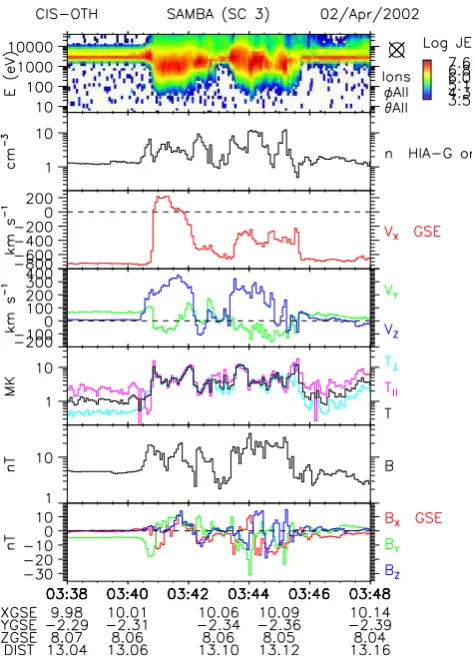
Fig. 1. Hot flow anomaly, 2 April 2002, summary; spin-resolution
all-ion spectrogram and moments from CIS/HIA, and magnetic field vectors from FGM (cf. Lucek et al., 2004b).
measurements from EFW serve two important purposes: first, they typically provide proxy density information at 5 Hz resolution (20×the cadence of the CIS moments); and sec-ond, confirm that the sometimes-dramatic density drops ob-served are not a CIS instrument artifact resulting from alias-ing, as might occur were changes to the velocity space lo-cation of the cold solar wind beam to cause it to appear anti-synchronously with the combined angular and energy sweeps of the analyzer.
In order to disentangle the possible effects of associated plasma structures, we have sought events that lack strong, adjacent upstream pulsations (e.g. SLAMS) or density over-shoots. By our criteria, attached fluctuations in spin-averaged density and magnetic field strength must not exceed 2×
the average values upstream (most are much lower), and where strong ULF are present, the nearest upstream maxima must not be significantly different from neighboring maxima where no density holes are present. In other words, adja-cent fluctuations must not be distinctive. Of the∼70 events identified from dates in 2002–2004, almost half were elim-inated from the statistical database due to multiple
occur-rences or other sub-structure that prevented unambiguous de-termination of, e.g., density minima or structure widths. Of the events retained, the majority were observed to have suit-able characteristics by both spacecrafts 1 (C1) and 3 (C3), for which the CIS/HIA instruments were operational. From the magnetic field and spacecraft potential measurements, we found that almost always the events were of sufficient spatial and temporal scales to be seen by all four probes. In our survey results, we present the C1 and C3 measurements sep-arately as a consistency check.
3 Case events
3.1 2 April 2002 hot flow anomaly
In order to contrast our observations with those typical of hot flow anomalies, we present in Fig. 1 an example an HFA observed by Cluster and examined in detail by Lucek et al. (2004b). The top panel provides ion energy fluxes from the all-ion HIA instrument, and shows a clear broadening of the spectrum near 03:40:30 UT, which resembles a mag-netosheath distribution and includes fluxes extending up to 40 keV. In most places, the density for this event is near or in excess of the solar wind values of 1–2 cm−3, although we note a brief gap in the spectrogram and a drop in den-sity at the trailing (upstream) edge near 03:45:30 UT. Very large flow deviations are observed withvxreversing and at-taining values>+200 km s−1, andvzreaching∼300 km s−1. In places the temperature increased by a factor of 10 over the ambient 1 MK level, with the last peak aligned with the density drop at the upstream edge. The magnetic field is highly structured, with intensity variations comparable to, but not strongly-correlated with, the density variations. Briefly near 03:42:15, and for a half-minute interval starting at 03:42:25 UT the magnetic field intensity drops below the ambient solar wind value, although for most times the field strength exceeds it. It is evident from inspection of the field components before 03:40 and after 03:46 UT that there was a large shear in the IMF direction across the structure. 3.2 2 April 2002, density hole
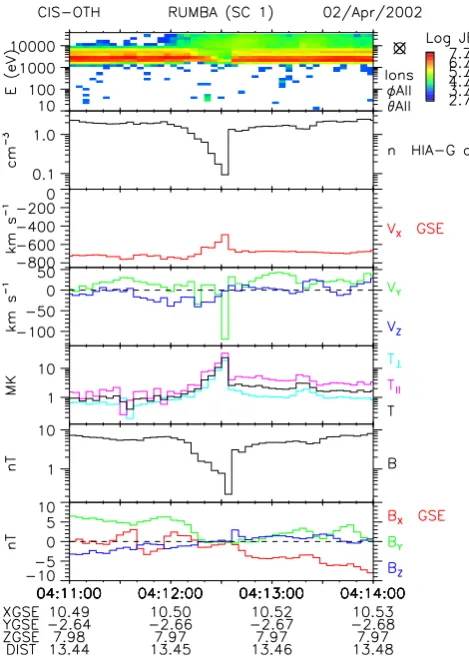
Figure 2 shows a density hole recorded half an hour after the HFA depicted in Fig. 1. This is a Q⊥→Qk transition
Fig. 2.
Fig. 2. 2 April 2002 04:11–04:14 UT summary plot. Same format
as for Fig. 1.
ThenandB profiles, as well as the energy flux spectro-gram are intriguing, as the upstream side shows a very abrupt transition, while the downstream side changes gradually. The spectrograms show that on the downstream edge the grad-ual change occurs with evident energy dispersion, suggest-ing a possible velocity filter effect. Spectrograms for C3 (not shown) substantiate this dispersion.
Figure 3 shows magnetic field data from FGM and space-craft potentials,φSC, from EFW. Offsets of 1 V have been ap-plied to the latter to make individual traces easier to discern. A running average of 2 s has been applied to remove>1 Hz structure. Although the maximum inB at 04:12:35 exceeds double the value immediately upstream, we consider the ad-jacent dip to reflect structure associated with the density hole, rather than the ambient solar wind field intensity.
Putting aside for now the substructure within the middle two dashed vertical lines, there is a clear rotation in the field across the structure. AlthoughφSCvaries somewhat crudely with the log of the density, we see that upon entrance into the structure it varies monotonically. The magnetic field traces, on the other hand have additional structure, indicating that on these (kinetic) scales the fast mode-like character of the density hole breaks down.
04:11:40 04:12:30 04:13:20
0.1 1.0
10.0 02 Apr 2002 0411:00-0414:00
C1 C2 C3 C4 |B| smooth: 45
04:11:40 04:12:30 04:13:20
-8 -6 -4 -2 0 2
4 C1 C2 C3 C4 B
X
04:11:40 04:12:30 04:13:20
-4 -2 0 2 4
6 C1 C2 C3 C4 BY
04:11:40 04:12:30 04:13:20
-4 -2 0 2 4
6 C1 C2 C3 C4 BZ
04:11:40 04:12:30 04:13:20
[image:5.595.308.547.63.449.2]-35 -30 -25 -20 -15 -10
Fig. 3.
Fig. 3. 2 April 2002 04:11–04:14 UT, magnetic fieldsBand space-craft potentialsφSC; from top down: FGM magnitude (log scale);
FGM GSE components; andφSCfrom EFW. Vertical lines denote
intervals for hodograms and timing analysis discussed in text.
3746 M. Wilber et al.: Foreshock density holes in context
-6 -4 -2 0 2 4 6 -8 -6 -4 -2 0 2
4 B⊥vHT v. Bn
-6 -4 -2 0 2 4 6 -6 -4 -2 0 2 4
6 B⊥1 v. Bn
-8 -6 -4 -2 0 2 4 -6 -4 -2 0 2 4
6 B⊥1 v. B⊥vHT
Bn x B⊥vHT x B⊥1
-4 -2 0 2 4 6 8 -8 -6 -4 -2 0 2 4
B
j1
v. B
k1-4 -2 0 2 4 6 8 -4
-2 0 2 4
6
B
i1v. B
k1-8 -6 -4 -2 0 2 4 -4
-2 0 2 4
6
B
i1v. B
j1C1
-2 0 2 4 6 8 -8 -6 -4 -2 0 2 4
B
j2
v. B
k2-2 0 2 4 6 8 -4
-2 0 2 4
6
B
i2v. B
k2-8 -6 -4 -2 0 2 4 -4
-2 0 2 4
6
B
i2v. B
j2C2
-4 -2 0 2 4 6 8 -8 -6 -4 -2 0 2 4
B
j3
v. B
k3-4 -2 0 2 4 6 8 -4
-2 0 2 4
6
B
i3v. B
k3-8 -6 -4 -2 0 2 4 -4
-2 0 2 4
6
B
i3v. B
j3C3
-4 -2 0 2 4 6 8 -8 -6 -4 -2 0 2 4
B
j4
v. B
k4-4 -2 0 2 4 6 8 -4
-2 0 2 4
6
B
i4v. B
k4-8 -6 -4 -2 0 2 4 -4
-2 0 2 4
6
B
i4v. B
j4C4
-2 0 2 4
-4 -2 0
2 B⊥vHT v. Bn
-2 0 2 4
0 2 4
6 B⊥1 v. Bn
-4 -2 0 2
0 2 4
6 B⊥1 v. B⊥vHT
Bn x B⊥vHT x B⊥1
-4 -2 0 2
-4 -2 0
2
B
j1v. B
k1-4 -2 0 2
0 2 4
6
B
i1v. B
k1-4 -2 0 2
0 2 4
6
B
i1v. B
j1C1
-4 -2 0 2
-4 -2 0
2
B
j2v. B
k2-4 -2 0 2
0 2 4
6
B
i2
v. B
k2-4 -2 0 2
0 2 4
6
B
i2
v. B
j2C2
-4 -2 0 2
0 2 4
6
B
j3
v. B
k3-4 -2 0 2
0 2 4
B
i3v. B
k30 2 4 6
0 2 4
B
i3v. B
j3C3
-4 -2 0 2
0 2 4
6
B
j4v. B
k4-4 -2 0 2
-2 0 2
4
B
i4v. B
k40 2 4 6
-2 0 2
4
B
i4v. B
j4 [image:6.595.51.286.65.224.2]C4
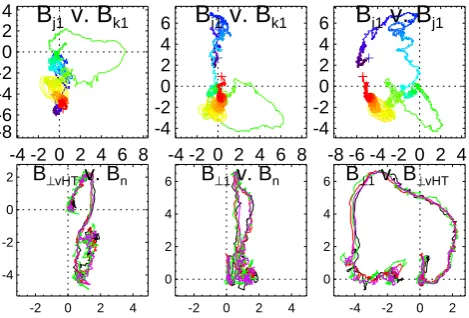
Fig. 4.
Fig. 4. 2 April 2002Bhodograms; top) C1 in minimum variance coordinates for 04:11:41–04:13:18 UT; bottom) all spacecraft, in timing analysis coordinates for 04:12:34–04:12:41 UT, with, left to right,rH T×n4pt,r⊥×n4pt,r⊥×rH T. See text for details.
We analyzed the density hole’s (upstream) exit transition using the multi-point timing analysis method (Harvey, 1998). Although the high solar wind speed of∼700 km s−1and the
∼100 km spacecraft separation scale made this challenging even with FGM’s high-resolution data, we were able to ob-tain sensible, if not accurate, results. The determinations for the downstream edge were inconsistent when using different field components, so we omit them. Application of a vari-ance analysis to the magnetic field over the short exit interval yielded nearly-degenerate medium and maximum eigenval-ues, indicating a circularly polarized rotation of the field. We used these two directions to construct maximum and medium variance components for the field,Bmax andBmed, respec-tively. These were adopted as two independent components for the timing analysis. Agreement between timing normals fromBmax andBmed was to within 5◦ of each of the indi-vidual minimum variance normals obtained from the four spacecraft, suggesting an excellent direction determination. A third timing normal for the field magnitudeB resulted in good agreement with the single-spacecraft normals, here to within 8◦.
The average normal direction for the upstream cav-ity edge obtained from timings of Bmax and Bmed was n4pt=[0.97,0.24,0.05]. Normal incidence fast magne-tosonic Mach numbers were variable, in part due to small normal flow projection variations, as well as from sam-pling resolutions that were marginal for this event. We found MA=1.06±0.35, indicating that the upstream edge was standing relative to the solar wind flow at approximately the Alfv´en speed.
The bottom row of Fig. 4 shows overlapping hodograms for the magnetic fields of the four spacecraft during the exit transition selection interval. From left to right the panels show projections onto then4pt×rH T,n4pt×r⊥andrH T×r⊥
planes, whererH T is along the de Hoffman-Teller velocity constructed from the upstream conditions and the normal di-rection, andr⊥completes an orthogonal coordinate system.
There appears to be a small non-zero normal component to the magnetic field∼1 nT, and the previously-noted circular polarization is evident in the right panel. Consistent with the small differences between the timing normal and the four minimum variance normals, the four hodograms constructed from minimum variance normals (not shown) are virtually indistinguishable. This suggests that the leading edge of the structure is a rotational discontinuity. For additional exam-ples of magnetohydrodynamic (MHD) discontinuity analy-ses applied to density holes and associated structures see Lin et al. (2008).
Figure 5 shows a distribution function obtained at 04:12:32 UT, just as the spacecraft was exiting the density hole. The left panel shows a slice through thevk×v⊥plane,
while the three others show slices in planes perpendicular toB at values ofvk=0,±800 km s−1 relative to the
paral-lel component of the plasma velocity (indicated by dashed colored lines in the left frame). The intensity of the solar wind beam (red contours), included in thevk×v⊥ slice and
in the middlev⊥0×v⊥1slice, is reduced relative to ambient values (not shown). All three slices perpendicular toBshow a sharp cut-off near their centers, which is consistent with a remote-sensing distribution obtained at the edge of a sharply-delimited region having occupied guiding centers (Meziane et al., 2003; Schwartz et al., 2006). In contrast, distributions obtained around the downstream edge (not shown) indicate a gradual variation in the supra-thermal population, but no clear remote-sensing edge, consistent with a gradient scale on the downstream edge>1 ion Larmor radius.
3.3 16 March 2003, nascent density hole
On 16 March 2003 Cluster observed a nascent density hole forming just upstream of the shock. This occurred during a transition fromQ⊥→oblique shock geometries. The
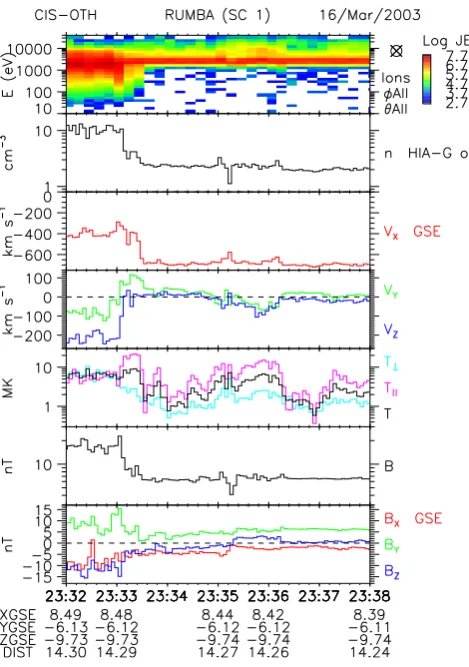
space-craft were well separated alongxGSEby∼11 200 km, which resulted in a difference of 15 s between the first and last ob-servation by C3 and C1, respectively. Separations transverse to the solar wind flow were only 3800 km, decreasing the likelihood of measuring spatial differences along the struc-ture. Figure 6 shows a summary of plasma parameters for C1 as it crossed the shock at 22:33:30 UT, and intercepted a small density hole a couple of minutes later at 23:35:15 UT. The spectrogram, which was obtained at 3-spin resolution, does not capture the density hole seen in the 4-s data. Again the solar wind speed was∼700 km s−1, with otherwise un-remarkable upstream field and plasma values. The density hole was centered on a distinct rotation in the magnetic field, but no density hole is apparent a minute later when the field rotates partially back to its pre-density hole orientation.
-2000-1000 0 1000 2000 -2000
-1000 0 1000 2000
04:12:30 - 04:12:34
V
||V
⊥0-2000-1000 0 1000 2000
-2000
-1000
0
1000
2000
04:12:30 - 04:12:34
V
⊥aV
⊥b-2000-1000 0 1000 2000
-2000
-1000
0
1000
2000
04:12:30 - 04:12:34
V
⊥aV
⊥b-29 -28 -27 -26 -25 -24
log
10(df/s
3cm
-6)
-29.3 -23.3
0
1
0
1
-2000-1000 0 1000 2000
-2000
-1000
0
1000
2000
04:12:30 - 04:12:34
V
⊥a [image:7.595.58.547.65.232.2]V
⊥bFig. 5.
[image:7.595.308.536.292.458.2]Fig. 5. 2 April 2002 04:11–04:14 UT, ion distributions from HIA in the spacecraft frame. Left panel showsvk×v⊥, while the three panels to the right show slices perpendicular toBat values ofvk=0,±800 km s−1relative to the parallel plasma velocity.
Fig. 6.
Fig. 6. 16 March 2003 23:32–23:38 UT summary plot. Same format
as for Fig. 1.
which excludes the shock crossing observed by C1. C2, C3 and C4 detected the density hole at nearly the same time, while C1 observed it last. C1 was closest to the shock, where it detected the cavity at its deepest.
23:33:30 23:34:00 23:34:30 23:35:00 23:35:30 23:36:00 23:36:30 23:37:00
10
16 Mar 2003 2333:30-2337:00
C1 C2 C3 C4 |B| smooth: 45
2
2333:30 2334:00 2334:30 2335:00 2335:30 2336:00 2336:30 2337:00 -8.5
-8.0 -7.5 -7.0 -6.5
Fig. 7.
Fig. 7. 16 March 2003 23:33:30–23:37:00 UT, magnetic field
in-tensity andφSC.
3.4 19 February 2003, time-developing structure
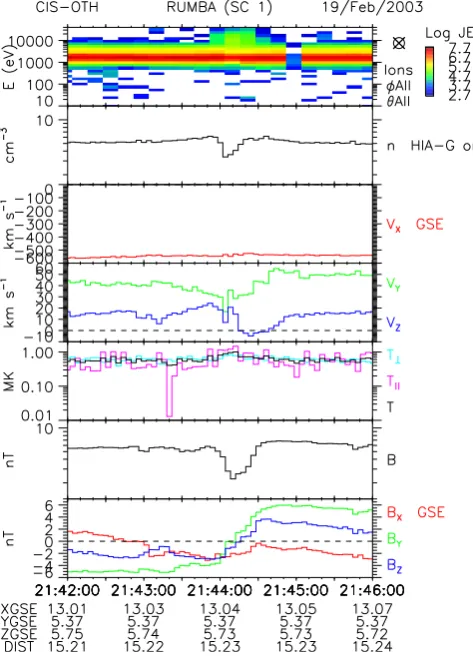
Not all events observed during the spring of 2003, while Cluster separations were large, show a clear signature of growth. On 19 February the spacecraft recorded a density hole during the passage of an IMF current sheet having a cross-structure magnetic rotation ofθ1B=141±8◦. We see in Fig. 8Q⊥foreshock characteristics on either side. While
there is a very small amount of density overshoot to either side, this is not apparent in the magnetic field data. The so-lar wind speed was∼550 km s−1, and the flow deviation is barely discernible.
[image:7.595.49.284.293.627.2]3748 M. Wilber et al.: Foreshock density holes in context
Fig. 8.
Fig. 8. 19 February 2003 21:42–21:46 UT summary plot. Same
format as for Fig. 1.
reductions in the density hole depth as it is successively ob-served over time. The magnetic field intensities, in contrast, show no clear trend in depth. The difference may be ac-counted for by large-amplitude 7.5 s magnetic field waves occurring within the density hole, which when superposed on top of macroscopic structure could significantly modify instantaneous minima. The previous event showing density hole growth was recorded when the spacecraft were in a con-figuration that was elongated alongxGSE, while in this case the formation was much closer to an equal-sided tetrahedron with separations of∼4000 km. We favor the interpretation that theφSC values best reflect the temporal change to the structure, with the 7.5 s waves leaving the density unper-turbed.
3.5 29 February 2004, no-shear density hole
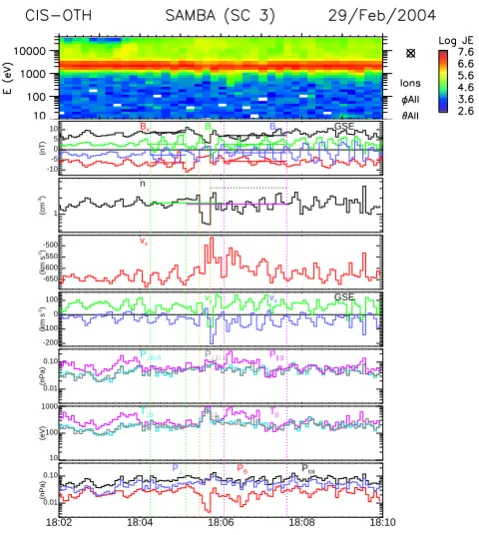
For the final case example we present in Fig. 10 a den-sity hole observed simultaneously with very coherent UFL waves, which are commonly associated with gyrating ion distributions in oblique foreshocks (Meziane et al., 2001; Mazelle et al., 2003). This is also of interest because it was
21:42:30 21:43:20 21:44:10 21:45:00 21:45:50
10 C1 19 Feb 2003 2142:00-2146:00C2 C3 C4 |B| smooth: 45
2142:30 2143:20 2144:10 2145:00 2145:50
[image:8.595.306.545.65.242.2]-6.0 -5.5 -5.0 -4.5 -4.0
Fig. 9.
Fig. 9. 19 February 2003 21:42–21:46 UT, magnetic field intensity
[image:8.595.307.552.320.354.2]andφSC.
Table 1. Occurrence counts for embedding foreshock geometries.
Q⊥ oblique Qk Q⊥↔Qk Q⊥↔oblique unknown
5 2 10 15 2 3
one of only two events (out of 37) that lacked a clear cross-structure magnetic shear, with θ1B=7±10◦. (The other event was embedded within aQkforeshock.) As in the
pre-vious case the solar wind speed was∼600 km s−1, and the flow deviation was minimal. (Here the perturbations tovx were larger, but still weak, at C1.)
4 Statistical examination of density holes
Using the selection criteria described in Sect. 2 we found
∼70 “isolated” density hole events (without large adjacent upstream perturbations). Of these, 37 were suitable for char-acterization, with the remainder having problematic struc-tures that could not cleanly be delimited. The latter included, e.g., structures with non-unique minima or indicators of suc-cessive density holes for which determinations ofθ1Bwere impossible. The case studies presented above show various types of embedding foreshocks, and we have examined the particle and magnetic field signatures for all density holes in our sample to categorize them as well. These results are sum-marized in Table 1. The significant magnetic shears across some structures resulted in a boundary between two different types of foreshocks, in which case the embedding foreshocks were determined to be transitional, e.g.Q⊥↔oblique. While
theQk→Q⊥transitions number 9 and theQ⊥→Qk
of the IMF rotation in combination with the location of the spacecraft determine the sequence. The statistics do allow us to see that density holes occur in a wide range of foreshock domains.
Characterization of other density hole attributes required a determination of interior and exterior plasma and field val-ues. This was facilitated with an interactive routine that dis-played the data and allowed the user to select representative upstream and downstream regions, and to delimit the extent of the density cavities. The final case example (Sect. 3.5 above) presented selection intervals (Fig. 10) for a near-worst case example, 29 February. In order to minimize aliasing ef-fects, the exterior regions were selected to contain an integral number of the coherent pulsations seen, and the hole bound-aries were selected to match where the interior densities fell below the mean values for the exterior intervals. The routine also drew horizontal fiducial lines corresponding to 2×the mean upstream values forBandn, in order to help establish that the events were within the maximum upstream pulsa-tion size. Average exterior plasma and field condipulsa-tions, along with variances, were computed and saved in a database. For the results presented below, we take as the density hole in-terior values spin-resolution plasma and field measurements obtained at the instant of each hole’s density minimum (all parameters subscripted with “min”).
An important parameter is the angle between the embed-ded current sheet and the motional electric field. We have determined the current sheet normals using the coplanarity method due to Colburn and Sonett (1966). As a consistency check these values were compared with those obtained using the methods due to Shrauner (1972) and Abraham-Shrauner and Yun (1976), which yielded similar results. Be-low folBe-low some of the more salient results.
4.1 Occurrence statistics
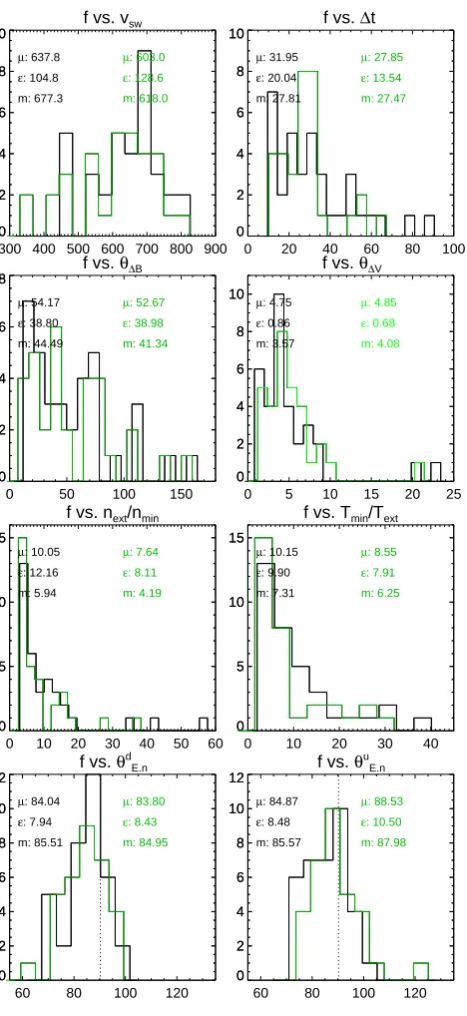
Figure 11 presents frequency histograms of various param-eters determined for each of the density holes in the sta-tistical sample. Black symbols and text correspond to C1, with green used for C3. Of the 37 events, there were 5 for which good determinations could not be made for C3, and 2 for which only C3 measurements were used. The first panel shows average upstream solar wind speeds, which were 638±105 km s−1and 603±129 km s−1, for C1 and C3, re-spectively. (Mean values are denoted byµ, standard devi-ations by and medians by m.) Differences between the two spacecraft are accounted for by the fact that of the 5 events included for C1 only, three had solar wind speeds >700 km s−1, while the two events exclusive to C3 had solar wind speeds∼325 km s−1.
The second (top right) panel shows event durations, which we regard as a rough proxy for scale size. However, the ori-entations found for the IMF current sheets were fairly uni-formly distributed, suggesting that many1tvalues should be lengthened by significant cosine factors as they transited the
18:02 18:04 18:06 18:08 18:10
-10 -5 0 5 10
(nT)
Bx By Bz GSE
18:02 18:04 18:06 18:08 18:10
1
(cm
-3)
n
18:02 18:04 18:06 18:08 18:10
-650 -600 -550 -500
(km s
-1)
vx
18:02 18:04 18:06 18:08 18:10
-200 -100 0 100
(km s
-1)
vy vz GSE
18:02 18:04 18:06 18:08 18:10
0.01 0.10
(nPa)
P⊥0⊥0 P⊥1⊥1 P|| ||
18:02 18:04 18:06 18:08 18:10
10 100 1000
(eV)
T⊥0 T⊥1 T||
18:02 18:04 18:06 18:08 18:10
0.01 0.10
(nPa)
Ptot
PB
[image:9.595.310.550.61.329.2]P⊥
Fig. 10.
Fig. 10. 29 February 2004 18:02–18:10 UT summary plot. HIA ion
energy spectrogram,B, and various HIA moments. Representative selection intervals indicated (see text for details).
spacecraft. (No attempt has been made to correct for this.) The mean values of 32.0±20.0 s and 27.9±13.5 s for C1 and C3, respectively, are marginally larger than found in an ear-lier study (Parks et al., 2006) that was not constrained to “iso-lated” density holes.
The third panel shows a distribution of the cross-structure magnetic shear angleθ1B, which largely reproduces the re-sult of Parks et al. (2006), with moderately larger aver-age shear values. The averaver-age values of 54.2±38.8◦ and
52.7±39.0◦, respectively, correspond to a preponderance of events withθ1B<90◦. This contrasts with hot flow anoma-lies that tend to have substantially largerθ1B values. The fourth frame presents frequencies of the plasma flow devi-ation anglesθ1v, which are determined from the flows up-stream and during measurements obtained at density minima. With mean flow perturbations near 4.8◦, this sample of den-sity holes has deviations much lower than seen for HFAs (for which large flow deviations are a defining characteristic).
3750 M. Wilber et al.: Foreshock density holes in context
f vs. vsw
0 2 4 6 8 10
300 400 500 600 700 800 900 0 2 4 6 8 10
µ: 637.8
ε: 104.8 m: 677.3
µ: 603.0 ε: 128.6 m: 618.0
f vs. ∆t
0 2 4 6 8 10
0 20 40 60 80 100
0 2 4 6 8 10
µ: 31.95
ε: 20.04 m: 27.81
µ: 27.85 ε: 13.54 m: 27.47
f vs. θ∆B
0 2 4 6 8
0 50 100 150
0 2 4 6 8
µ: 54.17
ε: 38.80 m: 44.49
µ: 52.67 ε: 38.98 m: 41.34
f vs. θ∆V
0 2 4 6 8 10
0 5 10 15 20 25
0 2 4 6 8 10 µ : 4.75
ε: 0.86 m: 3.57
µ: 4.85 ε: 0.68 m: 4.08
f vs. next/nmin
0 5 10 15
0 10 20 30 40 50 60
0 5 10 15
µ: 10.05
ε: 12.16 m: 5.94
µ: 7.64 ε: 8.11 m: 4.19
f vs. Tmin/Text
0 5 10 15
0 10 20 30 40
0 5 10 15
µ: 10.15
ε: 9.90 m: 7.31
µ: 8.55 ε: 7.91 m: 6.25
f vs. θd E.n 0 2 4 6 8 10 12
60 80 100 120
0 2 4 6 8 10 12
µ: 84.04
ε: 7.94 m: 85.51
µ: 83.80 ε: 8.43 m: 84.95
f vs. θu E.n 0 2 4 6 8 10 12
60 80 100 120
0 2 4 6 8 10 12
µ: 84.87
ε: 8.48 m: 85.57
[image:10.595.52.286.60.569.2]µ: 88.53 ε: 10.50 m: 87.98
Fig. 11.
Fig. 11. Frequency distributions:f vs.vsw;f vs.1t;f vs.θ1B;
fvs.θ1v;f vs.next/nmin;f vs.Tmin/Text;f vs.θEd·n;fvs.θEu·n;
C1 results are black; those for C3 are green.
The bottom two panels show distributions of the angles the convection electric fieldsEconvmake with the inferred cur-rent sheet normals for the downstream and upstream sides, respectively. These angles are defined such that values<90◦ correspond to electric fields pointing outward. The down-stream angles θEd·n have mean values that are lower than 90◦, 84.0±7.9◦and 83.8±8.4◦for C1 and C3, respectively. Again, this contrasts with the determinations made for HFAs
(Schwartz et al., 2000; Paschmann et al., 1988; Thomsen et al., 1993), which have the normal components to the fields pointing inward. The upstream anglesθEu·n are 84.9±8.5◦
and 88.5±10.5◦. The statistics for C3 are not compelling, although removal of the outlier at 125◦would shift the peak another 1.5◦from 90◦.
4.2 Correlations
We have tested for correlations between several parameters –1t,θ1v,θ1B,vsw,next/nmin,Tmin/Text,θEu·nandθEd·n– to
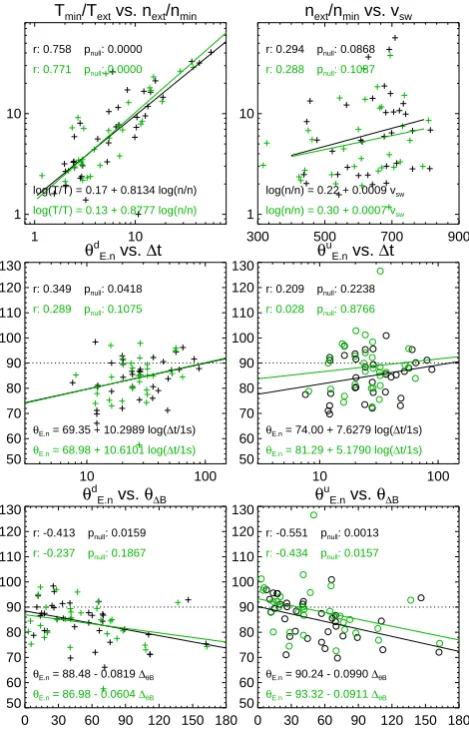
look for indications of controlling factors in the development of density holes. For the modest number of events in the sample, only a handful of relationships were manifest, which we present in Fig. 12. The most striking relationship found is betweenTmin/Textandnext/nmin, which we have accounted for above as resulting from interior temperatures being in-creasingly dominated by the supra-thermal population as the cold, dense solar wind beam is excluded. The only depen-dence uponvsw – and a weak one at that – is fornext/nmin. This may be related to the high average solar wind speeds observed for this sample; if decreases invswlead to weaker density holes, they will be increasingly difficult to detect.
The parameters most inclined to bear out correlations with other parameters are the angles betweenEconvand the down-stream and updown-stream IMF current sheet normals, θEd·n and θEu·n, respectively. The third panel of Fig. 12 shows a weak, but probable relationship betweenθEd·nand1t (p<0.04 and p<0.1 for C1 and C3). It is notable that the outward-pointing normal component approaches 0 (θEd·n→90◦) as1t increases; larger events appear to have weaker normal elec-tric field components. This dependence, while suggested by the best fit line, is not statistically demonstrated for the up-stream side of the structure, however (fourth panel). More compelling are the relationships betweenθE·nandθ1B
(bot-tom panels). Asθ1B→180◦,θE·ndecreases from 90◦
(tan-gency) to 75–80◦. This is to say that as the cross-structure magnetic shear increases, the normal component of the mo-tional electric field is increasingly outward.
5 Discussion
downstream limit. It is difficult to draw conclusions, given that the highly-structured magnetic fields observed are local to the spacecraft, and may not reflect global conditions, but possibilities include HFA expansion into regions containing density holes, HFAs being built up out of merging density holes, and the emergence of density holes out of embedded turbulence that may produce conditions favorable for density hole creation. Based upon the statistical results of Sect. 4, we conclude (below) that density holes have a different genesis and are unlikely to form HFAs through merging.
In Sect. 3.2 we presented what we consider to be an archetypal “isolated” density hole, which merits detailed dis-cussion. It is centered upon an IMF tangential discontinu-ity, exhibits a fast mode-like character on time scales corre-sponding to spatial extents&2000 km in the structure frame, has an order of magnitude temperature excess over surround-ing solar wind, and moderate flow deviations. The ion dis-tributions have two populations (Fig. 5), with an isotropic supra-thermal population and a solar wind beam intensity that has been greatly reduced. These characteristics are typi-cal of density holes overall. Differences between the higher-resolution magnetic field profiles and the proxy densities pro-vided by spacecraft potentials suggest that the fast mode-like character breaks down on scales corresponding to.500 km. This is not a surprise, as these are of the order of a solar wind ion Larmor radius, for which a break-down of MHD behav-ior might be expected.
We noted an asymmetry in the structure profile, with a dis-persive decrease in the solar wind beam flux on the down-stream side. We have found one event that shows a reverse asymmetry, indicating that the affect can occur on both the upstream and downstream edges. (Other events show “re-verse” asymmetry in the density profiles, but were not ob-served in burst mode, for which the spectrograms could re-solve the dispersion.) If some mechanism prevents new, ther-mal solar wind ions from gaining access to a density hole field line, more-rapid streaming along these flux tubes may lead to losses of the most energetic ions first, with the deepest part of the hole being the location where such a loss process may have been in effect the longest. This picture is not con-sistent, however, with rarefaction due to explosive expansion caused by an interior overpressure. Testing for excess inte-rior pressure is difficult, if not impossible, since the RAPID solid state detectors on Cluster do not provide measurements with high enough sampling rates, while a substantial partial pressure may be present above 40 keV. Efforts to analyze the stress balance at density hole edges have so far yielded no conclusive results.
The magnetic structure of the 2 April 2002 density hole is interesting as the variance and multi-point timing analy-sis points to a rotational discontinuity on the upstream edge embedded within a larger tangential discontinuity across the whole structure. Although RDs are consistent with reconnec-tion topologies, it remains to be seen whether tearing could take place in the presence of backstreaming ions that have
Tmin/Text vs. next/nmin
1 10
1 10
log(T/T) = 0.17 + 0.8134 log(n/n)
log(T/T) = 0.13 + 0.8777 log(n/n) r: 0.758 pnull: 0.0000
r: 0.771 pnull: 0.0000
next/nmin vs. vsw
300 500 700 900
1 10
log(n/n) = 0.22 + 0.0009 vsw
log(n/n) = 0.30 + 0.0007 vsw
r: 0.294 pnull: 0.0868
r: 0.288 pnull: 0.1087
θd E.n vs. ∆t
10 100
50 60 70 80 90 100 110 120 130
θE.n = 69.35 + 10.2989 log(∆t/1s)
θE.n = 68.98 + 10.6101 log(∆t/1s)
r: 0.349 pnull: 0.0418
r: 0.289 pnull: 0.1075
θu E.n vs. ∆t
10 100
50 60 70 80 90 100 110 120 130
θE.n = 74.00 + 7.6279 log(∆t/1s)
θE.n = 81.29 + 5.1790 log(∆t/1s)
r: 0.209 pnull: 0.2238
r: 0.028 pnull: 0.8766
θd
E.n vs. θ∆B
0 30 60 90 120 150 180
50 60 70 80 90 100 110 120 130
θE.n = 88.48 - 0.0819 ∆θB
θE.n = 86.98 - 0.0604 ∆θB
r: -0.413 pnull: 0.0159
r: -0.237 pnull: 0.1867
θu
E.n vs. θ∆B
0 30 60 90 120 150 180
50 60 70 80 90 100 110 120 130
θE.n = 90.24 - 0.0990 ∆θB
θE.n = 93.32 - 0.0911 ∆θB
r: -0.551 pnull: 0.0013
[image:11.595.311.546.65.430.2]r: -0.434 pnull: 0.0157
Fig. 12.
Fig. 12. Correlations. Tmin/Textvs.next/nmin;next/nminvs.vsw;
θEd·nvs.next/nmin;θEu·nvs.next/nmin;θEd·nvs.1t;θEu·nvs.1t;
θEd·nvs.θ1B;θEu·nvs.θ1B.
plasma frame parallel speeds many times in excess of the Alfv´en speed. The RD topology is interesting as it would suggest easy streaming access between the density hole inte-rior and the upstream. This seems to be contradicted by the remote-sensing distribution for supra-thermal ions (Fig. 5) that indicates strict confinement to guiding centers within the density hole, and by the abrupt drop in thermal solar wind ions at that edge.
3752 M. Wilber et al.: Foreshock density holes in context possibility is that the density hole formation is an antecedent
to subsequent upstream pulsation growth, rather than the re-verse as was proposed by Behlke et al. (2003).
A few cases, such as the event shown in Sect. 3.3, indicate substantial growth (increasing density depletion) of density holes during the 15–30 s spanning first and last observations by Cluster spacecraft. This corroborates a case event pre-sented by Parks et al. (2006), which was observed first by Cluster, and then by Double Star. Our third density hole case event (Sect. 3.4) suggests instead a measurable decay over
∼15 s, which raises the prospect of these events being rather transient. Whether forming or decaying, rapid temporal vari-ation is certain to muddy the statistical results of Sect. 4. As a proxy for size,1t is subject to projection effects due to variable structure orientations, as well as to the stage of de-velopment at which an event is observed.
In combination, the different case events presented, and the summary of embedding foreshock geometries for the sta-tistical sample (Table 1), show that density holes can occur over a wide range of foreshock geometries. We therefore conclude that geometry does not significantly constrain their formation, nor does the presence of differing backstreaming ion populations or ULF waves. While HFA phenomenology appears to be strongly dependent upon the magnetic shear of TDs interacting with the bow shock, it is notable that most of the density holes in this study haveθ1Bvalues<44◦. The only discernible relationship withθ1B involved θE·n. The
tendency for the normal component ofEconvto point increas-ingly away from the structure asθ1Bincreases further distin-guishes these structures from HFAs. However, the absence of a dependence for physical characteristics such asTmin/Textor θ1vmight be masked by the varying phases of development at which events are captured. Hybrid simulations by Thom-sen et al. (1993) predict much weaker interactions between tangential discontinuities and shocks whenEconvhas compo-nents pointing outward on both sides. These predict no edge enhancements, and notably do not produce density cavities. It may be the case that charge separation effects are impor-tant, which would require full particle methods. The flow de-viations reported here (θ1v∼5◦) are much smaller than previ-ously indicated, and the difference may be accounted for by our selection of “isolated” events; large upstream pulsations are likely to divert plasma flows.
It is notable that these events are found to occur for rel-atively high solar wind speeds∼620 km s−1. The highvsw values may in fact suffer from selection bias, as we have re-stricted ourselves to measurements obtained with the mag-netosheath mode of the HIA detector. In other words, these observations were constrained by mode settings that were de-signed to capture the foreshock when it was at or inside of the nominal shock location. This would predispose the events to occur during higher than average dynamic pressure inter-vals. (Had we selected events for which the analyzer was in solar wind mode, our sample would have been similarly bi-ased towards lower than average dynamic pressure intervals;
mixing both data sets, having different sources of measure-ment error, would have also introduced complications.) We note, however, that the frequency histogram forvsw(Fig. 11) is two-tailed, indicating that it is not seriously constrained at its lower limit. ˘Safr´ankov´a et al. (2000) had found solar wind speeds nearly as high in their survey of magnetosheath HFAs.
A final consideration is that the distribution of IMF cur-rent sheet orientations we found (not shown) were fairly uni-formly distributed in cone angleθvn. Large cone angles favor slow current sheet motions along the shock surface near the subsolar point. Burgess (1989); Schwartz et al. (2000) have argued that low contact speeds would be favorable for inject-ing shock-reflected ions into the current sheet.
6 Conclusions
We have presented case examples of foreshock density holes, and survey results from a sample of 37 events. In order to minimize the influence of upstream structures that could sig-nificantly alter plasma conditions, we have specifically se-lected events that lack strong trailing pulsations and density overshoots. Density holes can be observed to develop sig-nificantly over time scales as short as∼10 s, and may have comparably short lifetimes. The dispersive signatures seen in the few burst mode ion spectrograms may indicate that density holes do not form through explosive expansion fol-lowing strong heating. In addition to confirming results ob-tained using broader selection criteria, the simple existence of a statistical sample of such isolated density holes suggests that large-amplitude pulsations are not required for their for-mation.
As is the case for HFAs, density holes are observed over a wide range of foreshock geometries, are preferentially seen during fast solar wind flows (vsw∼620 km s−1), and are em-bedded within IMF current sheets. Unlike HFAs, isolated density holes lack particles with energies below that of the solar wind, and flow deviations tend to be rather small. (The large flow deviations for previously-identified events can be accounted for by large upstream pulsations, which stand rela-tive to the solar wind flow with large normal incidence speeds and likely cause the deflections in a manner similar to fast mode shocks.) Additional characteristics that further distin-guish density holes from hot flow anomalies include mag-netic shears that are typically much lower (hθ1Bi∼50–55◦),
inward-pointing motional electric field components seems to make these HDCs fundamentally distinct as well.
Finally, density holes seem to be unrelated to the fore-shock cavities described by, e.g. Sibeck et al. (2001), or to long-studied solar wind magnetic holes (Turner et al., 1977). Foreshock cavities appear to occur whereQkforeshock
do-mains are embedded withinQ⊥regions, while density holes
are found to be embedded within either type, or combination, of foreshock domains. Magnetic holes exhibit field intensity depletions, but not the defining, correlated density drops of density holes. The apparent association of the latter with the ion foreshock points to a mechanism involving backstream-ing ions or the bow shock itself, while magnetic holes are seen throughout the heliosphere, where no shock association is manifest.
Acknowledgements. M. Wilber would like to thank E. Lucek and A. Hull for helpful discussions. This work was supported by NASA grants NNG05GF99G and NASA-NNX07AP96G. We gratefully acknowledge the support of the FGM and EFW teams for magnetic fields and spacecraft potential data, and the Cluster Active Archive. Topical Editor R. Nakamura thanks M. Goldstein and another anonymous referee for their help in evaluating this paper.
References
Abraham-Shrauner, B.: Determination of magnetohydrodynamic shock normals, J. Geophys. Res., 77, 736–739, 1972.
Abraham-Shrauner, B. and Yun, S.: Interplanetary shocks seen by Ames plasma probe on Pioneer 6 and 7, J. Geophys. Res., 81, 2097–2102, 1976.
Anderson, K. A.: Measurements of Bow Shock Particles Far Up-stream From the Earth, J. Geophys. Res., 86, 4445–4454, 1981. Balogh, A., Carr, C. M., Ac˜una, M. H., Dunlop, M. W., Beek, T. J.,
Brown, P., Fornacon, K.-H., Georgescu, E., Glassmeier, K.-H., Harris, J., Musmann, G., Oddy, T., and Schwingenschuh, K.: The cluster Magnetic field investigation: overview of in-flight perfor-mance and initial results, Ann. Geophys., 19, 1207–1217, 2001, http://www.ann-geophys.net/19/1207/2001/.
Baumg¨artel, K.: Soliton approach to magnetic holes, J. Geophys. Res., 104, 28 295–28 308, 1999.
Behlke, R., Andr´e, M., Buchert, S., Vaivads, A., and Eriksson, A.: Multi-point electric field measurements of Short Large-Amplitude Magnetic Structures (SLAMS) at the Earth’s quasi-parallel bow shock, Geophys. Res. Lett., 30, 1177, doi:10.1029/ 2002GL015871, 2003.
Bonifazi, C. and Moreno, G.: Reflected and Diffuse Ions Back-streaming from the Earth’s Bow Shock 1, Basic Properties, J. Geophys. Res., 86, 4381–4396, 1981a.
Bonifazi, C. and Moreno, G.: Reflected and Diffuse Ions Back-streaming from the Earth’s Bow Shock 2, Origin, J. Geophys. Res., 86, 4397–4404, 1981b.
Burgess, D.: On the effect of a tangential discontinuity on ions spec-ularly reflected at an oblique shock, J. Geophys. Res., 94, 472– 478, 1989.
Burlaga, L. and Lemaire, J.: Interplanetary Magnetic Holes: The-ory, J. Geophys. Res., 83, 5157–5160, 1978.
Buti, B., Tsurutani, B., Neugebauer, M., and Goldstein, B.: Genera-tion Mechanism for Magnetic Holes in the Solar Wind, Geophys. Res. Lett., 28, 1355–1358, 2001.
Colburn, D. and Sonett, C.: Discontinuities in the solar win, Space Sci. Rev., 5, 439–506, 1966.
Eastwood, J., Sibeck, D., Angelopoulos, V., Phan, T., Bale, S., Mc-Fadden, J., Cully, C., Mende, S., Larson, D., Frey, S., Carlson, C., Glassmeier, K.-H., Auster, H., Roux, A., and Le Contel, O.: THEMIS observations of a hot flow anomaly: Solar wind, magnetosheath, and ground-based measurements, Geophys. Res. Lett., 35, L17S03, doi:10.1029/2008GL033475, 2008.
Fitzenreiter, R. and Burlaga, L.: Structure of Current Sheets in Mag-netic Holes at 1 AU, J. Geophys. Res., 83, 5579–5585, 1978. Fuselier, S., Thomsen, M., Gosling, J., Bame, S., and Russell, C.:
Fast shocks at the edges of hot diamagnetic cavities upstream from the earth’s bow shock, J. Geophys. Res., 92, 3187–3194, 1987.
Fuselier, S. A., Thomsen, M. F., Gosling, J. T., Bame, S. J., and Russell, C. T.: Gyrating and intermediate ion distributions up-stream from the Earth’s bow shock, J. Geophys. Res., 91, 91–99, 1986.
Greenstadt, E. W., Green, I. M., Inouye, G. T., Colburn, D. S., Bin-sack, J. H., and Lyon, E. F.: Dual satellite observations of Earth’s bow shock I: The thick pulsation shock, Cosmic Electrodyn., 1, 160–177, 1970a.
Greenstadt, E. W., Green, I. M., Inouye, G. T., Colburn, D. S., Bin-sack, J. H., and Lyon, E. F.: Dual satellite observations of Earth’s bow shock II: Field aligned upstream waves, Cosmic Electro-dyn., 1, 279–296, 1970b.
Greenstadt, E. W., Scarf, F. L., Russell, C. T., Holzer, R. E., Formisano, V., Hedgecock, P. C., and Neugebauer, M.: Struc-ture of a quasi-parallel, quasi-laminar bow shock, J. Geophys. Res., 82, 651–666, 1977.
Gustafsson, G., Bostr¨om, R., Holback, B., Holmgren, G., Lund-gren, A., Stasiewicz, K., ˚Ahl´en, L., Mozer, F., Pankow, D., Har-vey, P., Berg, P., Ulrich, R., Pedersen, A., Schmidt, R., Butler, A., Fransen, A., Klinge, D., Thomsen, M., F¨althammar, C.-G., Lindqvist, P.-A., Christenson, S., Holtet, J., Lybekk, B., Sten, T., Tanskanen, P., Lappalainen, K., and Wygant, J.: The electric-field and wave experiment for the Cluster mission, Space Sci. Rev., 79, 137–156, 1997.
Harvey, C. C.: Analysis Methods for Multi-Spacecraft Data, chap. Spatial Gradients and the Volumetric Tensor, pp. 307–322, ISSI Scientific Report, ESA Publications Division, Keplerlaan 1, 2200 AG Noordwijk, The Netherlands, 1998.
Hoppe, M. M., Russell, C. T., Frank, L. A., Eastman, T. E., and Greenstadt, E. W.: Upstream hydromagnetic waves and their association with backstreaming ion populations – ISEE 1 and 2 observations, J. Geophys. Res., 86, 4471–4492, 1981.
Lin, N., Lee, E., Mozer, F., Parks, G. K., Wilber, M., and R`eme, H.: Nonlinear low-frequency wave aspect of foreshock density holes, Ann. Geophys., 26, 3707–3718, 2008,
http://www.ann-geophys.net/26/3707/2008/.
Lucek, E., Horbury, T., Balogh, A., Dandouras, I., and R`eme, H.: Cluster obervations of structures at quasi-parallel bow shocks, Ann. Geophys., 22, 2309–2314, 2004a,
http://www.ann-geophys.net/22/2309/2004/.
3754 M. Wilber et al.: Foreshock density holes in context
A06207, doi:10.1029/2003JA010016, 2004b.
Lucek, E., Horbury, T., Dandouras, I., and R`eme, H.: Cluster ob-servations of the Earth’s quasi-parallel bow shock, J. Geophys. Res., 113, A07S02, doi:10.1029/2007JA012756, 2008.
Lucek, E. A., Horbury, T. S., Dunlop, M. W., Cargill, P. J., Schwartz, S. J., Balogh, A., Brown, P., Carr, C., Fornacon, K.-H., and Georgescu, E.: Cluster magnetic field observations at a quasi-parallel bow shock, Ann. Geophys., 20, 1699–1710, 2002, http://www.ann-geophys.net/20/1699/2002/.
Mann, G., L¨uhr, H., and Baumjohann, W.: Stastical analysis of short large-amplitude magnetic field structures in the vicinity of the quasi-parallel bow shock, J. Geophys. Res., 99, 13 315–13 323, 1994.
Mazelle, C., Meziane, K., Le Qu´eue, D., Wilber, M., Eastwood, J. P., R`eme, H., Sauvaud, J.-A., Bosqued, J.-M., Dandouras, I., McCarthy, M., Kistler, L. M., Klecker, B., Korth, A., Bavassano-Cattaneo, M. B., Lundin, R., and Balogh, A.: Production of Gy-rating Ions from Nonlinear Wave-Particle Interaction Upstream from the Earth’s Bow Shock: a Case Study from Cluster-CIS, Planet. Space Sci., 51, 785–795, 2003.
Meziane, K., Lin, R. P., Parks, G. K., Larson, D. E., Bale, S. D., Mason, G. M., Dwyer, J. R., and Lepping, R. P.: Evidence for acceleration of ions to∼1 MeV by adiabatic-like reflection at the quasi-perpendicular Earth’s bow shock, Geophys. Res. Lett., 26, 2925–2928, 1999.
Meziane, K., Mazelle, C., Lin, R. P., LeQu´eau, D., Larson, D. E., Parks, G. K., and Lepping, R. P.: Three-dimensional observa-tions of gyrating ion distribuobserva-tions far upstream from the Earth’s bow shock and their associated with low-frequency waves, J. Geophys. Res., 106, 5731–5742, 2001.
Meziane, K., Wilber, M., Lin, R. P., and Parks, G. K.: Gyrophase-Restricted 100 keV–2 MeV Ion Beams Near the Foreshock Boundary, Geophys. Res. Lett., 30, 2049, doi:10. 1029/2003GL017592, 2003.
Meziane, K., Wilber, M., Mazelle, C., Parks, G. K., and Hamza, A. M.: A review of field-aligned beams observed upstream of the bow shock, in: The Physics of Collisionless Shocks, 4th Annual IGPP International Astrophysics Conference, edited by: Li, G., Zank, G. P., and Russell, C. T., vol. 781, pp. 116–122, American Institute of Physics, 2005.
Parks, G., Lee, E., Mozer, F., Wilber, M., Lucek, E., Dandouras, I., R`eme, H., Mazelle, C., Cao, J., Meziane, K., Goldstein, M., and Escoubet, P.: Larmor radius size density holes discovered in the solar wind upstream of Earth’s bow shock, Phys. Plasmas, 13, 050701, doi:10.1063/1.2201056, 2006.
Parks, G., Lee, E., Lin, N., Mozer, F., Wilber, M., Lucek, E., Dan-douras, I., R`eme, H., Cao, J., Canu, P., Cornilleau-Wehrlin, N., D´ecr´eau, Goldstein, M., and Escoubet, P.: Density holes in the upstream solar wind, in: Turbulence and Nonlinear Processes in Astrophysical Plasmas; 6th Annual International Astrophysics Conference, edited by: Shaikh, D. and Zank, G., vol. 932 of AIP Conference Proceedings, pp. 9–15, American Institute of Physics, doi:10.1063/1.2778939, 2007.
Paschmann, G., Sckopke, N., Papamastorakis, I., Asbridge, J. R., Bame, S. J., and Gosling, J. T.: Characteristics of Reflected and Diffuse Ions Upstream from the Earth’s Bow Shock, J. Geophys. Res., 86, 4355–4364, 1981.
Paschmann, G., Haerendel, G., Sckopke, N., M¨obius, E., L¨uhr, H., and Carlson, C.: Three-dimensional plasma structures with
anomalous flow directions near the Earth’s bow shock, J. Geo-phys. Res., 93, 11 279–11 294, 1988.
R`eme, H., Aoustin, C., Bosqued, J. M., Dandouras, I., Lavraud, B., Sauvaud, J. A., Barthe, A., Bouyssou, J., Camus, T., Coeur-Joly, O., Cros, A., Cuvilo, J., Ducay, F., Garbarowitz, Y., Medale, J. L., Penou, E., Perrier, H., Romefort, D., Rouzaud, J., Vallat, C., Al-cayde, D., Jacquey, C., Mazelle, C., d’Uston, C., M¨obius, E., Kistler, L. M., Crocker, K., Granoff, M., Mouikis, C., Popecki, M., Vosbury, M., Klecker, B., Hovestadt, D., Kucharek, H., Kuenneth, E., Paschmann, G., Scholer, M., Sckopke†, N., Sei-denschwang, E., Carlson, C. W., Curtis, D. W., Ingraham, C., Lin, R. P., McFadden, J. P., Parks, G. K., Phan, T., Formisano, V., Amata, E., Bavassano-Cattaneo, M. B. Baldetti, P., Bruno, R., Chionchio, G., Di Lellis, A., Marcucci, M. F., Pallocchia, G., Ko-rth, A., Daly, P. W., Graeve, B., Rosenbauer, H., Vasyliunas, V., McCarthy, M., Wilber, M., Eliasson, L., Lundin, R., Olsen, S., Shelley, E. G., Fuselier, S., Ghielmetti, A. G., Lennartsson, W., Escoubet, C. P., Balsiger, H., Friedel, R., Cao, J.-B., Kovrazhkin, R. A., Papamastorakis, I., Pellat, R., Scudder, J., and Sonnerup, B. U. ¨O.: First multispacecraft ion measurements in and near the Earth’s magnetosphere with identical Cluster ion spectrometry (CIS) experiment, Ann. Geophys., 19, 1303–1354, 2001, http://www.ann-geophys.net/19/1303/2001/.
Russell, C. and Greenstadt, E.: Initial ISEE magnetometer results: Shock observations, Space Sci. Rev., 23, 3–37, 1979.
˘Safr´ankov´a, J., P˘rech, L., N˘eme˘cek, Z., Sibeck, D., and Mukai, T.: Magnetosheath response to the interplanetary magnetic field dis-continuity, J. Geophys. Res., 105, 25 113–25 121, 2000. ˘Safr´ankov´a, J., P˘rech, L., N˘eme˘cek, Z., and Sibeck, D.: The
struc-ture of hot flow anomalies in the magnetosheath, Adv. Space Res., 30, 2737–2744, 2002.
Sarris, E. T., Krimigis, S. M., , and Armstrong, T. P.: Observations of a High Energy Shock Spike in Interplanetary Space, Geophys. Res. Lett., 3, 133–136, 1976.
Schwartz, S., Chaloner, C., Christiansen, P. J., Coates, A., Hall, D., Johnstones, A., Gough, M., Norris, A., Rijnbeek, R. P., South-wood, D., and Woolliscroft, L.: An Active Current Sheet in the Solar Wind, Nature, 318, 269–271, 1985.
Schwartz, S., Sibeck, D., Wilber, M., Meziane, K., and Horbury, T.: Kinetic Aspects of Foreshock Cavities, Geophys. Res. Lett., 33, L12103, doi:10.1029/2005GL025612, 2006.
Schwartz, S. J.: Magnetic field structures and related phenomena at quasi-parallel shocks, Adv. Space Res., 11, (9)231–(9)240, 1991. Schwartz, S. J. and Burgess, D.: Quasi-parallel shocks – A patch-work of three-dimensional structures, Geophys. Res. Lett., 18, 373–376, 1991.
Schwartz, S. J., Kessel, R. L., Brown, C. C., Woolliscroft, L. J. C., and Dunlop, M. W.: Active current sheets near the Earth’s bow shock, J. Geophys. Res., 93, 11 295–11 310, 1988.
Schwartz, S. J., Paschmann, G., Sckopke, N., Bauer, T. M., Dunlop, M., Fazakerley, A. N., and Thomsen, M. F.: Conditions for the formation of hot flow anomalies at Earth’s bow shock, J. Geo-phys. Res., 105, 12 639–12 650, doi:10.1029/1999JA000320, 2000.
Sentman, D. D., Kennel, C. F., and Frank, L. A.: Plasma Rest Frame Distributions of Suprathermal Ions in the Earth’s Foreshock Re-gion, J. Geophys. Res., 86, 150–152, 1981.
R., Meng, C.-I., Mukai, T., N˘eme˘cek, Z., Parks, G., Phan, T., Ro-manov, S., ˘Safr´ankov´a, J., Sauvaud, J.-A. Singer, H., Solovyev, S., Szabo, A. Takahashi, K., Williams, D., Yumoto, K., and Zas-tenker, G.: Comprehensive study of the magnetospheric response to a hot flow anomaly, J. Geophys. Res., 104, 4577–4593, 1999. Sibeck, D., Decker, R., Mitchell, D., Lazarus, A., Lepping, R., and Szabo, A.: Solar wind preconditioning in the flank foreshock: IMP 8 observations, J. Geophys. Res., 106, 21 675–21 688, 2001. Sibeck, D., Phan, T.-D., Lin, R., Lepping, R., and Szabo, A.: Wind obserations of foreshock cavities: A case Study, J. Geophys. Res., 107, 1271, doi:10.1029/2003JA010374, 2002.
Stevens, M. and Kasper, J.: A scale-free analysis of magnetic holes at 1 AU, J. Geophys. Res., 112, A05109, doi:10.1029/ 2006JA012116, 2007.
Thomas, V., Winske, D., Thomsen, M., and Onsager, T.: Hybrid simulation of the formation of a hot flow anomaly, J. Geophys. Res., 96, 11 625–11 632, 1991.
Thomsen, M., Gosling, J., Bame, S., Quest, K., and Russell, C.: On the origin of hot diamagnetic cavities near the Earth’s bow shock, J. Geophys. Res., 93, 11 311–11 325, 1988.
Thomsen, M., Gosling, J., Bame, S., and Russell, C.: Magnetic Pul-sations at the Quasi-Parallel Shock, J. Geophys. Res., 95, 957– 966, 1990.
Thomsen, M., Thomas, V., Winske, J., and Gosling, J.: Observa-tional test of hot flow anomaly formation by the interaction of a magnetic discontinuity with the bow shock, J. Geophys. Res., 98, 15 319–15 330, 1993.
Thomsen, M. F., Gosling, J. T., Fuselier, S., Bame, S. J., and Rus-sell, C. T.: Hot, diamagnetic cavities near the Earth’s bow shock, J. Geophys. Res., 91, 2961–2973, 1986.
Tsurutani, B., Dasgupta, B., Galvan, C., Neugebauer, M., Lakhina, G., Arballo, J., Winterhalter, D., Goldstein, B., and Buti, B.: Phase-steepened Alfv´en waves, proton perpendicular energiza-tion and the creaenergiza-tion of magnetic holes and magnetic decreases: The ponderomotive force, Geophys. Res. Lett., 29, 2233, doi: 10.1029/2002GL015652, 2002.
Turner, J., Burlaga, L., Ness, N., and Lemaire, J.: Magnetic Holes in the Solar Wind, J. Geophys. Res., 82, 1921–1924, 1977. Winterhalter, D., Neugebauer, M., Goldstein, B., Smith, E., Bame,
S., and Balogh, A.: Ulysses field and plasma observations of magnetic holes in the solar wind and their relation to mirror-mode structures, J. Geophys. Res., 99, 23 371–23 381, 1994. Woolliscroft, L., Brown, C., Schwartz, S., Chaloner, C., and