261
1. Introduction
Concerning the global warming problem and rising air pollution, the demand for renewable energy and especially solar energy is more than ever before. The declining rate of construction expenses of photovoltaic plants which is getting very close to that of fossil fuel power plants has made the investment in photovoltaic energy more profitable than before. Achieving the goals of international agreements aiming at reducing the greenhouse gases such as Paris agreement, requires more global effort to develop solar energy. Prior to the planning and constructing a PV plant, a feasibility study has to be carried out in order to meet all the economic and technical aspects of the
PV plant. In general, there are different direct and indirect factors which have effect on the feasibility and profitability of construction of a PV plant, such as economy status of the country, electricity tariffs, tax, energy regulations, technology, market, the level of irradiance in the region of PV plant and the yield of PV plant. [1] Clearly, performance, and generated energy of a PV system are among the required parameters to perform a feasibility study. These parameters depend on meteorological status and technical parameters such as system components and the type of solar panels structure. Designing a PV plant is often carried out using modeling tools by which the modeling, simulation and economic evaluation of the plant are performed.
Click here, type the title of your paper, Capitalize first letter of each words
First Author
a, Second Author
b,*aFirst affiliation, Address, City and Postcode, Country
b
Second affiliation, Address, City and Postcode, Country
Journal of Solar Energy Research Vol 3 No 4 (2018) 261-266
Journal of Solar Energy Research (JSER)
Journal homepage: jser.ir
A B S T R A C T
Click here and insert your abstract text. Click here and insert your abstract text. Click here and insert your abstract text. Click here and insert your abstract text. Click here and insert your abstract text. Click here and insert your abstract text. Click here and insert your abstract text. Click here and insert your abstract text. Click here and insert your abstract text. Click here and insert your abstract text. Click here and insert your abstract text. Click here and insert your abstract text. Click here and insert your abstract text. Click here and insert your abstract text. Click here and insert your abstract text. Click here and insert your abstract text. Click here and insert your abstract text. Click here and insert your abstract text. Click here and insert your abstract text. Click here and insert your abstract text. Click here and insert your abstract text Click here and insert your abstract text Click here and insert your abstract text Click here and insert your abstract text Click here and insert your abstract text Click here and insert your abstract text Click here and insert your abst
© 2013Published by University of Tehran Press. All rights reserved. ARTICLE INFO
Received:
Received in revised form: Accepted:
Available online:
Keywords:
Type 3-6 keywords here,
separated by semicolons ;
Evaluation of Fixed and Single-Axis Tracking Photovoltaic Systems Using
Modeling Tool and Field Testing
H. Ekhteraei Toosi
a,*, S. K. Hosseini Sani
aaSun-Air Research Institute (SARI), Ferdowsi University of Mashhad, Mashhad, Iran *Email: [email protected]
Journal of Solar Energy Research (JSER)
Journal homepage: www.jser.ut.ac.ir
A B S T R A C T
One of the main issues to build a photovoltaic plant is to specify the type of mounting structure used for solar panels. Making a proper choice for the structure type is crucial to harvest the maximum performance from the PV plant. In this paper, two of the most common types of structures have been investigated by analyzing two 2.4 kW PV systems. One system has a fixed structure and the other one has a single vertical-axis structure. The energy production, performance ratio and final yield of both systems have been monitored, analyzed and compared over a one-year period. Performance of PV plants is often predicted by modeling tools prior to the construction of plant and the results of simulations are usually considered as a reliable source to design a PV plant and supply the equipment. Thus, the accuracy of modeling tool results are vital for both investors and installers. Therefore, PVsyst as one of the most commonly used modeling tools has been studied by simulating both PV systems and comparing the predicted and measured data. The error margin of simulations has been within the range of 1%, 3% and 1% for generated energy, performance ratio and final yield respectively, and the tracker system generated 28% more energy compared to fixed system in one year.
© 2018 Published by University of Tehran Press. All rights reserved. ARTICLE INFO
Received: 04 April 2018 Received in revised form: 19 Jun 2018
Accepted: 19 Jul 2018 Available online: 15 Dec 2018
Keywords:
262 As mentioned, one of the effective factors on energy production and eventually the revenue of a PV plant is the type of solar panel mounting structure. Structures are mainly built either with a fixed form or with tracking ability. Fixed structures are generally in two types. Permanent or seasonal structures which are fixed or can be reoriented by change of seasons. Tracking structures are also built with one or two axes. It is obvious that tracking systems can produce relatively more energy compared to fixed ones, but since they require more budget both in building and maintenance phases, they have a less share among the solar plants. Choosing a tracking structure over a fixed one for a PV plant depends on meteorological and irradiance status of the location, expenses, and the total revenue of the PV system. As a rule of thumb, utilizing a tracker structure is only justified when the revenue difference between two types of structures over the life time of plant, exceeds the difference in construction and maintenance expenses. A quantitative outcome of this rule depends on abovementioned economic factors which differ in every country. Thus, comparing the energy generation of the two structures, provides the investors with valuable data for planning a PV plant construction. Several papers [2,3,4,5,6] have compared the results of modeling tools and measured data for PV plants on different locations. Comparing the performance of fixed and dual-axis systems has been carried out in [7], while [8] has studied the yield of different types of tracking systems. In this paper, fixed and single-axis tracking systems have been investigated as most abundant PV structures, using measurements and modeling tools.
2. Modeling tools
There are various modeling tools for simulating and analyzing PV plants, both technically and economically. Having a reliable tool with a predictable range of error assists us to predict and evaluate the performance of PV plants before the construction. The prediction of PV plant outcome provides useful information for installers and users about the desirable performance of the system, which can be very helpful in cases in which the plant is not working properly. Five PV tools, which are used generally in the PV industry and researches are as below:
• PV*SOL Expert • PVsyst
• SAM • PVWatts • RETScreen
PV*SOL and PVsyst are high detailed tools for studying, modeling, designing and analyzing the
PV systems. SAM provides an accurate model for operation and financial evaluation of renewable energy power plants including PV plants. PVWatts is a simple tool to assess the PV system, which is helpful for initial feasibility studies. RETScreen facilitates a numerical analysis for financial modeling of PV plant and enables the user to perform a feasibility study both technically and financially. PVWatts and RETScreen need fewer system parameters as input data and have a simpler performance. They are only appropriate for primary feasibility study of the PV plant, while PV*SOL, PVsyst and SAM provide a more accurate simulation by receiving more parameters as input. [4] In this paper, PVsyst has been used for modeling the PV systems.
3. Performance Parameters
Performance parameters of PV systems have been proposed by the international energy agency (IEA) to analyze the performance of PV plants. Various parameters have been presented for describing the total performance of the system based on energy production, irradiance levels and loss effects. Such as array yield (Ya), reference yield (Yr), final yield (Yf), Performance Ratio (PR), Capacity Utilization Factor (CUF), inverter efficiency and system efficiency. [3] Among these, the performance ratio (PR) and final yield (Yf) are very useful and common for evaluating the performance of PV systems. In this paper, these two parameters are predicted and measured for both PV systems.
3.2. Performance Ratio (PR)
Performance Ratio is a location-independent index to measure the performance quality of the PV system. Practically, this is not possible to reach a PR of 100% since unavoidable losses such as thermal loss occur as PV plant works. PR index depends on various environmental and technical factors such as modules temperature, solar irradiance, soiling, shading, power loss, period of measurements, connection losses and efficiency of modules and inverters. [9] This parameter demonstrates the level of performance and reliability of PV plant and provides the possibility to make a comparison between various PV plants or monitor the performance of a PV system during any given term.
To calculate the PR of PV plant, some meteorological and technical data such as irradiance level, efficiency and modules area are required. The equation 1 is used to calculate the performance ratio.
263 In this equation, E is the generated energy of PV plant, GE is global irradiance at location of PV plant, A is the area of solar modules, and η is efficiency of modules.
3.1. Final Yield (Yf)
The final yield of PV system is defined as net output energy of PV plant divided by the nameplate power of photovoltaic array, [10] and it is calculated using equation 2. This factor can provide the net amount of energy that one kilowatt of PV array can produce during any given period. The final yield is not dependent on the system size and it can be utilized to predict the energy production capability of PV systems of different scales.
(2)
4. Measurements
In order to make a comparison between the performance of fixed and single-axis tracking systems as two popular mounting structures, a fixed PV system with 2.4 kW nominal power and a 2.4 kW vertical-axis (east-west) tracking system have been surveyed. Both systems are grid-connected, both have been built on the same location and use similar solar panels and inverters. The systems are built in city of Mashhad in the northeast of Iran. Both systems have 12 similar monocrystalline solar panels connected in a single string and a 2500 W grid-connected solar inverter. The output power, energy injected into the grid and irradiance have been monitored in 1 minute sequences over a one year period from July 2016 to July 2017. As [11] stated, evaluation of PVsyst results has shown to be within the predictable range of error compared to measured data, if the simulations are carried out in a one-year period. Shorter simulation terms lead to less accurate results.
From the total energy production of both systems, the final yield of PV systems as a major parameter to evaluate the PV plants in different locations have been calculated in one year. This is a useful index to predict the eventual energy production of any given PV system with the similar structure and equipment and in the same geographical region. The performance ratio of both systems also has been calculated using the data of irradiance and generated energy.
4.1. Measurement results
The fixed 2.4 kW system has a tilt angle of 35 degrees and azimuth angle of zero. The tracking system has a tilt angle of 42 degrees and a sweep angle of 82 degrees. Fixed system was on its third year of operation while the tracker was on its fifth year. Both used 12 similar monocrystalline solar
panels and a 2500 W grid-connected inverter. Both systems were positioned in the same location and both were cleaned with the same practice. The final yield of fixed and tracking systems over a 12 months period are plotted in figures 1 and 2 respectively.
Fig.1 . Final yield of the fixed system
Fig.2 . Final yield of the tracking system
5. Simulation
Analyzing the simulation results and comparing them to measurement data is a useful method to assess the accuracy of simulation tools since in general, technical and economic aspects of a PV plant should be predicted before installing the PV system. Thus, in order to make a fair comparison between the measured data of PV systems and the simulation data, both systems were simulated with all the details using PVsyst 6.43 software. The final yield and performance ratio have been studied to provide the data for evaluating the modeling tool.
5.1. Simulation results
Simulations have been carried out based on operational conditions of both systems. The fixed and tracker systems were on their third and fifth year of operation respectively. The soiling rate was
0 1 2 3 4 5 6
Ja
n
Fe
b
M
ar
A
p
r
M
ay Jun Jul Aug Sep Oct
No
v
D
e
c
Normalized Energy [kWh/kWp/day]
0 1 2 3 4 5 6 7 8 9
Ja
n
Fe
b
M
ar
A
p
r
M
ay Jun Jul Aug Sep Oct
No
v
D
e
c
264 considered 3% for both as a proportional value and since the data have been monitored from inverters directly, AC loss was not considered in the simulations and shading is not assumed as well.
Final yield of simulated fixed and tracking systems are depicted in figure 3 and 4 respectively.
Fig.3 . Final yield, system loss and collection loss of simulated fixed system
Fig.4 . Final yield, system loss and collection loss of simulated tracking system
6. Discussion
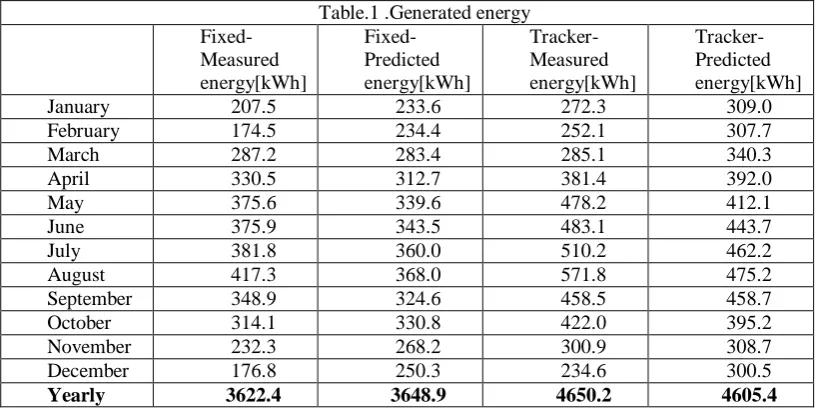
In order to evaluate the results of both PV systems and make a comparison between the function of fixed and tracking systems as well as comparing measured and predicted data, the generated energy, performance ratio and final yield of both systems have been demonstrated in the tables below. Table 1 lists the measured and simulation results of fixed and tracking systems. It
265 error of PR was 3% for the fixed structure and final yield shows only 0.9% error.
For the tracking system also the measured energy was not close to that of simulation on February and December because of snow. Moreover, in March the tracker did not track the sun due to some technical problems. Therefore, these three months are not appropriate to evaluate tracking ability of tracker system was inactive, for the rest the months the difference of energy under 16 percent with average of 7%. The annual
generation between two systems changes from a the accuracy of simulation results. However, for the rest of months the error of simulation results was produced energy was only 0.9% above the simulation result.
Comparing the measured energy of fixed and tracker shows that except for March in which the minimum of 15% in April to a maximum of 44% in February. Overall, the tracker produced 28% more energy than the fixed system in the entire year.
Table.1 .Generated energy
Tracker- Predicted energy[kWh] Tracker- Measured energy[kWh] Fixed- Predicted energy[kWh] Fixed- Measured energy[kWh] 309.0 272.3 233.6 207.5 January 307.7 252.1 234.4 174.5 February 340.3 285.1 283.4 287.2 March 392.0 381.4 312.7 330.5 April 412.1 478.2 339.6 375.6 May 443.7 483.1 343.5 375.9 June 462.2 510.2 360.0 381.8 July 475.2 571.8 368.0 417.3 August 458.7 458.5 324.6 348.9 September 395.2 422.0 330.8 314.1 October 308.7 300.9 268.2 232.3 November 300.5 234.6 250.3 176.8 December 4605.4 4650.2 3648.9 3622.4 Yearly
Table 2 provides the calculated and predicted amounts of PR for both systems. According to these values, the measured performance ratio of tracking system was 5% more than that of fixed system, while the simulation results show 4% difference between the PR of two systems. The simulation error was within 3% for both systems.
Table.2 .Performance Ratio Measurement
[%]
Simulatio n [%]
Fixed system 0.75 0.78
Tracking system 0.80 0.82
Table 3 shows the calculated and simulated values of final yield for both systems. Based on this, final yield of the single-axis tracking system is 1.17 hour more than fixed system and the simulation error was below 1% for both. This provides investors with a valuable information to compare the profitability of different PV systems with similar structures and in the same region.
Table.3 .Final Yield Measurement
[hour]
Simulation [hour]
Fixed system 4.13 4.17
Tracking system
5.30 5.26
7. Conclusions
266
References
[1] Rodrigues, S., Torabikalaki, R., Faria, F., Cafôfo, N., Chen, X., Ivaki, A. R., Meta-Lima, H., Morgado-Dias, F. (2016). Economic feasibility analysis of small scale PV systems in different countries. Solar Energy, 131, 81–95. https://doi.org/10.1016/j.solener.2016.02.019
[2] Raj, A., Gupta, M., & Panda, S. (2017). Design simulation and performance assessment of yield and loss forecasting for 100 KWp grid connected solar PV system. Proceedings on 2016 2nd International Conference on Next Generation
Computing Technologies, NGCT 2016, (October),
528–533.
https://doi.org/10.1109/NGCT.2016.7877472
[3] Shiva Kumar, B., & Sudhakar, K. (2015). Performance evaluation of 10 MW grid connected solar photovoltaic power plant in India. Energy
Reports, 1, 184–192.
https://doi.org/10.1016/j.egyr.2015.10.001
[4] Freeman, J., Blair, N., & Dobos, A. P. (2014). Validation of Multiple Tools for Flat Plate Photovoltaic Modeling Against Measured Data ,
Photovoltaic Specialist Conference (PVSC), 2014
IEEE 40th 1932–1937.
10.1109/PVSC.2014.6925304
[5] Ozerdem, O. C., Tackie, S., & Biricik, S. (2013). Performance Evaluation of Serhatkoy ( 1 . 2 MW ) PV Power Plant Tilt 25 ° Azimuth 0 °, Electrical and Electronics Engineering (ELECO),
2015 9th International Conference 6–10.
10.1109/ELECO.2015.7394510
[6] Best, S. R., Rodiek, J. A., & Brandhorst, H. W. (2011). Comparison of solar modeling data to actual PV installations: Power predictions and optimal tilt angles. Conference Record of the IEEE
Photovoltaic Specialists Conference, 001994–
001999.
https://doi.org/10.1109/PVSC.2011.6186345
[7] Lee, J. F., & Rahim, N. A. (2013). Performance comparison of dual-axis solar tracker vs static solar system in Malaysia. CEAT 2013 - 2013 IEEE
Conference on Clean Energy and Technology,
102–107.
https://doi.org/10.1109/CEAT.2013.6775608
[8] Suthar, M., Singh, G. K., & Saini, R. P. (n.d.). Performance Evaluation of Sun Tracking Photovoltaic Systems : a Case Study. Fifth International Conference on Advances in Recent Technologies in Communication and Computing
(ARTCom 2013). 10.1049/cp.2013.2193
[9] Verma, A., & Singhal, S. (2015). Solar PV Performance Parameter and Recommendation for Optimization of Performance in Large Scale Grid
Connected Solar PV Plant — Case Study, Journal
of Energy and Power Sources2(1), Volume 2, 40–
53.
[10] Marion, B., Adelstein, J., Boyle, K., Hayden, H., Hammond, B., Fletcher, T., Canada, B., Narang, D., Shugar, D., Wenger, H., Kimber, A., Mitchell, L., Townsend, T., Richter, S. (2005). Performance parameters for grid-connected PV systems. Photovoltaic Specialists Conference,
2005. Conference Record of the Thirty-First IEEE,
31(February), 1601–1606.
https://doi.org/10.1109/PVSC.2005.1488451
[11] Westbrook, O. W., & Collins, F. D. (2013). Energy model validation for large-scale photovoltaic systems. Photovoltaic Specialists
Conference (PVSC), 2013 IEEE 39th, 830–835.