Downloaded from ht
tp://www.jr
i.ir
J Reprod Infertil. 2016;17(3):177-183
Short Communication
Can a Short Term of Repeated Ejaculations Affect Seminal Parameters?
Jose Manuel Mayorga-Torres 1, Ashok Agarwal 2, Shubhadeep Roychoudhury 2, 3, Angela Cadavid 1, Walter Dario
Cardona-Maya 1*
1- Reproduction Group, Department of Microbiology and Parasitology, Medical School, University of Antioquia, Antioquia, Colombia
2- Center for Reproductive Medicine, Cleveland Clinic, Cleveland, Ohio, USA 3- Department of Life Science and Bioinformatics, Assam University, Silchar, India
Abstract
Background: The aim of the study was to assess the effect of four repeated ejacula-tions on the same day at two-hour intervals on conventional and functional semen parameters.
Methods: Three healthy men (32±3.6 years) donated the first semen samples after 3-4 days of sexual abstinence followed by three subsequent samples on the same day at two-hour interval each. Semen samples were processed and analyzed according to the World Health Organization (WHO) 2010 guidelines. Furthermore, intracellular reactive oxygen (ROS) production, sperm DNA fragmentation and mitochondrial function were evaluated by flow cytometry.
Results: An overall decreasing trend was noted in the conventional semen parame-ters at second, third and fourth evaluations after two hours of abstinence in compari-son to first evaluation after 3-4 days of abstinence. The statistical comparicompari-son of the
conventional semen parameters at fourth evaluation after 2 hr of abstinence revealed
significant reduction (p<0.05) in the parameters of concentration, total sperm count and total motile sperm count at fourth evaluation. The functional parameter of intra-cellular ROS production showed a decreasing trend with each subsequent evaluation, the difference being significant (p<0.05) at fourth evaluation in comparison to first evaluation. An increasing trend was noted for DNA fragmentation index (DFI),
alt-hough it remained within acceptable levels (<29%). The ∆Ψm high spermatozoa and
the integrity of the plasma membrane remained stable throughout the evaluations.
Conclusion: The findings of the present study indicate the potential use of additional semen samples with repeated ejaculations at short abstinence times in assisted repro-duction procedures particularly from severe oligospermic men.
Keywords: DNA fragmentation, Repeated ejaculation, ROS, Semen parameters, Sperm
qual-ity.
To cite this article: Mayorga-Torres JM, Agarwal A, Roychoudhury Sh, Cadavid A,
Cardo-na-Maya WD. Can a Short Term of Repeated Ejaculations Affect Seminal Parameters?. J Reprod Infertil. 2016;17(3):177-183.
Introduction
permatogenesis is influenced by several as-pects, those including metabolic, genetic, en-vironmental and physiological factors. Quan- tity or quality of sperm produced, or both can be influenced in this process (1). This is because many sperm are never produced because of cell death during meiosis, while many sperm released from the seminiferous tubules are abnormal. Evo-
lutionary processes due to sperm competition in mammals and other species have resulted in in-creased daily spermatogenesis, greater epididymal sperm storage and more sperm in the ejaculate (2-4). Epididymal transit time of sperm has been es-timated to range from 2 to 11 days (5). The varia-tion is probably due to the rate of passage through the cauda which in turn can be influenced by
* Corresponding Author:
Walter D. Cardona-Maya, Reproduction Group, Faculty of Medicine, University of Antioquia, Antioquia, Colombia
E-mail:
wdario.cardona@udea. edu.co
Received: Sept. 29, 2015
Downloaded from ht
tp://www.jr
i.ir
178 J Reprod Infertil, Vol 17, No 3, Jul-Sept 2016 Repeated Ejaculation and Seminal Parameters
JRI
ejaculatory frequency (6, 7).
Sexual abstinence, one of the several factors that influences semen parameters, is a clinical criteria included in the semen evaluation guidelines rec-ommended by the World Health Organization (WHO) to provide maximum sperm quality (8). Traditionally, 2 to 7 days of sexual abstinence is recommended when evaluating semen parameters (8) as a strategy for interlaboratory homogeniza-tion of the results. Longer abstinence intervals reward men with poor sperm production, because sperm accumulate in the excurrent ducts for 7 days or more of sexual abstinence; and otherwise penalize men with good sperm production, be-cause after 3 days or less of abstinence, their ex-current ducts are probably full (1). For normal ejaculates, when the male tract is unobstructed and the abstinence time short, the total number of spermatozoa in the ejaculate is correlated with
testicular volume (9, 10). This can provide a
meas-ure of the capability of the testes to produce sper-matozoa (11), as well as the patency of the male tract.
There is general agreement that semen volume and sperm concentration will increase with pro-longed sexual abstinence, but simultaneously it can have a negative impact on motility, viability (12-14) and seminal plasma contribution (15). Recently, our group has reported that during a two week period of daily ejaculation, the sperm con-centration or total count did not drop below the WHO reference values (16). During epididymal transit and storage, spermatozoa are greatly ex-posed to reactive oxygen species (ROS) (17). However, shorter abstinence period of one day was found to improve sperm quality by protecting from ROS damage (and higher seminal total anti-oxidant capacity), even though lower numbers of motile sperm were produced (18). A decrease in the levels of intracellular ROS in semen samples collected after only one day of abstinence was also demonstrated (16).
Sexual abstinence has also been associated with higher pregnancy rates forming a part of standard recommendation for couples in infertility treat-ments (12, 17, 19, 20). Short abstinence periods lead to reduction in the incidence of sperm DNA fragmentation and increase in pregnancy rates after assisted reproductive techniques (17, 21).
Thiseffectwasmarkedafterquickrepetitive
ejacu-lation with 3 hr of abstinence, and could be a
strategy to improve the DNA quality for sperm
selection in intra-cytoplasmic sperm injection (ICSI) (21). A second ejaculate within an hour after the first can yield a better sample quality (volume, count and motility) for assisted repro-ductive techniques in oligo-terato-asthenospermic men (22). In view of the paucity of currently available information on the semen quality of ejaculates after very short abstinence intervals, the effect of four repeated ejaculations was evaluated on the same day at two-hour interval each on con-ventional semen parameters according to WHO 2010 guidelines. Also, the functional sperm pa-rameters such as intracellular ROS production, DNA fragmentation index (DFI), mitochondrial
membrane potential (∆Ψm) and plasma membrane
integrity were evaluated as well.
Methods
Ethical approval for this study was obtained from the Institutional Research Ethics Committee, and all men provided informed consent. This study used semen samples collected in August of 2014. Three healthy men (32±3.6 years) were re-cruited from men serving as quality controls for studies at the Reproduction Group at the Medical School of the University of Antioquia.
Exclusion criteria for study participation were any history of urogenital surgery,
leukocytosper-mia (white blood cells >1×10⁶ cells/ml semen),
and azoospermia. In addition, self-reported ill-nesses or use of medication in the three months immediately preceding the study were recorded.
Semen analysis: Semen samples were produced by masturbation, collected into sterile sample con-tainers and delivered to the laboratory within 30
min of ejaculation. For the first ejaculation, a 3-4
day period of sexual abstinence was required and all samples were classified as normozoospermic. Thereafter, three ejaculates from each participant at two-hour intervals on the same day were ana-lyzed according to WHO 2010 guidelines (8) and functional parameters (23, 24). Concentration was determined using a Makler chamber (Sefi-Medical Instruments, Haifa) (25).
Intracellular ROS production: The intracellular
sperm ROS (ROS: H2O2, HO-, and ONOO-) levels
Downloaded from ht
tp://www.jr
i.ir
J Reprod Infertil, Vol 17, No 3, Jul-Sept 2016 179
Mayorga-Torres JM, et al.
JRI
(NO) and for the determination of the degree of overall oxidative stress (16, 24). Propidium iodide (PI) (Molecular Probes Inc, The Netherlands) was used in conjunction with DCFH-DA as a vitality
stain (final concentration 12 μM). DCFH-DA was
diluted to a final concentration of 1 μM in Ham´s
F12 medium containing 2×10⁶ spermatozoa in 300
μl. The cell suspensions were then incubated for
10 min at 37°C before being analyzed using a
flow cytometer. Results are expressed as the mean fluorescence intensity (MFI) of live cells exhibit-ing a fluorescent response.
Sperm Chromatin Structure Assay: The Sperm Chromatin Structure Assay (SCSA) was used to measure the DFI, as previously described by Evenson et al. (26, 27), and further modified by us
(24, 28-30). The sperm suspension (200 μl) was
added to a cytometry tube containing 200 μl of
acid detergent solution. After 30 s, the
spermato-zoa were stained with 600 μl of acridine orange
staining solution to give a final concentration of 6
μg/ml. The ratio of single stranded (red) to single
plus double stranded (green) fluorescence was expressed as %DFI.
Mitochondrialmembranepotential:∆Ψmwas
meas-ured by flow cytometry using 3,3′
-dihexyloxacar-bocyanine iodide (DIOC6; Molecular Probes Inc, The Netherlands) staining (16). DIOC6 is a cell-permeant, green-fluorescent cationic lipophilic dye that is selective for the mitochondria of live cells when used at low concentrations. PI was
used as a vitality counter stain. Briefly, 2×10⁶
spermatozoa suspended in 300 μl of medium were
incubated for 20 min at 37°C with DIOC6 (final
concentration of 10 nM) and subsequently
sub-jected to flow cytometry. Samples were scored as the percentage of cells in the population showing
∆Ψm.
Plasma membrane integrity: The integrity of the plasma membrane was assessed with the LIVE/ DEAD® Sperm Viability Kit (Molecular Probes Inc, The Netherlands), as performed previously (16). Staining was carried out according to the
manufacturer’s instructions. In brief, 300 μl of
sperm suspension, containing 2×10⁶ spermatozoa
was incubated with SYBR-14 and PI to final
con-centrations of 1 μM and 12 μM, respectively prior
to flow cytometry analysis. Data are expressed as the percentage of viable sperm positive to SYBR-14 and negative to PI. All flow cytometry anal-yses reported in this study were conducted on an Epics XL flow cytometer (Becton Dickinson, CA,
USA) with a 488 nm argon laser. Forward scatter
and side scatter measurements were taken to gen-erate a density plot, which was used to gate for sperm cells only. All data were acquired and ana-lyzed using WinMDI 2.9 Software (Scripps Re-search Institute, La Jolla, CA) and a total of 10,000 events were collected per sample.
Statistical analysis: To compare the variables among time periods, Friedman test was used. Data were analyzed using Prism 5.0 (GraphPad Soft-ware, San Diego, CA) statistical software and a p-value of <0.05 was considered to be statistically significant. All data are expressed as median and range.
Results
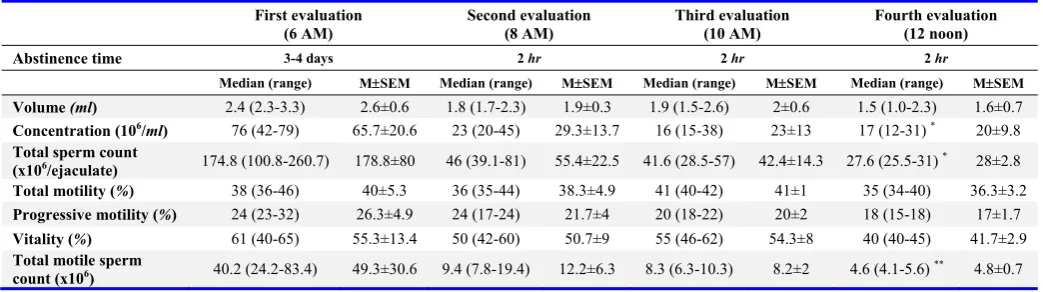
Table 1 shows that the conventional semen pa-rameters corresponded to WHO 2010 minimum criteria at the first evaluation after 3-4 days of
ab-stinence (volume: 1.4-1.7 ml, concentration:
12-16xl06 sperm/ml, total sperm count: 33-46xl06
/ejaculate, total motility: 38-42%, progressive mo-tility: 31-34%, vitality: 55-63%, and calculated total motile sperm count (TMSC): 6.38-11.42x
Table 1. Conventional semen parameters for four repeated ejaculations on the same day at two hour intervals (n=3)
First evaluation (6 AM)
Second evaluation (8 AM)
Third evaluation (10 AM)
Fourth evaluation (12 noon)
Abstinence time 3-4 days 2 hr 2 hr 2 hr
Median (range) MSEM Median (range) MSEM Median (range) MSEM Median (range) MSEM
Volume (ml) 2.4 (2.3-3.3) 2.6±0.6 1.8 (1.7-2.3) 1.9±0.3 1.9 (1.5-2.6) 2±0.6 1.5 (1.0-2.3) 1.6±0.7
Concentration (106/ml) 76 (42-79) 65.7±20.6 23 (20-45) 29.3±13.7 16 (15-38) 23±13 17 (12-31) * 20±9.8
Total sperm count
(x106/ejaculate) 174.8 (100.8-260.7) 178.8±80 46 (39.1-81) 55.4±22.5 41.6 (28.5-57) 42.4±14.3 27.6 (25.5-31) * 28±2.8
Total motility (%) 38 (36-46) 40±5.3 36 (35-44) 38.3±4.9 41 (40-42) 41±1 35 (34-40) 36.3±3.2
Progressive motility (%) 24 (23-32) 26.3±4.9 24 (17-24) 21.7±4 20 (18-22) 20±2 18 (15-18) 17±1.7
Vitality (%) 61 (40-65) 55.3±13.4 50 (42-60) 50.7±9 55 (46-62) 54.3±8 40 (40-45) 41.7±2.9
Total motile sperm
Downloaded from ht
tp://www.jr
i.ir
180 J Reprod Infertil, Vol 17, No 3, Jul-Sept 2016 Repeated Ejaculation and Seminal Parameters
JRI
106), the values for the parameter of progressive
motility being borderline (26.3±4.9%). At the
se-cond and third evaluations after 2 hr of abstinence
each, these semen parameters were still in accord-ance with WHO 2010 minimum criteria except progressive motility whereas vitality value was borderline (Table 1). However, at the fourth
eval-uation after another 2 hr of abstinence, only the
volume and concentration ranged within the WHO 2010 minimum criteria with total motility value as borderline, while total sperm count, pro-gressive motility, vitality and TMSC were below the WHO recommended guidelines. Despite the small sample size, the statistical comparison of the conventional semen parameters at second,
third and fourth evaluations after 2 hr of
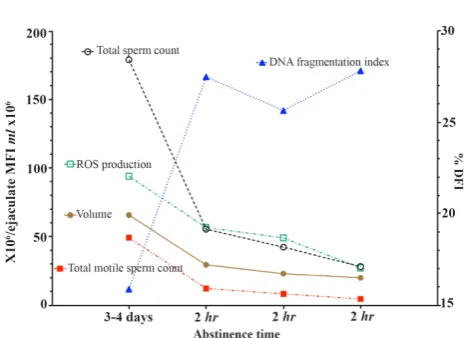
absti-nence each with that of first evaluation after 3-4 days of abstinence revealed significant reduction (p<0.05) in the parameters of concentration, total sperm count and TMSC at fourth evaluation (Ta-ble 1). Overall, a decreasing trend was noted in the conventional semen parameters at second, third and fourth evaluations after two hours of abstinence in comparison to first evaluation after 3-4 days of abstinence (Figure 1).
The functional semen parameters for four repeat-ed ejaculations on the same day at two hour inter-vals are presented in table 2. Statistical compari-son of the functional semen parameters
(intracel-lular ROS production, DFI, ∆Ψm high spermatozoa
and plasma membrane integrity) at second, third
and fourth evaluations after 2 hr of abstinence
each with that of first evaluation after 3-4 days of abstinence revealed significant reduction (p<0.05) only in the parameter of intracellular ROS produc-tion at fourth evaluaproduc-tion (Table 2). With each sub-sequent evaluation after the first one, a decreasing trend was noted in the parameter of ROS produc-tion and an increasing trend was found in the
pa-rameter of DFI, whereas ∆Ψm high spermatozoa and
the integrity of the plasma membrane remained
stable throughout the evaluations. DFI remained within acceptable levels (<29%) (Figure 1).
Discussion
In the present study, a decreasing trend was not-ed in the conventional semen parameters at se-cond, third and fourth evaluations after two hours of abstinence in comparison to first evaluation after 3-4 days of abstinence. Given the limitation of small sample size, significant reductions (p< 0.05) were noted only in the parameters of con-centration, total sperm count and TMSC at fourth
evaluation after 2 hr of abstinence in comparison
to that of first evaluation after 3-4 days of
absti-nence. Previous study on ejaculation after 1 hr of
abstinence reported lower volume and progressive motility, comparable total motility, and higher sperm density in oligospermic men (31). On the other hand, Gulmez et al. reported reduced semen volume and enhanced total motility in the
ejacu-late after 1 hr of abstinence, without any change
Table 2. Functional semen parameters for four repeated ejaculations on the same day at two-hour intervals (n=3)
First evaluation (6 AM)
Second evaluation (8 AM)
Third evaluation (10 AM)
Fourth evaluation (12 noon) Median (range) MSEM Median (range) MSEM Median (range) MSEM Median (range) MSEM ROS production, MFI 99.2 (81-101.7) 94±11.3 40.7 (34.1-95.1) 56.6±33.5 36.1 (19-92.1) 49.1±38.2 26.9 (26.7-27.9) * 27.2±0.6
DNA fragmentation index
(%) 43.5 (34.3-52.5) 15.9±7 51.5 (16.9-53.2) 27.5±2.8 34 (29.8-37.8) 25.6±9.8 16.6 (10.4-33-3) 27.8±3.6
∆Ψm high spermatozoa
(%) 13.46 (10.3-23.8) 27±13.9 27.5 (24.7-30.3) 26.4±20.6 28.9 (14.6-33.4) 26.3±2.8 29.13 (23.7-30.6) 21.9±14
Plasma membrane integrity
(%) 51.2 (39.7-55.7) 53±16.4 53.4 (43.5-58.4) 46.7±6.5 50.2 (42.2-51.7) 56.2±13 40.9 (35.3-41.5) 39.4±3.5
* Significance differences with first evaluation at p<0.05, MFI: Mean Fluorescence Intensity
Figure 1. Variation of selected conventional and functional
semen parameters. Figure shows general distribution of five semen parameters for four repeated ejaculations on the same day at two-hour intervals (mean, n=3): Volume (ml), total spermcount(x106/ejaculate),totalmotilespermcount(x106),
Downloaded from ht
tp://www.jr
i.ir
J Reprod Infertil, Vol 17, No 3, Jul-Sept 2016 181
Mayorga-Torres JM, et al.
JRI
in sperm density (32). Improved semen quality was also suggested by another group after a short-interval second ejaculation (33). Also, in men with severe oligoasthenoteratozoospermia (OAT),
a second ejaculate after 1 hr of abstinence could
improve the sperm concentration and motility (22). Another study showed that a second ejacu-late obtained two hours after the first one had sig-nificantly higher TMSC in comparison to the first ejaculate although there was no difference in pregnancy rate after insemination (19). In our study with four repeated ejaculations on the same day at two-hour intervals, the values of most of the conventional semen parameters did not drop below the WHO 2010 minimum criteria until the third evaluation.
The results about the relation between abstinence and DNA fragmentation are controversial (16). In the present study, an increasing trend was noted for DFI with each subsequent evaluation after the first one although it remained within acceptable levels (<29%) at all the evaluations (27). Similar to our data, De Jonge reported that frequent ejacu-lation increased the percentage of sperm with im-mature chromatin within one day of ejaculatory abstinence (12). These findings can be supported by the observations of Kucuk et al. who reported an increase in the number of sperm but not the pregnancy rate after insemination with the second
sample obtained after 2 hr of ejaculatory
absti-nence (19). In contrast, Gosalvez et al. demon-strated reduced sperm DNA fragmentation after short-term recurrent ejaculation (21). These dif-ferences can be attributed to the variability in the sample size used in respective studies.
There is general agreement that semen volume and sperm concentration will increase with pro-longed sexual abstinence, but simultaneously it can have a negative impact on motility, viability (12-14) and seminal plasma contribution (15). Our group has recently reported that during a two week period of daily ejaculation, the concentra-tion or total sperm count did not drop below the WHO reference values (16). With each subse-quent evaluation after the first one, a decreasing trend was noted in the functional parameter of ROS production, the difference being significant
(p<0.05) at fourth evaluation after 2 hr of
absti-nence in comparison to that of first evaluation after 3-4 days of abstinence. This is in accordance with our recent findings of decreased levels of intracellular ROS in semen samples collected af-ter one day of abstinence. Notably, in the current
study, two hours abstinence time with four repeat-ed ejaculations on the same day was usrepeat-ed. Such reduction in intracellular ROS production can be ascribed to the fact that those spermatozoa spent really short time in the epididymis and that their intracellular antioxidants had not been depleted. During epididymal transit and storage, spermato-zoa are greatly exposed to ROS (17). Marsburn et al. also showed that shorter abstinence period of one day could improve sperm quality by protect-ing from ROS damage, even though lower num-bers of motile sperm were produced (18).
In order to synthesize ATP, mitochondria con-tinuously oxidize substrates and maintain a proton gradient across the lipid bilayer in the respiratory
electron transport chain with a large ∆Ψm. ∆Ψm of
mitochondria is an essential indicator for assess-ing the physiology, viability, and fertilization po-tential of a sperm, the germ cell of males (34-36). As the mitochondria provide energy for sperm
movement, abnormal ∆Ψm of sperm mitochondria
may lead to mitochondria dysfunction and result
in male infertility (37). For successful fertilization,
a functionally constituted sperm plasma mem-brane is necessary, which is clearly dependent on the sperm maturation process (38). Results of this
study also demonstrated that ∆Ψm high spermatozoa
and plasma membrane integrity values remained stable throughout the repeated ejaculations on the same day at two-hour intervals.
Conclusion
Potential clinical use of repeated ejaculations at shorter abstinence times in assisted reproduction has not been adequately explored. The present study for the first time demonstrates the conven-tional as well as funcconven-tional semen parameters for four repeated ejaculations on the same day at two-hour intervals. Majority of conventional semen
parameters did not drop below the WHO2010
min-imum criteria until the third evaluation, while the functional parameter of intracellular ROS produc-tion showed a decreasing trend with each subse-quent evaluation. Even though an increasing trend was found in the parameter of DFI, it remained
within acceptable levels (<29%). The ∆Ψm high
Downloaded from ht
tp://www.jr
i.ir
182 J Reprod Infertil, Vol 17, No 3, Jul-Sept 2016 Repeated Ejaculation and Seminal Parameters
JRI
Acknowledgement
This study was supported by the grant of Estrat-egia de Sostenibilidad of the University of An-tioquia. The stay of Dr. Shubhadeep Roychoud-hury in Cleveland Clinic was supported by the Department of Biotechnology, Government of India.
Conflict of Interest
All of the authors of this manuscript declare that they have no conflicts of interest.
References
1. Amann RP. Considerations in evaluating human spermatogenesis on the basis of total sperm per eja-culate. J Androl. 2009;30(6):626-41.
2. Gomendio M, Roldan ER. Sperm competition in-fluences sperm size in mammals. Proc Biol Sci. 1991;243(1308):181-5.
3. delBarco-Trillo J, Tourmente M, Roldan ER. Meta-bolic rate limits the effect of sperm competition on mammalian spermatogenesis. PLoS One. 2013;8(9): e76510.
4. Joseph PN, Sharma RK, Agarwal A, Sirot LK. Men ejaculatelargervolumesofsemen,moremotilesperm, and more quickly when exposed to images of novel women. Evol Psychol Sci. 2015;1(4):195-200. 5. Johnson L, Varner DD. Effect of daily
spermatozo-an production but not age on trspermatozo-ansit time of sperma-tozoa through the human epididymis. Biol Reprod. 1988;39(4):812-7.
6. Amann RP. A critical review of methods for evalua-tion of spermatogenesis from seminal characteris-tics. J Androl. 1981;2(1):37-58.
7. Turner TT. De Graaf's thread: the human epididy-mis. J Androl. 2008;29(3):237-50.
8. World Health Organization. WHO laboratory ma-nual for the examination and processing of human semen. 5th ed. Geneva: WHO Press; 2010. 286 p. 9. Andersen AG, Jensen TK, Carlsen E, Jorgensen N,
Andersson AM, Krarup T, et al. High frequency of sub-optimal semen quality in an unselected popula-tion of young men. Hum Reprod. 2000;15(2):366-72.
10. Handelsman DJ, Conway AJ, Boylan LM, Turtle JR. Testicular function in potential sperm donors: normal ranges and the effects of smoking and vari-cocele. Int J Androl. 1984;7(5):369-82.
11. MacLeod J, Wang Y. Male fertility potential in terms of semen quality: a review of the past, a stu-dy of the present. Fertil Steril. 1979;31(2):103-16.
12. De Jonge C, LaFromboise M, Bosmans E, Ombelet W, Cox A, Nijs M. Influence of the abstinence pe-riod on human sperm quality. Fertil Steril. 2004;82 (1):57-65.
13. Magnus O, Tollefsrud A, Abyholm T, Purvis K. Effects of varying the abstinence period in the sa-me individuals on sperm quality. Arch Androl. 1991;26(3):199-203.
14. Pellestor F, Girardet A, Andreo B. Effect of long abstinence periods on human sperm quality. Int J Fertil Menopausal Stud. 1994;39(5):278-82. 15. Nnatu SN, Giwa-Osagie OF, Essien EE. Effect of
repeated semen ejaculation on sperm quality. Clin Exp Obstet Gynecol. 1991;18(1):39-42.
16. Mayorga-Torres BJ, Camargo M, Agarwal A, du Plessis SS, Cadavid AP, Cardona Maya WD. In-fluence of ejaculation frequency on seminal para-meters. Reprod Biol Endocrinol. 2015;13:47. 17. Sanchez-Martin P, Sanchez-Martin F,
Gonzalez-Martinez M, Gosalvez J. Increased pregnancy after reduced male abstinence. Syst Biol Reprod Med. 2013;59(5):256-60.
18. Marshburn PB, Giddings A, Causby S, Matthews ML, Usadi RS, Steuerwald N, et al. Influence of ejaculatory abstinence on seminal total antioxidant capacity and sperm membrane lipid peroxidation. Fertil Steril. 2014;102(3):705-10.
19. Kucuk T, Sozen E, Buluc B. Intrauterine insemina-tion with double ejaculate compared with single ejaculate in male factor infertility: a pilot study. J Androl. 2008;29(4):404-7.
20. Marshburn PB, Alanis M, Matthews ML, Usadi R, Papadakis MH, Kullstam S, et al. A short period of ejaculatory abstinence before intrauterine insemi-nation is associated with higher pregnancy rates. Fertil Steril. 2010;93(1):286-8.
21. Gosalvez J, Gonzalez-Martinez M, Lopez-Fernan-dez C, FernanLopez-Fernan-dez JL, Sanchez-Martin P. Shorter abstinence decreases sperm deoxyribonucleic acid fragmentation in ejaculate. Fertil Steril. 2011;96 (5):1083-6.
22. Bar-Hava I, Perri T, Ashkenazi J, Shelef M, Ben-Rafael Z, Orvieto R. The rationale for requesting a second consecutive sperm ejaculate for assisted re-productive technology. Gynecol Endocrinol. 2000; 14(6):433-6.
23. Cardona Maya WD, Berdugo Gutierrez JA, de los Rios J, Cadavid Jaramillo AP. Functional evalua-tion of sperm in Colombian fertile men. Arch Esp Urol. 2007;60(7):827-31.
pa-Downloaded from ht
tp://www.jr
i.ir
J Reprod Infertil, Vol 17, No 3, Jul-Sept 2016 183
Mayorga-Torres JM, et al.
JRI
rameters in normozoospermic infertile individuals]. Actas Urol Esp. 2013;37(4):221-7. Spanish. 25. Cardona-Maya W, Berdugo J, Cadavid A.
[Compa-ring the sperm concentration determined by the Makler and the Neubauer chambers]. Actas Urol Esp. 2008;32(4):443-5. Spanish.
26. Evenson DP. Sperm chromatin structure assay (SCSA®). Methods Mol Biol. 2013;927:147-64. 27. Evenson DP, Jost LK, Marshall D, Zinaman MJ,
Clegg E, Purvis K, et al. Utility of the sperm chro-matin structure assay as a diagnostic and prognos-tic tool in the human fertility clinic. Hum Reprod. 1999;14(4):1039-49.
28. Gil-Villa AM, Cardona-Maya W, Agarwal A, Shar-ma R, Cadavid A. Role of Shar-male factor in early re-current embryo loss: do antioxidants have any ef-fect? Fertil Steril. 2009;92(2):565-71.
29. Gil-VillaAM,Cardona-MayaW,AgarwalA, Shar-ma R, Cadavid A. Assessment of sperm factors possibly involved in early recurrent pregnancy loss. Fertil Steril. 2010;94(4):1465-72.
30. Rodriguez E, Gil-Villa AM, Aguirre-Acevedo DC, Cardona-Maya W, Cadavid AP. [Evaluation of atypical semen parameters in individuals whose couples had a history of early recurrent embryo de-ath: in search for a reference value]. Biomedica. 2011;31(1):100-7. Spanish.
31. Zverina J, Pondelickova J. Changes in seminal par-
ameters of ejaculates after repeated ejaculation. Andrologia. 1988;20(1):52-4.
32. GulmezI,TatlisenA,KaracagilM,KesekciS. Se-minal parameters of ejaculates collected successi-vely with sixty minute interval in infertile men: ef-fect of combination of prazosin and terbutaline on these parameters. Andrologia. 1991;23(2):167-9. 33. Check JH, Chase JS. Improved semen quality after
a short-interval second ejaculation. Fertil Steril. 1985;44(3):416-8.
34. EvensonDP,DarzynkiewiczZ,MelamedMR. Sim-ultaneous measurement by flow cytometry of sperm cell viability and mitochondrial membrane potential related to cell motility. J Histochem Cy-tochem. 1982;30(3):279-80.
35. Garner DL, Thomas CA, Joerg HW, DeJarnette JM, Marshall CE. Fluorometric assessments of mi-tochondrial function and viability in cryopreserved bovine spermatozoa. Biol Reprod. 1997;57(6): 1401-6.
36. Chen LB. Mitochondrial membrane potential in living cells. Annu Rev Cell Biol. 1988;4:155-81. 37. Frank SA, Hurst LD. Mitochondria and male
di-sease. Nature. 1996;383(6597):224.