Journal of Caring Sciences 2019; 8 (2): 89-93 doi:10.15171/jcs.2019.013
http:// journals.tbzmed.ac.ir/ JCS
© 2019 The Author(s). This work is published by Journal of Caring Sciences as an open access article distributed under the terms of the Original Article
Effect of Illness Perception Correction - Based Educational
Program on Quality Of Life and Self- Care in Patients with Heart
Failure: a Randomized Controlled Trial
Ali Sadeghi Akbari
1, Mohammad Ali Cheraghi
2, Anoushiravan kazemnejad
3, Mahin Nomali
2,
Maasoumeh Zakerimoghadam
2*1Department of Medical Surgical Nursing, Tabas Faculty of Nursing, Birjand University of Medical Sciences, Birjand, Iran 2Department of Critical Care Nursing, Faculty of Nursing & Midwifery, Tehran University of Medical Sciences, Tehran, Iran 3Department of Biostatistics, Tarbiyat Modarres University, Tehran, Iran
ARTICLE INFO ABSTRACT
Article type: Original article Article History:
Received: 19 June. 2018 Accepted: 22 Oct. 2018 ePublished: 1 Jun. 2019
Introduction: Because of the chronic nature of Heart Failure (HF), low Quality of Life (QoL) and poor self-care are prevalent among patients with HF. Thus, the aim of this study was to evaluate the effect of illness perception correction- based educational program on QoL,and self- care in patients with HF.
Methods:In this randomized controlled trial, 78 eligible patients were included in the study from Rajaei Heart Center (Tehran, Iran) and randomly assigned into intervention and control group with 1:1 allocation ratio. The intervention was a combination of illness perception correction- based education program (30- minute sessions over 3 consecutive days) and 10-minute phone calls made once a week in the course of 8 weeks. The control group received usual care. The primary outcome was quality of life and secondary outcomes were self- care and illness- perception which were measured at baseline and at the end of the study. SPSS version 13 was used for the analysis.
Results: Out of 76 eligible patients, 70 patients with HF finished the study. Although the mean of quality of life, self-care, and illness perception were not different at baseline, QoL (45.2 (8.3) VS 66.8 (15.4); P<0.001), self-care (18.5 (4.5) VS 37.1 (7.2); P<0.001), and illness- perception (183.6 (8.4) VS 151.2 (24.5); P<0.001) improved following the program in the intervention group in comparison to the control group.
Conclusion:According to the study findings, this program can be applied by nurses for patients with HF as a discharge plan in order to improve their QoL, self-care, and their illness perception.
Keywords:
Patient discharge, Perception, Quality of life, Self – care, Humans, Heart failure
*Corresponding Author: PhD in nursing education, Email: [email protected]
Citation:Sadeghi Akbari A, Cheraghi MA, Kazemnejad A, Nomali M, Zakerimoghadam M.Effect of illness perception correction - based educational
program on quality of life and self- care in patients with heart failure: a randomized controlled trial. J Caring Sci 2019; 8 (2): 89-93. doi: 10.15171/jcs. 2019.013
Introduction
Heart Failure (HF) is a common clinical syndrome with
high prevalence of comorbidities.1 Poorly organized care
and lack of continuity besides too many medications and medical visits, limited access to medical services, and inadequate communication between health care professionals are such treatment burdens experienced by
patients with HF.2 According to the previous studies, HF
has a negative effect on quality of life (QoL)3 and patients
with HF had a poor and undesirable level of QoL.4,5 In
addition, self-care behaviors are sub-optimal and
unsatisfactory among patients with HF5,6 that need to be
improved worldwide.6
Thus, interventions focusing on specific self- care
behaviors and on controlling some amendable variables implementing by nurses are needed to improve the self- care and QoL of patients with HF in both developed and
developing countries.3-7 In order to prevent the
chronicity, illness perceptions and expectations have been recommended as a useful starting point for further
interventions.8 Patients` perception regarding their
disease is one of the aspects of personal factors. This common- sense model hypothesizes that patients with mental representations of their disease can manage their
health problem effectively.9 Moreover, as illness
perceptions can affect the patients` health and well-being, a negative view to the illness was associated with equally
bad experiences of fatigue, and lowered QoL.10
Interventions promoting illness perception and beliefs
may cause improvement in treatment adherence,11
adherence to secondary prevention behavior, patients`
outcomes,12 ideal management of disease, and decreasing
the amount of morbidity and death.11 Therefore, there is a
great need in paying attention to patients` illness
perception13 and providing personalized health
education or intervention programs in order to promote
their illness perceptions.14 On the other hand,
effectiveness of person-centered approach focusing on patient's illness beliefs and emotional state on improving patients` outcomes has been reported to be quite effective
in optimizing the patients` outcome.15 Education based
on Leventhal self-regulation model is a specific kind of education provided according to the patients ` illness perception, with the ultimate goal of correcting it. It focuses on 5 components of disease perception, including identity, cause, time- line, consequences, and curability/
controllability.16
In the previous studies, strong associations have been
found between the perception of HF consequences and emotional (or physical) QoL, self - care confidence, and
illness coherence15 as well as, illness perception and self
-care behavior except for timeline and consequences.14
infarction (MI) in Iran,17 its efficacy has yet not been evaluated among patients with HF with different health care behaviors in our clinical settings. Thus, the aim of this study was to evaluate the effects of illness perception correction- based educational programs on QoL and self- care in patients with HF.
Materials and methods
We conducted a single blind randomized controlled clinical trial on patients with HF. The research ethics committee (REC) (No.93/d/182/130) and institutional review board (IRB) of Tehran University of Medical Sciences (TUMS) (Tehran, Iran) approved the study protocol. Moreover, it was registered on IRCT.ir by IRCT code no. IRCT201406094443N11.
The inclusion criteria were a definite diagnosis of HF,
ejection fraction (EF) of less than 40%, HF functional class II and III, being between 30 to 65 years of age, poor illness perception (as determined by scores of lower than 121), ability to understand and speak Farsi, having no known defects of sight, hearing, speech, having no cognitive or psychiatric disorders, and not suffering from other chronic diseases. The patients whose clinical conditions worsened during the study, had a tendency not to participate in the study or answer the phone calls of call- follow- up, and were discharged before the delivery of the intervention sessions were excluded from the study. In this study, based on 99% confidence level (α= 0.01), and 95% study power (β=5%), and physical health score of QoL between the intervention and control
group (42.1 (22.8) vs 23.9 (11.9),17 the sample size was 35
patients per group. By considering the attrition rate of 10 % during the study period, the final sample size rose to 39 patients in each group. Thus, 78 eligible patients were recruited between April and July 2014 from the Cardiac Internal Medicine ward and Coronary Care Unit in Rajaei Heart Center affiliated to Iran University of Medical Sciences (Tehran, Iran). Before randomization, the participants who met all inclusion criteria signed written
informed consent forms. Envelope shuffling
randomization method was used for random allocation which was conducted by a research nurse. Thus, participants were randomly assigned into two groups of intervention and control with 1:1 allocation ratio.
In the intervention group, illness perception correction-
based education was provided for each patient. The education was based on Leventhal self-regulation
model.16 It was carried out face-to-face, individually, and
in the ward by the researcher nurse over 3 days in a row (in 30-minute sessions). In the first session, we explained the identity and causes of the disease. Then, their incorrect perception of these two components were discussed. In the second session, the previous session's issues were reviewed and then, the patient's perceptions on time- line, consequences, and curability/ control ability were assessed and discussed. In the third session, the individual care program was provided, and the education delivered in the previous sessions was reviewed to be stacked in the patient`s mind. Then, written and verbal education on the patients` medications was provided. An educational booklet was delivered to them, too. During 8 weeks after getting
discharged, the patient`s questions were answered and they were encouraged to adhere to the pieces of advice provided through 10-minute-long phone calls once a week. Moreover, the timing of the phone call was previously arranged by the researcher according to patient preferences.
The control group received no intervention. They
received the routine nursing care, including education on medications and advice to limit daily salt and water, weigh themselves daily and other advice related to their disease. In order to respect the ethical principal of justice, an educational booklet was delivered to them at the end
of the study. In order to assess the eligibility criteria,
illness perception of the patients was measured by illness perception questionnaire (IPQ) according to patient`s self- report. IPQ was first developed by Weinman in
1996.18 IPQ contains 72 items with five-point Likert from
totally agree to totally disagree on symptoms (12 items), progress (7 items), outcomes (8 items), controllability/cur ability (11 items), and causes (16 items). The total score was obtained by adding up item scores to a maximum of 242. The mean score of less than 121 and greater than 121 were considered as negative and positive perceptions, respectively. A Farsi version of this questionnaire was prepared by forward- backward translation method. Then, face and content validity of the IPQ was confirmed by 10 faculty members of nursing and midwifery school at Tehran university of medical sciences. To determine its reliability, the IPQ was completed by 15 patients with HF and Cronbach's alpha was 0.88. The primary outcome was Quality of life (QoL).
The secondary outcomes were self-care and illness- perception which were evaluated at baseline and at the end of the study. Minnesota Living with HF Questionnaire (MLHFQ) was used to measure QoL.
MLHFQ was developed by Rector in 1993.19 In Iran, its
validity and reliability (Cronbach's alpha = 0.9) were also investigated by Abbasi, et al., in 2007. It consisted of 21 items on physical (13 items), socioeconomic (4 items), and psychological (4 items) aspects of life. Each item scores were between zero to five to represent the best and the worst situation, respectively. Higher scores indicated the
lower QOL.20 Self- care of patients was measured by
European Heart Failure Self-care Behavior (EHFSCB). Content validity of the EHFSCB questionnaire was approved by 20 faculty members and it was a reliable questionnaire (Cronbach's alpha = 0.71) containing 12 items, and the scores varied from 12-60. Lower scores indicated better self-care. Scores between 12 and 28, 29-44 and 45-60 were considered as good, moderate, and poor
self-care, respectively.21 Other study variables were
demographic and clinical variables, including age, gender, marital status, insurance, smoking, level of education, job, income, and family history of cardiovascular diseases (CVDs), and disease duration.
The data were analyzed by SPSS version 13 with per
Illness Perception-Based Education and outcomes
Results
In this study, the eligibility criteria of 105 patients with HF were assessed. Out of these, 78 eligible patients were included and 70 patients finished the program (attrition
rate ≅ 10%). Therefore, data related to 35 patients in each
group were analyzed. The study process from recruitment to analysis has been shown in Consolidated Standards of Reporting Trials (CONSORT) flow diagram (Figure 1).
Figure 1: Consort flow diagram
Table 1 indicated the demographic and clinical characteristics of the patients in the intervention and control groups. This table shows that the two groups had no difference with respect to demographic and clinical characteristics at baseline (P>0.01) (Table 1).
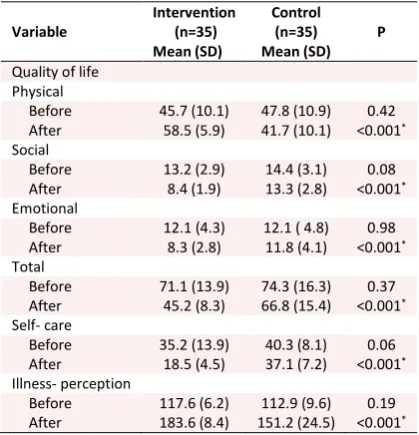
QoL, whether totally with regard to the three aspects,
was not different between the two groups at baseline. While QoL improved significantly, following the program in the intervention group compared with the control group, whether totally with regard to the three
aspects (P<0.001)(Table 2).
Although self-care was not different between the two
groups at baseline (0.066), it became better in the intervention group in comparison to the control group (P<0.001). In addition, no difference was found for illness perception between the two groups at baseline (P=0.190).
However, it improved significantly following the
program (P<0.001) (Table 2).
Table 1: demographic and clinical characteristics of
patients in the intervention and control group
Demographic and clinical variables
Intervention (n=35)
n (%)
Control (n=35) n (%)
P
Age (years)£ 71.4(7.7) 65.7(10.9) 0.87
Gender 0.62
Male 19 (54.3) 22 (62.9) Female 16 (45.7) 13 (37.1)
Marital status 0.20
Single 24 (68.6) 23 (65.7) Married 7 (20) 7 (20) Divorced & widowed 4 (11.4) 5 (14.3)
Level of education 0.68
Elementary school 7 (20) 10 (28.6) High school 21(60) 18 (51.4) Academic 7 (20) 7 (20)
Insurance 0.23
Yes 35 (100) 32 (91.4)
No 0 (0) 3 (8.6)
Smoking 0.76
Yes 6 (17.1) 8 (22.8)
No 29 (82.9) 27 (77.2)
Income 0.20
Enough 12 (34.3) 6 (17.1) Not enough 23 (65.7) 29 (82.9)
Job 0.88
Yes 13 (37.1) 16 (45.7)
No 22 (62.9) 19 (54.3)
Family history of CVDs 0.51
Yes 16 (54.3) 20 (57.1)
No 19 (45.7) 15 (42.9)
Disease duration (month)£
38.3 (33.6) 37.0 (34.4) 0.60
£Mean(SD)
Table 2: Comparison of mean and standard
deviation of quality of life, self- care, and illness perception between intervention and control groups
Variable
Intervention (n=35) Mean )SD(
Control (n=35) Mean )SD(
P
Quality of life Physical
Before 7.04 )1.01( 7404 )1.01( 0.42 After .40. ).01( 7104 )1.01( <0.001*
Social
Before 1.09 )901( 1707 ).01( 0..4 After 407 )101( 1.0. )904( <0.001*
Emotional
Before 12.1 (4.3) 12.1 ( 4.8) 0.98 After 8.3 (2.8) 11.8 (4.1) <0.001*
Total
Before 71.1 (13.9) 74.3 (16.3) 0.37 After 45.2 (8.3) 66.8 (15.4) <0.001*
Self- care
Before 35.2 (13.9) 40.3 (8.1) 0.06 After 18.5 (4.5) 37.1 (7.2) <0.001*
Illness- perception
Before 117.6 )6.2( 112.9 (9.6) 0.19 After 14.01 )407( 1.109 )970.( <0.001* *statically significance,
Discussion
perception is associated with poor physical and mental
health.22 Patients with negative illness perception
believed in non- controllable or curable, chronic identity
and severe consequences of the disease10 that result in
worse experiences of fatigue, depressive symptom
tology, and lowered QoL.10,23 In our study, the total QoL
improved significantly after the illness perception correction based educational program. Previous studies have showed that self- care education, applying effective care model, and administrating the continuous care model can enhance the QoL among patients with myocardial infarction (MI), and HF in the intervention in
comparison to the control group, too.24-26 In addition,
in-hospital illness perception intervention can improve rate of return to work (i.e. patients in the intervention group
returned to their work faster than the control group,27
and functional outcomes.28 Thus, due to the relationship
between illness perceptions and QoL, interventions for changing illness perceptions may be beneficial on
improving QoL.29
There are evidences indicating that implementation of illness perception intervention as a self- regulation model by health care providers provides an effective framework
for adherence to treatment13,30,31 and can lead to a
reduction in medical costs and burden of frequent
hospital admissions among patients with HF.32 Also,
effectiveness of educational programs on promoting self- care behaviors in patients with HF has been shown in the previous literature. In Shojafard et al., self- care was reported to be better in the intervention group than it was in the control group at the end of the study (54.49
(8.01) VS 29.29 (9.02), P<0.0001).33 In addition, in
Ghahramani et al., the patients` performance related to self- care improved significantly in the intervention group compared with the control group (80.75 (3.7) VS
54.78 (6.24) , P<0.0001).34 We found a significant increase
in the self-care of patients with HF following the program, too. In our study, during the study period, the patient`s illness perception improved significantly following the program in the intervention group in comparison with the control group. In line with our study, Broadbent et al., indicated that brief in-hospital
illness perception intervention can change perception.27
In contrast to our study, however, Bijsterbosch et al., stated that illness perceptions can change over time
because of the disease outcome.35 Thus, the improvement
of illness perception in our study might well have been brought about as a result of both the intervention and time.
Conclusion
In conclusion, the illness perception correction - based educational program may improve QoL and self- care in patients with HF. Nurses as key members of the health care team play an important role in patient education during the patients` hospitalization and after discharge from hospital. Therefore, this specific kind of education is recommended as an effective non-pharmacological intervention in order to promote QoL and self- care in patients with HF.
Acknowledgments
This article was extracted from the MS thesis from the field of critical care nursing at Tehran University of Medical Sciences (Tehran, Iran). Authors thank the IRB and REC of TUMS for having approved the study project and the patients for their participation in the study.
Ethical issues
None to be declared
Conflict of interest
The authors declare no conflict of interest in this study.
References
1. Yancy CW, Jessup M, Bozkurt B, Butler J, Casey DE,
Drazner MH, et al. 2013 ACCF/AHA guideline for the management of heart failure: executive summary: a report
of the American College of Cardiology
Foundation/American Heart Association Task Force on practice guidelines. J Am Coll Cardiol 2013; 62 (16): 1495-539. doi: 10.1016/j.jacc.2013.05.020.
2. Gallacher K, May CR, Montori VM, Mair FS.
Understanding patients’ experiences of treatment burden in chronic heart failure using normalization process theory. Ann Fam Med 2011; 9 (3): 253-43. doi: 10.1370/afm.1249
3. Shojaei F. Quality of life in patients with heart failure.
Hayat 2008; 14 (2): 5-13. (Persian)
4. Abedi HA, Yasaman-Alipour M, Abdeyazdan GH. Quality
of life in heart failure patients referred to the Kerman outpatient centers, 2010. Journal of Shahrekord Uuniversity of Medical Sciences 2011;13. (Persian)
5. Shojaei F, Asemi M, Yarandi AN, Hosseini FA. Self care
behaviours, quality of life among patients with heart failure. Iran Journal of Nursing. 2006; 18 (44): 49-55. (Persian)
6. Jaarsma T, Strömberg A, Ben Gal T, Cameron J, Driscoll
A, Duengen H-D, et al. Comparison of self-care behaviors of heart failure patients in 15 countries worldwide. Patient Education and Counseling 2013; 92 (1): 114-20. doi: 10.1016/ j.pec. 2013. 02.017.
7. Riegel B, Driscoll A, Suwanno J, Moser DK, Lennie TA,
Chung ML, et al. Heart failure self-care in developed and developing countries. Journal of Cardiac Failure 2009; 15 (6): 508-16. doi: 10.1016/j.cardfail.2009.01.009.
8. Gehrt TB, Carstensen TBW, Ørnbøl E, Fink PK, Kasch H,
Frostholm L. The role of illness perceptions in predicting outcome after acute whiplash trauma: a multicenter 12-month follow-up study. Lin J Pain 2015; 31 (1): 14-20. doi: 10.1097/ AJP. 0000000000000085.
9. Leventhal H, Meyer D, Nerenz D. The common sense
representation of illness danger. Contributions to Medical Psychology 1980; 2: 7-30.
10.Alsén P, Brink E, Persson L-O, Brändström Y, Karlson
BW. Illness perceptions after myocardial infarction: relations to fatigue, emotional distress, and health-related quality of life. J Cardiovasc Nurs 2010; 25 (2): E1-E10. doi: 10.1097/ JCN. 0b013 e3181c6dcfd.
11.Seyyedrasooli A, Parvan K, Rahmani A, Rahimi Z. Effect
Illness Perception-Based Education and outcomes
12.Stafford L, Jackson HJ, Berk M. Illness beliefs about heart
disease and adherence to secondary prevention regimens. Psychosomatic Medicine 2008; 70 (8): 942-8. doi: 10.1097/PSY.0b013e318187e22e.
13.Hsiao C-Y, Chang C, Chen C-D. An investigation on
illness perception and adherence among hypertensive patients. Kaohsiung J Med Sci 2012; 28 (8): 442-7. doi: 10.1016/j.kjms.2012.02.015.
14.Tsai J-C, Tsai P-S, Wang Y-T. Illness representations and
self-care behavior of patients with heart failure. 2014. Available from: https://sigma.nursingrepository.org/handle/ 10755/335090.
15.Goodman H, Firouzi A, Banya W, Lau-Walker M, Cowie
MR. Illness perception, self-care behaviour and quality of life of heart failure patients: A longitudinal questionnaire survey. Int J Nurs Stud 2013; 50 (7): 945-53. doi: 10.1016/ j.ijnurstu. 2012.11.007.
16.Leventhal H, Benyamini Y, Brownlee S, Diefenbach M,
Leventhal EA, Patrick-Miller L, et al. Illness
representations: theoretical foundations. Perceptions of health and illness 1997; 2: 19-46.
17.Sararoudi RB, Motmaen M, Maracy MR, Pishghadam E,
Kheirabadi GR. Efficacy of illness perception focused intervention on quality of life, anxiety, and depression in patients with myocardial infarction. J Res Med Sci 2016; 21: 125. doi: 10.4103/1735-1995.196607.
18.Weinman J, Petrie KJ, Moss-Morris R, Horne R. The
illness perception questionnaire: a new method for
assessing the cognitive representation of illness.
Psychology and Health 1996; 11 (3): 431-45. doi: 10.1080/ 08870449608400270.
19.Rector TS, Kubo SH, Cohn JN. Validity of the minnesota
living with heart failure questionnaire as a measure of therapeutic response to enalapril or placebo. American Journal of Cardiology1993; 71 (12): 1106-7. doi: 10.1016/ 0002-9149(93) 90582-W.
20.Abbasi A, Fayazi S, Ahmadi F, Haghighi Zadeh MH. The
efficacy of home walking exercise program on functional performance and quality of life in patients with heart failure. Journal of Gorgan University of Medical Sciences 2007; 9 (1): 49-54. (Persian)
21.Momeni M, Khoshtarash M, Ghanbari Khanghah A,
Salehzadeh A, Rahmatpour Self-care behaviors and related factors in patients with heart failure reffering to medical & educational center of heart in Rasht. Journal of Holistic Nursing and Midwifery 2013; 23 (1): 22-9. (Persian)
22.Frostholm L, Oernboel E, Christensen KS, Toft T, Olesen
F, Weinman J, et al. Do illness perceptions predict health outcomes in primary care patients? A 2-year follow-up study. J Psychosom Res 2007; 62 (2): 129-38. doi: 10.1016/ j.jpsychores. 2006.09.003.
23.Stafford L, Berk M, Jackson HJ. Are illness perceptions
about coronary artery disease predictive of depression andquality of life outcomes? J Psychosom Res 2009; 66 (3): 211-20. doi: 10.1016/j.jpsychores.2008.09.005.
24.Najafi S, Vahedparast H, Hafezi S, Saghafi A, Farsi Z,
Vahabi Y. Effect of self-care education on quality of life in patients suffering from myocardial infarction. IJCCN 2008; 1 (1): 35-9. (Persian)
25.Bagaei R, Khalkhali HR, Mashalahi A. The effect of
applying continuous care model on the quality of life in heart failure patients. The Journal Of Urmia Nursing and Midwifery Faculty 2015; 13 (8): 666-75. (Persian)
26.Sadeghi SM, Alavi ZF, Ahmadi FE, Karimi ZA, Babatabar
DH, EBADI A, et al. Effect of applying continuous care model on quality of life in heart failure patients. Journal of Behavioral Sciences 2009; 3 (1): 9-13. (Persian)
27.Broadbent E, Ellis CJ, Thomas J, Gamble G, Petrie KJ.
Further development of an illness perception intervention for myocardial infarction patients: A randomized controlled trial. J Psychosom Res 2009; 67 (1): 17-23. doi: 10.1016/ j.jpsychores. 2008.12.001.
28.Petrie KJ, Cameron LD, Ellis CJ, Buick D, Weinman J.
Changing illness perceptions after myocardial infarction: an early intervention randomized controlled trial. Psychosomatic Medicine 2002; 64 (4): 580-6. doi: 10.1097/00006842-200207000-00007.
29.French DP, Cooper A, Weinman J. Illness perceptions
predict attendance at cardiac rehabilitation following acute myocardial infarction: A systematic review with meta-analysis. J Psychosom Res 2006; 61 (6): 757-67. doi: 10.1016/ j.jpsychores. 2006.07.029.
30.Chen SL, Tsai JC, Lee WL. The impact of illness
perception on adherence to therapeutic regimens of patients with hypertension in Taiwan. Journal of Clinical Nursing 2009; 18 (15): 2234-44. doi: 10.1111/j.1365-2702.2008. 02706.x.
31.Fennessy MM, DeVon HA, Ryan C, Lopez JJ, Zerwic JJ.
Changing illness perceptions and adherence to dual antiplatelet therapy in patients with stable coronary disease. J Cardiovasc Nurs 2013; 28 (6): 573-83. doi: 10.1097/ JCN.0b013e31825d6060.
32.Moser DK, Dickson V, Jaarsma T, Lee C, Stromberg A,
Riegel B. Role of self-care in the patient with heart failure. Curr Cardiol Rep 2012; 14 (3): 265-75. doi: 10.1007/ s11886-012-0267-9.
33.Shojafard J, Nadrian H, Baghiani Moghadam MH,
Mazlumi Mahmudabad SS, Sanati HR, Asgar Shahi M. Effects of an educational program on self-care behaviors and its perceived benefits and barriers in patients with Heart Failure in Tehran. Journal of Payavard Salamat 2009; 2 (4): 43-55. (Persian)
34.Ghahramani A, Kamrani F, Mohamadzadeh S, Namadi M.
Effect of self care education on knowledge, performance and readmission of heart failure patients admitted in city hospitals of Ardabil. 2013; 8 (2): 65-72. (Persian)
35.Bijsterbosch J, Scharloo M, Visser AW, Watt I, Meulenbelt