Original Article
DOI: 10.22114/ajem.v0i0.355
Necessary Indicators for Developing a Hazmat Response Team of the
Iranian Health System
Parisa Hasani-Sharamin1,2, Hasan Bagheri3, Mahmood Salesi3, Fatemeh Dadashi2, Mahboubeh Rouhollahei3, Gholamreza Poorheidary3, Alireza Shahriary3*
1. Student Research Committee, Baqiyatallah University of Medical Sciences, Tehran, Iran. 2. Tehran Emergency Medical Service Center, Tehran, Iran
3. Chemical Injuries Research Center, Systems Biology and Poisonings Institute, Baqiyatallah University of Medical Sciences, Tehran, Iran.
*Corresponding author: Alireza Shahriary; Email: [email protected]
Published online: 2020-03-10
Abstract
Introduction: Although some countries have set up predetermined programs and specialized teams to deal with hazardous materials (Hazmat) induced events, in other countries including Iran there are many weaknesses in this regard.
Objective: We aimed to develop the necessary indicators for the formation of teams to deal with Hazmat accidents in the health system based on existing standards and resources as well as the indigenous conditions of Iran.
Methods: This cross-sectional study was carried out in two stages from 2018 to 2020. In the first stage, the literature review was performed and the current guidelines, standards, and models presented in other countries were reviewed and related items were extracted. In the second stage, semi-structured and purposeful interviews by managers and physicians specialized in Hazmat incidents working in Iran, were conducted. The interviews were recorded and later the recordings were transcribed and simultaneously the categorizing and coding of the interviews were performed.
Results: In the first stage, searching through the available resources for the present study identified 12 published references through which 10 indicators to develop a Hazmat team were ultimately extracted. In the second stage, a total of 10 interviews were conducted and data saturation occurred. Based on the results of the content analysis for the main indicators of designing and developing teams, 8 categories and 19 sub-categories were developed.
Conclusions: By interviewing and localizing the 10 main indicators that were achieved in the first stage, we finally reached the 8 indicators including: Training hazmat team’s members, required equipment for team, response plan, medical surveillance program, hazmat team structure, incident command system, hazmat team qualification of different levels, certification and maintenance of the certificate.
Key words: Emergency Medical Services; Hazardous Substances; Indicator;Iran; Qualitative Research Cite this article as: Hasani-SharaminP, Bagheri H, Salesi M, Dadashi F, Rouhollahei M, Poorheidary G, et al. Necessary Indicators for Developing a Hazmat Response Team of the Iranian Health System. Adv J Emerg Med. 2020;4(*):e*.
INTRODUCTION
Hazardous materials (Hazmat) refers to substances that in case of an uncontrolled release into the environment can cause the injury and death of humans, animals, or destruction of ecosystems (1-3). In recent years, due to technological events, natural disasters, or wars and terrorist activities the probability of the spread of Hazmat has been increased. As the International Red Cross has estimated that there were approximately 3200 technological disasters from 1998 to 2007 led to nearly 100 thousand kills and about 2 million injured people. This is especially has received more attention than ever before in developing countries where extraction, processing, and utilization of
chemical materials have been increased (2). Iran is also a developing country with a large production capacity, in which industrialization is rapidly growing (4, 5). The incidence of industrial chemical incidents in Iran between 2010 and 2013 have been increasing (6-10).
reduce exposure to Hazmat are critical during these events (11). Injuries caused by Hazmat to people and paramedics require specialized medical care (12). Considering the special conditions of treatment for such events like triage at the scene, performing emergency actions in the contaminated areas, decontamination of victims in the pre-hospital setting or emergency department (ED) and the way of transmission of them, attention to other associated traumas, appropriate antidote prescription, proper use of personal protection equipment, and special attention to the important principles of preventing contamination of healthcare personnel, should always be regarded. Therefore, emergency medical personnel must be adequately prepared for the challenges and problems such as traumatic, thermal, radiological, biological and chemical hazards (13). Several studies have shown that the health system and emergency medical services are not well-prepared for hazardous incidents, which can result in significant deaths of victims and operational forces (14-17).
Although some countries have set up predetermined programs and specialized teams to deal with potential events, in other countries including Iran there are many weaknesses in this regard; for example, dispersed roles, ambiguous responsibilities and lack of coordination between the various organizations involved in this area (1). In most countries, the emergency medical service (EMS) has become an integral part of the hazardous incident management team (18). At a specialized meeting held in Birmingham, UK, in 2012 on the response to hazardous events, it was reported that until 2004, ambulance personnel, unlike the police and firefighters, did not operate inside the “hot zone” of a Hazmat accident. The experience of emergency response practices and casualty treatment in simulated accidents showed long delays in victim relief, decontamination, and treatment done by ambulance personnel in the cold zone. Failure to operate in the hot zone precludes proper clinical care. So a program of starting up specialized health teams to provide services in hazardous environments has been developed, although no specific standards were defined for these teams and the basis of the standards was standards of the Fire department (19, 20).
In Iran, firefighters still manage these incidents, which have some problems in the implementation. On one hand, since the fire department and the EMS are two independent organizations, interagency coordination leads to delay in the response process; on the other hand, due to the absence of
firefighters, especially in road accidents, the response process has been disturbed. Such cases lead the authorities and agencies responsible for health-care affairs to plan for design, train, and implement chemical disaster response programs by EMS. Therefore, this study was carried out to develop the necessary indicators for the formation of teams to deal with Hazmat accidents in the health system based on existing standards and resources as well as the indigenous conditions of Iran.
Methods Study design
This cross-sectional study was carried out in two stages (data extraction and interview) from 2018 to 2020. All required permits were obtained from the ethics committee of Baqiyatallah University of Medical Sciences (Code: IR.BMSU.REC.1396.870). The researchers were committed to the principles of honesty, trustworthiness, and confidentiality in all stages of conducting the research and reporting the results. All interviews were conducted after presenting the introduction letter, receiving informed consent, with an appointment and permission to record the interviewee’s voice. The interviews were analyzed anonymously.
First stage
At this stage, the literature review was performed and the current guidelines, standards, and models presented in other countries were reviewed and related items were extracted. For this purpose, first, the keywords in English and Farsi were selected: “Dangerous Material Team”, “Hazmat team”, “hazardous area response team”, “CBRN team” and a manual search on Google, Google Scholar, PubMed, Ovid, Scopus, Science Direct, and SID during the years of 2000-2017 was done.
Second stage
was recorded and after the interview was over, the recording was transcribed and simultaneously the categorizing and coding of the interviews were performed.
Data analysis
Using MAXQDA software, transcribed interviews were analyzed and using the content analysis the results were presented in tables. For the content analysis, it was necessary, first, assign a unique term to a unique concept (code) and then merge similar concepts into a single topic (structuring).
RESULTS
First stage
Searching through the available resources, we finally identified 12 published references through which 10 indicators to develop a Hazmat team were ultimately extracted:
1) Response Program
2) Personal Protective Equipment Program (PPE) 3) Medical Surveillance Program
4) Training of Hazmat Team Members
5) Hazmat Team Response Structure and Process 6) Hazmat Team Call and Dispatch
7) Incident Command System (ICS) 8) Hazmat Team Equipment 9) Hazmat Team Accreditation
10) Certification and Maintenance of the certificate.
Second stage
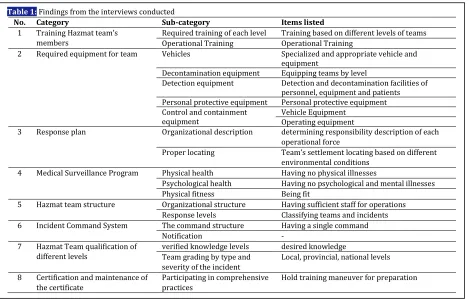
In the second phase, a total of 10 interviews were conducted and data saturation occurred. Based on the results of the content analysis for the main indicators of designing and developing teams, 8 categories and 19 sub-categories were developed (Table 1). The key concepts related to the required indicators to design teams were extracted from interviews with officials, technicians, and experts. In the following, you see the results of the main concepts, codes, and sub-codes.
1.Training of Hazmat team members
Training is one of the main principles of developing a Hazmat team that has been mentioned repeatedly in the interviews. Regarding this indicator, we obtained two sub-categories of required training based on performance levels and operational practices. Required Training based on Performance Levels: Given that the individuals’ tasks in different Hazmat incidents vary, training should be commensurate with the performance level of the individuals. As one official noted, “education should be classified and conducted concerning each person's job and level of education and degree.” And another said, “One of the main indicators is team classification and equipping them based on their levels.” One of the subcategories of training is operational training which is more marked in accidents, especially in incidents with scattered and specialized roles. As
Table 1: Findings from the interviews conducted
No. Category Sub-category Items listed
1 Training Hazmat team’s members
Required training of each level Training based on different levels of teams Operational Training Operational Training
2 Required equipment for team Vehicles Specialized and appropriate vehicle and equipment
Decontamination equipment Equipping teams by level
Detection equipment Detection and decontamination facilities of personnel, equipment and patients Personal protective equipment Personal protective equipment Control and containment
equipment Vehicle Equipment Operating equipment
3 Response plan Organizational description determining responsibility description of each operational force
Proper locating Team’s settlement locating based on different environmental conditions
4 Medical Surveillance Program Physical health Having no physical illnesses
Psychological health Having no psychological and mental illnesses
Physical fitness Being fit
5 Hazmat team structure Organizational structure Having sufficient staff for operations Response levels Classifying teams and incidents 6 Incident Command System The command structure Having a single command
Notification -
7 Hazmat Team qualification of different levels
verified knowledge levels desired knowledge Team grading by type and
severity of the incident
Local, provincial, national levels
8 Certification and maintenance of the certificate
Participating in comprehensive practices
one interviewee stated, “simulated training is very helpful, however, not symbolic maneuvers which are ironic...”
2.Team’s required equipment
This code was also mentioned by most interviewees. It was divided into 5 sub-categories: vehicles, decontamination equipment, detection equipment, personal protective equipment and control and containment equipment. One interviewee declared, “To develop a team we need to provide individuals with appropriate personal protective, vehicle, and operational equipment.” 3.Response plan
Developing a Hazmat response plan is the infrastructure needed to design and form teams. In this plan the tasks of organizations and individuals, and their responsibilities are identified, also the teams’ location of settlement should be set according to an appropriate locating system. One participant said, “Health system teams should work alongside firefighting teams rather than performing their duties_ for example immunization, triage, stabilizing the health condition, receiving and transporting casualties of a Hazmat incident, and hospital decontamination are among the responsibilities of a Hazmat team of the health system. These items must be written in the operational plans.”
4.Medical surveillance program
Hazmat incidents endanger rescuers, so having physical and even mental health to work in hazardous environments is a necessity. This code was divided into three sub-categories: physical health, mental health, and physical fitness. In this regard, one interviewee said, “to choose individuals, their physical condition, physical fitness and spirit of teamwork should be considered. It is better not to select older people and set age restrictions. There should be a specialist physician for the necessary treatment if there is a problem.”
5.Hazmat team’s structure
A Hazmat response team should consist of personnel groups at different operational levels. The minimum number of people required to create each group must be defined. The organization responsible for these teams should also be determined and certify all individuals according to their qualifications. This code was also divided into two subgroups of organizational structure and response levels. According to the interviewees, there should be a definitive organizational chart for the design of these teams. As one interviewee suggested, “All these teams must be under the supervision of one organization that certificates
and supervises them. Different instructions and approaches can lead to confusion and sometimes the conflict of responsibility”. Regarding the levels of response, the interviewees also indicated that the teams should be called and dispatched in proportion to the extent and level of the incident. “Not determining the incident’s level and the way of dispatching makes it possible for teams to be called in for events that may not be needed, which can be costly for the systems,” said one interviewee.
6.Incident command system
The incident command system must be activated in all Hazmat incidents. The command is important and can vary from one domain to another. However, in the case of Hazmat accidents, which often involve several organizations, a single command system consisting of the representatives of different organizations must be established. Notification processes must be defined. One of the interviewees said, “Often the major challenge in these events is the lack of interaction and coordination between the organizations and even the components of one organization. It should be determined that these teams will be operating at the scene under the supervision of what part. It is not acceptable that everybody orders at the scene and unified decisions must be made.”
7.Hazmat team qualification of different levels Given the numerous and vast types of hazardous materials, organizing the teams is difficult. In general, Hazmat teams and their members must be graded. Teams based on the type and severity of the incident can be classified differently. For example, one interviewee stated, “Nuclear, biological, chemical and explosive response teams can be separately designed, and they will be dispatched to incident-related accidents.” “These teams should be designed at local, regional and national levels and in case of a large incident, use higher levels which are more capable.” said another participant.
Required qualifications must be defined and evaluated to classify individuals. Each person must acquire the necessary qualifications based on the expected tasks and functions. To choose individuals their level of knowledge should be considered. As one participant remarked, “difficult and complicated tasks must be assigned to people of high competence and potential. Knowledge is important, but not as much as a skill... in addition to knowledge, one must work appropriately in real situations. A man’s competence must be assessed in real settings.”
Each team must obtain a valid certificate from the responsible organization, and operations without a certificate can endanger the safety and health of individuals. The certification process and documentation must be clear and be notified, and each organization must provide the eligibility for certification. The validity of the certificate should be specified and there must be re-evaluations for re-certification. One interviewee stated, “Sometimes some organizations run courses for their staff and issue certificates (we do not know if these certificates are valid or not) ... and for the next ten years, they work with the same certificate. There is no need to update themselves, receive continuing education and participate in operational and training courses.”
DISCUSSION
Increased dependence on hazardous substances requires a health system that through developing roles and responsibilities is capable of addressing public health and medical issues associated with the use of hazardous substances and their health effects. Preventing and reducing Hazmat accidents and their health consequences is a broad area that requires specific experts in many disciplines. The health system plays an important role in preventing these accidents and mitigating their negative effects on the communities exposed to it and the environments in which it may occur. Hazmat teams are necessary to respond to the accidental or intentional release of hazardous chemical agents to the environment. Hazmat teams also have the responsibility of quick assessment of the situation and controlling the operations of dealing with such events, including patient management and the decontamination process of the affected area (21).
One of the priorities is to establish and locate Hazmat teams in appropriate locations throughout the country so that they can be quickly in access if needed. Rapid response in chemical affected areas leads to the reduction of subsequent and worse consequences (22, 23). Also, the public health system is responsible for protecting public health against chemical accidents. Health care staff must have sufficient knowledge and capacity to manage victims (24). Fatemi, Ardalan et al. (2019) study showed that Iran's public health system currently does not have any specific training courses on hazardous substances harms and chemical accidents for health care staff. Medical centers also cannot manage these events. Lack of access to a Hazmat team for chemical accidents is one of the shortcomings in local response systems (8). In Iran,
various agencies and organizations such as the Emergency Medical Service, Fire department, Red Crescent Society, law enforcement forces, and numerous other organizations and agencies are responsible for responding quickly to Hazmat accidents and each of them considers itself as the responsible for these incidents. However, there is still not a specialized team responsible for Hazmat accidents. In Joshua Verson's study, simulated practices showed that to improve the performance of medical teams we should focus on four areas of access to equipment, content and organization, operational skills, and methods of decontamination and communication, should (25). While Hazmat disaster relief is a major challenge for the country, it is hoped that this study through the identification of requirements and standards of Hazmat teams in the health system, provide managers, officials, and stakeholders involved in responding to Hazmat incidents the ways to deal with such events. The results of this study can be used in the emergency response plan guidelines.
Limitations
Lack of access to the data of some organizations due to the confidentiality of the information and documents, the lack of documented information on the processes and response plan of Hazmat accidents in different domains of the health system and other involved organizations were among the problems of this study. In the process of interviews due to the beliefs of some managers and experts that there is no need for such teams in the health system as well as the inability to form the tea, it created many challenges.
CONCLUSIONS
By interviewing and localizing the 10 main indicators that were achieved in the first stage, we finally reached the 8 indicators including: Training hazmat team’s members, required equipment for team, response plan, medical surveillance program, hazmat team structure, incident command system, hazmat team qualification of different levels, certification and maintenance of the certificate.
ACKNOWLEDGEMENTS
I sincerely thank all my colleagues at the Chemical Injuries Research Center, Systems Biology and Poisonings Institute of Baqiyatallah University of Medical Sciences and the Tehran Emergency Medical Service Center who helped us with this study.
AUTHORS’ CONTRIBUTION
based on the recommendations of the International Committee of Medical Journal Editors. All the authors approved the final version to be published and agree to be accountable for all aspects of the work.
CONFLICT OF INTEREST None declared.
FUNDING None declared.
REFERENCES