University of New Orleans University of New Orleans
ScholarWorks@UNO
ScholarWorks@UNO
University of New Orleans Theses and
Dissertations Dissertations and Theses
8-8-2007
Developmental Pathways To Conduct Problems
Developmental Pathways To Conduct Problems
Danielle Dandreaux University of New Orleans
Follow this and additional works at: https://scholarworks.uno.edu/td
Recommended Citation Recommended Citation
Dandreaux, Danielle, "Developmental Pathways To Conduct Problems" (2007). University of New Orleans Theses and Dissertations. 566.
https://scholarworks.uno.edu/td/566
This Dissertation is protected by copyright and/or related rights. It has been brought to you by ScholarWorks@UNO with permission from the rights-holder(s). You are free to use this Dissertation in any way that is permitted by the copyright and related rights legislation that applies to your use. For other uses you need to obtain permission from the rights-holder(s) directly, unless additional rights are indicated by a Creative Commons license in the record and/ or on the work itself.
A Dissertation
Submitted to the Graduate Faculty of the University of New Orleans in partial fulfillment of the requirements for the degree of
Doctor of Philosophy In
Applied Developmental Psychology
By
Danielle Dandreaux
B.S. Arizona State University, 1999 M.S. University of New Orleans, 2002
Table of Contents
List of Tables ... iii
Abstract ... iv
Introduction ...1
Methods...30
Results ...43
Discussion ...52
References ...60
Table 1 ...8
Table 2 ...32
Table 3 ...44
Table 4 ...46
Table 5 ...48
Abstract
This study tests the predictions made by several causal theories proposing
different etiologies for childhood-onset and adolescent-onset conduct problems. It
investigates a variety of causal factors proven to be important for the development of
antisocial behaviors, specifically neuropsychological/cognitive deficits, temperamental
vulnerabilities, dysfunctional parenting, deviant peers, and rebelliousness. Current
theories generally agree that the early onset pathway is distinguished by interactions
between a child with a difficult temperament and dysfunctional parent-child interactions.
However, theories differ as to whether they emphasize the temperament and
neuro-cognitive deficits of the child, or the parenting behaviors. In the adolescent onset
pathway, theories typically focus on the importance of affiliation with deviant peers but
differ as to whether this is attributed to a personality characterized by the rejection of
traditional values and rebelliousness as leading to this association or failures in parenting
practices.
Seventy-eight pre-adjudicated adolescent (ranging in age from 11 to 18) boys
housed in two short-term detention facilities and one outpatient program for boys at risk
for involvement in the juvenile justice system in southeastern Louisiana participated in
the current study. The sample was ethnically diverse (56% African-American) and
largely came from facilities serving either a large urban or a largely suburban and rural
region of the state. The sample was divided into two groups based on the youngest age of
a self-reported delinquent act or parent-reported severe conduct problem. The
childhood-onset group (n =47) displayed at least one serious antisocial behavior prior to age 12,
predictions, however, this group also showed the strongest affiliation with deviant peers.
The only variable strongly associated with the adolescent onset group was lower scores
on a measure of traditionalism which indicates less endorsement of traditional values and
status hierarchies. The implications of these results for understanding different causal
trajectories to antisocial behavior and for designing better prevention and treatment
programs for antisocial youth are discussed.
Keywords: juvenile delinquency; age of onset; traditionalism; CU traits; parenting;
Introduction
There are a variety of factors that have been linked to conduct problems in youth.
These factors include both dispositional and environmental factors (Frick, 1994; Lytton,
1990). A few of the dispositional factors that have been researched extensively are
genetic predispositions, intelligence, and deficits in social cognition (Dodge & Frame,
1982; Frick, 1998; Hinshaw, 1992; Mason & Frick, 1994; Moffitt, 1993b; Rutter,
MacDonald, LeCouteur, Harrington, Bolton, & Abiley, 1990). Some of the
environmental factors that have been linked to conduct problems are a deviant peer
group, high-crime neighborhoods/poverty, and exposure to violence (Bierman, 1986;
Cohen, Cohen, & Brooks, 1993; Coie, Dodge, & Kupersmidt, 1990; Frick, 1998;
Huesmann & Malamuth, 1986; Ingoldsby & Shaw, 2002; Reid, 1993). First, this study
will review some of the best studied risk factors that play a role in most causal theories.
Second, it will focus on developmental models that provide a framework for
understanding how these many factors can place a child at risk for conduct problems.
Cognitive Deficits
One of the most common findings in delinquency research is an IQ deficit
(Culberton, Feral, & Gabby, 1989; Duncan, Kennedy, & Patrick, 1995; Moffitt, 1993b).
While deficits in IQ cannot fully explain delinquency, Raine (1993) states that .5 to .7 is
approximately the average effect size for the association between IQ and antisocial
behavior. Stated another way, there is about an eight-point or one-half standard deviation
IQ score difference typically found between delinquent youth and their non-delinquent
counterparts across studies (Lynam, Moffitt, & Stouthamer-Loeber, 1993; Moffitt,
Moffitt (1993a) has suggested that these global deficits are due primarily to
deficits in verbal abilities and executive functions. Many studies have been performed
examining the difference in the verbal IQ (VIQ) and the performance IQ (PIQ) in
delinquent samples. In fact, Wechsler was the first to observe the VIQ-PIQ discrepancy
in delinquent samples over 50 years ago, suggesting weaker verbal abilities in delinquent
samples (Wechsler, 1944 as cited in Law & Faison, 1996). Many studies have replicated
this finding that the PIQ is greater then the VIQ in delinquent samples (Cornell &
Wilson, 1992; Culberton et al., 1989; Duncan et al, 1995; Famularo, Fenton, Kinscherff,
Barnum, Bolduc, & Bunschaft, 1992; Lynam et al., 1993; Walsh, Beyer, & Petee, 1987;
Wong & Cornell, 1999). This finding is not limited to adjudicated samples. In a study of
preadolescents, clinic-referred children with conduct disorder compared to children
without conduct disorder had a significantly larger VIQ-PIQ discrepancy (Hodges &
Plow, 1990). In addition, there was a significant relationship between the number of
conduct disorder symptoms reported and the size of the discrepancy, with the most
severely antisocial children exhibiting the greatest discrepancy between their PIQ and
VIQ.
Family Dysfunction
In addition to cognitive deficits, many social risk factors have been associated
with conduct disorder and delinquency, and many of these risk factors occur within the
family. Family risk factors that are associated with the development of conduct disorder
include: parental antisocial personality disorder (APD; Frick, Lahey, Loeber,
Stouthamer-Loeber, Christ, & Hanson, 1992), parental substance use (Frick et al., 1992), maternal
et al., 1996), large family size, single parent homes (Kilgore, Snyder, & Lentz, 2000),
teen parent homes (Kilgore et al., 2000), family stress (Campbell, Pierce, Moore,
Marakovitz, & Newby, 1996), insecure attachment between parent and child (Shaw et al.,
1996), and the use of ineffective parenting practices (i.e. harsh parenting, poor
monitoring and supervision, low parental involvement, inconsistent parenting, and a lack
of warmth in parenting) (Brody, Ge, Conger, Gibbons, Murry, Gerrard, & Simons, 2001).
While there is general agreement that family dysfunction is linked to conduct
problems, the specific aspects of family dysfunction that are most important are less
clear. A meta-analysis comparing the different types of family dysfunction in relation to
conduct problems by Loeber and Stouthamer-Loeber (1986) reported that parental
socialization practices are the most powerful predictors of conduct problems.
Specifically, there are three types of parental socialization practices that are most highly
correlated with conduct problems (Amato & Keith, 1991; Emery, 1982; Frick, 1994;
Loeber & Loeber, 1986). First, the meta-analysis by Loeber and
Stouthamer-Loeber (1986) reported that low parental involvement was significantly associated with
conduct problems and delinquency in 22 of the 29 analyses reviewed. Second, in the
same meta-analysis, poor parental supervision was significantly associated with conduct
problems and delinquency in 10 of the 11 analyses reviewed; including six longitudinal
studies showing that supervision was a significant predictor of future antisocial behavior
and delinquency. Third, ineffectual discipline practices were highly associated with
conduct problems including inconsistent parenting, harsh discipline, and failure to use
positive strategies (Rey & Plapp, 1990; Wells & Rankin, 1988). Importantly, the most
interventions that are designed to change these ineffectual parental discipline practices
(Dumas, 1989; Frick, 1993; Kazdin, 1987).
Deviant Peers
Another frequently studied social risk factor to antisocial behavior is association
with deviant peers (Moffitt, 1993b; Patterson & Yoerger, 1997). Most researchers agree
that peers exert a powerful influence on youths’ antisocial behaviors (Deptula & Cohen,
2004). While, much of this research has focused on associations with deviant peers in
adolescence (Simons, Johnson, Conger, & Elder, 1998; Simons, Wu, Conger, & Lorenz,
1994), there is evidence for this association across development. For example, it has
been found that exposure to higher levels of aggressive peers in preschool is predictive of
future aggressive behaviors in children (Sinclair, Pettit, Harrist, Dodge, & Bates, 1994).
Importantly, association with deviant peers may not be independent of family
dysfunction. Fergusson and Horwood (1999) found that youth reporting the highest level
of association with deviant peers were characterized by family dysfunction, parental
adjustment difficulties, and high levels of exposure to family social and economic
disadvantage.
Temperament
Many researchers have examined the effect that child temperament may have on
the development of conduct problems. Temperament is defined as “individual
differences in behavioral style that are visible from early childhood” (Sanson & Prior,
1999). Temperamental differences appear relatively early in the lifespan (Garcia-Coll,
Kagan, & Reznick, 1984). They are enduring and contribute to a child’s behavior and
“comprises the emotional, motivational, and attentional bases of later personality”
(Sanson & Prior, 1999). There have been many temperament dimensions that have been
studied and may predispose a child for developing conduct problems (Frick & Morris,
2004); however, much research has focused on several specific dimensions.
First, Kochanska (1993) focuses on individual differences in fearfulness or
vulnerability to anxious arousal that are associated with a child’s emotional upset and
discomfort occasioned by wrongdoings, which she calls the affective discomfort
components of conscience. Consistent with this, Lytton (1990) found that many children
with conduct disorder are characterized by deficiencies in fear. Second, Kochanska
(1993) also proposes that differences in impulsivity and inhibitory control are associated
with a child’s behavioral control in situations when standards of conduct apply. The
overt manifestation of the capacity for behavioral control is the child’s compliance with
parental standards (Biederman, Rosenbaum, Hirschfield, Faraone, Boldue, Gersten,
Meminger, Kagan, Snidman, & Reznick, 1990; Kochanska & Aksan, 1995; Shaw & Bell,
1993). Consistent with this possibility, a number of studies have linked problems of
impulsivity with the development of conduct problems (see Frick, 1998; Frick & Morris,
2004 for a review).
Developmental Models
This is only a brief summary of the many risk factors that have been associated
with the development of conduct problems. The first implication of this research is that it
is very unlikely that the focus on any single risk factor will adequately account for the
development of severe conduct problems. There have been a number of different
explain the development of conduct problems. One approach is the cumulative risk
model. This approach states that it is the number of risk factors present that determines
how much a child is at risk for developing conduct problems and not the specific types of
risk factor. For example, Loeber and Farrington (2000) demonstrated that the risk for
serious conduct problems was a function of the number of risk factors present, with risk
increasing in a linear manner from the presence of no risk factors to the presence of six or
more risk factors. Although this cumulative risk approach recognizes the multiple factors
that can lead to conduct problems, it does not recognize another body of research.
Research has also suggested that is important to recognize that not all children with CD
develop their behavioral difficulties due to the same causal factors (Frick, Cornell, Bodin,
et al., 2003; Frick & Morris, 2004). Based on this limitation in the cumulative risk
approach, another approach has been to designate distinct subgroups of antisocial youth
who differ on the developmental processes leading to their conduct problems.
In its definition of Conduct Disorder (CD), the DSM-IV/TR makes the distinction
between children who begin showing severe antisocial and aggressive behaviors before
age 10 (i.e., childhood-onset) and those who do not show severe conduct problems before
age 10 (i.e., adolescent-onset). This distinction between childhood and adolescent onset
to severe conduct problems has proven to be very important for defining subgroups of
youth who differ in their childhood and adolescent behavior, and who differ in their
adjustment as young adults (Frick & Loney, 1999). Age of onset is one of the strongest
predictors of the severity and persistence of conduct problems (Lahey, Loeber, Quay,
Applegate et al., 1998; Lahey, Goodman, Waldman, Bird, et al., 1999; Mazerolle, Brame,
with an early onset of conduct problems have more convictions and commit more violent
crimes as adults (Moffitt, Caspi, Harrington, & Milne, 2002; Woodward, Fergusson, &
Horwood, 2002). In contrast, youth with an adolescent onset of conduct problems tend to
have a greater number of convictions and commit more crimes than non-delinquent
youth; however not as many as those with an early onset of conduct problems (Moffitt et
al., 2002). Youth with an adolescent onset of conduct problems are also more likely to
commit misdemeanors and nonviolent crimes (e.g., property and drug offenses) as adults,
compared to the greater rates of felonies and violent crimes committed by the early onset
group (Kjelsberg, 1999; Moffitt et al., 2002).
More importantly for causal theories, many researchers have studied how risk
factors are related differentially to early onset and adolescent onset of conduct problems
(Aguilar, Sroufe, Egeland, & Carlson, 2000; Cimbora & McIntosh, 2003; Fergusson,
Horwood, & Nagin, 2000; Fergusson, Lynsky, & Horwood, 1996; Kjelsberg, 1999;
Klevens, Restrepo, Roca, & Martinez, 2000; Kratzer & Hodgins, 1999; Magnusson, af
Klinteberg, & Stattin, 1994; Mazerolle et al., 2000; McCabe, Hough, Wood, & Yeh,
2001; Moffitt, Caspi, Dickson, Silva, & Stanton, 1996; Moffitt et al., 2002; Nagin,
Farrington, & Moffitt, 1995; Piquero, 2001; Piquero & Brezina, 2001; Raine, Yaralin,
Reynolds, Venables, & Mednick, 2002; Ridenour, Cottler, Robins, Compton, et al., 2002;
Silverthorn, Frick, & Reynolds, 2001; Tibbetts & Piquero, 1999; Woodward, Fergusson,
& Horwood, 2002). A summary of several risk factors and their differential association
with the onset groups is provided in Table 1. The findings are summarized under six
broad dimensions: neuropsychological/cognitive, temperament, dysfunctional parenting,
Table 1: Studies differentiating youth with early onset conduct problems, adolescent onset conduct problems and control groups.
Study N EO/
N AL
Age Type of Sample
Method of Dx
EO > Control AL > Control EO vs. AL EO = AL
Cimbora & McIntosh (2003) EO: 20M AL: 14M 13-18 1X
SR (Lo) guilt; (Lo)
fear; excitement; happiness
(Lo) guilt; (Lo) fear;
EO higher on: (Lo) guilt
anger; (Lo) fear
Moffitt et al. (2002) EO: 47M AL: 122M 18, 26
CO; P Rec., CI, P; SR; Obs.
convictions, property crimes, drug trafficking, & violent crimes; neuroticism; mental health problems; More controlling abuse against women, likely to be fathers; child abuse; SES; illegal income; childhood CP’s; alienation; distant from family; school drop-outs
property & drug offenses; convictions; variety of offenses neuroticism; impulsivity; mental health problems; abuse against women; SES; illegal income
EO higher on: convictions; adult convictions; neuroticism; callousness; mental health problems; drug & violent offenses; aggression; abuse against women; less education; lower status jobs; unemployment; childhood CP’s; distant from family; more school drop-outs AL higher on: impulsivity
Level of offending; variety of offenses; property offenses; mental health problems; illegal income;
equal rates of dx’d disorders;
Hi SA disorder & APD;
economic
difficulties; CP’s in adol.; police
contact; aggression; delinquent friends; perceived less risk; dangerous driving; unsafe sex behavior
Raine et al. (2002)
EO: 47 AL: 60
3-17 P; PR;
TR
(Lo) spatial ability age 3; (Lo) verbal &
(Lo) verbal IQ age 11; (Lo) scholastic ability
EO higher on: (Lo) spatial ability age 3
spatial IQ age 11; (Lo) scholastic ability; (Lo) reading ability Ridenour et al. (2002) EO: 654M 265F AL: 483M 313F
adult Antisocial
Personality
adult antisocial personality
EO higher on: adult antisocial personality
adolescent drug & alcohol misuse Woodward, Fergusson, & Horwood (2002) EO: 22 (18M & 4F) AL: 158 (98M & 226F) Birth - 21
PR; SR involvement in violent & conflictual relationships; assaulted partner; interpartner violence; socially disadvantaged family background, (Lo) SES; punitive mothering; physical parental punishment; (Lo) emotional mothering; parental violence; male; (Lo) IQ; childhood attention problems assaulted partner; elevated risk of partner difficulties
EO higher on: assaulted partner NA McCabe, Hough, 295 11-18
PR; SR NA NA EO higher on:
Wood, & Yeh (2001)
1X parental mental
illness; males; AA; ADHD; deviant peer association; bully & threaten others; aggressive offenses AL higher on: deviant peer exposure; parental monitoring Piquero (2001) EO: 270 African-American offenders Birth -18
CO; R Rec., WISC (Low) verbal IQ; (Low) Performance IQ; birth weight
N/A N/A N/A
Piquero & Brezina (2001)
1886 16 CO; SR; Obs. N/A maturity,
behavioral autonomy w/ peers, need for autonomy, rebelliousness; SES
N/A N/A
Silverthorn, Frick, & Reynolds (2001) EO: 11M 2F AL: 13M 30F 13-18 1X
SR, Rec. NA NA EO higher on:
younger @ ax; CU traits; impulse control AL higher on:
Males: special
education; gangs Females: Sexually abused; physically abused; ODD; CD; CU traits; impulse control violent/nonviolent delinquency White, Bates, & Buyske (2001) 698M EO: 7% AL: 33% 12-24; 15-27; 18-30 impulsivity; (Lo) harm avoidance; disinhibition; parental hostility; single parent; birth risk X family structure
impulsivity; (Lo) harm avoidance; disinhibition; parental hostility; single parent; birth risk X family structure
EO higher on: Disinhibition; birth risk X family structure impulsivity; (Lo) harm avoidance; parental hostility; single parent Aguilar et al. (2000) EO:38 (21M & 17F) AL: 35 (13M & 22F) Birth -16
CO; R? P; T; SP; CI; Obs. (Low) Math; psychosocial risk; single mothers; physical abuse; internalizing problems; levels of mom’s stress; neglectful and physically abusive parenting life stress; internalizing problems
EO higher on: (Low) achievement, Math & Reading; psychosocial risk; single mothers; physical abuse; (Low) parental responsiveness; internalizing Early temperament; early neuropsych variables; intelligence Fergusson et al. EO: 55 AL: 59 Birth - 18
P; T;
SR;
Offender diversity;
Offender
diversity; official
EO higher on: official
(2000) Rec.; Med
official contacts; adverse family life events; age of mother; parental education; SES; single parent; poor living standards; marital conflict; parental criminality; parental alcoholism/drug use; early conduct/ attention problems; (low) cognitive ability; deviant peer affiliation contacts; adverse family life events; age of mother; parental
education; SES; single parent; poor living standards; marital conflict; parental criminality; parental alcoholism/drug use; early conduct/ attention
problems; (low) cognitive ability; deviant peer affiliation
(increase til 16y/o then decrease)
contacts; age of mother; parental education; SES; single parent; poor living standards; marital conflict; parental criminality; parental alcoholism/dru g use; early conduct/ attention problems; (low) cognitive ability events Klevens et al. (2000) EO: 76M AL: 147M 18-30
CI; SR NA NA EO higher on:
Alcohol & drug use prior to offense;
skipped school; run away from home;
consumed drugs; carry a weapon; childhood
hyperactivity; oppositional behavior; (Lo) self-esteem; physically aggress women; (Lo) sense of coherence; been arrested; problems at home/work from drinking; used drugs in past month; oldest child; no father; family conflict; poverty; psychological abuse; severe punishment; unavailable mother; temporarily separated from mother;
education; youngest child Mazerolle et al. (2000) 3177 M 478 F 10-26
Rec. NA NA EO higher on:
Offending diversity NA Kjelsberg (1999) EO: 351 (261M & 90F) AL: 130 (67M & 63F) 15-39 1X
Rec. NA NA EO higher on:
males Males: Incarcerations; DBD; CD; attended correctional school; prior police contact; entered criminal registry < 15; SUD comorbidity; multiple caregivers <6; antisocial parent Females: Intravenous drug use; SUD; promiscuous behavior; not discharged home
AL higher on: Misdemeanor only
Females: Discharged home Kratzer & Hodgins (1999a) EO: 441M AL: 703M 13-30 CO; R (pure AL) Rec., Describe d in another article convictions; variety of offenses; violent offenses; delinquency; (Low) IQ
delinquency EO higher on: convictions; variety of offenses; violent acts, theft, & drug-related NA Kratzer & Hodgins (1999b) EO: 30F AL: 148F 13-30 CO; R (pure AL) Rec., Describe d in another article convictions; variety of offense; (Low) IQ; illegal acts; violent offenses
NA EO higher on:
convictions; Variety of offenses; illegal acts;
Theft and fraud convictions; violent crimes, vandalism, traffic, narcotics Sanford et al. (1999a) Adol. Informant EO: 25 AL: 30
NA NA EO higher on:
ADHD; aggressive CD symptoms; nonaggressive CD symptoms NA Sanford et al. (1999b) Parent Informant EO: 26 AL: 25
NA NA EO higher on:
ADHD; welfare NA Tibbetts & Piquero (1999) EO: 70 AL: 137 African-American offenders Birth - 18 Rec.; Med.;
NA NA EO lower on:
Birth weight; SES (F) Interactions: Birth weight x SES; birth weight x family
structure (only for males) Patterson & Yoerger (1997) EO: 53 AL: 60 Association with deviant peers (Lo) peer relations; (Lo) school achievement; parental ASB; (Lo) income; antisocial; association with deviant peers
EO higher on: Negative family context; family transitions; parental ASB; parental unemployment; (Lo) SES; less effective discipline practices; antisocial AL higher on: Social skills, peer-relational skills; self esteem Fergusson, Lynskey, & Horwood (1996) EO: 61 AL: 64 Birth - 16
PR; TR;
SR; family disadvantage; family adversity; attention deficit behaviors; (Lo) IQ; poor academic ability; (Lo) self-esteem; male; deviant peers deviant peers; Moderate levels of: Family disadvantage; family adversity; attention deficit behaviors; (Lo) IQ; poor academic ability; (Lo) self-esteem
EO higher on: family disadvantage; family adversity; attention deficit behaviors; (Lo) IQ; poor academic ability; (Lo) self-esteem; male deviant peers
al. (1996) AL: 108M SR; Rec.; Obs. alientation; callous; distant from family; school drop-outs childhood CP’s; violent crime convictions; callousness; distant from family; school drop-outs
police contact & records;
convictions; aggression; alienation;
delinquent friends; perceived less risk; unemployed; dangerous driving; unsafe sex behavior; SA
Nagin, Farrington, & Moffitt (1995)
403M 8-32 SR; PR;
TR; Self-reported offending; conviction rate; burglary; violent; use drugs; smoke; have sex; abuse alcohol; unskilled jobs, unemployed; employment instability; low SES; social failure; divorced; separated; have a child living elsewhere; hit wife/cohabite & don’t get along; (Lo)
concentration
Self-reported offending; violent; use drugs; smoke; have sex; abuse alcohol; divorced; separated; have a child living elsewhere; property crime; theft Only in Adolescence: unskilled jobs, unemployed; employment instability;
EO higher on: Burglary; social failure; hit
wife/cohabite & don’t get along
Divorced;
Magnusson et al. (1994)
EO: 59M AL: 60M
10-30
TR; Rec. Hyperactivity;
motor restlessness; concentration difficulties; (Lo) adrenaline excretion (autonomic sympathetic reactivity)
NA EO higher on:
Hyperactivity; motor
restlessness; concentration difficulties
NA
Neuropsychological/cognitive
Neuropsychological and cognitive deficits have been one of the most frequently
studied correlates of early onset conduct disorder. As previously stated, many
researchers have found that low IQ, specifically VIQ, is associated with conduct
problems (Culberton, Feral, & Gabby, 1989; Duncan, Kennedy, & Patrick, 1995; Moffitt,
1993b). IQ is also commonly used to differentiate early onset and adolescent onset youth
with conduct problems (Moffitt, 1993a; Piquero, 2001; Raine et al., 2002). Moffitt
(1993a) reported that there was a seventeen-point IQ difference when comparing early
onset youth with non-delinquents in her longitudinal study. Moffitt (1993a) found that
youth who did not meet criteria for early onset conduct problems, but had committed at
least one delinquent act, scored only an average of one-point below their non-delinquent
counterparts. Other researchers (Fergusson, Lynsky, & Horwood, 1996; Kratzer &
Hodgins, 1999; Woodward, Fergusson, & Horwood, 2002) have also reported that early
onset youth had lower IQ scores than both control and adolescent onset groups. Raine
and colleagues (2002) also reported that early onset youth had lower spatial ability at the
age of 3.
Alternatively, one study found that early onset boys were characterized by low
achievement scores, specifically math and reading, in comparison to adolescent onset
boys and a comparison group (Aguilar et al., 2000). However, they did not find any
differences in relation to intelligence. Similarly, it has been reported elsewhere that early
onset youth are poorer in academic ability compared to adolescent onset youth
Another study that examined cognitive ability in early onset and adolescent onset
boy offenders reported that adolescent onset Caucasian offenders scored higher on tests
of cognitive ability than the early onset Caucasian offenders (Donnellan, Ge, & Wenk,
2000). However, they did not find significant results related to spatial and perceptual
tests. The results for Hispanic youth were similar; however, there were no significant
differences on reading, arithmetic, spatial, and perceptual tests. Finally, there were no
significant differences for early onset and adolescent onset African American offenders
(Donnellan et al., 2000). Thus, race may be a factor to consider when examining the
association between cognitive deficits and the onset of conduct disorder.
Despite the potential moderating role of race, this research has been largely
consistent in finding that early onset youth are characterized by greater cognitive deficits
than their adolescent onset counterparts.
Temperament
Temperament has also been studied frequently as a correlate that differs between
youth with early onset and adolescent onset conduct problems (Cimbora & McIntosh,
2003). Unfortunately, the findings have been mixed. For example, Cimbora and
McIntosh (2003) reported that both early onset and adolescent onset youth were low on
self-report ratings of fear and guilt in comparison to controls. Although the two groups
did not differ on self-report ratings of fearlessness, the early onset youth reported lower
levels of guilt or affective morality than adolescent onset youth. Similarly, several
research groups (Moffitt et al., 1996; Moffitt et al., 2002; Silverthorn, Frick, & Reynolds,
2001) found that early onset youth scored higher on measures of callousness. However,
In their adjudicated sample, girls with adolescent onset also scored high on a measure of
callousness.
Most researchers agree that youth with childhood attention and concentration
problems are at risk for early onset conduct problems (Nagin, Farrington, & Moffitt,
1995; Woodward, Fergusson, & Horwood, 2002). It has been reported that early onset
youth exhibit more difficulty with impulse control (Silverthorn, Frick, & Reynolds, 2001)
and attention deficit behaviors (Fergusson, Lynsky, & Horwood, 1996). Accordingly,
McCabe and colleagues (2001) reported that youth with early onset conduct problems
exhibited higher rates of ADHD. However, this research has not always been consistent.
In a study of male delinquency, youth with both early onset and adolescent onset of
delinquency were higher on impulsivity than non-delinquents, but the two delinquent
groups did not differ (White, Bates, & Buyske, 2001). Even more surprisingly, Moffitt
and colleagues (2002) found that adolescent onset youth had the highest levels of
impulsivity in their birth cohort of New Zealand youth. Another inconsistency is that
girls with adolescent onset conduct problems also exhibit difficulties with impulse
control (Silverthorn, Frick, & Reynolds, 2001). Furthermore, Aguilar and colleagues
(2000) found no differences on any of their early temperament variables, including
impulsivity, between early and adolescent onset youth.
Due to the mixed findings regarding temperament, the results regarding onset of
conduct problems and temperament are unclear. Overall, it appears that early onset youth
are characterized by higher rates of callousness than adolescent onset youth; however the
results for impulsivity have not been consistent. Additionally, high levels of fearlessness
Dysfunctional Parenting
As noted previously, many aspects of family functioning have been studied in
relation to conduct problems. Youth with an early onset of delinquency appear to have a
more negative family context, including more family transitions, parental antisocial
behavior and parental unemployment, than youth without conduct problems (McCabe et
al., 2001; Patterson & Yoerger, 1997). Early onset youth have also been characterized by
increased family problems including harsh physical parental punishment, low emotional
responsiveness, and parental violence (Patterson & Yoerger, 1997; Woodward,
Fergusson, & Horwood, 2002). In addition, McCabe and colleagues (2001) reported that
parents of early onset youth had higher rates of mental illness when compared to
adolescent onset youths’ parents. Fergusson and colleagues (1996) reported that early
onset youth demonstrated higher levels of family disadvantage and adversity when
compared to both adolescent onset youth and controls. Low parental monitoring has also
associated with an earlier onset of conduct problems (McCabe et al., 2001).
It has been reported that adolescent onset youth also experience family
disadvantage, adversity, parental antisocial behavior and low parental income in
comparison to non-delinquents (Patterson & Yoerger, 1997). However, the levels of
family dysfunction for adolescent onset youth do not reach the levels experienced by the
early onset youth (Patterson & Yoerger, 1997). In contrast, one study of male delinquents
found that both early and late onset of delinquency was associated with higher rates of
parental hostility and having a single parent than non-delinquents (White, Bates, &
Buyske, 2001). Another study noted gender differences related to early onset of conduct
more likely to have an antisocial parent and multiple changes in caregivers before the age
of 6. However, there were no family risk factors associated with girls and early onset
criminal behavior.
Although there is a consensus in the research that early onset youth are
characterized by families with higher levels of disadvantage, few studies have compared
parental socialization practices including monitoring/supervision, discipline practices,
and involvement between the two onset groups. As previously noted, parental
socialization factors were the most powerful predictors of conduct problems in a
meta-analysis by Loeber and Stouthamer-Loeber (1986). It appears that early onset youth
experience lower parental monitoring (McCabe et al., 2001), less effective discipline
practices (Patterson & Yoerger, 1997), and low parental responsiveness (Aguilar et al.,
2000). However, there is a need for much more research on the family backgrounds of
the two onset groups.
Deviant Peers
The current findings related to age of onset and association with deviant peers are
also mixed. One study found that early onset youth are differentiated from adolescent
onset youth on more deviant peer associations and are also more likely to bully and
threaten others (McCabe et al., 2001). However, other findings indicate that the two
groups of antisocial youth do not differ in their association with delinquent friends
(Fergusson, Lynsky, & Horwood, 1996; Moffitt et al., 1996; Moffitt et al., 2002;
Patterson & Yoerger, 1997). Therefore, the majority of research findings do not suggest
Rebelliousness
Piquero and Brezina (2001) reported that adolescent onset youth are characterized
by higher rates of school rebelliousness, behavioral autonomy with peers, desire for
autonomy, and physical maturity. Rebelliousness at school may be an important setting
to test for the adolescent onset youth because at school they are continuously reminded of
the restrictions placed on their autonomy by adults (Piquero & Brezina, 2001). Moffitt
and colleagues (1996) also found that adolescent onset youth showed higher levels of a
personality trait named “traditionalism,” which measures unconventional values. For
example, these youth approve of permissive parenting, have little or no use for strict
religious rules, and disregard established status hierarchies. Thus, it appears in the
limited research examining rebelliousness or rejecting of traditional values that these
qualities are more strongly associated with youth in the adolescent onset trajectory. It
appears that the rebelliousness associated with youth with an adolescent onset of
delinquency may lead these youth to engage in many antisocial behaviors (Moffitt et al.,
1996). Additionally, it may be the only risk factor that adolescent onset youth are
consistently more impaired than early onset youth.
Causal Theories and Age of Onset
To summarize, early onset youth are characterized by greater cognitive deficits,
higher rates of callousness, and families with higher levels of dysfunction in comparison
to adolescent onset youth and non-delinquent youth. Adolescent onset youth and early
onset youth appear to be equally impaired on several risk factors including impulsivity,
fearlessness and deviant peer affiliations. Adolescent onset youth may be more impaired
not always been consistent. Also, there have been few attempts to develop theories to
explain these findings. Two exceptions are the developmental models proposed by
Moffitt and Patterson.
Moffitt (1993b) theorizes that the early behavior difficulties of the early onset
boys contribute to the development of persistent conduct problems because these children
evoke interactions that intensify their problem behavior. Children in the early onset
group may have a tendency toward problem behavior due to a more difficult
temperament and neuro-cognitive vulnerabilities which make them more likely to resist
their parents’ efforts to control them. Also, the problem behavior can affect the parents’
discipline strategies and the interactions with their parents and peers. Thus, Moffitt
(1993b) proposes that the early onset group develops conduct problems through a
transactional process of failed parent-child interactions.
Patterson and Yoerger (1997) also hypothesize that the early onset pathway
begins very early in the home. It is theorized that parents, siblings, and peers reinforce
early onset antisocial behavior. The initial reactions of family members to the child’s
coercive behaviors reinforce these behaviors giving them functional value. This leads to a
coercive family cycle that reinforces increasingly more severe antisocial behavior.
Both theories agree that the early onset pathway is characterized by dysfunctional
parent-child interactions. However, there are also some important differences in Moffitt
and Patterson’s characterization of the early onset trajectory. Moffitt (1993b) theorizes
that difficulties with parents and peers arise primarily due to the difficult temperament of
the child. She also theorizes that these children have neuro-cognitive deficiencies that
trajectory. Patterson and Yoerger (1997) place greater emphasis on parenting behaviors
in the development of early-onset conduct problems.
According to Moffitt (1993b), the adolescent onset pathway is the most common
course of antisocial behavior. The adolescent onset group has no history of conduct
problems in childhood and is at less risk for future antisocial behaviors in adulthood.
This group also tends to have a lack of consistency in conduct problems across different
contexts and also may have crime free periods. Moffitt (1993b) proposes that adolescents
are in a maturity gap, between their biological status and the status provided by society.
This gap occurs because adolescents begin to show biological and cognitive abilities
comparable in a number of respects to adults (Steinberg & Scott, 2003), yet are not
allowed by society to have the autonomy of adults. Moffitt proposes that the adolescent
onset group develops conduct disorder because these adolescents are striving to be
viewed as adults and may use social mimicry to imitate the early onset group to achieve
perceived adult status and decrease the maturity gap. Early onset youth tend to be
sexually experienced, free of their families, make their own rules, and take risks; thus,
Moffitt states that this lifestyle is coveted by their peers and influence the adolescent
onset youth. Adolescent onset youth may be especially susceptible to the maturity gap
due to their higher rates of rebelliousness. Rebelliousness or rejection of traditional
values may place these youth at an increased risk for drug/alcohol use, unsafe sex, and
dangerous driving (Moffitt et al., 1996).
Alternatively, the adolescent onset path is theorized by Patterson and Yoerger
(1997) to begin in early to middle adolescence. They theorize that this pathway also is
contrast to the early onset group, the adolescent onset group is primarily affected by
delinquent peers and secondarily by families. This results in a breakdown in parenting
practices, specifically monitoring, problem-solving, discipline, and positive
reinforcement. Patterson and Yoerger (1997) theorize that deviant peer involvement
leads to the development of covert (e.g. substance use, truancy, stealing, etc.), but not
overt antisocial behaviors.
In summary, both theories hypothesize that deviant peers primarily influence
youth in the adolescent onset pathway. However, Patterson also theorizes that these
youth are secondarily influenced through dysfunctional parenting. Moffitt’s theory
places greater emphasis on the rebelliousness of the youth.
Gender Differences
Much of the available research, and the theories to explain their findings, focus
primarily on boys with conduct problems. Current research on girls suggests a number of
potential differences. For example, factors associated with an adolescent onset in girls
include neuropsychological deficits, family dysfunction, and callousness, all of which are
associated with childhood onset in boys (Silverthorn & Frick, 1999; Silverthorn, Frick, &
Reynolds, 2001). Additionally, unlike boys with an adolescent onset of delinquency,
girls with an adolescent onset seem to be at an increased risk for continued problems in
adulthood (Silverthorn & Frick, 1999). These findings suggest that girls may follow a
different trajectory. In the delayed-onset pathway proposed by Silverthorn and Frick
(1999), they posit that girls typically show an adolescent onset of conduct problems.
However, many of the mechanisms in the adolescent onset girls appear to be similar to
development. The onset of conduct problems may be “delayed” until adolescence for a
number of reasons. Girls may have a delayed onset due to parents reinforcing them to
express their temperamental problems through internalizing behaviors rather then
externalizing behaviors in childhood (Silverthorn & Frick, 1999). It may also be due to
children adhering to gender stereotypes more strongly during their early school years,
whereby girls are discouraged from showing aggressive behaviors (Silverthorn & Frick,
1999). Finally, girls may experience more protective factors in childhood. For example,
girls in elementary school tend to receive more praise, less negative attention and higher
grades (Silverthorn & Frick, 1999).
It is important to note that this suggestion of a delayed onset has not been
uniformly accepted. For example, Moffitt and colleagues (2002) suggest that girls follow
the same two trajectories as the boys. These authors state that there are fewer girls in the
early onset trajectory because girls are less likely to experience the individual and
environmental risk factors that are required to maintain early onset antisocial behavior.
However, when they do show a childhood onset, Moffitt and colleagues (2002) suggests
that they show similar differences with their adolescent onset counterparts as found in
male samples. Because of the disagreement over whether or not girls show similar
developmental pathways, most authors suggest that boys and girls should be studied
separately when investigating these different trajectories (Moffitt et al., 2002; Silverthorn
& Frick, 1999). Further, because the theories that guide the current study were based on
Statement of Purpose
To further advance this important body of research, this study tested the
predictions made by the causal theories of Moffitt and Patterson. It examined a variety of
causal factors, specifically neuropsychological/cognitive deficits, temperament,
dysfunctional parenting, deviant peers, and rebelliousness, that have proven to be
important for the development of antisocial behaviors. While many studies have
examined these factors, few studies have separated the adolescent onset youth from other
youth to test the causal factors theorized to be associated with this group. This is an area
of serious neglect in the current research because youth on the adolescent onset trajectory
comprise a large number of youth experiencing delinquency in adolescence. Further, few
of these studies have explicitly compared causal models in testing differential correlates.
In the early onset pathway, both Moffitt and Patterson agree that this pathway is
characterized by dysfunctional parent-child interactions. However, Moffitt theorizes that
the key process is the temperament and neuro-cognitive deficits of the child. In contrast,
Patterson places greater emphasis on parenting behaviors in the development of
early-onset conduct problems. In the adolescent early-onset pathway, both theories agree that their
association with deviant peers primarily influences these youth. Patterson believes that it
is this association that leads to a breakdown in parenting practices. Alternatively, Moffitt
emphasizes rebelliousness or the rejection of traditional values by this group. Based on
these theories, the following hypotheses were tested in the current study.
Hypotheses
1) Based on past research, early onset youth were predicted to have more
a. Moffitt’s theory would predict stronger effects for
neuropsychological/cognitive deficits and higher rates of callousness.
b. Patterson’s theory would predict stronger effects for family dysfunction.
2) Based on past research, there were no differences predicted between the two
groups of antisocial youth on fearlessness, impulsivity, and deviant peer
associations, although Moffitt’s theory suggests that early onset youth may be
more impulsive.
3) Based on Moffitt’s theory, greater levels of rebelliousness were predicted for the
adolescent onset youth.
Methods
Participants
Ninety-eight pre-adjudicated adolescent boys housed in two short-term detention
facilities and one outpatient program in southeastern Louisiana were recruited for
participation. From the detention centers, parents or legal guardians of the boys were
contacted by detention center staff and asked for permission for the researcher to contact
them for potential participation. Of this initial pool, parents of 7 youth could not be
contacted for consent purposes and 8 youth were released from detention before data
collection leading to a participation rate of 85% (n=83). The participating detention
facilities were locally operated and primarily housed pre-adjudicated youth awaiting trial.
Approximately half (57%) of the participants were recruited from a facility in a rural area
of the Southeastern United States, while the other half were recruited from a detention
facility (29%) and an outpatient program (14%) in an adjacent large urban area. One
All youth who had a Peabody Picture Vocabulary score less than 65 (n=4) were
eliminated from analyses due to concerns about their ability to understand the
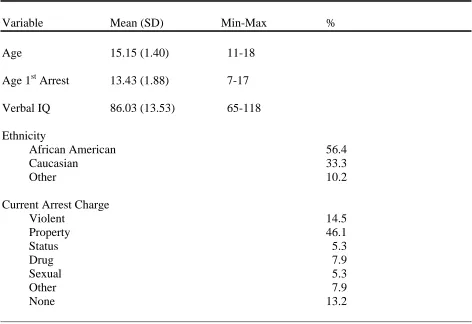
questionnaires leading to a final sample of 78 boys. The sample ranged in age from 11 to
18 (Mn = 15.15; SD = 1.40). The self-reported ethnic breakdown of the sample was
56.4% African-American and 33.3% Caucasian, which is representative of the
demographic distribution of the region served by the three programs. Based on parental
report of offense history, the majority of participants had at least one prior detention
Table 2
Sample Demographics
Variable Mean (SD) Min-Max %
Age 15.15 (1.40) 11-18
Age 1st Arrest 13.43 (1.88) 7-17
Verbal IQ 86.03 (13.53) 65-118
Ethnicity
African American 56.4
Caucasian 33.3
Other 10.2
Current Arrest Charge
Violent 14.5
Property 46.1
Status 5.3
Drug 7.9
Sexual 5.3
Other 7.9
None 13.2
Procedure
All procedures were approved by the Institutional Review Board of the University
of New Orleans. A detention center staff member contacted all parents of boys referred
to the two detention centers, who had valid phone numbers or addresses. The staff
member told the parent or legal guardian that a study was being conducted by researchers
at the local university, and asked permission to forward their phone number to the
researchers. Those parents who agreed to be contacted by the researchers were phoned
and had the study procedures explained to them. A maximum of five attempts were made
to contact parents/guardians by phone. Parents or legal guardians who agreed to have
their child participate were asked to have the consent process tape-recorded and were
subsequently mailed a copy of the consent form for their records.
Additionally, subjects were recruited by the Youth Service Bureau (YSB) of St.
Tammany Parish, an outpatient program which referred youth entering the Families In
Need of Supervision (FINS) program (for youth judged to be “out of control” by their
parents) and the Crossroads program (a diversion program for first time non-violent
offenders). Youth and their parents were referred by social workers. Parental consent
and youth assent were obtained individually at a room at the facility. The mental health
screening was required by the YSB and the social workers received a screening report
summarizing results that may aid in designing interventions for youth.
For the detained sample, once parental consent had been obtained, youth assent
procedures were conducted in a group format with two to eight youth in a private room at
the facility. The boys’ were informed that their parent/guardian provided permission for
youth were allowed to ask questions at any time. For youth who did not require parental
consent (18 years and older, n=1), youth consent procedures were conducted individually
in a private room at the facility. Confidentiality was strictly enforced by using
identification numbers rather than names on all forms, and this was explained in detail in
the consent and assent procedures.
For both samples, all data collection occurred in a private room within the facility
and was conducted by a data collection team of at least three persons. After obtaining
youth assent, a battery of questionnaires was administered to participants in small groups
(2-8 participants per group). To control for reading and comprehension differences, all
measures were read aloud to the group. While the questions were read, research
assistants were stationed in the room to ensure that a) participants understood the
questions, b) participants were answering the questions privately, c) participants were
answering the questions one at a time, and d) participants were able to ask questions. The
room was set up to maximize the separation of participants during data collection. The
assistants stood close enough to the youth to observe then, but far enough away to allow
them privacy. The battery consisted of self-report questionnaires that took approximately
one to one-and-a-half hours to complete. The participant then individually completed the
Peabody Picture Vocabulary Test (Dunn & Dunn, 1997). Following participation in the
study and collection of the measures, youth received a candy bar and beverage.
Measures
Delinquency: Age of Onset. Age of onset was estimated by determining the
earliest age at which any delinquent act or serious conduct problem was reported from
was used to assess the number and types of delinquent acts committed and earliest age
that these acts were committed from the youth self-report.
The SRD was developed from a list of all offenses reported in the Uniform Crime
Report with a juvenile base rate of greater than 1% (Elliot & Huzinga, 1984) and it lists
36 questions about illegal juvenile acts. The youth reported whether or not a specific act
had ever occurred, the number of times the act had occurred, and the age at which the act
first occurred. The general delinquency scale totals the number of delinquent acts across
all items and was used in analyses (Krueger, Schmutte, Caspi, Moffitt, Campbell, &
Silva, 1994). This scale assessed for the frequency of specific types of delinquent acts,
including drug offenses (9 items), violent offenses (8 items), property offenses (7 items),
and status offenses (4 items). The coefficient alpha in the current sample was 0.87 for the
total score.
In addition, parental report of conduct disorder symptoms listed in the DSM-IV,
first age of police contact and/or arrest, and arrest charges were assessed during the initial
phone contact with the custodial parent of all youth. The age of onset that was utilized for
data analysis was the youngest age reported based on these two sources of information,
limiting these to only severe forms of antisocial and delinquent behavior. The items
included to calculate age of onset were parental report of age of first police contact and
self report of youngest age of serious delinquent behavior including: damage/destroy
property at school/other places, stolen a motor vehicle/items over $50, bought/sold/held
stolen goods, carried a hidden weapon, attacked someone, gang fights, sold
relations with someone against their will, use force to get money from other
students/teachers/other people, and broken into a building/vehicle.
The use of both parent and child report to determine earliest age of onset was
based on past research showing that both parent report and adolescent self-report showed
similar median age of onset for antisocial behaviors and both were correlated with
external criteria (e.g. severity of impairment) (Lahey et al., 1999). Additionally,
Farrington and colleagues (1996) reported that self-report accesses behaviors that may
have not come to the attention of authorities or parents. Alternatively, parental report
may capture events that the youth may not want to report. Thus, the method used in this
study utilizes the advantages of both methods of obtaining information about the onset of
severe antisocial behaviors.
There has been little consistency in the literature concerning the operational
definition of early versus adolescent-onset. Fourteen years of age is the age used by both
Patterson and Yoerger (1993) and Tibbets and Piquero (1999) in their research to
designate adolescent onset of severe antisocial behavior. Alternatively, the DSM-IV/TR
makes the distinction between children who begin showing severe antisocial and
aggressive behaviors before age 10 (i.e., childhood-onset) and those who do not show
severe conduct problems before age 10 (i.e., adolescent-onset). Robins (1966) found that
youth age eleven years or younger were over twice as likely to be diagnosed with
Antisocial Personality Disorder as an adult compared boys who began exhibiting
antisocial behavior after the age of eleven. Therefore, there appears to be agreement that
early onset of conduct problems begins before the age of twelve. There is less agreement
considered adolescent onset in most definitions. Given this, age eleven was used as a
cut-off between early onset (n= 47) and adolescent onset (n = 31) groups for this study.
Most youth excluded from analyses based on their low verbal scores were in the
adolescent onset group (three of the four eliminated cases).
Neuropsychological/cognitive. Neuropsychological/cognitive deficits were
assessed using the Peabody Picture Vocabulary Test (PPVT-III; Dunn & Dunn, 1997).
The PPVT-III is a brief norm-referenced measure of verbal ability for those ages 2.5 to
90 years. This test assesses a child’s receptive language abilities. The standardized
scores of the third revision of the PPVT-III correlated .90 with the Full-Scale IQ scores
from the Wechsler Intelligence Scale for Children, Third Revision in a sample of 41
children ages 7 year, 11 months through 14 years, 4 months (Dunn & Dunn, 1997). The
correlation with Verbal Scale IQ was slightly higher than the correlation with
Performance Scale IQ (.91 and .82, respectively). The PPVT-III was also validated using
the Kaufman Adolescent and Adult Intelligence Test with adolescents’ aged 13 years
through 17 years, 8 months (Dunn & Dunn, 1997). The correlation with crystallized IQ
was slightly higher than with fluid IQ (.87 and .76, respectively). It was correlated .85
with the composite IQ score.
Impulsivity. Impulsivity was rated using two measures. First, the Behavioral
Assessment System for Children 2 Self-Report of Personality (BASC-2 SRP; Reynolds &
Kamphaus, 2004) is a behavior rating scale system that covers a broad range of both
adaptive and maladaptive child behavior. There are several SRP forms including, child
(SRP-C; ages 8-11) and adolescent (SRP-A; ages 12-21). Only the 176 item adolescent
nationwide sample of children and adolescents and has proven to produce reliable scores
using several indices of reliability (e.g., internal consistency and test-retest) (Reynolds &
Kamphaus, 2004). The 7-item Hyperactivity scale includes items; such as “Acts without
thinking,” “Is restless during movies” and was used as one measure of impulsivity. In the
current BASC-2 standardization sample, the Hyperactivity scale yielded a coefficient
alpha of 0.76 in adolescents aged 12-14 and 0.74 in adolescents aged 15-18 (Reynolds &
Kamphaus, 2004). Additionally, it had a two to eight week test-retest reliability of 0.69
(Reynolds & Kamphaus, 2004). The coefficient alpha in the current sample was 0.74.
The second measure of impulsivity was the Control subscale of the
Multidimensional Personality Questionnaire-Brief Form (MPQ-BF; Patrick, Curtain, &
Tellegen, 2002). This subscale uses 13 items, which are answered by selecting either
“True” or “False” to an item (e.g. “I like to stop and think things over before I do them”).
This subscale measures impulsivity in comparison to behavioral restraint. Moffitt and
colleagues (1996) used this measure and were able to distinguish boys with conduct
problems from abstainers. The Control subscale on the MPQ-BF and the full MPQ are
highly correlated (r = .93; Patrick, Curtain, & Tellegen, 2002). One item was eliminated
from this scale to achieve adequate internal consistency due to a low item-total
correlation of -0.01. This resulted in a coefficient alpha for the control scale of 0.77 in
the current sample.
Sensation Seeking. The Sensation Seeking scale on the BASC-2 SRP was used to
measure sensation seeking (Reynolds & Kamphaus, 2004). This scale measures the
youth’s desire to engage in potentially dangerous or exciting activities (e.g., “I like it
In the current BASC-2 standardization sample, the Sensation Seeking scale yielded a
coefficient alpha of 0.69 in adolescents aged 12-14 and 0.70 in adolescents aged 15-18
(Reynolds & Kamphaus, 2004). Additionally, it had a two to eight week test-retest
reliability of 0.76 (Reynolds & Kamphaus, 2004). In the current sample, the coefficient
alpha for this scale was 0.65.
Callousness. The Inventory of Callous-Unemotional Traits (ICU; Frick, 2004) is
a 24-item self-report scale designed to assess callous and unemotional traits in youth. The
ICU was derived from the CU scale of the Antisocial Process Screening Device (APSD;
Frick & Hare, 2000). The CU component of the APSD has emerged as a distinct factor in
clinic (Christian, Frick, Hill, Tyler, & Frazer, 1997), community (Frick, et al., 2003;
Frick, Bodin, & Barry, 2000), and forensic samples (Kruh, Frick, & Clements, 2005), and
has been shown to identify a more severe and aggressive subgroup of antisocial youth in
these samples. Further, antisocial youth who also show high CU scores show a number
of distinct characteristics, such as preference for novel, exciting, and dangerous activities
(Frick et al., 2003; Frick, Lilienfield, Ellis, Loney, & Silverthorn, 1999), decreased
sensitivity to cues of punishment when a reward-oriented response set is primed (Barry,
Frick, DeShazo, Grooms, McCoy, Ellis, & Loney, 2000; Fisher & Blair, 1998; Frick et
al., 2003) and less reactivity to threatening and emotionally disturbing stimuli (Blair,
1999; Loney, Frick, Clements, Ellis, & Kerlin, 2003).
However, the CU scale of the APSD has demonstrated only moderate internal
consistency in past studies (e.g., Loney et al., 2003), which is likely due to its small
number of items (n = 6) and three-point rating system. Also, 5 out of the 6 items are
developed to overcome these limitations. It was constructed based on a factor analysis of
parent and teacher ratings on the APSD, using the four items that loaded significantly on
the CU scale in both clinic-referred and community samples (Frick et al., 2000). These
four items (“is concerned about the feelings of others,” “feels bad or guilty,” “is
concerned about schoolwork,” and “does not show emotions”) were restructured into four
positively and four negatively worded items and placed on a four-point scale (0 = “not at
all true,” 1 = “somewhat true,” 3 = “very true,” and 4 = “definitely true”). One item was
deleted from the current scale due to an item-total correlation of -0.12 in the current
sample. The resulting alpha coefficient of the ICU scale was 0.81.
Parenting Practices. Parenting practices was assessed by the youth global
self-report format of the Alabama Parenting Questionnaire (APQ; Frick, 1991). The APQ
measures the five domains of parenting that have been most consistently related to
conduct problems: poor monitoring/supervision, involvement, inconsistent discipline,
corporal punishment, and positive reinforcement. The youth global self-report of the
APQ consists of 42 items that assess the frequency of different parenting practices and
uses 3 to 10 items to assess each construct. On the global report forms, items are rated on
a frequency scale of 1 to 5, (1= Never, 5= Always). Examples of items in each subscale
of the youth form include the following: “You have a friendly talk with your Mom”
(Parental Involvement subscale), “You parents praise you for behaving well” (Positive
Reinforcement subscale), “You go out without a set time to be home” (Poor
monitoring/Supervision subscale), “The punishment your parents give depends on their
mood” (Inconsistent Discipline subscale), and “Your parents spank you with their hand
responses of the items in a particular domain composes each subscale score on the global
formats. The APQ was chosen to measure parenting techniques because it assesses the
five domains of parenting that have been most consistently linked to conduct problems
(Frick, 1991). The global child self-report scales of the APQ demonstrated adequate
reliability and only minimal correlation with social desirability in a clinic-referred sample
(Shelton, Frick, & Wootton, 1996). Also, in a clinic-referred sample of adolescents, the
subscales of the APQ were associated with severe conduct problems (Frick, Christian, &
Wootton, 1999).
A composite score was formed from the APQ that involved converting all 5
subscales to z-scores and inverting the two positive parenting dimensions by multiplying
the standard scores by –1. Then, all five scales were summed to form a dysfunctional
parenting composite. In the current sample, the coefficient alpha for the involvement
with mothers scale was 0.87 (n=73) and for the positive parenting scale was 0.77. In the
current sample, the alpha coefficient for the poor monitoring/supervision scale was 0.79
(n=77). Furthermore, the coefficient alpha for the inconsistent discipline scale was 0.58
and for the corporal punishment scale was 0.72.
Deviant Peers. The Peer Delinquency Scale (PDS; Keenan, Loeber, Zhang,
Stouthamer-Loeber, & Van Kammen, 1995) was used to assess deviant peer association.
The PDS was developed for use in the Pittsburgh Youth Study to assess the level of
deviant peer group affiliation in a high-risk community sample of approximately the
same age as the current sample (see Loeber, Farrington, Stouthamer-Loeber, Moffitt, &
Caspi, 1998). On the PDS, participants report on their friends’ engagement in a wide
engaged in a number of deviant behaviors (e.g. shoplifting, skipping school, selling
drugs) in the last 6 months on a 5-point rating scale, ranging from “none” (0) to “all” (4).
Consistent with past research assessing delinquent peer affiliation, any rating above none
was considered as indicating some level of delinquent peer association, and the number
of behaviors in which there is some level of peer involvement was summed (Henry,
Tolan, & Gorman-Smith, 2001; Lahey, Gordon, Loeber, Stouthamer-Loeber, &
Farrington, 1999; Simons, Whitbeck, Conger, & Conger, 2001). Past research has
concluded that the PDS has high internal consistency and has been related to the youth’s
level of delinquency (Loeber et al., 1998). In the current sample, the coefficient alpha for
the PDS was 0.91.
Rebelliousness. Rebelliousness was measured in the current study using two
different measures that were selected to a) measure multiple aspects of rebelliousness and
b) do so in a way that was not confounded with delinquent behavior. The first measure is
the Parent Intrusiveness Scale (PIS; Gender and Achievement Research Program, 2004).
It measures adolescents’ perceptions that their parents allow them too little autonomy.
This scale includes six items based on items from the Philadelphia Family Management
Study (Gender and Achievement Research Program, 2004). Examples of items on the
scale include, “Your parent treats you more like a kid than like an adult” and “Your
parent always tells you what to do and how to act.” In the current sample, the coefficient
alpha for the PIS was 0.76.
The second measure is the Traditionalism subscale of the Multidimensional
Personality Questionnaire-Brief Form (MPQ-BF; Patrick, Curtain, & Tellegen, 2002).