Please cite this article as: S. Khalili, Y. ZareMehrjerdi, M. S. Fallahnezhad, H.Mohammadzade, Hotel Location Problem Using Erlang Queuing Model under Uncertainty, International Journal of Engineering (IJE), TRANSACTIONS C: Aspects Vol. 27, No. 12, (December 2014) 1879-1887
International Journal of Engineering
J o u r n a l H o m e p a g e : w w w . i j e . i r
Hotel Location Problem Using Erlang Queuing Model under Uncertainty
S. Khalili, Y. ZareMehrjerdi, M.S. Fallahnezhad*, H. Mohammadzade
Industrial Engineering Department, University of Yazd, Yazd, Iran
P A P E R I N F O
Paper history:
Received 17 February 2014 Received in revised form 21 June 2014 Accepted 14 August 2014
Keywords: Hotel Location Queuing Theory Fuzzy Queuing Models Hotel Profit Function Fuzzy Ranking Technique
A B S T R A C T
Selecting an appropriate location to construct a hotel is one of the most challenging concerns which hotel industry investors are facing with. In this study, we attempt to find a suitable response to this research/application need by a mathematical model using the queuing theory and fuzzy logic. Therefore, the hotel, the reception system and travelers accommodations are formulated by appropriate queuing models. Considering the fact that the arrival rate for hotel and the amount of time spent in hotel is not certain, thus a profit function is defined using fuzzy logic and fuzzy queuing models. Using the values of this function, candidate locations for constructing a hotel are compared, and the one with maximum profit for the investors is selected. Due to using fuzzy parameters in the profit function, the amounts of profit obtained for different locations are in the form of fuzzy numbers; thus, we use fuzzy ranking techniques to prioritize the candidate locations for constructing the hotel. A number of numerical examples are proposed to elaborate the application of proposed methodology. Finally, sensitivity analysis has been applied on model parameters. Our results indicate that unlike previous studies where hotel locations have only qualitative parameters, the proposed model is able to compare the candidate sites in terms of quantitative and financial aspects.
doi: 10.5829/idosi.ije.2014.27.12c.11
1. INTRODUCTION1
Currently, tourism industry is one of the three most important and lucrative industries after the oil and auto industry, and it is predicted that it will be earning the first rank in profitability in less than two decades.
Hotels are one of the main elements of the tourism industry, and thus development and improvement of the hotel industry can play a significant role in its growth and development. Based on the Neo Classical Economic Theory, when determining the location of Hotels, decision makers select locations which minimize the cost of building and construction, and in which the income is maximized [1]. Selecting a construction site for hotels is a strategic decision and it must be done by experts of such industry [2]. In fact, selecting a location to build a hotel significantly affects strategic competitiveness regarding the hotel operation and
1*Corresponding Author’s Email: [email protected](M.S.
Fallahnezhad)
flexibility to compete in the market and also increasing customer satisfaction [3].
In some aspects, locating hotels is different from locating other facilities. The goal of locating facilities in a supply chain such as warehouses, distribution centers, production sites, and locating public facilities such as hospitals, fire departments and police stations is to minimize the total distances or to minimize the maximum distances. These problems have been widely studied in the literature [4-8]. However, in a hotel location problem, the goal is to maximize both the hotel owners' profit and customer’s satisfaction. Therefore, it is possible that a good location provide benefits considering the tourist attractions and it can lead to more profits for the hotel owners, and hence more satisfaction for the customers.
Although the subject of hotel location has attracted much attention in the past, evidence points that research about this issue has remained at a low level [9-11]. Theories from different majors have been introduced which investigate the hotel location selection from various points of views, e.g. geographical [9, 12],
economical [13] and marketing theories [14, 15]. It should be stated that researchers mostly study theoretical aspects of this subject rather than answering empirical questions [10].
The rest of this study is as follows: in section 2, hotel location literature and fuzzy queuing models are investigated. In the third section, queuing model and the proposed algorithm are presented to resolve the hotel location issue. In the fourth section, a ranking technique is discussed. The fifth section presents a numerical example to clarify the subject. Finally, the sixth section is dedicated to conclusions and suggestions for future work.
2. LITERATURE REVIEW
The literature is divided into two main fields. First, the use of fuzzy concepts in queuing models and second, the studies related to the hotel location. There have been many efforts in fuzzy queuing field in recent years. Number of investigators [16-19] have been the pioneers to study the fuzzy queuing systems. Kao et al. [20] have used parametric planning method using α-cut approach to analyze the fuzzy queuing system. Buckleyet al. [21] has illustrated some samples which have considered the time between the two consecutive arrivals and the servicing time based on the probability theory in the fuzzy theory and have used it to determine the optimized number of the servers. Chen [22] has presented a model using the fuzzy membership function and considered the fuzzy arrival rate and fuzzy cost regarding the fuzzy parametric planning method. Chen [23] has designed a non-linear numerical mixed integer planning with the binary variables using the probability theory for the group arrival model with different numbers in each group in which boththe arrival time and the service time are fuzzy numbers. Rithaet al. [24] have studied N policy for queues with infinite capacity under uncertain arrival and service information. Fuzzy set theory has been applied to estimate the uncertainty associated with the input parameters, and triangular membership function has been used to analyze the model. Barak and Fallahnezhad [25] have studied two models of planning queuing systems and its effect on the cost of each system by using two fuzzy queuing models of M/M/1 and M/E2/1. They assumed that the rate of arrivals and the servicing rate were fuzzy data and also the system costs were fuzzy numbers. They compared two practical systems to study the different conditions of the operator's allocation in the queuing systems in real environment.
There are few works on the use of fuzzy or queuing theory in hotel location . Also, in most recent research regarding hotel location, researchers mostly express and present factors and effective measures of hotel location instead of helping decision makers to choose the
its location. Tsaur and Tzeng [32] showed by evidence that hotel`s location components, e.g. transportation facilities and parking access, are the most effective factors in evaluating the quality of hotel services Arbel and Pizam [33] have emphasized that one of the most effective factors in selecting a hotel by travelers is the short distance from the hotel to tourism attractions. Recently, Yang et al. [34] have provided a comprehensive discussion of research related to hotel location. They have categorized all the information in three main groups of theoretical, empirical and operational models. Each of these main groups were then divided into subgroups and the features of each were discussed. In a categorization, theoretical models consist of 4 groups: (1) Tourist-historic city model (THC model), (2) Mono-centric model, (3) Agglomeration model, and (4) Multi-dimensional model. Also the Empirical models are categorized in 6 subgroups: (1) Spatial statistical model, (2) Zoning regression mode, (3) Discrete choice model, (4) Simultaneous equation model, (5) Individual evaluation model, and (6) Hotel success model. Operational models consist of the 3 following subgroups: (1) Checklist method, (2) Statistical prediction and (3) Geographic Information System (GIS).
As mentioned above, in most studies related to hotel locations, no mathematical model has been presented. Thus, this study presents a model to determine the optimal location for a hotel using queuing theory and fuzzy theory models in order to fill the aforementioned research gap. First, hotel, reception system and guest accommodations are modeled by the principle of the queuing theory. After that, the Profit function of the hotel for all candidate locations is computed. Of course, some of the parameters of the Profit function are obtained from the fuzzy queuing models. Thus, its values are determined through fuzzy mathematics. Fuzzy values of the Profit function obtained for candidate locations are then prioritized and the location with the maximum value is considered as the optimal location for the hotel. Finally, a numerical example is provided for clarifying the proposed method.
3. THE PROPOSED MODEL
One of the important factors for tourists in choosing the hotel and their accommodations is the closeness of the hotel to tourism attractions of that region. Tourism attractions may include historical structures and monuments, religious locations, environmental attractions, entertainment locations and even occupational attractions. For instance, constructing a large factory with a large number of personnel can be considered as an occupational attraction of a region. Therefore, hotels are usually constructed close to tourism attractions. In the proposed model, this issue
has been taken into account so that the rate of the customer arrivals in the similar hotels in different locations is determined by using their distance from tourism attractions and increasing the distance of the hotel from tourism centers, decreases the reception rate and arrival rate of the hotels. In the following, since the proposed model is based on queuing model concepts, it is necessary to adapt the hotel, reception system and guest accommodations with a queuing system.
In this adaptation:
· Hotel guests are as customers in this queuing system with arrival rate of for hotel i. · Hotel rooms are as servers in this queuing
system and thus the number of the hotel room are the same as the servers of the queue system.
· The average duration of staying time in hotel i equals the inverse of the expected service time of the queuing system and is indicated by . · The average number of occupied rooms in
hotel i equals the expected number of customers in the queuing model which is represented by .
3. 1. Fundamental Premises and Model Symbols
· Hotel rooms are exactly the same. Regardless of the number of family or group members, they are accounted as one customer.
· The time between the customer arrivals and the amount of time spent in the hotel follows an exponential distribution.
· The rate of the customer arrivals to hotel i ( )
has inverse relation with the distance of hotel i from tourism attraction ( ), i.e. :
If:d1<d2< <... dn
Then:l l1> 2> >... ln
· Candidate hotels in different locations are similar in quality of service and differ only in the distance to a tourism attraction.
· Only one site is considered as a tourism attraction in this model.
· Investors are constrained in capital for constructing a hotel and at most units of money can be invested by them.
If:d1<d2< <... dn Then:C1>C2> >... Cn If:d1<d2< <... dn
Then:
1 2 ... n
P >P > >P
· In case that all hotel rooms are occupied, reserving a room for new guests is not possible
(the feature of Erlang queuing model.
(M M m m/ / / ) [30]).
· Since the capacity of the hotel is limited, we will eventually lose customers; therefore, a cost is incurred for each lost customer. This cost includes the net profit obtained from each customer for one night of hotel along with the cost of customer dissatisfaction.
3. 2. The Proposed Queuing Model Symbols
i
K : The capacity of queuing systems which is the number of the rooms in hotel i.
max
B : Maximum budget to construct a hotel.
i
d : The distance from hotel i to the tourism center. n: Number of customers in the hotel (number of the occupied rooms)
n
p :The probability of n customers staying in the hotel in a long period (the percentage of time in which the hotel has n occupied rooms).
i
l : The rate of customer arrivals to hotel i.
i
m :The service rate of customers in hotel i.
i
C : The price of building one room in hotel i.
i
P: The net profit of staying in each room of hotel i for
one night.
i
L: Average of the number of occupied rooms in hotel i.
i
AI : The expected annual income of hotel i.
i
EP : Expected profit of hotel construction at candidate location i.
i
CT: The total cost of losing customer annually for hotel i.
CD: The customer dissatisfaction cost.
i
CL: The cost of losing each customer per one night in hotel i due to full capacity.
In order to compare the candidate locations and selecting the best one for constructing the hotel, first regarding the constraint of the initial budget, maximum number of the rooms in hotel i which can be built is calculated by Equation (1):
max
i i
B K
C
= (1)
According to the above equation, as the hotel location becomes closer to the tourism center, building
additional rooms in the hotel become more expensive, and thus less room can be built in that hotel compared to farther hotels. In other words:
If :d1<d2< <... dn
Then :C C1> 2> >... Cn
And therefore:
max max max
1 2
1 2
... n
n
B B B
K K K
C C C
= < = < < =
After specifying the maximum number of rooms in each candidate location, average number of occupied rooms of each hotel is obtained. In order to calculate the average number of occupied rooms in each hotel, the queuing model is used to simulate the hotel system. According to the features of the hotel, the reception system and the considered assumption in the proposed model, the Erlang queuing model (M/M/m/m) is the best model for the hotel system. Since, the number of rooms are considered as the servers of the simulated queuing model of the hotel system, the queuing system used for hotel i is the Erlang model (M/M/k/k ). In the following, we use the calculations related to (M/M/k/k) model Gelenbe et al. [35] to obtain the average number of occupied rooms in ith hotel which is equal to the average number of customers in the hotel i ( ) as follows,
0
i
K i ni
n
L np
=
=
å
(2)0
!
n
n n
l p m p
æ ö ç ÷ è ø
= for n = 0, 1, 2, … , k. (3)
Since the sum of the steady-state probabilities must be equal to one:
0
1
i
K
m m
p
= =
å
(4)Therefore:
1
0 0
1 !
i m
K
m m
l p
m
-=
æ æ ö ö
= çç ç ÷ ÷÷ è ø
è
å
ø (5)and,π obtained by Equation 6:
1
0
1 1
! !
i
n K m
n
m
n m
l l
p
m m
-=
æ ö
æ ö æ ö
=ç ÷ çç ç ÷ ÷÷
è ø è
å
è ø ø (6)In the proposed model, values of some parameters ( ) are considered as triangular fuzzy numbers, thus according to fuzzy mathematics [36] and Zadeh's extension principle [37], values of and are calculated as fuzzy numbers, according to Equations (7-11).
( ,L M, R)
1 0 1 1 ( ) ( , , ) ! ! i
L M R
m K n
n n n n
m
n m
l l
p p p p
m m
-=
æ æ ö ö
ç ÷
= ç ÷ =
ç è ø ÷
è
å
ø% %
% % % (7)
1 0 1 1 ( ) ! ! i L m K n R R n m
L n L m
l l
p
m m
-=
æ æ ö ö
ç ÷
= ç ç ÷ ÷
è ø
è
å
ø (8)1 0 1 1 ( ) ! ! i M m K n M M n m
M n M m
l l
p
m m
-=
æ æ ö ö
ç ÷
= ç ÷
ç è ø ÷
è
å
ø(9) 1 0 1 1 ( ) ! ! i R m K n L L n m
R n R m
l l
p
m m
-=
æ æ ö ö
ç ÷
= ç ç ÷ ÷
è ø
è
å
ø(10)
0 0 0 0
(L ,L ,L ) ( , , )
i i i i
L M R
K K K K
n L M R n n n
n n n n
L np np np np
= = = =
=
å
= =å
å
å
% % % % % (11)
After specifying the average number of occupied rooms in hotel i, the expected annual income is easily calculated by the Equations (12-15). (the number of working days in a year is considered 365 days).
( L, M, R) 365 L
i i i i i i
AI% = AI AI% % AI% = ´ ´% P (12)
365
L L
i i i
AI% = ´L% ´P (13)
365
M M
i i i
AI% = ´L% ´P (14)
365
R R
i i i
AI% = ´L% ´P (15)
As mentioned before, due to the limited capacity of hotel, if the general arrival rate of customers to the hotel
i is λ. i then customers arrival rate to hotel i will be
(1 i)
i K
l -p .Therefore, the expected number of lost customers in each year will be (365 )
i
i K
l p
´ ´ .Also,
each customer will spend on average, 1
i
m% days in hotel i; thus, the total cost of losing each customer annually for hotel i will be calculated from Equation (16):
365 i Ki i
i
i CL
CT l p
m
´ ´ ´
= % % %
%
% (16)
In Equation (16), is the cost of losing each customer for hotel i due to full capacity and is obtained from the following equation:
i i i
CL% = +P CD% (17)
Since customer dissatisfaction cost due to the full capacity of the hotel is an approximated and qualitative parameter, we cannot allocate a crisp value to this cost.
Therefore, this parameter ( ) in Equation (17) is assumed to be fuzzy.
Finally, according to Equations (12) and (17), expected profit of constructing hotel at candidate location i is obtained from Equation (18).
i i i
EP% =AI% -CT% (18)
To evaluate Equation (18), we have used MATLAB software, and then the numerical examples mentioned in Section 5 are solved using the computer programming. Now, after calculating the expected profit of building the hotels in each candidate locations, the location with the most profit for investors is selected as the optimal to construct a hotel. According to Equation (18), the annual profit values for candidate locations are fuzzy. Thus, in order to rank the candidates and choose the optimal location for the hotel, fuzzy ranking techniques must be used.
4. RANKING FUZZY NUMBERS
Ranking of fuzzy numbers is based upon one or several different feature of fuzzy numbers. This feature may be the Center of Gravity, the area under the membership function, or the points of intersection between the sets. A ranking method considers the distinctive features of fuzzy numbers and ranks based upon them. Therefore, it is reasonable that for the same group of fuzzy numbers, different methods of ranking fuzzy numbers yield different rankings.
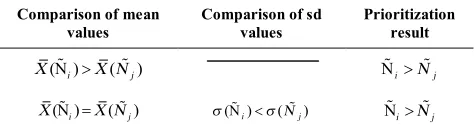
Variety of methods has been proposed for prioritizing fuzzy numbers [38-43]. We have employed the Lee and Li [44] method of prioritizing fuzzy numbers in this article. In this method, fuzzy numbers are compared using two criteria: (1) fuzzy number mean, and (2) fuzzy number dispersion. They have calculated the dispersion using the concept of standard deviation (sd). It is assumed that a fuzzy number with greater mean and less standard deviation has higher priority for the decision maker. Mean and standard deviation of fuzzy number is obtained from Equations (19) and (20).
2 N (N) 2 N (N) ( ( )) (N) ( ( )) s s
x x dx
X x dx m m =
ò
ò
% % % % (19) 2 12 2 2
(N)
2
(N)
( ( ))
(N) ( (N))
( ( )) M s
M s
x x dx
X x dx m d m é ù ê ú
=ê - ú
ê ú ë û
ò
ò
% % % %TABLE 1. Information related to different locations
100 (10,15,20)
(1.5,2,3) (118,120,125)
7000 50
Hotel 1
95 (10,15,20)
(1.5,2,3) (109,112,118)
6000 70
Hotel 2
92 (10,15,20)
(1.5,2,3) (103,109,112)
5000 95
Hotel 3
90 (10,15,20)
(1.5,2,3) (100,102,105)
4000 110
Hotel 4
88 (10,15,20)
(1.5,2,3) (95,100,105)
3000 140
Hotel 5
85 (10,15,20)
(1.5,2,3) (90,96,99)
2500 150
Hotel 6
82 (10,15,20)
(1.5,2,3) (90,94,100)
2200 165
Hotel 7
80 (10,15,20)
(1.5,2,3) (83,91,98)
2000 180
Hotel 8
TABLE 2. Ranking fuzzy numbers
Comparison of mean values
Comparison of sd values
Prioritization result
(N )i ( j)
X % >X N% N%i>N%j
(N )i ( j)
X % =X N% s(N )%i <s(N%j) N%i>N%j
Equations (19) and (20) would be converted to (21) and (22), if is a triangular fuzzy number as
(L,M,R) N%= .
1
(N) (L 2 M R) 4
X % = + + (21)
2 2 2
1
(N) (3 4 3 2 4 4 )
80 L M R RL LM MR
d % = + + - - - (22)
After calculating mean and standard deviation of fuzzy numbers and , prioritizing is done by the rules stated in Table 1.
The ranking method is implemented in MATLAB program and the numerical examples are also solved via MATLAB computer programmingof this method.
5. NUMERICAL RESULTS
5. 1. Example 1 one investor decides to build a hotel near the Shrine of Imam Reza (AS) in Mashhad, Iran. After investigating, 8 locations with different distances to the shrine are selected as candidates. The initial existing capital is 200000 units of money and different locations’ information is denoted in Table 2. Which candidate is the optimal location for a hotel?
5. 1. 1. Solution First, according to the capital constraint and using Equation (1), the number of possible rooms in each candidate location is calculated:
1
200000 28 7000
K = » 5
200000 66 3000
K = »
2
200000 33 6000
K = » 6
200000 80 2500
K = =
3
200000 40 5000
K = = 7
200000 90 2200
K = »
4
200000 50 4000
K = = 8
200000 100 2000
K = =
Then, according to Equations (7-11), the average numbers of occupied rooms are calculated for each candidate location:
(
)
1 26.2, 27.2, 27.5
L = L5=(31.6, 49.7, 61.1)
(
)
2 29.7, 31.7, 32.3
L = L6=
(
30, 47.9, 65.2)
(
)
3 32.7, 37.9, 38.9
L = L7=
(
30, 47, 66.5)
( )
4 33.2, 45, 48
L = L8=(27.6, 45.5, 65.3)
Now, using Equations (12-15), the annual income is calculated for each candidate.
( )
1 956300, 992800, 1003750
AI% = AI%5=(1014992, 1596364, 1962532)
( )
2 1029847, 1099197, 1120002
AI% = AI%6=(930750, 1486097, 2022830)
( )
3 1098066, 1272682, 1306262
AI% = AI%7=(897900,1 406710,1 99 403 5)
( )
4 1090620, 1478250, 1576800
AI% = AI%8=(805920,1 328600,1 90 667 0) Then using Equation (16), the total cost of losing customer annually is calculated for candidate locations.
(524000, 836000, 1210000) 1
CT% = CT%5»(0, 0, 0)
(251000, 406000, 59 )
2 7000
CT% = CT%6»(0, 0, 0)
(60400,1 00000,1 4 )
3 4000
CT% = CT%7»(0, 0, 0)
(1860, 2990, 4300) 4
Finally, according to Equation (18), expected profit of hotel construction at candidate locations is obtained.
( 253700, 156800, 4 )
1 79750
EP% = - EP%5=(1014992,1 596364,1 96 325 2)
(432847, 693197, 86 )
2 9002
EP% = EP%6=(930750,1 486097, 2022 308 )
(954066,1 172682,1 24 6 )
3 58 2
EP% = EP%7=(897900,1 406710,1 99 403 5) (1086320,1 475260,1 57 4)
4 49 0
EP% = EP%8=(805920,1 328600,1 90 667 0) Now, we are prioritizing candidate locations based on Lee and Li [39]method as follows:
First criterion: mean
1 134912
EP
X% = XEP%5=1542563
2 672060
EP
X% =
6 1481443
EP X% =
3 1136323
EP
X % = XEP%7=1223389
4 1402945
EP
X % =
8 913449
EP
X% =
In this particular example, considering the fuzzy number mean criteria for any of the eight candidate Locations, the same number is not achieved. Thus, using the first criterion, we are able to prioritize different Locations and we do not need to calculate the second criterion. According to the results of the first criterion, the best Location is Location 5. The remaining priorities are as follows:
5 6 4 7 3 8 2 1
EP% >EP% >EP% >EP% >EP% >EP% >EP% >EP%
5. 2. Numerical Example 2 Considering the numerical example, if passengers arrival rate to Mashhad reduces, and as a result of that the arrival rates to these locations reduces to half and the remaining parameters remain the same, then what would be the final ranking for the candidate hotels?
5. 2. 1. Solution With a 50% decrease in
l
%
i values in MATLAB program, the profit from building hotels in candidate locations will change. The average profit obtained by the fuzzy model of Lee and Li [39] is as shown below:1 86687
EP
X% = XEP%5=81103
2 86687
EP
X% = XEP%6=74460
3 88147
EP
X% = XEP%7=70335
4 83767
EP
X % =
8 43800
EP X% =
Using the first criterion in Lee and Li [44] method, ranking of candidate locations is obtained as below:
3 1 2 4 5 6 7 8
EP% >EP% =EP% >EP% >EP% >EP% >EP% >EP%
In this example, average profit for location 1 and 2 are equal. So, according to Lee and Li [44] method,the locations with less profit deviation, comes higher in ranking.
1
dæçEP ö =÷ 20483.34
è ø
% ,
2 37031
EP
dæç ö =÷
è ø
%
2 1
EP EP
dæç ö÷>dæç ö÷
è ø è ø
% %
Therefore, the final ranking of 8 candidate locations is as follows:
5. 3. Example 3 If passengers arrival rate to each of these hotels becomes 1/3 of its previous values, then what is the final ranking of candidate location?
5. 3. 1. Solution After obtaining the results from MATLAB program, the ranking is as follows:
1 2 3 4 5 6 7 8
EP EP% > % >EP% >EP% >EP% >EP% >EP% >EP%
This result was expected. In fact, if the overall arrival rate to a touristic city is low, then the construction of hotels with high capacity far from the tourism center is illogical. This would only lead to additional vacant rooms. Also, compared to the hotels closer to tourism center, these hotels would receive a lower room price for the occupied rooms. Therefore, constructing a high capacity hotel far from the tourism center is suitable when the overall arrival rate of customers to the city is high.
As it was observed, by changing the values of passengers arrival rates to the hotels, the ranking of candidate locations changes too. Therefore, it is necessary to perform a comprehensive sensitivity analysis for input parameters. By doing this, we could make more accurate estimates of more sensitive parameters.
5. 4. Sensitivity Analysis of Parameters Among the four parameters used in this model, namely: , , , , parameter was defined at the time of choosinghotellocation. Therefore, there is no need to perform sensitivity analysis on parameter ( ). Considering , it could be realized from numerical examples 2 and 3, that a change in strongly alters the final ranking.
Also, considering a reverse relationship between and in all of the equation of the proposed model, it is realized that there is no need to have a separate sensitivity analysis on , and we can also use the results of sensitivity analysis for .Since and are sensitive parameters of the model, we should take more care at the time of estimating these two parameters.
Also, parameter accepts values between (-50-%and +50%). Decremented alterations have been
3 2 1 4 5 6 7 8
performed, and by running the MATLAB program final ranking were monitored.
The results show that altering does not significantly change the final ranking. So, this parameter is not a very sensitive one, and we can estimate it with less accuracy compared to other parameters.
6. CONCLUSIONS AND SUGGESTIONS FOR FUTURE WORK
In this study, a model is presented for determining hotel location to maximize the profit. In this model, first different locations are selected as candidates for constructing a hotel. After that, each of these candidates are modeled using theoretical queuing models and concepts. A profit function is defined including the income and cost of hotel construction in each of these locations. Considering that some of the inputs of the problem are fuzzy, the values of the Profit function for different locations are fuzzy numbers. Thus, in order to select the best location, a fuzzy number ranking method is used. In this study, by incorporating triangular fuzzy numbers, we have presented a suitable model for encountering with real world uncertainties. Analyzing this data has shown that the results of the proposed method provide the decision makers more flexibility. The results of the classic calculations are only valid for certain data, and with any changes in the data, they lose their credibility. However, the results of fuzzy computation are obtained using the data in which uncertainty has been considered. Thus, these results even in the case of a change in the initial data in a given range (fuzzy number range) can be still valid. Using many tourism centers instead of one and taking into account the weighted summation of the distance of the hotel from any tourism center is proposed for future studies. In this model, all hotel rooms are considered the same, but considering rooms with different capacities for more adaptation to real world situations is suggested for future studies. Moreover, it is possible that the guests’ arrivals or the amount of time they spent follows a general function and in that case using one of the queuing models or general functions like G/G/m, G/G/m/m or other general models is proposed.
7. REFERENCES
1. Hayter, R., The dynamics of industrial location: the factory, the firm, and the production system:Wiley, (1997), 61-89.
2. Hanson, G. H., “Scale economies and the geographic concentration of industry,” Journal of Economic Geography,Vol. 1, No. 3,(2001), 255-276.
3. Mount, S. K., “‘Strategic Facilities Planning as a Component of the Business Plan,” Industrial Development,Vol. 159, No. 1, (1990), 879-882.
4. Daskin, M. S., Network and discrete location: models, algorithms, and applications:John Wiley & Sons,(2011), 27-53. 5. ReVelle, C. S., and Eiselt, H. A., “Location analysis: A
synthesis and survey,” European Journal of Operational Research,Vol. 165, No. 1, (2005), 1-19.
6. Drezner, Z., and Hamacher, H. W., Facility location: applications and theory: Springer,(2004), 105-130.
7. Suzuki, A., and Drezner, Z., “The p-center location problem in an area,”Location Science,Vol. 4, No. 1–2, (1996), 69-82. 8. Karimi, M., Eydi, A. R., and Korani, E., “Modeling of the
Capacitated Single Allocation Hub Location Problem with a Hierarchical Approch,” International Journal of Engineering,Vol. 27, No. 4, (2014), 573-586.
9. Egan, D. J., and Nield, K., “Towards a theory of intraurban hotel location,”Urban Studies,Vol. 37, No. 3, (2000), 611-621. 10. Karakaya, F., and Canel, C., “Underlying dimensions of
business location decisions,”Industrial Management & Data Systems,(1998), Vol. 98, No. 7, 321-329.
11. Hamilton, J. M., “Coastal landscape and the hedonic price of accommodation,”Ecological Economics,Vol. 62, No. 3,(2007), 594-602.
12. Shoval, N., “The geography of hotels in cities: An empirical validation of a forgotten model,”Tourism Geographies,Vol. 8, No. 1, (2006), 56-75.
13. Kalnins, A., and Chung, W., “Resource‐seeking agglomeration: a study of market entry in the lodging industry,” Strategic Management Journal,Vol. 25, No. 7, (2004), 689-699,. 14. Baum, J. A., and Haveman, H. A., “Love thy neighbor?
Differentiation and agglomeration in the Manhattan hotel industry, 1898-1990,” Administrative Science Quarterly,Vol. 42, No. 2, (1997), 304-338.
15. Urtasun, A., and Gutierrez, I., “Hotel location in tourism cities: Madrid 1936–1998,”Annals of Tourism Research,Vol. 33, No. 2, (2006), 382-402.
16. Buckley, J., “Elementary queuing theory based on possibility theory,”Fuzzy Sets and Systems,Vol. 37, No. 1, (1990), 43-52. 17. Li, R.-J., and Lee, E., “Analysis of fuzzy queues,”Computers &
Mathematics with Applications,Vol. 17, No. 7, (1989), 1143-1147.
18. Negi, D., and Lee, E., “Analysis and simulation of fuzzy queues,”Fuzzy Sets and Systems,Vol. 46, No. 3, (1992), 321-330.
19. Prade, H. M., "An outline of fuzzy or possibilistic models for queuing systems," Fuzzy Sets,Springer.(1980), 147-153 20. Kao, C., Li, C.-C., and Chen, S.-P., “Parametric programming to
the analysis of fuzzy queues,”Fuzzy Sets and Systems,Vol. 107, No. 1, (1999), 93-100.
21. Buckley, J. J., Feuring, T., and Hayashi, Y., “Fuzzy queuing theory revisited,” International Journal of Uncertainty, Fuzziness and Knowledge-Based Systems,Vol. 9, No. 05, (2001), 527-537.
22. Chen, S.-P., “Parametric nonlinear programming approach to fuzzy queues with bulk service,” European Journal of Operational Research,Vol. 163, No. 2,(2005), 434-444. 23. Chen, S.-P., “A bulk arrival queuing model with fuzzy
parameters and varying batch sizes,” Applied Mathematical Modelling,Vol. 30, No. 9, (2006), 920-929.
24. Ritha, W., and Menon, B. S., “Fuzzy N Policy Queues with Infinite Capacity,” Journal of Physical Sciences,Vol. 15, (2011), 73-82.
25. Barak, S., and Fallahnezhad, M., “Cost Analysis of Fuzzy Queuing Systems,” International Journal of Applied Operational Research,Vol. 2, No. 2, (2012), 25-36.
26. Chou, T.-Y., Hsu, C.-L., and Chen, M.-C., “A fuzzy multi-criteria decision model for international tourist hotels location selection,” International Journal of Hospitality Management,Vol. 27, No. 2, (2008), 293-301.
27. Begin, S., “The geography of a tourist business: Hotel distribution and urban development in Xiamen, China,”
28. Nicolau, J. L., “Assessing new hotel openings through an event study,”Tourism Management,Vol. 23, No. 1, (2002), 47-54. 29. Adam, I., and Amuquandoh, F. E., “Dimensions of hotel
location in the Kumasi Metropolis, Ghana,” Tourism Management Perspectives,Vol. 8, (2013), 1-8.
30. Shoval, N., McKercher, B., Ng, E., and Birenboim, A., “Hotel location and tourist activity in cities,” Annals of Tourism Research,Vol. 38, No. 4, (2011), 1594-1612.
31. Gray, W. S., and Liguori, S. C., Hotel and motel management and operations,New Jersey: Regents/Prentice Hall,(1994), 142-167.
32. Tsaur, S.-H., and Tzeng, G.-H., “Multiattribute decision making analysis for customer preference of tourist hotels,”Journal of Travel & Tourism Marketing,Vol. 4, No. 4, (1996), 55-69. 33. Arbel, A., and Pizam, A., “Some determinants of urban hotel
location: the tourists' inclinations,”Journal of Travel Research,Vol. 15, No. 3, (1977), 18-22.
34. Yang, Y., Luo, H., and Law, R., “Theoretical, empirical, and operational models in hotel location research,” International Journal of Hospitality Management,Vol. 36, (2014), 209-220. 35. Gelenbe, E., Pujolle, G., and Nelson, J., Introduction to Queuing
Networks, 2th ed.,Wiley,(1987), 76-98.
36. Buckley, J. J., Fuzzy probabilities and fuzzy sets for web planning,: Springer Verlag, (2004), 9-10
37. Zadeh, L. A., “Fuzzy sets as a basis for a theory of possibility,”
Fuzzy Sets and Systems,Vol. 1, No. 1, (1978), 3-28.
38. Asady, B., “The revised method of ranking LR fuzzy number based on deviation degree,” Expert Systems with Applications,Vol. 37, No. 7, (2010), 5056-5060.
39. Asady, B., and Zendehnam, A., “Ranking fuzzy numbers by distance minimization,”Applied Mathematical Modelling,Vol. 31, No. 11, (2007), 2589-2598
40. Chu, T.-C., and Tsao, C.-T., “Ranking fuzzy numbers with an area between the centroid point and original point,”Computers & Mathematics with Applications,Vol. 43, No. 1, (2002) 111-117.
41. Nejad, A. M., and Mashinchi, M., “Ranking fuzzy numbers based on the areas on the left and the right sides of fuzzy number,” Computers & Mathematics with Applications,Vol. 61, No. 2, (2011), 431-442.
42. Wang, Y.-J., and Lee, H.-S., “The revised method of ranking fuzzy numbers with an area between the centroid and original points,”Computers & Mathematics with Applications,Vol. 55, No. 9, (2008), 2033-2042.
43. Yu, V. F., Chi, H. T. X., and Shen, C.-w., “Ranking fuzzy numbers based on epsilon-deviation degree,” Applied Soft Computing, (2013).
44. Lee, E. S., and Li, R. J., “Comparison of fuzzy numbers based on the probability measure of fuzzy events,” Computers & Mathematics with Applications,Vol. 15, No. 10, (1988), 887-896.
Hotel Location Problem Using Erlang Queuing Model under
Uncertainty
RESEARCH NOTE
S. Khalili, Y. ZareMehrjerdi, M. S. Fallahnezhad, H. Mohammadzade
Industrial Engineering Department, University of Yazd, Yazd, Iran
P A P E R I N F O
Paper history:
Received 17 February 2014 Received in revised form 21 June 2014 Accepted 14August 2014
Keywords: Hotel Location Queuing Theory Fuzzy Queuing Models Hotel Profit Function Fuzzy Ranking Technique
هﺪﯿﮑﭼ ﻌﺗ ﯿﯿ ﻦ ﻧﺎﮑﻣبﺎﺨﺘﻧاو ﯽ
اﺮﺑﺐﺳﺎﻨﻣ ي ﺮﺘﻤﻬﻣﻪﻠﻤﺟزاﻞﺘﻫﺖﺧﺎﺳ ﯾ
ﻦ ﻪﻏﺪﻏد ﺎﻫ ﯽﯾﺎﻬﺸﻟﺎﭼو ﺎﻣﺮﺳﻪﮐﺖﺳا ﯾﻪ ناراﺬﮔ ﺖﻌﻨﺻ ﻞﺘﻫ راد ي ﺪﻨﺘﺴﻫوﺮﺑور نآﺎﺑ
. ارد ﯾ ﻦ ﻌﺳﻪﻟﺎﻘﻣ ﯽ ﺳو ﻪﺑ ﺎﺗﺖﺳاهﺪﺷ ﯿ
ﻪﻠ ي رﻮﺌﺗﻢﻠﻋود ي
زﺎﻓﻖﻄﻨﻣوﻒﺻ ي ، ﺦﺳﺎﭘ ﺎﺷ ﯾ ﻬﺘﺴ يﺎ اﻪﺑ ﯾ ﻦ ﻧﯿ زﺎ ﻘﺤﺗ ﯿ ﺗﺎﻘ ﯽ -دﺮﺑرﺎﮐ ي دﻮﺷهداد . رد اﯾ ﻦ ﺎﺘﺳار ، ﺳوﻞﺘﻫ ﯿ ﻢﺘﺴ ﺬﭘ ﯾ شﺮ زاهدﺎﻔﺘﺳاﺎﺑ،ناﺮﻓﺎﺴﻣنﺎﮑﺳاو
ﺎﻬﻟﺪﻣ ي لﺪﻣﺐﺳﺎﻨﻣﻒﺻ زﺎﺳ ي ﻣ ﯽ دﻮﺷ .
اﻪﺑﻪﺟﻮﺗﺎﺑﺲﭙﺳ ﯾ
ﻪﮑﻨ رﺎﮔﺪﻧﺎﻣنﺎﻣزتﺪﻣوﻞﺘﻫﻪﺑناﺮﻓﺎﺴﻣدوروخﺮﻧ ي
ردﺎﻬﻧآ
ﻌﻄﻗمﺪﻋزاﻞﺘﻫ ﯿ
ﺖ ﻣرادرﻮﺧﺮﺑ ﯽ ،ﺪﺷﺎﺑ لﺪﻣزاهدﺎﻔﺘﺳاﺎﺑ يﺎﻫ
زﺎﻓﻒﺻ ي ،ﯾ ﮏ ﺮﻌﺗﺪﻣآردﻊﺑﺎﺗ ﯾ
ﻒ ﺳاهﺪﺷ ﺖ
.
زاهدﺎﻔﺘﺳاﺎﺑ
دﺎﻘﻣ ﯾﺮ اﯾ ﻦ ﺎﻬﻧﺎﮑﻣ،ﻊﺑﺎﺗ ي ﺪﻧﺎﮐ ﯾﺪ اﺮﺑ ي ﺎﺑﻞﺘﻫﺖﺧﺎﺳ ﯾ ﺪﮑ ﯾ ﺮﮕ ﺎﻘﻣ ﯾ ﻪﺴ ﻧﺎﮑﻣوهﺪﺷ ﯽ ﺑﻪﮐ ﯿ ﺮﺘﺸ ﯾ ﻦ ﺼﻧارﺪﻣآرد ﯿ ﺐ ﺎﻣﺮﺳ ﯾﻪ -ناراﺬﮔ ﺎﻤﻧ ﯾﺪ ﻣبﺎﺨﺘﻧا ﯽ دﻮﺷ .
ﻟدﻪﺑﻪﺘﺒﻟا ﯿ ﻞ ﺎﻫﺮﺘﻣارﺎﭘزاهدﺎﻔﺘﺳا ي
زﺎﻓ ي ﻣ،ﺪﻣآردﻊﺑﺎﺗرد ﯿ
ناﺰ ﺪﻣآرد ﻪﺑ اﺮﺑهﺪﻣآﺖﺳد ي
ﺎﻬﻧﺎﮑﻣ ي زﺎﻓ داﺪﻋاترﻮﺻﻪﺑ ﻒﻠﺘﺨﻣ ي ﻣﻞﺻﺎﺣ ﯽ ﺪﻧﻮﺷ . اﺮﺑﺎﻨﺑ ﯾ ﻦ ، ﻨﮑﺗزاﺎﻬﺘﻧا رد ﯿ ﺎﻬﮑ ي ﻪﺒﺗر يﺪﻨﺑ زﺎﻓداﺪﻋا ي ﺖﻬﺟ ﻮﻟوا ﯾ ﺖ يﺪﻨﺑ ﺎﻬﻧﺎﮑﻣ ي ﺪﻧﺎﮐ ﯾﺪ ﻣهدﺎﻔﺘﺳا ﯽ دﻮﺷ .
ﯽﺘﯿﺳﺎﺴﺣﻞﯿﻠﺤﺗوهﺪﻣآيدﺪﻋلﺎﺜﻣﺪﻨﭼعﻮﺿﻮﻣنﺪﺷﻦﺷورﺖﻬﺟﺎﻬﺘﻧارد
ﺖﺳاﻪﺘﻓﺮﯾﺬﭘ ترﻮﺻيدﺎﻬﻨﺸﯿﭘلﺪﻣيﺎﻫﺮﺘﻣارﺎﭘيورﺮﺑ
.
ﯽﻣنﺎﺸﻧﺞﯾﺎﺘﻧ ﻪﻠﺌﺴﻣﻪﺑﻪﮐﻦﯿﺸﯿﭘ يﺎﻬﻟﺪﻣفﻼﺧﺮﺑﻪﮐﺪﻫد
نﺎﮑﻣ ﻪﺘﺧادﺮﭘﯽﻔﯿﮐتﺎﻬﺟزاﺎﻬﻨﺗﻞﺘﻫﯽﺑﺎﯾ يﺎﻬﻧﺎﮑﻣﻪﺴﯾﺎﻘﻣﻪﺑردﺎﻗﯽﺑﻮﺧﻪﺑيدﺎﻬﻨﺸﯿﭘلﺪﻣ،ﺪﻧا
ﯽﻟﺎﻣوﯽﻤﮐﺮﻈﻨﻣزاﺪﯾﺪﻧﺎﮐ
ﯽﻣارادارﯽﻌﻗاويﺎﯿﻧدﻒﻠﺘﺨﻣﻂﯾاﺮﺷﺎﺑﻖﯿﺒﻄﺗﺖﯿﻠﺑﺎﻗوهدﻮﺑ ﺪﺷﺎﺑ
.