Reliability Measurement in A Multi-path Transmission
Network Using SMP-BP Algorithm
https://doi.org/10.3991/ijoe.v15i11.10627
Xiaoling Li (*), Xinwei Zhou
Nanchang University Gongqing College, Jiangxi, China
Abstract—Data security is very important in the multi-path transmission networks (MTN). Efficient data security measurement in MTN is crucial so as to ensure the reliability of data transmission. To this end, this paper presents an improved algorithm using single-single minimal path based back-up path (SSMP-BP), which is designed to ensure the data transmission when the second path is out of work. From the simulation study, the proposed algorithm has the better network reliability compared with existing double minimal path based backup path (DMP-BP) approach. It could be found that, the proposed algo-rithm uses less back-up paths compared with DMP-BP so that less network re-sources like nodes are achieved.
Keywords—Data Security, Multi-path Transmission, Network, SMPBP, Algo-rithm, Efficiency
1
Introduction
Data security is very important in the network where the cloud-based communica-tions and transmissions could be conducted [1]. When carrying out the data transmis-sion, the time for a group of channels or paths without any crossover is less than the time spent on a single path. Multi-path transmission network (MTN) has been widely used in our daily life such as mobile ad hoc networks, cloud-based applications and multi-protocol label switch networks [2-4]. However, MTN is easily influenced by the errors or network fault, which will greatly impact the efficient data transferring and even a system break-down will be happened sometimes.
Table 1. A list of symbols is presented in the following in this paper.
Number of paths in the network A path in the network
A back-up path in the network
A multi-path transmission network (MTN) A set of nodes
A set of linkages A set of time delay
A set of cost for transmission Maximum value of
Current capacity of
Total number of minimal path A set of minimal path
Total number of linkages The start node
The end node The data from to Data quantity Upper boundary of
Total cost
Transmission time Time
Reliability
Index Index set
Assume that there are k paths in the network. If one
of them is out of service, the back-up path could be used. The current working
route will be . When another path
is out of work, based on the , another back-up
path will be selected . In some cases,
the working path will be out of service instantly one following another [7], the back-up path will be selected based on the previous . In this way, the data secu-rity could be ensured. However, how to measure the efficiency of data secusecu-rity under the multi-path transmission system needs to be further studied.
k
i
P
bi P G
N A
L
C
i
M aiÎA
i
x aiÎA
m
e P
e
n
s t
d s t
e d
e
d de
( , )e e F d P
( , )e e T d P
T () r P
, , , , ,o k u V l w
, ,
I K J
1 2
( , ,..., ,..., ,..., )
P P
P
iP
jP
ki
P
P
bi1 2 1 1
( , ,...
P P
P P P
i-,
bi,
i+.. ,..., )
P
jP
kP
j1
1, 2,...,
1, ,
1,...,
j
=
i
-
b j
+
k
P
bi1 2 1 1 1 1
( , ,...
P P
P P P
i-,
bi,
i+..
P
j-,
P P
bj,
j+..., )
P
kbq
-Some research has been done for the measurement of the reliability. For example, a single minimal path based back-up path (SMP-BP) algorithm was proposed for this purpose [8-10]. SMP-BP uses two individual paths as a working couple where the minimal paths without cross as back-up paths. It supports end-to-end path-based con-nection restoration in SPR (Shortest Path Restoration), PIR (Partial Information Res-toration) and CIR (Complete Information ResRes-toration) networks. If there are any er-rors, the back-up paths will be triggered [11]. A new path or route will be established with the functions of back-up path in the network.
The shortest path problem usually uses graphs including undirected, directed or mixed models to consider different objective functions such as minimized costs or time. However, some sharing of back-up paths is possible while using the aggregated service bandwidth on each link. It was reported that it is reasonable to increase backup path sharing using aggregated information as with PIR [12]. Low Cost an S-Disjoint (LCSD) paths algorithm is based on a SRLG disjoint active and backup paths for network protection that can be used to avoid the risk sharing with active path [13, 14]. More precisely, a route for the backup path to minimize the joint path failure probabil-ity between the primary and the backup paths will be determined. To demonstrate the feasibility of that, extensive evaluations under both single and double link failure models have been carried out in terms of robustness.
In this paper, an improved algorithm using single-single minimal path based back-up path (SSMP-BP) was introduced. SSMP-BP is designed to ensure the data trans-mission when the second path is out of work. The proposed algorithm uses two non-crossing paths as working routes one of which is non-non-crossing with the working path. That will be regarded as the back-up. When there are some working path fails, the back-up path will be evoked. A new working path will be created. Thus, there are two paths in the network which can transmit the data at the same time. This algorithm improves the back-up path selection through the non-crossing paths so that the relia-bility of transmission could be enhanced.
The rest of this paper is organized as follows. Section 2 gives the problem descrip-tion. Section 3 presents how to use the proposed algorithm to measure the data effi-ciency. Section 4 gives a simulation case which compares the DMP-BP, SMP-BP, and SSMP-BP. Section 5 concludes this paper.
2
Problem Description
Let denotes a MTN, is a set of nodes,
refers to a set of linkages for connecting the nodes. indicates a set of time delay. In , means the no. linkage. is the transmission delay. denotes the cost of the transmission. is used to present the maximum value of . means the current capacity of . is a vector showing the status of network
capac-( , , , )
G
=
N A L C
N
{ |
i1,2,.., }
A
=
a i
=
n
{ |
i1, 2,.., }
L
=
l i
=
n
C
=
{ |
c i
i=
1,2,.., }
n
a
ii
l
ic
ii
M
a
ix
ii
ity. Let denotes the total number of minimal path (MP). refers to no. MP . is the total
number of linkages. is the no. linkage in . Let and
represent the start and end nodes, means the data from to , means the data
quantity allocated to . is the upper boundary of . and shows the cost and time constrains respectively.
Some assumptions are made in this paper as follows:
• Every node will not be out of service.
• The capacity for each path/link follows random distribution and they are strictly independent.
• Each path couple contains two non-cross routes.
• The total input flow is equal to the output flow.
Based on the assumptions, let presents the total cost and is the transmission time. The calculation of and will be based on
[15], where is the cost of data passing . is the capacity under
the vector of the network status.
(1)
(2)
If the data from unit pass ( ) paths which are not cross over, could be divided into . The total transferring cost could be calculat-ed by:
(3)
Where , . is a non-negative integer and is the
maxi-mum data allocated to .
m
1 2
{ ,
,...,
,
,}
e
e e e eq en
P
=
a a
a a
e
e
=
1, 2,...,
m
n
eeq
a
q
P
eq
=
1, 2,...,
n
es
t
d
s
t
d
ee
P
d
ed
eB
T
( , )
e eF d P
T d P
( , )
e e( , )
e eF d P
T d P
( , )
e e( ,
d c
e eq)
a
eq1
min
q ne eqx
£ £X
1
( , )
e(
)
ne e e eq q
F d P
d c
=
=
å
g
1 1
( , )
min
ee n
e e e eq
q q n eq
d
T d P
l
x
= £ £
é
ù
ê
ú
=
+
ê
ú
ê
ú
å
d
l
l
³
2
d
1 2
( , ,..., ,..., )
d d
d
Vd
l1 2
1
( ,( , ,... , ))
( , )
F d P P
P P
V l lF d P
V VV=
=
å
1
d
ld
VV=
=
å
d
V£
d
Vd
Vd
V1
{ ,...,
,...,
n}
P
a
a
a
V
(4)
Thus, we can get:
(5)
(6)
In the multi-path network environment, Internet packet traffic keeps growing as the number of applications and services as well as their bandwidth requirements explode. It then becomes necessary to ensure that network throughput is maximized. In this problem description, dynamic multi-path routing is considered to improve network reliability. Multi-path routing is important for throughput, reliability and security. In multi-path routing, improvements in performance are achieved by utilizing more than one feasible path for more effective network resource utilization. Various research on multipath routing have addressed network redundancy, congestion, and QoS issues using the sensor data at each outgoing network link [11]. The real-time status will be captured by the sensors deployed in the network nodes such as routers, extenders, servers, etc. The time differences could be calculated by the sending and receiving time at different network nodes. For example, one data package is sent out by router in time through Internet (TCP/IP). After several time, router receives the at . The cost of transferring the data could be calculated by .
is the unit cost considering the transmission channel.
3
Proposed SSMP-BP Algorithm
3.1 SMP-BP algorithm
Define and represent the
work-ing and back-up paths, the reliability could be calculated by:
(7)
The first part considers possibility of working path that could
be in failure and the second part considers the possibility of back-up path which could be working after the failure of current working path so that the total reliability of the network could be optimized. is the probability of failure
1 1
(
) min
n
n
d
T
l
M
V
V
V Vw w Vw
w= £ £
ê
ú
£
-
ê
ú
ë
û
å
g
( , )
T d P
V V£
T
1 2
( ,( , ,... , ))
( , )
e eF d P P
P P
V l£
F d P
DP
A T1 B
DP T2 (T T2- 1)´Cu
u
C
( , )
P P
b o( )
P
k( , ,
b o k
=
1, 2,..., ,
m b o k
¹ ¹
)
( |
, )
( ) ( |
)
( ) ( |
)
SMP BP
r b o k r b r o k r o r b k
P
S P P P
P P P S P P
P P P S P P
-
=
+
( ) ( |
)
r b r o k
P P P S P P
( ) ( |
)
r o r b k
P P P S P P
at node at the condition of current working path failure and back-up path
working . And is the conditional probability of the survival of cur-rent working path when it is failed.
Assume that at least one of the path will be out of service, then will be
(8)
The low boundary of the capacity vector will be
consid-ered under the time and cost constraints. The measurement of and
will be based on and
. Let ,
, and are used for keeping the vector
can-didates . Set and are used for keeping the
index-es of and . is
used to keep the index of . Let denotes the total
number of in , then, is the
status vector of a network capacity. could be expressed as follows:
(9)
Where .
3.2 SMP-BP characteristics
SMP-BP has some characteristics, which are definedas follows.
• The prerequisite of the successful data transferring event for a single path is
the maximum capacity should not be less than required capacity .
• The prerequisite of the successful data transferring event for two paths is the sum of both maximum capacity should not be less than the required capacity,
.
r
P P
r( )
b( )
r o
P P
S P P
|
o k( )
r w
P P
:
( ) (1
(
1))
r
r w r r
r a P
P P
P x
w
Î
=
-
Õ
³
( , , ,
d T B MP
)
-
LBPs
( |
)
r i j
P S PP
( | )
r k
P S P
( , , ,( , ))
d T B p p
i j-
LBPs
( , , ,( ))
d T B P
k-
LBP
{ ,...,
1,...,
}
i
i i i in
P
=
a
a
aa
1
{ ,...,
,...,
}
j
j j j jn
P
=
a
a
ba
XX
XX
min( , , ,( , ))
d T B p p
i j-
LBPs
I
K
( , , ,( , ))
i jnon
-
d T B p p
-
LBPs
( , , ,( , ))
d T B p p
i j-
LBPs
J
( , , ,( , ))
d T B p p
i j-
LBPs
h
v( , , ,( , ))
d T B p p
i j-
LBPs
J
( , , ,( , ))
d T B p p
i j-
X
v( |
)
r i j
P S PP
1
( |
)
{
v}
h
r i j r v
v
P S PP
P
B
==
U
{ |
}
v v
B
=
X X
³
X
( )
P
kk
d
³
d
( , )
P P
i jData could be transmitted through two ways: single or two path, by comparing the network reliability and , some conclusions could be made:
.
If one path is out of service, we can get
,
, . That means the reliability of SMP-BP is better than DMP-BP because SMP-BP uses less back-up paths achieving the more efficient data transmission so as to save the network resources.
3.3 SSMP-BP model
Let and present two back-up paths. reveals the orders of these two paths. If the second path is out of service, the reliability could be measured by:
(10)
Formula (10) considers two back-up paths in the network system. is the
probability of network failure of current working path. is the
working probability of the first back-up path and represents the
second one which has the probability for replacing the first one. indicates the probability of failure of any back-up path since two back-up paths are considered. is the alternative back-up path selec-tion if one of them is failed.
Under this case, if the back-up path couple is , based on the DMP-BP approach, the network reliability is:
(11)
Based on (10) and (11), it could be observed that under the failure of second back-up path,
,
( |
)
r f
P S P
P S P P
r( |
f g)
( |
)
( |
)
r f g r f
P S P P
³
P S P
( |
, )
( |
,
)
SMP BP DMP BPr b o k r b o i j
P
-S P P P
³
P
-S P P PP
, , , ,
1, 2,..., ;
b o k i j
=
m
b o k
¹ ¹
b o i
¹ ¹ ¹
j
k
P
P
kk<
P P
k,
kk>
( |
,
,
)
( )[ ( ) ( |
)
( ) ( |
)]
SSMP BP
r b o k kk r b r o r k kk r k r o kk
P
S P P
P P
P P P P P S P P
P P P S P P
-
<
> =
+
( )[ ( ) ( |
)
( ) ( |
)]
r o r b r k kk r k r b kk
P P P P P S P P
P P P S P P
+
+
2 ( ) ( ) ( |
)
( )
( |
,
)
SMP BP
r b r o r k kk r k r b O kk
P P P P P S P P
P P P
S P P P
-=
+
( )
r b
P P
( ) ( |
)
r o r k kk
P P P S P P
( ) ( |
)
r k r o kk
P P P S P P
( )
r o
P P
( ) ( |
)
( ) ( |
)
r b r k kk r k r b kk
P P P S P P
+
P P P S P P
( ,
P P
k kk)
'
( |
,
)
( ) ( ) ( |
)
DMP BP
r b o k kk r b r o r k kk
P
S P P P P
P P P P P S P P
-
=
'
( |
,
,
)
( |
,
)
SSMP BP DMP BP
r b o k kk r b o k kk
P
S P P
P P
P
S P P P P
-.
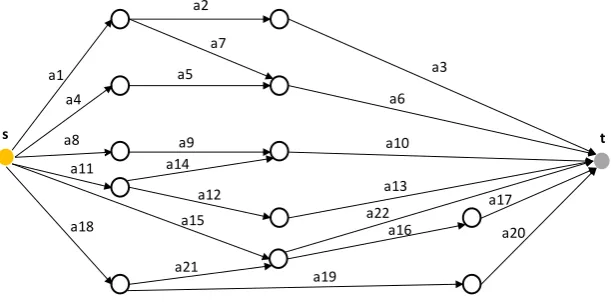
Fig. 1. A multi-path transmission network
4
Simulation Study
This section reports on a simulation study based on the following network structure as shown in Fig. 1. Some parameters are set as follows so that the proposed model could be evaluated by comparing with other approaches. , , . Assume the working paths couples are and . From Figure 1, the paths with non-crossing relation with and
are , , ,
, , ,
and .
The data is from [16], in DMP-MP algorithm, when the working path is , the reliability for the back-up path is listed in Table 1.
Table 2. Reliability list
3,4 0.78 3,10 0.40 4,10 0.70 6,8 0.55 3,5 0.77 4,5 0.89 5,6, 0.78 7,8 0 3,6 0.70 4,6 0.79 5,7 0.71 7,9 0 3,8 0.52 4,8 0.72 5,9 0.61 7,10 0 3,9 0.47 4,9 0.65 6,7 0.61 8,10 0
, , ,
1, 2,..., ;
b o k kk
=
m
b o k kk
¹ ¹ ¹
s t
a1
a2
a3
a4
a5
a6 a7
a8 a11
a15 a18
a9 a14
a12
a21 a19
a20 a16
a17 a22
a13 a10
200
d
=
T
=
13
2000
B
=
P
1=
( , , )
a a a
1 2 32
( , , )
4 5 6P
=
a a a
P
12
P
P
3=
( , ,
a a a
8 9 10)
P
4=
( ,
a a a
11 12,
13)
P
5=
( ,
a a a
15 16,
17)
6
( ,
18 19,
20)
P
=
a a a
P
7=
( ,
a a a
10 11,
14)
P
8=
( ,
a a
15 22)
P
9=
( ,
a a a
18 21,
22)
10
( ,
16 17,
18,
21)
P
=
a a a a
1 2
( , )
P P
,
The maximum value from Table 1 is =0.89. Thus, is the best back-up path couple. In this simulation study, we use it as the back-up path and the comparison of SSMP-BP and DMP-BP approaches is conducted.
Let present the back-up path in SSMP-BP, there are two path failure events with the out of service from and . When fails, will be triggered to re-place for sending the data with the help from . In this situation, (200,13,2000,
)- : and will be occurred twice. .
When fails, (200,13,2000, )- : , , and will be
occurred four times. .
Under the constraints of and , for the data transmission through , there is one (200,13,2000, )- :
. Thus, we can get . Since ,
then , according to Equation (8), we can get and
. Based on the Equation (7) and (10), we can get the following results under path failure case using as a back-up path:
- =0.15
Similarly, if we use as the back-up path, we can get:
,
- =0.15
It could be concluded that, using as the back-up paths, the network effi-ciency or reliability could be improved by 0.14 (14%). Using the proposed algorithm, under the failure of the second path, since is serving as a working path, the
possi-4 5
( |
)
r
P S P P
( , )
P P
4 54
P
1
P
P
2P
1P
41
P
P
22 4
( , )
P P
LBPs
X
1X
7P S P P
r( |
2 4) 0.71
=
2
P
( , )
P P
1 4LBPs
X
1X
7X
14X
211 4
( |
) 0.89
r
P S PP
=
T
B
( )
P
11
( )
P
LBP
X
LBP=
(50,50,40,0,0,0,0,0,0,0,0,0,0,0,
0,0,0,0,0,0,0,0)
P S P
r( | ) 0.58
1=
d
2=
120
£
d
2
( | ) 0
r
P S P
=
P P
r( ) 0.14
1=
2
( ) 0.14
r
P P
=
4
P
1 2 4 5 1 2 2 1
( |
,
)
( ) ( | )
( ) ( | )
DMP BP
r r r r r
P
S PP P P
P P P S P P P P S P
-
=
+
=
0.14 0 0.14 0.58 0.08
´
+
´
=
1 2 4 1 2 4 2 1 4
( |
, )
( ) ( |
)
( ) ( |
)
SSMP BP
r r r r r
P
S PP P
P P P S P P P P P S PP
-
=
+
=
0.14 0.71 0.14 0.89 0.23
´
+
´
=
1 2 4
( |
, )
SSMP BP r
P
S PP P
-
P
rDMP BP-( |
S PP P P
1 2,
4 5)
5
P
1 5
( |
) 0.88
rP S PP
=
P S P P
r( |
2 5) 0.70
=
1 2 5 1 2 5 2 1 5
( |
, )
( ) ( |
)
( ) ( |
)
SSMP BP
r r r r r
P
S PP P P P P S P P P P P S PP
-
=
+
=
0.14 0.70 0.14 0.88 0.23
´
+
´
=
1 2 5
( |
, )
SSMP BP r
P
-S PP P
P
rDMP BP-( |
S PP P P
1 2,
4 5)
4
,
5P P
4
bility is , or . According to the rule that data should be transmitted by non-crossing paths, the following paths will be available and . When the main path is , the first and second back-up paths are and
respec-tively. Based on equation (10),
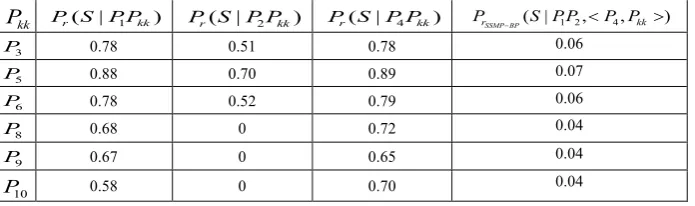
. Thus, we can get the results from Table 2.
Table 3. Reliability list
0.78 0.51 0.78 0.06 0.88 0.70 0.89 0.07 0.78 0.52 0.79 0.06
0.68 0 0.72 0.04
0.67 0 0.65 0.04
0.58 0 0.70 0.04
From Table 2, it could be observed that =0.14. Due to the maximum value
of when , is selected
to be the second back-up path. Thus, the first and second back-up paths will be
and . The network reliability will be . When
the back-up path couple is , when the path couple is out of service, using
CMP-BP algorithm, the reliability is . While, using the proposed algorithm, we can get:
That implies when the second path is failed, the network reliability will be in-creased by 0.05 (5%) using the proposed algorithm if and are used as the back-up paths. For the small scale network, traverse algorithms could be used for finding out the best back-up paths [17, 18]. However, for intermediate or large scale networks, these algorithms are not able to work properly [19]. The proposed SSMP-BP approach could be extended to a network with paths. If there are some working paths , is the back-up path, where and are non-crossing paths . Based on the proposed approach, the network reli-ability could be calculated by:
1
P
P
2P
43
, , , ,
5 6 8 9P P P P P
P
101 2
( , )
P P
P
4P
kk1 2 4 1 2
( |
,
,
) 2 ( ) ( )
SSMP BP
r kk r r
P
S PP
P P
P P P P
-
<
> =
4
4 1 2
( |
)
( )
( |
,
)
SMP BP
r kk r r kk
P S P P
P P P
S PP P
-+
kk
P P S P Pr( | 1 kk) P S P Pr( | 2 kk) P S P Pr( | 4 kk) PrSSMP BP- ( |S P P1 2,<P P4, kk>) 3 P 5 P 6 P 8 P 9 P 10 P 4
( )
rP P
1 2 4 5
( |
,
,
) 0.07
SSMP BP
r
P
-S PP
<
P P
> =
kk
=
3,5,6,8,9,10
P
54
P
5
P
( |
1 2,
4,
5) 0.07
SSMP BP
r
P
-S PP
<
P P
> =
4 5
( , )
P P
'
( |
1 2,
4 5) 0.02
DMP BP r
P
S PP P P
-
=
'
1 2 4 5 1 2 4 5
( |
,
,
)
( |
,
) 0.05
SSMP BP DMP BP
r r
P
S PP
P P
P
S PP P P
-
<
>
-
-=
4
P
P
5(
2)
u u
³
1 2
( , ,..., ,..., )
P P
P
iP
uP
tP
tP
i1, 2,...,
5
Conclusion
This paper introduces a SMP-BP algorithm to improve the network reliability un-der the situation of one transmission path failure. SMP-BP uses two non-crossing paths as working routes. And one path which is non-crossing with the working path will be used as the back-up. When a working path fails, the back-up path will be evoked and a new working path will be created with another working path. Thus, there are two paths in the network which can transmit the data at the same time. From the simulation study, the proposed algorithm has a better network reliability compared with existing DMP-BP approach. It could be found that, the proposed algorithm uses less back-up paths compared with DMP-BP so that less network resources like nodes are achieved.
Future research directions will be carried out in the following aspects. Firstly, the network disturbances are ignored in this research. Some disturbances such as power failure could be considered so that some probability theory could be integrated into this algorithm. Secondly, simulation study is only conducted. A testing scenario will be created in the future to evaluate the feasibility and practicality of this proposed algorithm.
6
Acknowledgement
This paper is supported by the project “Study of the web data security measure-ment under cloud computing” (No. 151513) from Science and Technology Fund in Department of Education, Jiangxi, China.
7
References
[1]Liew, S.-Y., C.-K. Tan, M.-L. Gan and H. G. Goh (2018). A Fast, Adaptive, and Energy-Efficient Data Collection Protocol in Multi-Channel-Multi-Path Wireless Sensor Net-works. IEEE Computational Intelligence Magazine 13(1): 30-40. https://doi.org/10.1109 /mci.2017.2773800
[2]Arianpoo, N., I. Aydin and V. C. Leung (2017). Network Coding as a Performance Booster for Concurrent Multi-Path Transfer of Data in Multi-Hop Wireless Networks. IEEE Trans-actions on Mobile Computing 16(4): 1047-1058. https://doi.org/10.1109/tmc.2016.258 5106
[3]Kumar, R., D. Kumar and D. Kumar (2017). EACO and FABC to multi-path data trans-mission in wireless sensor networks. IET Communications 11(4): 522-530. https://doi.org/ 10.1049/iet-com.2016.0859
1 2 1 2
2 1 3
1 2 1
( |
... , )
( ) ( | ... , )
( ) ( |
... , ) ...
( ) ( |
...
, )
G
r u r r u
r r u
r u r u
P S PP P P
P P P S P P P
P P P S PP P P
P P P S PP P
P
t t
t
t
-=
+
+
[4]Usman, M., N. Yang, M. A. Jan, X. He, M. Xu and K.-M. Lam (2018). A joint framework for QoS and QoE for video transmission over wireless multimedia sensor networks. IEEE Transactions on Mobile Computing 17(4): 746-759. https://doi.org/10.1109/tmc.2017. 2739744
[5]Ge, X., L. Pan, Q. Li, G. Mao and S. Tu (2017). "Multipath cooperative communications networks for augmented and virtual reality transmission." IEEE Transactions on Multime-dia 19(10): 2345-2358. https://doi.org/10.1109/tmm.2017.2733461
[6]Kotian, R., G. Exarchakos, S. Stavros and A. Liotta (2017). "Impact of transmission power control in multi-hop networks." Future Generation Computer Systems 75: 94-107. https://doi.org/10.1016/j.future.2016.10.010
[7]Liu, A., Q. Zhang, Z. Li, Y.-j. Choi, J. Li and N. Komuro (2017). "A green and reliable communication modeling for industrial internet of things." Computers & Electrical Engi-neering 58: 364-381. https://doi.org/10.1016/j.compeleceng.2016.09.005
[8]Zhang, H., P. Dong, S. Yu and J. Song (2017). "A scalable and smart hierarchical wireless communication architecture based on network/user separation." IEEE Wireless Communi-cations 24(1): 18-24. https://doi.org/10.1109/mwc.2017.1600135wc
[9]Jang, S., S.-G. Kang and S.-G. Yoon (2017). "CAMR: Congestion-Aware Multi-Path Routing Protocol for Wireless Mesh Networks." Journal of Electrical Engineering & Tech-nology 12(1): 411-419. https://doi.org/10.5370/jeet.2017.12.1.411
[10]Casoni, M., C. A. Grazia and M. Klapez (2017). "SDN-Based Resource Pooling to Provide Transparent Multi-Path Communications." IEEE Communications Magazine 55(12): 172-178. https://doi.org/10.1109/mcom.2017.1601214
[11]Kim, W. and W. Yoon (2017). "Multi-constrained Max–Min Fair Resource Allocation in Multi-channel Wireless Sensor Networks." Wireless Personal Communications 97(4): 5747-5765. https://doi.org/10.1007/s11277-017-4807-x
[12]Zhong, R. Y., Q. Dai, T. Qu, G. Hu and G. Q. Huang (2013). "RFID-enabled real-time manufacturing execution system for mass-customization production." Robotics and Com-puter-Integrated Manufacturing 29(2): 283-292. https://doi.org/10.1007/s11277-017-4807-x
[13]Holfeld, B., D. Wieruch, T. Wirth, L. Thiele, S. A. Ashraf, J. Huschke, I. Aktas and J. An-sari (2016). "Wireless Communication for Factory Automation: an opportunity for LTE and 5G systems." IEEE Communications Magazine 54(6): 36-43. https://doi.org/10.1109 /mcom.2016.7497764
[14]Sundaresan, S., R. Doss, W. Zhou and S. Piramuthu (2015). "Secure ownership transfer for multi-tag multi-owner passive RFID environment with individual-owner-privacy." Com-puter Communications 55: 112-124. https://doi.org/10.1016/j.comcom.2014.08.015 [15]Wan, Z., S. Liu, W. Ni and Z. Xu (2018). "An energy-efficient multi-level adaptive
clus-tering routing algorithm for underwater wireless sensor networks." Cluster Computing: 1-10. https://doi.org/1-10.1007/s10586-018-2376-8
[16]Lin, Y.-K. (2010). "Spare routing reliability for a stochastic flow network through two minimal paths under budget constraint." IEEE transactions on reliability 59(1): 2-10. https://doi.org/10.1109/tr.2010.2040765
[17]Zhu, L., R. Wang and H. Yang (2017). "Multi-path Data Distribution Mechanism Based on RPL for Energy Consumption and Time Delay." Information 8(4): 124. https://doi.org/ 10.3390/info8040124
[19]Ahmed, E., M. Imran, M. Guizani, A. Rayes, J. Lloret, G. Han and W. Guibene (2017). "Enabling mobile and wireless technologies for smart cities." IEEE Communications Mag-azine 55(1): 74-75. https://doi.org/10.1109/mcom.2017.7823341
8
Authors
Xiaoling Li is an Associate Professor and Senior Engineer in the Nanchang
Uni-versity Gongqing College, Jiujiang, Jiangxi, China. Her research interests include data security measurement and computer networks. She has published several papers in international journals and conferences.
Xinwei Zhou is an Lecturer and Engineer in Computer Network from the
Nan-chang University Gongqing College, Jiujiang, Jiangxi,China. His research focuses on computer networks and network reliability. He has published several papers in inter-national journals and conferences.