Scalable Computing: Practice and Experience
Volume 15, Number 2, pp. 153–168. http://www.scpe.org
ISSN 1895-1767 c
⃝2014 SCPE
ADAPTIVE TIME-BASED COORDINATED CHECKPOINTING FOR CLOUD COMPUTING WORKFLOWS
BAKHTA MEROUFEL1AND GHALEM BELALEM2
Abstract. Cloud computing is a new benchmark towards enterprise application development that can facilitate the execution of workflows in business process management system. The workflow technology can manage the business processes efficiently satisfying the requirements of modern enterprises. Besides the scheduling, the fault tolerance is a very important issue in the workflow management. In this paper, we analyse and compare between some existing checkpointing strategies, then we propose a lightweight checkpointing adequate to the cloud computing and the workflows characteristics. The proposed strategy is an Adaptive Time based Coordinated CheckpointingATCCp, it ensures a strong consistency without any synchronization. ATCCp
uses the concept of soft checkpointing to minimize the storage time and it uses theVIOLINtopology to improve the checkpointing performances. According to the experimental results, our approach decreases the overhead and the SLA violations.
Key words: Cloud computing, Workflow, Fault tolerance, Virtual machines, Checkpointing, Coordination,VIOLIN, Consis-tency state, Stable memory, Overhead.
AMS subject classifications. 68M14, 68M15, 68M20, 68W15, 94C12
1. Introduction. The cloud provisions pools of computing resources as services via the internet using a pay-as-you-go price model that eliminates initial costly capital investments in hardware and infrastructure. Research and academic communities can leverage the benefit of the cloud price model for their computation-intensive applications that traditionally run in HPC environments [34], [35], [36], [37] such as Amazon Web Services’ HPC offering [38] or science cloud initiatives [39].
The HPC cloud market paradigm are usually smaller scale HPC users, such as small companies and research groups who have limited access to supercomputer resources and varying demand over time. The perspective of cloud providers is expanding their offerings to cover the aggregate of these HPC. The user jobs (HPC or not) are presented as a workflows to facilitate the resources and the tasks management.
The workflow is a set of atomic tasks, interconnected in a directed acyclic graph through control flow and data flow dependencies. Moving workflows to a cloud computing environment enables the utilization of various cloud services to facilitate workflow execution. Besides the workflow scheduling, the failures are an important issue to deal with during the management of workflow execution.
To ensure the cloud reliability, the system must contain a fault tolerance module to allow the cloud to continue providing the services despite the occurrence of faults. Several fault tolerance techniques are proposed such as:
• Check pointing/Restart: when a task fails, it is allowed to be restarted from the recently checked pointed state rather than from the beginning [23], [12].
• Replication: it is a process of maintaining different copies of a data item or object. Various task replicas are run on different resources, and the execution is successful if at least one replicated task is not crashed [7], [14], [40]. Replication is a resource demanding.
• Resubmission: whenever a failed task is detected, it is resubmitted either to the same or to a different resource [16].
Replication suffers from large resource consumption and resubmission can significantly delay the overall completion time in case of multiple repeating failures. In this paper we use the fault tolerance based on checkpointing. In a distributed system, since the nodes in the system do not share memory, a global state of the system is defined as a set of local states, one from each node. In this case, transit and orphan messages need to be handled; otherwise they can lead to inconsistent checkpoints [12].
1Dept. of Computer Science, Faculty of Exact and Applied Sciences, University of Oran - Es Senia, Oran, Algeria ([email protected]).
2Dept. of Computer Science, Faculty of Exact and Applied Sciences, University of Oran - Es Senia, Oran, Algeria ([email protected]).
global state and it consists of the set of VMs checkpoints.
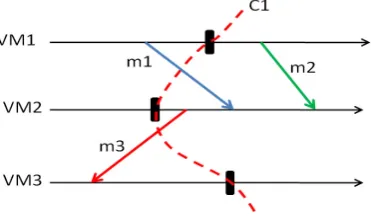
In the scenario presented in Figure 1.1, the message m2 is a regular message since its send and receive events are not stored in C1 (m2 was sent and received after C1). The m1 is a transit message because it was sent before C1 and received after C1 (the ”send event” ofm1 is recorded in the global state C1 but the ”receive event” is not). In case of a rollback, the VM2will wait them1 to be sent from VM1, but VM1has already sent this message (according to C1). The message m3 is an orphan message because its ”receive event” is recorded in C1 but the ”send event” in not recorded. In case of rollback, VM3 receives m3 twice (one recorded in C1 and other sent by VM2 after the rollback) which can lead to incorrect and inconsistent computations.
Fig. 1.1.Communication and checkpointing among three VMs
The checkpointing must create a consistent state. A state without any orphan message is consistent. If a consistent checkpointing do not create any transit messages then the consistency is strong. To satisfy that consistency, literature offers three main solutions:
• Independent checkpointing (Uncoordinated) [4], [5]: the checkpoints at each process are taken indepen-dently without any synchronization among the processes. Because of absence of synchronization, there is no guarantee that a set of local checkpoints taken will be a consistent set of checkpoints. It may require cascaded rollbacks that may lead to the initial state due to domino-effect [4]. The independent checkpointing stores all the checkpoint files during the job life.
• Coordinated or synchronous checkpointing [1], [12]: the processes will synchronize to take checkpoints in such a manner that the resulting global state is consistent. The main advantage is that it stores only one permanent checkpoint in the stable memory and it is domino-effect free.
• Communication induced checkpointing: the processes take two kinds of checkpoints, local and forced. Local checkpoints can be taken independently, while forced checkpoints are taken to guarantee the eventual progress of the recovery line. However, the messages are piggybacked and useless checkpoints can be created.
Even if the checkpointing is widely used in cloud computing environment [18], there are very few papers that study or take into consideration the influence of checkpointing technique. The random choice of check-pointing technique adds large overhead and decreases the system performance considerably. After studying a real execution trace of a cloud computing, it is proved that 80% of communications happen inside the server (among VMs) [8].
low-overhead time-based coordinated checkpointing (ATCCp). ATCCptechnique does not need any synchronization and it stores only one checkpointing file in the stable memory which decreases the overhead and the resource consumption. An initiator is selected in ATCCp to manage the resynchronization and to solve the timer problems.
The rest of this paper is structured as follows: Section 2 explains some related works. Section 3 presents the adopted system model and its characteristics. Section 4 analysis in detail the time based coordinated checkpointing strategies proposed in literature. In section 5, a description of ATCCp is given; a comparative study is also presented in the same section. The experimental results are presented in section 6. The conclusion and future works are presented in section 7.
2. Related works. Besides the scheduling, fault tolerance is a very important issue in workflow manage-ment. Literature proposes many works in this field. The authors in [7], [14] use the replication to tolerate the failures. This strategy is very effective when the system uses a deadline for the running application. However, the replication is resource demanding and it can add complexity to the system. The resubmission is also another strategy to ensure the correct execution of the workflow. The authors in [16] balance between the resubmission and the replication to minimize the disadvantages of each strategy. Even with this combination, fault tolerance decreases always the system performance and increases the SLA (service level agreement) violation [1].
The previous strategies (replication and resubmission) are used only for fault tolerance. Checkpointing is a fault tolerance technique but it can be used to ensure or improve other services. In [1], [15], [13] the authors use the checkpointing to ensure a fault tolerant scientific workflows. In this case, the system records periodically its state by checkpointing all the running tasks. The proposed approach in [1] uses two phase blocking coordinated checkpointing which considerably increases the system overhead. The authors in papers [15], [28] use independent checkpointing which causes the domino effect. Independent checkpointing is used also in [4], [5] to improve the migration and ensure the load balancing in cloud servers.
The fault tolerance service proposed in [28] and [29] chooses between replication and checkpointing to tolerate the workflow depending on several criteria such as the cost and the overhead. In [27], a comparison is done between the replication only and the combination between replication and checkpointing. The experimental results prove that the checkpointing improves the replication performance.
It is clear that the checkpointing is a very popular technique and it can be used to ensure many services at the same time. However, random choice of checkpointing technique can increase the system overhead and the SLA violation. According to Section 1, coordinated checkpointing ensures the consistency without the scalability and it is the contrary in case of uncoordinated checkpointing.
Time based coordinated checkpointing is a combination between both strategies (coordinated/ uncoordi-nated) and it ensures both scalability and consistency with the minimum overhead. Many papers studied and used this type of checkpointing. The majority of the proposed time based checkpointing suffer from many problems and imperfections. Before presenting and analyzing this type of checkpointing, we present in the next section the system model.
3. System model. The cloud computing is a set of datacenters geographically distributed. Each datacen-ter contains multiple physical machines (servers/Hosts). The hypervisor [9] in each server provides a virtualized hardware environment to support running multiple operating systems concurrently in different virtual machines (VMs) using one physical server (See Figure 3.1). The VM can accept a special user request to execute an application. All the virtual machines can concurrently serve, with different operating systems and software configuration environments according to the need of the user. The kernel level in the VM contains the commu-nication and the task management modules.
Fig. 3.1.System model
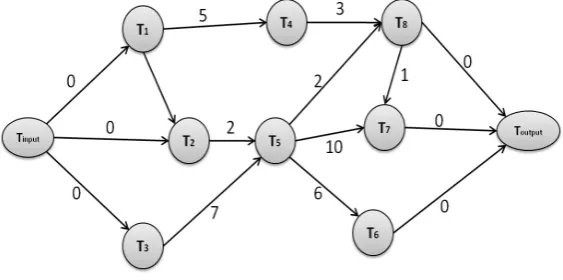
The application models in cloud computing can vary from multi-tier web applications such as e-commerce to scientific applications (parallel and data-driven applications and workflows) [15]. Typically such applications consist of several tasks, which communicate with each other. A task consists of some computation and commu-nication phases. Commucommu-nications among tasks create dependencies [15], [19]. The workflow is used to indicate the temporal relationship among tasks and to present their dependencies. In order to show how the workflow is presented in the system, we used an oriented graph as shown in Figure 3.2.
Fig. 3.2.Workflow example with eight tasks
The oriented graph consists of eight tasks from T1 to T8, and two dummy tasks: tinput and toutput. The
number above each arc (directed edges) shows the estimated dependency factor between the corresponding tasks. In other words, if taskT1sends five messages to taskT4 then theArcW eight= 5. The average communication rateµis calculated by the formula 3.1.
µ=
r ∑ l=0
ArcW eightl
r (3.1)
wherer is the number of arcs in the workflow. The number of tasks executed in parallel depends on the number of available VMs.
The work in [6] is similar to our proposition but it assumes that VMs clocks are perfectly synchronized, which may not be true in real system. The work in [6] ensures also only a simple consistency without taking into consideration the transit messages. Our ATCCpdeals with both transit and orphan messages to ensure a strong consistency with the minimum overhead and without any need for clock synchronization.
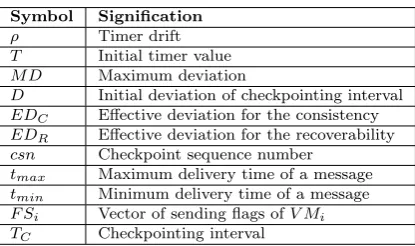
4. Time based coordinated checkpointing. Time based coordinated checkpointing is a combination between coordinated and uncoordinated checkpointing, it is proposed to avoid the problems of each checkpoint-ing strategy. To facilitate the understandcheckpoint-ing of our work, we present in Table 4.1 the principal symbols cited and used in the rest of this paper.
Table 4.1
Time based checkpointing parameters
Symbol Signification
ρ Timer drift T Initial timer value M D Maximum deviation
D Initial deviation of checkpointing interval EDC Effective deviation for the consistency
EDR Effective deviation for the recoverability
csn Checkpoint sequence number tmax Maximum delivery time of a message
tmin Minimum delivery time of a message
F Si Vector of sending flags ofV Mi
TC Checkpointing interval
Time based coordinated checkpointing is based on the idea that if the VMs create their checkpoints at the same time (without any deviation), orphan messages will not exist [17], [18], [23]. However, the clock synchro-nization among all the VMs is impossible in real systems. To overcome this problem, time based coordinated checkpointing uses a timer instead of real clock and it assumes that the VMs have loosely synchronized clocks. It assumes also that all the VMs timers are approximately synchronized with a deviation from real time of some valueρ, which presents the clock drift.
If a timer is started on each of two VMs at the same time, and each VM has clock drift rate equal toρ, the timers will expire at 2ρT seconds apart, whereT was the initial timer value and 10−8
< ρ <10−5. Assuming this, the clocks will exhibit a maximum drift of 2ρnT afterN checkpoint intervals [19]. Time based coordinated checkpointing ensures a strong consistency if it satisfies two conditions: consistency condition and recoverability condition.
4.1. Consistency condition. The consistency condition ensures that the system will not create any orphan message during the checkpointing process. So the checkpointing must ensure that if the ”sent event” of a messagem is not recorded in the checkpoint file of the source, the ”receive event” will not be recorded also in the checkpoint file of the destination [12]. To deal with orphan messages and satisfy the consistency condition, many solutions are proposed and implemented in the literature.
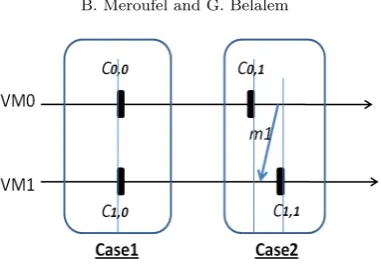
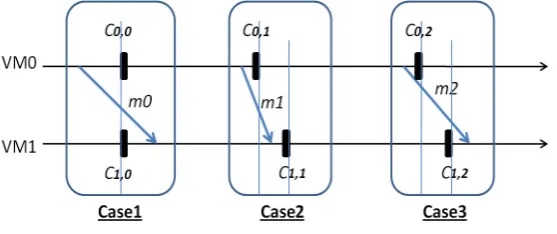
In [6], [17], [25], the authors assume that the timers (real or logical) are perfectly synchronized. In this case, all the VMs will create their checkpoints at the same time. In Case 1 of Figure 4.1, VM0 and VM1 create their checkpoint C0,0 andC1,0 at the same time (inCi,j: the i is the VM identifier and j is the checkpointcsn). If
VM0 sends a message m to VM1 after the checkpointing, it is sure that the message will be received after the checkpoint of VM1, som will never be an orphan message. However, the perfect timer synchronization among VMs is not possible in real systems.
To avoid the synchronization condition, the papers [18], [19], [24] take into account the timer deviationρ. In this case, orphan message can be created. The second case of Figure 4.1 illustrates a possible situation where VM0 creates its checkpointC0,1 at time t1 and then sends a message m1 to VM1. After receiving m1, VM1 creates the checkpoint C1,1. Som1 will be an orphan message and the consistency is not assured. If VM0did not sendm1 during the timer deviation (until VM1 creates itsC1,1), the consistency will be assured.
Fig. 4.1. Possible cases of consistency condition
the time interval after the checkpointing where potential orphan messages can be created. If ρ̸= 0 then the Maximum Deviation can be calculated by Formula 4.1:
M D=D+ 2ρnT (4.1)
where Dis the initial deviation of checkpointing intervals. A message sent duringM D after the checkpointing can cause an inconsistency. TheM D period can be minimized by taking into account the transmission time of the message, so the effective deviation of consistencyEDc will be (See Formula 4.2):
EDc=M D−tmin (4.2)
where tmin is the minimum delivery time of a message inside the server. IfM D = 0 then the timers are fully
synchronized (case 1 of Figure 4.1). Preventing a VM to send messages during EDc period (by buffering this
message until the end of EDc) can resolve the problem. However, blocking the communication increases the
response time and the SLA violation.
Both the timer synchronization and the blocked communication decrease the system performances. To ensure the consistency, another solution proposes the use of piggybacked messages [20], [21], [22], [23]. In this case, each message will piggyback some extra data and the receiver will decide to create or not the checkpoint according to this data. One of the piggybacked data is the checkpoint sequence number (csn) of the local VM. The csn is an integer number that will be incremented each time the VM creates its checkpoint file. In case of time based coordinated checkpoints, thecsn in all VMs of the server must be the same since all these VMs create their checkpoints using the same checkpointing intervalTC.
So, if a VM receives a message where the piggybackedcsnof the message is greater than the localcsn, the receiver VM knows that the sender has already created its checkpoint before sending the message. In this case and to avoid the creation of orphan message, the VM receiver must create its checkpoint before dealing with the received message (it buffers the message, creates the checkpoint and then computes this message).
In case 2 of Figure 4.1, the message m1 will piggyback the csn = 1, when VM1 receives this message, it compares the localcsn= 0 with thecsn of the message, since the localcsn is less than the sentcsn, VM1 will know that VM0 has created its checkpoint before sendingm1, so VM1 will be forced to create the checkpoint C1,1before dealing with m1. This strategy increases the delivery time of messages.
4.2. Recoverability condition. The recoverability condition ensures that the system will not create any transit message during the checkpointing process. The checkpointing must ensure that if the ”receive event” of a messagem is recorded in the checkpoint file of the destination, the ”send event” will also be recorded in the checkpoint file of the source [12].
Fig. 4.2.Possible cases of recoverability condition
The clock deviation also does not always cause a transit message. In case 2 of Figure 4.2, the message m1 is not transit since its send and receive events are not recorded in the global state. So the existence of transit message is related more to the transfer time of the message (time from sending a message to receiving it) compared to the checkpointing interval. The case 3 of Figure 4.2 presents the same situation of case2. However in case 3, the transfer delay of m2 was greater than the transfer delay ofm1 in case 2, so m2 is received after the checkpointing of VM1 but sent before the checkpointing of VM0 which makes it transit message.
To deal with the problem of transit messages, the paper [24] proposes to block the communication a certain period just before the checkpointing time. The transit message is a message sent before the checkpointing of a VMi and received after the checkpointing of VMj. So if we prevent VMi to send any message that can be
received after the checkpointing of VMj, the problem will be resolved.
Using time based checkpointing assumptions and adopting the same reasoning of blocked communication used to resolve the problem of case2 in Figure 4.1, we can estimate the time interval that can create potential transit messages. This interval named effective deviation of recoverability EDR is calculated by Formula 4.3:
EDR=M D+tmax (4.3)
where tmax is the maximum delivery time of a message in the server. However, blocking the communication
always adds an extra overhead to the system.
To avoid blocking communications, the papers [18], [20], [23] use the send-messages logging. In this strategy, the VM logs all the messages sent. In case of rollback of the receiver, it can ask the sender to re-sent these messages. But how many messages must be logged and until when. The only period that can create potential transit message is EDR before the checkpointing time [20], [24], [25]. So logging the message sent during
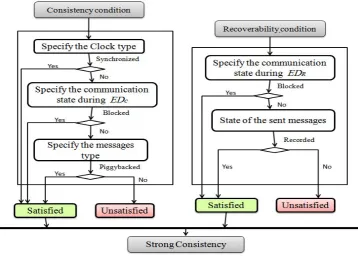
this period can resolve the transit message problem. We summarized all the used techniques that ensure the consistency and the recoverability conditions in Figure 4.3.
5. The contribution. In the previous section, we cited and explained the existing time-based coordinated checkpointing works. The majority of these works deal with the consistency by blocking the communications or piggybacking the messages. There are also some works that do not consider important parameters such as: timer drift, checkpointing overhead, message transfer time. Some works ensure only a simple consistency. So each strategy suffers from some imperfections and does not deal with some problems. And here comes our contribution as a solution of these imperfections and problems.
5.1. Adaptive Time based Coordinated Checkpointing (ATCCp). The proposed contribution in this paper is an adaptive time based non-blocking coordinated checkpointing (ATCCp). ATCCp ensures a strong consistency without overheating the system and without synchronizing the timers or blocking the com-munications. ATCCphas three phases: Initiator selection, Checkpointing and Resynchronization.
Fig. 4.3.Time based checkpointing strategies
5.1.2. Checkpointing Phase. Periodically, each VM creates its checkpoint independently without any control message exchange. ATCCp ensures a strong consistency by dealing with both consistency and recov-erability conditions. Since ATCCp is not blocking or synchronizing checkpointing, recording and piggybacking messages are the only solutions to ensure a strong consistency. Contrary to the previous cited works, our ap-proach ensures the desired consistency with the minimum overhead by reducing the number of recorded and piggybacked messages.
InATCCp, the messages sent duringEDC after the checkpointing are potential orphan messages. To avoid
blocking the communication duringEDC (such as the strategies in [18], [19], [24]), when a VM sends a message
duringEDCto another VM (in this case the ”send event” is not recorded), the VM receiver buffers the message
and creates its checkpoint file, then it computes the message. In this case, the ”receive event” will be also unrecorded in the checkpoint file of the receiver. However, not all the messages sent duringEDCwill force the
receivers to create their checkpoints. The VM destination is forced to create the checkpoint if the csn of the message (actually it is thecsn of the source VM) is greater than the localcsnof VM destination.
Besides thecsn, the piggybacked message will also contain the ”time to next checkpoint TNC” representing the rest of the time before the next checkpoint of the source. The goal of this information is the resynchro-nization. To reduce the number of piggybacked message inATCCp, a VMi piggybacks only its first application
message sent duringEDC (after it has create its checkpoint) to a VMj.
Each VMi uses a Boolean vectorF Si ofN size, whereN is the number of VMs in the server. TheF Si is
used to identify the first message sent to a VM destination, when VMisends a message to VMjthenF Si[j] = 1.
After each checkpointing the vector is initialized (F Si[j] = 0 / i̸=j). The second computation message sent
to the same destination can not force the checkpointing creation because the source and the destination have the same csn.
In ATCCp, the potential transit messages in VMi are those sent during the period EDR. So only the
messages sent during this period will be stored in the checkpoint file and VMi continues its execution without
receivercsn is 1) then it is sufficient to store only the messages sent during the last checkpointing interval.
5.1.3. Resynchronization Phase. In time based checkpointing approachs, the clock deviation increases with 2ρnT aftern checkpoint intervals [18], [19]. The goal of the resynchronization phase is to reinitialize the value ofρ. Ifρ= 0 then the Maximum deviation will be: M D=D+ 2ρnT =DwhereDis the initial deviation of checkpointing intervals. The synchronization can be executed by the initiator or the ordinary VM.
• The initiator can start the resynchronization when the deviation MD exceeds a certain threshold or the size of logged messages exceeds the buffer size of VMs. In this case, the initiator sends special messages to VMs to synchronize their timers.
• An ordinary VM can use its piggybacked message to minimize the deviation between the local timer and the destination timer. So when the VM receives the piggybacked message, it uses thecsnto decide to create or not the checkpoints and it uses the synchronization data (time to next checkpoint TNC and the message transfer delay) to minimize the clock deviation.
The combination between the initiator and the VM resynchronization decreases considerably the overhead. The initiator synchronization overheads the server by control messages but it decreases the resource consump-tion, i.e. the number of possible orphan and transit messages will be reduced since the EDR and EDC are
reduced. The VM synchronization adds more data on the piggybacked messages but it decreases the initiator resynchronization rate.
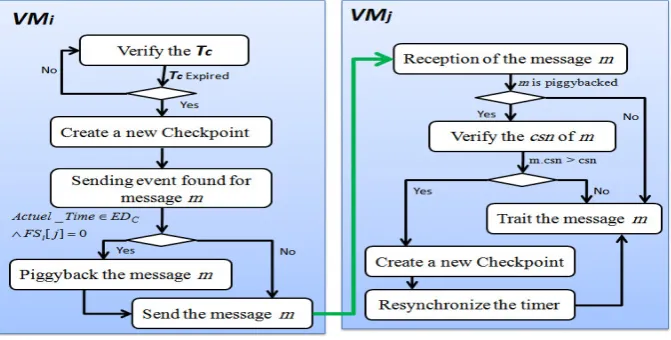
However, if the timer of the sender is faulty, the erroneous timer information will be spread to the receiver. Besides, since the transmission delay between the sender and the receiver is variable, the timer information from the sender may not reflect the correct situation when the message finally arrives at the receiver. To achieve more accurate timer synchronization, we can utilize the timers in the initiator as an absolute reference. The Figure 5.1 illustrates a part of ATCCp process (only the consistency condition and the resynchronization of an ordinary VM) in two communicating VMs (VMi and VMj). The green arrow presents a communication
message sent from VMi to VMj.
Fig. 5.1.ATCCp process in two VMs
Besides the checkpointing technique, it is proven that 70% of checkpointing overhead is caused by the storage phase (called the checkpointing latency), i.e. the time needed by the VM to store its checkpoint file in the stable memory. During the storage phase, the VM suspends its running task to execute the storage which means that the task will be delayed and therefore the whole workflow will be delayed also.
classical VIOLIN by implementing a checkpointing module in each VM. One VM will be selected asVIOLIN switch and in case of failure; another VM can replace it immediately. ATCCp does not need any extra-control messages or extra-resource, so its implementation will not need major modifications.
To facilitate the checkpointing process, we suppose that the VIOLIN switch is always the checkpointing initiator because it has a global view about the existing VMs in the host (server). In case of any need of control (for example: specifying the maximum deviation time or starting the resynchronization), the VIOLIN switch can forward the control messages without losing time in collecting data about the actual situation. Besides that, the VIOLIN switch uses the server clock to solve the timer problem.
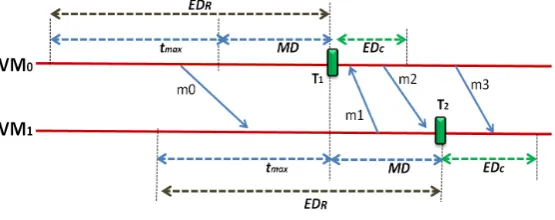
5.2. Analysis and comparative study. To analyze our contribution, we used the example of Figure 5.2.
Fig. 5.2.ATCCp parameters with an example
Figure 5.2 illustrates all the time intervals used in time based coordinated checkpointing (see Table 4.1). It presents also an example of the checkpointing process in two VMs .
• Each VM estimates itsEDR andEDC.
• VM0 and VM1 create their checkpoint files (T1 andT2 respectively) independently
• Each VM stores the messages sent during its EDR in the checkpointing file. Those messages are
probably transits. In case of rollback, the transit message will be sent again to its destination. In Figure 5.2, the message m1 is transit and it will be stored in the checkpoint file of VM1. In case of failure and rollback, the VM0requests VM1to resendm1, andm1 is already stored in the checkpointing file of VM1.
• The messages sent during EDC of the source can be an orphan message, so if the message is sent for
the first time to a destination, that message will be piggybacked by some data (specially the csn) and it will force the destination to create its checkpoint before the checkpointing (only ifcsn of the source is greater than thecsnof the destination). In this case, the message will be regular and thecsn of the source and the destination will be the same. In Figure 5.2, the VM0 sent m2 to the VM1 during its EDC and since this message is the first message sent to VM1 after the last checkpoint T1, it will be piggybacked by some data. At the reception of m2(Sourcecsn = 2 > Destinationcsn = 1), the VM1 creates its checkpoint T2 before treating this message (not illustrated in the Figure 5.2) and it will also resynchronize its timer. If VM0 sends a second message to VM1 duringEDC, the message will not be
piggybacked with extra-data and it will not force the destination to create its checkpoint file since csn
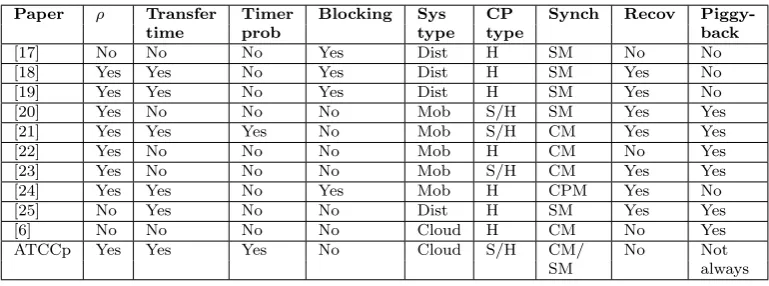
Our approach solves many problems of time based coordinated checkpoints proposed in literature and it does not omit the majority of parameters. Table 5.1 presents a comparison between ourATCCp and the other time based coordinated checkpointing cited in this paper.
Table 5.1
Comparison between time based checkpointing
Paper ρ Transfer Timer Blocking Sys CP Synch Recov
Piggy-time prob type type back
[17] No No No Yes Dist H SM No No
[18] Yes Yes No Yes Dist H SM Yes No
[19] Yes Yes No Yes Dist H SM Yes No
[20] Yes No No No Mob S/H SM Yes Yes
[21] Yes Yes Yes No Mob S/H CM Yes Yes
[22] Yes No No No Mob H CM No Yes
[23] Yes No No No Mob S/H CM Yes Yes
[24] Yes Yes No Yes Mob H CPM Yes No
[25] No Yes No No Dist H SM Yes Yes
[6] No No No No Cloud H CM No Yes
ATCCp Yes Yes Yes No Cloud S/H CM/ No Not
SM always
The comparison criteria are: considering the timer drift (ρ), considering the transfer time of messages (Transfer time), dealing with timer problems (Timer prob), if the system freezes communications or not (Blocking), the system type where the checkpointing strategy was implemented for (Sys type: Mob (Mobile), Dist(Distributed) or Cloud), the resynchronization tools (Synch represents the type of message where the synchronization is piggybacked: SM (Special messages), CM (Computing messages) or CPM (Checkpointing messages)), ensuring the recoverability condition (Recov), using the piggybacked messages (Piggyback). And finally the type of checkpoint files: Hard (H) or Soft (S). In hard checkpointing, the VM stores its state in the stable memory directly. In the soft type, the VM stores its checkpoint in the local memory or sends it to a storage manager and continues its execution immediately. The S/H means that the checkpointing uses both soft and hard checkpoint files.
6. Performance evaluation. In this section, we evaluate the performances of our checkpointing scheme using CloudSim simulator [11]. The CloudSim is currently the most sophisticated discrete event simulator for Clouds; it is an open source, scalable and low simulation overhead simulator [11]. It is used in many papers to simulate the scientific workflows [31], [32], [33].
The experimentations in [32] prove thatCloudSim has the best accuracy in workflows performances. The accuracy is defined as the ratio between the predicted performances using a specified metric and the real performances.
We did not compare ourATCCpwith the other time based coordinated checkpoints because theATCCpis a solution of classical time based checkpointing problems, which makes it clearly better than those strategies. However, we studied theATCCpbehavior compared to coordinated checkpointingCCpused in [1], [16], [35] and independent checkpointingICp used in [15], [28], [36]. The goal is proofing that our approach ensures a strong consistency with the minimum cost (like theCCp) and with the minimum overhead (like theICp). Simulation parameters are presented in Table 6.1.
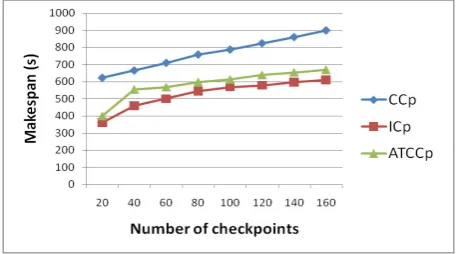
6.1. Makespan vs Number of VMs. In the first experiment, we measured the impact of number of checkpoints on the makespan (scalability) for the three checkpointing strategies ATCCp, ICp and CCp. We used the parameters cited in Table 6.1, except that the cloudlet length is fixed at 1000 MIPS,µ=50, the number of VMs is 40 and the checkpointing interval: 100< TC<600s. The makespan is measured by Formula 6.1.
makespan=maxTi∈TExectT ime(Ti) (6.1)
The results are presented in Figure 6.1. Incrementing the checkpointing number increases the makespan in all the strategies (ATCCp,CCp,ICp). ATCCp uses soft checkpointing and it does not need any coordination except in case of resynchronization, which makes its performances similar to theICpwith an average difference of 10%.
In our work, we present theSLAV iolationby the overhead caused during the checkpointing [8]. TheSLAis a
contract between customers and service providers of the level of service to be provided [1]. So the customer can precisely specify the margin for acceptable overhead (20% for example). If the overhead caused by the checkpoint exceeds the margin, then a SLA violation will be detected. In this experiment, SLAV iolation(ATCCp)=13%,
SLAV iolation (CCp)=27% andSLAV iolation(ICp)=11.78%.
Fig. 6.1. Makespan vs Number of checkpoints
6.2. Cost vs Number of checkpoints. As the cost is a very important parameter in cloud environment, we used the parameters of the first experiment to analyze the cost of all checkpointing strategies. The total cost is calculated using Formula 4.3:
TotalCost=
k ∑
i=1
Cost(Ti) + m ∑
j=1
Cost(CPj) (6.2)
wherek is the number of tasks in the workflow andm is the number of checkpoints created during the workflow execution. Cost(Ti) is the cost of running the taskTi in the specified resource, it includes the communication
cost (running the send/receive events). The cost of thejthround of checkpointing isCost(CP
j) and it includes
the coordination cost, the state recording cost and the storage cost.
According to the results illustrated in Figure 6.2, the cost of CCp is less than the cost of CCp and ICp (specially in case of high checkpointing rate). The only checkpointing communication needed in ATCCp is during the resynchronization so the coordination cost will be reduced. Also the use of VMs resynchronization minimizes the timer drift, so the periods EDC and EDR will also be reduced. In this case, the piggybacked
Fig. 6.2.Cost vs Number of checkpoints
cost and less bandwidth consumption. Also inATCCp, only one checkpointing state is needed to ensure a correct rollback.
In CCp, the server must record all the sent messages to avoid the transit messages (ensuring the recover-ability condition) and the initiator must coordinate with the VMs in each checkpointing round, which increases the cost. The cost ofICpwas significantly increased when the checkpointing rate increased because this type of checkpointing needs to store all the checkpoint files to ensure the correct rollback (domino effect). So theICp cost is due to the checkpointing latency (storage).
6.3. Communication rate vs cost. Communication rateµ represents the dependency degree between tasks of the workflow. This dependency causes a major problem in checkpointing techniques. In this experiment, we measured the cost of the ATCCp and CCp checkpointing in the system with different µ. The ICp is not affected by the communication rate since no coordination is needed.
Fig. 6.3.Communication rate Vs cost
The results (See Figure 6.3) prove that increasing the communication rate can improve the ATCCp per-formances since the communication among VMs (specially during the EDC) decreases the timer drift (using
the piggybacked messages). So the period EDR will be reduced and the initiator resynchronization frequency
will be decreased. In CCp, a high µ implies more storage space needed to ensure the recoverability condi-tion. The number of piggybacked messages in CCp will increase since this checkpointing does not block the communications. In our ATCCp, piggybacked messages are sent only duringEDC (See Section 5).
VIOLIN topology has improved both checkpointing techniques with almost 14.3% since the initiator is VIOLIN switch (it has a global view about the communication among VMs), so no time is needed to select an initiator, or to collect data about communications or VMs states in the server.
Fig. 6.4. Rollback duration Vs failure rate
7. Conclusion. When computationally-intensive workflows are executed, fault handling is very important, since the failure of a single component might lead to an abandonment of the entire workflow. This may lead to the loss of the stability and the reliability in the system. Since both the customer and the cloud computing are bound by the SLA contract, the choice of the checkpointing technique is very critical.
In this paper we proposed a fault tolerance service to tolerate failures using checkpointing technique. Our approach is a time-based coordinated checkpointingATCCp. It ensures a strong consistency with the minimum control messages and without blocking the VMs communications. ATCCp uses theVIOLIN topology and the soft checkpoint to improve the checkpointing performances.
To evaluate our approach, we compared it with the most popular checkpointing techniques: coordinated and uncoordinated checkpointing. The experimental results prove that ATCCpomits the problems of classical approaches. It decreases the overhead, minimizes the SLA violation and ensures a rapid rollback. Our work focuses on intra-server checkpointing. However, ATCCp can be easily extended to support the inter-server checkpointing by using multi-level checkpointing (Communication induced checkpointing at servers level and ATCCp at VMs level). In the future work, we will use a real platform such as eucalyptus [30] to implement the ATCCp.
REFERENCES
[1] M. Zhang, H. Jin, X. Shi and S. Wu,VirtCFT: A Transparent VM–Level Fault-Tolerant System for Virtual Clusters, IEEE Proceeding of the 16th International Conference on Parallel and Distributed Systems (ICPADS), 8–10 Dec. 2010, Shanghai, pp. 147–154.
[2] A. Kangarlou, P. Eugster and D. Xu,VNsnap: Taking Snapshots of Virtual Networked Infrastructures in the Cloud, IEEE Transactions on Services Computing, 5(4): 484–496, 2012.
[3] F. Mattern,Efficient Algorithms for Distributed Snapshots and Global Virtual Time Approximation, Journal of Parallel and Distributed Computing, 18(4): 423–434, 1993.
[4] S. Di ,Y. Robert, F. Vivien, D. Kondo, C–L. Wang and F. Cappello, Optimization of cloud task processing with checkpoint–restart mechanism, International Conference for High Performance Computing, Networking, Storage and Applications (SC2013), Nov. 17–22, 2013, Dever, Colorado, USA.
[5] D. Nguyen and N. Thoai,EBC: Application–level migration on multi–site cloud, The International Conference on Systems and Informatics (ICSAI), 19–20 May, 2012, pp. 876–889.
[6] H. Hui, Z. Zhan, W. Bai–Ling, Z. De–Cheng and Y. Xiao–Zong,A Two–level Application Transparent Checkpointing Scheme in Cloud Computing Environment, International Journal of Database Theory and Application, 6(2): 61–71, 2013. [7] O. Ben–Yehuda, A. Schuster, A. Sharov, M. Silberstein and A. Iosup,ExPERT: Pareto–Effcient Task Replication on Grids and a Cloud, IEEE 26th International Parallel & Distributed Processing Symposium (IPDPS), 21–25 May, 2013, pp. 167–178.
[9] M.N.O. Sadiku, S.M. Musa and O.D. Momoh,Cloud computing: Opportunities and challenges, Potentials IEEE Journal, 33(1): 34–35, 2014.
[10] W. Zhao, Y. Peng, F. Xie and Z. Dai,Modeling and Simulation of Cloud Computing: A Review, IEEE Asia Pacific Cloud Computing Congress (APCloudCC), 14–17 Nov. 2012, Shenzhen, pp. 20–24.
[11] R. Calheiros, R. Ranjan, A. Beloglazov1, C. De Rose and R. Buyya,CloudSim: a toolkit for modeling and simulation of cloud computing environments and evaluation of resource provisioning algorithms, Software: Practice and Experience journal, 41(1): 23–50, 2011.
[12] G. Cao and M. Singhal,On coordinated checkpointing in distributed systems, IEEE Transactions on Parallel and Distributed Systems, 9(2): 1213–1225, 1998.
[13] I. Egwutuoha, S. Chen, D.Levy, B. Selic and R. Calvo,A Proactive Fault Tolerance Approach to High Performance Computing (HPC) in the Cloud, Second International Conference on Cloud and Green Computing (CGC2012), 1–3 Nov. 2012, Xiangtan, pp. 268–273.
[14] L. Arockiam and G. Francis,FTM–A Middle Layer Architecture for Fault Tolerance in Cloud Computing, IJCA Special Issue on Issues and Challenges in Networking, Intelligence and Computing Technologies, ICNIT 2012, No.2, pp. 12–16. [15] T. Nguyen and J-A. Desideri,Resilience Issues for Application Workflows on Clouds, In Proceeding of the 8th International
Conference on Networking and Services (ICNS2012), Mach 2012, Sint–Maarten (NL).
[16] P. Palaniammal and R. Santhosh,Failure Prediction for Scalable Checkpoints in Scientific Workflows Using Replication and Resubmission task in Cloud Computing, International Journal of Science, Engineering and Technology Research (IJSETR), 2(4): 985–991, 2013.
[17] S. Neogy, A. Sinha and P. K. Das,Checkpointing with synchronized clocks in distributed systems, International Journal of UbiComp, 1(2): 64–91, 2010.
[18] N. Neves and W.K. Fuchs,Coordinated checkpointing without direct coordination, IEEE International Computer Perfor-mance and Dependability Symposium (IPDS98), 7–9 Sept. 1998, Durham, NC, pp. 23–31
[19] P.K. Suri and M. Satiza,System Progress Estimation in Time based Coordinated Checkpointing Protocols, International Journal of Computer Applications, 52(11): 1–6, 2012.
[20] N. Neves and W.K. Fuchs,Adaptive Recovery for Mobile Environments, Communications of the ACM, 40(1): 68–74, 1997. [21] C–Y. Lin, S–C. Wang and S–Y. Kuo,An Efficient Time–Based Checkpointing Protocol for Mobile Computing Systems over
Mobile IP, Mobile Networks and Applications, 8(6): 687–697, 2003.
[22] K. Singh,On mobile checkpointing using index and time together, World Academy Science, Engineering and Technology, Vol. 26, 2007, pp. 144–151.
[23] J. Surender, S. Arvind, K. Anil and S. Yashwant,Low Overhead Time Coordinated Checkpointing Algorithm for Mo-bile Distributed Systems, Computer Networks & Communications (NetCom) in Lecture Notes in Electrical Engineering (LNEE), Vol. 131, 2013, pp. 173–182.
[24] M. Tripathy and C.R. Tripathy,A new co–ordinated checkpointing and rollback recovery scheme for distributed shared memory clusters, International Journal of Distributed and Parallel Systems (IJDPS), 2(1): 49–58, 2011.
[25] B. Gupta and S. Rahimi,A Novel Low-Overhead Recovery Approach for Distributed Systems, Journal of Computer Systems, Networks and Communications, Vol. 2009, 2009, pp. 1–8.
[26] J. Fu, M. Min, R. Latham and C. D. Carothers,Parallel I/O Performance for Application–Level Checkpointing on the Blue Gene/P System, Workshop on Interfaces and Architectures for Scientific Data Storage (IASDS), in conjunction with IEEE International Conference on Cluster Computing (Cluster), 26–30 Sept. 2011, Austin, TX, pp. 465–473.
[27] I.I. Yusuf and H. W.Schmidt ,Parameterised Architectural Patterns for Providing Cloud Service Fault Tolerance with Accurate Costings. In Proceedings of the 16th International ACM SIGSOFT symposium on Component–based software engineering (CBSE13), June 17–21, 2013, Vancouver, BC, Canada, pp. 121–130.
[28] L. Ramakrishnan and D. A. Reed,Performability Modeling for Scheduling and Fault Tolerance Strategies for Scientific Workflows. In Proceedings of the 17th international symposium on High performance distributed computing (HPC08), 23–27 June 2008, Boston, MA, USA, pp. 23–34.
[29] M. Wang, L. Zhu and J. Chen,Risk–aware Checkpoint Selection in Cloud-based Scientific Workflow, Second International Conference on Cloud and Green Computing (CGC2012), Xiangtan, Hunan, China, November 1–3, 2012, pp. 137–144. [30] E. Caron, F. Desprez, D. Loureiro, and A. Muresan,Cloud computing resource management through a grid middleware:
A case study with DIET and eucalyptus, IEEE International Conference on Cloud computing (CLOUD2009), 21–25 Sept. 2009, Bangalore, India, pp. 151–154.
[31] M. Sudha and M. Monica,Investigation on Efficient Management of workflows in cloud computing Environment, Interna-tional Journal on Computer Science and Engineering (IJCSE), 2(5): 1841–1845, 2010.
[32] W. Chen and E. Deelman,WorkflowSim: A Toolkit for Simulating Scientific Workflows in Distributed Environments. In Proceedings of the IEEE 8th International Conference on E–Science (E–SCIENCE ’12), October 8–12, 2012, Chicago, IL, USA, pp. 1–8.
[33] R. N. Calheiros and R Buyya,Meeting Deadlines of Scientific Workflows in Public Clouds with Tasks Replication, IEEE Transactions on Parallel and Distributed Systems (TPDS), No. 99, 2013, pp. 1–10.
[34] A. Gupta, L. Kale, F. Gioachin, V. March, C. Suen, B. Lee, P. Faraboschi, R. Kaufmann and D. Milojicic,The Who, What, Why and How of High Performance Computing Applications in the Cloud, Technical Reports, HP Laboratories, HPL–2013–49, 2013. pp. 1841–1845.
[35] K.L. Keville, R. Garg, D.J. Yates, K. Arya and G. Cooperman,Towards Fault–Tolerant Energy Efficient High Perfor-mance Computing in the Cloud, IEEE International Conference on Cluster Computing (Cluster12), 24–28 Sept. 2012, Beijing, pp. 622–626.