Available Online At www.ijpret.com
INTERNATIONAL JOURNAL OF PURE AND
APPLIED RESEARCH IN ENGINEERING AND
TECHNOLOGY
A PATH FOR HORIZING YOUR INNOVATIVE WORK
SECURED VERTICAL HANDOFF BETWEEN 802.16A AND 802.16M FOR FOURTH
GENERATION (4G) WIRELESS NETWORKS USING PAPRMETER THRESHOLDING
PROTOCOL
SACHIN MARKE, S.S SHRIRAMWAR
1. M. Tech (comm.), Department of Electronics and Telecom. Engg, Priyadarshini college of Engineering, Nagpur, India.
2. Asst. Prof, Department of Electronics and Telecom. Engg, Priyadarshini college of Engineering, Nagpur, India.
3.
Accepted Date:
27/02/2013
Publish Date:
01/04/2013
Keywords
Handoff decision, 4G,
Public key Management, Mobile Node,
Wireless network
Corresponding Author Mr. Sachin Marke
Abstract
Available Online At www.ijpret.com
Introduction
One of the main issues in the Fourth
Generation (4G) wireless networks is the
vertical handoff decision. The handoff
mechanism in order to used to let a Mobile
Node (MN) switches from a network to
another without remarkable service
disconnection. In future heterogeneous 4G
network there may be several available
networks at the same time and location.
During this process i.e.( If a mobile
terminals need to switches from one
wireless system to another), how to
execute the vertical handoff at the right
time and how to satisfy the entire
applications working on mobile terminal are
still exciting research fields. The handoff is
the mechanism used in order to let a
Mobile Node (MN) switches from a network
to mobile node .The major issue which
generally degrades the Quality of Service
(QoS) is the delay required to choose
suitable network to which the MN may
connect .
In this context and in order to provide
continuous service we proposed in a
Distributed Vertical Handover Decision
(DVHD) scheme. DVHD main goals is to
reduce the processing delay at the
Mobile Node (MN) side and the number
of exchanged information between MN
and neighbor networks, by delegating the
user profiles and the computing task
among networks Briefly, DVHD process is
as follow; the MN initiates the handoff
process and sends its reference to all
available neighbor networks and computes
its Network Quality Value (NQV). NQV is
passed to the MN, which compares all
received NQVs and chooses the network
with the highest NQV as the network to
which it will redirect its connections.
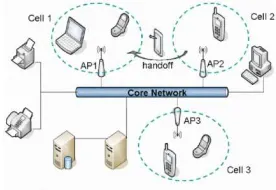
Figure 1: Vertical Handoff in heterogeneous
networks
Vertical handovers:
(A) Supervision of handover processes
Available Online At www.ijpret.com
Handover is the process of maintaining a
user’s active sessions when a mobile
terminal changes its connection from one
network to another access network, There
are two types of handover i.e. horizontal
and vertical. A horizontal handover is the
handover between points of attachment
supporting the same network technology.
for example, two neighboring base stations
of a cellular network. On the other hand, a
vertical handover is the handover when
points of attachment supporting different
network technologies.
A handover process can be divided into
three stages: hand-over decision, channel
assignment and radio link transfer.
Handover decision involves the selection of
the target point of attachment and the time
of the handover. channel assignment deals
with the allocation of channel resources
and Radio link transfer is for forming links
to new point of attachment.
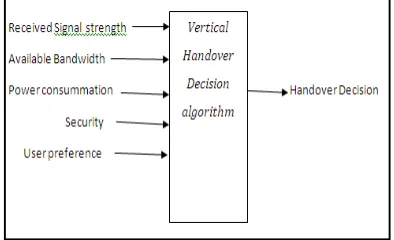
While choosing the best network
VHD(Vertical Handover decision) algorithms
has to take care of not only the efficiency
but also criteria’s such as service cost and
power so that maximum user satisfaction is
achieved. For Horizontal Handover Decision
measure parameter of concern is RSS.
Figure 2: Parameters used for making VHD
decisions
B) Key Management Issues for Public Key
Cryptography
The public key cryptography has one
interesting concept which solves the
problem of distributing secret keys. The
message send by user1 is received only by
user2 without agreeing on secret key ,
because encryption & decryption keys are
totally different. In practice, the methods
that have been developed for realizing
public key encryption are comparatively
slow, and public key cryptography is
generally used for encrypting ``session
Available Online At www.ijpret.com
traditional single-key encryption method
such as the Data Encryption Standard (DES).
Digital signatures are also implemented in
Public key cryptography. As public and
private keys are different, without
disclosing secret key users can sign their
data & allow others to verify their
signatures with the help of public key.
Public key cryptography provides two
schemes to encrypt messages:
1. Users can "sign" messages by encrypting
them with their private keys. Since any
message recipient can check that the user's
public key can decrypt the message, and
also prove that the user's secret key was
used to encrypt it.
2. Users can send secret messages, by
encrypting them with the recipient's public
key. In this case, only the intended recipient
can decrypt the message, since only that
user should have access to the required
secret key.
For a scalability reason, we use in our
proposal the first scheme. The public key or
the asymmetric cryptography allows each
user (sender) to have a pair of
public/private key. Once user-1 wants to
send a message to user-2, it encrypts the
message with its private key. Then, at the
reception of this message user-2 decrypts
the message using the user-1 public key.
To manage the creation and liberation
processes of the pair’s public/private key
we need a key management system, which
implements the Public Key Infrastructure
(PKI).
This PKI covers several jobs:
(i) Generates pairs of keys (public /
private keys).
(ii) Insures the correspondent between
public key and user.
(iii) Certifies the association between
each user and its public key.
(iv) Revokes key (in case of loss by its
owner, expiration date of its validity
or compromise).
C) SECURED-DISTRIBUTED VERTICAL
HANDOFF DECISION (SEC-DVHD)
The provision of seamless vertical handover
Available Online At www.ijpret.com
Handover Decision (VHD) scheme. we
assume that the MN is moving in an area
covered by different networks, managed by
one or different operator(s).
Networks involved in the mobility area are
divided into two categories:
(i) Serving Network (SN): SN is the network
to which the MN is actually connected.
(ii)Target Network (TN): TN is the available
network to which the MN may connect.
These networks consist of Point of
Attachments (PoAs) implementing different
technology types, such as UMTS, WiMax,
WiFi, etc. Handoff events occur when QoS
degradation appears at the SN. Thus, the
MN switches to the appropriate TN using
the DVHD scheme, this TN will be the MN’s
SN.
In the process of sec-DVHD, The MN
initiates the handoff process basing on QoS
degradation at the SN. Then, the MN sends
its Mobile Node Identity (MNID) to each TN,
encrypts the NQV using the PoA’s PrK (the
TN’s PoA to which the MN may connect)
and sends the encrypted NQV to the MN.
The MN receives the encrypted NQV from
all TNs, decrypts the received messages
using the corresponding PoA’s PuK. After
creating a list of confidence PoAs’ NQVs (by
eliminating the NQVs coming from
malicious PoA) the MN picks up the highest
NQV value and redirects its connection to
the chosen network.
Figure 2. Sec-DVHD Process
D) Sec-DVH DECISION MAKING
PARAMETERS
i)Bandwidth
Bandwidth is a measure of the width of a
range of frequencies. Higher the bandwidth,
lower the call dropping and call blocking
Available Online At www.ijpret.com
ii)Handoff Latency
The time elapses between the last packet
received via the old access router and the
arrival of the first packet along the new
access router after a handoff. This is known
as handoff latency. Handoff Latency affects
the QoS and it is essential to consider
handoff latency while designing any handoff
technique.
iii)Power Consumption
During handoff, frequent interface
activation can cause considerable battery
drainage. It is also important to incorporate
power consumption factor during handoff
decision.
iv)Network Cost
A multi criteria algorithm for handoff should
also consider the network cost factor.
Different charging policies are followed for
different type of traffic. So that in some
situation cost should also be consider as a
factor for decision making.
v)User Preferences
Based on the application requirements like
(real time, non-real time), service types
(Voice, data, video), Quality of service etc.
the user may prefer different network
according to the network performance
which is the important benefit of
heterogeneous networks.
vi)Network Throughput
Network throughput refers to the average
data rate of successful data or message
delivery over a specific communications
link. Handover to the network which has
higher throughput is desirable.
vii)Network Security
It consists of the provisions and policies
adopted by the network to prevent and
monitor unauthorized access, misuse,
modification, and network-accessible
resources.
Viii) Received Signal strength (RSS)
The performance of a wireless network
connection depends in part on signal
strength. The wireless signal strength in
each direction determines the total amount
of network bandwidth available along that
connection. A signal should be strong
Available Online At www.ijpret.com
station to maintain signal quality at
receiver.
(II) Simulation Result:
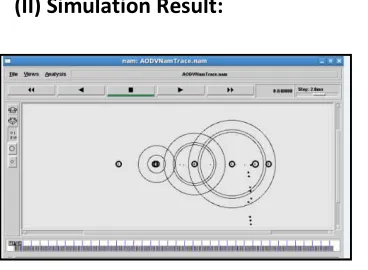
Figure 3: Output of simulation
We are going to use the simulation for:
• Determining the throughput for each node; ns-2 should calculate the bytes
received by each node.
• Determining the packet loses; ns-2 should calculate the bytes that are
transmitted and not receive by any
node.
• Providing network security through secured vertical handoff Decision
(Sec-DVHD) scheme using PKM(Public Key
Management).
Determining the average packets end to
end delay; ns-2 should calculate the
difference time of the last packet received
and the number of all packets received.
The simulation output shows the
communication between different nodes,
we can observe that different nodes are
transmitting the data packets
simultaneously. It can be noticed that due
to the atmospheric noise some amount of
packet drop occurs during the ongoing
communication between the nodes in the
network. Further development in the
research work will concentrate on providing
the security to the transmission of these
data packets in the form of Public Key
Infrastructure (PKI) algorithm.
(III) References:
1. Ram tawil, Jacques Demarjien and Guy
Pujolle, “Secured Vertical Handoff Decision
Scheme for the fourth Generation
wireless network”, International conference
,IEEE 24-27 nov.-2008.
2. Yaw Nkansa-Gyekye and Johnson I.
Agbinya, “Driven Vertical Handoff
Decision scheme Algorithm for 4G
wireless network”, AusWireless 2007, IEEE
Available Online At www.ijpret.com
3. Enrique Stevens-Navarro and Vincent
W.S.Wong, “Providing security in fourth
Generation wireless network”, IEEE-VTC
2006.
4. Mcnair, J., Zhu, F., 2004. Vertical
handoffs in fourth-generation multinetwork
environments. IEEE Wireless
Communications 11, 8–15.
5. G.Mapp, D.N Cotingham, F. Shaikh, P.
Vidales,L. Patanapongpibul, J. Crowcroft,
“An Architecture Framework for
Heterogeneous Networking” International
conference on wireless information
network and system(WINSYS), pp 5-10,
august 2006.
6. Y. Park and T. Park “A Survey of Security
Threats on 4G Network” in Communication
& Networking Lab. Samsung Adv. Inst. Of
Technology Globecom. Workshops, IEEE
Washington, DC pp 1-6. 22-01-2008.
7. Mandeep Kaur Gondara and Dr. Sanjay
Kadam” Requirements of Vertical Handoff
mechanism in 4G wireless networks”
International Journal of Wireless & Mobile