25
ISSN: 2250 – 2688Received: 31/01/2017 Revised: 21/03/2017 Accepted: 29/03/2017
Nidhi Jain
Department of Pharmacy, Barkatullah University, Bhopal, Madhya Pradesh-462026, India
Rahul Gupta
Department of Pharmacy, School of Medical and Allied Sciences, Galgotias University, Greater Noida, Uttar Pradesh, India
Correspondence
Nidhi Jain
Department of Pharmacy, Barkatullah University, Bhopal, Madhya Pradesh-462026, India
E mail: [email protected]
DOI: 10.24092/CRPS.2017.070104
Website: www.crpsonline.com
Quick Response Code:
Development and
in vitro
Evaluation of Floating Microparticles
of Cimetidine
Nidhi Jain, Rahul Gupta
ABSTRACT
Microspheres of Cimetidine by emulsion solvent diffusion technique were prepared for sustained delivery by using polymers like Ethyl cellulose and Carbopol 934 in order to extend the drug release for about 12 h in the upper GIT, which may result in enhanced absorption and there by improved bioavailability. The particle size was determined by optical micrometer and average particle size was found to be in range of 89.5± 2.63 to 124.33± 2.14. Formulation F2 containing Ethyl cellulose and Carbopol 934 polymer blend showed the best floating ability (97.5%) as compared with other formulations. From Scanning Electron Microscopy (SEM) it was observed that, Microparticles were found to be spherical in shape with smooth surface texture with a hollow space within. Among all formulations, F2 showed appropriate balance between buoyancy and drug release rate of 88.65% in 12 h, which was considered as the best formulation.
Key Words: Cimetidine, Microparticles, Emulsion solvent diffusion technique, Buoyancy, Bioavailability.
1. INTRODUCTION
Cimetidine a histamine H2-receptor antagonists is a potent agent for blocking the release
of gastric acid in patients treated with non-steroidal anti-inflammatory drugs. The drug has low bioavailability (60%) and half life of 2 h only1. Microparticles have been widely accepted as a means to achieve oral release. The Microparticles require a polymeric substance as a coat material or carrier. A number of different substances biodegradable as well as non- biodegradable have been investigated for the preparation of microparticles.
The colloidal drug delivery system/colloidal carriers like liposomes, microspheres and nanoparticles are known for its selective targeting2.The main aim of the present work was to develop the Cimetidine microparticles by using ethylcellulose-carbopol 934 as a polymer for prolonged, relatively constant effective level of Cimetidine and improve patient compliance3.The purpose of formulating gastric floating drug delivery system was to prolong the gastric residence time after oral administration, at particular site and controlling the release of drug especially useful for achieving controlled plasma level as well as improving bioavailability4. Floating dosage form (Microparticles) containing Cimetidine as drug is designed for the treatment of gastric ulcer.
2. MATERIALS AND METHODS
Cimetidine was obtained as a gift from Torrent Pharma Gujarat. Ethylcellulose, Carbopol 934. Dichloromethane, Ethanol and Polyvinyl alcohol were purchased from Central Drug House Delhi, India. Rest all other chemicals were of analytical and HPLC grade.
26
2.1 Preparation of floating Microparticles5,6Floating Microparticles were prepared by the emulsion solvent diffusion method. Cimetidine, Ethylcellulose and Carbopol 934 were dissolved in a mixture of Ethanol and Dichloromethane (DCM). The resulting solution was added slowly to stirred 250mL of aqueous solution of 0.50% (w/v) Poly vinyl alcohol (PVA) at room temperature. The stirring was done for 2 h at 1000-1200rpm by mechanical stirrer equipped with four bladed propellers. With continuous stirring solvent was allowed to evaporate. After evaporation of solvent, Microparticles were filtered by Whatman filter paper collected washed with water and dried at room temperature in a desiccator for 24 h.
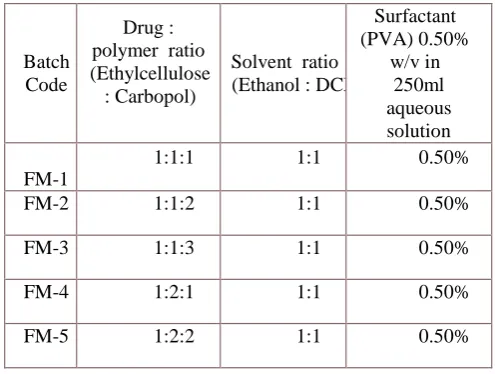
Table 1. Composition of the prepared Floating Microparticles
2.2 Evaluation Parameters7,8
2.2.1 Particle size and size distribution
Floating Microparticles were studied microscopically for their size and size distribution using calibrated ocular micrometer. Least count of the ocular micrometer was calculated as 75 μm. Around 50 particles from each formulation were observed and the data for each formulation were recorded.
2.2.2 Drug content and entrapment efficiency
The drug content was measured by extracting 78mg of Microparticles using 0.1 N HCl with agitation for 8 hrs. The dispersion was sonicated for 15 mins and filtered. After appropriate dilution with 0.1N HCl, absorbance was taken in UV spectrophotometer at λmax 298 nm. The % drug content was calculated from the formula:
Drug entrapment efficiency represents the proportion of the drug,
which has been incorporated into the Microparticles.
2.2.3 In vitro Buoyancy
Floating Microparticles in 78mg quantity calculated on the basis of single dose were dispersed in 900ml of 0.1 N HCl solution (pH 1.2) containing simulated gastric fluid at 37C. The mixture was stirred with a paddle at 100 rpm and after 12 hrs,first the layer of buoyant Microparticles (Wf) was pipetted out and then sinking Microparticles (Ws) were separated. Both Microparticles types were dried at 40C overnight. Weights of each were measured and buoyancy was determined.
Buoyancy (%) = [Wf/(Wf + Ws)] × 100
Wf = weights of the floating Microparticles.
Ws = weights of the settled Microparticles.
2.2.4 Yield of Floating Microparticles
The prepared floating Microparticles were collected and
weighed. The measured weight was divided by total amount of all
non-volatile components which were used for the preparation of
Microparticles.
2.2.5 Morphological Characterization
The floating Microparticles were examined by scanning electron microscopy (Zeiss Germany).
2.2.6 In vitro Drug release study in simulated gastrointestinal
fluid
Microparticles were evaluated on the basis of above tests and the best formulation was then used for determiningIn vitro
drug release study by the paddle type dissolution apparatus specified in USP XXIII.78mg of Cimetidine loaded floating Microparticles was weighed accurately and gently spread over the Batch
Code
Drug : polymer ratio (Ethylcellulose
: Carbopol)
Solvent ratio (Ethanol : DCM)
Surfactant (PVA) 0.50%
w/v in 250ml aqueous solution
FM-1
1:1:1 1:1 0.50%
FM-2 1:1:2 1:1 0.50%
FM-3 1:1:3 1:1 0.50%
FM-4 1:2:1 1:1 0.50%
27
surface of 900 ml of dissolution medium. The content was rotated and thermostatically controlled at 37±0.5C. The release was determined in dissolution medium of pH 1.2.Aliquot was withdrawn at predetermined time intervals and an equivalent amount of fresh medium was added to the release medium. The collected sample were analysed spectrophotometrically.3. RESULT AND DISCUSSION
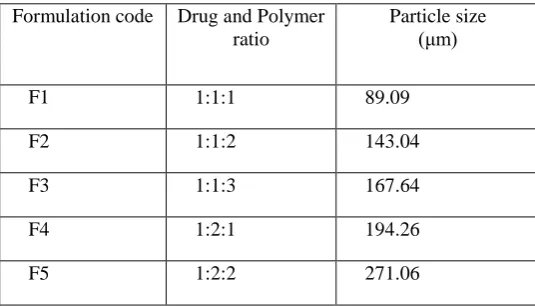
The Microparticles of Cimetidine were prepared by solvent diffusion evaporation method. The effect of formulation variables e.g. drug concentration, solvent ratio of internal phase (Ethanol/Dichloromethane), surfactant concentration and process variables e.g. stirring speed were studied in order to optimize the formulation. The results suggested that these variables influence the shape, size and size distribution, total drug loading efficiency and In vitro drug release. Hence, these parameters were optimized to prepare Microparticles of small size with narrow size distribution, good drug loading efficiency, good release at the gastrointestinal pH and good surface morphology. On studying the particle size (Tab. 2) of prepared formulations it was predicted that as the concentration of ethylcellulose was increased the size of particle increased while the concentration of carbopol has little effect on size as compared to ethylcellulose, so F5 formulation was prepared with maximum particle size (271.06 μm).
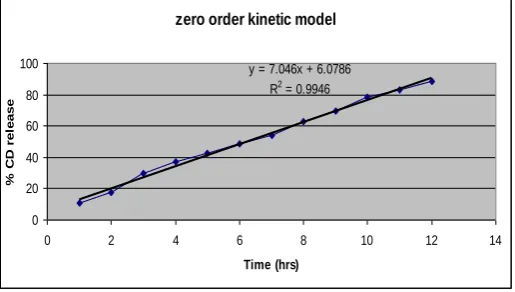
The percentage yield of Microparticles was found to be 79.0-96.4% which showed good efficiency to get good productivity of Microparticles. The entrapment efficiency was found to be 62.3-88.1% and similarlyIn vitro buoyancy was found to be 23.4-58.2 %(Table 3).The main aim of the study was floating so the buoyancy was the factor which needs to be considered for determining the best formulation. Formulation F3showed the buoyancy of 58.2% and this higher value as compared to other was attributed to the presence of maximum concentration of carbopol. Being super porous in nature, the increase in concentration of carbopol showed the maximum floating capability. The other evaluation parameters like % yield and entrapment showed to depend upon the concentration of ethylcellulose. The In vitro drug release study for F3 was performed in 1.2 pH 0.1N Hcl, confirmed that floating Microparticles resulted in sustained and prolonged release of drug in the GIT fluids and they released upto 88.65% in 12 hrs. The kinetics of the release was also determined through zero order , first order , higuchi model , Korsemeyer Pepas release kinetics graphs.
Table 2. Effect of Polymer ratio on Particle size of floating Microparticles
Table 3. Parameter of evaluation of Microparticles
Formulation code
% Yield %E.Efficiency % Bouyancy
F1 79.0 62.3 50.9
F2 82.0 64.7 51.2
F3 86.0 79.5 58.2
F4 94.2 83.5 35.7
F5 96.4 88.1 23.4
Figure 1.Scanning Electron microscopic Image Formulation code Drug and Polymer
ratio
Particle size (μm)
F1 1:1:1 89.09
F2 1:1:2 143.04
F3 1:1:3 167.64
F4 1:2:1 194.26
28
Table 4. % Drug release of F3 formulationTime(hours) % Drug Release
0 0
1 10.8
2 17.44
3 29.74
4 37.08
5 42.3
6 48.6
7 54.36
8 62.86
9 69.3
10 78.6
11 82.8
12 88.65
As per data of regression coefficient, the maximum value of regression coefficient was of KorsemeyerPeppas kinetic model so it can be inferred that release kinetics of drug from formulation F3 was according to KorsemeyerPeppas kinetic model.
zero order kinetic model
y = 7.046x + 6.0786 R2 = 0.9946
0 20 40 60 80 100
0 2 4 6 8 10 12 14
Time (hrs)
%
C
D
r
e
le
a
s
e
Figure 2. Zero order kinetic of drug release
Figure 3. First order kinetic of drug release
Figure 4. Higuchi kinetic of drug release
Figure 5. Korsemeyer Pepas kinetic of drug release
4. CONCLUSION
Microparticles ofCimetidine were successfully prepared by solvent diffusion evaporation method. These prepared Microparticles showed good size, surface morphology means
Higuchi kinetic model
y = 32.38x - 27.041 R2 = 0.9851
0 20 40 60 80 100
0 0.5 1 1.5 2 2.5 3 3.5 4
Square root of time
%
C
D
r
e
le
a
s
e
y = 0.856x + 1.027 R² = 0.994
0 0.5 1 1.5 2 2.5
0 0.5 1 1.5
L
o
g
%
C
D
r
e
le
a
s
e
29
smooth surface which is always an important factor to check the stability and strength of microstructure formulation. The In vitro release data of floating microparticles of cimetidine exhibited good buoyancy up to 12 hrs and released the drug in desired fashion for prolong duration of time. It could be easily concluded from above mentioned parameters that floating microparticles of cimetidine were most acceptable and premising formulation to get better drug release and good therapeutic effect.REFERENCES
1. Begum ASK, Basava RD. Formulation development and evaluation of Cimetidine floating microspheres. IJPRIF. 2016; 9: 182-192. 2. Kumari K, Sharma P, Gupta R. Polysorbate-Phospholipid Complex
Micelles as P-glycoprotein Inhibitor Drug Delivery System. JBPT. 2017; 1: 2-7.
3. Trivedi P, Verma AML, Garud N. Preparation and characterization of aceclofenac microspheres. Asian J Pharm. 2008; 19: 110-115. 4. Mathur P, Seth PR. Floating drug delivery system, An innovative
acceptable approach in gastroretentive drug delivery and novel dosage forms which retained in the stomach for prolong and predictable period of time. Arch App Sci Res. 2010; 2:257-270. 5. Streubel A, Siepmann J, Bodmeier R. Floating microparticles based
on low density foam powder. Int. J. Pharm. 2003; 241: 279-292. 6. Rajput G, Majmudar F, Patel J, Thakor R, Rajgor NB.
Stomach-specific mucoadhesive microsphere as a controlled drug delivery system. Sys Rev Pharm. 2010; 1: 36-44.
7. Kawashima Y, Niwa T, Takeuchi H , Hino T , Itloh Y . Hollow microspheres for use as floating drug delivery System in the stomach. J Pharm ScI. 1992; 8:135-140.