5
Evaluating Impact of Wormhole on Routing and
Routing Path Length
Shalki Naresh
Department of Computer Science and Engineering
MVEC, Jagadhri
Yamuna Nagar, India
[email protected]
Er. Navjot Singh
Assistant Professor
Department of Computer Science and Engineering
MVEC, Jagadhri
Yamuna Nagar, India
Abstract- WMN is the emerging wireless technology that can provide uninterrupted internet access to its users on a large scale. These networks are dynamic, self healing and self configuring. They gain popularity in few years due to their high bandwidth and low rates. Also these networks use the property of multi-hops. But these networks are open to many security attacks due to their open nature, wireless medium and many other factors. Of all these attacks the wormhole attack is the worst. In this attack two or more malicious nodes replays the overheard traffic with the help of tunnel. Thus results in drop of packets. In this paper, we have worked on finding the impact on some routing parameters of network like average affected nodes when base is at center, average affected nodes when base is at corner and affect on routing path length by employing strict protocol and verified protocols.
Keywords: WMN (Wireless Mesh Networks), wormhole, wormhole detection, Impact of wormhole.
I. INTRODUCTION
A. Wireless Mesh Networks
An emerging wireless technology that is accepted as the solution of internetworking for future generations is WMN.
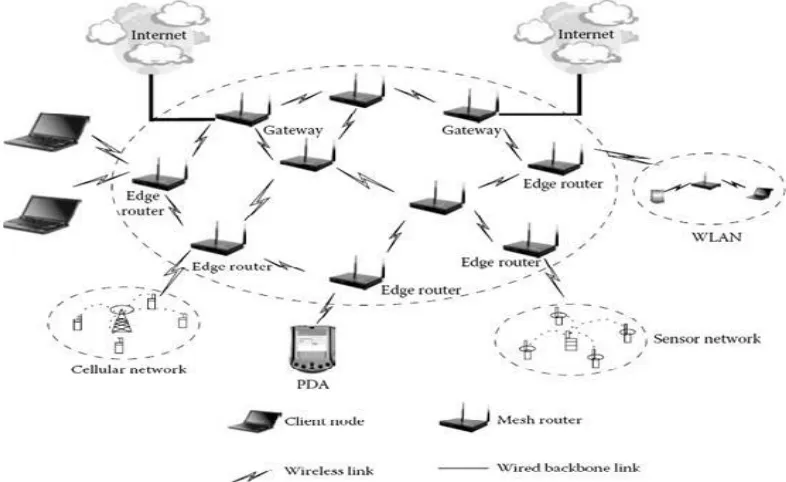
The main features of Wireless Mesh Networks are its fast and easy deployment, self configuration, etc. It does-not use the concept of fixed infrastructures like other wireless networks. On the other hand, the hosts depend on one another for keeping the connectivity of the network. The wireless ISP are opting WMNs for providing Internet Services because they are easy, fast, cost effective and offer high bandwidth. The WMNs are formed by using the: Mesh Clients and Mesh routers. The one which are static, enables power and forms the backbone of the network to provide the internet access which is multi-hop in nature are the mesh routers whereas the mesh clients are the one which access the internet via mesh routers [7]. A WMN can be of three types: Infrastructure WMN which simply use the mesh clients, mesh routers and employ the IEEE 802.11 technology; Client WMN in which there is no need of the router and there is peer to peer connection between the nodes which directly transmit data; and Hybrid WMN which is the combination of both infrastructure and client WMN in which connection between router and client is made by infrastructure part and client manages the routing [8]. A simple WMN is shown in figure 1:
6
B. Wormhole Attack
A security attack which causes DoS is wormhole attack. This attack does-not need any type encryption knowledge but still is able to mislead or disrupt the routing operations. Due to which its identification is necessary. This attack is great threat for wireless networks as they can disrupt the whole network by means of two or more attackers. A high speed link which is off-channel is used to form a link known as wormhole link. This attack has two types: exposed and hidden. In exposed mode the attacker attaches its identity with the tunneled and replayed packets whereas in hidden mode it does not reveal its identity [6].
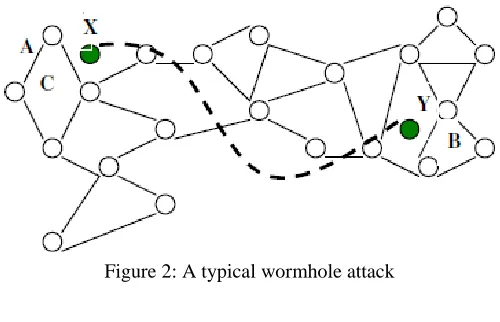
In this attack, a tunnel is formed between the conspired nodes so that they can transfer and replays the data packets of the network. This attack has bad effect on routing because the legal nodes can get confused about the packets and their legal neighbors. Figure 2 represents simple wormhole attack. In this, node Y replays the packets which are received by node X and vice versa. Generally, there is a distance of several hops between the node X and Y but due to wormhole (tunnel) the packets will reach earlier at Y from X (in comparison to actual path). And because of this the node A and B believes the attacker that they (attacker) are their legal neighbors for data transmission which results in drop of data and its packets [6].
Figure 2: A typical wormhole attack
II.
LITERATURE SURVEYMany articles are studied related to WMNs, Wormhole and its detection. Some of them are discussed below:
Dr. M.S. Aswal et.al [7] Wireless mesh networks (WMN) is a new area of technology and has an important role in next generation wireless mobile networks. WMN is distinguished by its dynamic healing, configuration and self-organization and its ability to enable quick deployment, flexible integration, low costs, easy maintenance, high reliability and scalability services. So security of this network is important. The vital need and challenges of security in WMNs are analyzed and reviewed in this paper. The possible active threats and open features of WMN with some respective defense mechanisms are also discussed. This paper can be utilized for the creation of a secured and full-proof WMN.
Safak Durukan Odabasi et.al [8] Internet has become an essential part of our daily lives now-a-days. It has a huge
growth in every field from banking transactions to online entertainment. The internet access of next generation has become wireless like cellular phones. For this purpose a new network has be designed or changes has to be made in existing design. The main advantage of networks with mesh design is their working capability without infrastructure. Wireless Mesh networks have additional access technology which is greater than the changed one in 4G (next generation wireless network).This paper is focused on mesh networks and its applications. Basic architecture, design factors, current routing protocols metrics of routing protocols in mesh networks is explained. Then the performance and effect of these protocols and its metrics are referred.
V. S. Shankar Sriram et.al [3] In Wormhole attack, an attacker with no cryptographic material and with limited resources can cause havoc on wireless networks. Initially it is believed that this attack can be possible on only Ad-hoc networks, but later it is concluded that wormhole attack can be possible on any wireless LANs based on infrastructure. In this paper, an architecture is proposed and is analyzed for
wormhole attack possibility on it with various
countermeasures/preventions to avoid this attack. In the proposed mechanism, information is shared among access points which are communicating so that rouge or malicious access point is prevented from behaving as false neighbors. This defense mechanism can widely lessen wormhole threat and no clock synchronization or information about location is needed by this mechanism
Pushpendra Niranjan et.al [5] Due to wireless transmissions in MANET, it has more security problems than wired networks. This paper is focused on tunneling attack in which there is no exploitation of nodes present in the network but still it can interfere the process of route establishment. The given method does not detect the suspicious nodes as in earlier methods but directly detects attacker nodes without making modification to protocols, by the use of time-delay and hop-count analysis and not making any special assumptions. The simulation of proposed work is done by using OPNET, results of which show the advantages of given method.
P Subhash et.al [13] The working of WMNs (Wireless Mesh Networks) is hugely degraded due to wormhole attack because an attacker of this attack is able to convince far away nodes as nearby/neighbor without knowing the cryptographic primitives. For secure communication in the network the knowledge of secure neighbor is mandatory. This paper presents a mechanism to verify secure neighbors to hinder wormhole attack and to prevent false links to get involved in network operations. The relative distance among neighbors is computed by using the scheme of node ranking and genuiniety of creation of neighborhood is checked by the use of connectivity information. The evaluation of mechanism is done by simulation of network under wormhole attack.
III. PROPOSED WORK AND IMPLEMENTATION
7
impact of this attack on routing parameters which includesfinding the average number of affected nodes when base is at centre and when base is at corner; and finding the impact of wormhole on routing path length. No GPS or clocks are used in our work. The work is discussed as:
1. Impact on routing: In this work, the average number of affected nodes at various pixels is found in two cases: Base at centre and Base at corner for 50, 100 and 150 nodes which is discussed below:
a. Base as Centre: In this case, the base is taken at centre and then the ratio of average affected nodes that are the neighbors of the base is found at various co-ordinates. This is done for 50, 100 and 150 nodes at radio range=50 and directional range= 80.
b. Base as Corner: In this case, the base is taken at the corner and then the ratio of average affected nodes that are the neighbors of the base is found at various co-ordinates. This is done for 50, 100 and 150 nodes at radio range=50 and directional range= 80.
2. Impact on routing path length: To know the impact of wormhole on routing path length the average trusted hops are found related to average number of hops. For this two
protocols are employed: Strict protocol and verified protocol. The average number of trusted hops are found by both of these protocols for 50, 100 and 150 nodes at radio range= 50, directional range=80.
The main objective of our work is:
To find impact of wormhole on neighbor nodes when
base is at centre.
To find impact of wormhole on neighbor nodes when
base is at corner.
To find impact of wormhole on the path length byusing strict and verified protocols.
IV. RESULTS AND DISCUSSION
On working on the above noted proposed work and after implementing it following results have been achieved:
a. Impact on Routing: For 50, 100 and 150 nodes the average affected ratio of nodes is found for below two cases:
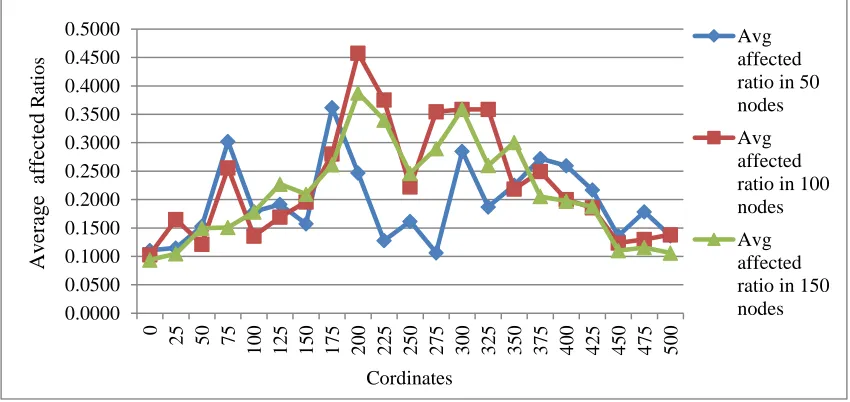
Base at centre: In the first case, the base is taken at the centre and the affect of wormhole attack is found on its neighbor nodes. Thus, we get the average affected ratio of nodes for 50, 100 and 150 nodes. The figure 3 shows the average affected ratio of nodes when base is takenas centre for 50, 100 and 150 nodes:
Figure 3: Average affected ratio when base is taken as centre for 50, 100 and 150 nodes
This graph shows the average affected ratio of nodes at various co-ordinates. By seeing this graph we find out that the when base is taken at centre the average affected ratio increases with increase in number of nodes. But in this case the average affected ratio is maximum for 100 nodes. We can work on changing the location of nodes so that the average affected ratio can be decreased.
Base at corner: In the second case, the base is taken at the corner and the affect of wormhole attack is found on its neighbor nodes. Thus, we get the average affected ratio of nodes for 50, 100 and 150 nodes. The figure 4 shows the average affected ratio of nodes when base is taken at corner for 50, 100 and 150 nodes: 0.0000
0.0500 0.1000 0.1500 0.2000 0.2500 0.3000 0.3500 0.4000 0.4500 0.5000
0 25 50 75
1
0
0
1
2
5
1
5
0
1
7
5
2
0
0
2
2
5
2
5
0
2
7
5
3
0
0
3
2
5
3
5
0
3
7
5
4
0
0
4
2
5
4
5
0
4
7
5
5
0
0
Avg affected ratio in 50 nodes
Avg affected ratio in 100 nodes
Avg affected ratio in 150 nodes
Cordinates
A
v
er
ag
e
af
fec
ted
R
atio
8
Figure 4: average affected ratio when base is taken at corner for 50, 100 and 150 nodesThis graph shows the average affected ratio with base as corner at various co-ordinates. From this graph it is clear that the average affected ratio increases with the increase in node number. The average affected ratio is maximum for 150 nodes. This affect can be controlled by varying the location of nodes.
b. Impact on routing path length:
The impact of
wormhole attack on the routing path length is found
for 50, 100 and 150 nodes. This is done by getting
the average trusted hops and average hops, by
employing the strict and verified protocol. This is
done for 50, 100 and 150 nodes. The results
achieved are as under:
For 50 nodes:
Figure 5 shows the impact on
routing path length for 50 nodes:
Figure 5: Affect of wormhole on path length for 50 nodes
The figure above shows that the average hops and trusted hops increases with each iteration. But for 50 nodes the value of average trusted hops is always less than that of average number of hops. The figure also shows that the trusted hops obtained in case of strict protocol are more than that of verified protocol.
For 100 nodes:
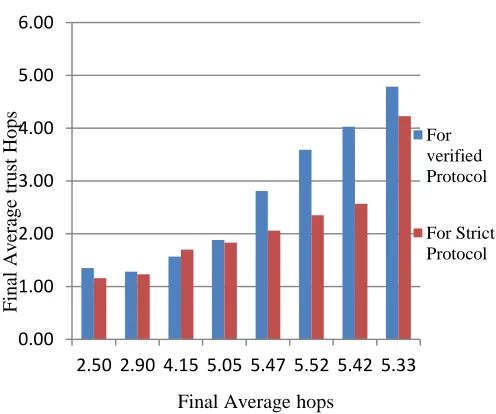
Figure 6 shows the impact on
routing path length for 100 nodes:
Figure 6: Affect of wormhole on path length for 100 nodes
The figure above shows that the values of both parameters increase with the iterations. It also shows that these value of trusted hops is less than average hops but is more than in case of 50 nodes. But in case of 100 nodes, the trusted hops obtained in case of verified protocol is more than strict protocol.
0.0000 0.2000 0.4000 0.6000 0.8000 1.0000 1.2000
0
25 50 75 100 125 150 571 002 225 250 275 030 325 350 375 004 425 450 475 500
Avg affected ratio in 50 nodes Avg affected ratio in 100 nodes Avg affected ratio in 150 nodes
Cordinates
A
v
er
ag
e
af
fec
ted
r
atio
0 0.2 0.4 0.6 0.8 1 1.2 1.4 1.6 1.8 2
2.50 2.39 2.96 3.51 4.26
For verified Protocol
For Strict Protocol
Fin
al
av
er
ag
e
tr
u
st
h
o
p
s
Final Average Hops
0.00 1.00 2.00 3.00 4.00 5.00 6.00
2.50 2.90 4.15 5.05 5.47 5.52 5.42 5.33 For verified Protocol
For Strict Protocol
Final Average hops
Fin
al
A
v
er
ag
e
tr
u
st
Ho
p
9
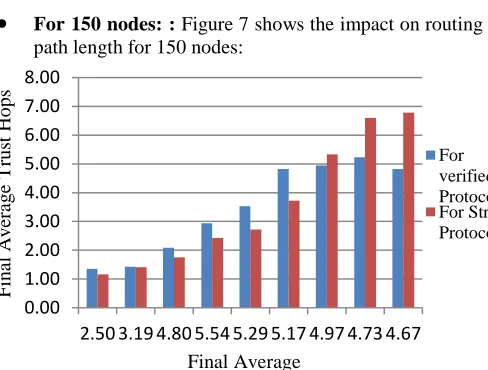
For 150 nodes: : Figure 7 shows the impact on routingpath length for 150 nodes:
Figure 7: Affect of wormhole on path length for 150 nodes
The figure above shows that average hops and trusted hops value increases with each iteration. It also shows that in some cases the value of average trusted hops is more than the average hops. The value of trusted hops is always more for strict protocol than verified protocol.
So, by studying these three cases we find out that the average hops and trusted hops increases with the increase in number of nodes and the strict protocol leaves less affect of wormhole on the nodes than the verified protocol.
V. CONCLUSION
In this research we study the wormhole attack which is a huge threat for the wireless networks. The impact of wormhole on some routing parameters is found. The impact of wormhole when base is taken as centre shows that the number of affected ratio increases as the number of nodes increases but in our study it is maximum for 100 nodes. Also when base is taken at corner, the affected ratio clearly grows with the number of nodes and in our case gives maximum value for 150 nodes. And on finding the impact of wormhole on routing path length we find out that the average number of trusted hops increases with increase in number of nodes. And also when strict protocol is employed the more average trusted hops are obtained as compared to verified protocol.
REFERENCES
[1] Issa Khalil, Saurabh Bagchi, Ness B. Shroff, “MOBIWORP: Mitigation of the Wormhole Attack in Mobile Multihop Wireless Networks.” [2] Hyunok Lee, Donald C. Cox, “A fully- distributed control time slot
assignment protocol for large wireless mesh networks”, 978-1-4244-2677-5/08/$25.00 c 2008 IEEE.
[3] V.S.Shankar Sriram, Ashish Pratap Singh, G.Sahoo, “Methodology for Securing Wireless LANs Against Wormhole Attack”, International Journal of Recent Trends in Engineering, Issue. 1, Vol. 1, May 2009. [4] Debdutta Barman Roy, Rituparna Chaki, Nabendu Chaki, “A new
cluster-based wormhole intrusion detection algorithm for mobile ad-hoc networks”, International Journal of Network Security & Its Applications (IJNSA), Vol 1, No 1, April 2009.
[5] Pushpendra Niranjan, Prashant Srivastava, Raj kumar Soni, Ram Pratap, “Detection of Wormhole Attack using Hop-count and Time delay
Analysis”, International Journal of Scientific and Research Publications, Volume 2, Issue 4, April 2012 ISSN 2250-3153.
[6] Priya Maidamwar and Nekita Chavhan, “ A survey on security issues to detect wormhole attack in wireless sensor network”, International Journal on AdHoc Networking Systems (IJANS) Vol. 2, No. 4, October 2012 DOI : 10.5121/ijans.2012.2404 37.
[7] Dr. M.S.Aswal, Paramjeet Rawat, Tarun Kumar, “Threats and Vulnerabilities in Wireless Mesh Networks”, International Journal of Recent Trends in Engineering, Vol 2, No. 4, November 2009.
[8] Safak Durukan Odabasi, A. Halim Zaim, “A survey on Wireless Mesh Networks, Routing Metrics and protocols”, International Journal of Electronics, Mechanical and Mechatronics Engineering Vol. 2 Num. 1 pp(92-104).
[9] Poonam Dabas, Prateek Thakral, “Detection and Prevention of Wormhole Attack in MANET: A Review”, International Journal of Advanced Research in Computer Science and Software Engineering Volume 3, Issue 3, March 2013.
[10] Ratika Sachdeva, Aashima Singla “Survey on Privacy Issues and Security Attacks in Wireless Mesh Networks”, International Journal of Advanced Research in Computer Science and Software Engineering Volume 3, Issue 4, April 2013.
[11] Virendra Dani, Vijay Birchha, “Security Enhancement Technique for Defending Wormhole Attacks in Wireless Mesh Networks”, (IJCSIT) International Journal of Computer Science and Information Technologies, Vol. 6 (4), 2015, 3943-3948.
[12] Ankur Rajput, Sachin Goyal, Ratish Agrawal, “Detecting Malicious Traffic in Wireless Mesh Network”, International Journal of Engineering Research and General Science Volume 3, Issue 2, Part 2, March-April, 2015 ISSN 2091-2730.
[13] P Subhash, S Ramachandram, “Secure Neighbor verification protocol in Wireless Mesh Networks”, Journal of Theoretical and Applied Information Technology 20th December 2015. Vol.82. No.2.
0.00 1.00 2.00 3.00 4.00 5.00 6.00 7.00 8.00
2.50 3.19 4.80 5.54 5.29 5.17 4.97 4.73 4.67 For verified Protocol For Strict Protocol
Final Average Hops
Fin
al
A
v
er
ag
e
T
ru
st H
o
p