Vol. 8, No. 1, 2015, 9-17
ISSN: 2320 –3242 (P), 2320 –3250 (online) Published on 28 May 2015
www.researchmathsci.org
International Journal of
Totally Regular Property of the Join of two Fuzzy Graphs
K. Radha1 and M.Vijaya2 1
P.G. Department of Mathematics, Periyar E.V.R. College Tiruchirappalli – 620023, Tamil Nadu, India 2
Department of mathematics, Bharathidasan University Constituent College Perambalur – 621107, Tamil Nadu, India
Email: [email protected]; [email protected]
Received 12 May 2015; accepted 21 May 2015
Abstract. In general, the Join of two totally regular fuzzy graphs need not be a totally regular fuzzy graph. In this paper, necessary and sufficient conditions for the Join of two totally regular fuzzy graphs to be totally regular under some restrictions are obtained.
Keywords: Total degree of a vertex, regular fuzzy graph, join AMS Mathematics Subject Classification (2010): 03E72, 05C72 1. Introduction
A fuzzy subset of a set V is a mapping σ from V to [0,1]. A fuzzy graph G is a pair of functions G:(σ, µ) where σ is a fuzzy subset of a non empty set V and µ is a symmetric fuzzy relation on σ,satisfying µ(uv) σ (u) σ (v). The underlying crisp graph of G : (σ,
µ) is denoted by G*:(V, E) where E V V. Fuzzy graph theory was introduced by Rosenfeld in 1975. Though it is very young, it has been growing fast and has numerous applications in various fields. During the same time Yeh and Bang have also introduced various concepts in connectedness in fuzzy graphs. Mordeson and Peng introduced the concept of operations on fuzzy graphs.
The operations of union, join, Cartesian product and composition on two fuzzy graphs were defined by Mordeson and Peng [2]. Sunitha and Vijayakumar discussed about the complement of the operations of union, join, Cartesian product and composition on two fuzzy graphs. The Regular property of fuzzy graphs which are obtained from two given fuzzy graphs using the operations union, join, Cartesian product and composition was discussed by Nagoorgani and Radha. In our earlier work [9,10], we have discussed the totally regular property of Cartesian product and some composition of two fuzzy graphs. In this paper we study about the Totally Regular property of the Join of two fuzzy graphs and the number of vertices in the fuzzy graphs are denoted by
First we go through some preliminaries which can be found in [1-8]. 2. Basic definitions
Definition 2.1. [7] The order of a fuzzy graph is defined by
Definition 2.2. [3] Let G:(σ, µ) be a fuzzy graph. The degree of a vertex u in G is defined by
! " #$
"
$%
Definition 2.3. [5] Let G:(σ, µ) be a fuzzy graph on &. The total degree of a vertex ' is defined by
! " (
#$ !
( .
If each vertex of G has the same total degree k, then G is said to be a totally regular fuzzy graph of total degree k
or a k-totally regular fuzzy graph.
Definition 2.4. [2] Assume that ') ' * · The join (sum) of and is defined as a fuzzy graph
( : ( ( , " ( ") on &- ' , . where ' '/ ' and . ./ ./ .′ where .′ is the set of all edges joining vertices of ' with vertices of ' ,
with
( ( / 01 ' / ' 0 '
0 '
" ( " = 2" / " , 0 ./ . , 0 .′
3
" 0 ' (i.e.) 0 . " 0 ' (i.e.) 0 .
3. Total degree of a vertex in Join
Here ') ' * . Hence .) . * . By definition,
!4 5 !6 "/ "
$%4 /%6
(
$ %′
(
71 ' , !4 5 !6 "
$%4
(
$ %′
!4 ( ( ∑$ %′
!4 5 !6 !4 ( 3.1
$ %′
Similarly,
71 ' , !4 5 !6 !6 (
$ %′
3.2
Lemma 3.1. [8] Let - , " - ( , ") be two fuzzy graphs 1. < = !4 5 !6 !4 ( , 0 '
!6 ( , 0 ' 2. < = !4 5 !6 !4 ( , 0 '
!6 ( , 0 '
4. Totally Regular Property of the Join
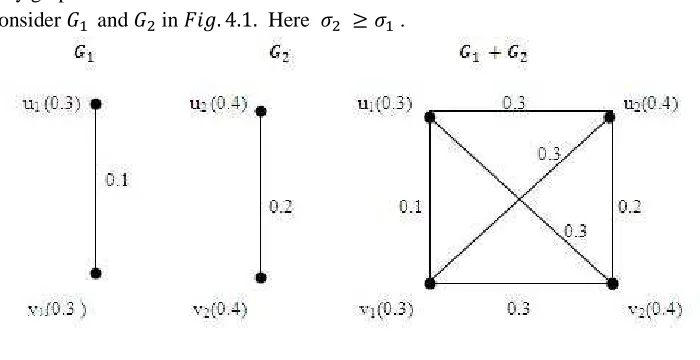
If are totally regular fuzzy graphs, then ( need not be a totally regular fuzzy graph.
Consider and in 7>. 4.1. Here < .
Figure 4.1:
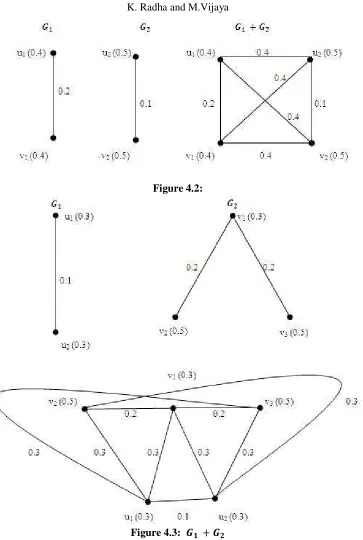
Similarly if ( is totally regular fuzzy graph then G1 is totally regular fuzzy graph
and G2 is not a totally regular fuzzy graph in 7>. 4.2.
Figure 4.2:
Figure 4.3: OP ( OQ
Theorem 4.1. Let be totally regular fuzzy graphs of the same degree such that is constant function. Then ( is totally regular fuzzy graph if and only if .
Proof : Let be k-totally regular fuzzy graphs.
Let R S 01 ' ' where c is a constant. For any ' , from (4.1) ,
!4 5 !6 !4 (
$ %′
!4 (
$ 6
T ( 4.1
For any ' , from (4.2) ,
!4 5 !6 !6 (
$ %′
!6 (
$ 4
T ( 4.2
From (4.3) and (4.4) , ( is a totally regular fuzzy graph. U T ( T ( U .
Hence the theorem.
Corollary 4.2. Let - , " - ( , ") be two k-totally regular fuzzy graphs such that < 1 < 1 is a constant function. Then ( is a totally regular fuzzy graph if and only if .
Proof: If < is a constant function, then is a constant function. < is a constant function, then is a constant function.
Hence the result follows from the above theorem 4.1.
Theorem 4.3. Let be two fuzzy graphs such that is constant function. Then ( is totally regular fuzzy graph if and only if are both totally regular fuzzy graphs of the same degree.
Proof: Let be two fuzzy graphs such that say and
X , for all ' ' where c is a constant.
For any ' , from definition (4.1) ,
!4 5 !6 !4 (
$ %′
!4 (
$ 6
!4 ( 4.3
!4 5 !6Y !6Y ( Y
$ %′
!6Y (
$ 4
!6Y ( 4.4
From 4.5 4.6 ,
( is a totally regular fuzzy graph. U !4 ( !6Y (
U !4 !6Y where ' Y ' are arbitrary. Hence ( is totally regular fuzzy graph if and only if are both totally regular fuzzy graphs of the same degree.
Corollary 4.4. Let - , " - ( , ") be two fuzzy graphs such that , < 1 < 1 is a constant function. Then ( is a totally regular fuzzy graph if and only if are both totally regular fuzzy graphs of the same degree .
Proof: Proof is similar to Corollary 4.2.
Theorem 4.5. Let - , " - ( , ") be two totally regular fuzzy graphs such that < 1 < . If ( is a totally regular fuzzy graph, then 1 is a constant function.
Proof: Let < let \ be a T\- totally regular fuzzy graph, i =1,2. For any ' , from definition (4.1) ,
!4 5 !6 !4 (
$ %′
!4 (
$ 6
T( 4.5
For any ' , from definition (4.2)
!4 5 !6 !6 (
$ %′
!6 (
$ 4
T( 4.6
Since ( is totally regular fuzzy graph then
T( T( , for any '
] T^ T ^ , for any '
_ For any , ' , ^ T^ T ^
]
Hence is a constant function.
Example 4.6. The converse of theorem 4.5 need not be true , for example , consider fig. 4.2. are two totally regular fuzzy graphs such that < 1 0 1 . But ( is not a totally regular fuzzy graph.
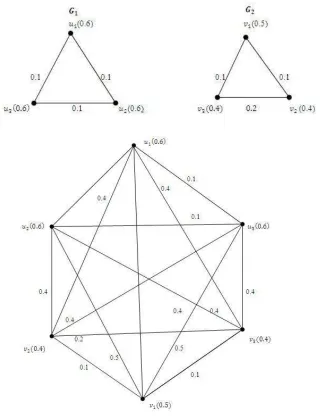
Figure 4.4: OP( OQ
Proof: From (4.3) , for any '
!4 5 !6 !4 ( !4 ( $ 6
$ %′
T(
From (4.4) , for any '
!4 5 !6 !6 (
$ %′
!6 (
$ 4
T(
Hence ( is totally regular fuzzy graph U T( T( U T^ T
^
U T^ T ^ .
Corollary 4.8. Let - , " - ( , ") be two totally regular fuzzy graphs such that < 1 < 1 is a constant function. Then ( is a totally regular fuzzy graph if and only if T^ T ^ where is the constant value of 1 .
5. Conclusion
In this paper, we have showed that the Join of two totally regular fuzzy graphs need not be a totally regular fuzzy graph. We have obtained necessary and sufficient condition for the Join of two fuzzy graphs to be totally regular in some particular cases.
REFERENCES
1. J.N.Mordeson and P.S.Nair, Fuzzy Graphs and Fuzzy Hypergraphs, Physica-verlag, Heidelberg, 2000.
2. J.N.Mordeson and C.S.Peng, Operations on fuzzy graphs, Inform. Sci., 79 (1994) 159-170.
3. A.NagoorGani and M.Basheer Ahamed, Order and size in fuzzy graph, Bulletin of Pure and Applied Sciences, 22E (1) (2003) 145-148.
4. A.Nagoorgani and K.Radha, The degree of a vertex in some fuzzy graphs, International Journal of Algorithms, Computing and Mathematics, 3 (2009) 107-117. 5. A.Nagoorgani and K.Radha, On regular fuzzy graphs, Journal of Physical Sciences,
12 (2008) 33-40.
7. A.Rosenfeld, Fuzzy Graphs, In: L. A. Zadeh, K.S. Fu, M. Shimura, Eds., Fuzzy sets and Their Applications, Academic Press, pp. 77-95 , 1975.
8. K.Radha and M.Vijaya, The total degree of a vertex in some fuzzy graphs, Jamal Academic Research journal: An interdisciplinary special issue, (2014) 160-168. 9. K.Radha and M.Vijaya, Totally regular property of cartesian product of two fuzzy
graphs, Jamal Academic Research Journal : An interdisciplinary special issue, (2015) 647-652.