Vol. 6, No. 1, 2015, 77-83
ISSN: 2320 –3242 (P), 2320 –3250 (online) Published on 22 January 2015
www.researchmathsci.org
77
International Journal of
On L-R Type Interval Valued Fuzzy Numbers in Critical
Path Analysis
D.Abirami1 and D.Stephen Dinagar2 1
P.G and Research Department of Mathematics, TBML College Porayar – 609 307, India. e-mail: [email protected]
Corresponding Author
2
P.G and Research Department of Mathematics, TBML College Porayar – 609 307, India. e-mail: [email protected]
Received 27 August 2014; accepted 28 November 2014
Abstract. In this paper, new arithmetic operations of L-R type interval valued fuzzy numbers are defined. A new ranking function and distance function are also defined with the aid of L-R type interval valued fuzzy numbers. Some more properties of both ranking and distance functions are also discussed. The proposed notion is applied in the domain of critical path analysis and a relevant numerical example of it is also included to justify the notion.
Keywords: Interval valued fuzzy numbers, l-r type interval valued fuzzy numbers, distance function, project network, critical path
AMS Mathematics Subject Classification (2010): 03E72, 90B99
1. Introduction
78
fuzzy project network. In this paper, a new approach of ranking value of L-R type interval valued fuzzy numbers to fuzzy critical analysis are introduced. It is also assumed that the uncertain parameters are represented by IVFNS. An algorithm to tackle the problem in fuzzy project decision analysis is proposed. Finally an illustrative numerical example is given to demonstrate the validity of the proposed methods.
This paper is organized as follows:In section 1, Introduction is introductory in nature.In section 2, we introduce some basic definitions which are useful for our work.In section 3, the definition of L-R type interval valued fuzzy numbers is proposed with arithmetic operations.In section 4, the properties of L-R type interval valued fuzzy numbers have been discussed.A new distance function for L-R type interval valued fuzzy numbers is proposed in section 5.In section 6,an application part of this work have been included. Finally the conclusion part is also given.
2. Preliminaries
Definition 2.1. A fuzzy set A~ in a universe of discourse X is defined as the following set of pairs
A
~
{(
x
,
~(
x
))
:
x
X
}
A
∈
≡
µ
.Here ~:x→[0,1] Aµ
is a mapping called the membership value of x∈X in a fuzzy set A~.Definition 2.2. The
α
−level set(or interval of confidence at levelα
(orα
−cut) of the fuzzy set A~ of X is a crisp set Aαthat contains all the elements of X that havemembership values in A greater than or equal to .i.e.,Aα ={x:µ~(x)≥α,x∈X,α∈[0,1]}
A
Definition 2.3. A fuzzy set A~ defined on the set of real numbers R is said to be a fuzzy number if its membership function has the following characteristics.
(i) A~is convex. i.e.,A~(λX1+(1−λ)X2)=minimum{A~(X1),A~(X2)}, for all R
X
X2, 1∈ and λ∈[0,1]
(ii) A~ is normal i.e., there exists an X0∈R such that ( ) 1 ~
0 = X A
(iii) A~is piecewise continuous.
Definition 2.4. A fuzzy number A~ is said to be a trapezoidal fuzzy number if its membership function ~(x):R→[0,1]
A
µ has the following characteristics.
(x) =
(( )) , ≤ ≤
1 , ≤ ≤ ( )
() , ≤ ≤
0 , ℎ !"#
$
Definition 2.5. An IVFNS A~ is called as zero – equivalent fuzzy number if R(A~)= 0and denoted by 0ˆ .
79
3. L-R type interval valued fuzzy numbers
Definition 3.1. The L-R type interval valued fuzzy number is of the form
)] , , , ( ), , , , [( ~ 2 1 2 1 2 1 2 1 U U U U L L L L
LR a a a a
A = α α α α where L U L U
a a a
a1≥ 1 , 2 ≤ 2 also 1, 2, 1, 1 ≥0 U U L
L α α α
α
Definition 3.2. The Ranking for A~ of L-R type interval valued fuzzy number is defined by 8 ) ( ) ( ) ( 2 ) ~
( 1 2 1 2 2 2 1 1
U L L L U U L L LR a a a a A
R = + + + + α +α − α +α
(3.1)
Definition 3.3. [Arithmetic Operations on L-R type IVFNS]
Let~ [( 1, 2, 1, 2),( 1 , 2 , 1 , 2) U U U U L L L L
LR a a a a
A = α α α α ,~ [( 1 , 2, 1 , 2),( 1 , 2 , 1 , 2 )
U U U U L L L L
LR b b b b
B = β β β β then we
have
(i) Addition:
LR
A~ ⊕B~LR= '(a*+ b*, a*+ b*,α*+β*,α*+β*-, (a.+ b., a.+ b.,α.+β.,α.+β.-/ (3.2) (ii) Subtraction:
LR
A~ ⊖ B~LR= '(a*− b*, a*− b*,α*+β*,α*+β*-, (a.− b., a.− b.,α.+β.,α.+β.-/ (3.3) (iii) Scalar Multiplication:
2ALR
~ = 3(2
4, 24, 254, 254), (26, 26, 256, 256)7"82 ≥ 0
2ALR
~ = 3(2
4, 24, 254, 254), (26, 26, 256, 256)7"82 < 0 (3.4)
Example 3.1. Let ALR ~
=[(4,5,2,2),(3,6,2,2)]BLR ~
= [(8,10,4,4),(6,12,4,4)] be L-R type interval valued fuzzy numbers then,
R(A~LR) = 4.5 and R(B~LR) = 9 by (3.1)
LR A~ ⊕BLR
~
= [(12,15,6,6),(9,18,6,6)] by (3.2)
LR
A~ ⊖ B~LR= [(-6,-3,6,6),(-9,0,6,6)] by (3.3)
R(A~LR⊕B~LR) = 13.5 and R(A~LR⊖ B~LR) = -4.5 by (3.1)
kALR ~
=[(8,10,4,4),(6,12,4,4)] and kBLR ~
= [(16,20,8,8),(12,24,8,8)] by (3.4)
3.1. Properties of L-R type interval valued fuzzy numbers Property 3.1.1. R(A~LR⊕B~LR) = R(A~LR)+ R(B~LR)
Property 3.1.2. R(A~LR⊖ B~LR) = R(A~LR)- R(B~LR)
Property 3.1.3. R(k ALR ~
) = k(R(ALR ~
)).
3.2. A distance function for L-R type interval valued fuzzy numbers
LetA~LR =[(a1L,a2L,α1L,α2L),(a1U,aU2,α1U,αU2) ~ [(1, 2, 1, 2),( 1, 2, 1 , 2)
U U U U L L L L
LR b b b b
B = β β β β then
we have,
(i) D(A~LR,B~LR)=max {>(4+ 6) − (?4+ ?6) − (54+ 56) + (@4+ @6)> + >(4+
6) − (?
4+ ?6) + (54+ 56) − (@4+ @6)>, >(4+ 6) − (?4+
80
(ii) D(A~LR,0) = D(A~LR) (5.2)
(iii) D(ALR ~
⊕BLR ~
)=D(A~LR)+D(B~LR) (5.3)
(iv) D(kA~LR)=kD(A~LR) (5.4)
(v) D(ALR ~
⊖ BLR ~
)
≠
D(A~LR) - D(B~LR) (5.5)Example 3.2.1. Let ALR ~
=[(4,5,2,2),(3,6,2,2)]BLR ~
= [(8,10,4,4),(6,12,4,4)] be L-R type interval valued fuzzy numbers then,
(i) D(A~LR,0) = 4.5 and D(B~LR) = 9 by (5.2)
(ii) D(A~LR,B~LR) = 4.5 by(5.1)
(iii) D(ALR ~
⊕BLR ~
) =13.5 by (5.3)
3.3. A distance function for L-R type interval valued fuzzy numbers
A fuzzy project network is an acyclic digraph where the vertices represents events and the directed edges represents the activities to be performed in a project.
Notations 3.3.1. The notations that will be used in the presented methods are as follows.
N: The set of all nodes in a project network. ADE: The activity between nodes i and j FETij: The fuzzy activity time of Aij.
FESj : The earliest fuzzy time of node j.
FLHFj: The latest fuzzy time of node j.
FTFi: The total floats fuzzy time of Aij.
Algorithm for fuzzy critical activity 3.3.1
Let FESi and FLHSi be the earliest fuzzy event time, and the latest Fuzzy event time for
event i, respectively Functions that define the earliest starting times, latest starting times and floats in terms of fuzzy activity durations are convex, normal whose membership functions are piecewise continues, hence the quantities such as earliest fuzzy event time FESi, the latest fuzzy event time FLHSi and the floats Ti are also IVFNS for an event i
respectively.
Step 1: Identify fuzzy activities in a fuzzy project
Step2: Establish precedence relationship of all fuzzy activities; by applying fuzzy
ranking function of L-R type IVFNS
Step 3: Construct the fuzzy project network with IVFNS as fuzzy activity times.
Step 4: Let FES1 be the earliest Fuzzy event time and FLHS1 be the latest fuzzy event time
for the initial event V1 of the project network and assume that
FES1 = FLHS1=0H Compute the earliest fuzzy event time FESj of the event Vj by using the
formula FKHSj = maxL∈M:L→O{FESi + ALO} (6.1)
Step 5: Let FESn be the earliest fuzzy event time and FLHSn be the latest fuzzy event time
81
FESn = FLHSn. Compute the latest fuzzy event time FLHSi by using the following equation
FLHSi = minD∈U{ FLHSO– ALO } (6.2) Step 6: compute the total float FTFijof each fuzzy activity Aij by using the following
equation FTFij= { FLHSj – FESi – ALO } (6.3)
Hence we can obtain the earliest fuzzy event time, latest fuzzy event time, and the total float of every fuzzy activity by using equations (6.1), (6.2) and (6.3).
Step 7: If FTFij = 0W then the activity Aij is said to be a fuzzy critical activity. That is
activities with zero equivalent fuzzy total float and they are equal fuzzy numbers and are always found on one or more fuzzy critical paths.
Step 8: The length of the longest fuzzy critical path from the start of the fuzzy project to
its finish is the minimum time required to complete the fuzzy project. This (or these) fuzzy project duration.
3.4. Illustration
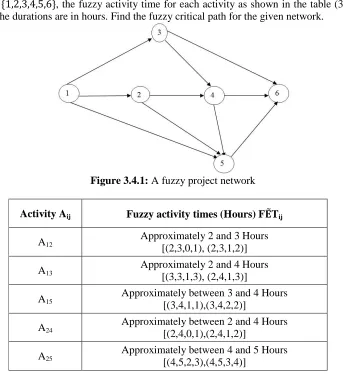
Let us consider the following project network as:
XH = {1,2,3,4,5,6}, the fuzzy activity time for each activity as shown in the table (3.4.1). All the durations are in hours. Find the fuzzy critical path for the given network.
Figure 3.4.1: A fuzzy project network
Activity Aij Fuzzy activity times (Hours) F^HTij
A12
Approximately 2 and 3 Hours [(2,3,0,1), (2,3,1,2)]
A13
Approximately 2 and 4 Hours [(3,3,1,3), (2,4,1,3)]
A15 Approximately between 3 and 4 Hours
[(3,4,1,1),(3,4,2,2)]
A24 Approximately between 2 and 4 Hours
[(2,4,0,1),(2,4,1,2)]
A25
82 A34
Approximately between 1 and 2 Hours [(1,2,0,0),(1,2,1,1)]
A36
Approximately between 7 and 12 Hours [(8,11,1,4),(7,12,1,4)]
A45 Approximately between 2 and 4 Hours
[(3,3,1,2),(2,4,1,2)]
A46 Approximately between 3 and 4 Hours
[(3,4,0,2),(3,4,1,3)]
A56
Approximately between 1 Hours [(1,1,0,1),(1,1,1,2)]
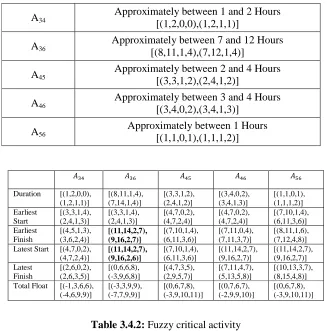
Table 3.4.2: Fuzzy critical activity
Figure 3.4.2: Fuzzy critical path
Fuzzy critical path is 1 → 3 → 6 . The minimum fuzzy project duration is the length of the fuzzy critical path. The fuzzy project duration is in fuzzy hours.[(11,14,2,7),(9,16,2,6)].
` `a `b `a `ba
Duration [(1,2,0,0), (1,2,1,1)]
[(8,11,1,4), (7,14,1,4)]
[(3,3,1,2), (2,4,1,2)]
[(3,4,0,2), (3,4,1,3)]
[(1,1,0,1), (1,1,1,2)] Earliest
Start
[(3,3,1,4), (2,4,1,3)]
[(3,3,1,4), (2,4,1,3)]
[(4,7,0,2), (4,7,2,4)]
[(4,7,0,2), (4,7,2,4)]
[(7,10,1,4), (6,11,3,6)] Earliest
Finish
[(4,5,1,3), (3,6,2,4)]
[(11,14,2,7), (9,16,2,7)]
[(7,10,1,4), (6,11,3,6)]
[(7,11,0,4), (7,11,3,7)]
[(8,11,1,6), (7,12,4,8)] Latest Start [(4,7,0,2),
(4,7,2,4)]
[(11,14,2,7), (9,16,2,6)]
[(7,10,1,4), (6,11,3,6)]
[(11,14,2,7), (9,16,2,7)]
[(11,14,2,7), (9,16,2,7)] Latest
Finish
[(2,6,0,2), (2,6,3,5)]
[(0,6,6,8), (-3,9,6,8)]
[(4,7,3,5), (2,9,5,7)]
[(7,11,4,7), (5,13,5,8)]
[(10,13,3,7), (8,15,4,8)] Total Float [(-1,3,6,6),
(-4,6,9,9)]
[(-3,3,9,9), (-7,7,9,9)]
[(0,6,7,8), (-3,9,10,11)]
[(0,7,6,7), (-2,9,9,10)]
83
In addition, when we utilize the notion proposed ‘Distance Function’, we have c(`d- = 7, c(`d- = 14, c(`d- = 11, c(`da- = 14 .
From this, It is note that the fuzzy critical path is 1 → 3 → 6,which is same as the critical path of the previous one.
8. Conclusion
In this paper a ranking function for L-R type interval valued fuzzy numbers to fuzzy critical analysis are introduced. Also it is important to note that a relevant numerical illustration was utilized to justify the proposed notions. The project characteristics like earliest time, latest time and total float time in terms of L-R type interval valued fuzzy numbers are calculated without converting the fuzzy nature to classical nature.
REFERENCES
1. V.Anusuya and R.Sathya, Complement of type-2 fuzzy shortest path using possibility measure, Intern. J. Fuzzy Mathematical Archive, 5(1) (2014) 19-27. 2. S.Chanas and J.Kamurowsks, The use of fuzzy variables in PERT, Fuzzy Sets and
Systems, 5(1) (1961) 11-19.
3. S.Chang, Y.Tsujimur and T.Tazawa, An efficient approach for large scale project planning based on fuzzy Delphi method, Fuzzy Sets and Systems, 76 (1995) 277-288.
4. C.T.Chen and S.F.Huang, Applying fuzzy method for measuring critically in project network, Information Sciences, 177 (2007) 2448-2458.
5. F.T.Lin and J.S.Yao, Fuzzy Critical Path method based on signed distance ranking and statistical confidence internal estimates, Journal of Super Computing, 24(3) (2003) 305-325.
6. P.Lorterapong and O.Moselhi, Project-network analysis using fuzzy sets theory, Journal of Construction Engineering and Management, 122(4) (1996) 308-318. 7. C.S.McCahon, Using PERT as an approximation of fuzzy project-network analysis,
IEEE Transaction on Engineering Management, 40(2) (1993) 146-153.
8. S.H.Nasution, Fuzzy critical path method, IEEE Transaction on Systems, MAN, and Cybernetics, 41(1) (1994) 48-57.
9. O.Oliveros and A.Robinson, Fuzzy logic approach for activity delay analysis scheduling updating, Construction Engineering and Management, 131(1) (2005) 42-51.
10. N.Ravishankar and V.Sireesha, P.B.Rao, An analytical method for finding critical path in a fuzzy project network, International Journal Contempt Mathematical Sciences, 5(20) (2000) 953-962.