Programming up to Congruence (Extended version)
Vilhelm Sj¨oberg
Stephanie Weirich
University of Pennsylvania, Philadelphia, PA, USA {vilhelm,sweirich}@cis.upenn.edu
Abstract
This paper presents the design of ZOMBIE, a dependently-typed programming language that uses an adaptation of a congruence closure algorithm for proof and type inference. This algorithm al-lows the type checker to automatically use equality assumptions from the context when reasoning about equality. Most dependently-typed languages automatically use equalities that follow fromβ -reduction during type checking; however, such reasoning is incom-patible with congruence closure. In contrast, ZOMBIEdoes not use automaticβ-reduction because types may contain potentially di-verging terms. Therefore ZOMBIE provides a unique opportunity to explore an alternative definition of equivalence in dependently-typed language design.
Our work includes the specification of the language via a bidirec-tional type system, which works “up-to-congruence,” and an algo-rithm for elaborating expressions in this language to an explicitly typed core language. We prove that our elaboration algorithm is complete with respect to the source type system, and always pro-duces well typed terms in the core language. This algorithm has been implemented in the ZOMBIElanguage, which includes gen-eral recursion, irrelevant arguments, heterogeneous equality and datatypes.
Categories and Subject Descriptors D.3.1 [Programming
Lan-guages]: Formal Definitions and Theory
Keywords Dependent types; Congruence closure
1.
Introduction
The ZOMBIElanguage [10] aims to provide a smooth path from ordinary functional programming in a language like Haskell to dependently typed programming in a language like Agda. However, one significant difference between Haskell and Agda is that in the latter, programmers must show that every function terminates. Such proofs often require delicate reasoning, especially when they must be done in conjunction with the function definition. In contrast, ZOMBIE includes arbitrary nontermination, relying on the type system to track whether an expression has been typechecked in the normalizing fragment of the language.
Permission to make digital or hard copies of all or part of this work for personal or classroom use is granted without fee provided that copies are not made or distributed for profit or commercial advantage and that copies bear this notice and the full citation on the first page. Copyrights for components of this work owned by others than the author(s) must be honored. Abstracting with credit is permitted. To copy otherwise, or republish, to post on servers or to redistribute to lists, requires prior specific permission and/or a fee. Request permissions from [email protected].
POPL ’15, January 15–17, 2015, Mumbai, India.
Copyright is held by the owner/author(s). Publication rights licensed to ACM. ACM 978-1-4503-3300-9/15/01. . . $15.00.
http://dx.doi.org/10.1145/2676726.2676974
Prior work on ZOMBIE[10, 28] has focused on the metatheory of the core language—type safety for the entire language and con-sistency for the normalizing fragment—and provides a solid foun-dation. However, it is not feasible to write programs directly in the core language because the terms get cluttered with type annotations and type conversion proofs. This paper addresses the other half of the design: crafting a programmer-friendlysurface language, which elaborates into the core.
The reason that elaboration is important in this context is that core ZOMBIEhas a weak definition of equivalence. Most dependently-typed languages define terms to be equal when they are (at least) β-convertible. However, the presence of nontermination makes this definition awkward. To check whether two types areβ-equivalent the type checker has to evaluate expressions inside them, which be-comes problematic if expressions may diverge—what if the type checker gets stuck in an infinite loop? Existing languages fix an arbitrary global cut off for how many steps of evaluation the type-checker is willing to do (Cayenne [3]), or only reduce expressions that have passed a conservative termination test (Idris [9]). Core ZOMBIE, somewhat radically, omits automaticβ-conversion com-pletely. Instead,β-equality is available only through explicit con-version.
Because ZOMBIEdoes not include automaticβ-conversion, it pro-vides an opportunity to explore an alternative definition of equiva-lence in a surface language design.
Congruence closure, also known as the theory of equality with
un-interpreted function symbols, is a basic operation in automatic the-orem provers for first-order logic (particularly SMT solvers, such as Z3 [14]). Given some contextΓwhich contains assumptions of the forma = b, the congruence closure ofΓis the set of equa-tions which are deducible by reflexivity, symmetry, transitivity, and changing subterms. Figure 1 specifies the congruence closure of a given context.
Although efficient algorithms for congruence closure are well-known [16, 22, 27] this reasoning principle has seen little use in
dependently-typed programming languages. The problem is not
lack of opportunity. Dependently-typed languages feature propo-sitional equality, writtena=b, which is a type that asserts the equality of the two expressions. Programs that use propositional equality build members of this type (using assumptions in the con-text, and various lemmas) and specify where and how they should be used. Congruence closure can assist with both of these tasks by automating the construction of these proofs and determining the “motive” for their elimination.
However, the adaption of this first-order technique to the higher-order logics of dependently-typed languages is not straightforward. The combination of congruence closure and fullβ-reduction makes the equality relation undecidable. As a result, most dependently-typed languages take the conservative approach of only incor-porating congruence closure as a meta-operation, such as Coq’s
a=b∈Γ
Γ`a=b Γ`a=a
Γ`b=a Γ`a=b Γ`a=c Γ`c=b
Γ`a=b
Γ`a=a0 Γ`b=b0 Γ`a b=a0b0
Figure 1. The “classic” congruence closure relation for untyped first-order logic terms
congruencetactic. While this tactic can assist with the creation of equality proofs, such proofs must still be explicitly eliminated. Pro-posals to use equations from the context automatically [1, 29, 30] have done so in addition to β-reduction, which makes it hard to characterize exactly which programs will typecheck, and also leaves open the question of how expressive congruence closure is in isolation.
In this work we define the ZOMBIE surface language to be fully “up to congruence”, i.e. types which are equated by congruence closure can always be used interchangeably, and then show how the elaborator can implement this type system.
Designing a language around an elaborator—an unavoidably com-plicated piece of software—raises the risk of making the language hard to understand. Programmers could find it difficult to predict what core term a given surface term will elaborate to, or they may have to think about the details of the elaboration algorithm in order to understand whether a program will successfully elaborate at all. We avoid these problems using two strategies. First, the syntax of the surface and the core language differ only byerasable
an-notationsand the operational semantics ignores these annotations.
Therefore the semantics of an expression is apparent just from look-ing at the source; the elaborator only adds annotations that can not change its behavior. Second, we define adeclarative specification
of the surface language, and prove that the elaborator is complete for the specification. As a result, the programmer does not have to think about the concrete elaboration algorithm.
We make the following contributions:
•We demonstrate how congruence closure is useful when pro-gramming, by comparing examples written in Agda, ZOMBIE, and ZOMBIE’s explicitly-typed core language (Section 2). •We define a dependently typed core language where the syntax
contains erasable annotations (Section 3).
•We define a typed version of the congruence closure relation that is compatible with our core language, including features (erasure, injectivity, and generalized assumption) suitable for a dependent type system (Section 4).
•We specify the surface language using a bidirectional type sys-tem that uses this congruence closure relation as itsdefinition
of type equality (Section 5).
•We define an elaboration algorithm of the surface language to the core language (Section 6) based on a novel algorithm for typed congruence closure (Section 7). We prove that our elabo-ration algorithm is complete for the surface language and pro-duces well-typed core language expressions. Our typed congru-ence closure algorithm both decides whether two terms are in the relation and also produces core language equality proofs. •We have implemented these algorithms in ZOMBIE, extending
the ideas of this paper to a language that includes datatypes and
data Term : Set where leaf : Term
branch : Term→Term→Term var : N→Term
data Unify : (t1 t2 : Term)→Set where nomatch : ∀{t1 t2}→Unify t1 t2 match : ∀{t1 t2} (s : Substitution)
→ap s t1 ≡ ap s t2→Unify t1 t2 Several lemmas
--apCompose : ∀ {s s’} (t : Term)
→ap (compose s s’) t ≡ ap s (ap s’ t)
apCompose = ...
singleton-6∈ : ∀ t x s→ (x ∈ t) →ap (singleton x s) t ≡ t singleton-6∈ = ...
varSingleton : ∀ x t→t ≡ ap (singleton x t) (var x)
varSingleton = ...
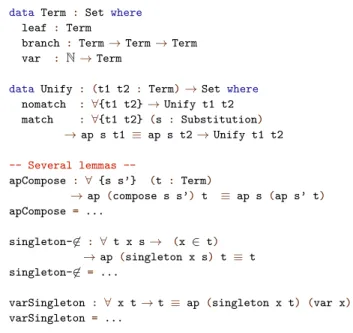
Figure 2. Supporting lemmas for Figure 3
pattern matching, a richer logical fragment, and other features. Congruence closure works well in this setting; in particular, it significantly simplifies the typing rules forcase-expressions (Section 8). Our implementation is available.1
2.
Programming up to congruence
Consider this simple proof in Agda, which shows that zero is a right identity for addition.
npluszero : (n : Nat)→n + 0 ≡ n npluszero zero = refl
npluszero (suc m) = cong suc (npluszero m)
The proof follows by induction on natural numbers. In the base case,reflis a proof of 0 = 0. In the next line,cong translates a proof of m + 0 ≡ m (from the recursive call) to a proof of
suc(m + 0) ≡ suc m.
This proof relies on the fact that Agda’s propositional equality relation (≡) is reflexive and a congruence relation. The former property holds by definition, but the latter must be explicitly shown. In other words, the proof relies on the following lemma:
cong : ∀ {A B} {m n : A}
→(f : A→B)→m ≡ n→f m ≡ f n cong f refl = refl
Now compare this proof to a similar result in ZOMBIE. The same reasoning is present: the proof follows via natural number induc-tion, using the reduction behavior of addition in both cases.
npluszero : (n : Nat)→(n + 0 = n)
npluszero n = case n [eq] of
Zero→(join : 0 + 0 = 0)
Suc m→
let _ = npluszero m in
(join : (Suc m) + 0 = Suc (m + 0))
{-# NO_TERMINATION_CHECK #-}
unify : (t1 t2 : Term)→Unify t1 t2 unify leaf leaf = match empty refl unify leaf (branch t2 t3) = nomatch unify (branch t1 t2) leaf = nomatch unify (branch t11 t12) (branch t21 t22)
with unify t11 t21 ... | nomatch = nomatch
... | match s p with unify (ap s t12) (ap s t22)
... | nomatch = nomatch
... | match s’ q
= match (compose s’ s)
(trans (apCompose (branch t11 t12)) (trans (cong2 (λ t1 t2→
branch (ap s’ t1) t2) p q) (sym (apCompose (branch t21 t22)))))
unify t1 (var x) with (x is∈ t1)
... | no q
= match (singleton x t1)
(trans (singleton-6∈ t x t q) (varSingleton x t))
... | yes p with t
... | var y
= match empty (cong var (sym (invvar p)))
... | _
= nomatch
unify (var x) t2 with unify t2 (var x)
... | nomatch = nomatch
... | match s p = match s (sym p)
prog unify : (t1 t2 : Term)→Unify t1 t2 rec unify t1 = \ t2 . case t1, t2 of
leaf, leaf→match empty _ leaf, branch _ _→nomatch branch _ _, leaf→nomatch branch t11 t12, branch t21 t22→
case (unify t11 t21) of nomatch→nomatch
match s p→case (unify (ap s t12) (ap s t22)) of nomatch→nomatch
match s’ _→
unfold (ap s’ (ap s t1)) in unfold (ap s’ (ap s t2)) in let _ = apCompose s’ s t1 in let _ = apCompose s’ s t2 in
match (compose s’ s) _ _ , var x→case (isin x t1) of
no q →
let _ = varSingleton x t1 in let _ = singletonNotIn t1 x t1 q in
match (singleton x t1) _ yes _→case t1 of
var y→let [_] = invvar x y p in match empty _
_ →
nomatch
var x, _→ case (unify t2 (var x)) of nomatch→nomatch
match s p→match s _
Figure 3. First-order unification in Agda (left) and in ZOMBIE(right)
Because ZOMBIE does not provide automatic β-equivalence, re-duction must be made explicit above. The termjoinexplicitly in-troduces an equality based on reduction. However, in the successor case, the ZOMBIE type checker is able to infer exactly how the equalities should be put together.
For comparison, the corresponding ZOMBIE core language term includes a number of explicit type coercions:
npluszero : (n : Nat)→(n + 0 = n)
npluszero (n : Nat) = case n [eq] of
Zero→join [;0 + 0 = 0] . join [~eq + 0 = ~eq]
Suc m→
let ih = npluszero m in
join [;(Suc m) + 0 = Suc (m + 0)] . join [(Suc m) + 0 = Suc ~ih] . join [~eq + 0 = ~eq]
Above, an expression of the forma . bconverts the type of the expressiona, using the equality proof b. Equality proofs may be formed in two ways, either via co-reduction (if a1 and a2 both reduce to some common termb, thenjoin[;a1=a2]is a proof of their equality) or by congruence (ifais a proof ofb1=b2, then
join[{ ∼a/x}A]is a proof of{b1/x}A={b2/x}A).
Both sorts of equality proofs are constructed in the example. In the base case, The proofjoin[;0 + 0 = 0]follows from reduc-tion, and is converted to be a proof of(n + 0) = n by the con-gruence proof. Here,eqis a proof that0 = n, an assumption de-rived from pattern matching. Congruence reasoning constructs a
proof that that((0 + 0) = 0) = ((n + 0) = n); the parts that dif-fer on each side of the equality are marked by~eqin the congru-ence proof. The successor case uses congrucongru-ence twice. The equal-ity derived from reduction is first coerced by a congruence de-rived from the recursive call (ih : m + 0 = m), so that it has type ((Suc m) + 0 = Suc m). This equality is then coerced by a con-gruence derived fromeq : (Suc m = n), so that the result has type (n + 0) = n.
As another example, Mu, Ko and Jansson [21] model relational pro-gram derivation in Agda. One property that they show is the univer-sal property of thefoldrfunction. In their code, they deliberately use Agda’s features for equational reasoning—showing exactly the derivation of the equality. The reduction behavior of a program is an important part of a proof.
foldr-universal : {A B} (h : List A→B) f e→ (h [] ≡ e)→(∀ x xs→h (x::xs) ≡ f x (h xs))→ (ys : List A)→h ys ≡ foldr f e ys
foldr-universal h f e base step [] = base foldr-universal h f e base step (x :: xs) =
h (x :: xs) ≡hstep x xsi
f x (h xs)
≡hcong (f x) (foldr-universal h f e base step xs)i
f x (foldr f e xs) ≡hrefli
foldr f e (x::xs) 2
log snoc_inv : (xs ys : List A)→(z : A)→((snoc xs z) = (snoc ys z))→xs = ys ind snoc_inv xs = \ ys z pf. case xs [xeq], ys of
Cons x xs’ , Cons y ys’→
let _ = (smartjoin : (snoc xs z) = Cons x (snoc xs’ z)) in let _ = (smartjoin : (snoc ys z) = Cons y (snoc ys’ z)) in let _ = snoc_inv xs’ [ord xeq] ys’ z _ in
_ ...
-- Agda pattern matching based solution
snoc-inv : ∀ xs ys z→(snoc xs z ≡ snoc ys z)→xs ≡ ys
snoc-inv (x :: xs’) (y :: ys’) z pf with (snoc xs’ z) | (snoc ys’ z) | inspect (snoc xs’) z | inspect (snoc ys’) z snoc-inv (.y :: xs’) (y :: ys’) z refl | .s2 | s2 | [ p ] | [ q ] with (snoc-inv xs’ ys’ z (trans p (sym q)))
snoc-inv (.y :: .ys’) (y :: ys’) z refl | .s2 | s2 | [ p ] | [ q ] | refl = refl ...
-- Alternative Agda solution based on congruence and injectivity cons-inj1 : ∀ {x xs y ys}→((x :: xs) ≡ y :: ys)→x ≡ y cons-inj1 refl = refl
cons-inj2 : ∀ {x xs y ys}→x :: xs ≡ y :: ys→xs ≡ ys cons-inj2 refl = refl
snoc-inv’ : ∀ xs ys z→(snoc xs z ≡ snoc ys z)→xs ≡ ys
snoc-inv’ (x :: xs’) (y :: ys’) z pf = cong2 _::_ (cons-inj1 pf) (snoc-inv’ xs’ ys’ z (cons-inj2 pf))
...
Figure 4. Pattern matching can be tricky in Agda
In ZOMBIE, the congruence closure algorithm can put the various steps together, including the unfolding, the step case and the induc-tion. Note that ZOMBIEallows programmers to notate arguments that are irrelevant (in square brackets, should have no affect on computation) and inferred (⇒instead of→, automatically deter-mined through unification).
foldrUniversal : [A :Type]⇒[B:Type]⇒ (h : List A→B)→(f : A→B→B)→ (e : B)→(h [] = e)→
((x:A)→(xs:List A)→h (x :: xs) = f x (h xs))→ (ys : List A)→h ys = fold e f ys
foldrUniversal [A][B] h f e base step xs = case xs [_] of
[]→let _ = (join : fold e f [] = e) in _
x :: xs’→
let _ = step x xs’ in
let _ = foldrUniversal h f e base step xs’ in let _ = (join : f x (fold e f xs’)
= fold e f (x :: xs’)) in _
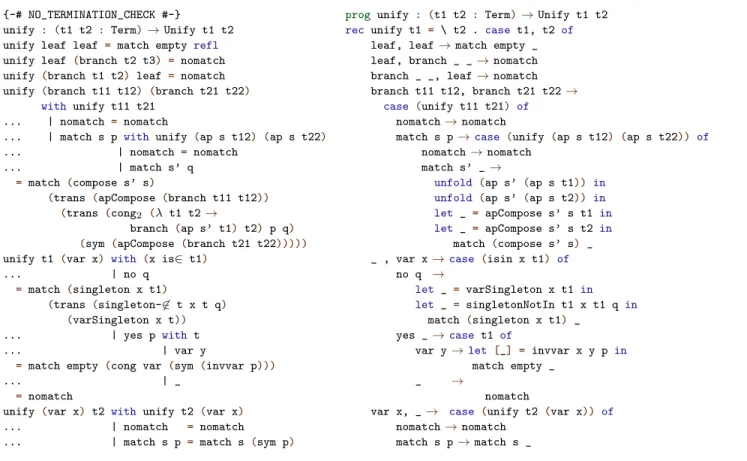
For a larger example, consider unification of first-order terms (Fig-ure 3). For this example, the term language is the simplest possible, consisting only of binary trees constructed bybranchandleafand possibly containing unification variables,var, represented as nat-ural numbers. We also use a typeSubstitutionof substitutions, which are built by the functionssingletonandcompose, and ap-plied to terms byap.
Proving that unify terminates is difficult because the termina-tion metric involves not just the structure of the terms but also the number of unassigned unification variables. (For example, see McBride [20]). To save development effort, a programmer may
elect to prove only a partial correctness property:if the function terminates then the substitution it returns is a unifier.
In other words, if theunifyfunction returns, it either says that the terms do not match, or produces a substitutionsand a proof that
sunifies them. We write the data structure in ZOMBIEas follows (the Agda version is similar):
data Unify (t1 : Term) (t2 : Term) : Type where nomatch
match of (s : Substitution) (pf : ap s t1 = ap s t2) Comparing the Agda and ZOMBIE implementations, we can see the effect of programming up-to-congruence instead of up-to-β. When the unifier returns match, it needs to supply a proof of equality. The Agda version explicitly constructs the proof using equational reasoning, which involves calling congruence lemmas
sym,trans,congandcong2from the standard library. The ZOMBIE version leaves such proof arguments as just an underscore, meaning that it can be inferred from the equations in the context. For that purpose, it introduces equalities to the context withunfold(forβ -reductions, see Section 8.2) and with calls to relevant lemmas. Figure 4 demonstrates how congruence closure makes ZOMBIE’s version of dependently-typed pattern matching (i.e smart case) both simple and powerful. The figure compares (parts of) inductive proofs in ZOMBIEand Agda of an inversion lemma about thesnoc
operation, which appends an element to the end of a list. When both lists are nonempty, the proof argument can be used to derive thatx = y (using the injectivity ofCons), and the recursive call shows thatxs’ = ys’. Congruence closure both puts these together in a proof ofCons x xs’ = Cons y ys’and supplies the necessary proof for the recursive call.
In Agda, one is tempted to prove the property by pattern match-ing on the equality between the lists. This approach leads to a
x, y, f, g, h ∈ expression variables expressions
a, b, c, A, B ::= Type|x
| (x:A)→ B|recfAx.a|a b
| •(x:A)→ B|recfA•x.a|a•b
| a=b|joinΣ|a.b
strategies
Σ ::= ;pi j :a=b
| {∼v1/x1}...{∼vj/xj}c:B
| injdoma|injrnga b|injeqi a values
v ::= Type|x
| (x:A)→ B|recfAx.a
| •(x:A)→ B|recfA•x.a
| a=b|joinΣ|v.b Figure 5. Syntax a;cbvb
(recf x.a)v ;cbv{v/x} {recf x.a/f}a
SCAPPBETA
(recf •.a)•;cbv{recf •.a/f}a
SCIAPPBETA
a;cbva0
a b;cbva0b
SCCTX1
a;cbva0
v a;cbvv a0
SCCTX2
a;cbva0
a•;cbva0•
SCCTX3
Figure 6. Call-by-value operational semantics “quite fun” puzzle.2 Here, the equivalence between
xandy can-not be observed until(snoc xs’ z)and(snoc xs’ z)are named. The so-called “inspect on steroids” trick provides the equalities (p : (snoc xs’ z = s2) and q : (snoc ys’ z) = s2) that are necessary to constructing the fourth argument for the recursive call. Although this development is not long, it is not at all straightfor-ward, requiring advanced knowledge of Agda idioms.
Alternatively, the reasoning used in the ZOMBIEexample is also available in Agda, as in the definition ofsnoc-inv’. However, this version requires the use of helper functions to prove that cons is injective and congruent.
3.
Annotated core language
We now turn to the theory of the system. We begin by describing the target of the elaborator: our annotated core language. This language is a small variant of the dependently-typed call-by-value language defined in prior work [28]. It corresponds to a portion of ZOMBIE’s core language, but to keep the proofs tractable we omit ZOMBIE’s recursive datatypes and replace its terminating sublanguage [10] with syntactic value restrictions.
2Posed by Eric Mertens on#agda.
|Type| = Type
|x| = x
|recfAx.a| = recf x.|a|
|recfA•x.a| = recf •.|a|
|(x:A)→ B| = (x:|A|)→ |B| |a b| = |a| |b|
| •(x:A)→ B| = •(x:|A|)→ |B| |a •b| = |a| •
|a=b| = (|a|=|b|)
|joinΣ| = join
|a.b| = |a|
Figure 7. The erasure function| · |
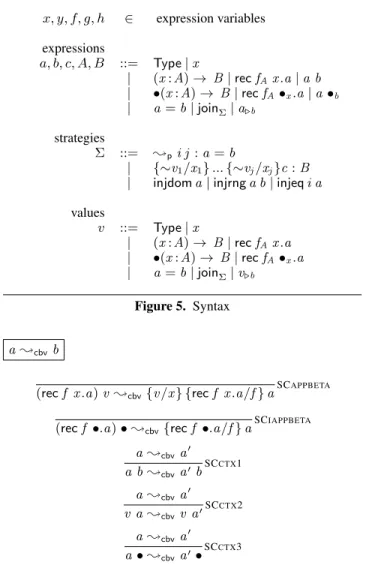
The syntax is shown in Figure 5. Terms, types and the sortType are collapsed into one syntactic category. By convention, we use lowercase metavariablesa,b for expressions that are terms and uppercase metavariablesA,Bfor expressions that are types.We use the notation{a/x}Bto denote the capture-avoiding substitution of aforxinB. The notationFV(a)calculates the set of free variables appearing in an expression. As is standard in dependently-typed languages, our notation for nondependent function typesA→Bis syntactic sugar for function types(x:A)→ B, where the variable xis not free inB.
Typeannotations, such asAinrecfA x.a, are optional and may
be omitted from expressions. Annotations are subscripted in Fig-ure 5. The meta-operator|a|removes these annotations (Figure 7). Expressions that contain no typing annotations are callederased. An expression that includes all annotations is called a core or
annotatedexpression. The core typing judgement, writtenΓ`a:
Aand described below, requires that all annotations be present. In this case, the judgement is syntax-directed and trivially decidable. Given a context and an expression, there is a simple algorithm to determine the type of that expression (if any). In contrast, type checking for erased terms is undecidable.
The only role of annotations is to ensure decidable type checking. They have no effect on the semantics. In fact, the operational semantics, writtena ;cbvb, is defined only for erased terms and
extended to terms with annotations via erasure. This operational semantics is a small-step, call-by-value evaluation relation, shown in Figure 6.
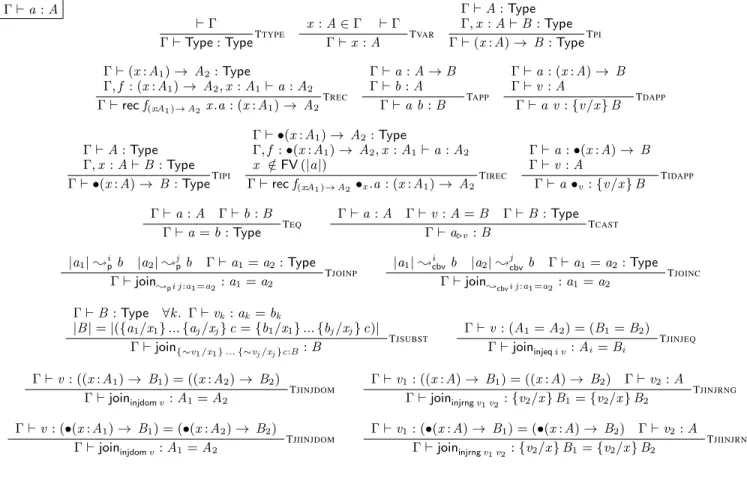
Figure 8 shows the typing rules of the core language typing judge-mentΓ`a:A. The type system identifies which expressions are types:Ais a type whenΓ`A:Typeholds. The rule TTYPE en-sures thatTypeitself is typeable. Additionally, the judgement`Γ (elided from the figure) states that each type inΓis well-formed. The variable lookup rule TVAR is standard. Function types are formed by the rule TPI, and introduced and eliminated by TREC, TAPP, and TDAPP. We use the notationA→Bfor(x:A)→ B whenxis not free inB.
Recursive functions are defined using expressionsrecf x.a, with the typing rule TREC. Such expressions are values, and applications step by the rule(rec f x.a) v ;cbv {v/x} {rec f x.a/f}a.
If the function makes no recursive calls we also use the syntactic sugarλx.a. When a function has a dependent type (TDAPP) then its argument must be a value (this restriction is common for languages with nontermination [18, 32]).
Irrelevance In addition to the normal function type, the core lan-guage also includecomputationally irrelevantfunction types•(x:
Γ`a:A
`Γ
Γ`Type:TypeTTYPE
x :A∈Γ `Γ Γ`x :A TVAR
Γ`A:Type Γ,x :A`B:Type Γ`(x:A)→ B:TypeTPI Γ`(x:A1)→ A2:Type
Γ,f : (x:A1)→ A2,x :A1`a:A2 Γ`recf(x:A1)→A2x.a: (x:A1)→ A2
TREC
Γ`a:A→B Γ`b:A
Γ`a b:B TAPP
Γ`a: (x:A)→ B Γ`v :A
Γ`a v :{v/x}B TDAPP
Γ`A:Type Γ,x :A`B:Type Γ` •(x:A)→ B:TypeTIPI
Γ` •(x:A1)→ A2:Type
Γ,f :•(x:A1)→ A2,x :A1`a:A2 x ∈/FV(|a|)
Γ`recf(x:A1)→A2•x.a: (x:A1)→ A2
TIREC
Γ`a:•(x:A)→ B Γ`v :A
Γ`a•v :{v/x}B
TIDAPP
Γ`a:A Γ`b:B Γ`a=b:Type TEQ
Γ`a:A Γ`v :A=B Γ`B:Type Γ`a.v:B
TCAST
|a1|;i
pb |a2|;jpb Γ`a1=a2:Type Γ`join;pi j:a1=a2:a1=a2
TJOINP
|a1|;i
cbvb |a2|;
j
cbvb Γ`a1=a2:Type
Γ`join;cbvi j:a1=a2 :a1 =a2
TJOINC
Γ`B:Type ∀k. Γ`vk:ak=bk
|B|=|({a1/x1}...{aj/xj}c={b1/x1}...{bj/xj}c)|
Γ`join{∼v1/x1}...{∼vj/xj}c:B :B
TJSUBST
Γ`v: (A1=A2) = (B1=B2) Γ`joininjeqi v:Ai =Bi
TJINJEQ
Γ`v: ((x:A1)→ B1) = ((x:A2)→ B2) Γ`joininjdomv :A1=A2
TJINJDOM
Γ`v1: ((x:A)→B1) = ((x:A)→ B2) Γ`v2:A Γ`joininjrngv
1v2:{v2/x}B1 ={v2/x}B2
TJINJRNG
Γ`v: (•(x:A1)→ B1) = (•(x:A2)→ B2) Γ`joininjdomv :A1=A2
TJIINJDOM
Γ`v1: (•(x:A)→ B1) = (•(x:A)→ B2) Γ`v2:A Γ`joininjrngv1v2:{v2/x}B1={v2/x}B2
TJIINJRNG
Figure 8. Typing rules for the annotated core language
A)→ B, which are inhabited by irrelevant functionsrecfA•x.b
and eliminated by irrelevant applicationsa•b. Many expressions in
a dependently typed program are only used for type checking, but do not affect the runtime behavior of the program, and these can be marked irrelevant. Some common examples are type arguments to polymorphic functions (e.g.map: •(A B :Type) →(A → B) → ListA → List B), indices to dependent datatypes (e.g. append:•(n m:Nat)→Vecn→Vecm→Vec(n+m)), and preconditions to functions (e.g.divide: (x y:Int)→ •(y6= 0)→ Int). When comparing two expressions for equality the typechecker will ignore arguments in irrelevant positions. For example, if both pandqhave typey6= 0, the typechecker will treatdividex y•p anddividex y•qas equal without looking at the last argument. Our treatment of irrelevance follows ICC* [6]. The introduction rule for irrelevant functions, TIREC, is similar to the rule for normal functions, but with the additional restriction that the bound variable must not remain in the erasure of the bodyb. This restriction means thatx can only appear in irrelevant positions inb, such as type annotations and proofs for conversions.
The application rule TIDAPPis also similar to normal application. To ensure type safety we must ensure that diverging terms are not erased [28]. In this version of the core language we use a rather simple-minded restriction, by requiring the argument to be a value. A more ambitious alternative would be to make the type system distinguish between terminating and possibly nonterminating ex-pressions, like in [10].
We include computational irrelevance in this work to show that, be-sides being generally useful, irrelevance works well with
congru-ence closure. Given that we already handle erasable annotations, we can support full irrelevance for free.
Equality The typing rules at the bottom of Figure 8 deal with propositional equality, a primitive type. The formation rule TEQ statesa=bis a well-formed type wheneveraandbare two well-typed expressions. There is no requirement that they have thesame
type (that is to say, our equality type is heterogeneous).
Propositional equality is eliminated by the rule TCAST: given a proof,v of an equationA =Bwe can change the type of an ex-pression fromAtoB. Since our equality is heterogeneous, we need to check thatBis in fact a type. We require the proof to be a value in order to rule out divergence. A full-scale language could use a more ambitious termination analysis. (Indeed, our ZOMBIE imple-mentation does so.) However, the congruence proofs generated by our elaborator are syntactic values, so for the purposes of this pa-per, the simple value restriction is enough. The proof termv in a type cast is an erasable annotation with no operational significance, so the typechecker considers equalities likea=a.vto be trivially
true, and the elaborator is free to insert coercions using congruence closure proofs anywhere.
The rest of the figure shows introduction rules for equality. Equal-ity proofs do not carry any information at runtime, so they all use the same term constructorjoin, but with different (erasable) anno-tations,Σ.
The rule TJOINPintroduces equations which are justified by the operational semantics. ZOMBIEsource programs must use TJOINP to explicitly indicate expressions that should be reduced. The rule
states thatjoinis a proof ofa1 =a2when the erasures ofa1and a2 reduce to a common expressionb, using the parallel reduction relation. This common expression,b, is not required to be a value. Note that without normalization, we need a cutoff for how long to evaluate, so programmers must specify the number of stepsi, jof reduction to allow (in ZOMBIEthis defaults to 1000 if these numbers are elided). The rule TJOINCis similar, except that it uses call-by-value evaluation directly instead of parallel reduction. Actually, these two rules hint at some subtleties which are outside the scope of this paper. In a normalizing confluent language, the evaluation order does not matter. But in a language with nontermi-nation the programmer needs more fine-grained control. Our im-plementation currently offers two evaluation strategies: CBV eval-uation (good for cases where an expression is expected to reduce to a value), and a parallel reduction which heuristically avoids un-folding recursive calls inside a function body (good when trying to prove recursive fixpoint equations).
The rule TJSUBSTstates that equality is a congruence. The simplest use of the rule is to change a single subexpression, using a proofv. The use of the proof is marked with a tilde in theΣannotation; for example, ifΓ ` v : y = 0then we can prove the equality joinVec Nat(∼v):Vec Naty=Vec Nat0. One can also eliminate several different equality proofs in one use of the rule. For example if Γ`v1:x = 0andΓ`v2:y= 0, then we can use both proofs at once in the expressionjoinVec Nat(∼v1+∼v2) :Vec Nat(x+y) =
Vec Nat(0 + 0). The syntax of subst includes a type annotationB, and the last premise of the TJSUBSTrule checks that the ascribed typeBmatches what one gets after substituting the given equalities into the template c. This annotation adds flexibility because the check is only up-to erasure: if needed the programmer can give the left- and right-hand side ofB different annotations to make both sides well-typed.
Finally, the rules TJINJEQ, TJINJDOM, TJINJDOM, TJINJRNG, and TJIINJRNGstate that the equality type and arrow type construc-tors are injective. The rule for arrow domains is exactly what one would expect: if(x:A)→ B= (x:A0)→ B, thenA=A0. The rule for arrow codomains must account for the bound variablex, so it states that the codomains are equal when any valuevis substi-tuted in. Making type constructors injective is unconventional for a dependent language. It is incompatible with e.g. Homotopy Type Theory, which provesNat→Void=Bool→Void. However, in our language we need arrow injectivity to prove type preservation, because type casts are erased and do not block reduction [28]. For example, if a function coerced by type cast steps viaβ-reduction, we must use arrow injectivity to derive casts for the argument and result of the application.
We also add injectivity for the equality type constructor (TJINJEQ). This is not required for type safety, but itisjustified by the metathe-ory, so it is safe to add. Injectivity is important for the surface lan-guage design, see Section 6.
The core language satisfies the usual properties for type systems. For the proofs in Section 6 we rely on the fact that it satisfies weakening, substitution (restricted to values), and regularity.
Lemma1(Weakening).IfΓ`a:AandΓ⊆Γ0, thenΓ0`a:A.
Lemma2(Value Substitution).IfΓ,x :A`b:BandΓ`v :A, thenΓ` {v/x}b:{v/x}B.
Lemma3(Regularity).
1.`Γandx :A∈Γ, thenΓ`A:Type. 2. IfΓ`a:Athen`ΓandΓ`A:Type
It also satisfies preservation, progress, and decidable type checking. The proofs of these lemmas are in Sj¨oberg et al. [28].
4.
Congruence closure
The driving idea behind our surface language is that the program-mer should never have to explicitly write a type casta.vif the proof
vcan be inferred by congruence closure. In this section we exactly specify which proofs can be inferred, by defining the typed congru-ence closure relationΓa=bshown in Figure 9.
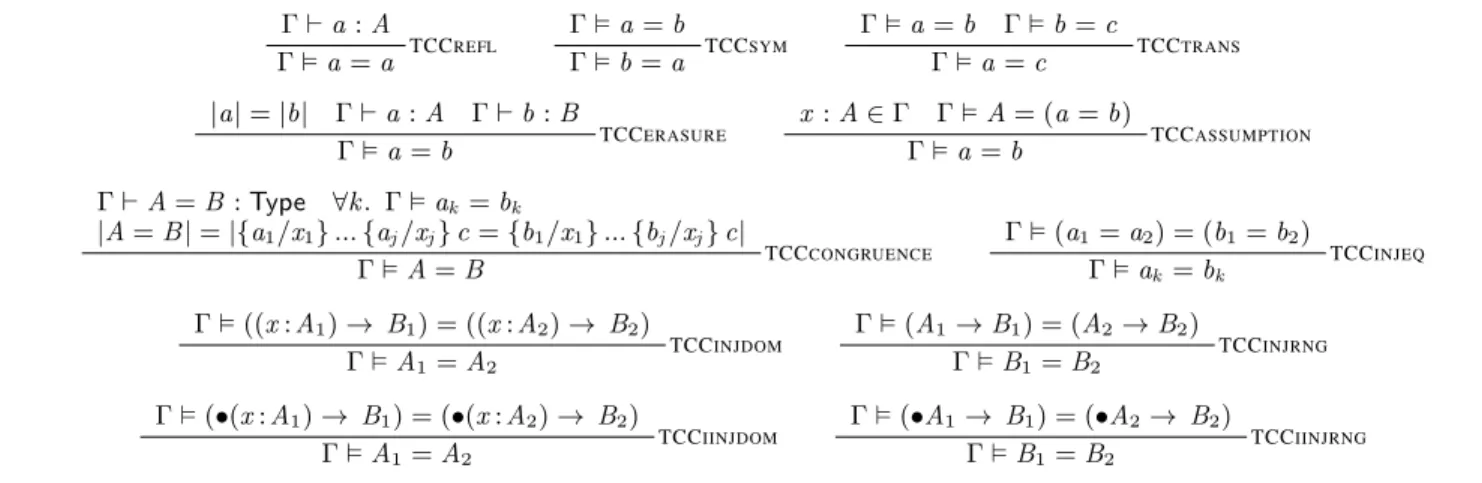
Like the usual congruence closure relation for first-order terms, the rules in Figure 9, specify that this relation is reflexive, symmetric and transitive. It also includes rules for using assumptions in the context and congruence by changing subterms. However, we make a few changes:
First, we add typing premises (in TCCREFLand TCCERASURE) to make sure that the relation only equates well-typed and fully-annotated core language terms. In other words,
IfΓa=b, thenΓ`a:AandΓ`b:B.
Next, we adapt the congruence rule so that it corresponds to the TJSUBSTrule of the core language. In particular, the rule TCC-CONGRUENCE includes an explicit erasure step so that the two sides of the equality can differ in their erasable portions.
Furthermore, we extend the relation in several ways.3We automat-ically use computational irrelevance, in the rule TCCERASURE. This makes sure that the programmer can ignore all annotations when reasoning about programs. Also, we reason up to injectiv-ity of datatype constructors (in rules TCCINJDOM, TCCINJRNG, and TCCINJEQ). As mentioned in Section 3 these rules are valid in the core language, and we will see in Section 6 that there is good reason to make the congruence closure algorithm use them auto-matically. Note that we restrict rule TCCINJRNGso that it applies only to nondependent function types; we explain this restriction in Section 6.
Finally, the rule TCCASSUMPTIONis a bit stronger than the classic rule from first order logic. In the first-order logic setting, this rule is defined as just the closure over equations in the context:
x :a=b∈Γ Γa=b
However, in a dependently typed language, we can have equations between equations. In this setting, the classic rule does not respect CC-equivalence of contexts. For example, it would prove the first of the following two problem instances, but not the second.
x:Nat, y:Nat, a:Type, h1: (x=y) =a, h2:x=yx=y x:Nat, y:Nat, a:Type, h1: (x=y) =a, h2:a x=y Therefore we replace the rule with the stronger version shown in the figure.
We were led to these strengthened rules by theoretical considera-tions when trying to show that our elaboration algorithm was com-plete with respect to the declarative specification (see Section 6). Once we implemented the current set of rules, we found that they were useful in practice as well as in theory, because they improved the elaboration of some examples in our test suite.
3Systems based around congruence closure often strengthen their automatic theorem prover in some way, e.g. Nieuwenhuis and Oliveras [23] add reasoning about natural number equations, and the Coqcongruencetactic automatically uses injectivity of data constructors [12].
Γ`a:A
Γa=a TCCREFL
Γa=b
Γb=a TCCSYM
Γa=b Γb=c
Γa=c TCCTRANS |a|=|b| Γ`a:A Γ`b:B
Γa=b TCCERASURE
x :A∈Γ ΓA= (a=b)
Γa=b TCCASSUMPTION
Γ`A=B:Type ∀k. Γak=bk
|A=B|=|{a1/x1}...{aj/xj}c={b1/x1}...{bj/xj}c|
ΓA=B TCCCONGRUENCE
Γ(a1=a2) = (b1=b2) Γak =bk
TCCINJEQ
Γ((x:A1)→ B1) = ((x:A2)→ B2) ΓA1=A2
TCCINJDOM
Γ(A1→B1) = (A2 →B2) ΓB1=B2
TCCINJRNG
Γ(•(x:A1)→ B1) = (•(x:A2)→ B2) ΓA1=A2
TCCIINJDOM
Γ(•A1→ B1) = (•A2→ B2) ΓB1=B2
TCCIINJRNG
Figure 9. Typed congruence closure relation
The stronger assumption rule is useful in situations where type-level computation produces equality types, for example when us-ing custom induction principles. Say we want to prove a theorem ∀n.f(n) = g(n)by first proving that course-of-values induction holds for any predicateP : Nat → Type, and then instantiating the induction lemma withP := (λn.f(n) =g(n)). Then in the step case after calling the induction hypothesis on some numberm, the context will containH :P(m), and byβ-reduction we know thatP(m) = (f(m) =g(m)). In that situation, the extended as-sumption rule says thatH should be used when constructing the congruence closure of the context, even if the programmer does not apply an explicit type cast toH, which accords with intuition.
5.
Surface language
Next, we give a precise specification of the surface language, which shows how type inference can use congruence closure to infer casts of the forma.v. Note that this process involves determining both
the location of such casts and the proof of equalityv.
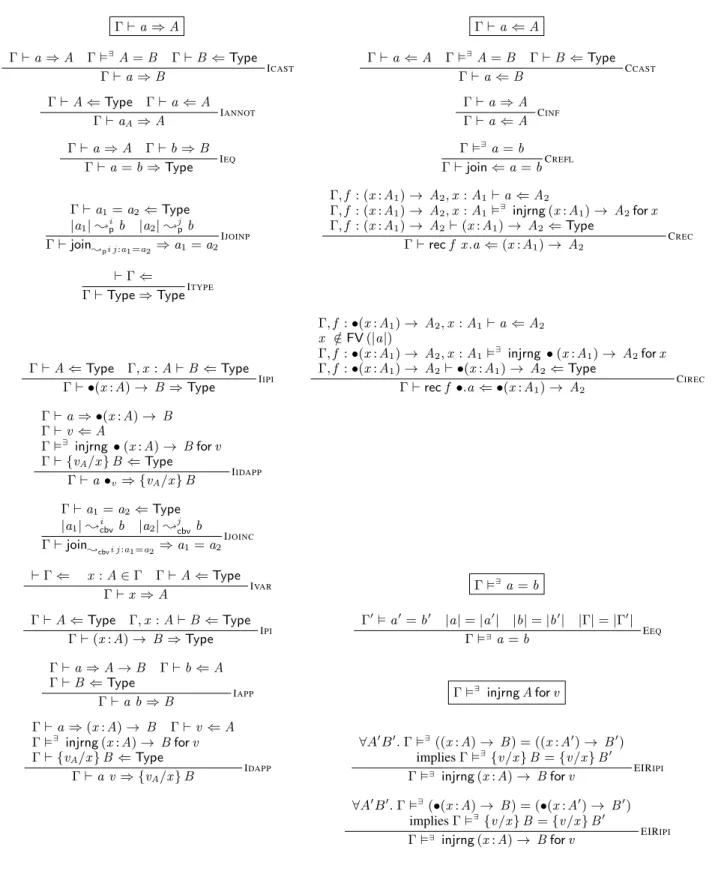
Figure 10 defines abidirectional type systemfor a partially anno-tated language. This type system is defined by two (mutually de-fined) judgements:type synthesis, writtenΓ` a ⇒A, andtype
checking, writtenΓ`a⇐A. HereΓandaare always inputs, but
Ais an output of the synthesizing judgement and an input of the checking judgement.
Bidirectional systems are a standard form of local type inference. In such systems, the programmer must provide types for top-level definitions, and those definitions are thencheckedagainst the as-cribed types. As a result, most type annotations can be omitted, e.g. in a definition like
foo : Nat→Nat→Nat foo = \ x y . 2*x + y
there is no need for type annotations on the bound variablesxand y, since the function is checked against a known top-level type. Most rules of this type system are standard for bidirectional sys-tems [25], including the rules for inferring the types of variables (IVAR), the well-formedness of types (IEQ, ITYPE, and IPI), non-dependent application (IAPP), and the mode switching rules CINF and IANNOT. Any term that has enough annotations to synthesize a typeAalso checks against that type (CINF). Conversely, some terms (e.g. functions) require a known type to check against, and
so if the surrounding context does not specify one, the programmer must add a type annotation (IANNOT).
The rules ICAST and CCAST in Figure 10 specify that checking and inference work “up-to-congruence.” At any point in the typ-ing derivation, the system can replace the inferred or checked type with something congruent. The notationΓ ∃
A = B lifts the congruence closure judgement from Section 4 to the partially an-notated surface language. These two rules contain kinding premises to maintain well-formedness of types. The invariant maintained by the type system is that (in a well-formed contextΓ) any synthesized type is guaranteed to be well-kinded, while it is the caller’s respon-sibility to ensure that any time the checking judgement is used the input type is well-kinded.
The rule for checking functions (CREC) is almost identical to the corresponding rule in the core language, with just two changes. First, the programmer can omit the typesA1, andA2, because in a bidirectional system they can be deduced from the type the expres-sion is checked against. Second, the new premiseinjrngslightly restricts the use of this rule. The difficulty is that the congruence closure algorithm does not implement the full TJINJRNG rule of the core language, but injective reasoning is needed by the type checker. Therefore, we rule out function types that do not support injectivity for their ranges in certain (pathological) typing contexts. This premise also appears in the rule for dependent application (IDAPP). We return to this issue in Section 6.
Equations that are provable via congruence closure are available via the checking rule, CREFL. In this case the proof term is just join, written as an underscore in the concrete syntax. Because this is a checking rule, the equation to be proved does not have to be written down directly if it can be inferred from the context. The rule IJOINP proves equations using the operational seman-tics. We saw this rule used in the npluszero example, written
join : 0 + 0 = 0in the concrete syntax. Note that the program-mer must explicitly write down the terms that should be reduced. The rule IJOINPis a synthesizing rather than checking rule in order to ensure that the typing rules are effectively implementable. Al-though the type system works “up to congruence” the operational semantics do not. So the expression itself needs to contain enough information to tell the typechecker which member of the equiva-lence class should be reduced—it cannot get this information from the checking context. (In practice, having to explicitly write this an-notation can be annoying. The ZOMBIEimplementation includes a featuresmartjoinwhich can help—see Section 8.2).
Γ`a⇒A Γ`a⇐A Γ`a⇒A Γ∃
A=B Γ`B⇐Type
Γ`a⇒B ICAST
Γ`a⇐A Γ∃
A=B Γ`B⇐Type
Γ`a⇐B CCAST
Γ`A⇐Type Γ`a⇐A Γ`aA⇒A
IANNOT
Γ`a⇒A Γ`a⇐A CINF Γ`a⇒A Γ`b ⇒B
Γ`a=b⇒Type IEQ
Γ∃ a=b Γ`join⇐a=bCREFL
Γ`a1=a2⇐Type |a1|;i
pb |a2|;jpb
Γ`join;pi j:a1=a2⇒a1=a2
IJOINP
Γ,f : (x:A1)→ A2,x :A1`a⇐A2
Γ,f : (x:A1)→ A2,x :A1∃ injrng(x:A1)→ A2forx Γ,f : (x:A1)→ A2`(x:A1)→ A2⇐Type
Γ`recf x.a⇐(x:A1)→ A2
CREC
`Γ⇐
Γ`Type⇒TypeITYPE
Γ`A⇐Type Γ,x :A`B⇐Type Γ` •(x:A)→ B⇒Type IIPI
Γ,f :•(x:A1)→ A2,x :A1`a⇐A2 x ∈/FV(|a|)
Γ,f :•(x:A1)→ A2,x :A1∃ injrng •(x:A1)→ A2forx Γ,f :•(x:A1)→ A2` •(x:A1)→ A2⇐Type
Γ`recf •.a⇐ •(x:A1)→ A2
CIREC
Γ`a⇒ •(x:A)→ B Γ`v ⇐A
Γ∃
injrng•(x:A)→ Bforv Γ` {vA/x}B⇐Type
Γ`a•v ⇒ {vA/x}B
IIDAPP
Γ`a1=a2⇐Type |a1|;i
cbvb |a2|;jcbvb
Γ`join;
cbvi j:a1=a2⇒a1=a2
IJOINC
`Γ⇐ x :A∈Γ Γ`A⇐Type
Γ`x ⇒A IVAR Γ
∃ a=b Γ`A⇐Type Γ,x :A`B⇐Type
Γ`(x:A)→ B⇒Type IPI
Γ0a0=b0 |a|=|a0| |b|=|b0| |Γ|=|Γ0|
Γ∃a=b EEQ
Γ`a⇒A→B Γ`b⇐A Γ`B⇐Type
Γ`a b⇒B IAPP Γ
∃
injrngAforv Γ`a⇒(x:A)→ B Γ`v ⇐A
Γ∃
injrng(x:A)→ Bforv Γ` {vA/x}B⇐Type
Γ`a v⇒ {vA/x}B
IDAPP
∀A0B0.Γ∃
((x:A)→ B) = ((x:A0)→ B0) impliesΓ∃{
v/x}B={v/x}B0
Γ∃ injrng(x:A)→ Bforv EIRIPI ∀A0B0.Γ∃
(•(x:A)→ B) = (•(x:A0)→ B0) impliesΓ∃{
v/x}B={v/x}B0
Γ∃ injrng(x:A)→ Bforv EIRIPI
Γ injrngAforv Γ`v:A Γ`(x:A)→ B:Type
∀A0B0.((Γ((x:A)→ B) = ((x:A0)→ B0))implies(Γ{v/x}B={v.v0/x}B
0
whereΓ`v0:A=A0))
Γ injrng(x:A)→ Bforv IRPI
Γ`v :A Γ` •(x:A)→ B:Type
∀A0B0.((Γ(•(x:A)→ B) = (•(x:A0)→ B0))implies(Γ{v/x}B={v.v0/x}B
0
whereΓ`v0:A=A0))
Γ injrng•(x:A)→ Bforv IRIPI
Figure 11. Core language injectivity restriction
It is also interesting to note the rules that donotappear in Figure 10. For example, there is no rule or surface syntax corresponding to TCAST, because this feature can be written as a user-level function. Similarly, the rather involved machinery for rewriting subterms and and erased terms (rule TJSUBST) can be entirely omitted, since it is subsumed by the congruence closure relation. The programmer only needs to introduce the equations into the context and they will be used automatically.
Finally we note that the surface language does not satisfy some of the usual properties of type systems. In particular, it lacks a general weakening lemma because theinjrngrelation cannot be weakened. Similarly, it does not satisfy a substitution lemma because that property fails for the congruence closure relation. (We might expect that Γ,x : C a = b and Γ ` v : C would imply Γ {v/x}a={v/x}b. But this fails ifCis an equation and the proof vmakes use of the operational semantics.) And it does not satisfy a strengthening lemma, because even variables that do not occur in a term may be implicitly used as assumptions of congruence proofs. The situations where weakening and substitution fail are rare (we have never encountered one when writing example programs in ZOMBIE) and there are straightforward workarounds for program-mers. Furthermore, these properties do hold for fully annotated ex-pressions, so there are no restrictions on the output of elaboration. However, the typing rules for the declarative system must be for-mulated to avoid these issues, which requires some extra premises. The rule IVARrequiresΓ`A⇐Type(proving this from`Γ⇐ would need weakening); IAPPrequiresΓ` B ⇐Type(proving this fromΓ ` A → B : Typewould need strengthening); and CRECrequiresΓ,f : (x:A1)→ A2 `(x:A1)→ A2 ⇐Type (proving this fromΓ ` (x :A1) → A2 ⇐ Type would need weakening).
6.
Elaboration
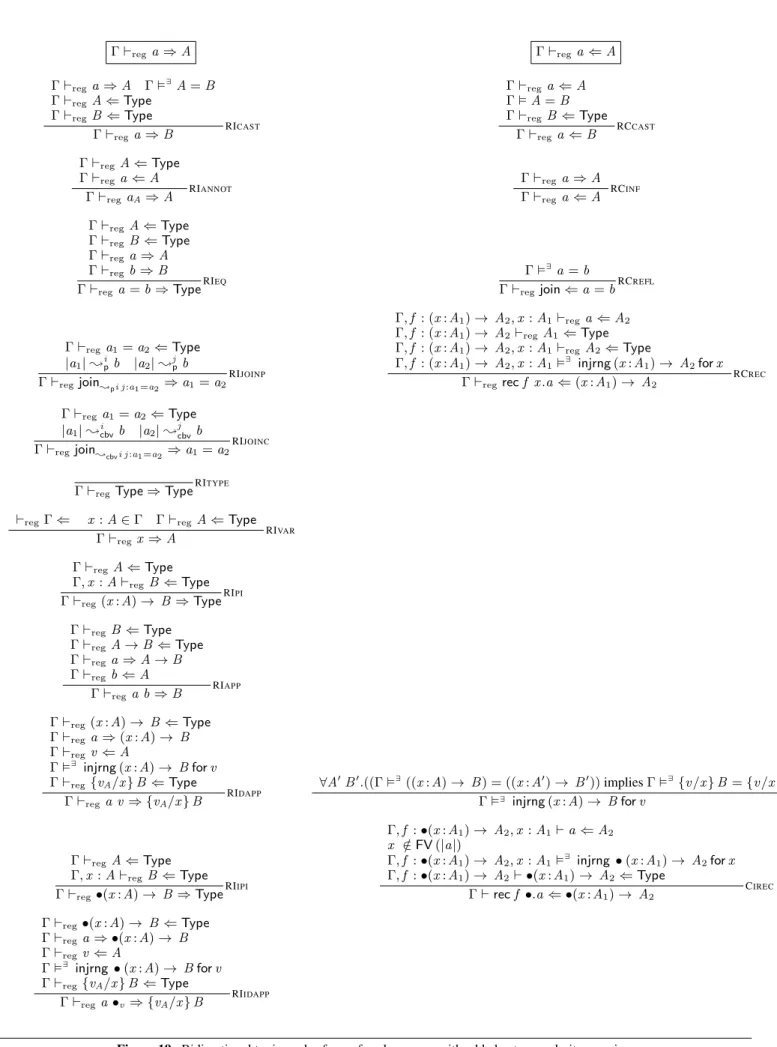
We implement the declarative system using an elaborating type-checker, which translates a surface language expression (if it is well-formed according to the bidirectional rules) to an expression in the core language.
We formalize the algorithm that the elaborator uses as two induc-tively defined judgements, writtenΓ0 a⇒a0:A0(Γ0andaare inputs) andΓ0 a⇐A0;a0(Γ0,a, andA0are inputs). The vari-ables with primes (Γ0,a0andA0) are fully annotated expressions in the core language, whilea is the surface language term being elaborated. The elaborator deals with each top-level definition in the program separately, and the contextΓ0 is an input containing the types of the previously elaborated definitions.
The job of the elaborator is to insert enough annotations in the term to create a well-typed core expression. It should not otherwise change the term. Stated more formally,
Theorem4(Elaboration soundness).
1. IfΓ a⇒a0:A, thenΓ`a0:Aand|a|=|a0|.
2. IfΓ`A:TypeandΓ a ⇐A;a0, thenΓ`a0:Aand |a|=|a0|.
Furthermore, the elaborator should accept those terms specified by the declarative system. If the type system of Section 5 accepts a program, then the elaborator succeeds (and produces an equivalent type in inference mode).
Theorem5(Elaboration completeness).
1. IfΓ`a⇒Aand Γ;Γ0andΓ0 A⇐Type;A0, then Γ0 a⇒a0:A00andΓ0A0=A00
2. IfΓ`a⇐Aand and Γ;Γ0andΓ0 A⇐Type;A0, thenΓ0 a⇐A0;a0.
Designing the elaboration rules follows the standard pattern of turning a declarative specification into an algorithm: remove all rules that are not syntax directed (in this case ICASTand CCAST), and generalize the premises of the remaining rules to create a syntax-directed system that accepts the same terms. At the same time, the uses of congruence closure relationΓa=b, must be replaced by appropriate calls to the congruence closure algorithm. We specify this algorithm using the following (partial) functions:
Γ A=? B;v, which checksAandBfor equality and produces core-language proofv.
Γ A=?(x :B1)→B
2;v, which checks whetherAis equal to some function type and produces that type and proofv. Γ A=?(B1=B2);v, which is similar to above, except
for equality types.
For example, consider the rule for elaborating function applica-tions:
Γ a⇒a0:A1 Γ A1=?(x:A)→B;v1 Γ v ⇐A;v0 Γ injrng(x:A)→Bforv0
Γ a v ⇒a0
.v1 v0:{v0/x}B
EIDAPP
In the corresponding declarative rule (IDAPP) the applied terma must have an arrow type, but this can be arranged by implicitly us-ing ICASTto adjusta’s type. Therefore, in the algorithmic system, the corresponding condition is that the type ofa should be equal to an arrow type(x :A) → B modulo the congruence closure. Operationally, the typechecker will infer some typeA1fora, then run the congruence closure algorithm to construct the set of all ex-pressions that are equal toA1, and check if the set contains some
expression which is an arrow type. The elaborated core term uses the produced proof ofA1 = (x:A)→ Bin a cast to change the type ofa.
At this point there is a potential problem: what ifA1 is equal to more than one arrow type? For example, ifA1 = (x:A)→ B = (x:A0)→ B, then the elaborator has to choose whether to check bagainstAorA0. A priori it is quite possible that only one of them will work; for example the contextΓmay contain an inconsistent equation likeNat → Nat = Bool → Nat. We do not wish to introduce a backtracking search here, because that could make type checking too slow.
This kind of mismatch in the domain type can be handled by extending the congruence closure algorithm. Note that things are fine ifΓ A = A0, since then it does not matter ifAorA0 is chosen. So the issue only arises ifΓ(x:A)→ B= (x:A0)→ Band notΓA=A0. Fortunately, type constructors are injective in the core language (Section 3). Including injectivity as part of the congruence closure judgement (by the rule TCCINJDOM) ensures that it does not matter which arrow type is picked.
We also have to worry about a mismatch in the codomain type, i.e. the case whenΓA1= (x:A)→ BandΓA1= (x:A0)→ B0for two different types. At first glance it seems as if we could use the same solution. After all, the core language includes a rule for injectivity of the range of function types (rule TJINJRNG). There is an important difference between this rule and TJINJDOM, however, which is the handling of the bound variablex in the codomainB: the rule says that this can be closed by substituting any value for it. As a result, we cannot match this rule in the congruence closure relation, because the algorithm would have to guess that value. In other words, to match this rule in the congruence closure relation would mean to add a rule like
Γ(x:A)→ B= (x:A)→ B0 Γ`v:A Γ{v/x}B={v/x}B0
This proposed rule is an axiom schema, which can be instantiated for any valuev. Unfortunately, that makes the resulting equational theory undecidable.
For example, the equational theory of SKI-combinators (which is known undecidable) could be encoded as an assumption context containing one indexed datatypeTand two equations:
data SK = S | K | App of SK SK T : SK→Type
ax1 : ((x y : SK)→
T (App (App K x) y)) = ((x y : SK)→T x)
ax2 : ((f g x : SK)→
T (App (App (App S f) g) x)) = ...
As far as writing an elaborator goes, maybe this is fine—after all, we only want to apply the axiom to the particular valuev from the function applicationa v. However, there does not seem to be any natural way to write a declarative specification explaining what valuesv should be candidates.
Instead, we restrict the declarative language to forbid this problem-atic case. That is, the programmer is not allowed to write a func-tion applicafunc-tion unless all possible return types for the funcfunc-tion are equal. Note that in cases when an application is forbidden by this check, the programmer can avoid the problem by proving the re-quired equation manually and ensuring that it is available in the context.
In the fully-annotated core language we express this restriction with the rule IRPI(in Figure 11), and then lift this operation to partially annotated terms by rule EIRPI(Figure 10). Operationally, the type-checker will search for all arrow types equal toA1 and check that the the codomains withv substituted are equal in the congruence closure. This takes advantage of the fact that equivalence classes under congruence closure can be efficiently represented—although the rule as written appears to quantify over potentially infinitely many function types, the algorithm in Section 7 will represent these as a finite union-find structure which can be effectively enumer-ated. In the core language rule we need to insert a type coercion fromAtoA0to make the right-hand side well typed. By the rule TCCINJDOMthat equality is always provable, so the typechecker will use the proof termv0 that the congruence closure algorithm produced.
In the case of a simple arrow typeA→B, the range injectivity rule is unproblematic and we do include it in the congruence closure relation (TCCINJRNG). So the application rule for simply-typed functions (EIAPP) does not need the injectivity restriction. On the other hand, if the core language did not support injectivity for arrow domains, we could have used the same injectivity restriction for both the domain and codomain.
The rule for checking function definitions (ECREC) Γ A=?(x :A1)→A2;v1
Γ,f : (x:A1)→ A2,x :A1 a⇐A2;a0
Γ,f : (x:A1)→ A2,x :A1 injrng(x:A1)→ A2forx Γ,f : (x:A1)→ A2 (x:A1)→ A2⇐Type;A0
Γ recf x.a⇐A;(recf(x:A1)→A2 x.a
0) .symmv1
ECREC
uses the same ideas that we saw in the application rule. First, while the declarative rule checks against a syntactic arrow type, the algorithmic system searches whether the typeAis equivalent to some arrow type(x:A1)→ A2. Second, to avoid trouble if there is more than one such function type, we add aninjrngrestriction. Thus the ECREC rule ensures that although there may be some choice about what typeA1 to give to the new variable x in the context, all the types that can be chosen are equal up to CC. We then need to design the type system so that all judgements are invariant under-CC equivalent contexts.
The rest of the elaborations rules hold few surprises. The rules for computationally irrelevant abstractions and applications (EIIPI, EIIDAPP, and ECIREC) are exactly analog to the rules for relevant functions.
On the checking side, the mode-change rule ECINFnow needs to prove that the synthesized and checked types are equal.
Γ a⇒a0:A Γ A=? B;v1 Γ a⇐B;a0
.v1
ECINF
This rule corresponds to a direct call to the congruence closure al-gorithm, producing a proof termv1. Note that the inputs are fully elaborated terms—in moving from the declarative to the algorith-mic type system, we replaced the undecidable conditionΓ∃
A= Bwith a decidable one.
Finally, the rule ECREFL elaborates checkable equality proofs (written as underscores in the concrete ZOMBIEsyntax).
Γ A=?(a=b)
;v1 Γ a ? =b;v Γ join⇐A;v.symmv1
ECREFL
As in the rule for application, the typechecker does a search through the equivalence class of the ascribed typeAto see if it contains any
equations. If there is more than one equation it does not matter which one gets picked, because the congruence relation includes injectivity of the equality type constructor (TCCINJEQ). In the elaborated term we need to prove(a =b) =AgivenA= (a = b). This can be done using TJOINP(for reflexivity) and TJSUBST, and we abbreviate that proof termsymmv1.
6.1 Properties of the congruence closure algorithm
It is attractive to base our type system around congruence closure because there exists efficient algorithms to decide it. But the cor-rectness proof for the elaborator does not need to go into details about how that algorithm work. It only assumes that the congru-ence closure algorithm satisfies the following properties. (We show the statement of these properties for function types below, the oth-ers are similar.)
Property6(Soundness).If Γ A = (? x : B1) → B2 ; v, then Γ ` v : A = ((x : B1) → B2) and |v| = join and ΓA= (x:B1)→ B2.
Property7(Completeness).IfΓA= (x:B1)→ B2then there exists aB1,0 B20andvsuch thatΓ A
?
= (x:B1)0 → B20;v.
Property8(Respects Congruence Closure).IfΓA=BandΓ B= (? x:C1)→ C2;vthenΓ A
?
= ((x:C10)→ C 0 2);v
0 . In other words, the algorithm should be sound and complete with respect to theΓ A = B relation; it should generate correct core proof terms v; and the output should depend only on the equivalence class the input is in. In the next section we show how to implement an algorithm satisfying this interface.
7.
Implementing congruence closure
Algorithms for congruence closure in the first-order setting are well studied, and our work builds on them. However, in our type system the relationΓa=bdoes more work than “classic” congruence closure: we must also handle erasure, terms with bound variables, (dependently) typed terms, the injectivity rules, the “assumption up to congruence” rule, and we must generate proof terms in the core language.
Our implementation proves an equationa=bin three steps. First, we erase all annotations from the input terms and explicitly mark places where the congruence rule can be applied, using an operation calledlabelling. Then we use an adapted version of the congruence closure algorithm by Nieuwenhuis and Oliveras [23]. Our version of their algorithm has been extended to also handle injectivity and “assumption up to congruence”, but it ignores all the checks that the terms involved are well-typed. Finally, we take the untyped proof of equality, and process it into a proof thataandbare also related by the typed relation. The implementation is factored in this way because the congruence rule does not necessarily preserve well-typedness, so the invariants of the algorithm are easier to maintain if we do not have to track well-typedness at the same time.
7.1 Labelling terms
In Γ a = b, the rule TCCCONGRUENCE is stated in terms of substitution. But existing algorithms expect congruence to be applied only to syntactic function applications: froma = b con-cludef a =f b. To bridge this gap, we preprocess equations into (erased)labelled expressions. A labelF is an erased language ex-pression with some designated holes (written –) in it, and a labelled
expression is a label applied to zero or more labelled expressions, i.e. a term in the following grammar.
a::=F ai
Typically a label will represent just a single node of the abstract syntax tree. For example, a wanted equation f x = f y will be processed into (– –) f x = (– –) f y, where the label (– –)means this is an application. However, for syntactic forms involving bound variables, it can be necessary to be more coarse-grained. For example, givena =bour implementation can prove recf x.a+x =recf x.b+x, which involves usingrecf x.–+x as a label. In general, to process an expressiona into a labelled term, the implementation will select the largest subexpressions that do not involve any bound variables.
The labelling step also deletes all annotations from the input ex-pressions. This means that we automatically compute the congru-ence closure up to erasure (rule TCCERASURE), at the cost of need-ing to do more work when we generate core language witnesses (Section 7.3).
Applying the labelling step simplifies the congruence closure prob-lems in several ways. We show the simpler problem by defining the relationΓ`L a =b
defined in Figure 12. Compared to Fig-ure 9 we no longer need a rule for erasFig-ure, congruence is only used on syntactic label applications, all the different injectivity rules are handled generically, and we do not ensure that the terms are well-typed. In the appendix we formally define thelabeloperation, and prove that it is complete in the following sense.
Lemma9.IfΓa=bthenlabelΓ`L
labela=labelb.
7.2 Untyped congruence closure
Next, we use an algorithm based on Nieuwenhuis and Oliveras [23] to decide theΓ `L
a = b relation. The algorithm first “flattens” the problem by allocatingconstantsci(i.e. fresh names) for every subexpression in the input. After this transformation every input equation has either the formc1 = c2 or c = F(c1, c2), that is, it is either an equation between two atomic constants or between a constant and a labelF applied to constants. Then follows the main loop of the algorithm, which is centered around three data-structures: a queue of input equations, a union-find structure and a lookup table. In each step of the loop, we take off an equation from the queue and update the state accordingly. When all the equations have been processed the union-find structure represents the congruence closure.
The union-find structure tracks which constants are known to be equal to each other. When the algorithm sees an input equation c1=c2it merges the corresponding union-find classes. This deals with the reflexivity, symmetry and transitivity rules. The lookup table is used to handle the congruence rule. It maps applications F(c1, c2)to some canonical representativec. If the algorithm sees an input equationc =F(c1, c2), thencis recorded as the repre-sentative. If the table already had an entryc0, then we deduce a new equationc=c0which is added to the queue.
In order to adapt this algorithm to our setting, we make three changes. First, we adapt the lookup tables to include thericher la-belscorresponding to the many syntactic categories of our core lan-guage. (Nieuwenhuis and Oliveras only use a single label meaning “application of a unary function.”)
Second, we deal with injectivity rules in a way similar to the implementation of Coq’scongruencetactic [12]. Certain labels are considered injective, and in each union-find class we identify
Γ`La=aLCCREFL
Γ`La=b
Γ`Lb=a LCCSYM
Γ`La
1=b Γ`Lb=a2 Γ`La
1=a2
LCCTRANS
x :A∈Γ Γ`L
A= ((–=–)a b)
Γ`La=b LCCASSUM
∀k. Γ`L
ak=bk
Γ`LF a
i=F bi
LCCCONG
Γ`L
Fa=Fb Finjective Γ`La=b LCCINJ Figure 12. Untyped congruence closure on labelled terms
the set of terms that start with an injective label. If we see an input equationc=F(c1, c2)andFis injective we record this in the class ofc. Whenever we merge two classes, we check for terms headed by the sameF; e.g. if we merge a class containingF(c1, c2)with a class containingF(c01, c
0
2), we deduce new equationsc1 =c01and c2=c02and add those to the queue.
Third, our implementation of theextended assumption ruleworks much like injectivity. With each union-find class we record two new pieces of information: whether any of the constants in the class (which represent types of our language) are known to be inhabited by a variable, and whether any of the constants in the class represents an equality type. Whenever we merge two classes we check for new equations to be added to the queue.
In Appendix D we give a precise description of our algorithm, and prove its correctness, i.e. that it terminates and returns “yes” iff the wanted equation is in theΓ`La=b
relation.
First we prove that flattening a context does not change which ex-pressions are equal in that context. Although the flattening algo-rithm itself is the same as in previous work, the statement of the correctness proof is refined to say that the new assumptionshare always used as plain assumptionsh.refl, as opposed to the general
assumption-up-to-CC rule h.p. The distinction is important,
be-cause although the flattening algorithm will process every assump-tion that was in the original context, it does not go on to recursively flatten the new assumptions that it added. So for completeness of the whole algorithm we need to know that there is never a need to reason about equality between such assumptions.
Then the correctness proof of the main algorithm is done in two parts. Thesoundnessof the algorithm (i.e. if the algorithm says “yes” then the two terms really are provably equal) is fairly straight-forward. We verify the invariant that every equation which is added to the input queue, union-find structure, and lookup table really is provably true. For each step of the algorithm which extends these datastructures we check that the new equation is provable from the already known ones. In fact, this proof closely mirrors the way the implementation in ZOMBIEworks: there the datastructures contain not only bare equations but also the evidence terms that justify them (see section 7.3), and each step of the algorithm builds new evi-dence terms from existing ones.
Thecompletenessdirection (ifΓ`L
a=bthen the algorithm will return “yes”) is more involved. We need to prove that at the end of a run of the algorithm, the union-find structure satisfies all the proof rules of the congruence relation. For our injectivity rule and extended assumption rule this means properties like
•For all ai and bi, ifF ai ≈R F bi and F is injective, then ∀k.ak≈Rbk.
•Ifx :A∈Γthen for alla, b, ifA≈R(a=b)thena≈Rb.
where≈Rdenotes the equivalence relation generated by the union-find links. The proof uses a generalized invariant: while the algo-rithm is still runningRsatisfies the proof rules modulo the pending
equationsEin the input queue, e.g. the invariant for the assumption rule is
Ifx : A ∈ Γthen for alla, b, ifA ≈R (a = b) then
a≈E,Rb.
However, the congruence rule presents some extra difficulties. The full congruence relation for a given contextΓis in general infinite (ifΓ `L
a = b, then by the congruence rule we will also have Γ`L
Sa=SbandΓ`L
S(Sa) =S(Sb)and . . . ). So at the end of the run of an algorithm the datastructures will not contain information about all possible congruence instances, but only those instances that involve terms from the input problem.
Following Corbineau [11] we attack this problem in two steps. First we show that at the end of the run of the algorithm the union-find structureR locallysatisfies the congruence rule in the following sense:
• Ifai ≈Rbifor all0≤i < n, andF aiandF biboth appeared in the list of input equations, thenF ai≈RF bi.
We then need to prove that this local completeness implies com-pleteness. This amounts to showing that if a given statementΓ`L
a = b is provable at all, it is provable by using the congruence rule only to prove equations between subexpressions ofΓ,a, andb. There are a few approaches to this in the literature. The algorithm by Nieuwenhuis and Oliveras [23] can be shown correct because it is an instance of Abstract Congruence Closure (ACC) [4], while the correctness proofs for ACC algorithms in general relies on results from rewriting theory. However, it is not immediately obvious how to generalize this approach to handle additional rules like injectiv-ity. Corbineau [11] instead gives a semantic argument about finite and general models.
As it happens, in our development there is a separate reason for us to prove that local uses of the congruence rule suffice: we need this result to bridge the gap between untyped and typed congruence. This is the subject of Section 7.3, and we use the lemmas from that section to finish the completeness argument. All in all, this yields:
Lemma10.The algorithm described above is a decision procedure for the relationΓ`L
a=b.
7.3 Typing restrictions and generating core language proofs
Along the pointers in the union-find structure, we also keep track of the evidence that showed that two expressions are equal. The syntax of the evidence terms is given by the following grammar. An evidence termpis either an assumptionx(with a proofpthatx’s type is an equation), reflexivity, symmetry, transitivity, injectivity, or an application of congruence annotated with a labelA.
p, q ::= x.p|refl|p
−1