Integrated Satellite-Terrestrial System Capacity over
Mix Shadowed Rician and Nakagami Channels
Arif Iqbal
1and Kazi M Ahmed
11
School of Engineering and Technology, Telecommunications Field of Study, Asian Institute of Technology, Thailand [email protected], kahmed @ait.ac.th,
Abstract: In this paper, we evaluate the ergodic capacity analysis
of an integrated satellite-terrestrial cooperative communication system under independent and non-identical shadowed Rician and Nakagami- fading channels. Multiple cooperative relay nodes are assumed between satellite and the destination node. Amplify-and-forward (AF) cooperative protocol is used at each fixed relay node for signal amplification. While for signals combining at the destination node, the maximum ratio combining (MRC) technique is exploited. An analytical approach is derived to evaluate the performance of the system in terms of ergodic capacity. We derive the approximate closed-form expression for calculating the ergodic capacity of the proposed system. It is shown that the derived analytical expression is very tight and applicable to the general operating conditions with the help of satellite channel data available from the literature. The analytical results are compared with Monte Carlo simulations, and they seem to agree well. Further it is shown that as the number of cooperative relay nodes between satellite and mobile users are increasing, the capacity of the system is decreasing. This is due to the fact are equal resources have to be allocated for relay communication.
Keywords: Integrated satellite-terrestrial cooperative system,
Amplify-and-forward, Joint probability density function, Ergodic capacity, Land mobile satellite channel.
1.
Introduction
Broadband satellite networks have gained much popularity as the demand for high data rates multimedia services is increasing day by day. Communication through a satellite play a vital role in a global wireless broadband communication network because they can unicast/broadcast IP based services to remote areas [1].
For a reliable satellite communication, there is always a line-of-sight (LOS) link between satellite and the receiving terminal. While taking the case of mobile terminal it is very difficult to maintain a LOS communication with satellite due to shadowing and blockages occurring as a deep fade for a long duration. To take over this situation, a cooperative relaying is used in integrated satellite-terrestrial systems, as it would extend the satellite coverage, and offers services inside covered areas as well as supports low cost user terminals with satellite transmission and reception capabilities. The integrated communication system is mainly composed of a space satellite and many local terrestrial cell sites on the ground. In this integrated system, both satellite and terrestrial terminals communicate with the mobile station by exploiting the same mobile satellite services (MSS) frequency band. ITU define an integrated satellite-terrestrial system, a system in which the fixed terrestrial node is used with MSS and operates as a part of MSS. In this integrated system, the terrestrial node is controlled by the satellite
resources and utilizes the same frequency spectrum as related with MSS system [2]. Thus, an integrated system is a single system that exercises both the terrestrial transmission through fixed relay node and traditional satellite link to provide services to a mobile user. By using both satellite and terrestrial components with proper network planning, the service provider can utilize the assign frequency band extensively and efficiently and can be able to offer inside and outside coverage to the mobile users. Since S-band is used for satellite broadcasting services, which is close to a frequency band used in 3G, the same antennas of the base station can be used in this system. As a consequence, the integrated satellite-terrestrial system is a cost-effective model because the terrestrial component of the system can be integrated into an already existing infrastructure. In 2003, federal communications commission (FCC) allowed MSS provider to modify their license to incorporate ancillary terrestrial component (ATC) services [3]. These systems are known as MSS-ATC in USA and Canada while MSS-CGC (MSS- Complementary Ground Component) in Europe. These systems are put into operation by using 1 3 GHz frequency range.
The information at the relay node can be process either using amplify-and-forward or decode-and-forward protocols. According to [4], AF is more appropriate to adopt because of its simplicity and the processing burden of AF protocol is less the DF. Cooperative relaying networks are useful in the satellite-terrestrial networks as it can extend the satellite coverage [5]. Hence, diversity gain can be achieved through multiple signal paths [6]. Integrated networks allow a Next generation network (NGN) by seamlessly interwroking and cooperative combining the most powerful aspect of the satellite and terrestrial system, according to the Always Best Connected (ABC) model [7].
with multiple fixed (infrastructure) relay [8] – [12], provides significant advantages in terms of SER and outage probability performance over the direct communication systems.
This study investigates the ergodic capacity analysis of a multiple relay integrated satellite-terrestrial cooperative system over independent and non-identical fading distribution paths between , and . In [12], we have discussed the outage probability and SER performances of the proposed integrated satellite-terrestrial system with detail mathematical closed form derivations. While in this paper, we have further extended our previous work to the capacity analysis of the proposed integrated satellite-terrestrial system under shadowed Rician and Nakagami- fading channels. To the best of our knowledge, the ergodic capacity analysis of a multiple relay integrated satellite-terrestrial cooperative system over shadowed Rician and Nakagami- fading distributions is not investigated yet. Hence, we derived an approximate closed-form expression to evaluate the performance in terms of ergodic capacity using practical satellite channel data for various fading conditions. We also verify the theoretical results we have derived with the Monte Carlo simulations.
The remaining part of this paper is organized as follows. In section 2, we explain the system model and fading model. The approximate closed-form expression of ergodic capacity of the proposed system is derived in Section 3 while the ergodic capacity performance using LMSC parameters is discussed in Section 4. Finally, the concluding remarks are given in Section 5.
Mathematical Notations and Functions:
describes the link between node and , while
· denotes the expectation. ·, ·,·,·, Γ·, , γ , and "· ; · ; · denote the vth order modified Bessel function of the second kind, the hypergeometric function, gamma function, instantaneous SNR of the link, average SNR of the link, and the Gauss hypergeometric function, respectively.
2.
System Model
2.1 Network Model
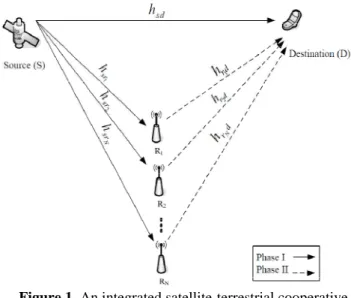
An integrated satellite-terrestrial cooperative system is shown in Fig. 1, where a source () is represented by a satellite communicates with a stationary destination node () with the help N cooperative fixed terrestrial relay nodes ( ),
# $ 1, … , &. In the first phase of cooperative communication, the source node broadcast information signal and the destination node as well as & cooperative relay nodes receive
Figure 1. An integrated satellite-terrestrial cooperative
system
the broadcasted information. While in the second phase of communication, each relay node amplifies the received signal and sends the scaled version to destination node. The destination node combines the all received signals using MRC combining technique and produce one better quality signal. This technique of broadcasting information from different locations makes communication possible even in bad channel conditions. The whole communication is completed in two orthogonal phases/channels and these orthogonal channel can be allocated to the relay nodes using Time Division Multiple Access (TDMA) of Frequency Division Multiple Access (FDMA). It is assumed that each node is equipped with single antenna, and the signal broadcasted by the source and relay nodes are perfectly synchronized at the destination node.
2.2 Fading Model
Independent and non-identical fading links are assumed between source, relay and destination nodes. The shadowed Rician distribution is assumed between , and , which is a more accurate distribution for analyzing the performance of land mobile satellite communication (LMSC) systems [15]. The fading coefficient for and nodes are represented as '() and '(*+ respectively as shown in Fig. 1. The channel coefficient between follows the Nakagami- distribution because there are multiple paths due to small buildings, trees and other objects and fading coefficient is denoted by '*+). In MRC combining technique, the multiple faded copies of the signal are received from
& relay nodes. These individual received signals are weighted and summed according their individual signal-to-noise ratio (SNR). The instantaneous SNR of the combined signal at the output of MRC at the destination node can be written as:
,-. $ ()/ 0 *+ 1 1
2
where ()$ |'()|"4(/&6 is the instantaneous SNR of the
and *+is the instantaneous SNR between the source and #th relay, and between the #th relay and destination. For the tractable analytical evaluation, *+, can be determined by its upper bound as
*+$
(*+ *+)
(*+/ *+) 2
Where (*+$ 8'(*+8"4(/&6 is the instantaneous SNR of
channel while *+)$ 8'*+)8"4*+/&6 is the instantaneous SNR of channel. While 4( and 4*+ are the transmit power of the and the node. The received noise at the #th relay and at the destination node is modeled as additive white Gaussian (AWGN) noise with variance &6. The probability density function (PDF) of the instantaneous SNR per symbol of and links is given by [15]
9 $2:1
6;<
2:66
2:66/ Ω> ?@
exp D2:
6;E
F <6, 1,"H@GIJK"HΩG@?@LΩ> 3
Here, Ω is the average power of the LOS component, 2:6 is the average power of the multipath component. While, 6 is allowed to vary over the wider range of 6M 0. We can model different types of LOS conditions for the land mobile satellite channels, i.e. very small values of 6correspond to the urban areas, while the value of 0 O 6O ∞ is associated with suburban and rural areas with partial obstruction of the LOS. Moreover, by substituting 6$ 0, above PDF minimizes to the Rayleigh PDF and while putting 6$ 1, it results in a Rice PDF.
The PDF of the instantaneous SNR per symbol between the is distributed according to the Nakagami- distribution which covers a broad variety of fading scenarios for the different values of the -fading parameter [16],
9 GQ+R $Γ D1 ; *+)E
?
?Sexp D
;*+)E 4
where is the traditional Nakagami multipath fading parameter which ranges from M 0.5 to ∞.
3.
Ergodic Capacity Analysis
The ergodic capacity is defined as the expected value of the instantaneous maximum mutual information between the source and the destination. Thus, the ergodic capacity of a multiple relay integrated satellite-terrestrial cooperative system operating over & relay nodes over orthogonal channels can be written as [17]
CGXYZ $
1
& / 1 log" ^. ln1 / ,-. 5
Moreover, a simple upper bound for the ergodic capacity derived from Jensen's inequality in [18] is given as
CGXYZ`
1
& / 1 log 1 / ,-. 6
It is noted that logx is a concave function. It is important to find out the ergodic capacity of the multiple relay integrated satellite-terrestrial cooperative system. In this context, the exact expression for the ergodic capacity can be calculated by the Gaussian approximation under independent and non-identical shadowed Rician and Nakagami fading channels. For this approximation, only the capacity first moment (mean) and second moment are required. Thus theoretically, the second-order approximation for CGQcan be obtained by using the Taylor expansion of bc1 / *+ with the mean of
*+, d*+e as given in [17]
CGXYZ $
1
& / 1 log" ^ fbc1 / ,-.
D21 / ,-." ,-."
,-." Eg 7
Now we derive the closed-form expression of combined PDF of two independent and non-identical channels given in (3) and (4). The combined PDF of the relaying path
, *+, can be expressed as [12]
9GQ+ $2:1 6;(*+<
2:66
2:66/ Ω>
?@ 1
Γ D;*+)E ?
F f D2:1
6;(*+/
;*+)E g 0
1 i!
k
26
FΓΓ6/ i
6Γ1 / i D
Ω
2:6;(*+2:66/ ΩE
F 0 < / i / 1l >
?LL
26
2?Lmn ;*+)
2:6;(*+o ?S
F ?SD2p"H@GI?
qQ+GIQ+RE (8) The average SNR between is represented by ;(*+ $
4(/&6 while ;*+)$ 4*+/&6 is the average SNR between
.
The first moment (mean) and the second moment of () and
*+ can be determined as
de $ r k
6 9GJKs 9
d" e $ r " k
6 9GJKs 10
Thus, the mean and second moment of ()can be obtained by substituting (3) in (9) and (10) and using the integral [19,eq.(3.351.3)]
() $2:1
6;()<
2:66
2:66/ Ω> ?@
0u!1
k
v26
Γ6/ u
Γ6Γ1 / u
F w Ω "H@GIqR"H@?@LΩx
v
()" $2:1 6;()<
2:66
2:66/ Ω> ?@
0u!1
k
v26
Γ6/ u
Γ6Γ1 / u
F w"H Ω @GIqR"H@?@LΩx
v
u / 2! w"H
@GIqRx SvLy
12
Now by substituting the end-to-end combined PDF (8) in (9) and (10) and using the integral [19, eq.(6.621.3)], the mean and second moment of *+can be obtained as
d*+e $
1 2:6;(*+<
2:66
2:66/ Ω>
?@ 1
Γ D;*+)E ?
0i!1
k
26
FΓΓ6/ i
6Γ1 / i D
Ω
2:6;(*+2:66/ ΩE
F 0 < / i / 1l > 2 mn ;*+)
2:6;(*+o ?S ?LL
26
F √{2|~ / |?SL"Γ} / 2Γi / l / 2Γ / i / 2.5
F " w} / 2; l / 0.5; / i / 2.5;SLx (13)
and
d*"+e $
1 2:6;(*+<
2:66
2:66/ Ω>
?@ 1
Γ D;*+)E ?
0i!1
k
26
FΓΓ6/ i
6Γ1 / i D
Ω
2:6;(*+2:66/ ΩE
F 0 < / i / 1l > 2 mn ;*+)
2:6;(*+o ?S ?LL
26
F √{2|~ / |?SLyΓ} / 3Γi / l / 3Γ / i / 3.5
F " w} / 3; l / 0.5; / i / 3.5;SLx (14)
respectively, where
~ $2:1
6;(*+/
;*+) 15 and
| $ 2n2:
6;(*+;*+) 16
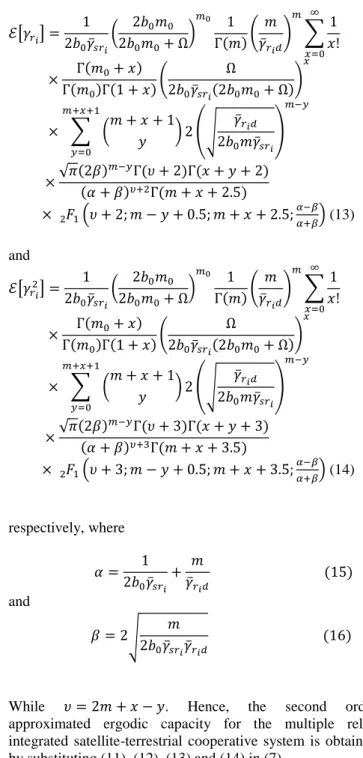
While } $ 2 / i l. Hence, the second order approximated ergodic capacity for the multiple relay integrated satellite-terrestrial cooperative system is obtained by substituting (11), (12), (13) and (14) in (7).
4.
Numerical and Simulation Results
In this section, we present the Monte Carlo simulation and analytical results of multiple relay integrated satellite-terrestrial cooperative system under independent and non-identical fading channels. The performance measure is ergodic capacity. About 10, channel realizations are randomly generated for simulation in Matlab. The AWGN
samples are complex Gaussian variables with zero mean and variance &6, while the three channel variables, the shadowed Rician '(), '(*+ and Nakagami '*+) are independently generated. The analytical results are obtained from the closed-form expression of ergodic capacity given in (7) using Mathematica program. The performance curves are plotted using the ergodic capacity versus the average SNR of the transmitted signal. The link experience Rayleigh fading at $ 1. The practical values of land mobile satellite channel (LMSC) are shown in Table 1.
We investigate the impact of the multiple relay cooperative communication on the ergodic capacity. The upper bound for the integrated satellite terrestrial cooperative system is obtained numerically using Jensen’s inequality (6), while the
Table 1: Land mobile satellite channel parameters [15]
Channel condition 6 :6 Ω
Frequent deep shadowing 2.56 0.0158 0.123 Moderate shadowing 7.64 0.129 0.372
Light shadowing 26 0.005 0.515
second order approximated ergodic capacity of the proposed system is calculated by substituting derived expressions in (7).
Figure 2: Ergodic capacity analysis of the multiple relay
integrated satellite-terrestrial cooperative system, the direct channel experience deep shadowing, 6$ 2.56, where the channel have LOS, 6$ 26 and the
Figure 3: Ergodic capacity analysis of the multiple relay
integrated satellite-terrestrial cooperative system, when the direct channel experience deep shadowing, 6$
2.56, while the channel have LOS, 6$ 26 and channel experience Nakagami-2 fading
Figure 3 shows the ergodic capacity curves of the scenario when we improve the quality of the channel at
1. As a result of this, the capacity performance is not enhancing. This shows that the ergodic capacity of the proposed multiple relay integrated satellite terrestrial cooperative system is mainly determined by the channel.
Figure 4: Ergodic capacity curves of multiple relay
integrated satellite-terrestrial cooperative system, when the satellite channels, and experience moderate and light shadowing respectively where link experience Nakagami- fading at $ 1.
Figure 5 and figure 6 show the ergodic capacity curves when the satellite link with destination node is undergoes moderate shadowing (6$ 7.64) and terrestrial channel suffer from Nakagami fading at $ 1 and 2 respectively. It is noted that in multiple relay cooperative communication, increasing the number of relay nodes degrades the ergodic capacity performance especially at high SNR. The reason is due to the orthogonal distribution of the system resources.
Figure 5: Ergodic capacity curves of multiple relay
integrated satellite-terrestrial cooperative system, when the satellite channels, and experience moderate and light shadowing respectively where the link experience Nakagami-2 fading.
5.
Conclusion
In this paper, we derived approximate closed-form expression of ergodic capacity of AF multiple relay integrated satellite-terrestrial cooperative system under independent and non-identical shadowed Rican and Nakagami- fading channels. Obtained results are examined by evaluating ergodic capacity under the variety of fading scenarios as shown in Table 1. The analysis of the study is verified using the results of the numerical computation and simulation. By using LMSC statistical experimental data of different fading conditions obtained from literature, our derived analytical approximated expression of ergodic capacity is very tight, this is applicable with any number of relay paths, and remains valid for a large class of satellite and terrestrial fading conditions. In additional, the performance of the proposed integrated system may be further improved by using multicarrier transmission like OFDM with pre-distortion technique in satellite transmission.
6.
Acknowledgement
The first would like to thank the Higher Education Commission (HEC) Pakistan for providing funds for his higher studies.
References
[1] H. Skinnemoen, R. Leirvik, J. Hetland, H. Fanebust, and V. Paxal, “Interactive IP-network via satellite DVB-RCS,” IEEE Journal on Selected Areas in communications,, vol. 22, no. 3, pp. 508–517, 2004. [2] Annex, “Annex 4 to working party 4b chairman’s
report on the 26th meeting”, Document 4B/85, 27 May, 2009.
[4] J. Laneman, D. Tse, and G. Wornell, “Cooperative diversity in wireless networks: Efficient protocols and outage behavior,” IEEE Transactions on Information Theory,, vol. 50, no. 12, pp. 3062–3080, 2004.
[5] A. Vanelli-Coralli, G. Corazza, G. Karagiannidis, P. Mathiopoulos, D. Michalopoulos, C. Mosquera, S. Papaharalabos, and S. Scalise, “Satellite communications Research trends and open issues,” in Proceeding of the International Workshop on Satellite and Space Communications, IWSSC’07., 2007, pp. 71– 75.
[6] J. N. Laneman, N. C. David, and G. W. Wornell, Cooperative diversity in wireless networks: Efficient protocols and outage behavior,” IEEE Transaction on Information Theory, vol. 50, no. 12, pp. 3062–3080, 2004.
[7] S. Kota, G. Giambene, and S. Kim, “Satellite component of NGN: Integrated and hybrid networks,” International Journal of Satellite Communications and Networking, vol. 29, no. 3, pp. 191–208, 2011.
[8] D. Ahn, S. Kim, H. Kim, and D. Park, “A cooperative transmit diversity scheme for mobile satellite broadcasting systems,” International Journal of Satellite Communications and Networking, vol. 28, no. 5-6, pp. 352–368, 2010.
[9] N. Chuberre, O. Courseille, P. Laine, L. Roullet, T. Quignon, and M. Tatard, “Hybrid satellite and terrestrial infrastructure for mobile broadcast services delivery: an outlook to the unlimited mobile TV system performance,” International Journal of Satellite Communications and Networking, vol. 26, no. 5, pp. 405–426, 2008.
[10] S. Lee, S. Lee, K. Kim, and J. Seo, “Personal and mobile satellite DMB services in KOREA,” IEEE Transactions on Broadcasting,, vol. 53, no. 1, pp. 179– 187, 2007.
[11] Y. Labrador, M. Karimi, D. Pan, and J. Miller, “An approach to cooperative satellite communications in 4G mobile systems,” Journal of Communications, vol. 4, no. 10, pp. 815–826, 2009.
[12] A. Iqbal and K. Ahmed, “A hybrid satellite-terrestrial cooperative network over non- identically distributed fading channels,” journal of Communications, vol. 6, no. 7, pp. 581–589, 2011.
[13] J. Snyder and S. Patsiokas, “XM satellite radio-satellite technology meets a real market,” in Proceedings of the 22nd AIAA International Communications Satellite Systems Conference and Exhibit, Monterey, CA, U.S.A., May 2004.
[14] R. Briskman and S. Sharma, “DARS satellite constellation performance.” in Proceedings of the 20th AIAA International Communications Satellite Systems Conference and Exhibit, Montreal, Canada,, May 2002. [15] A. Abdi, W. Lau, M. Alouini, and M. Kaveh, “A new
simple model for land mobile satellite channels: first-and second-order statistics,” IEEE Transactions on Wireless Communications,, vol. 2, no. 3, pp. 519–528, 2003.
[16] M. Simon and M. Alouini, Digital communication over fading channels. Wiley-IEEE Press, 2005, vol. 86. [17] S. Chen, W. Wang, and X. Zhang, “Ergodic and outage
capacity analysis of cooperative diversity systems under Rayleigh fading channels,” in IEEE International
Conference on Communications Workshops,, 2009, pp. 1–5.
[18] G. Farhadi and N. Beaulieu, “Ergodic capacity of multi-hop wireless relaying systems in Rayleigh fading,” in IEEE Global Telecommunications Conference, 2008, pp. 1–6.