IMPACT OF PLANNED TEACHING PROGRAMME, KNOWLEDGE AND AWARENESS TO PREVENT CARDIOVASCULAR DISEASES: AN ANALYSIS
Vipna Kumari Bhandari1, Dr.Mridula Saikia Khanikor2
Department of Nursing
1,2
Shri Venkateshwara University, Uttar Pradesh
Abstract
Although the burden of fatal and non-fatal CVD events in India, limited data are available describing the incidence or prevalence rates of various CVD risk factors in this population and the factors that can negatively influence the development of these predisposing factors coronary artery. It is known that CVD are the main causes of mortality worldwide. It is expected that by 2030 CVD-related mortality will increase to 25 million. Therefore, this is the purpose for the company to have, knowledge and awareness of CVD risk factors and is the prevention, change and modification of the quality of life for the improvement of the individual, the family, the society and the country worldwide. Knowledge, awareness of risk status, scenario of disease and planned teaching programmer about the risk factors of CAD can motivate people to take preventive measures.This research of review presents evidence regarding the knowledge and awareness of CVDs in SSA. To the best of our knowledge, and it is the first systematic review of the knowledge and perceptions of CVDs. Our results are based on a systematic search of five databases, integrating both qualitative and quantitative evidence on the topic.
1. OVERVIEW
Cardiovascular diseases (CVDs) are essential in the general population, for the most part, among adults[1]. In light of various epidemiological researches, a few nonmodifiable and modifiable CVDs risk factors have been recognized. Advanced age, family history, and male sexual orientation are nonmodifiable risk factors. Modifiable risk factors incorporate smoking, hypertension, diabetes, dyslipidemia, weight, physical inactivity, unhealthy eating regimens, and overwhelming liquor consumption [2]. Cardiovascular diseases are the leading reason for death, accounting for more than 17 million deaths every year (30% everything being equal). The rate of increase in CVD-related mortalities is perhaps the highest in the world.
tended to the knowledge of CVDs risk factors [3]. There is a developing increase in the prevalence of CVDs risk factors in the Middle East. Lebanese population ≥ , 45 years old, bears a generous burden of modifiable CVDs risk factors. In a presidential advisory gave in 2012, the leaders of leading heart social orders called to diminish deaths from no communicable by 25% regularly 2025 [4].
In light of this recommendation and since the Lebanese awareness of CVDs risk factors has not been at this point evaluated, this research was directed. The flow research was intended to examine the prevalence and consciousness of CVDs risk factors among Lebanese people 45 years old or more in urban and country regions. No communicable diseases (NCD) account for over 1.4 billion handicap balanced life years (DALYs), which is 58.5% of the worldwide health burden [5].
2. AWARENESS OF CARDIOVASCULAR RISK FACTORS
Atherosclerosis starts right off the bat throughout everyday life and can prompt Coronary Heart Disease (CHD) in more seasoned adulthood. Young adults with cardiovascular risk factors are at increased risk of CHD further down the road, and even marginal degrees of these risk factors are related to atherosclerotic changes that continue into adulthood. In this research, considers have demonstrated that people who arrive at middle-age with positive degrees of major cardiovascular risk factors have a fundamentally lower rate of cardiovascular disease and a more noteworthy life span, featuring the basic for perceiving and treating cardiovascular risk factors right off the bat throughout everyday life.
3. KNOWLEDGE AND AWARENESS OF CARDIOVASCULAR DISEASE RISK FACTORS
An estimated 23.3 million people will die by 2030 due to cardiovascular disease. High blood pressure, high cholesterol, high blood sugar, smoking, obesity and physical inactivity are conventional risk factors. Although cardiovascular diseases occur in middle age or later, risk factors (smoking, dietary factors, etc.) are largely determined by the behaviors learned during childhood and continued into adulthood. Adherence to nutritional recommendations and healthy lifestyles can play an essential role in the prevention of cardiovascular diseases. In order to encourage people to adopt a protective cardio lifestyle; little is known about the knowledge of cardiovascular risk factors in the general population.
increase in morbidity and mortality from chronic diseases. Materials and methods: a population research was conducted on people over 30 years old. The questionnaire on heart disease data (HDFQ) was used to assess the level of knowledge and awareness of risk factors during the face-to-face interview with the participants.
The percentage of participants who knew the risk factors were 48% and 52% did not know it. Among the risk factors, overweight has been classified as the most common, followed by high cholesterol (98%), hypertension (94%) and smoking (92%). Participants were also aware of regular physical activity and exercise to reduce risk factors for heart disease. This research revealed the need to increase population awareness using community-based educational programs.
4. EFFECT OF PLANNED TEACHING PROGRAMME TO PREVENT
CARDIOVASCULAR DISEASES
Myocardial infarction (MI) is a leading cause of morbidity and mortality. Annually, more than 3,000,000, people are evaluated to have acute MI, and more than 4,000,000 have MI[23]. In India, ischaemic heart disease accounted for 12.9% of medically guaranteed deaths in 2008. The meaning of cardiovascular health index depends on seven health factors and practices: smoking, body mass index (BMI), diet, physical activity, blood pressure, and glucose and cho lesterol levels[24]. The estimation of cardiovascular health index things, for example, smoking, BMI, blood pressure, and psychological factors may counteract the repeat of the disease. Stopping smoking improves health results among patients post-MI and increases their survival rate. Systolic blood pressure (SBP) and diastolic blood pressure (DBP) are indicators and markers of the risk of MI and cardiovascular occasions.
Moreover, weight and overweight are related to the risk of acute MI, followed by mortality. Other than the physical and clinical impacts, MI may largely affect psychological measurements. Patients with MI may show negative psychological responses, for example, sadness, anxiety, and stress. These emotional responses were seen as related to an increase in mortality risk. Anxiety and misery were the significant reasons patients didn't comply with rehabilitation programs. The adequacy of health education projects has turned into a significant issue in overseeing patients with MI. Numerous investigations have demonstrated that health education can improve cardiovascular health index things through the advancement of health-related practices, increase compliance rate and improve quality of life. In cardiovascular showing programs, patients will be educated about the diseases, risk factors, compliance with medicine, diet system, regular activities, and stress decrease.
The data had been analyzed in SPSS version 24 for all computations. To access the knowledge of the patients about the cardiovascular diseases, the questions based on knowledge were given one mark each for correct answer and zero for incorrect one. Total 30 questions were asked for knowledge which makes the maximum marks to be 30. The obtained score before and after the teaching program was categorized into 3 groups as score up to 7 as low, from 8 to 14 as medium score and above 14 as high score, to test their association with the demographic variables of the patients.
Gender And Age Distribution Of The Patients In The Study
The table 1 and 2 reveals the gender and age distribution of the patients. It can be seen in the table 1 that 62% of the patients in the study were male, whereas 38% of the patients were female. Table 2 shows that the 44% of the patients in the study were in the age groups of 31 to 40 years, followed by those in the age group of 41 to 50 years (22.5%) and 51 to 60 years (19%).
Gender Frequency Percent
Male 124 62.0
Female 76 38.0
Total 200 100.0
Table 1: Gender distribution of the patients
Age (in years) Frequency Percent
31 to 40 88 44.0
41 to 50 45 22.5
51 to 60 38 19.0
61 to 70 29 14.5
Total 200 100.0
Table 2: Age distribution of the patients Type Of The Family Of The Patient
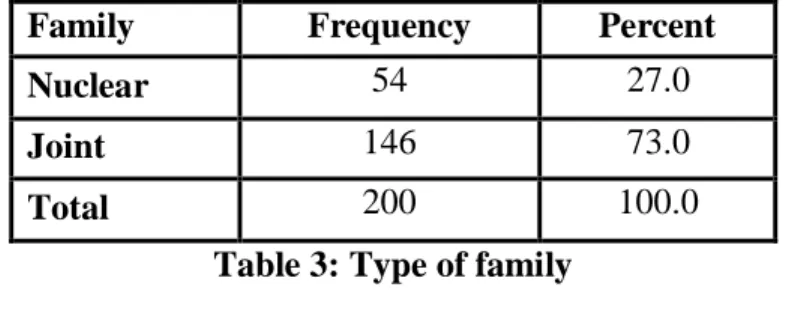
The table 3 illustrates the type of the family, i.e., nuclear or joint that the patient has. It was found out that 73% of the patients had a joint family; on the other hand 27% of the patients had it in nuclear form.
Family Frequency Percent
Nuclear 54 27.0
Joint 146 73.0
Total 200 100.0
Educational Status Of The Patient
The table 4 doles out the patient’s education being illiterate, studied upto primary, secondary or high schooletc. It can be seen that 26% of the respondents had primary education followed by those who studied upto high school, whereas 18% of the patients in the study were college graduates.
Education Frequency Percent
Illiterate 21 10.5
Primary 53 26.5
Secondary 40 20.0
High School 50 25.0
Graduate and above 36 18.0
Total 200 100.0
Table 4 Education level of the patients Illness History Of Patient’s Family
The table 5 shows the illness history that the family of patient had. It can be seen in the table that 13.5% of the patient’s family had a history of hypertension, followed by the ones who had a history of diabetes mellitus (12.5%) and cardiovascular diseases (10.5%) in their family.
Personal History Frequency Percent
Diabetes Mellitus 25 12.5
Hypertension 27 13.5
Cardiovascular Diseases 21 10.5
Genetic Disorder 9 4.5
Any Other 118 59.0
Total 200 100.0
Table 5: Illness history of the patient’s family Occupation of the patient
The table 6 and 7 describes the occupation and the income of the patients. It was found from the table 6 that 26% of the patients were working as a labor followed by the housewives/househusbands (17.5%). The table 7 shows the income of the patients as 39.5% of the patients had monthly income of more than Rs. 20000 and 17% of the patients had it between Rs. 15001 and Rs. 20000.
Occupation Frequency Percent
Labor 52 26.0
Teacher 18 9.0
Factory Worker 16 8.0
Any Other 79 39.5
Total 200 100.0
Table 6: Occupation of the patient Health Insurance
The table 4.17 marks out how many of the patient had the health insurance and it was seen that only 22.5% of them had it and the rest didn’t.
Health Insurance Frequency Percent
Yes 45 22.5
No 155 77.5
Total 200 100.0
Table 7: Number of patients having health insurance
To evaluate the effectiveness of planned teaching on the level of knowledge hypothesis given below were formed and tested. The table 4.19 gives the descriptive statistics of the scores obtained pre and post teaching and it was found that the mean score obtained by the patients before teaching them was 9, whereas the mean score obtained after teaching them was 10. The table 4.20 illustrates to the conducted paired t-test on the test scores of the patients and the obtained difference of 1.005 was found to be statistically significant. Thus we had enough evidence to reject the null hypothesis and we conclude that the planned teaching was effective to increase the knowledge of cardiovascular diseases.
6. CONCLUSION
In any case, information on the knowledge of risk factors for CVD among Indian school children is limited. In small research among Indian children researching in classes sixth tenth, awareness in regards to non-communicable disease was seen as unsatisfactory, with only 9.6% realizing that cardiovascular diseases are preventable. Coronary heart disease (chd) is an increasing worldwide health burden. While the prevalence of CHD has stabilized in developed countries, the condition has recently started to affect developing countries because of increasing life hope, urbanization, and lifestyle changes; these are examples of territories encountering this epidemiological progress.
Modifiable risk factors, for example, hypertension, diabetes mellitus, hyperlipidemia, a stationary lifestyle, weight and smoking, are viewed as the fundamental antecedents of CHD. The increasing pattern of CHD and its related risk factors has highlighted the need to reinforce national surveillance plans and endeavors to lessen CHD-related morbidity and mortality. Numerous countries have implemented an essential counteractive action approach, be that as it may, a key perspective influencing the achievement of this technique is the knowledge of the individuals at risk concerning a particular health problem.
REFERENCES
[1].S. Mendis, P. Puska, and B. Norrving, Global Atlas on Cardiovascular Disease
Prevention and Control, WHO, Geneva, Switzerland, 2011,
http://www.who.int/cardiovascular_diseases/publications/atlas_cvd/en/.
[2].D.-M. Wu, L. Pai, N.-F. Chu et al., “Prevalence and clustering of cardiovascular risk factors among healthy adults in a Chinese population: The MJ Health Screening Center Study in Taiwan,” International Journal of Obesity, vol. 25, no. 8, pp. 1189–1195, 2001 [3].R. S. L. Cassani, F. Nobre, A. PazinFilho, and A. Schmidt, “Prevalence of cardiovascular
risk factors in a population of Brazilian Industry Workers,” ArquivosBrasileiros de Cardiologia, vol. 92, no. 1, pp. 16–22, 2009
[4].M. A. Sánchez-Chaparro, J. Román-García, E. Calvo-Bonacho et al., “Prevalence of cardiovascular risk factors in the Spanish working population,” Revista Española de Cardiología, vol. 59, no. 5, pp. 421–430, 2006.