Published online: 11.06.2016 --- © jbm 2016
--- M. Girard1
e-mail: [email protected] A. Girard2
e-mail: [email protected] A.-C. Suppin3
e-mail: [email protected]
The Scentscape: An Integrative Framework Describing Scents
in Servicescapes
Marc Girard · Anna Girard · Anna-Caroline Suppin · Silke Bartsch
Abstract: The systematic use of ambient scents is a trend in service companies that is accompanied by increasing research attention. However, we lack a theoretical framework that ad-dresses ambient scents’ specific role in physical surroundings of services. Thus, this article develops the ‘scentscape’, a model that describes the process of olfactory stimulation and its impacts on customers and employees in service environments. The paper extends Bitner's servicescape model (1992) and combines it with Gulas and Bloch's (1995) model of the influence of ambient scent, while integrating further results from a literature review in scent-related sciences. The paper consolidates existing theory into a holistic framework and discusses present inconsistent findings. The scentscape illustrates different scent sources, provides an overview of the process of scent perception and evoked internal and behavioral reactions in a servicescape. We derive 11 key findings, which need to be considered by managers and scientists when using / investigating scents in service environments. We identify key determinants and independencies to be considered by service academics and provide a wide range of future research directions. We provide crucial facts to guide practitioners in integrating ambient scents in service settings. The scentscape illustrates that the olfactory situation in an environment will influence individuals through their perceived air quality even if no ambient scents are introduced into the servicescape. Therefore, an active indoor air quality management should be generally a key task for managers, in order to avoid the potential negative impact of an unpleasant olfactory experience – and focus of further research.
Introduction
The systematic use of scents is an intensifying trend in service companies (Bell 2007; Klara 2012). Meanwhile, marketers intentionally incorporate scents into locations’ interior design in a variety of settings, ranging from retail (e.g., Abercrombie & Fitch created a brand scent for use in stores, on textiles, and employee perfume), to transportation services (e.g., Singapore Airlines holistically integrates a signature scent into its communication concept as perfume, ambient scent, and refreshing tissues), to hotel businesses (e.g., the Starwood Group created a unique fragrance for each hotel chain that mainly used in the lobbies), and many other areas (Bell 2007; Goldkuhl and Styvén 2007).
Using scents in a service provider’s physical environment might generally be related to various managerial objectives ranging from covering bad smells present in the service delivery location, to enhancing a service brand’s recall value, to increasing customers’ service experiences and employee performance – mostly with the ultimate goal of increasing sales (Goldkuhl and Styvén 2007; Lindstrom 2005). An understanding of scents’ specific characteristics and effects is therefore crucial to help companies to effectively and cautiously leverage the power of the sense of smell in service environments.
The marketing literature has long acknowledged that ambient scents, as part of the physical environment, affect individuals, and has considered its influence predominantly in retail or laboratory settings (e.g., Laird 1935; Madzharov et al. 2015; Mattila and Wirtz 2001; Morrin and Chebat 2005; Morrison et al. 2011; Spangenberg et al. 1996). Over the past decades, empirical research has analyzed a variety of isolated variables that can potentially be influenced by scents, as emotions, cognitions and behaviors (Olahut 2013; Teller and Dennis 2012).
In fact, research on the influence of ambient scents has predominantly focused on the customer perspective, and few studies have investigated scents’ impacts on work-related contexts. However, a typical service environment affects not only a service provider’s customers, but also the employees involved in the service delivery process (Bitner 1990; Parish et al. 2008). The introduction of ambient scents will thus affect the perception and satisfaction of both customers as well as employees and will become an integral part of their experiences and interactions (Bitner 1992). Interestingly, there are also barely any explicit studies on scents in service settings that account for the specifics of service environments and delivery (Maille 2006; McDonnell 2007), despite the increased importance of external environmental cues due to a service’s intangibility (Zeithaml 1981).
In conclusion, although there has recently been research, many academics have called for additional investigation of the potential of scents as a controllable marketing instrument (Bosmans 2006; Morrin and Ratneshwar 2000; Zomerdijk and Voss 2010): “One of the least-understood variables in an environment’s ambient conditions is ambient scent” (Zemke and Shoemaker 2007, p. 929). Owing to the very fragmented research (Teller and Dennis 2012), we especially lack a theoretically motivated framework that addresses ambient scents’ role in the physical surroundings of service settings. Thus, both a theoretical as well as a managerial need exists for a more in-depth understanding of scents in service environments. This paper seeks to contribute
to the emerging body of research on scents in service settings by addressing the following central research questions:
RQ1. What impacts do pleasant ambient scents have on customers and
employees present in a service environment?
RQ2. Which factors influence ambient scents’ impacts on customers and
employees in a service environment?
This article merges existing theories and empirical findings from various disciplines into a framework that describes how ambient scents affect both customers and employees in a service environment. We build on the structure of Bitner’s servicescape model (1992) and combine it with the specific findings of Gulas and Bloch’s (1995) model of the influence of ambient scents. Further, we will integrate scent-related research and findings from service literature to develop the ‘scentscape’– inventing the term scentscape by bringing together the two above-mentioned models – as an integrative framework for scents in service environments (MacInnis 2011). The scentscape holistically describes the process of olfactory stimulation and its impacts on customers and employees, while considering specific characteristics and relevant moderators in service settings. This is a step towards enabling organizations to better evaluate influencing factors and to build an understanding of potential effects of ambient scents, leading to a more effective integration of olfactory stimuli into an organization’s marketing strategy. We derive 11 major insights and discuss key managerial as well as research implications. Overall, the paper’s contribution lies in giving an overview over the state of the art scent research in services-capes to identify future research possibilities and to give management implications based on our integrated scentscape model.
Underlying Conceptual Models
We will first shortly describe the two basic models, on which our framework is based.
The Model of the Influence of Ambient Scent
Ambient scents are defined as “scents that are present in the environment and do not emanate from a specific product” (Bosmans 2006, p. 32). Scientific publications in marketing on ambient scents’ influences often refer to the conceptual model of Gulas and Bloch (1995), which is based on Mehrabian and Russell’s (1974) general model of environmental psychology, and is mainly used to describe consumer responses in the context of retailing (e.g., Mattila and Wirtz 2001; Morrison et al. 2011; Spangenberg et al. 1996).
The model postulates that a scent needs to be perceived consciously in order to affect consumer behavior. Depending on the individual olfactory scent acuity (sensitivity to scents) and moderated by personal scent preferences, scent perception then leads to internal affective consumer responses. In turn, these reactions induce
approach or avoidance behavior towards an individual’s environment. Gulas and Bloch (1995) argue that individual characteristics such as gender and age affect an individual’s scent acuity, which then determines whether or not a specific scent is perceived consciously. However, besides individual characteristics, physiological pre-dispositions and past experiences with olfactory stimuli influence preferences for specific scents, which then moderate a customer’s affective response. Finally, other atmospheric elements (e.g., music) as well as a scent’s congruence with other features of the environment (e.g., colors) also play a moderating role.
Gulas and Bloch’s model undoubtedly helps explain the ‘black box’ of scent perceptions and their effects on customers (Davies et al. 2003). However, the model simplifies some aspects of scent perception, processing and reactions, which makes further adaptations necessary. To further strengthen the model’s explanatory power, we will discuss the model’s drawbacks in detail for instance, scent as one-dimensional input factor (discussed in insight 3), conscious perception of scents (insight 4), moderators in scent perception (insight 5), and scent physiological and cognitive reactions (insight 9) and integrate additional findings from multidisciplinary scent research into our final scentscape framework. Prior to that, we introduce the servicescape model as basis, specifically explaining environmental influence and effects in service environments.
The Servicescape Model
Bitner’s (1992) model of the servicescape – defined as “the immediate physical and social environments surrounding a service experience, transaction or event” (Bitner 2000, p. 48) – is one of the most salient models in service research. According to the servicescape model, ambient scents are specific environmental cues that are an integral part of a service environment (among many others), and thus affect its holistic perception. Influenced by individual moderators or situational factors, olfactory stimuli can cause emotional and cognitive internal reactions within customers and employees and therefore affect their approach/avoidance behavior as well as possible social interactions (Bitner 2000; Bitner 1992).
Bitner’s servicescape model provides many aspects that are so far not considered in Gulas and Bloch’s model of ambient scent − as air quality (discussed in insight 2 and 8), physiological and cognitive responses of customers as well as employees on scents (insight 9), and ambient scent’s influence on social interaction (insight 11) −
why we now merge the two perspectives.
Integrative Framework for Scents in Servicescapes: The Scentscape
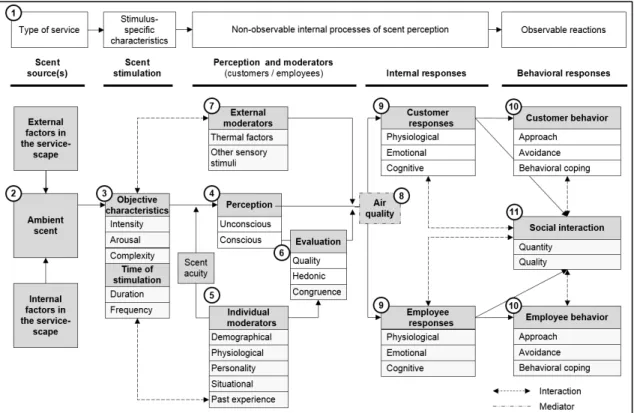
The integrative scentscape framework (see Figure 1) illustrates different sources of scents and their stimulation of customers and/or employees present in a servicescape. It also provides an overview of the processes of scent perception as well as individuals’ evoked internal responses and behavioral reactions. We present 11 major insights explaining the scentscape model in the following.
Fig. 1: The Scentscape Model
Insight 1: The importance of ambient scents as environmental cue depends on the service type: the lower the extent of search qualities of a service, the higher the importance of scents.
Intangibility usually complicates the evaluation of a service. In contrast to products, most ser-vices lack specific search qualities that a customer can evaluate prior to their utilization (e.g., packaging). Instead, experience qualities – those features that can only be assessed during or after use (e.g., entertainment in a theater), along with credence qualities, which cannot be eval-uated even after the service utilization (e.g., legal advice), are distinct aspects of most services (Zeithaml 1981). Due to this intangibility, the importance of external environmental cues – such as ambient scents – in customers’ determination of a service’s quality generally increases (Baker et al. 2002); especially in service businesses, where the actual service experience and trust in the delivery are distinct. Thus, we argue that, the lower the extent of search qualities of a service, the higher the importance of scents as external environmental cues, as “a proprietary scent can ‘tangibilize’ a company’s service” (Zemke and Shoemaker 2007, p. 937).
Insight 2: Internal and external scent sources in the servicescape influence customers and employees present.
Contrary to product-specific scents, ambient scents do not emanate from a specific product, but can be viewed as a manageable environmental cue, for instance, via a service location’s air con-ditioning system (Bosmans 2006). However, not only directly controlled olfactory cues should be taken into account in service settings; Bitner (1992) subsumes these additional olfactory cues as air quality in her servicescape model. To specify aspects of air quality, we distinguish between internal and external scent sources. During a service delivery process, either the cus-tomer or the customer’s object is directly involved. Therefore, olfactory emissions of external individuals or external objects (e.g., the customer’s dog at the veterinarian) must be considered, as they might interact with an ambient scent introduced into the servicescape. Furthermore, other internal factors (besides the ambient scent) can also influence the olfactory situation, such as employee emissions (e.g., sweat) or smelling objects used during the delivery process (e.g., shampoo at a hairdresser). We integrate these additional internal and external scent sources as relevant further olfactory stimuli into our model.
Insight 3: Scent is a complex and multi-dimensional cue – its objective characteristics com-prise its intensity, arousal potential, and complexity, as well as the duration and/or frequency of scent exposure.
In Gulas and Bloch’s (1995) model ambient scent is a uni-dimensional cue. In fact,
ambient scents have many different objective characteristics − which can induce
different reactions − why we discuss them in the following: A scent’s intensity, which
relates to the perceived strength of a smell impression, depends on the specific concentration of an olfactory stimulus and determines whether or not a specific scent is perceived consciously or unconsciously. Scent perception sensitivity thresholds vary greatly between individuals (Pyrski and Zufall 2009).
A scent’s direct influence on the central nervous system (CNS) as relaxing or energizing can be characterized based on its arousal potential – independent of the level of consciousness of its perception (Jellinek 1996; Pfaff 2006). Different scents have distinct activation potentials, which are associated with corresponding levels of vigilance (Gould and Martin 2001; Heuberger et al. 2001): For instance, the odor of roses has a relaxing effect, whereas that of lemons is said to be arousing. Therefore, depending on the intention of scenting a specific ser-vicescape, the stimulus should be properly selected considering its arousal level (e.g., a rose scent seems appropriate for a spa, but inappropriate for a fitness center).
A scent’s complexity depends on how many components a scent consists of. Herrmann et al. (2013) recently transferred scent complexity from food complexity as distinct scent characteris-tic, and argue that simple stimuli can be processed more easily. Grabenhorst et al. (2011) how-ever argue that complex scents – including pleasant as well as unpleasant components – evoke an attentional capture effect, which can then influence internal and behavioral responses. In general, in real-life situations, most scents consist of multiple components and, more important-ly, mono-scents are said to be unable to evoke ‘natural’ (non-artificial) human responses (Kirk-Smith and Booth 1987; von Kempski 2002). Thus, we conclude that research has not
yet clari-fied, which degree of scent complexity is appropriate for ambient scents in service environ-ments.
Depending on the exposure duration, a physiological effect called adaptation might occur. Ad-aptation is a stimulus-induced sensitivity reduction, where a continuous exposure to a specific scent leads to a decrease in the perceived intensity. In most cases, such olfactory cell fatigue occurs within 10 seconds, depending on a scent’s structure and concentration. After removing the stimulus, the olfactory cells’ sensitivity usually recovers fully (Köster and de Wijk 1991). In contrast, frequent exposure to a scent might lead to the effect of habituation, an experience-based sensitivity reduction. Habituation can lead to a decrease of the perceived intensity to an entirely unconscious perception after repeated contact with a specific scent (e.g., the smell of one’s home). The specific smell perception decreases over time, as the scent is rated as not sig-nificant by the respective brain areas and is thus ignored (Poellinger et al. 2001). Any model trying to predict ambient scent’s influence without considering its key characteristics intensity, arousal level, complexity, and exposure must thus fall short in its explanatory power.
Insight 4: Scents do not need to be consciously perceived to evoke reactions within exposed individuals.
In Gulas and Bloch’s (1995) model ambient scent only affects individuals, when consciously perceived. In fact, human scent perception and the formation of an actual smell impression are embedded in a complex two-step process of physiological and neurological procedures. The first step relates to the reception of an olfactory molecule by the physiological scent receptors in the nasal mucous membrane. The second step comprises multiple neurological and psychologi-cal processings of the perceived signals in various areas of the human brain. The actual percep-tion of a scent can be processed consciously or unconsciously, while the potential of the scent to actually impact an individual is independent of the consciousness level of exposure (Doty 2001; Pyrski and Zufall 2009). Thus, even if customers or employees do not consciously per-ceive a (pleasant or unpleasant) scent, it might still (positively or negatively) affect the exposed individuals within a servicescape (Lee and Schwarz 2012; Li et al. 2007).
Insight 5: The perceived scent intensity depends on an individual’s scent acuity, which is de-termined by numerous individual moderators such as demographical, physiological, situational, personality-related or experience-related factors (see the effect of habituation).
Olfactory acuity generally improves until one’s 20s, remains stable between 20 and 60 years, and decreases after 60 (Doty 1991). Regarding the role of gender, women are said to generally have higher olfactory acuity than men (Brand and Millot 2001; Chen and Dalton 2005). Keller et al. (2012) show that young, non-smoking females have the highest average scent acuity.
Health status and pathological dysfunction of the olfactory sense can reduce or alter olfactory acuity or can lead to a total loss of sensitivity within affected individuals
(anosmia) (Tafalla 2013). Also, specific personality traits are said to influence olfactory acuity, such as being anx-ious or neurotic increases scent acuity while extraversion decreases it (Chen and Dalton 2005; La Buissonnière-Ariza et al. 2013; Pause et al. 1998).
Newly added compared to Gulas and Bloch’s (1995) model are situational factors: Tiredness, reduced attention, and smoking decrease olfactory acuity (Frye et al. 1990; Vennemann et al. 2008), while the moderate consumption of alcohol (Engen et al. 1975) tends to increase it. One’s emotional state also seems to influence scent acuity (Chen and Dalton 2005).
The latest results even indicate that there are differences between cultures in general (Croy et al. 2014), especially between industrialized and non-industrialized populations. Possible explanations for indigenous people’s higher sensitivity to scents might be less exposure to air pollu-tion, better training owing to the higher importance of the sense of smell (Sorokowska et al. 2013), or genetic predisposition (Mainland et al. 2014).
Insight 6: When consciously perceived, individuals can evaluate the subjective characteristics of a scent: its quality, hedonic value (preferences), and its perceived congruence.
A scent’s quality relates to the verbal description of a smell based on previous experiences and evoked impressions using adjectives (e.g., sweet or rotten) or nouns describing a scent’s sup-posed source (e.g., it smells like roses) (Pyrski and Zufall 2009). Overall, the human nose is able to distinguish up to 10,000 scent qualities (Buck and Axel 1991).
Hedonic value relates to the emotional evaluation of a smell as either pleasant or unpleasant. Preferences for certain scents are very subjective and depend on learning and education (Ayabe-Kanamura et al. 1998; Gulas and Bloch 1995). Scents are also directly linked with past experiences and events, which usually determine whether a smell is evaluated as pleasant or unpleasant. Therefore, almost every scent is connected with certain associations and provides an identity to the context in which we perceive it. This link is strengthened with the frequency of perception in a specific context (Orth and Bourrain 2008; Sandoz 2009). The only smell uni-versally perceived as pleasant seems to be the scent of newborns (Lundström et al. 2013). Fur-thermore, the hedonic evaluation is interrelated with a scent’s intensity (Takagi 1989): Even a pleasurable fragrance can be perceived as unpleasant if the concentration is too high.
We also try to further substantiate the phenomenon of congruence in the context of scent per-ception: Schema theory defines congruence as a positive comparison between the perceived attributes of a service and an already existing schema of past experiences (Mandler 1982). The crucial question is in which schema does a scent need to fit in the context of a specific service, that is, will it be congruent with the brand, the servicescape, or the managerial intention the ambient scent seeks to support (e.g., creating a relaxing atmosphere)? Ideally, all three should align. For instance, in the case of most public transportation companies congruence is hard to determine: Most have a mediocre brand image, and their servicescapes are usually old and/or dirty. A pleasant ambient scent applied to create a pleasant transportation
experience would therefore fit neither the brand image nor the servicescape. This example illustrates the challenge of scent congruence in the context of service management. Olahut (2013) therefore argues that congruence should be considered as a separate scent dimension, and not just a moderator as Gulas and Bloch (1995) suggest. However, she too does not specify to what schema a scent should fit. The problem of congruence is becoming even more complex, because one scent can never fit all, since each person has different olfactory experiences, brand images, or schemas activated in relation to a specific servicescape. Every scent can induce different smell percep-tions, both within an individual (owing to situational moderators) as well as between individu-als (owing to individual moderators), which makes it virtually impossible to develop and de-ploy ‘the one and only’ congruent scent.
Thus, it can be assumed that an ambient scent should at least not be incongruent – neither to the servicescape, nor the brand positioning, nor the scenting’s managerial objective. Further-more, we argue that it is likely that individuals will learn to adapt their individual schema ac-cordingly when they repeatedly perceive a particular scent in the context of a specific service (Mandler 1982).
Insight 7: External moderators, such as thermal conditions, and other stimuli present in the service environment influence ambient scent’s perception.
First, the ambient scent and perceptions of it might vary depending on thermal factors, such as temperature, humidity, and air pressure in an indoor environment (Henshaw 2014; von Kempski 2002). For instance, with increased room temperature different molecular components of a scent source volatize and individuals thus get a different smell impression.
Second, ambient scents’ effects might be moderated by other stimuli present in the service en-vironment (Gulas and Bloch 1995). Individuals perceive their environment with all their senses (Ackerman 1990; Krishna 2012; Mehrabian and Russell 1974), and if the respective visual, acoustic, haptic, and olfactory impressions are congruent or do not differ widely, general in-formation processing is improved (Mandler 1982).
The most prominent of our senses is vision (Ackerman 1990): If what we see and what we smell fits, individuals are able to identify a scent faster and more accurately. Without a visual counterpart, the human brain is hardly able to identify or allocate a scent’s source (Gottfried and Dolan 2003). Similar results were achieved by Mani (1999), who showed that individuals are able to learn associations more accurately if a scent is congruent with visually presented stimuli. Also, recent research revealed that if customers are confronted with a messy environ-ment, a pleasant ambient scent significantly worsens product evaluations, owing to a mismatch between unpleasant visual impressions and pleasant olfactory stimulation (Doucé et al. 2014).
Several studies have investigated the interaction between music and ambient scent: Congruent music seems to moderate ambient scent’s effects; Spangenberg et al. (2005) revealed better evaluation of an environment and higher behavioral intentions in a setting with congruent acoustic and olfactory cues. In line with this, Mattila and Wirtz (2001) could demonstrate that music and ambient scent that are congruent in terms of their arousal level lead to better evalua-tions of the environment, higher satisfaction, and more favorable shopping behavior.
Krishna et al. (2010) studied the interaction between sense of touch and sense of smell. The authors showed that if an ambient scent is congruent with haptic characteristics of a product (e.g., its texture), product evaluations significantly improved.
However, too much stimulation might also lead to negative effects (Morrin and Chebat 2005), as most individuals prefer intermediate levels of stimulation (Steenkamp and Baumgartner 1992).
Insight 8: Perceived air quality (PAQ) mediates ambient scents’ influences on internal and behavioral reactions of exposed individuals, independent of the consciousness level of scent perception.
Perceived air quality describes an individual’s subjective and holistic impression of an indoor’s olfactory situation, and is considered crucial for the well-being and health of exposed individu-als (Frontczak et al. 2012; Frontczak and Wargocki 2011). Von Kempski (2002) suggests that indoor air must be objectively unpolluted (i.e., hygienically clean) as well as perceived as sub-jectively pleasant, natural, and fresh. The PAQ in a servicescape is generally influenced by in-ternal and external scent sources (see insight 2), and if applied also by diffused ambient scents. Hence, even if no ambient scents are deliberately introduced into a servicescape, the olfactory situation in the environment will still influence individuals through their perceived air quality. If a service provider decides to diffuse pleasant ambient scents, its introduction will first lead to improved PAQ (von Kempski 2004; von Kempski 2002), and can then lead to an indirect positive affectation of exposed individuals. We therefore consider PAQ an important mediator in the context of scent research.
Insight 9: Olfactory stimulation evokes various reactions in humans, ranging from mere physiological responses, to emotional reactions, and to complex cognitive responses.
Gulas and Bloch (1995) integrate only affective responses on customers into their model. How-ever, as Bitner (1992) suggests scents can also induce physiological and
cognitive reactions in customers − as well as employees, as they are part of the same
environment.
First, olfactory stimulation can induce physiological activation (activation of the CNS), and can therefore trigger an alteration of skin conductance responses (Møller and Dijksterhuis 2003), human brain activity (e.g., Masago et al. 2000; Owen and Patterson 2002; van Toller et al. 1993), blood pressure (Heuberger et al. 2001; Heuberger et al. 2004; Höferl et al. 2006), and dilation of the pupils (Schneider et al. 2009). Owing to the activation of the CNS, olfactory stimulation can enhance the processing and storage of scent information as well as of other stimuli perceived in the same context, such as sounds, textures, etc. (Gould and Martin 2001). This seems promising, as scents could be generally used to activate exposed subjects in a ser-vicescape.
Also, olfactory stimuli can affect bodily functions during sleep (Badia et al. 1990): Some scents enhance sleeping efficiency and reduce movement while sleeping (Goel
et al. 2005; Raudenbush et al. 2003). This could be interesting for hotels in order to improve their custom-ers’ sleep quality. Furthermore, specific scents can reduce the perceived intensity of pain (Marchand and Arsenault 2002; Villemure et al. 2003). In a marketing context, this could be relevant, for instance, to reduce perceived pain in piercing or waxing studios.
Second, scents can also induce emotional reactions in customers and employees. On the one hand, several studies show that the introduction of a pleasurable ambient scent can positively affect individuals’ emotions (Mattila and Wirtz 2001; Michon et al. 2005; Morrison et al. 2011; Schifferstein et al. 2011; Spangenberg et al. 2005), as well as mood (Baron 1990; Baron and Thomley 1994; Knasko 1995; Warm et al. 1991). On the other hand, many other studies are not able to reveal any effects of scent on people’s mood or emotions (Gilbert et al. 1997; Knasko 1993; Ludvigson and Rottman 1989; Mitchell et al. 1995; Morrin and Chebat 2005; Teller and Dennis 2012). One explanation for these inconsistent results might be that different ambient scents were used which – despite all being rated as pleasant by the respondents –were linked with different previous personal experiences, and thus led to different affective responses. Overall, it seems certain that unpleasant scents worsen mood and lead to negative emotions (Asmus and Bell 1999; Knasko 1992; Rotton 1983).
Third, there is evidence of an influence of ambient scents on customers’ cognitive responses. Regarding memories, there is evidence that even after a long time, events can be remembered better if they are stored in combination with a specific scent (Baeyens et al. 1996; Epple and Herz 1999; Herz and Cupchik 1992; Laird 1935; Lehrner et al. 2000; Lehrner et al. 2005; Robin et al. 1999). This memory power of scents, also known as the Proust phenomenon (Miles and Berntsen 2011), might help service companies to link their offerings to a specific ambient scent, thereby increasing the recall and recognition potential of their services, even after a long time.
Furthermore, the presence of a pleasant ambient scent can induce customers to evaluate the (service) environment (Michon et al. 2005; Morrin and Chebat 2005; Parsons 2009; Schifferstein et al. 2011; Spangenberg et al. 1996; Spangenberg et al. 2005; Spangenberg et al. 2006), as well as present service employees (Baron 1981; Baron 1986; Baron 1983; Maille 2006; Mattila and Wirtz 2001) more positively. Further studies demonstrate an impact of ambi-ent scents on the evaluation of service quality (Maille 2006; McDonnell 2007; Morrin and Chebat 2005), or a brand (Mani 1999; Morrin and Ratneshwar 2003; Morrin and Ratneshwar 2000). Olfactory stimulation also seems to affect sense of time: Subjects evaluate the perceived dwelling, waiting, and shopping time as shorter in a scented environment (Maille 2006; Spangenberg et al. 1996; Spangenberg et al. 2006). It even seems possible to positively influ-ence overall customer satisfaction by means of ambient scents (Mattila and Wirtz 2001; Morrison et al. 2011).
Regarding scents’ influence on employees, we could identify several studies that conducted laboratory experiments in work-related contexts. The results suggest that ambient scents can alter the evaluation of the (work) environment (Baron 1990; Baron and Bronfen 1994), other persons present (Baron 1981; Baron 1986; Baron 1983; Fiore and Kim 1997; Li et al. 2007; McGlone et al. 2013), an individual’s self-evaluation in terms of goal and performance assess-ments (Baron 1990; Gilbert et al.
1997; Knasko 1992; Knasko 1993), and positively influence employees’ perceived stress levels (Baron and Bronfen 1994; Baron and Thomley 1994).
As a result, pleasant ambient scents are able to positively influence various physiological, emo-tional, and cognitive reactions in both customers and employees present in a servicescape.
Insight 10: Scents can induce approach or avoidance behavior in customers and employees in or towards a servicescape.
First, ambient scents seem to raise exploration and information search tendencies in customers (Doucé et al. 2013; Mattila and Wirtz 2001), the willingness to buy and pay (Fiore et al. 2000; Herrmann et al. 2013), as well as the intention to revisit (Spangenberg et al. 1996; Spangenberg et al. 2005; Spangenberg et al. 2006). Besides scents’ effects on perceived dwelling time, there is also evidence for such an influence on the actual length of stay in an environment (Guéguen and Petr 2006; Maille 2006). Scents can even enhance behavior, for instance, dancing in a nightclub (Schifferstein et al. 2011), the conversion rate from store visitors to paying customers (Jacob et al. 2014), as well as the amount of items bought (Madzharov et al. 2015; Spangenberg et al. 2006), and shoppers’ overall expenditures (Chebat et al. 2009; Guéguen and Petr 2006; Hirsch 1995; Jacob et al. 2014; Madzharov et al. 2015; Morrin and Chebat 2005; Spangenberg et al. 2006).
Second, concerning possible effects on employees, experiments on work-related behavior show that olfactory stimuli can enhance individuals’ physical performance in routine jobs (Barker et al. 2003; Ho and Spence 2005; Raudenbush et al. 2002; Sakamoto et al. 2005; Warm et al. 1991), mathematical operations (Degel and Köster 1999; Gilbert et al. 1997; Knasko 1993; Ludvigson and Rottman 1989), and linguistic tasks (Baron and Bronfen 1994; Baron and Thomley 1994; Degel and Köster 1999; Herrmann et al. 2013; Knasko 1993; Rotton 1983), whereas unpleasant scents divert employees and lead to less responsiveness and performance, as well as higher error rates (Habel et al. 2007; Nordin et al. 2013; Rotton 1983). Furthermore, unpleasant scents increase employees’ motivation to escape the environment (Asmus and Bell 1999). To date, there seems to be no evidence for any impact of olfactory stimulation on crea-tivity tasks (Degel and Köster 1999; Knasko 1992).
Third, besides approach and avoidance behavior, other reactions to scents also seem possible. In Bitner’s servicescape model (1992), individual behavior evoked by a service environment main-ly includes physical behavior towards or away from the environment or stimulus. However, other reactions seem possible, such as staying within an unfavorable situation, complaining, or asking for help (Hirschman 1970). To expand the original servicescape model beyond approach and avoidance behavior, we intend to integrate the concept of coping.
The concept of coping stems from stress research and implies “constantly changing cognitive and behavioral efforts to manage specific external and/or internal demands that are appraised as taxing or exceeding the resources of the person” (Lazarus and Folkman 1984, p. 141). Thus, coping has two main functions: The cognitive regulation of emotional responses caused by stress (emotion-focused coping) as well as actions taken to change the situation that is per-ceived as being
stressful (problem-focused coping) (Folkman et al. 1986). Besides escaping from an unpleasant environment, which is similar to avoidance behavior, Aldwin and Revenson (1987) identify other possible behavioral reactions: To passively remain within the situation when alternatives would harm more than improve the situation (exercised caution); to actively seek to change the unpleasant situation (instrumental action); to request assistance from third parties (support mobilization); or to seek to express displeasure and/or to get something positive from the situation through negotiation, bargaining, or compromise (negotiation). Scent-related examples in service settings might be: During a train ride, avoidance is hardly possible, but one can change compartments or hold one’s nose. When sitting near a smelly toilet in a restaurant, one can ask for another table or advice the service employees to clean. From an employee’s perspective, avoiding the workplace is not realistic, but for instance if it stinks in the office, one might change the situation by opening a window or actively scenting the environment with a pleasurable perfume.
In our scentscape model, we integrate these possibilities by adding behavioral coping as addi-tional response to complement approach and avoidance behavior.
Insight 11: Scents can affect the quality and quantity of social interactions between customers and employees in the service encounter as well as among each other.
Few studies have investigated the influence of ambient scents on the quantity and quality of social encounters – a remarkable research deficit, since social interaction is often a crucial as-pect, especially in services (Zemke and Shoemaker 2007). The identified studies imply that pleasant olfactory stimulation can have a positive impact on the possibility and frequency of social interactions (Doucé et al. 2013; Zemke and Shoemaker 2007; Zemke and Shoemaker 2008). Scents might also improve interaction quality, as they can lead to enhanced bargaining power (Baron 1990), which might be interesting for sales pitches. Scents seem also able to en-hance people’s willingness to help (Baron 1997; Baron and Thomley 1994), and lowers conflict potential of exposed individuals (Baron 1990), which could be relevant to improve safety pre-cautions, for instance, at mass events, such as rock concerts.
Taken together, the outlined insights summarized in the scentscape model provide a rich inte-grative framework that explains the perception and effects of scents in a service context. We showed that one and the same scent can smell differently to different people and might trigger a variety of different (physiological, emotional, cognitive, and behavioral) reactions. The mana-gerial challenge of controlling a systematic influence of scents in a servicescape becomes clear.
From a research perspective, we recognize that there might be further interaction effects be-tween some of the factors introduced in the scentscape model. However, a fine-grained under-standing of all interactions is beyond the scope of this article.
Implications
We have shaped a new framework, which outlines that scent-specific characteristics must be considered, and that scents will lead to non-observable
internal processes of scent perception as well as observable reactions in both customers and employees. The ideas put forward in this article lead to a number of managerial as well as research-related implications.
Managerial Implications
Managers and marketers increasingly utilize ambient scents within service organizations’ physical surroundings (Elejalde-Ruiz 2014), but unfortunately the ultimate impacts of such olfactory stimuli on individuals in a service facility is not yet fully understood. Several challenging managerial implications arise when considering the scentscape’s influence on customers and employees. Overall, a careful management of the olfactory situation in a scentscape can contribute to the achievement of a company’s marketing goals. The scentscape provides a visual framework that guides managers on relevant issues and questions that should be raised and answered before introducing ambient scents into a service environment.
Ambient scent constitutes an additional environmental cue. Its importance depends mainly on the service type. If the service is characterized by a high degree of credence qualities or a high extent of explanatory aspects, ambient scents can act as sensory information and might facilitate the evaluation of a service and its quality (Zeithaml 1981): For instance, in a hospital, ambient scent can enhance the perceived cleanliness, and patients might take this as an indication of high-quality medical treatment. But also, for settings where the service experience is key, for instance in nightclubs, ambient scent can act as an additional experience cue enriching the environment (Berry et al. 2006). Arousing scents moreover support the processing of other available information (Gould and Martin 2001), which generally might help customers to evaluate a service.
Even if an organization does not deliberately introduce ambient scents into its servicescape, the olfactory situation in a service environment still influences present customers and employees via their perceived air quality (von Kempski 2002); for instance, if many people perspire in a fashion store on a hot summer’s day, the PAQ would be poor. Such external and internal factors are mostly hard to control. Ideally, companies should take neutralizing countermeasures for any uncontrollable internal or external scent emissions to avoid negative impact on a servicescape’s air quality or undesired interferences with a pleasurable ambient scent. Therefore, active indoor air quality management is critical to ensure pleasant and fresh air, so as to avoid a potential negative effect of unpleasant olfactory experiences in the service delivery
If managers decide to introduce ambient scents in their servicescape, they should not see scents as one-dimensional cue. The selection of an olfactory stimulus depends on the intention sought through scent use: If the objective is to create a relaxing atmosphere in a spa, the arousal potential should be low, whereas in a fitness center, an energetic scent may be chosen. Furthermore, a scent’s hedonic evaluation interacts with its intensity – even a pleasant scent can become irritating if its intensity is too high. The right intensity also depends on the target group’s scent acuity. At a retirement home, for instance, the stimulus’ intensity
should be adjusted higher than in a young ladies gym if the intention is to reach a conscious perception by exposed individuals.
In general, when thinking about introducing ambient scent into a servicescape, it should be perceived as pleasant by the target group, bearing in mind that almost no scent is universally evaluated as pleasant. Therefore, we recommend that a scent should be rated at least as not un-pleasant (i.e., neutral or pleasant) by the majority of the target groups. The scent preferences of the managers choosing a scent are secondary.
A further challenge lies with a scent’s congruence. As noted, there are multiple reference objects, and a scent should at least not be incongruent with the brand’s positioning, the services-cape (including other stimuli present, such as music), and the scenting intention (e.g., creating a relaxing atmosphere). For instance, the fashion retailer Abercrombie & Fitch creates a multisensory experience environment where everything fits together: The brand image is young and wild, and so is their servicescape. Likewise, their ambient scent, labeled Fierce, smells intense and wild. However, the concept always needs to fit to the specific target customer group, as most elderly people would probably feel overwhelmed by the stimuli overload in such services-capes (Steenkamp and Baumgartner 1992). Therefore, managers should carefully coordinate and integrate congruent sensory stimuli within a service environment.
Scent adaptation should be considered – for employees in general – and also for customers remaining in a servicescape for a while (e.g., in a cinema). In contrast, for frequent visitors of a servicescape – or employees repeatedly exposed to olfactory stimulation in their workplace – the effect of habituation is more likely. Owing to these, ad hoc observation of scent reactions could be insufficient, as customers and employees might no longer cautiously perceive the scent, but it could still exert an influence via unconscious perception. Thus, managers should measure and monitor ambient scent’s effects in the long run, to cautiously and consistently assess managerial benefits.
In general, “predicting specific odor effects (i.e., specific moods, thoughts, attitudes, or behaviors) [is] a risky business” (Bone and Ellen 1999, p. 259). Thus, ambient scent’s influences on customers and employees should always first be tested in a pilot. A specific ambient scent can trigger various physiological, emotional, cognitive, and behavioral responses. However, the de-sired reactions in customers are not necessarily the same as for employees. For instance, lavender, which is relaxing, might be ideal for a customer’s relaxation in a spa, but not for the employees’ productivity, as they need to be aroused in order to consistently deliver excellent service. Furthermore, not only positive reactions are to be expected; for instance, a very intense scent in a fashion store might work for a young target group, but among the employees present in the store for eight hours a day, it might lead to behavioral coping or even avoidance (Asmus and Bell 1999). Managers should therefore always balance and align their targets regarding desired customer responses to pleasurable ambient scents with their employees’ interests (or vice versa).
Finally, because scent perception can be conscious and unconscious, scents could be considered as a manipulative marketing attempt to inappropriately
influence customers and/or employees; therefore, ethical considerations should be taken into account (Bradford and Desrochers 2009; Lunardo 2012; Lunardo and Mbengue 2013). As people smell with every breath they take and breathing is vital for life, it is hardly possible to fully elude olfactory stimulation (Ackerman 1990). This is why it seems appropriate to make transparent use of ambient scents in any servicescape. Customers and employees should at least be informed about the application of scents and, optimally, they should be able to choose whether or not they want to be exposed (e.g., through scented and unscented hotel rooms). Otherwise, reactance cannot be precluded, and the expected positive effect of a pleasant scent could be reversed by negative emotions towards the company (Bradford and Desrochers 2009; Lunardo 2012). However, by openly communicating the use of ambient scent (e.g., via signs at entrances), the scentscape can even support the signaling of an organization’s positioning and serve as distinction over its competitors.
In sum, the scentscape provides an overview of a large number of crucial factors that need to be considered by managers when introducing ambient scents, but also on possible consequences that might occur through pleasant or unpleasant air quality. Hence, we strongly recommend that service managers acknowledge scents and the scentscape as a manageable element of the organization’s environment and marketing strategy.
Research Implications
Our framework also proposes a variety of interesting research implications. The scentscape is intended as a trigger for future empirical research to examine individual scent variables and their possible influences in the context of varied service organizations. The striking lack of re-search regarding the investigation of scent effects in service businesses generally, with the exception of the retail sector, also calls for research on the different importance and differential effects of the scentscape across various service industry types, for instance, depending on the extent of inherent credence and experience qualities. Our model therefore constitutes a first theoretical step towards closing the gap between the topic’s high practical relevance and the prevailing lack of service research.
The scentscape provides a visual overview of a range of influencing factors and consequences that should be considered when investigating ambient scent’s effects. In most empirical re-search, scent is seen as a one-dimensional stimulus, whereas in fact, the interaction of the different objective and subjective characteristics should be considered and further investigated. Regarding the time dimension, to date, no long-term studies have investigated the effects of repeated or enduring scent exposure in a marketing context. There is both a theoretical and practical need to explore whether beneficial short-term influences of scent exposure shown in ad hoc studies might, over time, level out or even turn negative. Based on optimal arousal theory (McClelland et al. 1976), we assume that a novel ambient scent stimulus has a stronger influence when it is first introduced than in the long run, but this assumption needs further investigation. Moreover: What happens if
permanent scent diffusion is removed after a while? Will individuals miss the pleasant ambient cue?
Our literature review illustrates the necessity of increasing research on the effects of ambient scents on employees. To our best knowledge, to date, there are only a few laboratory experiments in work-related contexts. Therefore, we call for further investigation in this underrepresented research area; for instance, the examination of a scent’s impacts on emotional and cognitive internal responses such as motivation, job satisfaction, and commitment of employees pre-sent in a scented servicescape. Research may also consider a scent’s influence on customers, for instance on perceived service experience or value. The newly integrated concept of behavioral coping should also be investigated for both customers and employees. Also, few studies have focused on the impacts of ambient scents on social interactions. Because the social encounter during the ‘moment of truth’ is a crucial aspect in the service delivery process of many services (Bitner et al. 1994), it becomes clear that further research regarding ambient scents’ influence on social interactions is inevitable and urgently needed.
Furthermore, despite an extensive literature review, we could find no empirical study in marketing or service research on the role of perceived air quality. The insights from air conditioning research suggest that PAQ could be a variable mediating ambient scent’s influences on the internal and behavioral responses of exposed individuals. The scentscape calls for future investigation, to validate this relationship in an empirical setting.
Also, a range of possible moderators needs further investigation. For instance, how do different combinations of individual characteristics affect scent acuity? Or: How do ambient scents interact with other stimuli present in the servicescape? The last question is probably one of the most important aspects for managers, as ambient scents are only one aspect among many within the sensory appearance of service environments.
Finally, most of the studies we found examine scents’ influences via laboratory experiments. Following the discussion about rigor vs. relevance (Varadarajan 2003), more field experiments on scents’ influences with real brands as well as real customers and employees would be beneficial to validate previous findings in real-life situations. In general, experimental methods and surveys are widely considered appropriate for assessing scents’ impact in marketing and services research, using latent constructs for indirect measurement of dependent variables. We suggest that direct measurements from neuroscience (e.g., via fMRI) could also be beneficial in scent marketing research, since olfactory stimuli’s influences on the different cerebral areas could be studied more directly and in greater depth.
In sum, the scentscape constitutes an attempt to increase existing theory regarding ambient scents’ effects in services research. The framework provides a wide range of directions for future research on the stimulus scent itself, on dependent variables, and on adequate research methodologies: “Olfaction has always been seen as the least important of our senses, but I think that if science is able to devote it the time
and energies it deserves, olfaction (…) could be a key that will open many
References
Ackerman, Diane (1990), A Natural History of the Senses. New York, NY: Random House.
Aldwin, Carolyn M. and Tracey A. Revenson (1987), "Does Coping Help? A Reexamination of the Relation Between Coping and Mental Health," Journal of Personality and Social Psychology, 53 (2), 337-48.
Asmus, Cheryl L. and Paul A. Bell (1999), "Effects of Environmental Odor and Coping Style on Negative Affect, Anger, Arousal, and Escape," Journal of Applied Social Psychology, 29 (2), 245-60.
Ayabe-Kanamura, Saho, Ina Schicker, Matthias Laska, Robyn Hudson, Hans Distel, Tatsu Kobayakawa, and Sachiko Saito (1998), "Differences in Perception of Everyday Odors: a Japanese-German Cross-cultural Study," Chemical Senses, 23 (1), 31-38.
Badia, Pietro, Nancy Wesensten, William Lammers, Joel Culpepper, and John Harsh (1990), "Responsiveness to Olfactory Stimuli Presented in Sleep," Physiology & Behavior, 48 (1), 87-90.
Baeyens, Frank, Amy Wrzesniewski, Jan de Houwer, and Paul Eelen (1996), "Toilet Rooms, Body Massages, and Smells: Two Field Studies on Human Evaluative Odor Conditioning," Current Psychology, 15 (1), 77-96.
Baker, Julie, A. Parasuraman, Dhruv Grewal, and Glenn B. Voss (2002), "The Influence of Multiple Store Environment Cues on Perceived Merchandise Value and Patronage Intentions," Journal of Marketing, 66 (2), 120-41.
Barker, Shannon, Pamela Grayhem, Jerrod Koon, Jessica Perkins, Allison Whalen, and Bryan Raudenbush (2003), "Improved Performance on Clerical Tasks Associated with Administration of Peppermint Odor," Perceptual and Motor Skills, 97 (3), 1007-10.
Baron, Robert A. (1990), "Environmentally Induced Positive Affect: Its Impact on Self-Efficacy, Task Performance, Negotiation, and Conflict," Journal of Applied Social Psychology, 20 (5), 368-84.
---- (1981), "Olfaction and Human Social Behavior: Effects of a Pleasant Scent on Attraction and Social Perception," Personality and Social Psychology Bulletin, 7 (4), 611-16.
---- (1986), "Self-Presentation in Job Interviews: When There Can Be "Too Much of a Good Thing"," Journal of Applied Social Psychology, 16 (1), 16-28.
---- (1983), ""Sweet Smell of Success"? The Impact of Pleasant Artificial Scents on Evaluations of Job Applicants," Journal of Applied Psychology, 68 (4), 709-13. ---- (1997), "The Sweet Smell of... Helping: Effects of Pleasant Ambient Fragrance on
Prosocial Behavior in Shopping Malls," Personality and Social Psychology Bulletin, 23 (5), 498-503.
Baron, Robert A. and Marna I. Bronfen (1994), "A Whiff of Reality: Empirical Evidence Concerning the Effects of Pleasant Fragrances on Work-Related Behavior," Journal of Applied Social Psychology, 24 (13), 1179-203.
Baron, Robert A. and Jill Thomley (1994), "A WHIFF OF REALITY: Positive Affect as a Potential Mediator of the Effects of Pleasant Fragrances on Task Performance and Helping," Environment and Behavior, 26 (6), 766-84.
Bell, Stephen (2007), "Future sense: defining brands through scent," Market Leader, Autumn/38, 60-62.
Berry, Leonard L., Eileen A. Wall, and Lewis P. Carbone (2006), "Service Clues and Customer Assessment of the Service Experience: Lessons from Marketing," Academy of Management Perspectives, 20 (2), 43-57.
Bitner, Mary Jo (1990), "Evaluating Service Encounters: The Effects of Physical Surroundings and Employee Responses," Journal of Marketing, 54 (2), 69-82. ---- (2000), "The Servicescape," in Handbook of Services Marketing & Management
Teresa A. Swartz, ed. 1. ed. Thousand Oaks, CA: SAGE Publications.
---- (1992), "Servicescapes: The Impact of Physical Surroundings on Customers and Employees," Journal of Marketing, 56 (2), 57-71.
Bitner, Mary Jo, Bernard H. Booms, and Lois A. Mohr (1994), "Critical Service Encounters: The Employee's Viewpoint," Journal of Marketing, 58 (4), 95-106. Bone, Paula Fitzgerald and Pam Scholder Ellen (1999), "Scents in The Marketplace:
Explaining a Fraction of Olfaction," Journal of Retailing, 75 (2), 243-62.
Bosmans, Anick (2006), "Scents and Sensibility: When Do (In)Congruent Ambient Scents Influence Product Evaluations?," Journal of Marketing, 70 (3), 32-43.
Bradford, Kevin and Debra Desrochers (2009), "The Use of Scents to Influence Consumers: The Sense of Using Scents to Make Cents," Journal of Business Ethics, 90 (2), 141-53.
Brand, Gérard and Jean-Louis Millot (2001), "Sex differences in human olfaction: Between evidence and enigma," The Quarterly Journal of Experimental Psychology Section B, 54 (3), 259-70.
Buck, Linda B. and Richard Axel (1991), "A Novel Multigene Family May Encode Odorant Receptors: A Molecular Basis for Odor Recognition," Cell, 65 (1), 175-87. Chebat, Jean-Charles, Maureen Morrin, and Daniel-Robert Chebat (2009), "Does Age
Attenuate the Impact of Pleasant Ambient Scent on Consumer Response?," Environment and Behavior, 41 (2), 258-67.
Chen, Denise and Pamela Dalton (2005), "The Effect of Emotion and Personality on Olfactory Perception," Chemical Senses, 30 (4), 345-51.
Croy, Ilona, Heike Hoffmann, Carl Philpott, Philippe Rombaux, Antje Welge-Luessen, Jan Vodicka, Iordanis Konstantinidis, Eduardo Morera, and Thomas Hummel (2014), "Retronasal testing of olfactory function: an investigation and comparison in seven countries," European Archives of Oto-Rhino-Laryngology, 271 (5), 1087-95. Davies, Barry J., Dion Kooijman, and Philippa Ward (2003), "The Sweet Smell of
Success: Olfaction in Retailing," Journal of Marketing Management, 19 (5-6), 611-27.
Degel, Joachim and Egon Peter Köster (1999), "Odors: Implicit Memory and Performance Effects," Chemical Senses, 24 (3), 317-25.
Doty, Richard L. (1991), "Influences of Aging on Human Olfactory Function," in The Human Sense of Smell, David G. Laing and Richard L. Doty and W. Breipohl, eds. Berlin u.a.: Springer.
---- (2001), "Olfaction," Annual Review of Psychology, 52 (1), 423-52.
Doucé, Lieve, Wim Janssens, Gilbert Swinnen, and Koenraad van Cleempoel (2014), "Influencing consumer reactions towards a tidy versus a messy store using pleasant ambient scents," Journal of Environmental Psychology, 40, 351-58.
Doucé, Lieve, Karolien Poels, Wim Janssens, and Charlotte de Backer (2013), "Smelling the books: The effect of chocolate scent on purchase-related behavior in a bookstore," Journal of Environmental Psychology, 36, 65-69.
Elejalde-Ruiz, Alexia (2014), "For branding, many places adopt signature scents," in Los Angeles Times. Los Angeles.
Engen, Trygg, Raymond A. Kilduff, and Nicholas J. Rummo (1975), "The Influence of Alcohol on Odor Detection," Chemical Senses, 1 (3), 323-29.
Epple, Gisela and Rachel S. Herz (1999), "Ambient Odors Associated to Failure Influence Cognitive Performance in Children," Developmental Psychobiology, 35 (2), 103-07.
Fiore, Ann Marie and Soyoung Kim (1997), "Olfactory Cues of Appearance Affecting Impressions of Professional Image of Women," Journal of Career Development, 23 (4), 247-63.
Fiore, Ann Marie, Xinlu Yah, and Eunah Yoh (2000), "Effects of a Product Display and Environmental Fragrancing on Approach Responses and Pleasurable Experiences," Psychology & Marketing, 17 (1), 27-54.
Folkman, Susan, Richard S. Lazarus, Christine Dunkel-Schetter, Anita DeLongis, and Rand J. Gruen (1986), "Dynamics of a Stressful Encounter: Cognitive Appraisal, Coping, and Encounter Outcomes," Journal of Personality and Social Psychology, 50 (5), 992-1003.
Frontczak, Monika, Stefano Schiavon, John Goins, Edward Arens, Hui Zhang, and Pawel Wargocki (2012), "Quantitative relationships between occupant satisfaction and satisfaction aspects of indoor environmental quality and building design," Indoor Air, 22 (2), 119-31.
Frontczak, Monika and Pawel Wargocki (2011), "Literature survey on how different factors influence human comfort in indoor environments," Building and Environment, 46 (4), 922-37.
Frye, Richard E., Brian S. Schwartz, and Richard L. Doty (1990), "Dose-Related Effects of Cigarette Smoking on Olfactory Function," The Journal Of The American Medical Association, 263 (9), 1233-36.
Gilbert, Avery N., Susan C. Knasko, and John Sabini (1997), "Sex Differences in Task Performance Associated with Attention to Ambient Odor," Archives of Environmental Health, 52 (3), 195-99.
Goel, Namni, Kim Hyungsoo, and Raymund P. Lao (2005), "An Olfactory Stimulus Modifies Nighttime Sleep in Young Men and Women," Chronobiology International, 22 (5), 889-904.
Goldkuhl, Lena and Maria Styvén (2007), "Sensing the scent of service success," European Journal of Marketing, 41 (11), 1297-305.
Gottfried, Jay A. and Raymond J. Dolan (2003), "The Nose Smells What the Eye Sees: Crossmodal Visual Facilitation of Human Olfactory Perception," Neuron, 39 (2), 375-86.
Gould, A. and G. Martin (2001), "'A Good Odour to Breathe?' The Effect of Pleasant Ambient Odour on Human Visual Vigilance," Applied Cognitive Psychology, 15 (2), 225-32.
Grabenhorst, Fabian, Edmund T. Rolls, and Christian Margot (2011), "A hedonically complex odor mixture produces an attentional capture effect in the brain," NeuroImage, 55 (2), 832-43.
Guéguen, Nicolas and Christine Petr (2006), "Odors and consumer behavior in a restaurant," International Journal of Hospitality Management, 25 (2), 335-39. Gulas, Charles S. and Peter H. Bloch (1995), "Right Under our Noses: Ambient Scent
and Consumer Responses," Journal of Business and Psychology, 10 (1), 87-98. Habel, Ute, Kathrin Koch, Katharina Pauly, Thilo Kellermann, Martina Reske, Volker
Backes, Nina Y. Seiferth, Tony Stöcker, Tilo Kircher, Katrin Amunts, N. Jon Shah, and Frank Schneider (2007), "The influence of olfactory-induced negative emotion on verbal working memory: Individual differences in neurobehavioral findings," Brain Research, 1152, 158-70.
Henshaw, Victoria (2014), Urban Smellscapes: Understanding and designing city smell environments. New York, NY: Routledge.
Herrmann, Andreas, Manja Zidansek, David E. Sprott, and Eric R. Spangenberg (2013), "The Power of Simplicity: Processing Fluency and the Effects of Olfactory Cues on Retail Sales," Journal of Retailing, 89 (1), 30-43.
Herz, Rachel S. and Gerald C. Cupchik (1992), "An experimental characterization of odor-evoked memories in humans," Chemical Senses, 17 (5), 519-28.
Heuberger, Eva, Tapanee Hongratanaworakit, Carina Böhm, Ruth Weber, and Gerhard Buchbauer (2001), "Effects of Chiral Fragrances on Human Autonomic Nervous System Parameters and Self-evaluation," Chemical Senses, 26 (3), 281-92.
Heuberger, Eva, Sandra Redhammer, and Gerhard Buchbauer (2004), "Transdermal Absorption of (–)-Linalool Induces Autonomic Deactivation but has No Impact on Ratings of Well-Being in Humans," Neuropsychopharmacology, 29 (10), 1925-32. Hirsch, Alan R. (1995), "Effects of Ambient Odors on Slot-Machine Usage in a Las
Vegas Casino," Psychology & Marketing, 12 (7), 585-94.
Hirschman, Albert Otto (1970), Exit, Voice, and Loyalty: Responses to Decline in Firms, Organizations, and States. Cambridge, MA u.a.: Harvard University Press. Ho, Cristy and Charles Spence (2005), "Olfactory facilitation of dual-Task
performance," Neuroscience Letters, 389 (1), 35-40.
Höferl, Martina, Sabine Krist, and Gerhard Buchbauer (2006), "Chirality Influences the Effects of Linalool on Physiological Parameters of Stress," Planta Med, 72 (13), 1188-92.
Jacob, Céline, Jordy Stefan, and Nicolas Guéguen (2014), "Ambient scent and consumer behavior: a field study in a florist's retail shop," The International Review of Retail, Distribution and Consumer Research, 24 (1), 116-20.
Jellinek, Paul (1996), Psychologiscal Basis of Perfumery (4. ed.). London u.a.: Chapman & Hall.
Keller, Andreas, Margaret Hempstead, Iran A. Gomez, Avery N. Gilbert, and Leslie B. Vosshall (2012), "An olfactory demography of a diverse metropolitan population," BMC Neuroscience, 13 (1), 122-38.
Kirk-Smith, M. D. and David A. Booth (1987), "Chemoreception in human behaviour: experimental analysis of the social effects of fragrances," Chemical Senses, 12 (1), 159-66.
Klara, Robert (2012), "Something in the Air: In a growing trend, retailers are perfuming stores with near-subliminal scents. Call it branding's final frontier," in Adweek. New York.
Knasko, Susan C. (1992), "Ambient odor's effect on creativity, mood, and perceived health," Chemical Senses, 17 (1), 27-35.
---- (1993), "Performance, Mood, and Health During Exposure in Intermittent Odors," Archives of Environmental Health, 48 (5), 305-08.
---- (1995), "Pleasant Odors and Congruency: Effects on Approach Behavior," Chemical Senses, 20 (5), 479 - 87.
Köster, Egon P. and Rene A. de Wijk (1991), "Olfactory Adaptation," in The Human Sense of Smell, David G. Laing and Richard L. Doty and W. Breipohl, eds. Berlin u.a.: Springer.
Krishna, Aradhna (2012), "An integrative review of sensory marketing: Engaging the senses to affect perception, judgment and behavior," Journal of Consumer Psychology, 22 (3), 332-51.
Krishna, Aradhna, Ryan S. Elder, and Cindy Caldara (2010), "Feminine to smell but masculine to touch? Multisensory congruence and its effect on the aesthetic experience," Journal of Consumer Psychology, 20 (4), 410-18.
La Buissonnière-Ariza, Valérie, Franco Lepore, Kevin M. Kojok, and Johannes Frasnelli (2013), "Increased Odor Detection Speed in Highly Anxious Healthy Adults," Chemical Senses, 38 (7), 577-84.
Laird, Donald A. (1935), "What Can You Do With Your Nose?," Scientific Monthly, New York, 41 (2), 126-30.
Lazarus, Richard S. and Susan Folkman (1984), Stress, Appraisal, and Coping. New York, NY: Springer
Lee, Spike W. S. and Norbert Schwarz (2012), "Bidirectionality, Mediation, and Moderation of Metaphorical Effects: The Embodiment of Social Suspicion and Fishy Smells," Journal of Personality and Social Psychology, 103 (5), 737-49. Lehrner, Johann P., Christine Eckersberger, Peter Walla, G. Pötsch, and Lüder
Deecke (2000), "Ambient odor of orange in a dental office reduces anxiety and improves mood in female patients," Physiology & Behavior, 71 (1-2), 83-86.
Lehrner, Johann P., G. Marwinski, S. Lehr, P. Johren, and L. Deecke (2005), "Ambient odors of orange and lavender reduce anxiety and improve mood in a dental office," Physiology & Behavior, 86 (1-2), 92-95.
Li, Wen, Isabel Moallem, Ken A. Paller, and Jay A. Gottfried (2007), "Subliminal Smells Can Guide Social Preferences," Psychological Science, 18 (12), 1044-49. Lindstrom, Martin (2005), Brand Sense: Build Powerful Brands Through Touch, Taste,
Smell, Sight, and Sound. New York: Free Press.
Ludvigson, H. Wayne and Theresa R. Rottman (1989), "Effects of ambient odors of lavender and cloves on cognition, memory, affect and mood," Chemical Senses, 14 (4), 525-36.
Lunardo, Renaud (2012), "Negative effects of ambient scents on consumers' skepticism about retailer's motives," Journal of Retailing and Consumer Services, 19 (2), 179-85.