“Minimum Wage Increase
Amounts to Minimum Gain!”
Submission to the
Minimum Wage Board of Saskatchewan
Marilyn Braun-Pollon
Vice President
Table of Contents
1.0 Introduction...2
2.0 It’s a Small Business World After All ... 3
3.0 Small Business Outlook for 2007 ... 3
4.0 Finding Employees a Major Concern ... 4
5.0 Small Business Owners Increasing Their Wages to Stay Competitive ... 4
6.0 Minimum Wage Rates ... 5
7.0 Profile of Minimum Wage Earners... 5
8.0 Poverty Cannot Be Solved by Minimum Wage Policy ... 6
9.0 CFIB’s Views of Indexing the Minimum Wage... 7
9.1 Small businesses oppose use of Low Income Cut-off (LICO) ... 7
9.2 No clear support for indexing minimum wage to Consumer Price Index (CPI) ... 7
10.0 Impact of Minimum Wage Increases ... 8
10.1 The facts about the impact of a minimum wage increase... 9
11.0 Alternatives... 10
11.1 Increase the basic personal tax exemption ... 10
11.2 Introduce a special minimum wage for those earning gratuities... 10
11.3 Introduce a special training wage ... 11
12.0 Other Issues of Concern ... 11
12.1 Expanding minimum wage coverage... 11
12.2 Conduct a thorough economic impact analysis ... 11
13.0 Conclusion and Recommendations... 12
CFIB Submission to the Minimum Wage Board of Saskatchewan
1.0 Introduction
The Canadian Federation of Independent Business (CFIB) is pleased to provide this submission to the Minimum Wage Board. The CFIB is a non-partisan, non-profit, political action organization that represents 105,000 small- and medium-sized businesses across the country; 5,250 members based in Saskatchewan. CFIB members operate and employ residents in every region of the province, and in every sector of the economy.
We understand the Minimum Wage Board is not only reviewing Saskatchewan’s minimum wage, but has also been asked by the Minister of Labour to study the idea of raising the province’s minimum wage to the Low Income Cut-off (LICO) and tying future increases to the Consumer Price Index (CPI). CFIB’s submission will outline a number of dimensions as well as recommendations to achieve policy objectives without undermining growth and job creation. It is important to note that the overwhelming majority of CFIB’s small business members already pay well above the minimum wage, as they weigh the education, experience and skills of their valued employees against the ability of their firms to pay. But, raising the legislated minimum wage level causes upward pressure on the entire wage structure, which causes difficulty and reduces employment opportunities for young people, the working poor and unskilled workers. CFIB believes raising the minimum wage is a pretty blunt tool for helping low income workers, and certainly less effective than concentrating on helping people upgrade their skills to qualify for better-paying positions. If the provincial government were truly serious about wanting to improve the standard of living for those earning the lowest wages, they could increase the amount workers can earn tax-free before income tax kicks in. Letting people keep more of their money would be much more effective and would not compromise small business’ ability to grow and create jobs. CFIB also recommends the Board seriously examine a tiered minimum wage for employees in training and those earning gratuities (similar approaches in B.C., Ontario, Nova Scotia and Quebec).
“I feel that the minimum wage should not be controlled apart from the needs of the market place. If the minimum wage gets too high, then businesses will simply use more technology or simply not hire at the lower level. If the economy does well, the market place will dictate the value of an employee’s service. If the demand for workers is high they will benefit accordingly. It is time the government kept its hand out of the market place and let the issues of supply and demand deal with the appropriate level of compensation for basic services. If we would allow investors to reinvest their capital we would sustain higher jobs and employment and also more commitment of capital for the purpose of longer term rewards. Likely at the end of the day both the government and individuals would end up being further ahead because of the stronger economic climate.” CFIB member
CFIB hopes the Minimum Wage Board and the provincial government realize that the vast majority of minimum wage earners are young, first-time employees who voluntarily work part-time and do not rely on their minimum wage income for their livelihoods. The facts reveal those who work for minimum wage are typically not the working poor, but rather young people living at home. CFIB encourages the Board to consider the impact of your recommendations and how your policies may end up hurting those you’re trying to help.
2.0 It’s A Small Business World After All
Only 25 years ago, Canada’s small business sector contributed 25 per cent of our gross domestic product (GDP). Today, small- and medium-sized enterprises (SMEs) account for almost half of our GDP and employ six out of 10 Canadians. Almost three quarters of Saskatchewan businesses employ fewer than five employees, and more than 94 per cent of Saskatchewan businesses have fewer than 50 employees – the upper limit most often used in defining small business. Small business plays a significant role in the province and is considered the life blood of the economy. Given the critical role SMEs play in our national and provincial economies, their priorities and concerns must be given careful consideration in government policy.
3.0 Small Business Outlook for 2007
CFIB’s Quarterly Business Barometer (QBB) has proven to be an accurate indicator of economic performance at the national level and is used by a number of financial institutions in Canada including Bloomberg, Bank of Canada and Scotiabank as an indicator of the Canadian economy.
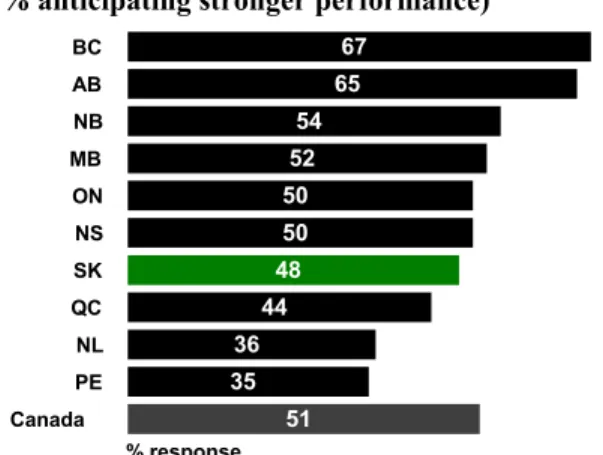
CFIB’s latest quarterly survey reveals Saskatchewan small- and medium-sized business owners’ level of optimism has improved since last quarter, but lags behind other Western provinces (refer Figure 1).
Figure 1: 12-Month Small Business Outlook (% anticipating stronger performance)
67 65 54 52 50 50 48 44 36 35 51 % response BC AB NB MB ON NS SK QC NL PE Canada
Source: CFIB 2007 Saskatchewan Business Barometer, March 2007
Up from the last quarterly update, 48 per cent of small business owners in Saskatchewan say they expect to be performing much stronger or somewhat stronger 12 months from now, while six per cent expect to be worse off. The remaining 46 per cent see things remaining much the same. However, Saskatchewan continues to lag behind the optimism levels found in B.C. and Alberta, and has been passed in the most recent quarter by Manitoba.
It is important to note that not all regions of the province are experiencing growth like cities such as Regina and Saskatoon, and it is these communities and sectors where an increase in the minimum wage may be harmful. Employers in the food services industry, where tips comprise a large component of employee earnings, and those who employ young and inexperienced workers, may have considerable difficulty adjusting to the cost burden imposed by a higher, mandated minimum wage.
While the Minimum Wage Board may choose to use CFIB’s research (as it did in its 2004 report) to say the economy is strong and can withstand an increase in the minimum wage – we certainly hope the Board does not ignore the fact that the sectors that are driving the current economic stability are NOT those which employ minimum wage earners. While the level of optimism has improved from the previous quarter, we must remember governments can either fuel or dampen optimism by the policies they introduce.
4.0 Finding Employees a Major Concern
A stronger economy brings new challenges; chief among them for businesses is the difficulty of finding qualified labour. Over the past five years, the number of members identifying labour shortages has increased from 40 per cent of members identifying it as a problem to 64 per cent of members identifying it as a concern as of January 2007.
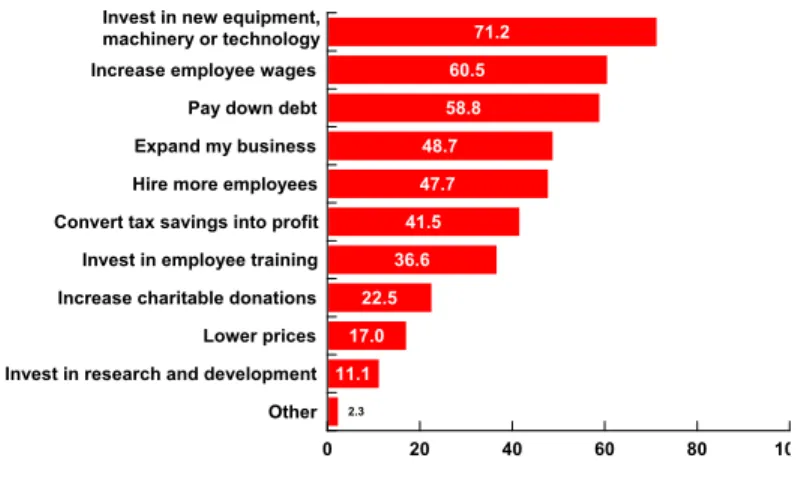
Figure 3: Saskatchewan Business Owners want to modernize, increase salaries and pay down debt
71.2 60.5 58.8 48.7 47.7 41.5 36.6 22.5 17.0 11.1 2.3 0 20 40 60 80 10
Increase employee wages Pay down debt Expand my business Hire more employees Convert tax savings into profit Invest in employee training Increase charitable donations Lower prices Invest in research and development Other Invest in new equipment, machinery or technology
Source: CFIB Saskatchewan Business Tax Review Survey, May 2005 Question: What would you do with the savings from a reduction in provincial taxes?
Not surprisingly, eight in 10 small business owners in Saskatchewan expect it to be harder to find employees in the next five years (refer Figure 2).
The link between shortages of qualified workers and minimum wage is quite explicit. Because small businesses have difficulty
hiring and retaining qualified workers, they are willing to pay higher wages to keep skilled workers. Otherwise they must go through the onerous process of hiring and training new employees.
Figure 2: Do you think it will become easier or harder to find employees in the next five years?
Easier 1% The same 13% Harder 83% Don't know 3%
Source: CFIB Shortage of Qualified Labour Survey, Aug. 2006
5.0 Small Business Owners Increasing Their Wages to Stay Competitive
Small business owners increasing their employee wages to stay competitive is clearly evidenced by data from CFIB’s May 2005 survey. Small business owners said their top three priorities for investment were modernizing their business, increasing employee wages and paying down debt (refer Figure 3). Small businesses know very well that they need to make these investments to stay competitive. They also look to improving their bottom line and investing in employee training. These investment priorities suggest Saskatchewan small businesses are keen to reinvest in the Saskatchewan economy and workers. To summarize, it is not because of legislation that Saskatchewan small businesses pay competitive wages. Most already pay more than the minimum wage. Rather, it is because to stay competitive in today’s economy, small businesses need to hire qualified workers, they need to invest in ongoing training and they need to pay competitive wages to retain them.
6.0 Minimum Wage Rates
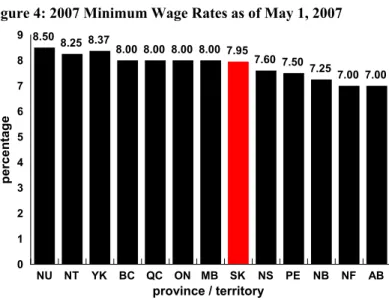
Figure 4: 2007 Minimum Wage Rates as of May 1, 2007
Source: Inter-provincial Labour websites
In 2005, Statistics Canada reported that some 587,000 individuals worked at or below the minimum wage set by their province. This represented 4.3 per cent of all employees in Canada, down from 4.6 per cent in 2004. Minimum wages in Canada range from $8.50 per hour in Nunavut to $7.00 per hour in Alberta and Newfoundland (refer Figure 4). Even with the lowest minimum wage in Canada, Alberta has by far the lowest proportion of employees working at or below minimum wage (1.5%). It is also important to note that some provinces allow special wages to be paid to liquor servers and other tip earners, and/or to inexperienced employees. Currently B.C., Ontario, Nova Scotia and Quebec offer such approaches. 8.50 8.25 8.37 8.00 8.00 8.00 8.00 7.95 7.60 7.50 7.25 7.00 7.00 NU NT YK BC QC ON MB SK NS PE NB NF AB province / territory 0 1 2 3 4 5 6 7 8 9 p er c e n ta g e
7.0 Profile of Minimum Wage Earners
Figure 5: Percentage of Employees Working for Minimum Wage (by province)
Source: Statistics Canada, Labour Force Survey, 2005
The age and profile of those generally earning a minimum wage is often overlooked. In fact, Statistics Canada released a report in October 2006, which revealed that 5.9 per cent of the Saskatchewan workforce earned the minimum wage in 2000, compared to 3.9 in 2005 (refer Figure 5). 5.6 1.5 3.9 4.9 4.5 4.6 5.2 3.1 4.3 6.8 BC AB SK MB ON QC NS NB PE NF province 0 1 2 3 4 5 6 7 p e rc en ta g e
A 2004 study of minimum wage workers in Canada, Sussman and Tabi concluded that most minimum-wage workers are young: 69 per cent of men and 60 per cent of women working at the minimum wage were between 15 and 24 years of age. Of the young workers, 56 per cent of them lived at home with their parents or other family members, which reflects the large number of minimum wage workers under 25, any of whom have not finished their schooling. A 2006 Statistics Canada report noted that almost one-quarter of all minimum wage workers were part of a couple. The incidence rate for this group was quite low – less than two per cent. This breakdown indicates that the majority of minimum wage earners are not the main breadwinners of a household.
Many different studies have shown similar results with respect to who is actually earning minimum wage. With the majority being youth that live with their families, it is reasonable to assume the income from their minimum wage job is not the sole source for living. While those who advocate for large increases in the minimum wage often cite the reason is to reduce poverty, the facts tell a very different story. If the argument of increasing minimum wage is that the change will assist those living in poverty, then that particular goal will not be achieved.
8.0 Poverty Cannot be Solved by Minimum Wage Policy
Poverty is a much bigger issue that cannot be solved by minimum wage policy and must be dealt with a more comprehensive approach. As Andrew Coyne of the National Post stated:
“Social objectives should be socially financed.” In fact, research reveals there is little correlation between the minimum wage and the number of working poor. A recent study completed for the Federal Labour Code review by Professor Morley Gunderson noted that poverty is related to family income relative to family need, while minimum wages are paid to individuals irrespective of their family situation or need. As stated in section 7.0, the profile of a minimum wage earner clearly shows the majority of them are youth between the ages of 15 and 24 years of age and living with their parents or other family members. However, governments across Canada always look to the minimum wage policy debate as a way to help the working poor. Professor Gunderson states: “The disadvantage of minimum wages as an anti-poverty device are generally associated with the fact that they are at best an exceedingly blunt instrument for dealing with poverty, and may actually have a perverse effect, exacerbating poverty.”
A report conducted by the Fraser Institute in October, 2005 stated: “No one should equate the plight of a teenager unable to buy the latest video game on his part-time salary with the circumstances of a single mother dependent on that same wage. The failure to distinguish between low earnings and poverty has led to calls for a dramatic increase in the province’s minimum wage, which would unintentially harm the very people it is intended to help.”
The Minister of Labour in his news release of May 1, 2007 confuses the issue between low income workers and poverty by stating: “Making our province the best place to live, work and build strong futures means doing what we can to help lift our low income people out of poverty. It is important that we continuously consider new ways to approach problems we’ve been observing for years – in this case low income workers who struggle to provide for themselves and for their families.” The Minister goes on to say: ”There are also issues about people who are working full-time and living in poverty.” The Minister mixes the two issues. Poverty and low income are not the same.
As the Fraser Institute states, “The difference between being a low-paid worker, and living in poverty, is neither trivial nor semantic. Poverty is an absolute condition in which individuals lack basic necessities. Low income, on the other hand, is a relative measure of income used to determine to what extent some Canadians are less well-off than others.”
CFIB believes that simply raising the minimum wage is a pretty blunt tool for helping low income Saskatchewan residents, and certainly less effective than concentrating on helping people upgrade their skills to qualify for better paying positions. The Minimum Wage Board must realize the vast majority of minimum wage earners are young, first-time employees who do not rely on their minimum wage income for their livelihoods. While the Minimum Wage Board may think they are being compassionate by increasing the minimum wage, it must realize the unintended consequences of its decisions.
9.0 CFIB’s Views Of Indexing The Minimum Wage
We understand the Minister of Labour has asked the Minimum Wage Board to study the idea of raising the province’s minimum wage to the Low Income Cut-off (LICO) and tying future increases to the Consumer Price Index during its review.
CFIB is disappointed the Minister of Labour is proceeding with the review of these issues. It should be noted that in meetings with CFIB and the Minister, along with other business groups, the Minister assured us that the government was not moving on the minimum wage recommendations contained in the Vulnerable Workers report. In fact, the Minister promised consultation prior to any action on these items. In recent meetings with the Minister of Labour in February, there was no mention of moving forward on these minimum wage recommendations.
9.1 Small businesses oppose use of Low Income Cut-off (LICO)
CFIB opposes the adoption of the Statistics Canada Low Income Cut-off (LICOs) as a standard measure of minimum wage. If this were done in Saskatchewan, it is estimated the minimum wage would increase immediately by 8.2 per cent from $7.95 to $8.60 per hour. The Statistic’s Canada Low Income Cut-off is a defined threshold below which a family will devote a relatively larger share of its income on food, shelter, and clothing for each of the five different community population sizes. The LICOs are dependent on both family size and community size. The larger the family or the larger the community, the higher the LICO is. Does this mean that there will be 35 minimum wages corresponding to the 35 LICOs? While enforcement alone would produce a bureaucratic mess, there would also be perverse effects regarding which individuals would be hired, and where jobs would be located. In discussing the use of LICO with the Department of Labour officials it became very clear that it would be difficult to determine what the minimum wage structure in Saskatchewan would be if it were tied to LICO.
9.2 No clear support for indexing minimum wage to Consumer Price Index (CPI)
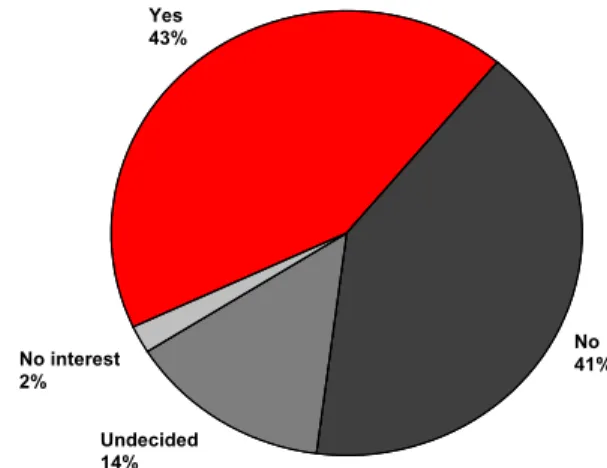
Last year, CFIB surveyed its members on the issue of whether the Saskatchewan minimum wage should be indexed to inflation. In total, 519 Saskatchewan business owners took the time to respond to the survey. Our members’ views are split on the issue with 43 per cent of Saskatchewan respondents in support of such a plan and 41 per cent opposed (refer to Figure 6).
Figure 6: Should the Saskatchewan minimum wage be indexed to inflation? Yes 43% No 41% Undecided 14% No interest 2%
Source: CFIB Mandate 223, August 2006
Of the 43 per cent that support indexation to inflation, they believe legislation would ensure low-paid workers would not be left behind. Regular increases through indexing would prevent large catch-up adjustments if no changes were made over several years. However, 41 per cent of respondents do not support the Saskatchewan minimum wage being indexed as they feel mandated
increases in the minimum wage would inevitably inflate the wages of all employees and limit job opportunities. Some believe the proponents of indexation would press for a large, one-time CFIB Submission to the Saskatchewan Minimum Wage Board (2007) Page 7
increase in the minimum wage before indexation is implemented. Our members’ fears are justified as the Minister has now asked the Board to study this very idea of raising the province’s minimum wage to the LICO and then tying future increases to the CPI. It should also be noted that no other province in Canada indexes their minimum wage to CPI except in the Yukon. A further 14 per cent were undecided while two per cent had no interest in this issue.
CFIB therefore strongly recommends the Board reject the move to increase the minimum wage to the Low Income Cut-off, as well as reject tying the minimum wage to CPI based on the split views of Saskatchewan’s business community.
The Minimum Wage Board must realize that while Saskatchewan has begun to make progress in providing a more business friendly environment, small business owners fear the government may consider costly measures such as the one proposed with increasing the minimum wage to the Low Income Cut-off and then tying future increases to CPI. While the Fraser Institute’s recent report: Canadian Provincial Investment Climate Report ranked Saskatchewan as having the third-best climate for investment, trailing only Alberta and British Columbia, the same report also gave Saskatchewan the lowest mark of all 10 provinces in the area of labour market regulation. Many local and national firms do not view Saskatchewan as “open for business” from a labour legislation perspective. CFIB believes moving Saskatchewan in the direction of being among the few provinces in Canada to index its minimum wage would essentially undo the good work done to date.
10.0 Impact of Minimum Wage Increases
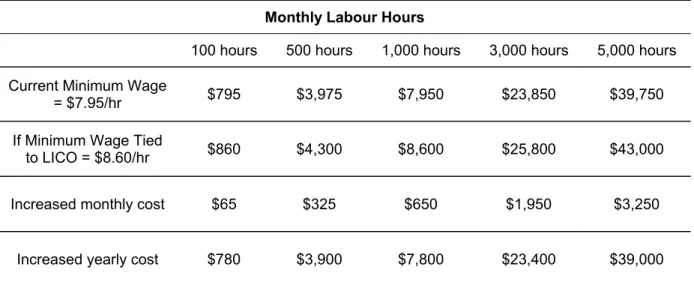
Unfortunately, there are those who think an increase in the minimum wage does not have a significant impact on a firm’s bottom line. They say, “What is an extra dollar per hour? It’s no big deal.” Unfortunately this view is too narrow. For a small business trying to effectively manage its payroll costs, even a modest increase in the minimum wage has an impact. If the Minimum Wage Board recommended the government increase the province’s minimum wage to the Low Income Cut-off, it would immediately increase to about $8.60 per hour. The following table shows the effect of an eight per cent increase to Saskatchewan’s minimum wage on various monthly labour hours (refer to Table 1). Keep in mind that this table excludes payroll taxes, which can add on another 20 per cent for small business owners.
Table 1: Impact of 8.2 per cent Increase to Minimum Wage… What It Means to Business?
Monthly Labour Hours
100 hours 500 hours 1,000 hours 3,000 hours 5,000 hours
Current Minimum Wage
= $7.95/hr $795 $3,975 $7,950 $23,850 $39,750
If Minimum Wage Tied
to LICO = $8.60/hr $860 $4,300 $8,600 $25,800 $43,000
Increased monthly cost $65 $325 $650 $1,950 $3,250
Increased yearly cost $780 $3,900 $7,800 $23,400 $39,000
*Based on 40 hour week and excludes payroll taxes.
With each increase to minimum wage, it becomes more difficult for small business owners to be able to afford to hire more employees, or to increase the hours of their existing staff.
Employers have several reactions to an increase in minimum wage:
10.1 The facts about the impact of a minimum wage increase: Fact #1: Increased payroll costs
When government legislates an increase to minimum wage, a business must add to its payroll costs to meet that new higher rate. Higher wages of any degree automatically create increases in the employer’s portion of Employment Insurance premiums and Canada Pension Plan contributions. Where applicable, the higher payroll also creates a higher Workers’ Compensation premium to be paid by the business. Unfortunately, employers have no choice but to implement these payroll-related increases. Assessing the impact of minimum wage changes requires the consideration of all direct and indirect costs.
Fact #2: Negatively impacts entry-level, unskilled and inexperienced workers
Several recent studies such as the one by Professor Morley Gunderson, Chair of the University of Toronto Economics Department, estimates that for every 10 per cent increase in the minimum wage, there is a three per cent increase in the unemployment rate, mostly impacting youth employment (ages 15-25). Increasing the minimum wage reduces employment hours and opportunities for entry level employees.
Fact #3: Causes ripple effect throughout the entire wage structure
Some may argue that given so few people actually work at or below minimum wage, raising the rate would not impact that many employers. However, the reality is that those earning minimum wage do not exist in isolation. As the minimum wage increases, employers who already pay in excess of minimum wage are also pressured to increase wages. For example, many employers like to keep a wage differential between new employees with no experience and those who have been with the firm for many years. As the base wage increases, this employer must also raise the wages for those employees who are already earning in excess of minimum wage. It amounts to a ripple effect throughout the entire wage structure. For these very reasons, cursory impact assessments of minimum wage changes will often only examine remuneration for entry-level positions. The real impact is much deeper.
Fact #4: Government coffers win with a minimum wage increase
As the provincial government begins taxing income at $8,778, government itself is a winner whenever there is an increase in the minimum wage. While low income earners will be remitting more provincial and federal income tax, and payroll deductions – the impact is escalated given that a minimum wage increase causes ripple effects throughout the entire wage structure.
Fact #5: Saskatchewan remains one of the most affordable places to live in Canada
Any discussion on minimum wage must take into account the cost of living in Saskatchewan. According to the provincial government, one of the advantages to living in Saskatchewan has been its low cost of living. The government’s recent launch of the Saskatchewan! campaign boasted about Saskatchewan’s low cost of living – a lower cost of living means you’ve got more CFIB Submission to the Saskatchewan Minimum Wage Board (2007) Page 9
money left over to buy the things you want. While other provinces have experienced significant increases in utility costs, child-care fees and automobile insurance premiums, these costs in Saskatchewan have remained relatively stable. It is interesting to point out Quebec’s Liberal government recently rejected the idea of following Ontario’s lead toward a higher minimum wage, pointing to the cost of living is much lower in Quebec.
11.0 Alternatives
Increasing the minimum wage to assist low income earners is only one tool that policy makers have at their disposal. CFIB believes there are practical policy alternatives to increasing the minimum wage so that those most in need of income support receive it without creating unintended negative consequences for other job seekers and the businesses that would create those jobs. CFIB urges the Board to consider other alternatives such as:
11.1 Increase the basic personal tax exemption
Targeted tax relief is an alternative that would have a much more beneficial effect for all parties.
Each province provides personal and spousal tax exemptions from provincial income taxes. Currently, the basic personal exemption for provincial
personal income tax in Saskatchewan is $8,778. This means that a person can earn $8,778 of income before paying income tax. Currently, residents of Alberta are able to earn $15,435 before any deductions are taken from their pay cheque, which serves to significantly increase the take-home income of lower-income earners. For example, if Saskatchewan were to match Alberta’s basic personal exemption, an individual earning $7.95 per hour would be taking home $14,478.20 after taxes and deductions, earning more than they would have under a minimum wage increase of $0.45 per hour higher. A strategy to implement a higher basic personal exemption would result in higher take-home pay for a greater number of wage earners. While some may argue such a move is costly to the provincial treasury, CFIB believes increasing the basic exemption for those earning under $25,000 would be a good start. Even the Manitoba Minimum Wage Board agrees, stating that, “a combination of strategies is essential to alleviate poverty (including an) increase in personal tax exemptions.” CFIB urges the Minimum Wage Board to recommend the option of increasing the basic personal and spousal exemptions as an effective means of increasing the income for low-income earners.
“The government should increase the amount of personal exemptions for lower income people rather than to constantly increase minimum wage as only the government benefits when the minimum wage is increased. Businesses are left with having to increase their price to cover extra costs.”
CFIB member
11.2 Introduce a special minimum wage for those earning gratuities
For jobs in which employees earn an important share of their income through gratuities, such as in the hospitality and service sectors, jurisdictions like Quebec and Ontario have a special minimum wage. Knowing that those who work in the restaurant or hospitality industry are most likely to work for minimum wage and earn tips, CFIB urges the Board to consider a two-tiered minimum wage system to account for the gratuities. A comprehensive study entitled “Tipping Practices in Licensed Establishments in Ontario” found that tipped income is highly significant in the hospitality industry. The study found that 50 per cent of a gratuity earner’s income comes from tips.
11.3 Introduce a special training wage
The reality is that new employees require a lot of basic training such as general education, interpersonal and communication skills, an awareness of the economy and the world of work – in excess of the skills required to do the actual job. Therefore a training wage would help offset the significant cost of on-the-job training. In jurisdictions like British Columbia, employees with fewer than 500 hours of experience with one or more employers are subject to a lower hourly rate. In Nova Scotia, the rate is lower for those employees with less than three months experience with the same employer.
CFIB’s survey entitled Skilled in Training
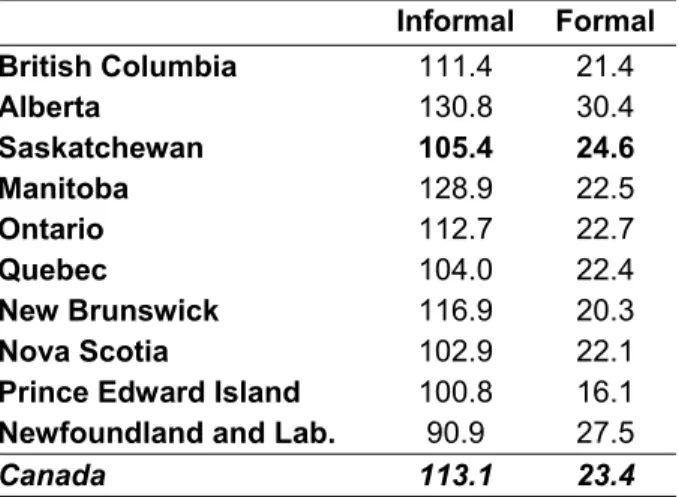
revealed that SMEs are doing their part in training Canada’s work force. The following table reveals that using informal methods, Saskatchewan SMEs spend 105 hours per year training a new employee (refer to Table 2). On-the-job training is often handled by the small business owner him or herself. Saskatchewan should follow the lead of other jurisdictions and implement a training wage for a new employee for a short, defined period of time before graduating to the general minimum wage.
Table 2: Time Spent Training a New Employee (number of hours per year)
Informal Formal British Columbia 111.4 21.4 Alberta 130.8 30.4 Saskatchewan 105.4 24.6 Manitoba 128.9 22.5 Ontario 112.7 22.7 Quebec 104.0 22.4 New Brunswick 116.9 20.3 Nova Scotia 102.9 22.1
Prince Edward Island 100.8 16.1
Newfoundland and Lab. 90.9 27.5
Canada 113.1 23.4
Source: CFIB Skilled in Training survey, May 2003
12.0 Other Issues Of Concern
12.1 Expanding minimum wage coverage
In the past, various labour groups have called for the minimum wage to be applied to all workers without exceptions or exemptions, like seasonal and permanent agriculture workers. Given the many challenges faced in much of the agriculture community, CFIB is concerned over the negative impact introducing minimum wage or any new labour legislation may create in this sector. As a province, we must ensure that no impediments are put into place that would further deter investment or growth of the livestock industry and value added opportunities. We are very concerned that by introducing minimum wage and other labour legislation, producers would be reluctant to invest in much needed industry development and diversity. Furthermore, the CFIB strongly believes minimum wage legislation in the agriculture industry could put Saskatchewan producers at a competitive disadvantage with neighbouring provinces where such legislation does not exist.
12.2 Conduct a thorough economic impact analysis
As CFIB has stated in previous correspondence to the Board, we believe the Board must conduct an economic impact analysis prior to making any decisions. The analysis should study the employment and economic impact (to employers, employees and communities) of the Board’s decision or recommendations. As a Board appointed by the Provincial Government to
CFIB Submission to the Saskatchewan Minimum Wage Board (2007) Page 12 represent the public interest, you have an obligation to ensure that all facts are made public to the people of this province.
13.0 Conclusion and Recommendations
As stated previously, the small business sector is the engine of our provincial economy, and the government has made significant progress in working towards providing a more business friendly environment. However, many small business owners fear that the government may consider costly measures as it responds to a number of reviews being completed, such as the minimum wage review.
As stated earlier, it is not because of legislation that Saskatchewan small businesses pay competitive wages. Rather, it is because to stay competitive in today’s economy, small businesses need to pay competitive wages to retain workers.
A strong Saskatchewan economy should not automatically give a green light to mandated wage increases – the Minimum Wage Board must not ignore the fact that the sectors that are driving the current economic stability are NOT those, which employ minimum wage earners.
Simply raising the minimum wage is a pretty blunt tool for helping low income Saskatchewan residents. A number of possible alternatives to raising the minimum wage should be considered as part of a strategy to assist low-income earners.
In summary, the CFIB recommends the Minimum Wage Board:
• Reject the proposal to raise the province’s minimum wage to the Low Income Cut-off;
• Reject the proposal to index minimum wage to the Consumer Price Index (CPI) based on the split views of Saskatchewan’s small business community; and
• Oppose expansion of minimum wage coverage to classes of employees currently not included.
Further, CFIB believes before any increase in the minimum wage is considered, the following alternatives must be considered:
• Increase the basic personal and spousal tax exemptions;
• Introduce a special training wage; and
• Introduce a special minimum wage for those earning gratuities.
CFIB also recommends the Board conduct an independent cost analysis that studies the employment and economic impact (to employers, employees and communities) of the Board’s decision or recommendations. This study should be released to the public.
CFIB believes Minimum Wage Review Board of Saskatchewan should take a look beyond the common practice of implementing a minimum wage increase. Now is the time to be creative and deviate from the somewhat predictable plan of regular rate increases. Again, thank you for the opportunity to bring forward the opinions from the Saskatchewan members of the Canadian Federation of Independent Business.