Molecular Pathways: Interleukin-35 in
Autoimmunity and Cancer
Yuliya Pylayeva-Gupta
Abstract
Immunosuppressive functions conferred by regulatory cyto-kines are important for maintaining homeostasis in immune responses. IL35 has recently emerged as a novel regulator of immune responses. Once thought to be specifically expressed by T regulatory cells, induction of IL35 expression has now been detected in multiple cell types in a variety of diseases, prompting research into regulation of its expression, signaling specificity, target cell populations, and functional outputs. Recent studies
have revealed that by directingde novogeneration of regulatory T and B cells and inhibiting T effector responses, IL35 plays an important role in the development of autoimmune diseases and cancer. IL35 is overexpressed in a variety of cancers and may exert its function both on antitumor immune responses as well as directly on tumor cells. As such, IL35 is rapidly emerging as a promising biomarker and an attractive cancer therapy target.
Clin Cancer Res; 22(20); 4973–8.2016 AACR.
Background
The immune system is a powerful weapon in defense against pathogens. However, immune responses that fail to be properly regulated can result in autoimmune conditions, and compro-mised immune responses enable growth of cancer. A robust system of regulatory elements has evolved to ensure homeo-static control of immunity. These include cell contact-depen-dent and indepencontact-depen-dent mechanisms, the latter of which is typically mediated by cytokines. Cytokines affect a broad range of immune cell properties, including proliferation and differ-entiation. This review will focus on the role of immunosup-pressive cytokine IL35 in control of immune regulation and discuss potential for targeting IL35-regulated pathways as a way to ameliorate autoimmunity and enhance antitumor immune responses.
IL35 is a member of the IL12 family of heterodimeric cytokines. These cytokines form via combinations of p19, p28, p35, p40, and Ebi3 subunits, and in addition to IL35 (p35/Ebi3) also include IL12 (p35/p40), IL23 (p19/p40), and IL27 (p28/Ebi3; ref. 1). Members of IL12 family exhibit mostly proinflammatory (IL12 and IL23) or mostly immu-nosuppressive (IL27 and IL35) effector functions (1). As proposed nearly 20 years ago by Devergne and colleagues, IL35 itself is formed by interaction between p35 and Ebi3 (2). However, the functional studies demonstrating immunosup-pressive capacity of IL35 were only completed in the mid-2000s by Vignali and colleagues (3). They found that sub-units p35 and Ebi3 were coexpressed in Foxp3þ T cells and
that lack of either subunit reduced suppressive capacity of T regulatory cells (Treg) in vitro and led to poor control of inflammatory bowel disease in vivo (3). IL35 was first reported to be produced exclusively by Tregs (3, 4). More recent studies have demonstrated that IL35 can also be produced by tolerogenic dendritic cells (DC; ref. 5) and B cells (6–8). Studies reporting expression of IL35 in cancer cells are also beginning to emerge. So far, some nonimmune cell types, such as pancreatic cancer cells, nasopharyngeal carcinoma, melanoma, and breast cancer cells were shown to express IL35 (9–11). IL35 is not constitutively expressed in normal tissues (12), and lack of developmental defects in IL12a/(p35 null) andEbi3/ mice suggests that it is not essential for normal development (13, 14). As such, expres-sion of IL35 in immune cells appears to be induced in conditions accompanied by underlying inflammation. For example, IL35 expression is not detectable in na€ve T cells or B cells, but can be triggered by inflammatory input, impinging at least in part on Toll-like receptor stimulation (12, 15). Our understanding of specific disease-driven phys-iologic cues that trigger the expression of IL35 in this expand-ing array of cell types is far from complete, and more research needs to be done to determine the regulatory mechanisms that affect IL35 expression in the context of inflammation and cancer.
IL35 signaling is mediated by binding to its cognate receptor and subsequent activation of the JAK–STAT pathway (Fig. 1). Just as there are multiple subunits that comprise IL12 family of cytokines, there are multiple receptor subunits (gp130, IL12Rb1, IL12Rb2, IL23R, and IL27Ra) that can accommodate binding of IL12 cytokine family heterodimers (1, 16). To identify the cognate receptor for IL35, Collison and colleagues used T cells that lacked expression of select receptor chains and demonstrated that gp130 and IL12Rb2 expressed on T cells were able to transduce the IL35 signal (17). Once IL35 bound to the receptor, the signal was propagated by a heterodimer of STAT1 and STAT4 (17). As some of the target genes of this heterodimer included IL12a and Ebi3 themselves, STAT1: Department of Genetics, The Lineberger Comprehensive Cancer
Cen-ter, University of North Carolina at Chapel Hill, Chapel Hill, North Carolina.
Corresponding Author:Yuliya Pylayeva-Gupta, Department of Genetics, Uni-versity of North Carolina at Chapel Hill, 450 West Drive, Chapel Hill, NC 27599. Phone: 919-962-8296; Fax: 919-966-8212; E-mail: [email protected]
doi:10.1158/1078-0432.CCR-16-0743
2016 American Association for Cancer Research.
STAT4 signal resulted in sustained expression of IL35 via a feed–forward loop. Intriguingly, single-chain gp130 or IL12Rb2 receptor-deficient T cells still exhibited some degree of response to IL35, suggesting that IL35 possesses a unique ability to signal through homodimers of gp130 and IL12Rb2 (1, 18), engaging STAT1 or STAT4 signaling, respectively. Either one of the combinations was sufficient to mediate partial inhibition of T-cell proliferation; however, use of gp130:IL12Rb2 heterodimer was required for maximal sup-pression (17). Adding more complexity, it appears that IL35 signaling is mediated through diverse receptor chain pairings in different immune cells. A recent report demonstrated that IL35 activity in B cells is mediated by a heterodimer of IL12Rb2:IL27Ra, which signals through STAT1:STAT3 (7). Althoughin vivotargets of IL35 still await precise characteri-zation, cell type-specific expression of IL35 receptor subunits may dictate restriction of its biological activity. For example, IL12Rb2 expression is restricted to activated DC, T cells, and NK cells, whereas gp130 is ubiquitously expressed and may conduct IL35 signaling in a variety of cells, including cancer cells (19–23).
Early studies unraveled the role of IL35 in immunomodula-tion in inflammatory disease and demonstrated functional role for IL35 in conferring cell contact-independent T-cell suppression. So far, the best studied mechanism of immuno-modulatory activity of IL35 has been exemplified by induction of Tregs and suppression of T-cell effector function and pro-liferative capacity in a variety of in vitro andin vivo systems (3, 24, 25). The mechanism of IL35 action on target T cells seems to be 2-fold (Fig. 1). First, IL35 can induce cell-cycle arrest of effector T-cell population and inhibit production of effector cytokines (3, 24). This has also been shown in a mouse model, where transgenic mice with IL35 overexpression in islet cells induced cell-cycle arrest of resident T cells, leading to reduced inflammation and a decrease in diabetes-associated symptoms (26). Furthermore, studies performed on CD4þ
Tregs derived from IL12a/ or Ebi3/ mice demonstrated reduced capacity of mutant Tregs to inhibit proliferation of T effector cells (3, 27). These observations were validated using a recombinant version of IL35 (rIL35), which led to a decrease in cell proliferation of T effector cells (3). Although informa-tive, experiments utilizing rIL35 need to be interpreted carefully due to a low rate of formation of active heterodimers of p35 and Ebi3 in preparation of rIL35 (28). Another mechanism by which IL35 affects inflammatory microenviron-ment is through expansion of Tregs. Proliferation of CD4þ CD25þFoxp3 T cells was induced after exposure to IL35, which also led to increase in IL10 expression and functional suppression of T effector cells (29). Supporting this notion, treatment with recombinant IL35 (rIL35) induced expansion of tolerance-conferring CD4þCD39þFoxp3 T cells in a model of collagen-induced arthritis (CIA) (30). Using a com-plimentary approach, transfection of IL35-encoding vectors into conventional na€ve CD4þFoxp3T cells resulted in con-version to cells with a regulatory phenotype, which were termed iTr35 cells (15). This suppressive capacity of IL35 is also evident in CD8þ Tregs, as they could suppress T-cell proliferation in an IL35-dependent manner (31). In addition to suppressing CD4þand CD8þT cells, expression of IL35 by T cells has been implicated in reduced differentiation capacity of T effector cells. For example, differentiation of Th17 effectors from CD4þ T cells is perturbed following exposure to rIL35, and this defect correlated with alleviated symptoms in mouse models of Th1/Th17–driven inflammatory diseases, such as CIA and colitis (27, 29). Supporting this notion, T cells derived from Ebi3/ mice exhibited increased production of IL17 (32, 33).
The role of IL35 expression in cell types other than T cells is only beginning to be elucidated (Fig. 2). A regulatory popu-lation of B cells, termed Bregs has long been implicated in the suppression of T cell–mediated immune responses and control of autoimmune diseases, such as experimental autoimmune © 2016 American Association for Cancer Research
Ebi3
gp130 gp130 IL27R
a
T cell B cell
gp130 IL12R
b
2
IL12R
b
2
IL12R
b
2
IL12R
b
2
STAT1 STAT1
p35
STAT4
STAT1 STAT4
STAT3
Tregs
iTr35 Proliferation Bregs
Figure 1.
IL35-dependent signaling pathways. When
signaling via gp130:gp130 or IL12Rb2:IL12Rb2
homodimers, IL35 inhibits proliferation of target T and B cells. Signals transduced
through gp130:IL12Rb2 or IL27Ra:IL12Rb2
encephalitis (EAE) and CIA (34–38). Although cell-surface markers used to identify this cell population depend on disease context, the unifying functional suppressive mechanism has, for a long time, impinged on the production of IL10 (34, 39, 40). However, it was realized that Bregs may operate through a variety of immunosuppressive mechanisms, as at least some of the regulatory functions of Bregs can be mediated indepen-dently of IL10 (41–43). In support of this notion, a recent study by Wang and colleagues utilized rIL35 to induce suppressive Bregs (7). Treatment with rIL35 also converted na€ve B cells into Bregs that were capable of producing de novo IL35. This IL35-mediated expansion of Bregs and Tregs occurred concur-rently with the inhibition of T effector responses (7). Another study documented upregulation ofEbi3gene after stimulation of B cells with TLR and CD40 (6). This observation led to a series of elegant experiments, where chimeric mice, in which B cells lacked expression of either p35 or Ebi3, exhibited exac-erbated EAE as well as protection from infection with Salmo-nella(6), suggesting that IL35 production by B cells controls hyperactive immune responses. In this case, the activity of IL35 seemed to affect regulation of antigen-presenting capacity of B cells, decreased autoimmunity, and increased clearance of infectious agent. In addition to studies on B cells, a recent report by Dixon and colleagues has also demonstrated that expression of IL35 by tolerogenic DCs suppresses T-cell activation (5).
Clinical
–
Translational Advances
A number of studies suggest that levels of IL35fluctuate in disease (16, 44). Elucidation of the precise role of IL35 in humans awaits generation of better reagents that will
not only allow for accurate detection of this cytokine, but will enable characterization of its action outside of murine cells and disease models. Nevertheless, substantial preclin-ical evidence for the immunomodulatory potential of IL35 has stimulated interest in developing IL35 as a biomarker and potential treatment target in inflammatory diseases (Fig. 2).
As IL35 confers an important regulatory role on immune responses, there is considerable interest in understanding the therapeutic potential of modulating IL35 levels and signaling in a variety of diseases. Reduction in IL35 expres-sion has been associated with multiple inflammatory con-ditions, such as inflammatory bowel disease, liver fibrosis, myocarditis, encephalomyelitis, and autoimmune disease, and correlated with severity of disease and increase in inflammation (3, 29, 30, 45). In this case, administration of rIL35, IL35 gene therapy, or adoptive transfer of IL35 competent cells may alleviate disease symptoms. For exam-ple, adoptive transfer of IL35þTregs alleviated symptoms of colitis, intratracheal administration of rIL35 reduced airway inflammation in a model of allergy (46), and rIL35 decreased severity of arthritis and uveitis (7, 30). Similarly, overexpression of IL35 protected from acute GVHD, myo-carditis, and atherosclerosis (47–49). Genetic studies using IL12a- andEbi3-null mice have validated the importance of IL35 in alleviating symptoms of autoimmune and chronic inflammation (6).
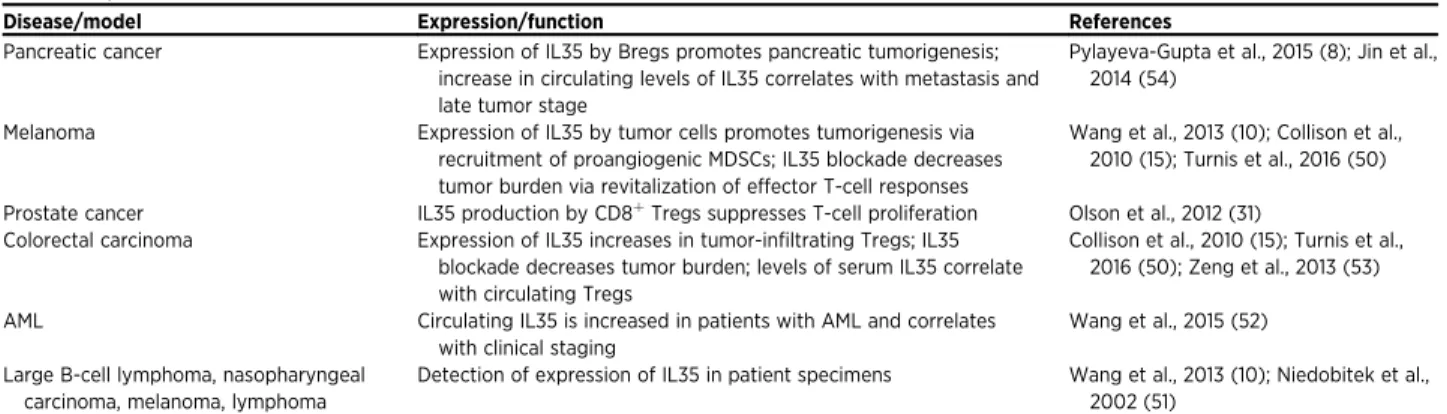
Perhaps not surprisingly, contrary to autoimmune condi-tions, expression of IL35 has been implicated in promoting tumorigenesis (Table 1; refs. 8, 10, 31, 50). Elevated levels of IL35 were detected in lymphoma cells (51) and lung cancer and predicted poor outcome in cases of leukemia, colorectal © 2016 American Association for Cancer Research
Ebi3
p35
Treg Breg Dendritic cell
Autoimmunity Cancer
• Expansion of
immunosuppressive cells • Suppression of T effector cells and Th17 cells
• Compromised antitumor immunity
• Exhaustion of T cells in cancer microenvironment
IL-35
IL-35
Inflammation
Figure 2.
Proposed functional roles of IL35 in disease. Expression of IL35 is induced in many disease
contexts under conditions of inflammation. A
few different cell types, such as Treg, Breg, and DC, have been shown to express IL35, although precise regulation of induction is still not clear. In models of cancer, production of IL35 impairs antitumor immune responses and promotes tumorigenesis. In autoimmunity and chronic
inflammation, expression of IL35 is protective
cancer, and pancreatic cancer (52–54). Increase in tumor-infiltrating IL35þ T cells and Bregs has now also been reported in melanoma, colorectal cancer, and pancreatic cancer (8, 50). These observations suggest that inhibition of IL35 expression or downstream signaling may suppress tumorigenic potential. Functional experiments showed that Ebi3-null mice have reduced metastatic burden when chal-lenged with a melanoma cell line (55), and in a separate study, a model of melanoma exhibited dependence on IL35 for the accumulation of MDSC and induction of angiogen-esis (10). Using a mouse model of pancreatic cancer, we have demonstrated that IL35þ Bregs are directly recruited to the tumor cell vicinity via a chemokine gradient of CXCL13 and promote tumorigenesis in an IL35-dependent manner (8). A recent elegant study by Turnis and colleagues used an Ebi3 reporter mouse to follow the fate of IL35þ cells in cancer development and test the effect of Ebi3 genetic ablation specifically in the Treg cell lineage (50). Resulting observations have implicated IL35 production by Tregs in control of antitumor immunity (50). Using models of colon, lung, and melanoma, this study has shown that Treg-pro-duced IL35 regulates antigen-specific CD8þT-cell infiltration, T effector function and memory, as well as T-cell exhaustion. On the basis of the known complexity of IL35 regulation and target selection, the effects of IL35 in tumor promotion are likely multifaceted and may impinge on controlling antitu-mor immunity, angiogenesis, and potentially, tuantitu-mor cell proliferation directly (8, 10, 11, 50).
Conclusions/Future Directions
The regulatory potential of IL35 makes it an attractive target for therapeutic intervention. Recombinant IL35 or IL35-producing cells can alleviate autoimmunity, while disruption of IL35 expres-sion or signaling may reactivate antitumor immunity. There are still many questions and challenges that need to be resolved before thefield is able to move forward. Generation of robust reagents for studies of IL35 in human systems will enable vali-dation of the physiologic importance of IL35 signaling in disease. Relevance of various cellular sources of IL35 needs to be validated in vivo. Structural studies aimed at unmasking interactions between IL35 and its receptors will allow us to understand the mechanism of receptor utilization by IL35 and more readily identify recipient cell populations. Overall, understanding the regulation and physiologic relevance of IL35 productionin vivo will enhance our capacity to assess the value of therapeutic utilization of IL35 in disease.
Disclosure of Potential Conflicts of Interest
No potential conflicts of interest were disclosed.
Grant Support
Y. Pylayeva-Gupta is supported by a Pancreatic Cancer Action Network-AACR Pathway to Leadership grant (13-70-25-PYLA).
Received July 15, 2016; revised August 11, 2016; accepted August 12, 2016; published OnlineFirst August 31, 2016.
References
1. Vignali DA, Kuchroo VK. IL-12 family cytokines: immunological play-makers. Nat Immunol 2012;13:722–8.
2. Devergne O, Birkenbach M, Kieff E. Epstein-Barr virus-induced gene 3 and the p35 subunit of interleukin 12 form a novel heterodimeric
hemato-poietin. Proc Natl Acad Sci U S A 1997;94:12041–6.
3. Collison LW, Workman CJ, Kuo TT, Boyd K, Wang Y, Vignali KM, et al. The inhibitory cytokine IL-35 contributes to regulatory T-cell function. Nature 2007;450:566–9.
4. Chaturvedi V, Collison LW, Guy CS, Workman CJ, Vignali DA. Cutting edge: Human regulatory T cells require IL-35 to mediate suppression and
infectious tolerance. J Immunol 2011;186:6661–6.
5. Dixon KO, van der Kooij SW, Vignali DA, van Kooten C. Human tolerogenic dendritic cells produce IL-35 in the absence
of other IL-12 family members. Eur J Immunol 2015;45:1736–
47.
6. Shen P, Roch T, Lampropoulou V, O'Connor RA, Stervbo U, Hilgen-berg E, et al. IL-35-producing B cells are critical regulators of immu-nity during autoimmune and infectious diseases. Nature 2014;507: 366–70.
7. Wang RX, Yu CR, Dambuza IM, Mahdi RM, Dolinska MB, Sergeev YV, et al. Interleukin-35 induces regulatory B cells that suppress autoimmune
dis-ease. Nat Med 2014;20:633–41.
Table 1. Expression and function of IL35 in cancer
Disease/model Expression/function References
Pancreatic cancer Expression of IL35 by Bregs promotes pancreatic tumorigenesis;
increase in circulating levels of IL35 correlates with metastasis and late tumor stage
Pylayeva-Gupta et al., 2015 (8); Jin et al., 2014 (54)
Melanoma Expression of IL35 by tumor cells promotes tumorigenesis via
recruitment of proangiogenic MDSCs; IL35 blockade decreases tumor burden via revitalization of effector T-cell responses
Wang et al., 2013 (10); Collison et al., 2010 (15); Turnis et al., 2016 (50)
Prostate cancer IL35 production by CD8þTregs suppresses T-cell proliferation Olson et al., 2012 (31)
Colorectal carcinoma Expression of IL35 increases in tumor-infiltrating Tregs; IL35
blockade decreases tumor burden; levels of serum IL35 correlate with circulating Tregs
Collison et al., 2010 (15); Turnis et al., 2016 (50); Zeng et al., 2013 (53)
AML Circulating IL35 is increased in patients with AML and correlates
with clinical staging
Wang et al., 2015 (52)
Large B-cell lymphoma, nasopharyngeal carcinoma, melanoma, lymphoma
Detection of expression of IL35 in patient specimens Wang et al., 2013 (10); Niedobitek et al.,
2002 (51)
8. Pylayeva-Gupta Y, Das S, Handler JS, Hajdu CH, Coffre M, Koralov SB, et al. IL35-producing B cells promote the development of pancreatic neoplasia.
Cancer Discov 2016;6:247–55.
9. Nicholl MB, Ledgewood CL, Chen X, Bai Q, Qin C, Cook KM, et al. IL-35 promotes pancreas cancer growth through enhancement of proliferation and inhibition of apoptosis: evidence for a role as an autocrine growth
factor. Cytokine 2014;70:126–33.
10. Wang Z, Liu JQ, Liu Z, Shen R, Zhang G, Xu J, et al. Tumor-derived IL-35 promotes tumor growth by enhancing myeloid cell accumulation and
angiogenesis. J Immunol 2013;190:2415–23.
11. Long J, Zhang X, Wen M, Kong Q, Lv Z, An Y, et al. IL-35 over-expression increases apoptosis sensitivity and suppresses cell growth in human cancer cells. Biochem Biophys Res Commun 2013;430:
364–9.
12. Li X, Mai J, Virtue A, Yin Y, Gong R, Sha X, et al. IL-35 is a novel responsive
anti-inflammatory cytokine–a new system of categorizing anti-infl
amma-tory cytokines. PLoS One 2012;7:e33628.
13. Mattner F, Magram J, Ferrante J, Launois P, Di Padova K, Behin R, et al. Genetically resistant mice lacking interleukin-12 are susceptible to infection with Leishmania major and mount a polarized Th2 cell
response. Eur J Immunol 1996;26:1553–9.
14. Nieuwenhuis EE, Neurath MF, Corazza N, Iijima H, Trgovcich J, Wirtz S, et al. Disruption of T helper 2-immune responses in Epstein-Barr
virus-induced gene 3-deficient mice. Proc Natl Acad Sci U S A 2002;99:
16951–6.
15. Collison LW, Chaturvedi V, Henderson AL, Giacomin PR, Guy C, Bankoti J, et al. IL-35-mediated induction of a potent regulatory T cell population.
Nat Immunol 2010;11:1093–101.
16. Olson BM, Sullivan JA, Burlingham WJ. Interleukin 35: a key mediator of suppression and the propagation of infectious tolerance. Front Immunol 2013;4:315.
17. Collison LW, Delgoffe GM, Guy CS, Vignali KM, Chaturvedi V, Fairweather D, et al. The composition and signaling of the IL-35 receptor are
uncon-ventional. Nat Immunol 2012;13:290–9.
18. Garbers C, Hermanns HM, Schaper F, Muller-Newen G, Grotzinger J, Rose-John S, et al. Plasticity and cross-talk of interleukin 6-type cytokines.
Cytokine Growth Factor Rev 2012;23:85–97.
19. Presky DH, Yang H, Minetti LJ, Chua AO, Nabavi N, Wu CY, et al. A functional interleukin 12 receptor complex is composed of two beta-type cytokine receptor subunits. Proc Natl Acad Sci U S A 1996;93:
14002–7.
20. Grohmann U, Belladonna ML, Bianchi R, Orabona C, Ayroldi E, Fioretti MC, et al. IL-12 acts directly on DC to promote nuclear localization of NF-kappaB and primes DC for IL-12 production. Immunity 1998;9:
315–23.
21. Trinchieri G. Interleukin-12 and the regulation of innate resistance and adaptive immunity. Nat Rev Immunol 2003;3:133–46.
22. Saito M, Yoshida K, Hibi M, Taga T, Kishimoto T. Molecular cloning of a murine IL-6 receptor-associated signal transducer, gp130, and its regulated
expressionin vivo. J Immunol 1992;148:4066–71.
23. Lesina M, Kurkowski MU, Ludes K, Rose-John S, Treiber M, Kloppel G, et al. Stat3/Socs3 activation by IL-6 transsignaling promotes progression of pancreatic intraepithelial neoplasia and development of pancreatic cancer.
Cancer Cell 2011;19:456–69.
24. Collison LW, Pillai MR, Chaturvedi V, Vignali DA. Regulatory T cell suppression is potentiated by target T cells in a cell contact, IL-35- and
IL-10-dependent manner. J Immunol 2009;182:6121–8.
25. Pillai MR, Collison LW, Wang X, Finkelstein D, Rehg JE, Boyd K, et al. The plasticity of regulatory T cell function. J Immunol 2011;187: 4987–97.
26. Bettini M, Castellaw AH, Lennon GP, Burton AR, Vignali DA. Prevention of autoimmune diabetes by ectopic pancreatic beta-cell expression of
inter-leukin-35. Diabetes 2012;61:1519–26.
27. Wirtz S, Billmeier U, McHedlidze T, Blumberg RS, Neurath MF. Interleukin-35 mediates mucosal immune responses that protect
against T-cell-dependent colitis. Gastroenterology 2011;141:1875–
86.
28. Egwuagu CE, Yu CR, Sun L, Wang R. Interleukin 35: critical regulator of immunity and lymphocyte-mediated diseases. Cytokine Growth Factor
Rev 2015;26:587–93.
29. Niedbala W, Wei XQ, Cai B, Hueber AJ, Leung BP, McInnes IB, et al. IL-35 is a novel cytokine with therapeutic effects against collagen-induced arthritis through the expansion of regulatory T cells and suppression of Th17 cells. Eur J Immunol 2007;37:
3021–9.
30. Kochetkova I, Golden S, Holderness K, Callis G, Pascual DW. IL-35
stimulation of CD39þregulatory T cells confers protection against
colla-gen II-induced arthritis via the production of IL-10. J Immunol 2010;184: 7144–53.
31. Olson BM, Jankowska-Gan E, Becker JT, Vignali DA, Burlingham WJ,
McNeel DG. Human prostate tumor antigen-specific CD8þregulatory T
cells are inhibited by CTLA-4 or IL-35 blockade. J Immunol 2012;189: 5590–601.
32. Yang J, Yang M, Htut TM, Ouyang X, Hanidu A, Li X, et al. Epstein-Barr virus-induced gene 3 negatively regulates IL-17, IL-22 and RORgamma t.
Eur J Immunol 2008;38:1204–14.
33. Liu JQ, Liu Z, Zhang X, Shi Y, Talebian F, Carl JW Jr, et al. Increased Th17
and regulatory T cell responses in EBV-induced gene 3-deficient mice lead
to marginally enhanced development of autoimmune encephalomyelitis. J Immunol 2012;188:3099–106.
34. Fillatreau S, Sweenie CH, McGeachy MJ, Gray D, Anderton SM. B cells regulate autoimmunity by provision of IL-10. Nat Immunol 2002;3:
944–50.
35. Mauri C, Ehrenstein MR. The 'short' history of regulatory B cells. Trends
Immunol 2008;29:34–40.
36. Yanaba K, Bouaziz JD, Haas KM, Poe JC, Fujimoto M, Tedder TF. A
regulatory B cell subset with a unique CD1dhiCD5þphenotype
con-trols T cell-dependent inflammatory responses. Immunity 2008;28:
639–50.
37. Barr TA, Shen P, Brown S, Lampropoulou V, Roch T, Lawrie S, et al. B cell depletion therapy ameliorates autoimmune disease through ablation of IL-6-producing B cells. J Exp Med 2012;209: 1001–10.
38. Mauri C, Bosma A. Immune regulatory function of B cells. Annu Rev
Immunol 2012;30:221–41.
39. Banchereau J, Pascual V, O'Garra A. From IL-2 to IL-37: the expanding
spectrum of anti-inflammatory cytokines. Nat Immunol 2012;13:
925–31.
40. Kalampokis I, Yoshizaki A, Tedder TF. IL-10-producing regulatory B cells (B10 cells) in autoimmune disease. Arthritis Res Ther 2013; 15Suppl 1:S1.
41. Wilson MS, Taylor MD, O'Gorman MT, Balic A, Barr TA, Filbey K, et al.
Helminth-induced CD19þCD23hi B cells modulate experimental
allergic and autoimmune inflammation. Eur J Immunol 2010;40:
1682–96.
42. Su Y, Zhang AH, Noben-Trauth N, Scott DW. B-cell gene therapy for tolerance induction: host but not donor B-cell derived IL-10 is necessary for tolerance. Front Microbiol 2011;2:154.
43. Flores-Borja F, Bosma A, Ng D, Reddy V, Ehrenstein MR, Isenberg DA,
et al. CD19þCD24hiCD38hi B cells maintain regulatory T cells while
limiting TH1 and TH17 differentiation. Sci Transl Med 2013;5: 173ra23.
44. Sawant DV, Hamilton K, Vignali DA. Interleukin-35: expanding its job
profile. J Interferon Cytokine Res 2015;35:499–512.
45. Tirotta E, Duncker P, Oak J, Klaus S, Tsukamoto MR, Gov L, et al.
Epstein-Barr virus-induced gene 3 negatively regulates neuroinflammation and T
cell activation following coronavirus-induced encephalomyelitis. J Neu-roimmunol 2013;254:110–6.
46. Huang CH, Loo EX, Kuo IC, Soh GH, Goh DL, Lee BW, et al. Airway
inflammation and IgE production induced by dust mite allergen-specific
memory/effector Th2 cell line can be effectively attenuated by IL-35. J Immunol 2011;187:462–71.
47. Hu Y, Dong C, Yue Y, Xiong S. In vivo delivery of interleukin-35 relieves coxsackievirus-B3-induced viral myocarditis by inhibiting Th17 cells. Arch
Virol 2014;159:2411–9.
48. Liu Y, Wu Y, Wang Y, Cai Y, Hu B, Bao G, et al. IL-35 mitigates murine acute graft-versus-host disease with retention of graft-versus-leukemia effects.
Leukemia 2015;29:939–46.
49. Huang Y, Lin YZ, Shi Y, Ji QW. IL-35: a potential target for the treatment of
50. Turnis ME, Sawant DV, Szymczak-Workman AL, Andrews LP, Delgoffe GM, Yano H, et al. Interleukin-35 limits anti-tumor immunity. Immunity
2016;44:316–29.
51. Niedobitek G, Pazolt D, Teichmann M, Devergne O. Frequent expres-sion of the Epstein-Barr virus (EBV)-induced gene, EBI3, an IL-12 p40-related cytokine, in Hodgkin and Reed-Sternberg cells. J Pathol 2002;
198:310–6.
52. Wang J, Tao Q, Wang H, Wang Z, Wu F, Pan Y, et al. Elevated IL-35 in bone marrow of the patients with acute myeloid leukemia. Hum Immunol
2015;76:681–6.
53. Zeng JC, Zhang Z, Li TY, Liang YF, Wang HM, Bao JJ, et al. Assessing the role of IL-35 in colorectal cancer progression and prognosis. Int J Clin Exp
Pathol 2013;6:1806–16.
54. Jin P, Ren H, Sun W, Xin W, Zhang H, Hao J. Circulating IL-35 in pancreatic ductal adenocarcinoma patients. Hum Immunol 2014;75:
29–33.
55. Sauer KA, Maxeiner JH, Karwot R, Scholtes P, Lehr HA, Birkenbach M, et al. Immunosurveillance of lung melanoma metastasis in
EBI-3-deficient mice mediated by CD8þ T cells. J Immunol 2008;181: