P R E L I M I N A R Y C O M M U N I C A T I O N
Open Access
Statistical filtering for NMR based structure
generation
Jochen Junker
Abstract
The constitutional assignment of natural products by NMR spectroscopy is usually based on 2D NMR experiments like COSY, HSQC, and HMBC. The difficulty of a structure elucidation problem depends more on the type of the investigated molecule than on its size. Saturated compounds can usually be assigned unambiguously by hand using only COSY and13C-HMBC data, whereas condensed heterocycles are problematic due to their lack of protons that could show interatomic connectivities. Different computer programs were developed to aid in the structural assignment process, one of them COCON. In the case of unsaturated and substituted molecules structure generators frequently will generate a very large number of possible solutions. This article presents a“statistical filter”for the reduction of the number of results. The filter works by generating 3D conformations using smi23d, a simple MD approach. All molecules for which the generation of constitutional restraints failed were eliminated from the result set. Some structural elements removed by the statistical filter were analyzed and checked against Beilstein. The automatic removal of molecules for which no MD parameter set could be created was included into WEBCOCON. The effect of this filter varies in dependence of the NMR data set used, but in no case the correct constitution was removed from the resulting set.
Findings
Nuclear Magnetic Resonance is the most common tool used for the structure elucidation of new compounds. The used 2D NMR experiments like COSY, HSQC, and 13
C-HMBC deliver correlation information between atoms that can be translated into connectivity informa-tion. Out of these, correlation information from COSY and HSQC experiments can be transcribed directly into connectivity between atoms. But the13C-HMBC correla-tions need more attention because of their ambiguity and complexity. Hence the difficulty of the structure elucidation problem depends more on the type of the investigated molecule than on its size. Saturated com-pounds can usually be assigned unambiguously using mainly COSY and some 13C-HMBC data, whereas con-densed heterocycles are problematic due to their lack of protons that could show interatomic connectivities. This ambiguity has driven the development of different soft-ware packages to aid in the interpretation of the13 C-HMBC correlation data [1-19] as much as the develop-ment of additional correlation experidevelop-ments [20,21].
When the observed connectivity information is used as input for the structure generation program COCON [3,22-24] it will create all compatible constitutional assignments. In the case of unsaturated molecules COCON will usually generate a very large number of possible solutions. Since the solutions will then have to be checked manually for their chemical feasibility and sense, Different efforts have been made to reduce the number solutions. Among others, ranking of the consti-tutional assignments by chemical shift deviation and/or substructural elements have been tested [25,26] inte-grated to COCON runs. Unfortunately, the described software could not be made available for the online ver-sion of COCON (WEBCOCON at http://cocon.nmr.de), since it uses data protected by Intellectual Property. A different way of handling the result set had to be cho-sen, and the statistical filter was implemented.
The idea behind the filter is, to compare the suggested constitutions against existing molecules, like the ones contained in the PubChem (PubChem can be found at http://pubchem.ncbi.nlm.nih.gov/) database. For each COCON-suggested constitution all 1 sphere elements of the constitutions are checked for corresponding ele-ments in PubChem. This comparison is done indirectly, Correspondence: [email protected]
Fundação Oswaldo Cruz - CDTS, Rio de Janeiro - RJ, Brazil
by generating molecular dynamics parameters in smi23d. The software smi23d (smi23d is available under the Apache 2.0 license and can be downloaded from http://www.chembiogrid.org/cheminfo/smi23d/) has been used to generate 3D coordinates for almost 13M compounds contained in PubChem (The corresponding 3D coordinates generated by smi23d can be found at http://www.chembiogrid.org/cheminfo/p3d/; the error observed is ~ 0.4% (= 53.000) false negatives for 13M compounds) and succeeded on generating coordinates for 99.6% of the molecules contained in the Database. The filtering application actually uses smi23d to gener-ate 3D coordingener-ates for all constitutional assignments generated by COCON and eliminates those for which smi23d fails because of lacking parameters. Since smi23d has successfully been used on so many well known compounds, this means that the structural ele-ment for which parameters were missing has hardly ever been observed and therefore might not exist in natural products. Due to the nature of the filter, no ranking of the remaining constitutions is carried out and further methods might be necessary to improve the results. All calculations were run on the publicly available WEBCO-CON server, using the input files provided there as examples. Calculation times varied from several minutes to two hours for 1 and 2. For 3the longest running time was 3 days for the generation of the 523.668 con-stitutional assignments using COSY,13C-HMBC correla-tions and open atom types. A webpage allowing direct access to the results of the structure generator runs pre-sented here has been set up on the WEBCOCON server http://cocon.nmr.de/StatisticalFilter/ (The results are also mirrored at http://science.jotjot.net/StatisticalFilter/ ).
Ascomycin is a well known ethyl derivative of Tacroli-mus, it serves as example of a large natural product, fea-turing 43 Carbon atoms. Using experimental NMR correlation data (COSY and 13C-HMBC correlations)
together with fixed atom types, COCON generates only one solution, independent of the statistical filter. Addi-tionally the filter showed no effect on the number of constitutional assignments generated, when no atom types were defined, in which case a total of 100 different constitutions were proposed.
The results change with the second example molecule, Aflatoxin B1 with 17 Carbon atoms. Using COSY and 13
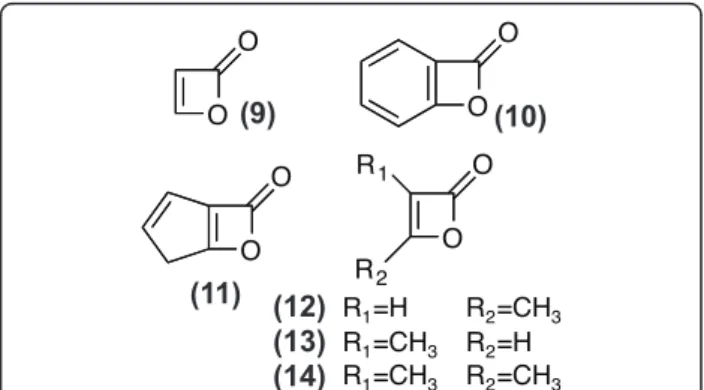
C-HMBC data alone, COCON generates 970 struc-tures. This drops to 539 results after filtering, a reduc-tion by 45%. When the atom types are predefined COCON still generates 68 constitutional assignments, that are reduced to 58 after filtering, a reduction by 15%. The ten excluded constitutions (see Figure 1) all contain oxet-2-one as structural element, that can be found in 6 basic variations in 85 compounds in Pub-Chem (see Figure 2). Until now, no natural product has been described with this substructure. The numbers of results for the different COCON runs for 1and 2are summarized in table 1. Oroidin3 has been frequently used for the demonstration of COCON. It’s relatively low number of protons and therefore small number of experimentally available COSY and 13C-HMBC correla-tions lead to a total of 523.668 possible constitutional assignments, out of which only 1904 belong to the cor-rect atom type combination. After the statistical filtering there are still 252.566 respectively 1486 suggestions left. In this case the reliable structure elucidation by NMR needs 15N-HMBC or 1,1-ADEQUATE correlations. For calculations with open atom types, only when using
2 2 2 2
2 2 2 2
2 2 2 2
2 2 2 2 2 2
2 2
2 2
2
2 2 2 2
2 2
2
(4) (5)
(6)
(7) (8)
Figure 1The constitutions 4-8 shown here are excluded by the statistical filter. Each constitution appears with two Different13C chemical shift assignments in the solution set.
2 2
2 2
2 2
2 2 5
5
5 + 5 &+
5 &+ 5 + 5 &+ 5 &+ (12)
(13) (14)
(9) (10)
(11)
Figure 2Basic variations of the structural element Oxet-2-one that is excluded by the statistical filter, as found in 85 hits from PubChem.
Table 1 Number of constitutional assignments suggested for 1 and 2.
open atom types fixed atom types no filter after filter no filter after filter
1 100 100 1 1
both kinds of correlation information and filtering, a reasonable amount of 275 suggested constitutions is generated.
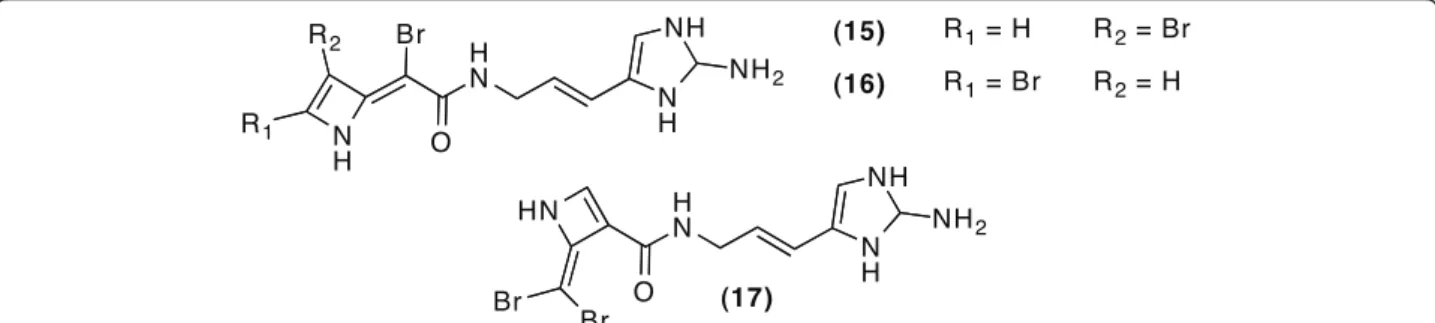
When the 15N-HMBC correlations and fixed atom types are added to the COSY and13C-HMBC based cal-culation the statistical filter excludes only the constitu-tional assignments containing the 1-nitro-prop-2-en-Z-ylidene substructural element (see Figure 3). According to Beilstein, this structural element appears only 14 times, always in conjunction with an aromatic ring, as depicted in Figure 4. When 1,1-ADEQUATE correla-tions are added instead, and atom types are fixed, the filter excludes 16 constitutions, shown in Figure 5. All
1 + 1+ 1+ + 1 2 %U 1 + 5 1 + 1+ 1+ + 1 2 +1 %U %U
5 5 + 5 %U
5 %U 5 +
Figure 3Constitutional assignments excluded by the statistical filter when the structure generator runs with COSY, HMBC,15N-HMBC correlation data and atom types for Oroidin.
+ 1 2 1 + +1 %U %U 1 1+ + 1 2 + 1 +1 %U 1 1+ %U + 1 2 1 + 1+ %U %U 1 +1
+ 1 2 + 1 1+ %U
%U +1 1
1
+ 1+ %U 1 %U
1
+ 1+ %U 1 %U 1+ 2 1+ 1+ 2 1+ + 1 +1
2 + 1 1 %U %U +1 + 1 %U 2 + 1 1 %U +1
+1
+ 1 +1
2 1+ +1 1 %U %U + 1 +1
2 1+ + 1 1 %U %U 1 + 1 %U %U 1+ +1 2 1+ 1+ +1 +1 1 %U %U 2
+1 +1 2 1+ %U + 1 1+ 1 %U + 1 2 1+ + 1 1+ 1 %U %U +1 %U 1+ +1 1 %U 2 1+ 1+ 1+ +1 1 %U 2 1+ %U
Figure 5Constitutional assignments excluded by the statistical filter when the structure generator runs with COSY, HMBC, 1,1-ADEQUATE correlation data and atom types for Oroidin.
+1 & 2 5 5 + 5 12 5
21
(18) (19)
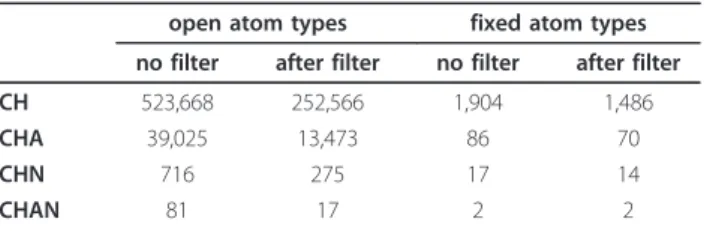
resulting numbers of constitutional assignments for the Different combinations of correlation data are summar-ized in table 2.
The results from tables 1 and 2 show that the filter excludes more constitutional assignments when the atom types are undefined (45% - 65%) then when the atom types are defined (~ 20%). In neither case the cor-rect constitutions were excluded, and in the case of Ascomycin the filter did not exclude any constitutional assignment. The calculation time increases depending on the number of possible constitutional assignments, as smi23d runs about 0.5 s per structure. This explains the observed 3 days for the generation of the 523,668 con-stitutional assignments for Oroidin using COSY,13 C-HMBC correlations and open atom types, COCON itself only needed about 21 minutes. It would take consider-ably more time to sort out the 271,102 excluded consti-tutional assignments manually. Whilst nobody will manually examine the 523,668 resp. 252,566 constitu-tional assignments obtained for Oroidin (see table 2), looking at a mere 275 constitutional assignments instead of 716 is a considerable improvement. When looking at the excluded constitutions, and checking for the com-mon structural elements, it turns out that they are not stable or do not exist in PubChem. Run times for the filter could be cut down in the future by restricting the MD run to just the generation of the parameters, but this would need changing the existing smi23d software
package, and throwing away the possibility of improved visualization of the results with the 3D structures. The new statistical filtering presented here has already been made available in WEBCOCON, optionally only the fil-tered results of runs of the structure generator may be exhibited. Statistical filtering has been applied to the COCON runs for the structure elucidation of Ascomy-cin1, Aflatoxcin B12 and Oroidin3 (Figure 6), exam-ple molecules that have already been used on other occasions. The molecules are available as examples on the WEBCOCON server, together with the results pre-sented here.
Availability
The WEBCOCON server is freely accessible via http:// cocon.nmr.de.
Acknowledgements
The authors wishes to thank Rainer Haessner and the Technische Universität München for providing the Hardware for the WEBCOCON Server.
Authors’contributions
JJ maintains the WEBCOCON software, has implemented the changes and has run all the calculations shown.
Competing interests
The author declares that they have no competing interests.
Received: 19 April 2011 Accepted: 11 August 2011 Published: 11 August 2011
References
1. Elyashberg M, Williams A, Martin G:Computer-assisted structure verification and elucidation tools in NMR-based structure elucidation. Prog Nucl Mag Res Sp2008,53(1-2):1-104.
2. Peng C, Bodenhausen G, Qiu S, Fong H, Farnsworth N, Yuan S, Zheng C:
Computer-assisted structure elucidation: Application of CISOC-SES to the resonance assignment and structure generation of betulinic acid.Magn Reson Chem1998,36(4):267-278.
3. Lindel T, Junker J, Kock M:COCON: From NMR correlation data to molecular constitutions.J Mol Model1997,3:364-368.
4. Stefani R, Nascimento P, Costa F:Computer-aided structure elucidation of organic compounds: Recent advances.Quim Nova2007,30(5):1347-1356. 5. Elyashberg M, Blinov K, Molodtsov S, Williams A, Martin G:Fuzzy structure
generation: A new efficient tool for computer-aided structure elucidation (CASE).J Chem Inf Model2007,47(3):1053-1066. 6. Smurnyy Y, Elyashberg M, Blinov K, Lefebvre B, Martin G, Williams A:
Computer-aided determination of relative stereochemistry and 3D models of complex organic molecules from 2D NMR spectra.Tetrahedron
2005,61(42):9980-9989.
7. Sharman G, Jones I, Parnell M, Willis M, Mahon M, Carlson D, Williams A, Elyashberg M, Blinov K, Molodtsov S:Automated structure elucidation of two unexpected products in a reaction of an alpha,beta-unsaturated pyruvate.Magn Reson Chem2004,42(7):567-572.
8. Steinbeck C:Recent developments in automated structure elucidation of natural products.Nat Prod Rep2004,21(4):512-518.
9. Schulz K, Korytko A, Munk M:Applications of a HOUDINI-based structure elucidation system.J Chem Inf Comp Sci2003,43(5):1447-1456. 10. Steinbeck C:SENECA: A platform-independent, distributed, and parallel
system for computer-assisted structure elucidation in organic chemistry. J Chem Inf Comp Sci2001,41(6):1500-1507.
11. Steinbeck C:Recent advancements in the development of SENECA, a computer program for Computer Assisted Structure Elucidation based on a stochastic algorithm.Abstr Pap Am Chem S1999,218:U360-U360.
Table 2 Number of constitutional assignments suggested for 3 depending on the type of correlation information used.
open atom types fixed atom types no filter after filter no filter after filter
CH 523,668 252,566 1,904 1,486
CHA 39,025 13,473 86 70
CHN 716 275 17 14
CHAN 81 17 2 2
The correlations are encoded as: C = COSY, H =13
C-HMBC, N =15
N-HMBC and A = 1,1-ADEQUATE.
+2
2
2 2+
2
2 2
2 +2
2 1
2 2
2
2 2
2 2
2
1 + + 1
1+ +
1
2 1 + %U
%U
12. Strokov I, Lebedev K:Computer aided method for chemical structure elucidation using spectral databases and C-13 NMR correlation tables.J Chem Inf Comp Sci1999,39(4):659-665.
13. Madison M, Schulz K, Korytko A, Munk M:SESAMI: An integrated desktop structure elucidation tool.Internet J Chem1998,1(34):CP1-U22. 14. Steinbeck C:LUCY - A program for structure elucidation from NMR
correlation experiments.Angew Chem Int Edit1996,35(17):1984-1986. 15. Bangov I, Laude I, Cabrolbass D:Combinatorial Problems in the Treatment
of fuzzy C-13 NMR Spectral Information in the Process of Computer-Aided Structure Elucidation - Estimation of the Carbon-Atom Hybridization and Alpha-Environment States.Anal Chim Acta1994,
298:33-52.
16. Funatsu K:Computer-Assisted Structure Elucidation for Organic-Compound.J Syn Org Chem Jpn1993,51(6):516-528.
17. Lebedev K, Nekhoroshev S, Kirshansky S, Derendjaev B:Computer Method of Fragmentary Formula Prediction of an unknown by its Mass and NMR-Spectra.Sibirskii Khim Zh+1992, ,3:72-79.
18. Guzowskaswider B, Hippe Z:Structure Elucidation of organic-compounds aided by the Computer-Program System Scannet.J Mol Struct1992,
275:225-234.
19. Nuzillard J, Massiot G:Computer-Aided Spectral Assignment in NMR Spectroscopy.Anal Chim Acta1991,242:37-41.
20. Reif B, Kock M, Kerssebaum R, Kang H, Fenical W, Griesinger C:ADEQUATE, a new set of experiments to determine the constitution of small molecules at natural abundance.J Magn Reson Ser A1996,118(2):282-285. 21. Kock M, Junker J, Lindel T:Impact of the H-1,N-15-HMBC experiment on
the constitutional analysis of alkaloids.Org Lett1999,1:2041-2044. 22. Lindel T, Junker J, Kock M:2D-NMR-guided constitutional analysis of
organic compounds employing the computer program COCON.Eur J Org Chem1999, 573-577.
23. Kock M, Junker J, Maier W, Will M, Lindel T:A COCON analysis of proton-poor heterocycles-Application of carbon chemical shift predictions for the evaluation of structural proposals.Eur J Org Chem1999, 579-586. 24. Junker J, Maier W, Lindel T, Kock M:Computer-assisted constitutional assignment of large molecules: COCON analysis of ascomycin.Org Lett
1999,1:737-740.
25. Meiler J, Kock M:Novel methods of automated structure elucidation based on C-13 NMR spectroscopy.Magn Reson Chem2004,
42(12):1042-1045.
26. Meiler J, Sanli E, Junker J, Meusinger R, Lindel T, Will M, Maier W, Kock M:
Validation of structural proposals by substructure analysis and C-13 NMR chemical shift prediction.J Chem Inf Comp Sci2002,42:241-248.
doi:10.1186/1758-2946-3-31
Cite this article as:Junker:Statistical filtering for NMR based structure generation.Journal of Cheminformatics20113:31.
Open access provides opportunities to our colleagues in other parts of the globe, by allowing
anyone to view the content free of charge.
Publish with
Chemistry
Central and every
scientist can read your work free of charge
W. Jeffery Hurst, The Hershey Company.
available free of charge to the entire scientific community peer reviewed and published immediately upon acceptance cited in PubMed and archived on PubMed Central yours you keep the copyright
Submit your manuscript here: