Vol. 6, No. 1, 2013, 66-88
ISSN 1307-5543 – www.ejpam.com
Transmuted Modified Weibull Distribution: A Generalization
of the Modified Weibull Probability Distribution
Muhammad Shuaib Khan
∗, Robert King
School of Mathematical and Physical Sciences, The University of Newcastle, Callaghan, NSW 2308, Australia
Abstract. This paper introduces a transmuted modified Weibull distribution as an important compet-itive model which contains eleven life time distributions as special cases. We generalized the three parameter modified Weibull distribution using the quadratic rank transmutation map studied by Shaw et al. [12]to develop a transmuted modified Weibull distribution. The properties of the transmuted modified Weibull distribution are discussed. Least square estimation is used to evaluate the parame-ters. Explicit expressions are derived for the quantiles. We derive the moments and examine the order statistics. We propose the method of maximum likelihood for estimating the model parameters and obtain the observed information matrix. This model is capable of modeling of various shapes of aging and failure criteria.
2010 Mathematics Subject Classifications: 90B25; 62N05
Key Words and Phrases: Reliability functions, moment estimation, moment generating function, least square estimation, order statistics, maximum likelihood estimation.
1. Introduction
The Weibull distribution is a life time probability distribution used in the reliability engi-neering discipline. We introduce the transmuted modified Weibull distribution which extends recent development on transmuted Weibull distribution by Aryal et al. [1]. More recently Aryal et al. [2] introduced the transmuted extreme value distribution. In this article, we introduce and study several mathematical properties of new reliability model referred to as the transmuted modified Weibull distribution. This paper focuses on all the properties of this model and presents the graphical analysis of the subject distribution. This paper presents the relationship between shape parameter and other properties such as non-reliability function, reliability function, instantaneous failure rate, cumulative instantaneous failure rate models. Recently Ammar et al.[10]proposed the modified Weibull distribution.
FM W(t) =1−exp(−αt−ηtβ). (1)
∗Corresponding author.
Email addresses:Shuaib.statgmail.om(M. Shuaib),robert.kingnewastle.edu.au(R. King)
This article defined the family of transmuted modified Weibull distributions. The main fea-ture of this model is that a transmuted parameterλ is introduced in the subject distribution which provides greater flexibility in the form of new distributions. Using the quadratic rank transmutation map studied by Shaw et al. [12], we develop the four parameter transmuted modified Weibull distribution T M W D(α,β,η,λ,t). We provide a comprehensive description of mathematical properties of the subject distribution with the hope that it will attract wider applications in reliability, engineering and in other areas of research. These distributions have several attractive properties for more details we refer to[5, 8, 4, 6, 7, 13].
The article is organized as follows, In Section 2, we present the flexibility of the subject distribution and some special sub-models. In Section 3, we demonstrate the reliability func-tions of the subject model. A range of mathematical properties are considered in Section 4-5. These include quantile functions, moment estimation, moment generating function and least square estimation. In Section 6, the minimum, maximum and median order statistics models are discussed. We also demonstrate the joint density functions g(t1,tn)of the trans-muted modified Weibull distribution. In Section 7, we demonstrate the maximum likelihood estimates(M LES)of the unknown parameters and the asymptotic confidence intervals of the unknown parameters. However, some of these quantities could not be evaluated in closed form and therefore special cases were used to express them. In Section 8, we fit the TMW model to illustrate its usefulness. In Section 9, concluding remarks are addressed.
2. Transmuted Modified Weibull Distribution
A random variable T is said to have transmuted Modified Weibull probability distribu-tion with parameters α,β,η > 0 and−1≤ λ ≤1 . It can be used to represent the failure probability density function is given by
fT M W(t) = (α+β ηtβ−1)exp(−αt−ηtβ)(1−λ+2λexp(−αt−ηtβ)) t >0 (2) Whereβandηare the shape parameters representing the different patterns of the trans-muted modified Weibull distribution and are positive,αis a scale parameter representing the characteristic life and is also positive,λis the transmuted parameter. The restrictions in equa-tion (2) on the values ofα,β,ηandλare always the same.
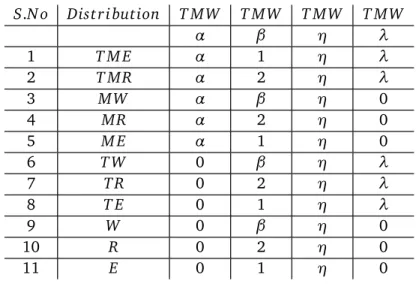
The transmuted modified Weibull distribution is very flexible model that approaches to different distributions when its parameters are changed. The flexibility of the transmuted modified Weibull distribution is explained in Table 1. The subject distribution includes as special cases the transmuted modified Exponential (TME), transmuted Linear Failure Rate (TLFR), transmuted Weibull (TW), transmuted Rayleigh (TR) and transmuted Exponential distributions. Figure 1 shows the transmuted modified Weibull distribution that approaches to eleven different lifetime distributions when its parameters are changed. The cumulative distribution function of the transmuted modified Weibull distribution is denoted byFT M W(t)
and is defined as
Figure 1: Sub Models of Transmuted Modified Weibull Distribution
Table 1: Modified and Transmuted Modified type distributions: T=Transmuted; M=Modified; W=Weibull; E=Exponential; R=Rayleigh
S.N o Dist r i bution T M W T M W T M W T M W
α β η λ
1 T M E α 1 η λ
2 T M R α 2 η λ
3 M W α β η 0
4 M R α 2 η 0
5 M E α 1 η 0
6 T W 0 β η λ
7 T R 0 2 η λ
8 T E 0 1 η λ
9 W 0 β η 0
10 R 0 2 η 0
11 E 0 1 η 0
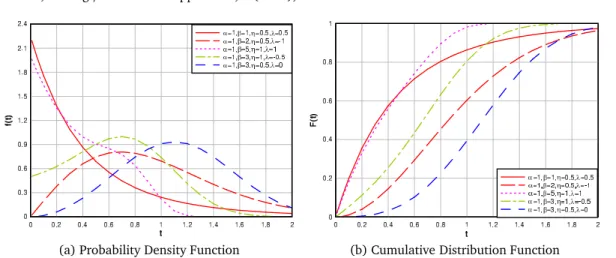
Figure 2a shows the diverse shape of the transmuted modified Weibull PDF with different choice of parameters. The beauty of the subject distribution and its sub models are explained in Table 1.
(a) Probability Density Function (b) Cumulative Distribution Function
Figure 2: Transmuted Modified Weibull PDF & CDF
3. Reliability Analysis
The transmuted modified Weibull distribution can be a useful characterization of life time data analysis. The reliability function (RF) of the transmuted modified Weibull distribution is denoted byRT M W(t)also known as the survivor function and is defined as
RT M W(t) =1−FT M W(t)
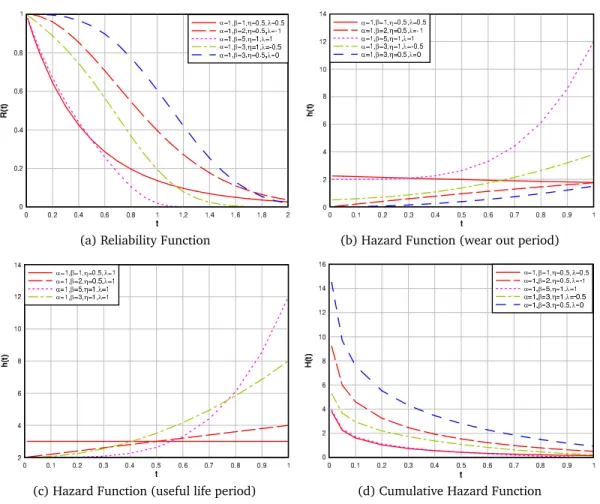
RT M W(t) =1−(1−exp(−αt−ηtβ))(1+λexp(−αt−ηtβ)) (4) It is important to note that RT M W(t) +FT M W(t) = 1 . Figure 3a illustrates the reliability pattern of the transmuted modified Weibull distribution with different choice of parameters. One of the characteristic in reliability analysis is the hazard rate function defined by
hT M W(t) = fT M W(t)
1−FT M W(t)
(5)
The hazard function (HF) of the transmuted modified Weibull distribution also known as instantaneous failure rate denoted byhT M W(t)and is defined as fT M W(t)
RT M W(t)
hT M W(t) = (α+β ηt
β−1)exp(−αt−ηtβ)(1−λ+2λexp(−αt−ηtβ))
1−(1−exp(−αt−ηtβ))(1+λexp(−αt−ηtβ)) (6) It is important to note that the units forhT M W(t)is the probability of failure per unit of time, distance or cycles.
(a) Reliability Function (b) Hazard Function (wear out period)
(c) Hazard Function (useful life period) (d) Cumulative Hazard Function
Figure 3: Transmuted Modified Weibull Reliability and Hazard Functions
In both cases when β = 5 the distribution has the strictly increasing HR. whenβ = 1 , the HR is steadily increasing in Figure 3b which represents failure life between early failures and wear out periods. Whenβ =1 , the HR is constant in Figure 3c which represents failure life in useful life period. When β > 1 , the HF is continually increasing which represents failures occurs after the useful life periods and approaches to the wear-out failures. The HR of the TMWD as given in equation (6) becomes identical with the HR of transmuted modified Rayleigh distribution for β = 2 and for β = 1 it coincides with the transmuted modified Exponential distribution. So the transmuted modified Weibull distribution is a very flexible reliability model.
The Cumulative hazard function of the transmuted modified Weibull distribution is de-noted byHT M W(t)and is defined as
hazard failure rates with different choices of parameters. For all choice of parameters the distribution has the decreasing patterns of cumulative instantaneous failure rates.
Theorem 1. The hazard rate function of the transmuted modified Weibull distribution has the following properties
(i) Ifβ=1the failure rate is same as the T M E D(α,η,λ,t)
(ii) Ifβ=2the failure rate is same as the T LF RD(α,η,λ,t)
(iii) Ifα=0the failure rate is same as the T W D(β,η,λ,t)
(iv) Ifα=0,β=1the failure rate is same as the T E D(η,λ,t)
(v) Ifα=0,β=2the failure rate is same as the T RD(η,λ,t)
(vi) Ifλ=0the failure rate is same as the M W D(α,β,η,t)
(vii) Ifλ=0,β=1the failure rate is same as the M E D(α,η,t)
(viii) Ifλ=0,β=2the failure rate is same as the M RD(α,η,t)
Proof. The hazard function (HF) of the transmuted modified Weibull distribution is given in equation (6) has the special cases with different choice of parameters
(i) Ifβ=1 the failure rate is same as theT M E D(α,η,λ,t)
hT M E(t) =(α+η)exp(−αt−ηt)(1−λ+2λexp(−αt−ηt))
1−(1−exp(−αt−ηt))(1+λexp(−αt−ηt))
(ii) Ifβ=2 the failure rate is same as theT LF RD(α,η,λ,t)
hT L F R(t) = (α+2ηt)exp(−αt−ηt
2)(1−λ+2λexp(−αt−ηt2))
1−(1−exp(−αt−ηt2))(1+λexp(−αt−ηt2))
(iii) Ifα=0 the failure rate is same as theT W D(β,η,λ,t)
hT W(t) = (β ηt
β−1)exp(−ηtβ)(1−λ+2λexp(−ηtβ)) 1−(1−exp(−ηtβ))(1+λexp(−ηtβ))
(iv) Ifα=0,β=1 the failure rate is same as theT E D(η,λ,t)
hT E(t) = (η)exp(−ηt)(1−λ+2λexp(−ηt))
1−(1−exp(−ηt))(1+λexp(−ηt))
(v) Ifα=0,β=2 the failure rate is same as theT RD(η,λ,t)
hT R(t) = (2ηt)exp(−ηt
2)(1−λ+2λexp(−ηt2))
(vi) Ifλ=0 the failure rate is same as theM W D(α,β,η,t)
hM W(t) =
(α+β ηtβ−1)exp(−αt−ηtβ)
1−(1−exp(−αt−ηtβ))
(vii) Ifλ=0,β=1 the failure rate is same as theM E D(α,η,t)
hM E(t) = (α+η)exp(−αt−ηt)
1−(1−exp(−αt−ηt))
(viii) Ifλ=0,β=2 the failure rate is same as theM RD(α,η,t)
hM R(t) = (α+2ηt)exp(−αt−ηt
2)
1−(1−exp(−αt−ηt2))
4. Statistical Properties
This section explain the statistical properties of the T M W D(α,β,η,λ,t)
4.1. Quantile and Median
The quantile tqof theT M W D(α,β,η,λ,t)is the real solution of the following equation
ηtqβ+αtq+ln
1−
(1+λ)−p(1+λ)2−4λq
2λ
=0 (8)
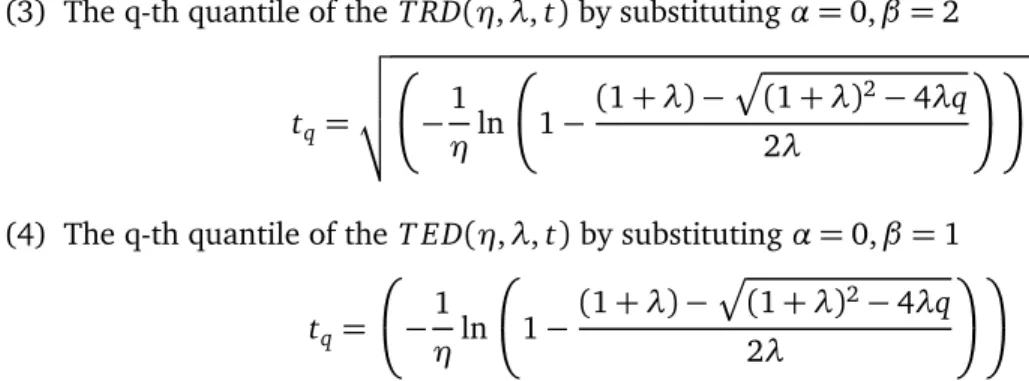
The above equation (8) has no closed-form solution in tq, so we have different cases by sub-stituting the parametric values in the above quantile equation. So the derived special cases are
(1) The q-th quantile of theT LF RD(α,η,λ,t)by substitutingβ=2
tq=
−α+
Ç
α2−4ηln
1−(1+λ)−
p
(1+λ)2−4λq 2λ
2η
(2) The q-th quantile of theT W D(β,η,λ,t)by substitutingα=0
tq=
−
1
ηln
1−
(1+λ)−p(1+λ)2−4λq
2λ
1
(3) The q-th quantile of theT RD(η,λ,t)by substitutingα=0,β=2
tq=
v u u t
−
1
ηln
1−
(1+λ)−p(1+λ)2−4λq
2λ
(4) The q-th quantile of theT E D(η,λ,t)by substitutingα=0,β=1
tq=
−
1
ηln
1−
(1+λ)−p(1+λ)2−4λq
2λ
By puttingq=0.5 in equation (8) we can get the median ofT M W D(α,β,η,λ,t).
The median life of the subject distribution is the 50th percentile. In practice, this is the life by which 50 percent of the units will be expected to have failed and so it is the life at which 50 percent of the units would be expected to still survive. Figure 4a shows the trans-muted modified Weibull median life with different choice of parameters are 0.1 ≤ β ≤ 5,
λ = 0.3, 0.5, 0.7, 1 and the value of η = 2. It is important to note that as the λ increases the pattern of the median life increases. Figure 4b shows the multiple patterns of the sub-ject distribution for B-life with different choice of parameters. Here the B−0.1 life shows the maximum values of percentiles life and B−0.00001 life shows the minimum values of percentiles life. So as the percentile decreases the pattern of B-lives decreases. All of these B-lives are of increasing patterns. Here asβ→ ∞then these B-lives are also increasing. The subject distribution for percentile life is applying in those situations where the B-lives are of increasing order.
(a) Median (b) B-lives
Figure 4: Transmuted Modified Weibull Quantiles
4.2. Random Number Generation
The random number ast of the T M W D(α,β,η,λ,t)is defined by the following equation
ηtβ +αt+ln
1−
(1+λ)−p(1+λ)2−4λξ
2λ
=0 (9)
The above equation is not in closed form solution in t, Usingξa random number uni-formly distributed from zero to one, we have solved the above equationF(t) =ξto obtain a random number int.
4.3. Moments
The following theorem gives the kthmoment of theT M W D(α,β,η,λ,t)
Theorem 2. If T has the T M W D(α,β,η,λ,t) with|λ| ≥1, then the kthmoment of T sayµk
is given as follows
µk=
P∞
i=0
(−1)iηi
i! h
(1−λ)Γ(iβ+k+1)
αiβ+k +
βηΓ(β(i+1)+k) αβ(i+1)+k
i
ifα,β,η >0
+2λP∞i=0(−1)i(2η)i
i!
hαΓ(iβ+k+1)
(2α)iβ+k+1 +
βηΓ(β(i+1)+k) (2α)β(i+1)+k
i
η− k β Γ
1+βk (1−λ) +λ2−
k β
ifα=0
α−kΓ(1+k)((1−λ) +λ2−k) ifβ=0
(10)
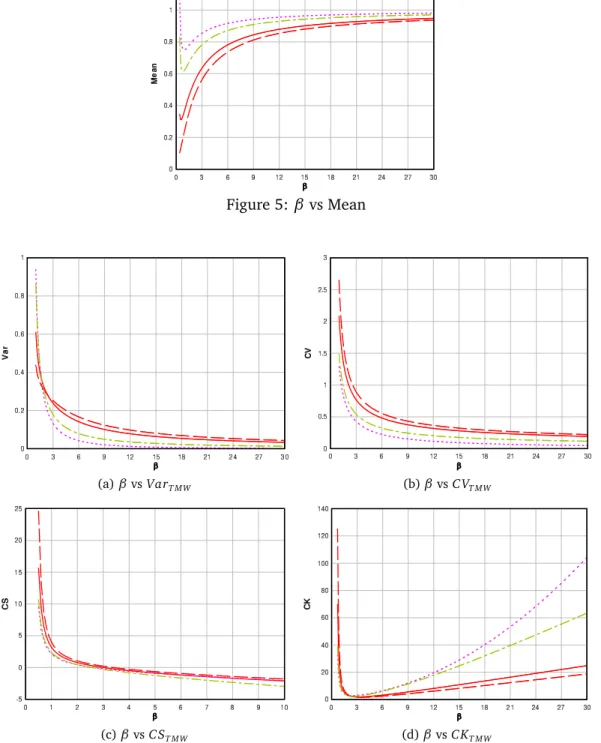
Based on the above results given in Theorem 2, the coefficient of variation, coefficient of skewness and coefficient of kurtosis of T M W D can be obtained according to the following relation
C VT M W =
r
µ2
µ1−1 (11)
C ST M W =µ3−3µ2µ1+2µ
3 1
(µ2−µ21)32
(12)
C KT M W =µ4−4µ3µ1+6µ2µ
2 1−3µ41
(µ2−µ21)2 (13)
Figure 5:β vs Mean
(a)βvsVarT M W (b)βvsC VT M W
(c)βvsC ST M W (d)βvsC KT M W
Figure 6: Transmuted Modified Weibullβvs. Coefficients
measure the skewness of the distribution. The relationship betweenβandC.ST M W is shown in Figure 6c. From our calculations it is clear thatC.ST M W becomes asymptotically decreasing as β → ∞ . Here C.KT M W is the quantity used to measure the kurtosis of the distribution. The relationship betweenβ and C.KT M W is shown in Figure 6d. From our calculations it is clear that asβ→ ∞the value ofC.KT M W becomes asymptotically decreasing.
4.4. Moment Generating Function
The following theorem gives the moment generating function (mgf) ofT M W D(α,β,η,λ,t)
Theorem 3. If T has the T M W D(α,β,η,λ,t) with |λ| ≥ 1 , then the moment generating function of T say Mx(t)is given as follows
Mx(t) =
P∞
i=0
(−1)iηi
i! h
(1−λ)(αΓ(iβ+1)
α−t)iβ+1+
βηΓ(β(i+1)) (α−t)β(i+1)
i
ifα,β,η >0
+2λP∞i=0 (−1)i(2η)i
i!
h αΓ(iβ+1)
(2α−t)iβ+1+
βηΓ(β(i+1)+k) (2α−t)β(i+1)
i
P∞
i=0
ti
i!η
−i β Γ
1+βi (1−λ) +λ2−
i β
ifα=0
α1α−−λt +22αλ−t
ifβ=0
(14)
The proof of this theorem is provided in Appendix. Based on the above results given in Theorem 3, the measure of central tendency, measure of dispersion, coefficient of variation, coefficient of skewness and coefficient of kurtosis of T M W D(α,β,η,λ,t) can be obtained according to the above relation in Theorem 2.
5. Least Square Estimation
LetT1,T2, . . . ,Tnbe a random sample ofT M W D(α,β,η,λ,t)transmuted modified Weibull distribution with cdf FT M W(t), and suppose that T(i),i=1, 2, . . . ,ndenote the ordered
sam-ple. For sample of size n, we have
E(F(T(i))) =
i n+1 The least square estimators (LSES) are obtained by minimizing
Q(α,β,η,λ) =
n
X
i=0
F(T(i))− i
n+1
2
(15)
By using (3) and (15) we have the following equation
Q(α,β,η,λ) =
n
X
i=0
(1−exp(−αt−ηtβ))(1+λexp(−αt−ηtβ))− i
n+1
2
To minimize equation (16) with respect toα,β,ηandλ, we differentiate with respect to these parameters, which leads to the following equations
n
X
i=0
((1−exp(−αt−ηtβ))
1+λexp(−αt−ηtβ))− i
n+1
(t)
×((1+λ)exp(−αt−ηtβ))−2λ(1−exp(−αt−ηtβ)) =0
n
X
i=0
((1−exp(−αt−ηtβ))
1+λexp(−αt−ηtβ))− i
n+1
ηtβln(t)
×((1+λ)exp(−αt−ηtβ))−2λ(1−exp(−αt−ηtβ)) =0
n
X
i=0
((1−exp(−αt−ηtβ))
1+λexp(−αt−ηtβ))− i
n+1
tβ
×((1+λ)exp(−αt−ηtβ))−2λ(1−exp(−αt−ηtβ)) =0
n
X
i=0
((1−exp(−αt−ηtβ))
1+λexp(−αt−ηtβ))− i
n+1
×(exp(−αt−ηtβ))−2(1−exp(−αt−ηtβ)) =0
6. Order Statistics
Let T1:n ≤T2:n ≤. . .≤ Tn:n be the order statistics from the continuous distribution, then the pdf ofTr:n 1≤r≤nis given by
fr:n(t) =Cr:n(F(t))r−1(1−F(t))n−rf(t), t>0 (17) The joint pdf ofTr:nandTs:n1≤r≤s≤n, is given by
fr:s:n(t,u) =Cr:s:n(F(t))r−1(F(u)−F(t))s−r−1(1−F(t))n−sf(t)f(u), (18) for 0≤t≤u≤ ∞and whereCr:n=( n!
r−1)!(n−r)! andCr:s:n=
n!
(r−1)!(s−r−1)!(n−s)!
6.1. Distribution of Minimum and Maximum
Theorem 4. Let t1,t2, . . .tnare independently identically distributed ordered random variables from the transmuted modified Weibull distribution having Ist order and nth order probability density function is given by
f1:n(t) =n(1−(1−exp(−αt−ηtβ))(1+λexp(−αt−ηtβ)))n−1(α
+β ηtβ−1)×exp(−αt−ηtβ)(1−λ+2λexp(−αt−ηtβ)) (19)
fn:n(t) =n((1−exp(−αt−ηtβ))(1+λexp(−αt−ηtβ)))n−1(α+β ηtβ−1)
×exp(−αt−ηtβ)(1−λ+2λexp(−αt−ηtβ)) (20)
Proof. For the minimum and maximum order statistic of the four parameters transmuted modified Weibull distribution have different life time distributions when its parameters are changed.
Case A: Minimum order statistic
1. The minimum order statistic of theT LF RD(α,η,λ,t)by substitutingβ=2 f1:n(t) =n(1−(1−exp(−αt−ηt2))(1+λexp(−αt−ηt2)))n−1(α+2ηt)
×exp(−αt−ηt2)(1−λ+2λexp(−αt−ηt2))
2. The minimum order statistic of theT M E D(α,η,λ,t)by substitutingβ=1 f1:n(t) =n(1−(1−exp(−αt−ηt))(1+λexp(−αt−ηt)))n−1(α+η)
×exp(−αt−ηt)(1−λ+2λexp(−αt−ηt))
3. The minimum order statistic of theT W D(β,η,λ,t)by substitutingα=0 f1:n(t) =n(1−(1−exp(−ηtβ))(1+λexp(−ηtβ)))n−1(β ηtβ−1)
×exp(−ηtβ)(1−λ+2λexp(−ηtβ))
4. The minimum order statistic of theT RD(η,λ,t)by substitutingα=0,β=2 f1:n(t) =n(1−(1−exp(−ηt2))(1+λexp(−ηt2)))n−1(2ηt)
×exp(−ηt2)(1−λ+2λexp(−ηt2))
5. The minimum order statistic of theT E D(η,λ,t)by substitutingα=0,β=1
f1:n(t) =n(1−(1−exp(−ηt))(1+λexp(−ηt)))n−1(η)×exp(−ηt)(1−λ+2λexp(−ηt))
7. The minimum order statistic of theM RD(α,η,t)by substitutingβ=2,λ=0, f1:n(t) =n(1−(1−exp(−αt−ηt2)))n−1(α+2ηt)exp(−αt−ηt2)
8. The minimum order statistic of theM E D(α,η,t) by substitutingβ=1,λ=0, f1:n(t) =n(1−(1−exp(−αt−ηt)))n−1(α+η)exp(−αt−ηt)
Case B: Maximum order statistic
1. The maximum order statistic of theT LF RD(α,η,λ,t)by substitutingβ=2 fn:n(t) =n((1−exp(−αt−ηt2))(1+λexp(−αt−ηt2)))n−1(α+2ηt)
×exp(−αt−ηt2)(1−λ+2λexp(−αt−ηt2))
2. The maximum order statistic of theT M E D(α,η,λ,t) by substitutingβ=1 fn:n(t) =n((1−exp(−αt−ηt))(1+λexp(−αt−ηt)))n−1(α+η)
×exp(−αt−ηt)(1−λ+2λexp(−αt−ηt))
3. The maximum order statistic of theT W D(β,η,λ,t)by substitutingα=0 fn:n(t) =n((1−exp(−ηtβ))(1+λexp(−ηtβ)))n−1(β ηtβ−1)
×exp(−ηtβ)(1−λ+2λexp(−ηtβ))
4. The maximum order statistic of theT RD(η,λ,t)by substitutingα=0,β=2 fn:n(t) =n((1−exp(−ηt2))(1+λexp(−ηt2)))n−1(2ηt)
×exp(−ηt2)(1−λ+2λexp(−ηt2))
5. The maximum order statistic of theT E D(η,λ,t)by substitutingα=0,β=1
fn:n(t) =n((1−exp(−ηt))(1+λexp(−ηt)))n−1(η)×exp(−ηt)(1−λ+2λexp(−ηt))
6. The maximum order statistic of theM W D(α,β,η,t)by substitutingλ=0, fn:n(t) =n((1−exp(−αt−ηtβ)))n−1(α+β ηtβ−1)exp(−αt−ηtβ)
8. The maximum order statistic of theM E D(α,η,t)by substitutingβ=1,λ=0, fn:n(t) =n((1−exp(−αt−ηt)))n−1(α+η)exp(−αt−ηt)
Theorem 5. Let t1,t2, . . .tnare independently identically distributed ordered random variables from the transmuted modified Weibull distribution having median order Tm+1probability density
function is given by
g(˜t) = (2m+1)!
m!m! (F(˜t))
m(1−F(˜t))mf(˜t), 0≤˜t ≤ ∞ (21)
Proof. Using (21) the median order statistic of the four parameters transmuted modified Weibull distribution is given below
g(˜t) =(2m+1)!
m!m! ((1−exp(−α˜t−η˜t
β))(1+λexp(−α˜t−η˜tβ)))m(α+β η˜tβ−1)
×(1−(1−exp(−α˜t−η˜tβ))(1+λexp(−α˜t−η˜tβ)))m
×exp(−α˜t−η˜tβ)(1−λ+2λexp(−α˜t−η˜tβ)) (22)
Using (22) we have different life time distributions of median order statistic when its param-eters are changed
1. The median order statistic of theT LF RD(α,η,λ,t) by substitutingβ=2
g(˜t) =(2m+1)!
m!m! ((1−exp(−α˜t−η˜t
2))(1+λexp(−α˜t−η˜t2)))m(α+2η˜t)
×(1−(1−exp(−α˜t−η˜t2))(1+λexp(−α˜t−η˜t2)))m
×exp(−α˜t−η˜t2)(1−λ+2λexp(−α˜t−η˜t2))
2. The median order statistic of theT M E D(α,η,λ,t) by substitutingβ=1
g(˜t) =(2m+1)!
m!m! ((1−exp(−α˜t−η˜t))(1+λexp(−α˜t−η˜t)))
m(α+η)
×(1−(1−exp(−α˜t−η˜t))(1+λexp(−α˜t−η˜t)))m
×exp(−α˜t−η˜t)(1−λ+2λexp(−α˜t−η˜t))
3. The median order statistic of theT W D(β,η,λ,t)by substitutingα=0
g(˜t) =(2m+1)!
m!m! ((1−exp(−η˜t
β))(1+λexp(−η˜tβ)))m(β η˜tβ−1)
×(1−(1−exp(−η˜tβ))(1+λexp(−η˜tβ)))m
4. The median order statistic of theT RD(η,λ,t)by substitutingα=0,β=2
g(˜t) =(2m+1)!
m!m! ((1−exp(−η˜t
2))(1+λexp(−η˜t2)))m(2η˜t)
×(1−(1−exp(−η˜t2))(1+λexp(−η˜t2)))m
×exp(−η˜t2)(1−λ+2λexp(−η˜t2))
5. The median order statistic of theT E D(η,λ,t)by substitutingα=0,β=1
g(˜t) =(2m+1)!
m!m! ((1−exp(−η˜t))(1+λexp(−η˜t))) m(η˜t)
×(1−(1−exp(−η˜t))(1+λexp(−η˜t)))m
×exp(−η˜t)(1−λ+2λexp(−η˜t))
6. The median order statistic of theM W D(α,β,η,t)by substitutingλ=0,
g(˜t) =(2m+1)!
m!m! ((1−exp(−α˜t−η˜t
β))m(α+β η˜tβ−1)
×(1−(1−exp(−α˜t−ηt˜β))m×exp(−α˜t−η˜tβ)
7. The median order statistic of theM RD(α,η,t) by substitutingβ=2,λ=0,
g(˜t) =(2m+1)!
m!m! ((1−exp(−α˜t−η˜t
2))m(α+2η˜t)
×(1−(1−exp(−α˜t−η˜t2))m×exp(−α˜t−η˜t2)
8. The median order statistic of theM E D(α,η,t)by substitutingβ=1,λ=0,
g(˜t) =(2m+1)!
m!m! ((1−exp(−α˜t−η˜t))
m(α+η)
×(1−(1−exp(−α˜t−η˜t))m×exp(−α˜t−η˜t)
6.2. Joint Distribution of rth Order Statistic
T
rand sth Order Statistic
T
sThe joint pdf ofTr andTs with Tr=t andTs=u, (1≤r≤s≤n) in (18) by taking r=1 ands=nin (17) the minimum and maximum joint density can be written as
g(t1,tn) =n(n−1)(F(tn)−F(t1))n−2f(t1)f(t2) (23) Theorem 6. Let t1,t2, . . . ,tn be independently identically distributed ordered random variables from the transmuted modified Weibull distribution having joint probability density function using (2)and(3)in(23)is given by
g(t1,tn) =n(n−1)(α+β ηt β−1
1 )exp(−αt1−ηt
β
1)(1−λ+2λexp(−αt1−ηt
β
×(α+β ηtβn−1)exp(−αtn−ηtnβ)(1−λ+2λexp(−αtn−ηtβn))
×[(1−exp(−αtn−ηtβn))(1+λexp(−αtn−ηtβn))
−(1−exp(−αt1−ηtβ1))(1+λexp(−αt1−ηtβ1))]n−2 (24)
Proof. Using (24), the joint probability density functiong(t1,tn)of the subject distribution has different joint distributions when its parameters are changed
1. The min and max order statistic of theT LF RD(α,η,λ,t) by substitutingβ=2 g(t1,tn) =n(n−1)(α+2ηt1)exp(−αt1−ηt12)(1−λ+2λexp(−αt1−ηt21))
×(α+2ηtn)exp(−αtn−ηt2n)(1−λ+2λexp(−αtn−ηt2n))
×[(1−exp(−αtn−ηt2n))(1+λexp(−αtn−ηt2n))
−(1−exp(−αt1−ηt21))(1+λexp(−αt1−ηt12))]
n−2
2. The min and max order statistic of theT M E D(α,η,λ,t) by substitutingβ=1 g(t1,tn) =n(n−1)(α+η)exp(−αt1−ηt1)(1−λ+2λexp(−αt1−ηt1))
×(α+η)exp(−αtn−ηtn)(1−λ+2λexp(−αtn−ηtn))
×[(1−exp(−αtn−ηtn))(1+λexp(−αtn−ηtn))
−(1−exp(−αt1−ηt1))(1+λexp(−αt1−ηt1))]n−2
3. The min and mix order statistic of theT W D(β,η,λ,t)by substitutingα=0
g(t1,tn) =n(n−1)(β ηt1β−1)exp(−ηtβ1)(1−λ+2λexp(−ηt1β))
×(β ηtβn−1)exp(−ηtβn)(1−λ+2λexp(−ηtβn))
×[(1−ηtβn))(1+λexp(−ηtβn))
−(1−exp(−ηtβ1))(1+λexp(−ηt1β))]n−2
4. The min and max order statistic of theT RD(η,λ,t)by substitutingα=0,β=2 g(t1,tn) =n(n−1)(2ηt1)exp(−ηt21)(1−λ+2λexp(−ηt
2 1))
×(2ηtn)exp(−ηt2n)(1−λ+2λexp(−ηt2n))×[(1−ηt2n))(1+λexp(−ηt2n))
−(1−exp(−ηt21))(1+λexp(−ηt21))]n−2
5. The min and max order statistic of theT E D(η,λ,t)by substitutingα=0,β=1 g(t1,tn) =n(n−1)(η)exp(−ηt1)(1−λ+2λexp(−ηt1))
×(η)exp(−ηtn)(1−λ+2λexp(−ηtn))×[(1−ηtn))(1+λexp(−ηtn))
6. The min and max order statistic of theM W D(α,β,η,t)by substitutingλ=0,
g(t1,tn) =n(n−1)(β2η2t β−1
1 t
β−1
n )exp(−ηt β
1 −ηt
β n)
[(1−exp(−ηtβn))−(1−exp(−ηtβ1))]n−2
7. The min and max order statistic of theM RD(α,η,t) by substitutingβ=2,λ=0, g(t1,tn) =n(n−1)(4η2t1tn)exp(−ηt12−ηt2n)
[(1−exp(−ηt2n))−(1−exp(−ηt21))]n−2
8. The min and max order statistic of theM E D(α,η,t)by substitutingβ=1,λ=0, g(t1,tn) =n(n−1)(η2)exp(−ηt1−ηtn)
[(1−exp(−ηtn))−(1−exp(−ηt1))]n−2
7. Maximum Likelihood Estimation
Consider the random samplest1,t2, . . .tnconsisting ofnobservations from the transmuted modified Weibull distribution T M W D(α,β,η,λ,t) having probability density function. The likelihood function of equation (2) is given by
L(t1, . . .tn,α,β,η,λ,) =Y(α+β ηtβ−1)exp(−αt−ηtβ)(1−λ+2λexp(−αt−ηtβ))
(25) By accumulation taking logarithm of equation (25), we find the log-likelihood function Ł=lnL , differentiating equation (26) with respect toα,β,ηandλthen equating it to zero, we obtain the estimating equations are
L(t1,t2, . . .tn,α,β,η,λ,) = n
X
i=0
ln(α+β ηtβi−1)−α
n
X
i=0
ti−η n
X
i=0
tβi
+
n
X
i=0
ln(1−λ+2λexp(−αti−ηtβi )) (26)
∂Ł
∂ α=
n
X
i=0
1
(α+β ηtβi−1)−
n
X
i=0
ti− n
X
i=0
2λtiexp(−αti−ηt β i )
(1−λ+2λexp(−αti−ηt β i ))
(27)
∂Ł
∂ β =
n
X
i=0
tβi −1(1+βln(ti)) (α+β ηtβi−1) −
n
X
i=0
tβi ln(ti)− n
X
i=0
2λexp(−αti−ηtβi )tβi ln(ti) (1−λ+2λexp(−αti−ηt
β i ))
=0 (28)
∂Ł
∂ η =
n
X
i=0
βtβi−1
(α+β ηtβi−1)−
n
X
i=0
tβi − n
X
i=0
2λexp(−αti−ηtβi )tβi
(1−λ+2λexp(−αti−ηtβi ))
∂Ł
∂ λ=
n
X
i=0
2 exp(−αti−ηtβi )−1
(1−λ+2λexp(−αti−ηtβi ))
=0 (30)
By solving this nonlinear system of equations (27) -(30), these solutions will yield the ML estimatorsαˆ, βˆ,ηˆandλˆ. For the four parameters transmuted modified Weibull distribution T M W D(α,β,η,λ,t) pdf all the second order derivatives exist. Thus we have the inverse dispersion matrix is
ˆ α ˆ β ˆ η ˆ λ ∼N α β η λ , ˆ
V11 Vˆ12 Vˆ13 Vˆ14
ˆ
V21 Vˆ22 Vˆ23 Vˆ24
ˆ
V31 Vˆ32 Vˆ33 Vˆ34
ˆ
V41 Vˆ42 Vˆ43 Vˆ44
V−1=−E
V11 ... V14
... ... ... V41 ... V44
=−E
∂2Ł
∂ α2 ...
∂2Ł
∂ α∂ λ ... ... ... ∂2Ł
∂ α∂ λ ... ∂2Ł
∂ λ2 (31)
Equation (31) is the variance covariance matrix of the T M W D(α,β,η,λ,t)
V11= ∂
2Ł
∂ α2 V12=
∂2Ł
∂ α∂ β
V22= ∂
2Ł
∂ β2 V13=
∂2Ł
∂ α∂ η
V33= ∂
2Ł
∂ η2 V14=
∂2Ł
∂ α∂ λ
V44= ∂
2Ł
∂ λ2 V23=
∂2Ł
∂ β ∂ η
V24=
∂2Ł
∂ β ∂ λ V34= ∂2Ł
∂ η∂ λ
By solving this inverse dispersion matrix, these solutions will yield the asymptotic variance and co-variances of these ML estimators for αˆ, βˆ, ηˆand λˆ. By using (31), approximately 100(1−α)% confidence intervals forα,β,ηandλcan be determined as
ˆ α±Zα
2 p
ˆ
V11 βˆ±Zα 2
p
ˆ
V22 ηˆ±Zα 2
p
ˆ
V33 λˆ±Zα 2
p
ˆ
V44
WhereZα
2 is the upperαth percentile of the standard normal distribution.
8. Numerical Example
data have been obtained from Dumonceaux and Antle[3].
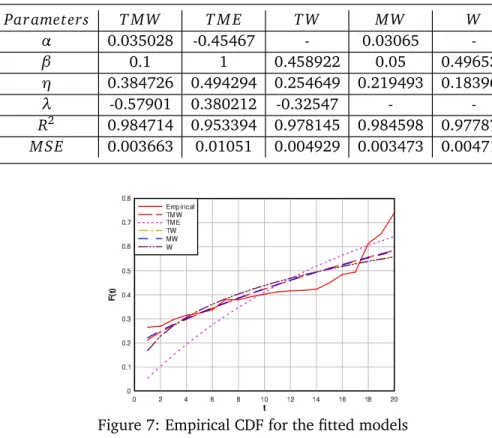
The analysis of least square estimates for the unknown parameters in these distributions namely: Transmuted Modified Weibull (TMW), Transmuted Weibull (TW), Transmuted Mod-ified exponential (TME), ModMod-ified Weibull (MW) and Weibull (W) distributions by using the method of least squares are defined. The LSE(s) of the unknown parameter(s), coefficient of determination(R2)and the corresponding Mean square error for transmuted modified Weibull families of distributions are given in Table 2.
We have provided the parametric estimate of the cumulative distribution function and the fitted functions in Figure 7. It is clear that the transmuted modified Weibull (TMW) distribution provides better fit than the other distributions. In this analysis some estimated values are negative which is not good in the LSE. Another check is to compare the respective coefficients of determination for these regression lines. We have supporting evidence that the coefficient of determination of (TMW) is 0.984714, which is higher than the coefficient of determination of (TME), (TW), (MW) and (W) distributions. Hence the data point from the transmuted modified Weibull (TMW) has better relationship and hence this distribution is good model for life time data.
Table 2: Estimated parameters of TMW, TME, TW, MW and W Distributions
Par ameters T M W T M E T W M W W
α 0.035028 -0.45467 - 0.03065
-β 0.1 1 0.458922 0.05 0.496531
η 0.384726 0.494294 0.254649 0.219493 0.183961
λ -0.57901 0.380212 -0.32547 -
-R2 0.984714 0.953394 0.978145 0.984598 0.977871 M SE 0.003663 0.01051 0.004929 0.003473 0.004713
9. Concluding Remarks
In this paper we introduce a new generalization of the Weibull distribution called trans-muted modified Weibull distribution and presented its theoretical properties. The new dis-tribution is very flexible model that approaches to different life time disdis-tributions when its parameters are changed. From the instantaneous failure rate analysis it is observed that it has increasing and decreasing failure rate pattern for life time data. This model has the capability to provide consistent results from all estimation methods.
References
[1] G. R. Aryall and C. P. Tsokos. Transmuted Weibull distribution: A Generalization of the Weibull Probability Distribution.European Journal of Pure and Applied Mathematics, Vol. 4, No. 2, 89-102. 2011.
[2] G. R. Aryall and C. P. Tsokos. On the transmuted extreme value distribution with ap-plications. Nonlinear Analysis: Theory, Methods and applications, Vol. 71, 1401-1407. 2009.
[3] R. Dumonceaux and C. Antle. Discrimination between the log-normal and the Weibull distributions,Technometrics, 15(4), 923-926. 1973.
[4] C.-C. Liu. A Comparison between the Weibull and Lognormal Models used to Analyze Reliability Data. PhD thesisUniversity of Nottingham, UK. 1997.
[5] G. Mudholkar, D. Srivastava, and G. Kollia. A generalization of the Weibull distribu-tion with applicadistribu-tion to the analysis of survival data.Journal of the American Statistical Association, 91(436):1575-1583, 1996.
[6] M. M. Nassar and F. H. Eissa. On the Exponentiated Weibull Distribution. Communica-tions in Statistics - Theory and Methods, 32(7):1317-1336, 2003.
[7] M. Pal, M. M. Ali, and J. Woo. On the exponentiated Weibull distribution. Statistica. (2):139-147, 2006.
[8] H. Pham and C.-D. Lai. On Recent Generalizations of the Weibull Distribution. IEEE Transactions on Reliability, 56(3):454-458, 2007.
[9] M. Z. Raqab. Inferences for generalized exponential distribution based on record Statis-tics.Journal of Statistical Planning and Inference. Vol. 104, 2, pp. 339-350. 2002.
[10] A. M. Sarhan and M. Zaindin. Modified Weibull distribution, Applied Sciences, Vol.11, 2009, pp. 123-136. 2009.
[12] W. Shaw and I. Buckley. The alchemy of probability distributions: beyond Gram-Charlier expansions and a skew-kurtotic-normal distribution from a rank transmutation map. Research report, 2007.
[13] M. Zaindin and A. M. Sarhan. Parameters Estimation of the Modified Weibull Distribu-tion,Applied Mathematical Sciences,Vol. 3, no. 11, 541-550. 2009.
Appendix
Proof of Theorem 2
µk=
Z ∞
0
tkf(α,β,η,λ,t)d t By substituting (2) into the above relation we have
µk=
Z ∞
0
tk(α+β ηtβ−1)exp(−αt−ηtβ)(1−λ+2λexp(−αt−ηtβ))d t (A1)
Case A:In this caseα,β,η >0 and|λ| ≥1. The exponent quantity isE x p(−ηtβ)
E x p(−ηtβ) =
∞
X
i=0
(−1)iηi(t)iβ
i! (A2)
Here equation (A1) takes the following form
µk=
∞
X
i=0
(−1)iηi i!
(1−λ)
Γ(iβ+k+1)
αiβ+k +
β ηΓ(β(i+1) +k) αβ(i+1)+k
+2λ
∞
X
i=0
(−1)i(2η)i
i!
αΓ(iβ+k+1)
2αiβ+k+1 +
β ηΓ(β(i+1) +k)
2αβ(i+1)+k
(A3)
Case B:In this caseα=0,β,η >0 and|λ| ≥1.
µk=
Z ∞
0
tk(β ηtβ−1)exp(−ηtβ)(1−λ+2λexp(−ηtβ))d t
By substitutingw=ηt(β)then we get
µk=η −k
β Γ
1+ k β
(1−λ) +λ2−
k β
(A4)
Case C:In this caseα >0,β=0,η=0 and|λ| ≥1.
µk=
Z ∞
0
tkαexp(−αt)(1−λ+2λexp(−αt))d t
Proof of Theorem 3
Mx(t) =
Z ∞
0
et xf(α,β,η,λ,t)d t
By substituting (2) into the above relation we have
Mx(t) =
Z ∞
0
et x(α+β ηtβ−1)exp(−αt−ηtβ)(1−λ+2λexp(−αt−ηtβ))d t (A6)
Case A: In this caseα,β,η > 0 and |λ| ≥ 1. The exponent quantity is E x p(−ηtβ). Here equation (A6) takes the following form
Mx(t) = ∞
X
i=0
(−1)iηi
i!
(1−λ)
αΓ(iβ+1) (α−t)iβ+1 +
β ηΓ(β(i+1)) (α−t)β(i+1)
+2λ
∞
X
i=0
(−1)i(2η)i i!
αΓ(iβ+1) (2α−t)iβ+1 +
β ηΓ(β(i+1) +k) (2α−t)β(i+1)
(A7)
Case B:In this caseα=0,β,η >0 and|λ| ≥1.
Mx(t) =
Z ∞
0
et x(β ηtβ−1)exp(−ηtβ)(1−λ+2λexp(−ηtβ))d t
By substitutingw=ηt(β)then we get
Mx(t) =
∞
X
i=0
ti i!η
−k β Γ
1+ i β
(1−λ) +λ2−
i β