Large-Scale Deployment of Three
Intelligent Web-based Database Tutors
Antonija Mitrovic and the ICTG team
Computer Science Department, University of Canterbury, Christchurch, New Zealand
We present our experiences with DatabasePlace, a Web portal aimed at university-level students enrolled in database courses. The portal was established by Addison-Wesley in January 2003. Besides presenting information about the textbooks, the portal also provides additional domain information, online quizzes and three Intelligent Tutoring Systems developed by the Intelligent Computer Tutoring Group (ICTG). We briefly present the three systems, and then discuss our experiences. We also compare the DatabasePlace students to our local students using the three ITSs.
Keywords: intelligent tutoring systems, evaluation, stu-dent modelling.
1. Introduction
Intelligent Tutoring Systems (ITS) are knowl-edge-based systems that provide individualized instruction, by being able to adapt to the know-ledge, learning abilities and needs of each in-dividual student. ITSs offer many advantages over the traditional classroom scenario: they are always available, non-judgemental and provide tailored feedback [1,11]. The current state-of-the-art ITSs achieve improvements of one stan-dard deviation compared to traditional class-room teaching, but are not yet as effective as one-on-one human tutoring[1,2,7,8].
In this paper, we discuss our experiences in pro-viding three Web-enabled ITSs that teach var-ious database skills to university students. We have developed the three systems within ICTG, and have been using them with our local stu-dents at the University of Canterbury starting in 1998. In 2002 we signed a contract with Addison-Wesley to provide the three ITSs and
online quizzes on DatabasePlace, their Web por-tal (www.databaseplace.com). DatabasePlace was opened in January 2003, serving two ITSs: SQL-Tutor, which teaches the SQL database query language, and NORMIT, the data nor-malization tutor. ER-Tutor, an ITS that teaches database design using the Entity-Relationship data model, was added to the portal in January 2004.
Databases are ubiquitous in today’s informa-tion systems. Our tutors are Web-enabled, and thus are classroom and platform independent. All three tutors are problem-solving environ-ments, where the system presents problems to solve and offers adaptive problem-solving sup-port and feedback.
In Section 2 we present a brief overview of the architecture and functionality of our tu-tors. The following three sections discuss SQL-Tutor, ER-Tutor and NORMIT. Section 5 pres-ents some experiences with DatabasePlace, fol-lowed by conclusions in the last section.
2. Constraint-Based Tutors
Fig. 1.The architecture of our tutors
to establish a session. The session manager re-quires the student modeller to retrieve the model for the student, if there is one, or to create a model for a new student. Each student action is sent to the session manager, to be linked to the appropriate session and stored in the student’s log. The action is then sent to the pedagogi-cal module (PM). If the submitted action is a solution to the current step, the PM sends it to the student modeller, which diagnoses the so-lution, updates the student model and sends the result of the diagnosis back to the PM, which generates feedback.
SQL-Tutor and NORMIT are Web-enabled tors with a centralized architecture, with all tu-toring functions performed on the server side. In these two domains, solutions produced by students are textual, and the amount of informa-tion to be sent to the server is small, so that the centralized architecture is appropriate. In ER-Tutor, students draw diagrams, and some tutor-ing functions related to drawtutor-ing are performed on the client side. The tutoring functions are therefore distributed between the server and the Java applet, as described later.
Domain knowledge consists of a set of con-straints. Constraint-based Modeling (CBM) [8,10] is a student modeling approach that is not interested in the exact sequence of states in the problem space the student has traversed, but in what state he/she is currently in. As long as the student never reaches a state that is known to be wrong, they are free to
per-form whatever actions they please. The do-main model is a collection of state descriptions of the form: If<relevance condition>is true, then <satisfaction condition>had better also be true, otherwise something has gone wrong.
A simple example of a constraint is as follows:
If you are driving in New Zealand, you better be on the left side of the road.
The knowledge base consists of constraints used for testing the student’s solution for syntax er-rors and comparing it against the system’s ideal solution to find semantic errors. The knowledge base enables the ITS to identify correct student solutions, no matter whether they are identical to the system’s ideal solutions or the student has used an alternative way of solving the same problem. Constraints are problem-independent and modular, and therefore easy to evaluate. They are written in Lisp, and can contain built-in functions as well as domain-specific ones. For examples of constraints, please see[5,7,8,9,12]. If the satisfaction condition of a relevant con-straint is met by the student solution, the solu-tion is correct. In the opposite case, the student will be given feedback on errors.
One of the advantages of CBM over other stu-dent modeling approaches [6] is its indepen-dence from the problsolving strategy em-ployed by the student. CBM models students’ evaluative, rather than generative knowledge and, therefore, does not attempt to induce the student’s problem-solving strategy. CBM does not require an executable domain model, and is applicable in situations in which such a model would be difficult to construct(such as database design or SQL query generation). Furthermore, CBM eliminates the need for bug libraries, i.e. collections of typical errors made by students. On the contrary, CBM focuses on correct know-ledge only. If a student performs an incorrect ac-tion, that action will violate some constraints. A violated constraint means that student’s know-ledge is incomplete/incorrect, and the system can respond by generating an appropriate feed-back message.
long-term model records the history of usage for each constraint. This information is used to se-lect problems of appropriate complexity for the student, and to generate feedback.
All constraint-based tutors contain predefined database problems. ER-Tutor and SQL-Tutor also contain a pre-specified ideal solution for each problem, as there are no problem solvers for these two tutors. NORMIT, on the other hand, contains a problem solver, and is capable of solving both pre-specified problems and the problems entered by students.
The pedagogical module is the driving engine of the whole system. Its main tasks are to generate appropriate feedback messages for the student and to select new practice problems. PM indi-vidualizes these actions to each student, based on their student model. Unlike ITSs based on model tracing [1,4], constraint-based tutors do not follow each student’s solution step-by-step: a student’s solution is only evaluated once it is submitted, although the student may submit a partial solution to get ideas on how to progress.
3. SQL-Tutor
Students experience many problems when learn-ing SQL. Some errors come from the burden of having to memorize database schemas; oth-ers come from misconceptions in the student’s understanding of SQL and the relational data model. Furthermore, students find that it is not easy to learn SQL by working with a RDBMS, because error messages are very often hard to understand, and are limited to the syntax only. The Web-enabled version of SQL-Tutor has been used in courses at the University of Can-terbury since 1999. For a detailed discussion of the system, see [5,7,8]. The system con-tains several databases and a set of problems and their ideal solutions. The interface was de-signed to be robust, flexible, and easy to use. It reduces the memory load by displaying the database schema, the text of a problem, the ba-sic structure of the query, and explanations of the elements of SQL. The interface removes some of the cognitive load required for check-ing the low-level syntax, and enables the student to focus on query definition.
SQL-Tutor checks the student’s solution by com-paring it to the correct solution using domain knowledge represented in the form of about 700 constraints. The students may select prob-lems in several ways: they may work their way through a series of problems for each database
(ordered by their complexity), ask the system to select a problem on the basis of their model, select a problem from a list, or select the type of problem they wish to work on, where the sys-tem then selects an individual problem of that type on the basis of their student model.
4. ER-Tutor
Database design is a process of generating a database schema using a specific data model. The quality of conceptual schemas is of crit-ical importance for database systems. Most database courses teach conceptual database de-sign using the Entity-Relationship(ER)model, a high-level data model [3]. Although the tra-ditional method of learning ER modeling in a classroom environment may be sufficient as an introduction to database design, students cannot gain expertise by attending lectures only: like in other design tasks, extensive practice is neces-sary. ER-Tutor assists students in this task. The system is designed to complement classroom teaching, and therefore assumes that students are already familiar with the fundamentals of database theory. In ER-Tutor [9,12], students construct ER schemas that satisfy a given set of requirements. The system assists students dur-ing problem solvdur-ing and guides them towards the correct solution by providing tailored feed-back.
Fig. 2.The interface of ER-Tutor
students create ER diagrams. The feedback from the system is provided in the pane on the right. The ER diagram is constructed using the workspace integrated into the interface. When-ever a new object is created, the system asks for it to be named by highlighting a phrase from the problem text. This interface has two benefits: the student is forced to think about the require-ments in terms of the original problem text, and it is also easier for the tutor to understand the semantics of the constructs in the student’s di-agram. Once the student has completed the problem or requires guidance from the system, the solution is evaluated. Depending on the re-sults of the evaluation, the system may either congratulate the student or offer hints on their errors. The domain knowledge of ER-Tutor is represented as a set of 135 constraints, which are used for testing the student’s solution (for syntax errors)and comparing it to the ideal so-lution.
5. NORMIT
Database normalization is the process of re-fining a relational database schema in order to ensure that all tables are of high quality
may submit a solution or request a new problem at any time. He/she may also review the history of the session, or examine their student model. NORMIT currently contains over 80 problem-independent constraints that describe the basic principles of the domain. Some constraints check the syntax of the solution, while others check the semantics by comparing the student’s solution to the ideal solution, generated by the problem solver. In order to identify constraints, we studied material in textbooks, such as [3], and also used our own experience in teaching database normalization.
6. DatabasePlace
The number of DatabasePlace users has been increasing steadily, as illustrated in Figure 3. Students get access to the portal by buying a database book published by Addison-Wesley, or by obtaining access directly from the Web. The contract with the publisher does not allow for collecting general information about the users or their background knowledge prior to using the ITSs, but we do have access to session logs. Although we do not know where the users come from, it is evident from the figure that most of the students come from the northern hemi-sphere; there are fewer new users during July-August period. ER-Tutor was available on the portal a year later than the other two tutors, but it is equally popular. NORMIT seems to attract the least number of users, which is not surpris-ing, taking into account the highly theoretical nature of its instructional area.
Fig. 3.The number of DatabasePlace users
We performed numerous evaluation studies on these three ITSs with local students at the Uni-versity of Canterbury, the results of which show that they increase students’ knowledge signif-icantly [7,8,9,12]. The ITSs are especially ef-fective for less able students, although we have proofs that they are also beneficial for more ad-vanced students. Subjective information shows that students appreciate working with the tutors, as they are available at any time and from any place, and especially praise the feedback pro-vided. Since we have no knowledge of back-grounds of students using the same systems on DatabasePlace, it is interesting to see whether the same effects are achieved on the portal. We performed various analyses of student data collected on the portal. DatabasePlace students prefer different problems from Canterbury stu-dents. For example, Canterbury students most often select problems from two databases of-fered in SQL-Tutor(MOVIE and COMPANY), while DatabasePlace students prefer other data-bases. These superficial differences can be ex-plained easily: Canterbury students use SQL-Tutor in the labs, as a complement to lectures. In the course taught by the author, many examples used in lectures come from these two databases. DatabasePlace students, on the other hand, use SQL-Tutor (most likely) completely indepen-dently from the courses they are enrolled in, and select databases based on their own prefer-ences.
A more interesting analysis looks at the com-pletion rates. On average, 3-15% of Canter-bury students log on to the ITSs without even making any attempts at solving problems. The percentage of students behaving the same way in DatabasePlace is higher, and ranges from 30% to 45%. The percentage of students who complete no problems for Canterbury students ranges from 3% to 12% (depending on the system), while for DatabasePlace students this range is much wider(12-40%). We believe this illustrates the effect of having no human teacher in the loop: Canterbury students are told in lec-tures that the tutoring systems are useful for practice, and that they may help students learn better, while no such reinforcement is there for DatabasePlace students.
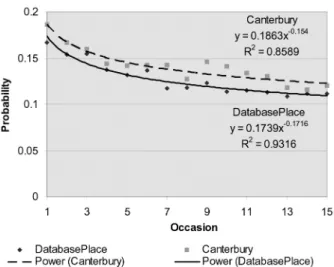
Fig. 4.Learning curves
4 shows the learning curves for students us-ing NORMIT. We compared two groups of dents: the Canterbury group included all stu-dents participating in a study performed in 2004, while the DatabasePlace group consisted of all students using NORMIT on DatabasePlace. To produce the learning curve, we calculate the probability of violating a constraint on its nth
occasion of being relevant. This probability is then averaged over all constraints and over all students. Figure 4 shows the raw data points and also the fitted power curves. It can be seen that both power curves represent very good approx-imations of the data sets, with the R2fits of 0.86 and 0.93 for the Canterbury and DatabasePlace groups respectively. A good fit to the power curve is widely accepted in the ITS area as a measure of the psychological appropriateness of the used knowledge representation formal-ism; in our case, these graphs show that stu-dents indeed do acquire knowledge in the area as represented in the system (i.e. the students learn constraints). The initial probability of er-rors is slightly higher for Canterbury students
(0.19)than for Database Place students(0.17), but the difference is not significant. The learn-ing rates(i.e. the exponents of the power curves)
are comparable, meaning that both groups learn equally well. The slightly higher R2 for the DatabasePlace group is the statistical effect of a much larger size of the group; there were less than 50 Canterbury students, compared to al-most two thousand students using NORMIT on DatabasePlace.
7. Conclusions
We presented three of our constraint-based tu-tors for the database area, which are used with local students at the University of Canterbury, and also at a Web portal with worldwide stu-dents. The DatabasePlace Web portal has been active for more than three years now, and the three ITSs available on it have been used by sev-eral thousand students. At Canterbury, we have conducted multiple evaluation studies since 1998, but with much smaller populations of stu-dents. The analyses we performed on student logs collected both locally and from Database-Place show that both groups of students learn equally effectively using these systems, although there are differences in attrition rates and problem completion rates. We believe that it is beneficial to have the teacher involved in the process, as is the case with Canterbury students, which increases student participation and mo-tivation. It is encouraging, though, to see that students’ learning is not affected by not having the teacher actively involved, as students learn equally well on the DatabasePlace portal.
References
[1] J. R. ANDERSON, A. T. CORBETT, K. R. KOEDINGER, R. PELLETIER, Cognitive Tutors: Lessons Learned.
The Journal of the Learning Sciences 1995; 4(2); pp. 167–207.
[2] B. S. BLOOM, The 2-sigma problem: The search for methods of group instruction as effective as one-to-one tutoring.Educational Researcher1984; 13; pp. 4–16.
[3] R. ELMASRI, S. B. NAVATHE, Fundamentals of Database Systems.Addison Wesley, 2004.
[4] K. R. KOEDINGER, J. R. ANDERSON, W. H. HADLEY, & M. A. MARK, Intelligent tutoring goes to school in the big city.Artificial Intelligence in Education
1997; 8(1); pp. 30–43.
[5] A. MITROVIC, Experiences in Implementing Constraint-based Modelling in SQL-Tutor. In: Goettl BP, Halff HM, Redfield CL, Shute VJ, editors.Proceedings of the 4th International
Con-ference on Intelligent Tutoring Systems, 1998, pp. 414–423.
[6] A. MITROVIC, K. KOEDINGER, B. MARTIN, A Com-parative Analysis of Cognitive Tutoring and Constraint-based Modelling. In: Brusilovsky P, Corbett A, de Rosis F, editors.Proceedings of the 9th International Conference on User Modeling,
Springer-Verlag, LNAI 2702, 2003, pp. 313–322. [7] A. MITROVIC, B. MARTIN, M. MAYO, Using
Evalua-tion to Shape ITS Design: Results and Experiences with SQL-Tutor.User Modeling and User-adapted Interaction2002; 12(2-3); pp. 243–279.
[8] A. MITROVIC, S. OHLSSON, Evaluation of a Constraint-based Tutor for a Database Language.
Artificial Intelligence in Education1999; 10(3-4); pp. 238–256.
[9] A. MITROVIC, P. SURAWEERA, B. MARTIN, A. WEERASINGHE, DB-suite: Experiences with Three Intelligent, Web-based Database Tutors.Interactive Learning Research2004; 15(4); pp. 409–432. [10] S. OHLSSON, Constraint-based Student Modelling.
In Proc. of Student Modelling: the Key to Individual-ized Knowledge-based Instruction, Springer-Verlag, Berlin, pp. 167–189, 1994.
[11] J. A. SELF, Theoretical foundations for intelligent tutoring systems.Artificial Intelligence in Education
1990; 1(4); pp. 3–14.
[12] P. SURAWEERA, A. MITROVIC, An Intelligent Tu-toring System for Entity-Relationship Modelling.
Artificial Intelligence in Education2004; 14(3-4); pp. 375–417.
Received:June, 2006
Accepted:September, 2006
Contact address:
Antonija Mitrovic Computer Science Department University of Canterbury Private Bag 4800, Christchurch New Zealand
http://www.cosc.canterbury.ac.nz/∼tanja/ictg.html
ANTONIJAMITROVICis an Associate Professor at the Department of Computer Science and Software Engineering, the University of Can-terbury, New Zealand. She received her BEng(1987), MSc(1991)
and PhD(1994)degrees from the University of Nis, Yugoslavia. Her main research interest is the application of artificial intelligence tech-niques to education. She has authored and co-authored 110 research papers published in international and national journals and conferences. She is the leader of the Intelligent Computer Tutoring Group, where a new methodology for developing intelligent tutoring systems has been developed. Several intelligent tutoring systems based on this methodol-ogy have been evaluated in real classrooms since 1998, and the results show that these systems have a significant positive effect on students’ learning.
The Intelligent Computer Tutoring Group(ICTG)was established in 1998 for research in the area of Artificial Intelligence in Education. The focus of the group is on student modeling. We have implemented several constraint-based ITSs, which have been thoroughly evaluated. We are currently developing ASPIRE, an authoring system for develop-ing constraint-based ITSs. Some of other current projects in the group concentrate on supporting meta-cognitive skills and collaborative learn-ing in our tutors. More information about ICTG and the current projects
can be found at http://www.cosc.canterbury.ac.nz/tanja.