AHyCo: a Web-Based Adaptive
Hypermedia Courseware System
Natasa Hoic-Bozic
1and Vedran Mornar
21Department of Computer Science, Faculty of Philosophy, University of Rijeka, Croatia 2Faculty of Electrical Engineering and Computing, University of Zagreb, Croatia
Adaptive hypermedia courseware systems resolve the problem of users’ disorientation in hyperspace through the adaptive navigation and presentation support. We de-scribe the AHyCo(Adaptive Hypermedia Courseware)
— an adaptive Web-based educational system for cre-ation and reuse of adaptive courseware with emphasis on adaptive navigation support and lessons sequencing. The proposed model consists of the domain model, the student model, and the adaptive model. The system is composed of two environments: the authoring environment and the learning environment.
Keywords: Web-based adaptive educational systems, adaptive hypermedia, adaptive navigation support, courseware authoring, AHyCo (Adaptive Hypermedia
Courseware)system.
1. Introduction
Traditional computer-aided education has been greatly enhanced by utilizing the Web-based hy-permedia systems. Despite their advantages, some problems related to the usage of such WWW systems become apparent as well, par-ticularly concerning the disorientation of the users, or the “getting lost in hyperspace” prob-lem(Maurer & Scherbakov 1996). An adaptive hypermedia system(AHS) resolves this prob-lem by adapting the presentation of hyperme-dia content or links, based on the user model
(Brusilovsky 1996).
In this paper we describe the AHyCo — an adap-tive educational hypermedia system (AEHS) for creation and reuse of adaptive courseware with emphasis on adaptive navigation support and lessons sequencing. The purpose of lessons or curriculum sequencing technology is to pro-vide a student with the most suitable sequence
of knowledge units to learn (H¨ubscher 2000). It helps the student to find an optimal naviga-tional path through the material to be learned
(Hoic-Bozic & Mornar 2001a).
The model we propose marks all the links and suggests which page the student should visit, according to the student’s knowledge and some specific attributes of each lesson. A main prin-ciple for our approach is to maximize the space that the user may explore and to accomplish a trade-off between free exploration and guided exploration.
The proposed model consists of the domain model, the student model, and the adaptive model. The system is composed of two en-vironments: the authoring environment and the learning environment.
The remainder of this paper is organized as fol-lows: in section II some more recent achieve-ments in the area of adaptive hypermedia sys-tems have been mentioned, section III describes the domain model, student model and adapta-tion model of the AHyCo system, secadapta-tion IV describes some of the implementation issues, section V presents the authoring and learning environments, section VI describes the use and evaluation of the AHyCo system, section VII presents conclusions and future plans.
2. Background
According to Brusilovsky(1996), with the term
adaptive hypermedia systemswe denote all
features of the user in the user model and ap-ply this model to adapt various visible aspects of the system to the user. An adaptive hyper-media system(AHS)adapts the presentation of content or links, based on the user model. Two major technologies in adaptive hypermedia are distinguished: adaptive presentation and adap-tive navigation support. Adapadap-tive presentation adapts either the content of a document or the style of the text. Adaptive navigation support concentrates on changing the presentation of links.
The most popular area for adaptive hypermedia research is the educational hypermedia, where the goal of a student is to learn the material on a particular subject (Brusilovsky, 1996). The most important element in educational hyper-media is the user knowledge of the subject that is being taught. Certain student may know al-most nothing about the same lesson that may be trivial and boring for another. In both cases the students need navigational help to find their way through the knowledge space.
A number of first generation adaptive hyperme-dia systems(Carver, Hill, & Pooch, 1999)were built between 1985 and 1993. They were gener-ally standalone PC or Macintosh-based systems with limited adaptability through stereotype-based user models and limited adaptation tech-niques. ISIS-Tutor is a good example of a first-generation adaptive system (Brusilovsky, & Pesin, 1994).
Since 1993 the Web has become the primary platform for developing educational AHS( Brusi-lovsky, 1999). These second-generation AHS were generally platform independent. They in-troduced new features such as adaptive multi-media. Some examples areELM-ART ( Brusi-lovsky, Schwarz, & Weber, 1996), InterBook
(Eklund, & Brusilovsky, 1998), DCG ( Vas-sileva, 1997), AHM (Da Silva, 1998), CALAT
(Nakabayashi, 1997),KBS Hyperbook(Henze, & Nejdl, 2000), ALICE (Kavcic, 2001), AHA
(De Bra, & Ruiter, 2001)andAHA!(De Bra, et al. 2003),NetCoach(Weber, et al. 2001),ALE
(Specht, et al., 2001).
The second-generation AHS mostly use link an-notation. A variant of the overlay model for representing the student’s knowledge is used, sometimes in combination with stereotypes. The educational state of the concepts from the do-main model is updated if user visits the page
that presents the concept’s content. Some of the AHS (CALAT, InterBook, ELM-ART, KBS
Hyperbook, ALICE, NetCoach)use tests as
ad-ditional and more reliable criteria.
The most important shortcoming of an AHS is the authoring part. The process of authoring should include the development of the actual hypermedia content (lessons, tests, etc.) and the definition of the rules for adaptation. In order to motivate more authors to use the adaptive hypermedia, the authoring process should be made much simpler than in some existing GUI-based authoring tools(NetCoach, ALE). The authoring component should enable the straightforward creation of concepts, the linkage of concepts by prerequisite relation-ships, and easy generation of the test questions. It should be user-friendly enough to enable a person who is not a computer expert to design the courseware. That includes the development of a graphic editor for concept networks, which will enable the authors to define the prerequisite relationships with a drag-and-drop interface. In our AHSAHyCo, particular attention is given to the authoring component of the system.
AHyCouser interface is form-based. We strictly separate the learning dependencies ( prerequi-site relationships)from the actual content( mul-timedia fragments). This separation allows the authors to use the same set of fragments from a domain to build diverse courseware by sim-ply defining new prerequisite relationships and the values for adaptation rules (Hoic-Bozic, & Mornar, 2003).
AHyCoattempts to provide a complete
course-ware management system for practical courses.
AHyCois delivered as an Open Source software
(AHyCo, 2003). It uses an easy to use graph-ical drag-and-drop interface for the definition of prerequisite relations between learning ob-jects. AHyCois designed to enable the authors to develop adaptive learning courses without the knowledge of programming.
3. The Model of the AHyCo
domain as a set of reusable concepts linked to-gether with prerequisite relationships, the stu-dent model encompassing the stustu-dent’s know-ledge of the learning concepts, and the adap-tive model which contains rules for adaptation
(Hoic-Bozic & Mornar, 2001b).
3.1. Domain Model
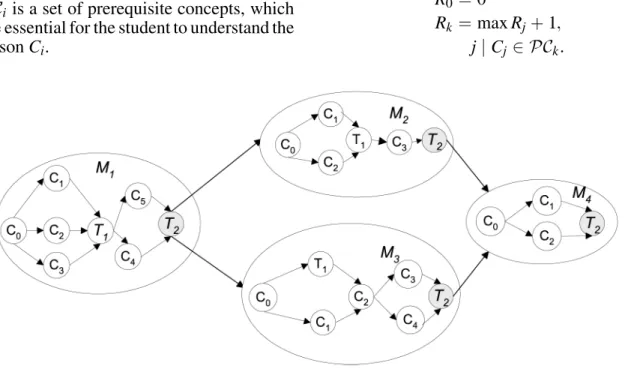
A domain model of the proposed AHS has a two-level structure and consists of concepts as elementary pieces of knowledge for the given learning domain(Fig. 1).
For the first domain level the AHS use the form of a graph(Ck LCk), whereCk is the set of con-cepts andLCk is the set of arcs,LCk CkCk. Links represent the prerequisite relationships
that denote pedagogical constraints, for ex-ample Ci Cj means “concept Ci should be learned before concept Cj”. The AHS
distin-guish between the lessons Ci and tests Tj as
the concepts or graph nodes. Tests contain the questions about the domain lessons.
A lessonCiis defined as a
(FCi PCi Qi Ri wci lMyi) where:
FCiis a set of multimedia fragments(small building blocks, e.g. a piece of text, graphics, sound, video clip:::).
PCi is a set of prerequisite concepts, which are essential for the student to understand the lessonCi.
Qi is a set of questions related to lessonCi. All questions are multiple-choice/ multiple-or-single-answer, so each question is defined as(FQ q A a B)where:
FQis the set of multimedia fragments that form the question.
qis the weight of the question or the con-fidence level of the fact that student ei-ther knows the lesson if he/she answers the question correctly, or does not know the lesson if he/she answers incorrectly, q2(0 1].
A is the set of offered answers. Each of-fered answer Aj is an ordered pair. The
first element is a set of multimedia frag-ments, or a function fj(p1 p2 ::: pn)that evaluates a candidate’s answer on the basis of parameters p1, p2,:::, pn. Function fj is defined in a scripting language and will be evaluated after the random generation of the parameters. The second element is vi, the value of the ith answer, which
can be positive (for correct answers) or negative. More obvious answers generally should have a smaller value.
Bis the set of lower and upper bounds for parametersp1,p2,:::,pn.
Riis the rank of the lessonCicalculated as
R0=0
Rk =maxRj+1 jjCj2PCk:
wciis the weight of the lesson,wci2(0 1). lMyi is the minimum acceptable knowledge
level for MYCIN model,lMyi 2(;1 1). A testTjis defined as a(PTj nj Nj Rj)where:
PTjis a set of prerequisite concepts-lessons,
PTj = fCi j Ci Tjg. Tj will contain the questions related to lessonsCi.
njis the total number of questions inTj.
Njis the set of configuration rules that spec-ify how many questions for each concept
Ci2PTjare placed into the testTj. Rjis the rank of the testTj.
To split the domain into more manageable units, concepts are grouped into modules Mk. The
second level of the domain model is a directed graphD = (M LM), whereM is the set of modules and LM is the set of arcs, LM
MM. The arc connecting modulesMk and Ml exists if Mk Ml. The directed graph D represents the class the student has enrolled. A moduleMkis defined as a(Ck PMk lmk Rk) where:
Ckis a set of concepts that create the module.
PMk is a set of prerequisite modules for moduleMk.
lmk is the minimum acceptable knowledge
for module,lmk 2(;1 1). Rkis the rank of the moduleMk.
The domain model distinguishes between the two kinds of tests: the mini-tests or quizzesTk
for modification of the navigation within the module, and one final testTf for the navigation
between the modules. The final test is the node with the highest rank in the graph(Ck LCk). The proposed representation for the domain structure is suitable for storing learning ma-terials from different areas(computer science, mathematics, medicine, art, etc.). The struc-ture of the knowledge is not necessarily hi-erarchical (chapters, subchapters, pages) but rather concept-oriented(Hoic-Bozic & Mornar, 2001a).
The pedagogical constraints between the lessons depend on the subject area. For example, for math lessons,Ci Cj usually means that it is impossible for a student to start learningCj if
he/she has not gained the knowledge ofCi. For some other subject areas, the prerequisite rela-tionships simply denote the sequence of learn-ing, proposed by the author. For the same set of lessons, another teacher may choose a com-pletely different learning sequence, i.e. prereq-uisite relationships.
3.2. Student Model
For the AHyCo system, a two-level student model as a variant of the overlay model( Brusi-lovsky, 1996) for representing the student’s knowledge is proposed. The first level repre-sents the estimate of students’ knowledge about the lessons. The second level represents the knowledge about the modules. For every lesson
Cithe main attributes recorded for each student
areriandki. For everyMkthe AHS is recorded
the knowledge value about modulekmk.
ri is the estimate about whether the student has
read the lesson Ci or not. ki is the estimate
about the student’s knowledge of the lessonCi
and is calculated using a variant of the MYCIN model, a widely used expert systems’ model
(Anjaneyulu 1997, Ng & Abramson, 1990). The knowledge value of a lesson is set by test-ing and can range from ;1 (student does not know the lesson) to 1 (student knows the les-son). Before the student takes any of the tests, all lessons in the student model have an initial value ofki =0.
After answering each test question related to lesson Ci, the new knowledge value k0
i for the
lesson Ci is calculated according to (1). The new valuek0
iis based on the previous knowledge
value ki and the factor q, the question weight
or the confidence level of the fact that the stu-dent knows or does not know the lesson. If the student answers the question correctly, f = q, otherwise f =;q.
k0
i = 8 <
:
ki+(1;ki)f ki >0 f >0
ki+(1+ki)f ki <0 f <0 (1)
(ki+f)=(1;min(jkij jfj)) otherwise
The model asymptotically increases/decreases the knowledge value with each correct/incorrect answer according to the previous knowledge value ki and the question weight q from the
The knowledge valuekmkof a moduleMkis set
according to(2).
kmk = X
jjC12Ck
kjwcj (2)
According to the formula, more important les-sons for the module (with higher weight wcj) have greater influence when calculating the knowledge levelkmk.
3.3. Adaptation Model
The adaptation model consists of adaptation rules that define how the domain model and the student model are combined to perform adaptive navigation support.
In our system, we employed the adaptive nav-igation, which is a combination of free(open) and guided (forced) navigation. The student can freely follow any hyperlink within a mod-ule or graph(Ck LCk), but a list of hyperlinks is offered that suit him best, according to the navi-gation plan generated for him. The AHyCo use the combination of link sorting and link annota-tion adaptive techniques. The navigaannota-tion within a graph(M LM)is restricted and depends on the student’s knowledge valuekmk.
According to the student model and currently displayed lessonCa, the concepts from module Mk are classified into several subsets: learned
concepts CLa, recommended concepts where all prerequisite concepts have been visitedCCa, and not recommended conceptsCNa. There are also completely recommended conceptsCPaor recommended concepts that are in direct pre-requisite relationship withCa.
ConceptsCi from the Ck of the module Mk are classified according to the algorithm 1:
Input: graph(Ck LCk), active lessonCa 2Ck
Output: setsCLa,CPa,CCa,CNa
CLa =,CPa=,CCa=,CNa = for eachCi 2CknfCag
ifri =true
/*Ciis visited */
CLa=CLafCig else ifCa Ci
ifrj =true 8Cj 2PCinfCag
/* all prerequisites forCiare
visited exceptCa–
Ciis completely recommended */
CPa =CPafCig else
/*Ciis not recommended */
CNa=CNafCig else ifrj =true 8Cj 2PCi
/* all prerequisites forCiare visited –Ciis recommended */
CCa =CCafCig else
/*Ciis not recommended */
CNa=CNafCig
Algorithm 1. Classifying the conceptsCi2Ck.
Navigation within the module Mk goes on
be-fore the student solves the final test Tf. This
navigation is actually the traversing of a directed graph (Ck LCk), following the hyperlinks sug-gested by the system on the bottom of the page. The model uses mini-tests or quizzesTjto check
the students’ knowledge and to correct the stu-dent model while he/she navigates within the module. Transition to another module is possi-ble after the successful completion of the final testTf (Hoic-Bozic & Mornar, 2001a). There are three possible outcomes of the test Tf
be-longing to the moduleMk:
Tf is completely passed — theMkis learned:
knowledge valuekmk >lmk andki >lMyi,
8Ci 2 Ck. The student can proceed to an-other module according to the directed graph
(M LM);
Tf is partially passed — the conceptsCiwith ki lMyi are offered for repetition but the
student can proceed to another module since thekmk >lmk;Mk is partially learned; Tk is not passed — kmk lmk the concepts Ci with ki lMyi from Mk are offered for
repetition and the student should retake the testTfin order to proceed to another module.
The student model is updated after the test Tj
has been solved according to the algorithm 2: Input: the student model,lmkandlMyifrom the
domain model, results of the testTj,Ci2PTj
use MYCIN for calculatingki
if9Ci2PTj,ki lMyi setrpi =1
Mk is partially learned
ifTj=Tf
/*Tjis final test forMk */ calculate valuekmkofMk
ifkmk >lmk Mkis learned
elseMkis partially learned
Algorithm 2.Updating the student model afterTj.
4. Implementation Issues
In the development of the AHyCo system we rely on the Microsoft .NET technology. ASP .NET provides a new server-side control ar-chitecture which facilitates the development of highly interactive web pages. It has an event-based programming model, making web devel-opment much more like traditional VB forms programming. An average ASP.NET page re-quires less code than an equivalent ASP page, which leads to greater developer productivity and better maintainability. ASP.NET pages are also compiled, so web servers running ASP.NET applications significantly exceed the perfor-mance and scalability levels of previous ASP applications(Anderson et al. 2001).
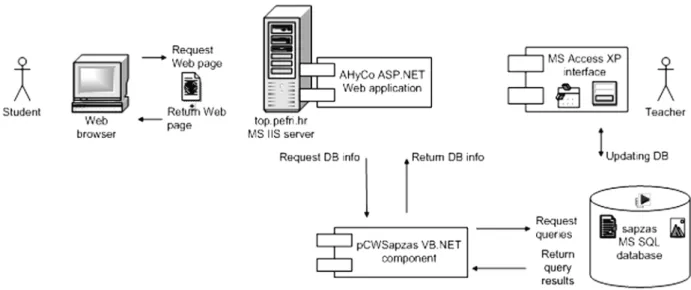
The AHyCo network application is based on the relational database management system. The system components(Fig. 2)are:
a) relational database b) authoring interface
c) midle-tier component for communication be-tween Web application and database
d) ASP.NET Web application.
4.1. Relational Database
All information about the subject matter and the students are stored in a Microsoft SQL Server 2000 database.
The main part of the database model is the learn-ing and testlearn-ing subschema. The formulas and smaller multimedia fragments of lessons and questions are stored in the database as binary ob-jects. Larger multimedia objects, such as video or audio clips, are stored in the file system, and are connected to the lessons by hyperlinks. For security reasons, the set of IP addresses that are allowed to access the system can be speci-fied.
4.2. Authoring Interface
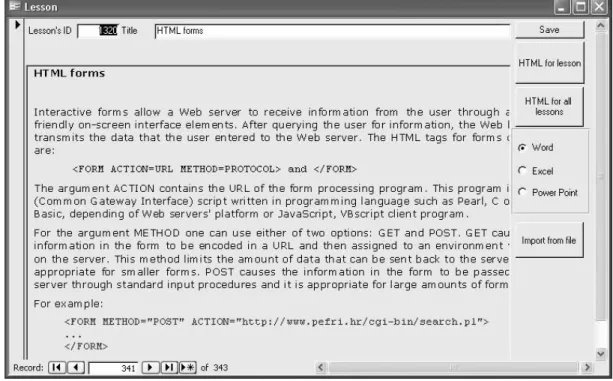
AHyCo system uses Microsoft Access forms as an interface for the authors. Because the lessons and the questions are stored in the database as Word objects, the author can use the familiar Microsoft Word application for updating. Word
is chosen because of its programming features: the fragmentsFCican be easily connected, up-dated and converted to HTML or PDF format. To enhance performance of the system and en-sure better scalability, the lessons and questions are also stored on the Web server as sets of HTML documents during the courseware prepa-ration phase.
The author names the lessons Ci and groups
them into modulesMk. The modules are grouped
into subjects. The prerequisite relationships beetween concepts and modules are defined.
The author should also determine the weight of the questions(q)and lessons (wcj) and the minimum acceptable knowledge level for each concept in the module(lMyi)and for modules themselves(lmk). This elements form the vari-able part of the adaptation rules.
In our system we separate the learning de-pendencies(prerequisite relationships)and the variable part of the adaptation rules from the actual content (multimedia fragments). This separation allows the authors to use the same set of fragments from a domain to build diverse courseware by simply defining new prerequisite relationships and values for the adaptation rules
(Hoic-Bozic & Mornar 2001a).
4.3. Middle-tier Component
The midle-tier component is responsible for communication between the Web application and the database. It contains the logic of the system — the rules for adaptation(Anderson et al. 2001).
To generate the pages, the system consults the middle-tier component. This component deter-mines which content will be shown next, ac-cording to the adaptation rules and informa-tion from the domain model and the student model. Based on the information returned from the middle-tier component, appropriate HTML fragments are composed together by the Web application that is responsible for displaying the lesson or test question simultaneously with the rest of the page(hyperlinks and buttons for nav-igation).
4.4. Web Application
The learning environment is implemented as a Microsoft ASP.NET C# web application. This is the only part of the system with which the students interact. They use the Web browser-based interface to the learning environment of the AHyCo courseware.
The web application needs to perform the fol-lowing tasks: login and validate the student, list subjects related to the student, display lessons’ content and navigational elements, display tests’ questions and submit the students’ answers, dis-play the test results.
Web pages presented to a student are gener-ated adaptively (on the fly) when the student requests them, based on the contents extracted from the database. There are three kinds of pages: lessons, questions and special pages
(e.g. login page, help, and test results page).
5. Authoring and Learning Environments
The system is composed of two environments: the authoring environment and the learning en-vironment. The authoring environment is used by teachers to define adaptive courseware ma-terials in various learning domains. The web-based learning environment allows the student to log in and study automatically generated courseware, which dynamically adapts accord-ing to his/her success in acquiring knowledge.
5.1. Authoring
Authoring is the crucial task in adaptive hy-permedia design. It includes the development of both the network of lessons and the tests. Before the courseware construction has started, the author should divide the subject matter into smaller parts(concepts or lessons). The lessons should be connected by prerequisite relations and grouped into modules.
The first authoring step includes creation of the set of hypermedia fragments FCi(text, image,
:::)that represent the content of the lessonCi
Fig. 3.MS Access form with Word OLE object that contains the text of a lesson.
During the authoring phase, the author sets the rules for adaptation by defining the prerequi-site graphs of concepts (C LC) and modules
(M LM). The graphs are created and con-nected by using a graphic editor with a drag-and-drop user interface(Fig 4.).
When defining the lessons in a module, the au-thor determines the weightwciof the lesson for
the particular module, as well as the minimum acceptable knowledge level for each lesson in the modulelMyi. When defining the test
ques-tions, the author defines the weight q of the questions for the associated lesson. Tests will
be created randomly, so explicit enumeration of questions is not necessary, only the structure of the test should be specified. For each module in a domain, the minimum knowledge levellmk
is set. Hence non-technical educators are able to use the adaptive features in a simple manner. The authors do not need to take into account any other adaptation rules, or to use any other tool. The authoring process is thus concentrated on the definition of prerequisites and on the estab-lishment of the difficulty level for lessons and tests. The responsibility for adaptive navigation remains on theAHyCo system (Hoic-Bozic & Mornar, 2001b).
5.2. Learning Environment
To use the AHyCo learning environment, a stu-dent has to log in.
After the process of authorization, the student has to choose the subject for learning. For the selected subjectD, the Web page containing the lessonCiis generated. This lesson is chosen in
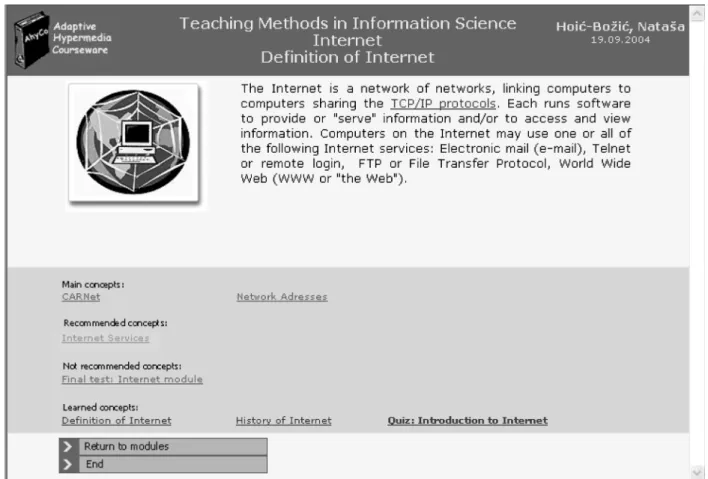
accordance with adaptation rules and the data stored in the student model, to correspond with the students’ previous knowledge. The upper part of the page(Fig. 5)is static and represents the content of a lesson.
At the bottom of the page, hyperlinks to the con-tinuation lessons or testsTjproposed by the
sys-tem are enumerated. The suggested hyperlinks are automatically generated before the page is shown and are annotated with various colors corresponding to concept types.
The concepts are listed in the following order:
Completely recommended or main concepts — green color annotates the concepts where all prerequisite concepts have been visited
and these concepts are the best continua-tion for Ci according to the directed graph
(Ck LCk).
Recommended concepts — orange color an-notates all other concepts where all prereq-uisite concepts have been read.
Not recommended concepts – red color an-notates the concepts where some of the pre-requisite concepts have not been read or the knowledge level of some prerequisite
ki lMyi.
Visited concepts — blue color annotates the lessons withri =trueorki>lMyi.
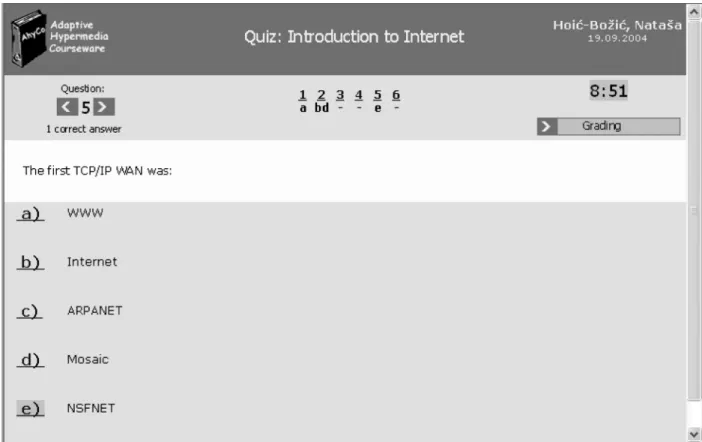
All the hyperlinks within the hypertext network are functional, so the student can follow any hy-perlink. The idea of free navigation is only to support and aid students. It is up to individual student if he/she will follow the system’s sug-gestions. After the student has finished learning of the module’s lessons, he/she should choose the final test button. Test questions(Fig. 6)and the sequence of the offered answers are gener-ated randomly.
Fig. 6.The question page.
Transition to another module is possible after the successful completion of a test Tf.
Out-comes of the tests by individual lessons are dis-played separately.
6. Using and Evaluating the AHyCo System
The AHyCo system is currently being used in teaching the students at the Faculty of Philoso-phy, University of Rijeka.
The purpose of this research was partly to ex-plore how the use of adaptive hypermedia sys-tem improves students’ learning and to find out the students’ attitude concerning the AHyCo us-age.
However, the main goal of the AHyCo system evaluation was to find out how the adaptation rules could be corrected according to the stu-dents’ results in gathering the knowledge. The system enables the diagnostic of the success in the adaptive courseware authoring. According to the students’ knowledge results, the teacher finds out possible shortcomings in the devel-oped learning materials. After that, the author
should correct the adaptation rules. In that way, the teachers – authors learn how to create and structure learning materials for use with AHyCo system in a better way.
A research has been conducted at the Depart-ment of Information Science, Faculty of Philos-ophy, Rijeka on 19 senior students of Informa-tion Science in the context of the class “Seminar on Teaching Methods in Information Science”. Part of the class’s subject matter has been pre-sented as six AHyCo modules. Each module has various number of concepts linked together with prerequisite relationships.
In the context of the class, the students, as future teachers in schools, learn how to use informa-tion and communicainforma-tion technology in educa-tion. So AHyCo system has been useful not only as a learning tool, but also as an example of using computer technology and new teaching methods.
connection to Croatian Academic Research Net-work(CARNet)or to their own home comput-ers.
After the students had finished learning with AHyCo, the evaluation of the system was per-formed according to their knowledge levels about the concepts(ki)and modules(kmk). Despite of the fact that the main purpose of the evaluation was not to show the level of students’ success in learning, we could mention that all the students accomplished the goal and success-fully solved the final testTf of the last module M6.
Actually, the main goal was to find out how to correct the variable part of the adaptation rules
(the question weightq, the lesson weight wci, the MYCIN levellMyi, the module level lmk) and to verify if the prerequisite relationships were correctly defined (prerequisite graphs of modules(M LM)and concepts(C LC)). Analyzing the basic statistic data (mean, me-dian, standard deviation, quartile values) and the correlation coefficients for ki and kmk, as
well as by cluster analysis, recommendations for the authors were proposed about the correc-tions of the adaptation rules.
In order to explore the students’ attitude con-cerning the AHyCo usage, the questionnaire about the effectiveness and quality of AHyCo and the level of students’ acceptance of AHyCo as a teaching resource was developed. Accord-ing to the questionnaire results, the students ac-cepted the new way of learning with AHyCo system. The main difficulty regarding the learn-ing conditions was in gainlearn-ing access to AHyCo courseware since computers at the Faculty were not available all the time.
7. Conclusion and Future Work
In this paper we have discussed the model and implementation of AHyCo system for develop-ment and distribution of the adaptive Web-based courseware. The navigation model is based on adaptive lessons sequencing and adaptive navi-gation support techniques. To accomplish a trade-off between free and guided navigation, the list of suggested hyperlinks is offered at the
bottom of the page, in the optimal order gen-erated by the system. However, a student is allowed to follow any of them.
In order to verify the results, the sample course-ware was generated at the Department of Com-puter Science, Faculty of Philosophy, Rijeka. The main purpose of the evaluation was to find out how adaptation rules could be corrected ac-cording to the students’ knowledge levels about the concepts and modules.
According to the results of statistical analysis, recommendations for authors have been pro-posed with regard to correction of adaptation rules and improvement of prerequisite graphs. In the further development of this research, the developed AHyCo system will be improved based on the results obtained during the devel-opment and evaluation. We will modify the sample AHyCo courseware according to the proposed rules and verify the new version on the next generation of students.
References
1] AHyCo Home Page (in Croatian), (2003), http://AHyCo.zpm.fer.hr/
2] R. ANDERSON ET AL.ASP.NET, Wrox Press,
Birm-ingham, 2001.
3] K. ANJANEYULU, Concept Level Modelling on the
WWW”, Proceedings of the AI-ED 97 8th World Conference on Artificial Intelligence in Education, Knowledge and Media in Learning Systems,(1997),
Kobe, Japan.
4] P. BRUSILOVSKY, L. PESIN, ISIS-Tutor: an
intelli-gent learning environment for CDS/ISIS users, Pro-ceedings of the interdisciplinary workshop on com-plex learning in computer environments(CLCE’94), (1994), Joensuu, Finland.
5] P. BRUSILOVSKY, Methods and Techniques of
Adap-tive Hypermedia,User Modeling and User-Adapted Interaction, 6(1996), pp. 87–129.
6] P. BRUSILOVSKY, E. SCHWARZ, G. WEBER,
ELM-ART: an intelligent tutoring system on World Wide Web,Proceedings of the Third International Con-ference on Intelligent Tutoring Systems ITS’96,
(1996), Montreal, Canada.
7] P. BRUSILOVSKY, Adaptive and intelligent
technolo-gies for Web-based Education, K¨unstliche Intel-ligenz, Special issue on intelligent systems and teleteaching, 4(1999), pp. 19–25.
8] A.C. CARVER, J.M.D. HILL, U.W. POOCH, Third
9] D.P. DASILVA, Concepts and documents for adaptive
educational hypermedia: a model and a prototype,
Proceedings of the 2nd Workshop on Adaptive Hy-pertext and Hypermedia HYPERTEXT’98,(1998),
Pittsburgh, USA.
10] P. DEBRA, J.P. RUITER, AHA! Adaptive
hyperme-dia for all,Proceedings of the WebNet Conference,
(2001), Orlando, Florida.
11] P. DEBRA ET AL. AHA! The Adaptive Hypermedia
Architecture, Proceedings of the ACM Hypertext Conference,(2003), Nottingham, UK.
12] J. EKLUND, P. BRUSILOVSKY, Individualising
in-teraction in Web-based instructional systems in higher education, Presented at The Apple Univer-sity Consortium’s Academic Conference, (1998),
Melbourne, Australia.
13] N. HENZE, W. NEJDL, Extendible adaptive
hyper-media courseware: Integrating different courses and Web material,Proceedings of Adaptive Hypermedia and Adaptive Web-Based Systems AH 2000,(2000),
Trento, Italy.
14] N. HOIC´-BOˇZIC´, V. MORNAR, An Approach to
Navi-gation Support in Adaptive Educational Hypermedia System, Proceedings of Multimedia and Hyper-media Systems Conference MIPRO 2001, (2001),
Opatija, Croatia.
15] N. HOIC´-BOˇZIC´, V. MORNAR, Navigation Support
in a Web-Based Adaptive Educational Hyperme-dia System, Proceedings of AMCIS 2001,(2001),
Boston, Massachusetts.
16] N. HOIC´-BOˇZIC´, V. MORNAR, An approach to
adap-tive hypermedia courseware authoring,Proceedings of Hypermedia and Grid Systems, MIPRO 2003,
(2003), Opatija, Croatia.
17] R. H ¨UBSCHER, Logically Optimal Curriculum
Se-quences for Adaptive Hypermedia Systems, Pro-ceedings of Adaptive Hypermedia and Adaptive Web-Based Systems AH 2000,(2000), Trento, Italy.
18] A. KAVCIC,Adaptation in Web-Based Educational
Hypermedia With Regard to the Uncertainty of User Knowledge(Ph.D. Thesis, in Slovenian), Ljubljana,
Slovenia: Faculty of computer and information science, University of Ljubljana, 2001.
19] H. MAURER, N. SCHERBAKOV,Multimedia
author-ing for presentation and education: the official guide to HM-Card, Addison-Wesley, Bonn, 1996.
20] K. NAKABAYASHI, Architecture of an intelligent
tu-toring system on the WWW, Proceedings of the 8th World Conference of the AIED Society,(1997),
Kobe, Japan.
21] K. NG, B. ABRAMSON, Uncertainty Management in
Expert Systems,IEEE Expert,2(1990), pp. 29–47.
22] M. SPECHT, M. KRAVCIK, L. PESIN, R. KLEMKE,
Authoring Adaptive Educational Hypermedia in WINDS,Proceedings of ABIS2001,(2001),
Dort-mund, Germany.
23] J. VASSILEVA, Dynamic course generation on the
WWW,Proceedings of AI-ED 97- 8th World Confer-ence on Artificial Intelligence in Education,(1997),
Kobe, Japan.
24] G. WEBER, H.C. KUHL, S. WEIBELZAHL,
Develop-ing adaptive internet-based courses with the au-thoring system NetCoach, Proceedings of Third Workshop on Adaptive Hypertext and Hypermedia,
(2001), Sonthofen, Germany.
Received:October, 2002
Revised:February, 2005
Accepted:May, 2005
Contact address:
Natasa Hoic-Bozic Department of Information Science Faculty of Philosophy University of Rijeka Omladinska 14 HR-51000 Rijeka Croatia e-mail:[email protected] Vedran Mornar Department of Applied Mathematics Faculty of Electrical Engineering and Computing University of Zagreb Unska 3 HR-10000 Zagreb Croatia e-mail:[email protected]
NATASAHOIC-BOZICis an assistant professor at the Department of In-formation Science, Faculty of Philosophy, University of Rijeka. She received Ph.D. degree in computer science from the Faculty of Electrical Engineering and Computing, University of Zagreb, Croatia. Her main research interests include information and communication technology
(especially hypermedia and Internet)in education. She participated in several research projects in the field of e-learning.