BY
KATHERINE SCHULTZ
A paper presented to the faculty of The University of North Carolina at Chapel Hill in partial fulfillment of the requirements for the degree of Master of Public Health in the
Department of Maternal and Child Health Chapel Hill, NC
March 30, 2015
Approved by:
Table of Contents
ABSTRACT 3
RECOGNITION OF AUTHORSHIP 4
ACRONYMS & ABBREVIATIONS 5
INTRODUCTION 6
PROBLEM STATEMENT 6
REVIEW OF THE LITERATURE 9
THE HIV/AIDSCONTINUUM OF CARE 9
HIV/AIDS AND AFRICAN AMERICANS 13
HIV/AIDS AND WOMEN OF COLOR 14
HIV/AIDS IN THE SOUTH 15
THE BIOPSYCHOSOCIAL MODEL AND INTERSECTIONALITY PARADIGM 20
BIOPSYCHOSOCIAL NEEDS 22
NURSE-GUIDED PATIENT NAVIGATION PROGRAMS 25
OBJECTIVES 26
METHODS 27
RESULTS 29
DISCUSSION 40
CONCLUSIONS 45
ACKNOWLEDGEMENTS 46
APPENDICES 47
APPENDIXA:INTERVIEWGUIDE 47
REFERENCES 54
ABSTRACT
Objectives: To examine the biopsychosocial needs of HIV-positive African American women in a nurse-guided patient navigation program and make recommendations for future programs.
Methods: Twenty-one in-depth, semi-structured interviews were conducted with a sample of women from the Guide to Healing (G2H) patient navigation program. The biopsychosocial model and intersectionality paradigm were used as analytical
frameworks. Qualitative narrative analysis was used to analyze key patterns and themes. Results: Women expressed high levels of psychological and subsistence needs, but showed optimism when considering their future. The Nurse Guide was highly regarded and provided emotional support, ultimately encouraging retention in care.
Conclusions: Patient navigation programs using qualified nurses as guides are a
promising intervention for HIV-positive women of color. Recommendations for future programs include offering more opportunities for mental health care, providing assistance with basic needs, and creating patient navigation programs based on the biopsychosocial model and intersectionality paradigm. Further research on how stress from caretaking affects women’s health is recommended.
ACRONYMS & ABBREVIATIONS
AIDS Acquired immunodeficiency syndrome ACA Patient Protection and Affordable Care Act ART Antiretroviral therapy
CD4 CD4 T lymphocyte
CDC Center for Disease Control and Prevention DHHS Department of Health and Human Services HIV Human immunodeficiency virus
HRSA Health Resources and Services Administration IPV Intimate partner violence
NCDPH North Carolina Division of Public Health
NHAS National HIV/AIDS Strategy
NHHS National HIV Surveillance System ONAP Office of National AIDS Policy PLWHA People living with HIV/AIDS
RNA Ribonucleic acid
STI Sexually transmitted infections
WHO World Health Organization
INTRODUCTION
This research is a qualitative examination of 21 semi-structured, in-depth interviews conducted with HIV-positive African American women participating in a nurse-guided patient navigation program. The interviews were originally analyzed by Sullivan et al., (2014) as an evaluation of the patient navigation program, made possible by a grant from the US Department of Health and Human Service (please see
Recognition of Authorship and Acknowledgements). This manuscript differs from that of Sullivan et al., by expressly analyzing the complex physical, emotional, and
psychological needs of the women in the program, rather than evaluating the program itself.
PROBLEM STATEMENT
In the United States, HIV is no longer the virtual death sentence it was at the height of the epidemic. Thanks to combination antiretroviral therapy (ART), life
expectancy for many HIV-positive adults now approaches that of uninfected individuals (1). As a result of these medical advances, HIV largely has changed from an acute, life-threatening disease to a chronic one (2). However, HIV remains a major public health concern in the US. Each year, there are roughly 50,000 new diagnoses of HIV reported (3), and the Centers for Disease Control and Prevention (CDC) estimates that there are currently 1.2 million people living with HIV/AIDS (PLWHA) in the US (3).
HIV also continues to disproportionately affect certain racial and ethnic minorities, particularly non-Hispanic African Americans/Blacksa
(4). Minorities have the highest
prevalence of HIV infection in the US (3). From 2008 to 2012, the rate of HIV infection among African Americans in the US was 58.3 per 100,000 population, eight times the infection rate of non-Hispanic Whitesb
(4). The disparities in HIV diagnosis rates
between minorities and Whites are even more striking when considering the composition of the US population. African Americans made up about 13% of the population in 2010, but accounted for 44% of all new HIV infections (4). When compared with HIV-infected Whites, African Americans also experience worse health outcomes, including greater losses of life (4,5). Life expectancies for HIV-positive African Americans continue to lag behind HIV-positive Whites (1).
There is recent evidence that suggests rates of HIV infection are slowing among women of color (WOC) (6), but racial disparities in HIV infection among women remain pronounced. In 2012, the rate of HIV infection among African American women in the US was nearly 20 times the rate of White women (4). African American heterosexual women as a group were more affected by new HIV infections in 2010 than African American heterosexual men, heterosexual women of all other races, and intravenous drug users (7).
In light of the aforementioned disparities, the White House and the Office of National AIDS Policy (ONAP) have made it a priority to reduce HIV-related health inequalities in the US (8). In order to prevent new infections in disproportionately affected communities, the National HIV/AIDS Strategy (NHAS) focuses on intensifying prevention efforts among African Americans. NHAS recognizes the importance of increasing access to consistent, quality health care for PLWHA.
Adhering to medical appointments and treatment plans is necessary to achieve optimal health outcomes (9–16), but such adherence is often contingent upon meeting necessary psychosocial needs. Safe housing, reliable transportation, freedom from hunger, a good provider-patient relationship, and social support, among others things, are vital for PLWHA seeking to maintain their health (17). Psychosocial needs are often most pressing for certain groups of PLWHA, particularly racial and ethnic minorities, women, the poor, and those living in the American South (18–21). Health care providers and public health professionals must support the physical, psychological, and social needs of PLWHA in order to ensure patients’ adherence to care and good health. Supportive measures can include increased coordination on HIV programs between federal, state, and local governments, innovative health care service models, and effective community-based approaches to prevention and treatment (8).
REVIEW OF THE LITERATURE
THE HIV/AIDSCONTINUUM OF CARE
Over the years, ART regimens have become less complicated and cause fewer adverse side effects (15). ART works by inhibiting the replication of the HIV virus, thus reducing the amount of HIV RNA in the blood, the viral load, to an undetectable level (22). Viral loads and CD4 levels are used to monitor the progression of HIV disease in an individual, and their response to ART (22). In the earlier years of the HIV epidemic, PLWHA often did not start ART until their CD4 counts were below 200 cells per cubic millimeter (23), leaving them vulnerable to AIDS-related opportunistic infections and death. However, evidence has shown that earlier ART initiation at higher CD4 counts, along with counseling and education on safe sex, can prevent both AIDS-related morbidity and mortality and HIV transmission (23–25).
The World Health Organization (WHO) and the US Department of Health and Human Services (DHHS) recommend that ART be used to prevent disease progression in all HIV-positive individuals and endorse early initiation of ART (22,26). There is strong evidence of the benefits of starting ART when CD4 counts drop below 350 cells/mm3
(27–29), and a growing body of research that supports starting ART at CD4 counts above 350 cells/mm3
(24,30,31), and above 500 cells/mm3
(32). However, prevention of both illnesses and transmission is highly dependent upon an individual’s adherence to the treatment plan(33) and the decision to start ART should always include a consideration of an individual’s health, life situation, and willingness to begin treatment (22).
ART is crucial in preventing clinical complications and HIV transmission, but medical care, counseling, and education on reducing high-risk behavior are vitally important as well (24). The WHO states that ART should be used within “a broad continuum of care”(26). The HIV/AIDS continuum of care is a model of health care service delivery and consists of the following steps: diagnosis, linkage to medical care, and retention in medical care, which includes the receipt of and adherence to ART (Fig. 1) (14,15,36,37). The continuum of care can also be used to identify the gaps and discrepancies that exist in linking PLWHA to regular medical care and ART (36). Measuring retention in care is complicated, and there is not yet a standardized definition of retention (38,39). In the literature, the measurement of retention in medical care may vary (39,40).
Therefore, expert guidelines are helpful in defining retention in care. The DHHS and HIV Medicine Association of Infectious Diseases Society of America recommend viral load monitoring at least every 3-4 months during the first 2 years of ART, with monitoring extended to every 6 months for those with 2 years of consistent viral suppression (22). The viral load testing is presumed to represent a medical care visit. The Health Resources and Services Administration’s (HRSA) HIV/AIDS Bureau (HAB) has defined the percentage of PLWHA who had at least one medical visit in each 6-month period over a 24-6-month measurement period with at least 60 days between visits as a core performance measure (41).
promotion to the individual patient (42). The first year of care is a particularly vulnerable time, and linkage to care and visit adherence during this period is crucial for health outcomes. Non-adherence to appointments was a significant predictor of lower CD4 counts and detectable viral loads (12,43). Missed visits may also delay initiation of ART, leading to worse health outcomes in the interim (14). Missed visits in an individual’s first year in care are also strongly associated with increased mortality (44,45). Any missed visit has been associated with a 69% increase in the risk for death, with a 12% increase for each subsequent missed visit (45). Even missing visits for as few as three months in the first year of ART predicts poorer survival rates (12). PLWHA who miss appointments or fall out of regular medical care must be re-engaged in care (14).
Figure 1. Steps in the HIV/AIDS Continuum of Care. Reprinted from Mugavero et al., (2011)(37), with permission from Oxford University Press.
Figure 2. Health Resources and Services Administration, HIV/AIDS Bureau, continuum of engagement in HIV care. Reprinted from Cheever (2007)(10), with permission from Oxford University Press.
having had at least one HIV medical care visit from January 2011 through April 2011. The high number of PLWHA who are neither in care nor virally suppressed indicate that there are many missed opportunities along the continuum to improve health outcomes. In 2013, an executive order from President Barack Obama addressed these missed opportunities and prioritized the continuum of care by establishing the HIV Care Continuum Initiative (46). Among other things, the Continuum Initiative encourages innovative approaches that increase access to HIV testing and treatment and promotes implementation of effective, evidence-based health care service delivery models. Similar to NHAS, the Continuum Initiative places special emphasis on developing interventions that target the populations most vulnerable to HIV infection.
HIV/AIDS AND AFRICAN AMERICANS
Significant racial and ethnic disparities exist along the continuum of care for HIV-positive African Americans. Data from the NHSS has consistently shown that Whites are better linked to care (11), retained in care (40,47,48), and virally suppressed (3) than African Americans. Non-Hispanic Black race was significantly associated with more missed appointments (40,45,49–51), putting African Americans at greater risk for AIDS-related morbidity and mortality. Even when in medical care, African Americans were less likely to initiate ART (52,53), and more likely to experience virologic failure while on ART (≥50 viral copies/milliliter) when compared to Whites (49).
ART later, and were less likely to receive ART than Whites. Women were less likely to initiate ART than men. Yet even after multivariate adjustment for ART uptake and despite presenting at earlier HIV stages, women had an increased risk for death when compared to men. The results from this study suggest that racial and/or sexual disparities can exist not just in access to care, but also in receiving treatment.
HIV/AIDS AND WOMEN OF COLOR
Disparities in HIV infection and along the continuum of care have a huge effect on WOC. In 2012, the rate of HIV infection among African American women in the US was 37.8 per 100,000 population, while the infection rate for White women was only 1.9 (4) . WOC represented 83% of new HIV diagnoses in women in 2012. Approximately 64% of the diagnoses were African American women, and the majority of those women contracted HIV through heterosexual transmission (4). African American women have an estimated lifetime risk of 1 in 30 for receiving an HIV diagnosis, while White women have a 1 in 588 risk (54). Research estimating loss of life among PLWHA found that African American women experienced an 83% greater loss in life expectancy than White women (5).
and that racial and ethnic minorities from the American South were the most vulnerable group overall to HIV and AIDS-related morbidity (53).
HIV/AIDS IN THE SOUTH
The American South, defined as 16 states and the District of Columbia (56), is disproportionately affected by a high incidence and prevalence of HIV/AIDS (57,58). The South also has some of the worst health outcomes for HIV-positive people of color in the US (53,59,60). Statistics on HIV case-fatality rates deaths in thirty-seven states showed that 9 of the 10 states with the highest case-fatality rates were in the South (59). Significant factors associated with increased case-fatality rates include non-Hispanic Black race and female sex (59). The South had the lowest three-year survival rate for those diagnosed with HIV between 2002 and 2006 of any geographic region in the US (60). Among all African American individuals with HIV, three-year survival rates are the lowest in the South (60).
11 times greater than the rate of 2.2 among White women. This represents the largest racial disparity between any group in North Carolina, including between African American and White males. The proportion of newly diagnosed African American women in North Carolina who presented with either late-stage HIV or AIDS in 2012 was three times higher than the proportion of White women who did so.
Multiple, complex causes drive HIV-related racial disparities in the South. In 2003, the Southern States Manifesto identified factors unique to the South that influenced the regional spread of HIV (62). Among those factors were inadequate federal funding for vulnerable populations to obtain ART; poor health infrastructure in a largely rural region; too few trained providers; a lack of stable housing, transportation, and supportive services; higher rates of sexually transmitted infections (STIs); greater stigma against PLWHA; and a high percentage of impoverished and uninsured citizens. Nine years later, an update found that some things, such as an increased potential for greater access to health care through the Patient Protection and Affordable Care Act (ACA) and a federal HIV funding structure that now takes into account living HIV cases and not just historic AIDS data, had improved (21). However, the update acknowledged that the South continues to face disproportionate challenges in controlling HIV that are fueled by the aforementioned socio-cultural determinants.
One cannot discuss HIV disparities in the United States without first
discrimination found in the US, along with associated low educational attainment, unemployment, poverty, lack of health care secondary to insurance status, unstable housing, and substance abuse can be referred to as “structural violence” (63). The author will examine the effects of such structural violence on HIV-positive WOC in the US in the following paragraphs.
It is important to examine heterosexual HIV transmission within the
aforementioned socio-cultural context of the South. There is strong evidence that parents in the South support comprehensive sexual education, including information on HIV prevention (64,65). However, although most states now mandate sexual education and HIV prevention be taught in schools, only 13 states require that information be medically accurate and 27 states require that abstinence be stressed in HIV prevention (66). Almost all of the Southern states, including North Carolina, require that schools stress abstinence in HIV prevention.
Research suggests that the presence of ulcerative and inflammatory sexually transmitted infections (STIs) increase both the risk of transmitting and contracting HIV (67,68). During unprotected heterosexual activity, women also have a higher biological risk for contracting HIV than men (69). African Americans are disproportionately affected by STIs, both nationally and in North Carolina (61,70). Therefore, it is not surprising that the high rates of STIs in the South (61,71), combined with the lack of comprehensive sexual education in schools, facilitate the spread of HIV among WOC.
exacerbate the spread of STIs, including HIV (72). Many communities in the US remain highly segregated, reinforced by real estate practices, such as redlining, and white flight (73). A segregated neighborhood can limit the choice of sexual partners, contributing to dense sexual networks that increase HIV transmission risk (7). The choice of sexual partners may also be influenced by institutionalized racism, as demonstrated by disproportionately high rates of incarceration/jailing and/or mortality rates among African American men (63,74–76), resulting in a ratio of fewer males to females in certain communities (77). Incarceration has also been associated with concurrent sexual relationships and HIV transmission (78,79). In the rural South, differential sex ratios may also be influenced by the selective migration of African American males to urban areas in search of more economic opportunity (72).
Fewer eligible male partners can contribute to a lower perceived power among African American women in choosing and negotiating their relationships (80,81). A case-control study of African Americans in North Carolina attempted to identify characteristics associated with HIV infection (82). Researchers found that certain high-risk traits, such as a history of STIs or unprotected sex with multiple partners, were indeed associated with HIV infection. However, more than 25% of cases denied high-risk traits. For these individuals, HIV infection was associated with low household income, low educational attainment, and food insecurity, indicating that poverty plays an important role in disease transmission.
Poverty and lack of economic opportunity put both people of color and
highest percentage of individuals without health insurance (83). Nationally, African American households had the lowest median household income, the highest poverty rate, and the second highest percentage of uninsured individuals of any other racial or ethnic group (83). There are also gender differences in national poverty levels, with women, particularly those over age 65, experiencing higher rates of poverty than men.
Residential segregation plays a role in economic disparities by concentrating poverty in minority neighborhoods (84). Evidence suggests that the physical and economic isolation of people of color reduces their access to quality care and increases their exposure to unhealthy environments, resulting in adverse health outcomes (84,85).
Changes to national health policies have attempted to mitigate disparities in medical care and health outcomes. The ACA made it illegal to deny insurance to those with pre-existing health conditions, established high-risk pools for individuals with chronic illnesses, created marketplaces and tax credits to assist previously uninsured or under-insured individuals in purchasing better coverage, and expanded Medicaid to those within 133% of the federal poverty level (8). These changes have the potential to
significantly improve health outcomes for PLWHA in the South, but the current political environment is proving inhospitable for parts of the ACA. In 2012, the Supreme Court upheld a challenge to the constitutionality of the ACA’s Medicaid expansion and 23 states have not yet expanded Medicaid as of December 2014 (86,87).
ACA. These individuals fell into a ‘coverage gap’ and remain uninsured. It’s estimated that 5.7 million Americans will remain uninsured in 2016 without the Medicaid
expansion (89). The South has been particularly hard hit, as it contains the majority of the states that declined to expand Medicaid. In 2014, it was estimated that 3.8 million Southerners who would have received insurance coverage through the Medicaid
expansion instead fell into a cover gap (90). This represented 80% of the total uninsured individuals in the US at that time. The missed opportunity to expand Medicaid in areas of the US most affected by HIV means that PLWHA in the South will continue to have sub-optimal access to care and worse health outcomes.
PLWHA in the South, regardless of their insurance status, require specialized treatment and medical providers (91), yet the South has less access to quality health care services and fewer expert providers than other parts of the country (74,92). Even for PLWHA in regular care, there is evidence of racial and sexual disparities in the receipt of ART and in outcomes(52). The provider-patient relationship is incredibly important for PLWHA (93). Distrust of health care providers is a barrier to accessing care for
PLWHA, while a trusting relationship is associated with better adherence to visits and ART, fewer emergency room visits, and improved health outcomes(94).
THE BIOPSYCHOSOCIAL MODEL AND INTERSECTIONALITY PARADIGM
common psychosocial needs of PLWHA as “physical, psychological, social and spiritual” problems: struggles with mental health; fear of stigma or reprisals from their family, friends, and community; a lack of social support; medical co-morbidities; and financial concerns (17). Further development of the biopsychosocial model has focused on changing the medical providers’ attitude from clinical detachment to “reflective participation, thus infusing [patient] care with greater warmth and caring” (96).
The biopsychosocial model is also helpful for medical and social science researchers. It can serve as a bridge between the traditional biomedical model and the innovative theoretical paradigm of intersectionality (97). African American feminist scholars originally developed intersectionality theory to combat the marginalization they felt from both White feminists and male African American civil rights activists (98). Intersectionality emerged as a way to examine how multiple social identities, such as race, gender, and class, intersect and contribute to inequities and social injustice (98). The intersectionality paradigm observes that historically marginalized groups experience greater inequities (97) and theorizes that an individual’s life and health status are more than just the sum of their parts (99). For example, the social inequities and associated health impacts experienced by an African American woman are different from those experienced by a White woman, just as the inequities and health impacts experienced by a White woman are different from those experienced by a White man. The benefit of using intersectionality as a research framework is that it allows not just for the
inequality is inherent in HIV transmission and worse HIV-related outcomes, so it is logical to examine the experiences of HIV-positive WOC from an intersectional
viewpoint. Intersectionality is also useful as a framework in nursing research, a field that has in the past been dominated by a white, middle-class perspective (101). Since this research is concerned with both health disparities and nursing practice, the author will use the intersectionality paradigm as a theoretical framework for discussion.
BIOPSYCHOSOCIAL NEEDS
Practitioners who use the biopsychosocial model to address the psychological and social needs of their HIV-positive patients can improve individuals’ quality of life, produce better treatment adherence, and reduce the potential for further disease
transmission (17). Needs that remain unaddressed can act as barriers to care and health. The life experiences of HIV-positive women are unique and their multiple, complex needs require careful consideration in order to provide appropriate care (18–20).
Mental health problems are prevalent among PLWHA (20,102). There is evidence that HIV-positive women experience more depressive symptoms than men (103,104), and there are strong associations between depression and substance abuse (103). Depression has been identified as a barrier to HIV testing, entry to care, and engagement in care for HIV-positive WOC (93,105). Symptoms of depression have also been linked with lower access to care, missed appointments, and less social support (103) and higher rates of ART discontinuation among WOC (106). Depression has the
Mental health treatment needs extend beyond depression for many PLWHA. Trauma and stressful life events, including childhood sexual and physical abuse, are sadly common in this population (108–111). Serious stressors, like experiencing a physical assault or the death of a loved one, are associated with ART non-adherence and virologic failure (108). However, less intense but more frequent stressful events also have the ability to disrupt a patient’s life and engagement in care (108). Treating stressful life events may help PLWHA cope better with their disease. Social support throughout the disease process is often expressed as a need by PLWHA (112), particularly by women (93,113). Unsurprisingly, HIV-related stigma or fear of stigma, acts as barrier to accessing care (114). Social rejection and HIV-related stigma were related to decreased ART adherence (115) and engagement in care(116).
Greater gender equality is a universal need for HIV-positive women (117,118). The SAVA syndemic refers to the co-occurring and mutually reinforcing epidemics of intimate partner violence (IPV), substance abuse, and HIV infection found among impoverished women (119). Besides the obvious dangers of IPV and substance abuse, SAVA has been associated with depressive symptoms (120) and worse HIV-related health outcomes(121). Abused women are less likely to use ART (122), may be afraid to disclose their HIV status or to negotiate safe sex with their partners (118), and may be unable to leave their abusers due to financial constraints (117).
their disease (123). Poverty, especially hunger, was a greater predictor of non-adherence to ART than depression, internalized stigma, or other social stressors (124). Finding reliable transportation to appointments is a frequently cited need for many PLWAH in the South (92,114), an area that lacks the public transportation options found in other areas of the country (38). Ancillary services, such as assistance with housing and transportation, are associated with entry to and retention in care for vulnerable sub-populations of PLWHA (107).
PLWHA have a need to access expert medical care, and the organizational structure of a clinic can facilitate that need. Things like flexible scheduling, extended appointment hours, co-located services, a good provider-patient relationship and brief but comprehensive visits are important to PLWHA (93,114). Especially in rural areas, the need for quality medical care to address physical co-morbidities beyond HIV was noted (92). There is also a need for culturally sensitive medical care (126), especially among HIV-positive WOC, who may feel they are treated differently because of race or gender.
NURSE-GUIDED PATIENT NAVIGATION PROGRAMS
As HIV care in the US has shifted from acute, inpatient care to outpatient chronic disease management, patient navigation is an appealing option to improve health
outcomes for PLWHA (15,116,127). Patient navigation utilizes the guidance and support of health care workers to promote linkage to care and retention and re-engagement in care (128). It is a patient-centered health care service delivery model that integrates medical care, often for populations vulnerable to poor health outcomes because of health
disparities (129). Patient navigation was first used in New York City in 1990 for women with breast cancer, many of whom were African American and of low socioeconomic status (129). Patient navigation eliminated barriers to medical care and improved health outcomes for these women. It can be used at any point that patients access health care, from disease prevention to diagnosis to treatment. Since then, patient navigation has been used to improve health outcomes for a variety of diseases, including HIV (127,130,131)
Patient navigation’s focus on reducing barriers to care can be especially helpful for HIV-positive WOC (37,93,114,130). Patient navigators may be HIV-infected peers or lay health workers whose socio-cultural backgrounds are similar to patients (37). Social workers or nurses may also be navigators depending on the level of skills needed at the given phase of navigation (129). One advantage of using a nurse as a navigator is the ability to provide enhanced patient support proportionate to a higher level of
education (131). Nurses are trained in assessing patients’ needs and providing
nurse-guided patient navigation program indicated high levels of satisfaction with the care received (132).
Several studies have examined the efficacy of patient navigation for PLWHA, but there is little published research on navigation for HIV-positive WOC, with the exception of previous work by Sullivan et al (133). Navigation by lay health workers was linked to reduced barriers to care, significantly improved viral loads, and increased engagement with providers and utilization of HIV primary care in four separate HRSA-funded interventions (130). Peer navigators for HIV-positive individuals returning to their community after jail time demonstrated successful assistance with the transition and social services engagement (131). Advanced practice nurses acting as navigators for HIV-positive individuals with serious mental illness demonstrated a significant reduction in viral loads (134,135).
OBJECTIVES
This paper examines self-reported psychosocial needs of HIV-positive African
American women currently in medical care, with an aim to make recommendations that
could improve health care service delivery, retention in care, and ultimately, quality of
life for these women.
This is a qualitative analysis of interviews conducted among a sample of women
from the Guide to Healing (G2H) program. G2H was originally funded from 2009-2014
as part of HRSA’s Special Projects of National Significance (SPNS) Enhancing Access
for Women of Color Initiative (HRSA). The G2H program’s goal was to retain
experienced registered nurse, known as a ‘Nurse Guide’. G2H program interventions
included rapid linkage to care, structural support in the form of transportation assistance
and cell phones, and a weekly support group. The Nurse Guide also had experience in
mental health. Patient navigation services were provided for up to eight months for each
woman.
G2H is based on the self-determination theory of behavior change (136). This
theoretical model has been used to help with lifestyle changes (137), and posits that
sustainable behavioral change can only occur when the motivation to change is intrinsic
and an individual feels autonomous, competent and connected within a social network.
The Nurse Guide provides support in attaining these core needs through an orientation to
care, patient education, regular phone contacts, care coordination, and counseling with a
strengths-based perspective.
The Guide to Healing Program was implemented at the Infectious Disease Clinic
at the UNC Health Care System in Chapel Hill, NC, beginning in January 2011. The
clinic is an academic, hospital-based facility that provided care to over 1,700 PLWHA in
2010, the majority of whom were people of color.
METHODS
Study participants
The study participants were selected from all women enrolled in the G2H
program. The study sample was purposefully constructed to represent the larger program
population. To be eligible for the study, women had to have one or more contacts (either
her at least 8 months prior to study recruitment to allow for the full intervention period.
After an initial screening for eligibility, research personnel contacted 36 women
by phone. Of those women, staff were unable to reach 14 (39%), one (3%) refused to
participate, and 21 (58%) agreed to participate and were consented. Members of the Duke
University evaluation team conducted semi-structured, in-depth interviews. The study
received Institutional Review Board approval from both Duke University and the
University of North Carolina at Chapel Hill.
Interview tool development
The research team, nurse guide, and clinic providers developed questions for the
semi-structured interview. Questions focused on experiences with the nurse guide, as
well as the study participants’ background and experiences with medical care and
providers (please see Appendix A for interview guide). The interview guide was first
piloted with three G2H participants, with minor revisions made for clarity.
Data collection
Twenty-one semi-structured, in-depth interviews were conducted over the phone.
Prior to beginning the interview, informed consent was obtained verbally by research
staff. All interviews were digitally recorded and ranged from thirty to sixty minutes.
Data analysis
Participant interviews were transcribed verbatim and corrected against audio
recordings when necessary. Members of the research team analyzed each transcript with
the data by carefully reviewing the transcripts and identifying patterns in a line-by-line,
grounded theory-based analysis (139). These patterns informed the inductive
development of various thematic categories, or ‘codes’. Creation of codes was deemed
finished upon reaching thematic saturation. Each interview transcript was then
independently read and coded by two research team members, providing additional rigor
through analytic triangulation (139). When discrepancies emerged, researchers reached
consensus by discussing the coding. Together, members of the research team identified
central themes and explored relationships between coding categories and participant
narratives.
This author then used the qualitative theoretical perspective of narrative analysis
to identify and understand the recurring patterns and themes inherent in the life
experiences of these women. As elucidated by Patton (139), narrative analysis asks,
“What does this narrative reveal about the person and world from which it came? How
can this narrative be interpreted to understand and illuminate the life and culture that
created it?” Narrative analysis draws from the theoretical perspective of phenomenology
by honoring “people’s stories as data that can stand on their own as pure description of
experiences” (139). Narrative analysis also acknowledges that an in-depth exploration of
people’s stories lead us to a greater understanding of the connections between the
psychological, socio-cultural, and political aspects of the human experience (139).
RESULTS
Participant characteristics
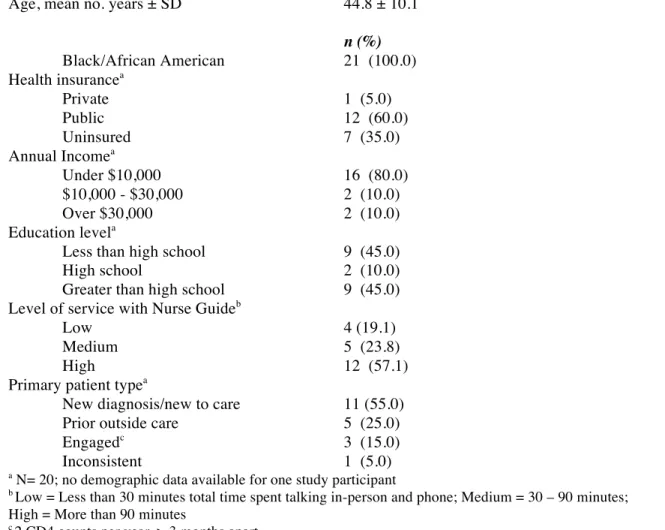
age was 45 years old. A majority of participants received public insurance (60%) and had an annual income below $10,000 (80%).
TABLE 1. SELECTED DEMOGRAPHIC CHARACTERISTICS OF PATIENTS INTERVIEWED FOR GUIDE TO HEALING PROGRAM EVALUATION (N=21)
Characteristic
Age, mean no. years ± SD 44.8 ± 10.1 n (%)
Black/African American 21 (100.0) Health insurancea
Private 1 (5.0)
Public 12 (60.0)
Uninsured 7 (35.0)
Annual Incomea
Under $10,000 16 (80.0)
$10,000 - $30,000 2 (10.0)
Over $30,000 2 (10.0)
Education levela
Less than high school 9 (45.0)
High school 2 (10.0)
Greater than high school 9 (45.0) Level of service with Nurse Guideb
Low 4 (19.1)
Medium 5 (23.8)
High 12 (57.1)
Primary patient typea
New diagnosis/new to care 11 (55.0)
Prior outside care 5 (25.0)
Engagedc 3 (15.0)
Inconsistent 1 (5.0)
a N= 20; no demographic data available for one study participant
b Low = Less than 30 minutes total time spent talking in-person and phone; Medium = 30 – 90 minutes;
High = More than 90 minutes
c 2 CD4 counts per year, > 3 months apart
Physical co-morbidities
Multiple women talked about dealing with co-morbidities, ranging from
hypothyroidism to cancer to strokes to renal failure. One woman in treatment for cancer emphasized that HIV was not her main concern at the time, due to other pressing health concerns:
I went through chemo and all of that and I didn’t take the radiation, so now they
are trying to see what steps they are going to have to do since they decide that the
cancer may be coming back. They couldn’t get to one of the lumps in my arm
because of the location and my stroke. So, I have to have a surgery on that and I
haven’t done that yet and don’t even know if I want to. But I am going through
those obstacles right now, so I can’t even really think about having HIV, that’s
irrelevant to me right now.
However, many of the women, even those with physical health problems, were able to list the healthy behaviors they practiced. Regular exercise, eating a healthy diet, praying, and adhering to their medications and treatment plans were endorsed by several study participants. Said one woman:
I mean, I’m just healthy. The only health issue I had was the AIDS, so, I mean,
other than that I’m completely healthy. I mean, I don’t have any other medical
issues.
Approximately half (n=11, 52%) of the women interviewed reported struggles with mental health, with depression the most commonly cited problem. Their HIV diagnosis was frequently described as a source of fear, stress, and depression:
Well, for the last two years I’ve spent being diagnosed, that was a major stressor
in my life, just dealing with that on top of everything else. It added to a lot of
stress and strain. I went through a very bad phase of depression, and it got to me
really bad.
Even for women who did not report current mental health problems, emotional distress related to their HIV diagnosis was common.
It was like I was hearing it and wasn’t hearing it. I was like, I heard what they
said, but I didn’t accept it, take it in. My whole world was even tumbled down. In
my mind right then it was over. It was over. That was the end.
Several newly diagnosed women who experienced emotional distress related to their diagnosis found the Nurse Guide a source of support and reassurance.
I went in for a regular yearly appointment, and the doctor called me back and
told me, you know, he had me come back in, and he gave me this diagnosis. And,
you know, [Nurse Guide] just talked to me about it and how it was affecting me at
that time, because I had went through a phase of I didn’t want to go to work, I
didn’t want to be at home, I was scared to be around my family. I was scared to
Women reported several sources of stressors in their daily lives, most often related to financial needs. Here, two respondents talk about their financial struggle:
I do receive the food stamps benefit, but it's not much. It's like $185 and in
between, the dates when you're getting them, after I pay my bills, I barely have
food to eat. It's like I'm struggling until I get my food stamps.
I am on disability Social Security for now. Not much, it’s a struggle. It’s a very
tight, tight budget, but I juggle, is the only thing I know I can say, and I thank God
for what gets done, and my needs are met so the only thing I can do is keep
pushing on them because I have to look at it it’s not only going to be like this. I’m
not going to school for nothing. Anything worth having I know it’s not going to
be easy so that’s why I have to keep pushing forward. Believe me, it’s not
comfortable.
Being spread too thin was another source of stress for some women. One woman expressed her situation by saying she was trying to be “Superwoman”. Problems arose when a woman constantly neglected her own needs in favor of others: “Lot of us women don’t go to the doctor because we’re too busy sending everybody else.”
Caregiving
It’s like seeing my children and my grandchildren and everything. They're right
there. It really inspires me to keep up doing what I’m doing. So I keep my health
and everything, you know, up to par and stuff.
I’m not taking my pills for me. I’m taking it for [my partner] and my daughter.
I’m their future and without me, there is no us.
Social support
Many women reported having several accepting and supportive family members they could talk to about HIV. Some women reported having fewer close contacts, while a few women reported having little to no support. Often a lack of social support was related to mistrust, as women feared disclosing their HIV status to people they felt they could not trust:
But I don’t have full contact with too many people, with my family or whatever,
but they're not the type of people that I could sit and really express myself to,
whatever. I can't really talk to them about it without their getting -- showing
everybody, calling everybody, telling everybody, you know, stress out stuff or
whatever. I don’t trust them.
I have a couple of people in my corner, but everybody is not my friend. But I have
maybe like one person that's my friend and then, there's a social worker like every
The Nurse Guide, a trusted health care professional, turned out to be a valuable resource for the women with fewer social supports. The first woman quoted above stated that the Nurse Guide was, “Someone I can open up with, you know, because I can’t even stand, discuss things with my mother or my sister, whatever. She was like a true friend who
listens.”
Stigma
About a quarter of patients reported experiencing stigma related to their diagnoses. The most searing example came from a woman who experienced severe physical
isolation after being diagnosed with HIV while incarcerated in the 1980s.
Well, being diagnosed in prison, I got segregated, put in a single cell, locked
down, couldn’t be around anybody because they had a fear at that time of just
breathing, touching or anything…So, I had survived it and I was what would you
say, I am shunned. So, we can put it like that, shunned and locked down. In
prison, when you have done something that you shouldn’t have done, you get
locked down in single cell. So, I was locked down…And they had the jail doctor,
but she was just as bad as everybody else shunning people and telling you that
you couldn’t eat. We had certain procedures that I had to wear this, don’t touch
this, don’t drink out of this, special cups. I mean it was terrible, but that was back
then…And so I just went through hell in prison. But when I got out, it wasn’t
much different because the same mentality was on the street and then I had just
found out myself and didn’t know whether -- after jail, I didn’t know whether to
somebody, I totally told it. So, it wasn’t a matter of hiding it. I found that if you
can accept it, then it doesn’t matter what anybody else because you are the one
who got to live with it anyway.
Knowing what we now know about HIV, this mentality seems to come from another era. Yet it was only within the last thirty years ago that PLWHA were physically isolated like this for their disease. To provide appropriate medical care for PLWHA, health care professionals must recognize the past and present emotional suffering that often comes with diagnosis and disclosure.
Experiences with HIV
The women’s experiences regarding their engagement and participation in their HIV care were largely optimistic and future-oriented:
I found that if you can accept [HIV], then it doesn’t matter what anybody else
because you are the one who got to live with it anyway. So, as long as you take
precautions not to put anyone else in danger, it is not anything -- it is just like to
me any other illness, only thing is you have to be more responsible. So, as long as
I am responsible and I take care of myself and others, I just deal with it every day.
When asked what helped her remain adherent to her medications, one woman responded:
Because I want to live. I want to live and I know without those medicines, I know,
because I've seen people that don't take them, that refuse to take them and I see
the shape that they're in and I just refuse to be in that predicament when I know
G2H structural support
Transportation assistance
As part of the G2H program, women received assistance with transportation, most commonly vouchers to purchase gas, bus tickets, or free parking at the hospital. Multiple women reported that this assistance was “very” instrumental in helping them attend appointments. Without the transportation assistance, women reported that they could not have afforded to attend all of their scheduled appointments.
[The transportation support] was very good. It was very good because I
explained to them that I live so far and they worked with me in helping the person
that brings me up because I have to spend out of my pocket a little bit and I’m not
financially able.
Cell phone assistance
Five women received cell phones from the G2H program to facilitate contact with their medical providers. The cell phones were less enthusiastically received than the transportation support, although two women did find them helpful in communicating with their providers.
No, I never used it. You can only call the clinic. If I needed, I could call. For
other personal things, you can’t. So, I never used it. I just got my own cell phone
and then just like the program was ending and they were going to be cutting it off.
And I was like, I never used it anyway. I couldn’t call like Walgreens for my
medication, you could only call [the clinic].
Women in the G2H program had the choice to attend weekly support groups on a variety of topics related to living with HIV. While many women expressed interest in attending the support groups, only five women in this study reported attending one or more sessions. The most commonly cited reasons for non-attendance were the additional cost/time to get to the clinic, and timing that was inconvenient to the women’s schedules.
But the days that the support groups and stuff were held was not anything that
was conducive with my job and being able to get there for the appointments and
stuff, so I just elected to not go to any of them.
The women who did attend one or more support groups had largely positive experiences there. Women reported that they enjoyed being in a friendly, supportive atmosphere where they did not have to worry about self-censoring or being “shamed”.
I did enjoy because it allowed me to release, it allowed me to -- not that this was
always good, but everybody was going through stuff and I mean a couple of us
were going through like the same thing and I think that each of us talking about
what we were going through. I mean, it was a healthy group, because I mean, we
got to release it, you know? Like and it didn’t matter, because it was just us in the
group, so we could say whatever it was that we were feeling, and just got to
release it, talk about it, and go on from it.
Nurse Guide
She was more like a supporter. She knew what was going on so therefore it was
easier to discuss things with her. I don’t discuss that with everybody. It was
more of a one-on-one, more like a counseling or support thing than just, I’m not
just a nurse, you know? It’s a support thing.
The majority of the people that worked [at another facility] during the time I was
going there was to me, my opinion, was only there for the check. They were not
concerned about me. They weren’t concerned about me.
For patients, especially those newly diagnosed, the Nurse Guide provided emotional reassurance through their difficult adjustment periods and encouraged retention in care:
If I couldn’t get a hold of the doctor, I would call [Nurse Guide] when I wasn’t
feeling good because as I said, I went from the liquid to the pills to the one pill. It
was a struggle for me, and in the beginning, I was sickly. I was in a lot of pain
and I cried a lot. [Nurse Guide] was there for support, gave me hugs, which I
truly appreciated, because when you’re hurting, and you’re in pain, and you
really don’t want nobody to touch you anyway, a gentle hand is what you need
and [Nurse Guide] has that. Her professional manner is awesome, so I’ve got to
give it to [Nurse Guide]. She did a very good job with me. That’s exactly why I’m
still going to the clinic today, and I’m still taking my pills today because sorta
[Working with the Nurse Guide] was outstanding. I mean, to find somebody that
cares about you, that’s all you need. That gives you that boost to want to even try
harder, you know.
DISCUSSION
This research presents the self-reported biopsychosocial needs of HIV-positive African American women, and examines how a nurse-guided patient navigation program met those needs. The results indicate that the women expressed high levels of
psychological needs, ranging from mental illnesses, most prominently depression, to emotional distress and chronic stressors. While emotional distress was often related to their HIV diagnosis, women’s day-to-day stressors were more likely to be related to financial concerns or subsistence needs. This is unsurprising, as the majority of the study population reported being uninsured or having public insurance, and having an annual income well under the federal government’s 2015 poverty guidelines (140). The significance of poverty to PLWHA and the importance of meeting survival needs have been firmly established within the literature (124,125,141). The importance of these needs often eclipses the significance of chronic disease management. Women attempting to fulfill basic survival needs for themselves and for their families may feel that HIV, while quite distressing, does not qualify as one of their main stressors (110).
a Superwoman (143). African American women associated being strong with certain positive outcomes, like the preservation of self, family, and community in difficult times (142). However, a perceived need to appear strong also increased women’s risk for emotional distress and depression (143).
The Superwoman mentality was not further explored in this research, but should be examined in future research with HIV-positive WOC. Ten women in the G2H study reported acting as caretakers to their children or relatives. The results of
Woods-Giscombé’s 2010 work show that what she referred to as the “Superwoman schema” was associated by African American women with poor self-reported health behaviors,
including little time for self-care. HIV-positive WOC who are already under stress from not being able to meet their families’ basic needs, coupled with pressure to not appear weak, may face especially difficult challenges in maintaining their own mental and physical health.
A central tenet of the biopsychosocial model according to Borrell-Carrió,
Suchman, and Epstein (2004) involves generating a warm, caring, and open relationship between the health care provider and the patient. The Nurse Guide created this type of relationship with her patients, according to all of the women we interviewed. Many of the women regarded the Nurse Guide as their friend as well as their nurse. Even women who reported having difficulty trusting family members, or having previous
relationship has implications for future retention in care. It has been demonstrated that adherence to clinic appointments and treatment plans is crucial to quality of life and survival for PLWHA (12,14,43,45,144). If, as the women reported, their relationship with the Nurse Guide provided some sort of motivation to keep appointments and adhere to ART, then this intervention has implications for retention in care and should be further researched.
The women interviewed for this study could be conceptualized as, per Kelly (2009), “intersectionally invisible”. They possess multiple characteristics that
disadvantage them in American society: they are women, racial minorities, HIV-positive, and mainly of low socioeconomic status and low educational attainment. They may have debilitating physical co-morbidities, little social support, or have been through traumatic events in their past, in the case of the woman who experienced extreme physical isolation in prison. If one examines the experiences of these women, and HIV in the South,
through intersectionality and the biopsychosocial model, it becomes clear that interventions that address systemic factors are needed (15,125).
1. Providing assistance with subsistence needs, as well as transportation, to address basic needs. The use of “social infrastructure” (assistance with housing, food, utility bills, personal hygiene) has been used to complement medical care for PLWHA in Alabama (125). Just as assistance with transportation helps women regularly attend their appointments, so might assistance with food, especially for women with children or dependents. Monetary resources that were originally intended for providing cell phones to patients could instead be put towards subsistence needs.
2. Providing co-located support for mental health in the clinic would allow for a greater focus on women’s mental health. The Nurse Guide had experience with mental health, but had many other responsibilities to fulfill in her position. The additional mental health care could feasibly be provided through expanded support group sessions. Women reported an interest in attending the weekly support groups, but often could not due to the timing of the groups. Figuring out a time convenient to the most women possible would allow for greater access to the mental health benefits of supportive group counseling.
4. Finally, the Nurse Guide truly exemplified the biopsychosocial ideal of creating a warm and caring relationship with patients. Creating a training program based on both the biopsychosocial model and intersectionality would help other
facilities that are interested in replicating a similar patient navigation program for HIV-positive WOC.
There are several limitations to this work. First, the patient sample was created through convenience sampling. Twenty-one transcripts were analyzed for this study. While this number is adequate for a qualitative evaluation, this number represents 58% of the total participants in the G2H program. A higher response rate may have offered richer textual descriptions of women’s experiences.
The women who did complete interviews had higher levels of interaction with the Nurse Guide. This could potentially indicate that these individuals had higher needs than other women who were not interviewed. It could also mean that the interviewed women had better relationships with the Nurse Guide, and wanted to offer feedback on someone they liked. Women may also have been reluctant to offer any constructive feedback on the Nurse Guide if they felt a personal connection with her. The G2H program began in 2011 and ended in 2014, so there is a potential for recall bias, depending on when a woman began to work with the Nurse Guide.
Despite these limitations, the author feels that this paper offers insight into the biopsychosocial needs of HIV-positive WOC in the South and offers realistic
recommendations for future patient navigation programs.
CONCLUSIONS
There are multiple interconnected factors that influence the disproportionate HIV epidemic among African American women in the American South. The complexity of the epidemic requires interventions based in the biopsychosocial model, rather than the traditional biomedical model. The use of an intersectionality framework can assist in identifying and remedying factors that make African American women more vulnerable to both HIV transmission and worse HIV-related health outcomes.
Nurse-guided patient navigation is an innovative health care service delivery model that has the potential to improve retention in care among HIV-positive WOC. The results of this study demonstrated high levels of patient satisfaction with the Nurse Guide leading a patient navigation program at large, university-based infectious disease clinic. The results also showed that women in the program expressed high levels of
women in obtaining basic survival needs, and providing training for nurse guides based in the biopsychosocial model and the intersectionality paradigm. The author recommends that both quantitative and qualitative evaluations be used to assess these
recommendations in future programs.
ACKNOWLEDGEMENTS
This paper is based on original research made possible by grant number
H97HA15148 from the US Department of Health and Human Services, Health Resources and Services Administration (HRSA), HIV/AIDS Bureau’s Special Projects of National Significance Program. The author has no conflict of interest to disclose.
APPENDICES
APPENDIXA:INTERVIEWGUIDE
Part 1: Life Context/Health Behaviors
1. Tell me a little about yourself and a typical day in your life. a. Do you go to school or work?
b. How do you spend most of your time?
2. How has your health been lately? a. Physical health? Mental health?
3. What do you do to stay healthy?
4. What are the main issues/stresses facing you? a. How long have these been a concern for you? b. How do you take care of these issues?
c. Who do you turn to in your life to get support?
i. What about for your HIV? Who do you turn to get support for your HIV?
5. How do you feel you are managing the medical aspects of your HIV now? If you are taking medications for your HIV, how has that been for you lately?
a. What, if any, challenges have you had in taking your HIV medications as prescribed?
b. What has helped you take your medications as prescribed? i. What system do you use to help take your medications?
c. What about attending appointments at the UNC ID clinic? How easy or difficult has that been for you?
i. What, if any, challenges have you had attending appointments? How often do you have these challenges?
ii. What has helped you attend appointments?
a. What was that like for you? Part 2: Working with the Nurse Guide
You spent some time with the Nurse Guide at the UNC clinic. I’d like to hear more about that.
7. How would you describe your relationship with [Nurse Guide]?
a. Have you worked with other HIV health care providers in the past?
b. How has working with [Nurse Guide] been similar or different to those providers? Probe what type of provider comparison is being made to.
c. How has working with [Nurse Guide] been similar or different to other non-HIV providers you have worked with? Probe what type of provider comparison is being made to.
8. How is [Nurse Guide] similar or different to other HIV care providers at UNC?
9. How helpful would you say working with [Nurse Guide] was?
10. What sorts of things did you and [Nurse Guide] talk about?
a. Think back to your early conversations with [Nurse Guide]. What things did you talk about with her at your first or second visit or call with her?
11. What did you know about HIV in general before you started working with [Nurse Guide]?
a. Optional probes if question not understood: how someone gets HIV, how someone takes care of themselves with HIV, definitions of CD4 and viral loads, etc
12. How well were you managing your HIV before you started working with [Nurse Guide]?
13. What did you know about how to manage your own HIV before you started working with [Nurse Guide]?
14. What did you learn from working with [Nurse Guide]?
b. Did you learn anything new about what you needed to do to manage your HIV from working with [Nurse Guide]?
i. Optional probes if question is not understood: how to get medical questions answered, making timely appointments, talking to providers, taking medications, overcoming barriers to attending appointments
c. Did you learn anything new about how HIV works from working with [Nurse Guide]?
i. Probe: Did you learn about CD4 counts, viral loads or medications from [Nurse Guide]?
d. Did you learn any specific skills to care for your HIV? i. Such as: setting up schedules or reminders,
15. Overall, how would you say working with [Nurse Guide] affected the way you take care of your HIV?
16. What did you like best about working with [Nurse Guide]?
17. We are always interested in making our programs the best they can be, there is always room for improvement, so can you tell me what you wish was different about the time you spent with [Nurse Guide]?
18. Are you still working with [Nurse Guide] now? If no:
19. When you stopped working with her, what was that transition like? Did you feel ready to stop working with her?
a. Do you have a different nurse you work with now? ii. What is his/her name?
b. How does your relationship with (name) compare with your relationship with [Nurse Guide]?
20. Has anything changed about your ability to take care of your HIV since you stopped working with [Nurse Guide]?
Optional Probes:
a. What about taking your medications as prescribed? b. Any changes in how you attend appointments?
c. Any changes in how you contact the clinic or your nurse/provider?
21. Who else are you getting support from now? Who can you talk to about your HIV?
Part 3: Support Groups
22. Did you attend any of the support groups offered in the clinic?
If no: What made you decide not to attend? Is there anything that could be changed about the support group that would allow you to attend?
a. Did you attend any of the psychological support groups led by [clinic doctor]?
b. Did you attend any of the educational groups led by guest speakers?
Note: If participant attended both types of groups, probe for each type for #s 17-21.
23. Can you tell me about the support group(s) you attended?
24. What did you like about the group(s)? a. What kept you coming back to group?
25. What did you learn from the group(s)?
26. What was the relationship between the women like in the group(s)? a. Did you feel accepted? Supported?
28. IF ATTENDED EDUCATIONAL GROUP:
a. What were the specific topics you found the most useful? b. Which topics did you not find useful?
Part 4: Transportation Support
Did you receive transportation support (parking passes/gas cards) to help you attend your clinic appointments?
If yes,
29. How important was that transportation support in helping you attend your appointments?
30. Is there something else the clinic could do to make getting to your appointments easier?
31. What are you doing to get to clinic now? a. How is that working for you?
Part 5: Phone Support
Did you receive a cell phone so that you could call and receive calls from the clinic? If yes,
32. Tell me about how you used this phone. a. How often did you use the phone?
33. Did you find having this phone was useful or not? a. How was the cell phone useful?
b. What could have made the clinic cell phone more useful?
34. Is there anything that we didn’t ask you about that you want to share?
35. Do you have anything else you’d like to say about the Nurse Guide program
Part 6: Demographics
1. Year of HIV diagnosis 2. Insurance Status:
• Private • Medicare • Medicaid
• Other Public (VA, Tri-Care, Indian Health) • State ADAP
• UNC Pharmacy Assistance • UNC Charity Care Program • Other
• None 3. Race/Ethnicity:
• African American • Latino
• Asian American • Native American • Multi-racial 4. Years of education:
• No high school • Some high school • High school grad • Some college • College grad
• Some post baccalaureate 5. Income: