Measuring Concurrency Attitudes:
Development and Validation of a
Vignette-Based Scale
Anna B. Cope1*, Catalina Ramirez1, Robert F. DeVellis2, Robert Agans3, Victor
J. Schoenbach4, Adaora A. Adimora1,4
1 Division of Infectious Diseases, School of Medicine, University of North Carolina at Chapel Hill, Chapel
Hill, North Carolina, United States of America, 2 Department of Health Behavior, University of North Carolina Gillings School of Global Public Health, Chapel Hill, North Carolina, United States of America, 3 Department of Biostatistics, University of North Carolina Gillings School of Global Public Health, Chapel Hill, North Carolina, United States of America, 4 Department of Epidemiology, University of North Carolina Gillings School of Global Public Health, Chapel Hill, North Carolina, United States of America
Abstract
Background
Concurrent sexual partnerships (partnerships that overlap in time) may contribute to higher rates of HIV transmission in African Americans. Attitudes toward a behavior constitute an important component of most models of health-related behavior and behavioral change. We have developed a scale, employing realistic vignettes that appear to reliably measure attitudes about concurrency in young African American adults.
Methods
Vignette-based items to assess attitudes about concurrency were developed following focus groups and cognitive testing of items adapted from existing scales assessing psycho-social constructs surrounding related sexual behaviors. The new items were included in a telephone survey of African American adults (18–34 years old) in Eastern North Carolina immediately before and after a radio campaign designed to discourage concurrency. We performed an exploratory factor analysis on each sample (pre- and post-campaign) to cross-validate results. We retained factors with a primary loading of0.50 and no second-ary loading>0.30. Cronbach’s coefficient alpha was used to evaluate internal reliability. Associations in the predicted direction between the mean responses to items on the final factor and known correlates of concurrency validated the scale.
Results
Factor analysis in a random pre-campaign subsample yielded a one-factor 6-item scale with acceptable internal consistency (Cronbach’sα= 0.79). As expected, the attitude factor was positively associated with participation in concurrent partnerships, whether assessed by self-report (r = 0.298, p<0.0001) or deduced from dates of recent sexual partnerships (r = 0.298, p<0.0001). The factor was also positively associated with alcohol (r = 0.216, p<0.0001) and
a11111
OPEN ACCESS
Citation: Cope AB, Ramirez C, DeVellis RF, Agans
R, Schoenbach VJ, Adimora AA (2016) Measuring Concurrency Attitudes: Development and Validation of a Vignette-Based Scale. PLoS ONE 11 (10): e0163947. doi:10.1371/journal.
pone.0163947
Editor: Eli Samuel Rosenberg, Emory University
School of Public Health, UNITED STATES
Received: February 28, 2016
Accepted: September 16, 2016
Published: October 20, 2016
Copyright: This is an open access article, free of all
copyright, and may be freely reproduced, distributed, transmitted, modified, built upon, or otherwise used by anyone for any lawful purpose. The work is made available under theCreative
Commons CC0public domain dedication.
Data Availability Statement: All relevant data are
within the paper.
Funding: This research was supported by grants
from the National Institute on Minority Health and
Health Disparities (NIMHD,http://www.nimhd.nih.
gov/), National Institute of Health (NIH; grant no. NIH1R01MD004065; Adimora, Adaora, PI) and The Eunice Kennedy Shriver National Institute of Child Health and Human Development (NICHD,
drug use (r = 0.225, p<0.0001) and negatively associated with increasing age (r = -0.088, p-= 0.02) and female gender (r p-= -0.232, p<0.0001). Factor analyses repeated in the second random pre-campaign subsample and post-campaign sample confirmed these results.
Conclusion
A vignette-based scale may be an effective measure of key attitudes related to concurrency and potentially a useful tool to evaluate interventions addressing this network pattern.
Introduction
African Americans comprised only 13% of the total US population in 2014 [1] yet accounted
for almost two-thirds (64%) of persons diagnosed with heterosexually transmitted HIV
infec-tion [2]. Concurrent sexual partnerships, sexual partnerships that overlap in time, can increase
sexual network connectivity and therefore, the likelihood of HIV transmission [3–6]. Social
and economic forces promote a higher prevalence of concurrent partnerships among African
Americans [7–10], especially in the Southern US, where rates of other sexually transmitted
infections and heterosexually transmitted HIV are high [11]. Although successful control of
the U.S. HIV epidemic will ultimately require modifying larger social and structural forces, behavioral interventions are urgently needed to help change sexual network patterns, such as concurrency, that increase HIV transmission.
Little published research documents psychosocial factors that predict participation in con-currency. Several leading theories of behavioral prediction and change, including Fishbein’s
inte-grative model of behavior, [12,13] hold that attitudes, norms, and self-efficacy are primary
determinants of intention to perform a behavior [14–16]. Thus, attitudes toward initiation or
continuation of a concurrent partnership are a natural target for predicting and influencing behavior. However, the measurement of attitudes towards sexual concurrency has received
mini-mal attention [17]. The context and motivations for engaging in sexual concurrency are
compli-cated and existing scales to measure attitudes toward other sexual behaviors may not be directly adaptable to this network pattern. Qualitative research has identified a variety of motivations for and situations in which concurrency occurs, including transitions between relationships, reactive concurrency (in which one partner has concurrent partnerships in response to the other partner’s concurrency), compensatory concurrency that occurs because of perceived deficits of a partner, separational concurrency during physical separation due, for example, to incarceration, open
partnerships, co-parenting, and survival sex [18,19]. Accurate measurement of attitudes toward
concurrency may require an instrument that incorporates the nuances of these specific situations. In this paper we present the development of a scale to measure changes in attitudes toward concurrency to evaluate the effectiveness of a radio campaign to discourage concurrency among young, heterosexual African Americans in Eastern North Carolina, an area with
ele-vated concurrency and HIV prevalence [20,21]. A companion paper reports the results of the
campaign (in preparation).
Methods
Overall Study Design
Data for this analysis were collected in conjunction with an eight-month radio campaign in Eastern North Carolina (NC) that aimed to 1) inform young, heterosexual African Americans about the association between concurrent sexual partnerships and HIV dissemination in the
funders had no role in study design, data collection and analysis, decision to publish, or preparation of the manuscript.
Competing Interests: The authors have declared
community and 2) decrease acceptability of concurrency [20]. Computer-assisted telephone interviews (CATI) were conducted with independent samples of people living in 6 largely rural counties, immediately before and after the campaign, to assess changes in behavioral beliefs, attitudes, normative beliefs, and self-efficacy in relation to concurrency and participation in concurrent partnerships. For both the pre- and post-campaign surveys, we used an electronic
white page sampling frame with embedded listings of age and race [22,23] and drew a random
sample of 18 to 34 year-old African American men and women that could be contacted via landline telephones, with stratification by county to ensure the samples were proportional to population size. Respondents were eligible to participate in surveys if they were not institution-alized, spoke English, resided in one of the six study counties (Edgecombe, Greene, Lenoir, Nash, Pitt and Wilson), and (for the post-campaign survey) had not participated in the pre-campaign survey. All analyses were conducted in SAS version 9.3 (Cary, NC).
Item Generation and Refinement
We developed an exploratory conceptual model to understand participation in concurrency among African Americans. Using Fishbein’s integrative model of behavior, which holds that attitudes, norms and self-efficacy are primary determinants of intention to perform a specific
behavior, [12,13,24] we explored participation in concurrent sexual behavior in our study
pop-ulation. Our model also integrated social constructionist frameworks of gender and power
[25,26], constructs that previously have been associated with concurrency [27].
Before initiating the main study, we conducted six focus groups among African American adults in the target age range and counties to identify factors that may promote concurrency in their communities. Focus group participants cited numerous contributors, including low male-to-female ratios, high male incarceration rates, poverty, desire to fulfill sexual and emotional needs that are not met by a main partnership, avoidance of hurt feelings and vulnerability that may accompany a monogamous relationship, retaliation against one’s partner, and having a
child with a previous partner [20].
Candidate survey items were adapted from published construct definitions and validated scales for measuring attitudes, norms, self-efficacy, and behavioral beliefs about similar sexual
risk behaviors [28–32]. These items used 4-point Likert-type response choices. To ensure that
the candidate survey items would be understandable to respondents of the main study survey, preliminary cognitive testing of these items was conducted on a sample of 37 NC African Americans, ages 18 to 45 years, with a CATI-administered instrument. We recruited a small convenience sample of participants for the preliminary cognitive testing by 1) targeted sam-pling of African American households in NC counties not participating in the main study and 2) inviting nominations from study staff of potential respondents who satisfied the target age and racial categories (to reduce costs for respondent recruitment for preliminary cognitive test-ing). If more than one eligible respondent resided within the household, young males were oversampled to ensure representation among this important sub-group. Clarity, precision, and general applicability were assessed through a set of follow-up questions asking participants to explain their understanding of the meaning of each item.
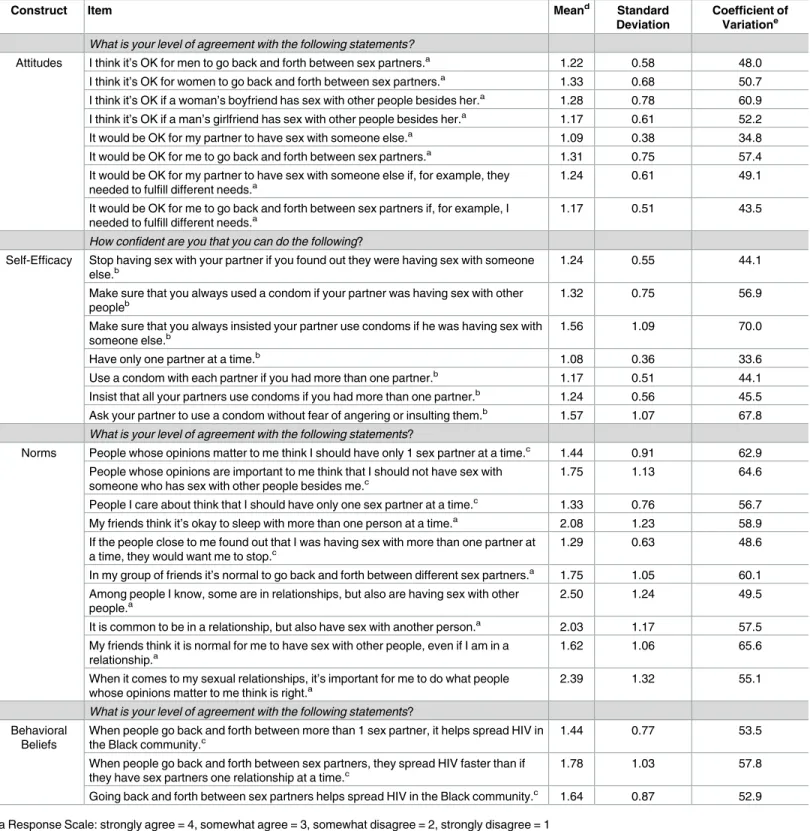
Approximately half of respondents who participated in preliminary cognitive testing of the items were men (N = 19, 51%) and most had graduated from high school (N = 33, 89%) and had never been married (N = 23, 62%). Only one respondent had never had sex. Preliminary cognitive testing indicated that the original candidate items measuring attitudes, norms, behav-ioral beliefs and self-efficacy in relation to concurrent sexual partnerships yielded highly skewed response distributions with limited variability (range of coefficient of variation
Table 1. Means, standard deviations, and coefficients of variation for candidate items measuring attitudes, norms, beliefs, and self-efficacy from preliminary cognitive testing (N = 37).
Construct Item Meand Standard
Deviation
Coefficient of Variatione
What is your level of agreement with the following statements?
Attitudes I think it’s OK for men to go back and forth between sex partners.a 1.22 0.58 48.0 I think it’s OK for women to go back and forth between sex partners.a 1.33 0.68 50.7 I think it’s OK if a woman’s boyfriend has sex with other people besides her.a 1.28 0.78 60.9 I think it’s OK if a man’s girlfriend has sex with other people besides her.a 1.17 0.61 52.2 It would be OK for my partner to have sex with someone else.a 1.09 0.38 34.8 It would be OK for me to go back and forth between sex partners.a 1.31 0.75 57.4 It would be OK for my partner to have sex with someone else if, for example, they
needed to fulfill different needs.a
1.24 0.61 49.1
It would be OK for me to go back and forth between sex partners if, for example, I needed to fulfill different needs.a
1.17 0.51 43.5
How confident are you that you can do the following?
Self-Efficacy Stop having sex with your partner if you found out they were having sex with someone else.b
1.24 0.55 44.1
Make sure that you always used a condom if your partner was having sex with other peopleb
1.32 0.75 56.9
Make sure that you always insisted your partner use condoms if he was having sex with someone else.b
1.56 1.09 70.0
Have only one partner at a time.b 1.08 0.36 33.6
Use a condom with each partner if you had more than one partner.b 1.17 0.51 44.1 Insist that all your partners use condoms if you had more than one partner.b 1.24 0.56 45.5 Ask your partner to use a condom without fear of angering or insulting them.b 1.57 1.07 67.8 What is your level of agreement with the following statements?
Norms People whose opinions matter to me think I should have only 1 sex partner at a time.c 1.44 0.91 62.9 People whose opinions are important to me think that I should not have sex with
someone who has sex with other people besides me.c
1.75 1.13 64.6
People I care about think that I should have only one sex partner at a time.c 1.33 0.76 56.7 My friends think it’s okay to sleep with more than one person at a time.a 2.08 1.23 58.9 If the people close to me found out that I was having sex with more than one partner at
a time, they would want me to stop.c
1.29 0.63 48.6
In my group of friends it’s normal to go back and forth between different sex partners.a 1.75 1.05 60.1 Among people I know, some are in relationships, but also are having sex with other
people.a
2.50 1.24 49.5
It is common to be in a relationship, but also have sex with another person.a 2.03 1.17 57.5 My friends think it is normal for me to have sex with other people, even if I am in a
relationship.a
1.62 1.06 65.6
When it comes to my sexual relationships, it’s important for me to do what people whose opinions matter to me think is right.a
2.39 1.32 55.1
What is your level of agreement with the following statements?
Behavioral Beliefs
When people go back and forth between more than 1 sex partner, it helps spread HIV in the Black community.c
1.44 0.77 53.5
When people go back and forth between sex partners, they spread HIV faster than if they have sex partners one relationship at a time.c
1.78 1.03 57.8
Going back and forth between sex partners helps spread HIV in the Black community.c 1.64 0.87 52.9
a Response Scale: strongly agree = 4, somewhat agree = 3, somewhat disagree = 2, strongly disagree = 1 b Response Scale: very confident = 1, somewhat confident = 2, somewhat unconfident = 3, very unconfident = 4 c Response Scale: strongly agree = 1, somewhat agree = 2, somewhat disagree = 3, strongly disagree = 4 d Larger numbers indicate greater acceptance of concurrency
e Coefficients of Variation calculated as 100 x (standard deviation/mean)
Based on the themes emerging from the focus groups and results of the preliminary cogni-tive testing of the initial candidate items, we developed a set of items incorporating vignettes with realistic scenarios involving concurrency or related behaviors. Each vignette-style item asked the respondent how much s/he agreed that the behavior of fictional characters presented in the scenario was acceptable. We revised items related to self-efficacy by asking respondents to assess the likelihood they would behave in the manner presented in the hypothetical situa-tion. To broaden the potential response distribution and enhance sensitivity to small
differ-ences [33], we increased the number of response choices from four to 10 for the attitude and
self-efficacy items. Items measuring norms and behavioral beliefs continued to use four response choices.
We conducted cognitive testing of the revised items in a separate convenience sample of 16 African American respondents (6 men and 10 women) between the ages of 18 and 34 years who were recruited and nominated by study staff. To reduce study-related costs, the conve-nience sample was comprised of individuals known by study staff in the target age and racial categories for the main study. The convenience sample respondents did not live in the study counties and were therefore ensured of exclusion from both the main pre- and post-campaign studies. Responses to the revised items demonstrated greater variability (coefficients of varia-tion range: 21.4–126.3), with vignette-style attitude items and self-efficacy items displaying the most (coefficients of variation range: 66.3–126.3). The revised items were used for the main pre- and post-campaign surveys.
Factor Analysis
Data collected during the pre- (February through June 2012) and post- (June through November 2013) campaign surveys were used to perform a factor analysis of the revised item set, which served as a content pool from which potential items for the final scale could emerge. Item responses were recoded if necessary so that pro-concurrency responses had higher numerical values. We considered only the revised items with a 10-point response scale (attitude vignette-style items and revised self-efficacy items) in the factor analysis to
avoid methods variance due to differences in response formats [34]. The surveys also
col-lected information on respondents’ marital status, sexual behaviors including dates of sexual partnerships in the past year, recent alcohol and drug use, as well as other socio-demographic characteristics.
We randomly divided the pre-campaign survey respondents into two equal-sized groups and performed the same set of analyses on each group, to enable cross-validation of the factor analysis results. To determine the optimal number of factors to retain, we performed an explor-atory factor analysis on each half of the pre-campaign sample. The explorexplor-atory analysis
included an assessment of Cattell’s Scree Plot, Kaiser criterion of Eigenvalues1.0, and the
overall interpretability of the resulting factors. The factor analysis used an oblique rotation method that did not require the assumption that the underlying factors were uncorrelated. We
retained factors with a primary loading of0.50 and no secondary loading>0.30. Items that
loaded poorly across all factors were discarded. Cronbach’s alpha was used to evaluate internal consistency of the items within each individual factor. Factors with low internal reliability
(Cronbach’sα<0.7) were not retained. Furthermore, items that factored together but did not
make theoretical sense were also discarded. The mean responses of items with a primary load-ing on the resultload-ing factors were averaged to create composite factor scores. The factor analysis was repeated in the second pre-campaign subsample and in the post-campaign sample. Results from each sample were compared for agreement to confirm the resulting factor solution for
Validation
Our conceptual model posits that people who are more accepting of concurrency are more
likely to engage in it [14–16]. Thus, a valid scale should be positively correlated with behavioral
reports of concurrency and their correlates, and negatively correlated with factors inversely associated with concurrency. To ascertain construct validity, we reviewed existing literature
about concurrency and predicted,a priori, the direction of the association between the scale
and five socio-demographic and behavioral variables measured in the main surveys. Prior research indicates that men, younger adults, unmarried persons, and people with drug and/or heavy alcohol use have greater involvement in concurrency and should accordingly endorse
attitudes more accepting of concurrency (i.e., higher scale scores) [7,21,36–38].
We measured concurrency in this population using two methods. First, we provided the def-inition of concurrency and directly asked respondents if they had participated in this behavior in the past 12 months (self-report). Secondly, we measured concurrency as overlapping sexual partnerships at any point during the past year based on reported dates of first and last sex with
the three most recent partners, one of the UNAIDS-recommended definitions [39]. We used
direct questioning to characterize binge drinking (report of5 [men] or4 [women] alcoholic
drinks on the same occasion on at least 1 day in the past 30 days) and marijuana use (report of
smoking marijuana1 time in the last 12 months).
We examined the association between the attitude factor score and known correlates of con-currency using Pearson’s correlation statistic for continuous variables (number of partners in the past 12 months and age) and Spearman’s correlation statistic for categorical variables (sex-ual concurrency, gender, substance abuse, and marital status). The analysis was conducted sep-arately in the pre- and post-campaign samples. Statistically significant correlation coefficients in the predicted direction were considered as validation that the factor measures attitudes about concurrency.
Ethics Statement
The University of North Carolina at Chapel Hill Biomedical Institutional Review Board approved all study procedures (IRB #09–2142). Participants in the focus groups, the pilot sur-veys, and the pre- and post-campaign studies provided written informed consent.
Results
Factor Analysis
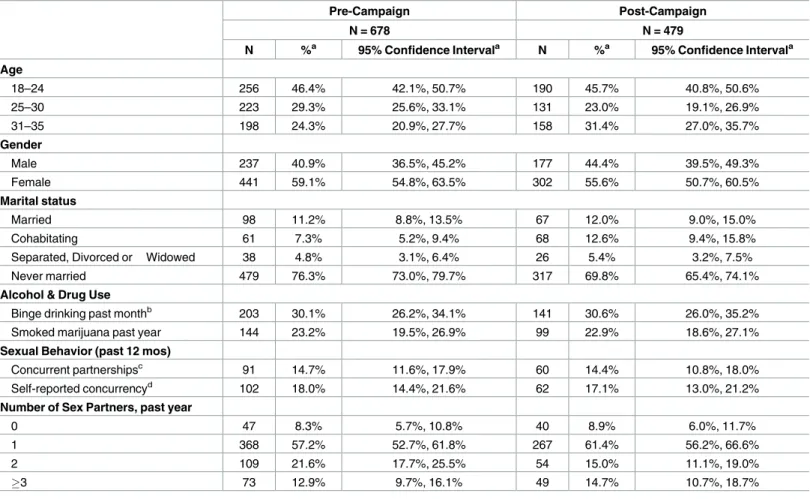
A total of 1,157 people were surveyed for the main media campaign evaluation. Pre-campaign respondents (N = 678) were predominantly young (46.4% 18–24 years old) and female
(59.1%), and most (84.8%) had graduated high school (Table 2). Post-campaign respondents
(N = 479) were similar to pre-campaign respondents, with a slightly lower proportion of people who had never been married (69.8% vs. 76.3% pre-campaign).
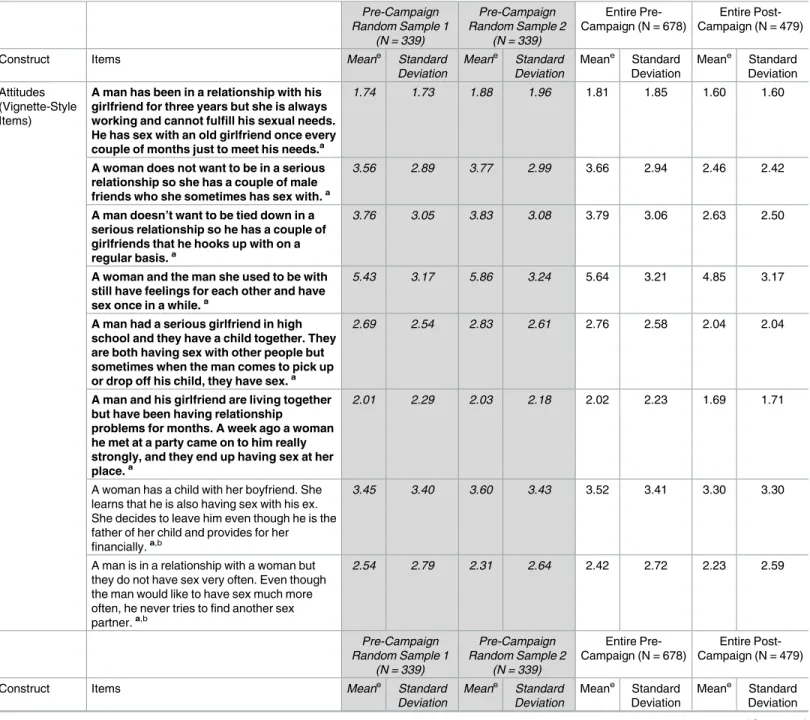
The mean response was less than 6 (out of 10) for all revised attitude and self-efficacy items,
where 1 denoted the lowest and 10 denoted the highest acceptance of concurrency (Table 3).
still have feelings for each other and have sex once in a while” (pre-campaign = 5.64, post-campaign = 4.85).
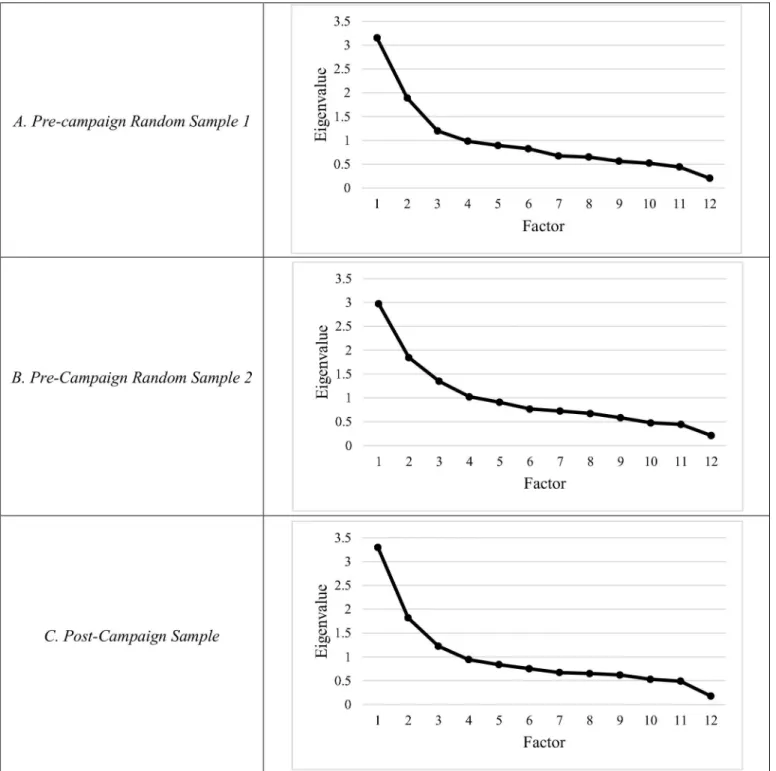
In the first random pre-campaign subsample, three factors emerged with Eigenvalues greater than 1.00 (3.08; 1.84; 1.24) among the revised attitude and self-efficacy items; these three factors accounted for 53.6% of the total item variance. Upon visual inspection, the scree
plot also suggested that three factors should be retained in the factor analysis (Fig 1A).
Examination of the factor loading scores from the factor analysis revealed that most of the revised items loaded onto only one factor. Moreover, four revised items displayed evidence of loading across two different factors. Cronbach’s alpha supported internal reliability only for
Factor 1 (α= 0.82); reliabilities for Factor 2 and Factor 3 were 0.53 and 0.50, respectively. Even
after removing revised items that cross-loaded across more than one factor, reliability estimates for factors 2 and 3 were low. The revised items that loaded onto Factor 1 were all vignettes and clearly related to attitudes toward concurrency. The interpretation of Factors 2 and 3 was less straightforward, with revised items associated with both self-efficacy and attitude loading onto both factors. The resulting low internal consistency and lack of interpretability prompted us to remove Factors 2 and 3 from further consideration.
Table 2. Demographic and Risk Characteristics of Pre- and Post-Campaign Respondents.
Pre-Campaign Post-Campaign
N = 678 N = 479
N %a 95% Confidence Intervala N %a 95% Confidence Intervala
Age
18–24 256 46.4% 42.1%, 50.7% 190 45.7% 40.8%, 50.6%
25–30 223 29.3% 25.6%, 33.1% 131 23.0% 19.1%, 26.9%
31–35 198 24.3% 20.9%, 27.7% 158 31.4% 27.0%, 35.7%
Gender
Male 237 40.9% 36.5%, 45.2% 177 44.4% 39.5%, 49.3%
Female 441 59.1% 54.8%, 63.5% 302 55.6% 50.7%, 60.5%
Marital status
Married 98 11.2% 8.8%, 13.5% 67 12.0% 9.0%, 15.0%
Cohabitating 61 7.3% 5.2%, 9.4% 68 12.6% 9.4%, 15.8%
Separated, Divorced or Widowed 38 4.8% 3.1%, 6.4% 26 5.4% 3.2%, 7.5%
Never married 479 76.3% 73.0%, 79.7% 317 69.8% 65.4%, 74.1%
Alcohol & Drug Use
Binge drinking past monthb 203 30.1% 26.2%, 34.1% 141 30.6% 26.0%, 35.2%
Smoked marijuana past year 144 23.2% 19.5%, 26.9% 99 22.9% 18.6%, 27.1%
Sexual Behavior (past 12 mos)
Concurrent partnershipsc 91 14.7% 11.6%, 17.9% 60 14.4% 10.8%, 18.0%
Self-reported concurrencyd 102 18.0% 14.4%, 21.6% 62 17.1% 13.0%, 21.2%
Number of Sex Partners, past year
0 47 8.3% 5.7%, 10.8% 40 8.9% 6.0%, 11.7%
1 368 57.2% 52.7%, 61.8% 267 61.4% 56.2%, 66.6%
2 109 21.6% 17.7%, 25.5% 54 15.0% 11.1%, 19.0%
3 73 12.9% 9.7%, 16.1% 49 14.7% 10.7%, 18.7%
a Percentages and 95% confidence intervals weighted based on differential sampling and non-response b Drinking 5+ (men) or 4+ (women) alcoholic drinks on the same occasion on at least 1 day in the past 30 days. c Overlapping sexual partnerships at any point in the past year inferred from reported dates of sexual partnerships. d Self-reported concurrency when given the definition of concurrency
After we restricted the analysis to only one factor, loadings for six revised items, all
vignettes, were high (>0.50). The remaining six revised items had low loadings (<0.40) and
were removed from further consideration. We re-analyzed the reduced vignette-style item
pool, extracting only a single factor [Table 4]; this factor accounted for 51.6% of the total
vari-ance and had acceptable reliability (Cronbach’sα= 0.79). Very similar results were obtained
from the second pre-campaign subsample (48.4% of total item variance, Cronbach’sα= 0.79)
Table 3. Survey means and standard deviations for revised items developed from cognitive testing and focus group analysis and included on pre- and post-campaign surveys.
Pre-Campaign Random Sample 1
(N = 339)
Pre-Campaign Random Sample 2
(N = 339)
Entire Pre-Campaign (N = 678)
Entire Post-Campaign (N = 479)
Construct Items Meane Standard
Deviation
Meane Standard Deviation
Meane Standard Deviation
Meane Standard Deviation Attitudes
(Vignette-Style Items)
A man has been in a relationship with his girlfriend for three years but she is always working and cannot fulfill his sexual needs. He has sex with an old girlfriend once every couple of months just to meet his needs.a
1.74 1.73 1.88 1.96 1.81 1.85 1.60 1.60
A woman does not want to be in a serious relationship so she has a couple of male friends who she sometimes has sex with.a
3.56 2.89 3.77 2.99 3.66 2.94 2.46 2.42
A man doesn’t want to be tied down in a serious relationship so he has a couple of girlfriends that he hooks up with on a regular basis.a
3.76 3.05 3.83 3.08 3.79 3.06 2.63 2.50
A woman and the man she used to be with still have feelings for each other and have sex once in a while.a
5.43 3.17 5.86 3.24 5.64 3.21 4.85 3.17
A man had a serious girlfriend in high school and they have a child together. They are both having sex with other people but sometimes when the man comes to pick up or drop off his child, they have sex.a
2.69 2.54 2.83 2.61 2.76 2.58 2.04 2.04
A man and his girlfriend are living together but have been having relationship
problems for months. A week ago a woman he met at a party came on to him really strongly, and they end up having sex at her place.a
2.01 2.29 2.03 2.18 2.02 2.23 1.69 1.71
A woman has a child with her boyfriend. She learns that he is also having sex with his ex. She decides to leave him even though he is the father of her child and provides for her financially.a,b
3.45 3.40 3.60 3.43 3.52 3.41 3.30 3.30
A man is in a relationship with a woman but they do not have sex very often. Even though the man would like to have sex much more often, he never tries to find another sex partner.a,b
2.54 2.79 2.31 2.64 2.42 2.72 2.23 2.59
Pre-Campaign Random Sample 1
(N = 339)
Pre-Campaign Random Sample 2
(N = 339)
Entire Pre-Campaign (N = 678)
Entire Post-Campaign (N = 479)
Construct Items Meane Standard
Deviation
Meane Standard Deviation
Meane Standard Deviation
Meane Standard Deviation
as well as from the entire post-campaign sample (51.1% of variance, Cronbach’s α= 0.80) (Fig 1B and 1CandTable 4).
Validation
In the pre-campaign sample, our hypothesized attitude factor displayed a statistically signifi-cant positive association with having participated in concurrent partnerships, whether assessed
by self-report (r = 0.298, p<0.0001) or deduced from dates of recent sexual partnerships
(r = 0.298, p<0.0001). In addition, the factor score was positively correlated with reported
number of sexual partners in the past year (r = 0.350, p<0.0001), a variable that is also strongly
correlated with involvement in concurrency. Similar associations were observed in the
post-campaign sample (Table 5).
As predicteda priori, attitude factor scores were positively associated with binge drinking
and marijuana use in both the pre- (binge drinking r = 0.216, p<0.0001; marijuana use
Table 3. (Continued)
Self-Efficacy You find out that your [girlfriend/boyfriend] of three years has been having sex with their ex. How likely is it that you that you would end your relationship?b,c
1.94 2.11 1.96 2.29 1.95 2.20 1.75 1.96
You think your [girlfriend/boyfriend] may be having sex with someone else. How likely is it that you would [ask him to] use a condom when the two of you next have sex?b,c
1.73 2.06 1.75 2.04 1.74 2.05 1.92 2.34
How confident are you that you can satisfy your own sexual needs with just one sex partner?b,c
1.62 1.89 1.77 1.99 1.70 1.94 1.48 1.48
You and your boyfriend/girlfriend of three years have a child together. You discover they are having sex with someone else. How confident are you that you can end the relationship?b,c
2.49 2.39 2.29 2.29 2.39 2.34 2.26 2.14
Norms When it comes to my sexual relationships, it’s important for me to do what my friends think best.d
1.15 0.63 1.13 0.49 1.14 0.56 1.11 0.40
In my group of friends it’s normal to have more than 1 sexual relationship at a time.d
1.60 1.09 1.65 1.08 1.62 1.09 1.55 0.96
Among people I know, some are in
relationships but are also having sex with other people.d
2.52 1.23 2.65 1.29 2.58 1.26 2.67 1.29
My friends think it’s okay to sleep with more than one person at a time.d
1.97 1.15 2.02 1.23 1.99 1.19 2.13 1.25
It is common to be in a relationship but also have sex with another person.d
2.13 1.22 2.04 1.22 2.08 1.22 2.02 1.20
Behavioral Beliefs
Concurrency helps spread HIV.b,d 1.04 0.21 1.07 0.26 1.06 0.23 1.20 0.57
Concurrency is a problem in our community.b,d 1.07 0.25 1.13 0.73 1.10 0.54 1.27 0.81 Concurrency has a negative impact on our
children.b,d
1.08 0.27 1.10 0.30 1.09 0.29 1.33 0.76
a Response Scale: On a scale of 1 to 10, with 1 being not at all okay and 10 being completely okay b Scale reversed so larger number indicates a “pro-concurrency” response
c Response Scale: On a scale of 1 to 10, with 1 being not at all likely and 10 being very likely
d Response Scale: strongly agree = 1, somewhat agree = 2, somewhat disagree = 3, strongly disagree = 4 e Larger number indicated pro-concurrency response
Bolded items included in final factor
r = 0.225, p<0.0001) and the post-campaign samples (binge drinking r = 0.178, p = 0.0001;
marijuana use r = 0.316, p<0.0001). Similarly, the data supported our expectations that
women would display attitudes indicating lower acceptance of concurrency than did men
(pre-campaign r = -0.232, p<0.0001; post-campaign r = -0.274, p<0.0001) and that older
respon-dents would have attitudes less accepting of concurrency than younger responrespon-dents
(pre-Fig 1. Cattell’s Scree Plot. Cattell’s Scree Plot of the raw eigenvalues for the (A) first pre-campaign random sample, (B) second pre-campaign
random sample and (C) the post-campaign sample.
campaign r = -0.088, p = 0.02; post-campaign r = -0.116, p = 0.01). However, contrary to our expectations, we did not observe married respondents to have lower acceptance of concurrency
(pre-campaign r = -0.14 p = 0. 7; post-campaign r = -0.087 p = 0.06) [Table 5].
Discussion
In this paper we report the development and evaluation of a scale for measuring attitudes toward concurrent sexual partnerships among young African American adults in the general population in Eastern North Carolina. Items adapted from previously published scales assess-ing attitudes about sexual behaviors had highly-skewed response distributions with insufficient variability for assessing concurrency-related attitudes in this population. Using feedback about these items and qualitative research, we developed vignette-style items that exhibited greater variability in responses. Factor analysis of the vignette-style items yielded a single concurrency attitude factor with acceptable internal consistency. The single factor was associated with con-currency and known correlates of concon-currency in the predicted directions, providing construct validity. Thus, we believe that these results suggest that this scale may accurately assess young African Americans’ attitudes toward concurrency in a variety of realistic situations.
Behavioral theory regards attitudes as a critical construct for predicting behavioral intention
and behavior itself [14–16,40]. However, there is little published research on methods for
mea-suring attitudes toward sexual behavior other than condom use [17,28–32]. The candidate set
of items used during our cognitive assessment were adapted from definitions of psychosocial constructs and previously validated scales used to assess attitudes, norms, and self-efficacy
toward related sexual risk behaviors [28–32]. However, the distributions of responses to these
items in cognitive testing had very low variability.
Results of focus group discussions helped us develop a pool of vignette-style items that respondents understood and were willing to endorse. The new items referred to fictional char-acters in common situations. Unlike the items adapted from existing scales, the vignettes may have encouraged respondents to think of familiar real-life situations, possibly even reminding
Table 4. Factor Analysis of vignette-style items included in final factor for measuring attitudes toward concurrency.
Factor 1 Loading Scores
Item Pre-Campaign
Random Sample 1
Pre-Campaign Random Sample 2
Post-Campaign Sample
A man doesn’t want to be tied down in a serious relationship so he has a couple of girlfriends that he hooks up with on a regular basis.
0.803 0.854 0.852
A woman does not want to be in a serious relationship so she has a couple of male friends who she sometimes has sex with.
0.799 0.787 0.793
A man had a serious girlfriend in high school and they have a child together. They are both having sex with other people but sometimes when the man comes to pick up or drop off his child, they have sex.
0.764 0.723 0.723
A woman and the man she used to be with still have feelings for each other and have sex once in a while.
0.722 0.710 0.626
A man and his girlfriend are living together but have been having relationship problems for months. A week ago a woman he met at a party came on to him really strongly, and they end up having sex at her place.
0.598 0.554 0.617
A man has been in a relationship with his girlfriend for three years but she is always working and cannot fulfill his sexual needs. He has sex with an old girlfriend once every couple of months just to meet his needs.
0.566 0.512 0.644
Factor Score: Mean (Standard Deviation) 3.20 (1.89) 3.37 (1.90) 2.54 (1.61)
Cronbach’s alpha 0.79 0.79 0.80
Total Item Variance 51.6% 48.4% 51.1%
them of people they knew. Respondents were still asked to provide their personal opinions of
stigmatized behaviors but were not directly evaluating theirownbehavior. Given the sensitivity
of concurrency, a third-person perspective may diminish respondents’ fear of socially undesirable
responses [41]. The respondent can countenance others’ potentially stigmatized behaviors
with-out necessarily endorsing them or suggesting that the respondent would engage in them. This greater distance from the behavior may allow respondents to be more comfortable in answering honestly, as their responses reflect less on them as individuals. However, it is possible that indi-viduals hold differing views for themselves and for people more generally, which would lower validity when the variable of interest is an assessment of the respondent her/himself. Despite this disadvantage, the vignette-based items appeared to be valid in our analyses. In addition, 10-point response scales may have been more sensitive to nuances of feeling than 4-point response scales.
Although vignettes have been used to assess psychosocial constructs related to sexual health,
[42–45] we are not aware of a previous instance in which a factor analysis approach empirically
validated a scale of vignette-style items. Exploratory factor analysis provides a more rigorous
Table 5. Validation of Factor: Associations between the attitude factor score and known correlates of concurrency.
Predicted Association (+ positive;–negative)
Rationale Pre-Campaign
Correlation (N = 678)
Post-Campaign Correlation
(N = 479)
ra p-value ra p-value
Sexual Behavior Variables Concurrency in past 12 months (based on dates)
+ People engaging in concurrent partnerships will have attitudes favorable toward concurrency.
0.298 <0.0001 0.277 <0.0001 Self-reported concurrency in
past 12 months (when given definition)
+ People engaging in concurrent partnerships will have attitudes favorable toward concurrency.
0.298 <0.0001 0.325 <0.0001
Number of sex partners past year
+ People with more sex partners in the past year will be more likely to engage in concurrent partnerships [36] and will therefore have attitudes favorable toward
concurrency.
0.350 <0.0001 0.445 <0.0001
Demographic Variables
Binge drinking past monthb + The prevalence of concurrency is higher among people who binge drink [37]. Therefore respondents reporting binge drinking will be more likely to have attitudes favorable toward concurrency.
0.216 <0.0001 0.178 0.0001
Smoked marijuana in past year
+ The prevalence of concurrency is higher among people who use marijuana [37]. Therefore respondents reporting marijuana use will be more likely to have attitudes favorable toward concurrency.
0.225 <0.0001 0.316 <0.0001
Age – The prevalence of concurrency is lower among older
people [36,37]. Therefore older respondents will be less likely to have attitudes favorable toward concurrency.
-0.088 0.02 -0.116 0.01
Gender – The prevalence of concurrency is lower among females
than males [7,21,38]. Therefore female respondents will be less likely to have attitudes favorable toward concurrency.
-0.232 <0.0001 -0.274 <0.0001
Marital Status – The prevalence of concurrency is lower among people who are married [7,21,36–38]. Therefore married respondents will be less likely to have attitudes favorable toward concurrency.
-0.14 0.7 -0.087 0.06
a. Pearson’s correlation statistic was used with continuous variables (number of partners in the past 12 months and age) and Spearman’s correlation statistic was used with categorical variables (sexual concurrency, gender, substance abuse, and marital status).
b. Drinking 5+ (men) or 4+ (women) alcoholic drinks on the same occasion on at least 1 day in the past 30 days.
replication test than confirmatory factor analysis [35]. Therefore, we chose to replicate the exploratory factor analysis conducted on the first half of the pre-campaign sample on a second sample to provide confirmation or cross-validation of results. The same factor with the same set of vignette-style items and similar reliability estimates emerged in each sample, supporting our conclusion of a one-factor solution. The revised self-efficacy items used in this analysis resulted in a factor with low internal consistency, suggesting that further refinement is neces-sary to measure this construct in this population. We were unable to perform test-retest assess-ment in the same sample because this study consisted of two independent cross-sectional samples. We believe that internal consistency may more directly address the reliability of the instrument than test-retest methods, which are susceptible to 1) confounding of true reliability with stability in the construct over time and 2) data contamination due to respondents’ level of
motivation at the initial and subsequent testing time points (i.e. deliberative effects) [46].
How-ever, we recommend that future users of this scale consider test-retest assessments to examine temporal stability within their populations.
Formal validation provided further evidence that the identified factor measures attitudes about concurrency. Our adaptation of Fishbein’s integrative model of behavior theorizes that certain socio-demographic traits and behavioral beliefs are associated with individual concur-rency attitudes, which in turn influence individual behavior. We observed associations in the predicted direction between the factor score and known correlates of concurrency (e.g., male
sex, youth, and substance abuse) [7,21,36–38], supporting validation of the scale. However, we
did not observe an association between pro-concurrency attitudes on this scale and unmarried status, which may be partly due to the relatively small numbers of married respondents in both the pre-campaign (11.2%) and post-campaign (12.0%) samples. Although some of the correla-tions with validation criteria were modest, it is worth noting that the latter were not measures of closely-related constructs but in some cases patterns of behavior (e.g., alcohol and marijuana consumption) that have multiple determinants or demographic factors (e.g., gender, age) that influence attitudes. Although we believe that these are relevant to attitudes toward concur-rency, their relationship to those attitudes is somewhat indirect. Consequently, we regard the fact that the associations observed were modest as neither surprising nor discouraging. Rather, we believe that they constitute encouraging preliminary evidence for the validity of the concur-rency attitude factor in this and similar populations. As with any new instrument, periodic review of this scale will be needed to establish its validity among African Americans from dif-ferent parts of the country and for persons from other racial/ethnic backgrounds.
Surveys were conducted over the telephone, protecting respondents’ privacy in providing information about their attitudes and sexual behaviors and reducing potential social desirabil-ity bias in their responses. While a growing number of households rely only on cell phone ser-vice, the portability of cell phone numbers makes it difficult to target a specific geographic area and would have required a substantial increase in our research budget. Although respondents lived in a household with a landline, most respondents owned a cellular phone (84%, data not
show), similar to levels of cell phone ownership reported by other sources [47]. Comparison to
the American Community Survey indicated that our sample included adequate representation by gender, age, and marital status for this geographic region (Results paper, in preparation).
Acknowledgments
The authors thank Drs. Joan Cates, Jane Brown, and Wizdom Powell, and the Carolina Survey Research Laboratory. We thank Andre Brown, Thierry Fortune, and Diane Francis for assisting with the analysis of the focus group interviews and review of questionnaire items. We also thank the members of the Community Advisory Board for their insight and support in devel-oping the final survey. Finally, we thank all interviewers and respondents in the pilot, pre-, and post-campaign surveys. This research was supported by grants from the National Institute on Minority Health and Health Disparities (NIMHD), National Institute of Health (NIH; grant no. NIH1R01MD004065; Adimora, Adaora, PI) and The Eunice Kennedy Shriver National Institute of Child Health and Human Development (NICHD), National Institutes of Health (NIH; grant no. 1K24HD059358; Adimora, Adaora, PI).
Author Contributions
Conceptualization: ABC CR AAA.
Data curation: ABC.
Formal analysis: ABC RFD VJS.
Funding acquisition: AAA.
Investigation: ABC CR RA VJS AAA.
Methodology: ABC RFD VJS.
Project administration: AAA CR.
Software: ABC RFD.
Supervision: AAA.
Validation: ABC VJS AAA.
Visualization: ABC RFD.
Writing – original draft: ABC.
Writing – review & editing: ABC CR RFD RA VJS AAA.
References
1. Quick Facts: United States: United States Census Bureau; [January 23, 2016]. Available from:http:// quickfacts.census.gov/qfd/states/00000.html
2. HIV Surveillance Report, 2014: Centers for Disease Control and Prevention; November 2015 [January 23, 2016]. Available from:http://www.cdc.gov/hiv/library/reports/surveillance/.
3. Adimora AA, Schoenbach VJ, Doherty IA (2006) HIV and African Americans in the southern United States: sexual networks and social context. Sex Transm Dis 33: S39–45. doi:10.1097/01.olq. 0000228298.07826.68PMID:16794554
4. Morris M, Kretzschmar M (1997) Concurrent partnerships and the spread of HIV. AIDS 11: 641–648. PMID:9108946
5. Morris M, Kretzschmar M (1995) Concurrent Partnerships and Transmission Dynamics in Networks. Social Networks 17: 299–318.
6. Watts CH, May RM (1992) The influence of concurrent partnerships on the dynamics of HIV/AIDS. Math Biosci 108: 89–104. PMID:1551000
7. Adimora AA, Schoenbach VJ (2002) Contextual factors and the black-white disparity in heterosexual HIV transmission. Epidemiology 13: 707–712. doi:10.1097/01.EDE.0000024139.60291.08PMID:
8. Adimora AA, Schoenbach VJ (2005) Social context, sexual networks, and racial disparities in rates of sexually transmitted infections. J Infect Dis 191 Suppl 1: S115–122. doi:10.1086/425280PMID:
15627221
9. Adimora AA, Schoenbach VJ, Taylor EM, Khan MR, Schwartz RJ, et al. (2013) Sex ratio, poverty, and concurrent partnerships among men and women in the United States: a multilevel analysis. Ann Epide-miol 23: 716–719. doi:10.1016/j.annepidem.2013.08.002PMID:24099690
10. Thomas JC, Thomas KK (1999) Things ain’t what they ought to be: social forces underlying racial dis-parities in rates of sexually transmitted diseases in a rural North Carolina county. Soc Sci Med 49: 1075–1084. PMID:10475671
11. Sexually Transmitted Disease Surveillance 2013 Atlanta: Centers for Disease Control and Preven-tion; 2014 [January 23, 2016]. Available from:http://www.cdc.gov/std/stats13/surv2013-print.pdf.
12. Fishbein M (2000) The role of theory in HIV prevention. AIDS Care 12: 273–278. doi:10.1080/ 09540120050042918PMID:10928203
13. Fishbein M, Cappella J (2006) The role of theory in developing effective health communications. Jour-nal of Communication 56: S1–S17.
14. Fishbein M (1980) A theory of reasoned action: some applications and implications. In: Howe H, Page M, editors. Nebraska Symposium on Motivation, 1979. Lincoln: University of Nebraska Press. pp. 65– 116.
15. Ajzen I (1991) The theory of planned behavior. Organ Behav Hum Decis Process 50: 179–211.
16. Ajzen I, Fishbein M (1980) Understanding Attitudes and Predicting Social Behavior. Englewood Cliffs, N.J.: Prentice Hall. 278 p.
17. Carey MP, Scott-Sheldon LA, Senn TE, Carey KB (2013) Attitudes toward sexual partner concurrency: development and evaluation of a brief, self-report measure for field research. AIDS Behav 17: 779– 789. doi:10.1007/s10461-012-0346-3PMID:23080361
18. Gorbach PM, Drumright LN, Holmes KK (2005) Discord, discordance, and concurrency: comparing individual and partnership-level analyses of new partnerships of young adults at risk of sexually trans-mitted infections. Sex Transm Dis 32: 7–12. PMID:15614115
19. Senn T, Scott-Sheldon LJ, Seward D, Wright E, Carey M (2011) Sexual Partner Concurrency of Urban Male and Female STD Clinic Patients: A Qualitative Study. Archives of Sexual Behavior 40: 775–784. doi:10.1007/s10508-010-9688-yPMID:21052812
20. Cates JR, Francis DB, Ramirez C, Brown JD, Schoenbach VJ, et al. (2015) Reducing Concurrent Sex-ual Partnerships Among Blacks in the Rural Southeastern United States: Development of Narrative Messages for a Radio Campaign. J Health Commun: 1–11.
21. Adimora AA, Schoenbach VJ, Martinson F, Donaldson KH, Stancil TR, et al. (2004) Concurrent sexual partnerships among African Americans in the rural south. Annals of Epidemiology 14: 155–160. doi:
10.1016/S1047-2797(03)00129-7PMID:15036217
22. Kish L (1949) A procedure for objective respondent selection within the household. Journal of the American Statistical Association 44: 380–387.
23. Kish L (1965) Survey Sampling. New York: John Wiley & Sons.
24. Fishbein M, Yzer MC (2003) Using Theory to Design Effective Health Behavior Interventions. Commu-nication Theory 13: 164–183.
25. Whitehead TL (1997) Urban low-income African American men, HIV/AIDS, and gender identity. Med Anthropol Q 11: 411–447. PMID:9408898
26. Wingood GM, Scd, DiClemente RJ (2000) Application of the theory of gender and power to examine HIV-related exposures, risk factors, and effective interventions for women. Health Educ Behav 27: 539–565. PMID:11009126
27. Lilleston PS, Hebert LE, Jennings JM, Holtgrave DR, Ellen JM, et al. (2015) Attitudes Towards Power in Relationships and Sexual Concurrency Within Heterosexual Youth Partnerships in Baltimore, MD. AIDS Behav 19: 2280–2290. doi:10.1007/s10461-015-1105-zPMID:26054391
28. Brafford LJ, Beck KH (1991) Development and validation of a condom self-efficacy scale for college students. Journal of American College Health 39: 219–225. doi:10.1080/07448481.1991.9936238
PMID:1783705
29. Basen-Engquist K, Masse L, Coyle K, Kirby D, Parcel G, et al. (1999) Validity of scales measuring the psychosocial determinants of HIV/STD-related risk behavior in adolescents. Health Education Research 14: 25–38. PMID:10537945
31. Pulerwitz J, Gortmaker S, DeJong W (2000) Measuring Sexual Relationship Power in HIV/STD Research. Sex Roles 42: 637–660.
32. St. Lawrence JS, Chapdelaine AP, Devieux JG, O’Bannon RE, Brasfield TL, et al. (1999) Measuring Perceived Barriers to Condom Use: Psychometric Evaluation of the Condom Barriers Scale. Assess-ment 6: 391–404. PMID:10539985
33. Schoenberg NE, Ravdal H (2000) Using vignettes in awareness and attitudinal research. International Journal of Social Research Methodology 3.
34. DeVellis RF (2012) Scale Development: Theory and Applications. Thousand Oaks, CA: Sage Publications.
35. Saucier GG, L.R. (1996) The language of personality: Lexical perspectives on the five-factor model. In: Wiggins JS, editor. The five-factor model of personality: theoretical perspectives New York, NY: The Guilford Press.
36. Adimora AA, Schoenbach VJ, Bonas DM, Martinson FE, Donaldson KH, et al. (2002) Concurrent sex-ual partnerships among women in the United States. Epidemiology 13: 320–327. PMID:11964934 37. Adimora AA, Schoenbach VJ, Doherty IA (2007) Concurrent sexual partnerships among men in the
United States. Am J Public Health 97: 2230–2237. doi:10.2105/AJPH.2006.099069PMID:17971556 38. Manhart LE, Aral SO, Holmes KK, Foxman B (2002) Sex partner concurrency: measurement,
preva-lence, and correlates among urban 18-39-year-olds. Sex Transm Dis 29: 133–143. PMID:11875374 39. UNAIDS Consultation on Concurrent Sexual Partnerships: Recommendations from a meeting of the
UNAIDS Reference Group on Estimates, Modelling and Projections held in Nairobi, Kenya, April 20-21st 2009. [October 22, 2015]. Available from:http://www.epidem.org/sites/default/files/reports/ Concurrency_meeting_recommendations_Updated_Nov_2009.pdf.
40. Kraus S (1995) Attitudes and the Prediction of Behavior: A Meta-Analysis of the Empirical Literature. Personality and Social Psychology Bulletin 21: 58–75.
41. Bradbury-Jones C, Taylor J, Herber OR (2014) Vignette development and administration: a framework for protecting research participants. International Journal of Social Research Methodology 17: 427– 440.
42. Cohen LA, Romberg E, Grace EG, Barnes DM (2005) Attitudes of advanced dental education students toward individuals with AIDS. J Dent Educ 69: 896–900. PMID:16081572
43. Kelly JA, St Lawrence JS, Smith S Jr., Hood HV, Cook DJ (1987) Stigmatization of AIDS patients by physicians. Am J Public Health 77: 789–791. PMID:3592030
44. Li L, Wu Z, Zhao Y, Lin C, Detels R, et al. (2007) Using case vignettes to measure HIV-related stigma among health professionals in China. Int J Epidemiol 36: 178–184. doi:10.1093/ije/dyl256PMID:
17175545
45. Simone SJ, Fulero SM (2001) Psychologists’ perceptions of their duty to protect uninformed sex part-ners of HIV-positive clients. Behav Sci Law 19: 423–436. PMID:11443701
46. Yu CH (2005) Test-Retest Reliability. In: Leonard KK, editor. Encyclopedia of Social Measurement: Elsevier Academic Press.