THE DEVELOPMENT OF AN ENANTIOSELECTIVE CATION RADICAL DIELS-ALDER REACTION AND OTHER COMPLEXITY GENERATING TRANSFORMATIONS
Peter Daniel Morse
A dissertation submitted to the faculty at the University of North Carolina at Chapel Hill in partial fulfillment of the requirements for the degree of Doctor of Philosophy in the Department
of Chemistry
Chapel Hill 2015
iii ABSTRACT
Peter Daniel Morse: The Development of an Enantioselective Cation Radical Diels Alder Reaction and Related Complexity Generating Transformations
(Under the direction of David A. Nicewicz)
Herein is described the development of three synthetic transformations that are united in their being initiated by the single electron oxidation of olefins to cation radical intermediates.
The development of an enantioselective cation radical Diels-Alder reaction is first described. The control of the absolute stereochemistry of cation radical reactions is a major challenge to the field. This methodology centers on the use of chiral anions as a means of inducing asymmetry, and sets important precedent that ion pairing is a viable means of enantioinduction in cation radical reactions.
An anti-Markovnikov intramolecular hydrofunctionalization reaction using amide and thioamide nucleophiles is also described. This transformation is a mild route to construct
oxazoline and thiazoline motifs bearing substitution patterns that are challenging to synthesize by alternative methods. Additionally, evidence for disparate mechanisms for amide and thioamide substrate cyclization is presented.
iv
v
ACKNOWLEDGEMENTS
There are countless people that have helped me to grow and supported me throughout my career in graduate school. This time has matured me and built me up in ways I never expected, and I would not trade the experience for anything in the world.
First and foremost I need to thank my parents. I am eternally grateful for the way you raised me and the values you’ve instilled in me. You’ve given me guidance every step of the way but never pressured me, and that has given me great peace in knowing that each path I’ve taken in life is one that I chose myself. I also need to thank my sister Katy and brother Chris for their support, it has been wonderful seeing how our relationships have grown as we’ve each started making our way out into the real world.
I would like to thank my advisor, Professor David Nicewicz, for his mentorship over the years. Thank you for allowing me to be a part of your lab and giving me the opportunity to work on fascinating and challenging projects. Thank you especially for allowing me to grow as a researcher at my own pace and showing great patience.
vi
I am grateful for the friendship of my classmates, especially Brendan and Nate – thank you for being there through all the rough patches and always being up to grab a beer and commiserate. I am also extremely thankful for all the friendships I’ve been able to have outside the department and school. I never imagined North Carolina would feel like home, but now it’s hard to imagine being anywhere else.
vii
TABLE OF CONTENTS
LIST OF TABLES ... x
LIST OF ABBREVIATIONS ... xv
CHAPTER 1: INTRODUCTION TO VISIBLE LIGHT PHOTOREDOX CATALYSIS ... 1
Introduction ... 1
1.1 Olefin cation radicals: reactivity and methods for their generation ... 1
1.2 Basic principles of electron transfer and photoredox catalysis ... 6
1.3 Photoredox catalysts ... 11
1.4 Early examples of olefin activation via single electron oxidation ... 13
1.5 Prior examples of enantioselective photoredox reactions ... 15
1.6 REFERENCES...21
CHAPTER 2: THE DEVELOPMENT OF AN ENANTIOSELECTIVE CATION RADICAL DIELS-ALDER REACTION ... 26
Overview of the traditional Diels-Alder reaction ... 26
2.1 A History of the cation radical Diels-Alder reaction ... 29
2.2 Synthesis and application of disulfonyl amide catalysts ... 50
2.3 Incorporation of hydrogen bonding secondary interactions into the system ... 55
2.4 Progress towards the development of an aromatic Claisen rearrangement ... 61
viii
Application to [2+2] cycloadditions ... 65
2.6
Application of chiral anions to anti-Markovnikov hydrofunctionalizations ... 66
2.7
References ... 73 2.8
REFERENCES...70 CHAPTER 3: PHOTOREDOX CATALYZED HYDROFUNCTIONALIZATION
REACTIONS FOR THE SYNTHESIS OF OXAZOLINES AND THIAZOLINES ... 76
Occurrence and and applications of oxazolines and thiazolines ... 76
3.1
Previous methods for the synthesis of oxazolines and thiazolines ... 77
3.2
Optimization and scope of the photoredox catalyzed hydrofunctionalization ... 82
3.3
Proposed mechanism of hydrofunctionalization ... 88
3.4
Cyclization of allylic thioamides for thiazoline synthesis ... 89 3.5
REFERENCES...90 CHAPTER 4: THE APPLICATION OF A POLAR-RADICAL CROSSOVER
CYCLOADDITION REACTION TOWARDS THE TOTAL SYNTHESIS OF
RUBRIFLORDILACTONE B ... 96
Introduction ... 96
4.1
Rubriflordilactone B ... 97
4.2
Total synthesis of rubriflordilactone A and related natural products ... 100
4.3
Retrosynthetic analysis of rubriflordilactone B ... 102
4.4
Background on the enantioselective Mukuiyama vinylogous aldol reaction ... 104
4.5
Mukuiyama vinylogous aldol optimization using siloxyfuran nucleophiles ... 106
4.6
Initial PRCC reaction optimization for THF ring construction ... 111
ix
A move to propargyl alcohol PRCC substrates ... 113 4.8
REFERENCES...112 APPENDIX 1: SUPPORTING INFORMATION FOR THE DEVELOPMENT OF AN ENANTIOSELECTIVE CATION RADICAL DIELS-ALDER REACTION ... 118 APPENDIX 2: SUPPORTING INFORMATION FOR THE PHOTOREDOX
CATALYZED HYDROFUNCTIONALIZATION REACTIONS FOR THE
SYNTHESIS OF OXAZOLINES AND THIAZOLINES ... 149 APPENDIX 3: SUPPORTING INFORMATION FOR THE APPLICATION OF A POLAR-RADICAL CROSSOVER CYCLOADDITION REACTION
x
LIST OF TABLES
Figure 1.1: An overview of olefin cation radicals ... 2
Figure 1.2: Spin and charge density can be harnessed in orthogonal reaction vectors ... 3
Figure 1.3: Functional group decomposition resulting in cation radical generation ... 4
Figure 1.4: Electrochemical olefin oxidation allows for net oxidative difunctionalization ... 4
Figure 1.5: Chemical one electron oxidation of olefins to generate cation radicals ... 6
Figure 1.6: An FMO representation of single electron transfer between a donor and acceptor ... 7
Figure 1.7: An FMO representation of photoinduced electron transfer ... 9
Figure 1.8: Oxidation and reduction potentials of selected potentials donors and acceptors ... 11
Figure 1.9: Oxopyrylium and acridinium salts as organic photoredox catalysts ... 12
Figure 1.10: First examples of [2+2] dimerization initiated by single electron oxidation ... 14
Figure 1.11: Photoredox catalyzed arene bromination ... 15
Figure 1.12: Overview of popular modes of enantioinduction in catalysis ... 16
Figure 1.13: The enantioselective alpha-alkylation of aldehydes ... 17
Figure 1.14: PCET enables the development of an aza-Pinacol reaction ... 19
Figure 1.15: A Lewis acid and photoredox co-catalyzed enantioselective [2+2] cycloaddition .. 20
Figure 1.16: Application of a dual-functional chiral-at-iridium complex ... 21
Figure 2.1: Overview of the Diels-Alder reaction and relevant FMO interactions ... 27
Figure 2.2: Representative examples of catalytic enantioselective Diels-Alder reactions ... 28
Figure 2.3: Early representative examples of the scope cation radical Diels-Alder reaction ... 30
Figure 2.4: Stereochemical outcomes indicate that stepwise bond formation occurs ... 31
xi
Figure 2.6: A general mechanism for the cation radical Diels-Alder reaction ... 34
Figure 2.7: The first observation of enantioinduction in the cation radical Diels-Alder reaction ... 35
Figure 2.8: Design of a new class of photoredox catalysts bearing chiral anions ... 36
Figure 2.9: The role of solvent polarity in influencing ion pairing interactions ... 38
Figure 2.10: Precedent for the ability of chiral anions to induce asymmetry catalytically ... 39
Figure 2.11: Range of acidities of various chiral Brønsted acids measured in MeCN ... 40
Figure 2.12: Synthesis of chiral anion bearing photoredox catalysts ... 41
Figure 2.13: Design of intramolecular cation radical DA reaction substrates ... 42
Figure 2.14: General strategy for intramolecular DA reaction substrates ... 43
Figure 2.15: Racemic results for cyclization of DA substrates using a TPT catalyst ... 43
Figure 2.16: Screen of TP salts bearing chiral anions for their ability to induce asymmetry ... 44
Figure 2.17: Solvent effects on reactivity and selectivity ... 46
Figure 2.18: Catalyst loading and temperature effects on reactivity and selectivity ... 47
Figure 2.19: Investigating the effect of adding excess chiral anion to the reaction ... 48
Figure 2.20: Substrate scope of the enantioselective cation radical DA after optimization ... 49
Figure 2.21: Select intermolecular DA results ... 50
Figure 2.22: Potential limitations of the N-trifylphosphoramidate anion moiety ... 51
Figure 2.23: Synthesis of chiral disulfonyl amides ... 51
Figure 2.24: Attempts to use disulfonyl amidate anions to influence enantioselectivity ... 52
Figure 2.25: Unsuccessful attempts to construct BINOL-derived disulfonyl amides with sterically demanding functional groups at the 3,3’-positions ... 53
Figure 2.26: Further unsuccessful attempts to construct BINOL-derived disulfonyl amides with sterically demanding functional groups at the 3,3’-positions ... 54
xii
Figure 2.28: Previous work demonstrating the ability of hydrogen
bonding interactions to improve enantioselectivity in chiral ion pairing catalysis ... 56
Figure 2.29: Synthesis of triazole containing chiral anions ... 58
Figure 2.30: Attempts to design a cation radical DA reaction incorporating H-bonding opportunities ... 59
Figure 2.31: Attempts to use allylic amides as hydrogen bonding handles ... 60
Figure 2.32: Use of triazole containing TPT salt as a catalyst using the model substrate ... 60
Figure 2.33: Prior report of a cation radical aromatic Claisen rearrangement ... 62
Figure 2.34: Strategy for developing an asymmetric aromatic Claisen rearrangement ... 62
Figure 2.35: Attempts to use photoredox catalysts to catalyze aromatic Claisen rearrangements ... 63
Figure 2.36: Attempts to use chiral photoredox catalysts in the aromatic Claisen rearrangement ... 64
Figure 2.37: Attempt to carry out a standard Claisen rearrangement ... 65
Figure 2.38: Attempts to induce asymmetry in [2+2] cyclodaddition reactions ... 66
Figure 2.39: Select examples of anti-Markovnikov hydroacetoxylation reactions ... 67
Figure 2.40: Proposed mechanism for the catalytic hydroacetoxylation reaction ... 68
Figure 2.41: Hydroacetoxylation of substrates with allylic hydrogen bonding groups ... 69
Figure 2.42: Attempts to control the absolute stereochemistry of the hydroacetoxylation ... 71
Figure 3.1: Observation of oxazoline byproduct formation during the hydroacetoxylation of allylic amides ... 76
Figure 3.2: Naming and numbering conventions for oxazolines and thiazolines ... 76
Figure 3.3: Select examples of small molecules containing oxazoline and thiazoline moieties .. 77
Figure 3.4: Three-step oxazoline synthesis from a carboxylic acid ... 78
Figure 3.5: Examples of single step oxazoline syntheses from amino alcohols ... 79
xiii
Figure 3.7: Metal-catalyzed cyclizations of propargyl amides ... 81
Figure 3.8: Acid-catalyzed cyclizations of allylic amides and thioamides ... 82
Figure 3.9: Results of a hydrogen atom donor co-catalyst screen ... 83
Figure 3.10: Scope of amide substitution patterns tolerated in the hydrofunctionalization reaction ... 84
Figure 3.11: PHOX-type ligand synthesis via copper-catalyzed coupling ... 85
Figure 3.12: Re-optimization of hydrogen atom donor for 2-bromoamide substrate ... 85
Figure 3.13: Scope of alkene substitution patterns ... 87
Figure 3.14: Plausible hydrofunctionalization mechanism ... 89
Figure 3.15: Initial scope of the allylic thioamide cyclization ... 90
Figure 3.16: Experiments to assess plausibility of thioamide oxidation as a mechanism ... 91
Figure 3.17: Plausible intermediate in thioamide cyclization reactions ... 92
Figure 4.1: A photoredox catalyzed PRCC and proposed mechanism ... 97
Figure 4.2: Observation of a key PRCC disconnect in the structure of rubriflordilactone B ... 98
Figure 4.3: The stereochemical outcome of PRCC reactions relevant to this study ... 99
Figure 4.4: Construction of the fused ABC ring system in the first reported total synthesis of rubriflordilactone A ... 101
Figure 4.5: An alternative lactone annulation strategy ... 102
Figure 4.6: Retrosynthetic analysis of rubriflordilactone B ... 103
Figure 4.7: Examples of a Lewis acid catalyzed MVAR reaction using a siloxyfuran nucleophile ... 104
Figure 4.8: Select examples of enantioselective MVAR reactions ... 105
Figure 4.9: A chiral titanium Lewis acid allows acrolein to be used as an electrophile in the enantioselective MVAR reaction ... 106
xiv
Figure 4.11: Derivatization of an aldol product allows relative
stereochemistry to be established ... 108
Figure 4.12: Initial optimization of an MVAR using chiral ligands ... 109
Figure 4.13: Screen for MVAR reactivity with acrolein electrophile catalyzed by the Carreira catalyst ... 110
Figure 4.14: MVAR results with a β-TMS aldehyde electrophile ... 111
Figure 4.15: PRCC attempt between indene and a butenolide substituted allyl alcohol ... 112
Figure 4.16: PRCC initial result between indene and a vinyl TMS containing substrate ... 113
Figure 4.17: Proposed route to set the correct C20 methyl group stereochemistry ... 113
Figure 4.18: MVAR optimization with a propargaldehyde and desilation ... 114
xv
LIST OF ABBREVIATIONS
*Ered and Ered* •CF3
°C +e− ±H+ −e−
13C NMR
19F NMR
1H NMR
2-PMN 4-MeO-TPT 9,10-DCA A Å Ac AcO− AcOH
Excited state half wave reduction potential Trifluoromethyl radical
Degrees Celsius
Single electron reduction Protonation/deprotonation Single electron oxidation
Carbon nuclear magnetic resonance spectroscopy
Fluorine nuclear magnetic resonance spectroscopy
xvi Acr+ Acrolein An anti Ar atm b.p. BDE BET BF3•OEt2 BF4 BINOL Bn Boc BOX bpy bpz br s Bz CAN cat. Cbz Acridinium Propenal Anthracene
on the opposite face Aryl
Atmosphere Boiling point
Bond dissociation energy Back electron transfer
Boron trifluoride diethyl etherate Tetrafluoroborate 1,1’-Bi-2-napthol Benzyl tert-Butoxycarbonyl bis(oxazoline) ligand 2,2’-bipyridine 2,2’-bipyrazine broad singlet Benzoyl
Ceric ammonium nitrate Catalytic
xvii CDCl3 CHCl3 Cinnamyl cis cm conc. COSY D d d.r. DBU DCE DCM dd ddd DDQ decomp. DFT DMAP DMF DMSO E E
Chloroform−d1 Chloroform
3-Phenylprop-2-enyl on the same side centimeter Concentrated Correlation spectroscopy Donor doublet Diastereomeric ratio 1,8-Diazabicycloundec-7-ene 1,2-Dichloroethane Dichloromethane doublet of doublets
doublet of doublets of doublets
2,3-dichloro-5,6-dicyano-1,4-benzoquinone Decomposition
Density functional theory 4-N,N-dimethylaminopyridine
N,N-Dimethylformamide Dimethyl sulfoxide Energy
xviii Ep/2 Ered EC50 EDCI ee EI El endo
Ep/2ox
Equiv. ESI Et Et2O
Et3N / TEA EtOAc EtOH exo F FMO GC-MS h h
Half-peak oxidation potential Half wave reduction potential
Half maximal effective concentration 1-Ethyl-3-(3-dimethylaminopropyl)carbodiimide enantiomeric excess Electron ionization Electrophilic Endocyclic
Half peak oxidation potential Equivalent Electrospray ionization Ethyl Diethyl ether Triethylamine Ethyl acetate Ethanol Exocyclic Faraday constant
Frontier molecular orbital
Gas chromatography mass spectrometry Hour
xix H2SO4
HAD (and HAD−H) HAD− HAT HBr HCOOH HFIP HIV HMDS HOMO HSQC Hz iPr IC50 IR J kcal L L LAH Langlois reagent LED Sulfuric acid
Hydrogen atom donor Hydrogen atom donor anion Hydrogen atom transfer Hydrobromic acid Formic acid
1,1,1,3,3,3-hexafluoroisopropanol Human immunodeficiency virus Hexamethyldisilazane
Highest occupied molecular orbital Heteronuclear single-quantum correlation spectroscopy
Hertz
iso-Propyl
Half maximal inhibitory concentration Infrared spectroscopy
scalar coupling constant Kilocalorie
Ligand Liter
xx LRMS LUMO m M m Me MeCN MeNO2 MeO MeOH Mes MHz min mL mmol mol MS Ms MTS MVAR n n nBu
Low resolution mass spectroscopy Lowest unoccupied molecular orbital
meta Molarity, mmol/mL multiplet Methyl Acetonitrile Nitromethane Methoxy Methanol Mesityl Megahertz Minute milliliter millimole Mole Molecular Sieves Methanesulfonyl Methyl thiosalicylate
Mukaiyama Vinylogous Aldol Reaction moles (of electrons transferred)
xxi N/D nm NMR NO2 NO3- nOe NOESY Nu o O2 p p-TsOH pdt PET PF6 PG Ph phen PhMe photo-NOCAS Phth
pKa PPh3
Not determined Nanometer
Nuclear magnetic resonance spectroscopy Nitro
Nitrate
Nuclear Overhauser enhancement Nuclear Overhauser effect spectroscopy Nucleophile
ortho
Molecular oxygen
para
para-Toluenesulfonic acid Product
Photoinduced electron transfer Hexafluorophosphate
Protecting group Phenyl
phenanthrene Toluene
Photochemical nucleophile/olefin combination Phthalimide
−log10 (acid dissociation constant)
xxii ppm PPTS PRCC PTFE Py q quant. R R rt s S s SbCl6− SCE SET SHE SI SM SOMO Syn t tBu
parts per million
Pyridinium p-toluenesulfinate Polar radical crossover cyclization Polytetrafluoroethylene Pyridine quartet Quantitative Generic substituent rectus Ambient/room temperature singlet sinister Solvent Hexachloroantimonate Saturated Calomel Electrode Single electron transfer Standard hydrogen electrode Selectivity Index
Starting material
Singly occupied molecular orbital on the same face
triplet
xxiii TBS Tf TFA THF TLC TMS TPT trans Ts TsO V X Z δ
ΔEcoul
ΔG λ µL ν tert-Butyldimethylsilyl Trifluoromethanesulfonyl Trifluoroacetic acid Tetrahydrofuran
Thin layer chromatography Trimethylsilyl
2,4,6-triphenylpyrylium tetrafluoroborate on the opposite side
para-Toluenesulfonyl Tosylate Volts X-type ligand Zusammen Chemical shift
Coulombic interaction term Change in Gibbs free energy Wavelength
1
CHAPTER 1:INTRODUCTION TO VISIBLE LIGHT PHOTOREDOX CATALYSIS
Introduction 1.1
In recent years, there has been a veritable explosion of research in the field of photoredox catalysis.1,2 This research has resulted in the discovery of a myriad of powerful new
transformations for organic synthesis. These reactions are hallmarked by their ability to accomplish highly challenging bond constructions under operationally mild conditions.
However, in spite of these successes, there persists a paucity of general solutions for carrying out these transformations in an enantioselective fashion. We propose that this stands as one of the largest challenges to the field at this time. The overarching goal of the research disclosed herein is the discovery and development of a novel means of inducing asymmetry in net redox-neutral reactions that are catalyzed by the single electron oxidation of olefinic starting materials. Before discussing the proposal for this research program, the history and fundamental principles of photoredox catalysis must first be reviewed, especially as they apply to the activation of olefins by their oxidation to cation radical intermediates. This step is key to the asymmetric cation radical Diels-Alder (DA), the first project to be discussed, as well as the racemic transformations presented in subsequent chapters. In this chapter, prior art in the development of enantioselective photoredox reactions will also be reviewed.
Olefin cation radicals: reactivity and methods for their generation 1.2
2
An overview of olefin cation radicals).3–7 While the reported reactions are varied, they display many common features. One major hallmark is their umpolung reactivity relative to their olefin precursors. For example, highly electron rich, and therefore nucleophilic, olefins are rendered electrophilic upon single electron oxidation and will go on to react with other nucleophiles (Figure 1.2).8 Expected regiochemical outcomes are often reversed as well: intermolecular [2+2] cycloadditions give rise to more strained “head-to-head” adducts,9,10 and nucleophiles attack at the position that gives rise to formal anti-Markovnikov addition products. Both of these
examples will be discussed in detail.
Figure 1.1: An overview of olefin cation radicals
3
Figure 1.2: Spin and charge density can be harnessed in orthogonal reaction vectors
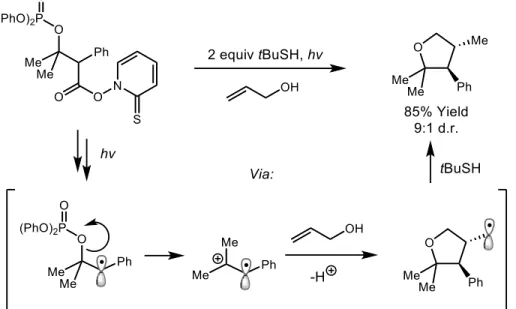
Many methods have been developed for the generation of cation radicals, one of which is the decomposition of certain functional groups. For example, Newcomb and Crich have shown that molecules bearing O-acyl thiohydroxamate esters vicinal to a phosphate ester will
decompose upon irradiation by ultraviolet light to first generate a carbon centered radical, as shown in Figure 1.3.13 This then promotes heterolytic bond cleavage of the adjacent phosphate ester, resulting in the generation of a cation radical, which is then trapped by allyl alcohol to ultimately produce tetrahydrofuran products. This method is well suited to carrying out basic studies on the reactivity patterns of olefin cation radical intermediates. However, the extensive pre-functionalization required of the substrates presents a significant limitation to the utility of this method in synthetic chemistry.
4
An alternative and direct strategy is the electrochemical oxidation of an olefin using an electrolytic cell. Numerous reactions have been developed using these setups that are reviewed elsewhere.14 Advances in the design of electrolytic cells have made these transformations accessible to the synthetic chemist, and they have been productively employed in the arena of complex molecule synthesis. However, since the continuously oxidative conditions preclude the possibility of returning electrons to the substrates, and incipient radicals are readily oxidized to carbocations, only net oxidative reactions can typically be carried out. This can be seen in the oxidative olefin difunctionalization reported by Moeller in Figure 1.4.15 In this reaction,
oxidation of an enol ether results in formation of a cation radical, which is attacked by a pendant hydroxyl group. The insipient radical is then oxidized to a carbocation, which is subsequently trapped by methanol to give the final product.
5
Historically, the potential use of cation radical mediated reactions in synthesis has been underexplored. A significant reason for this is likely the inherent limitations associated with the methods for their generation that have been previously discussed. Chemical oxidation is an attractive strategy that presents many benefits over both strategies presented previously.16 This tactic involves using a second molecule, dubbed the acceptor (A), which is a sufficiently strong oxidant such that it can remove an electron from the donor substrate (D) in a single electron transfer (SET) process (Figure 1.5). Like electrochemical oxidation, cation radicals can be
directly generated from precursor olefins by this method (Figure 1.5). However, because electron transfer events occur only upon collision between the substrate and oxidant, high-energy
intermediates are present in lower concentrations. A major benefit of this is that it allows for oxidative and reductive processes to take place concurrently in the same reaction vessel without interfering with each other.1 This not only allows for the oxidant to be used in catalytic
quantities, but can also allow for net redox neutral reactions to be developed. As will be seen, the success of this strategy has led to the disclosure of a number of new and powerful
6
Basic principles of electron transfer and photoredox catalysis 1.3
Electron transfer between a given donor (D) and acceptor (A) is an elementary chemical process, which is mathematically well defined. In the gas phase, the free energy change for electron transfer between the donor and acceptor is given below (Equation 1):
∆𝐺 =𝐼𝑃!− 𝐸𝐴! (1)
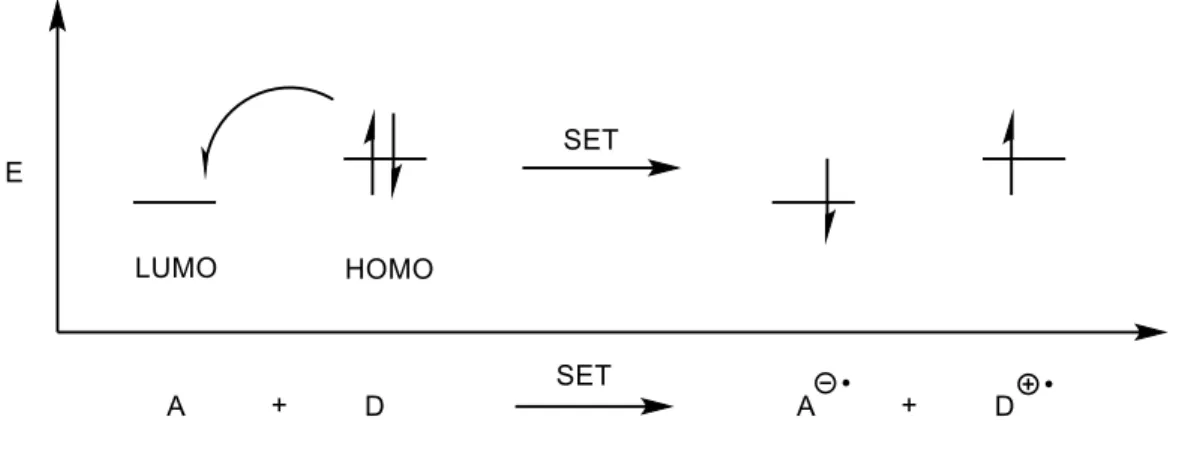
Here, IPD represents the donor’s ionization potential and EAA represents the acceptor’s electron affinity. In order for a particular redox event to be feasible, ∆𝐺 must be negative, meaning EAA must be greater than IPD. Given that these values are estimated from the respective HOMO (donor) and LUMO (acceptor) energies of the participants, this process can be visually depicted as below:
Figure 1.6: An FMO representation of single electron transfer between a donor and acceptor
Additional factors must be taken into account when moving from the gas phase to
reactions occurring in solution. In a simple situation in which an electron transfer event results in the formation of a solvent separated ion pair, the products are stabilized by both solvation (𝐸!"#$)
and a Coulombic attraction (𝐸!"#$). The free energy of formation of the solvent separated ion
pair (∆𝐺!!"#) is then given by Equation 2:
∆𝐺!!"# = 𝐼𝑃! − 𝐸𝐴!− 𝐸!∗− 𝐸
7
The modified equation also accounts for the excitation energy of an excited acceptor species (𝐸!∗), if one is present in the reaction. Furthermore, EAA and IPD are related to the
reduction potentials of the respective donor and acceptor, as shown in Equations 3 and 4:
𝐼𝑃! = 𝐸(𝐷!./𝐷) −∆𝐺 𝐷!. +𝐶 (3) 𝐸𝐴! = 𝐸(𝐴/𝐴!.) −∆𝐺 𝐴!. +𝐶 (4)
In these equations, C is a constant. ∆𝐺 𝐷!. and ∆𝐺 𝐴!. represent the solvation energies
of each species, and therefore can also be represented as:
−𝐸!"#$ = ∆𝐺 𝐷!. +∆𝐺 𝐴!. (5)
From the preceding equations, the Rehm-Weller equation can be derived:
∆𝐺!!"# = 23.06[ 𝐸(𝐷!./𝐷)−𝐸(𝐴/𝐴!.) − 𝐸
!"#$ ] −𝐸!∗ (6)
This equation can be used to determine the spontaneity of electron transfer between the ground and excited states of two different species using their respective reduction potentials and the excited state energy of the excited species. The reduction potentials found in Equations 3 through 6 can be measured using cyclic voltammetry experiments, giving values in units of volts referenced to the particular electrode used. In this text, all values given are referenced to the saturated calomel electrode (vs. SCE). Furthermore, reduction potentials are only reported for when the redox event is reversible. In these cases, such as with many of the photoredox catalysts discussed herein, values are denoted as Ered.
The oxidation of olefins, which are the predominant donor species in this text, is typically an irreversible process. In these cases, half-peak oxidation potentials are obtained by cyclic voltammetry experiments and are denoted as Ep/2. These potentials are obtained by calculating a simple mean between the observed onset of oxidation and the peak potential in the
8
such values constant is critical in order to establish a standard scale for comparisons. Other factors can complicate the analysis as well, such as the fact that these measurements are all obtained at the surface of an electrode as opposed to in bulk solution. Keeping these limitations in mind, reduction potentials still serve as a valuable tool for estimating if electron transfer between two species will be favorable.
As can be seen visually in Figure 1.6 and mathematically in Equation 1, the HOMO of the donor (D) must be higher in energy than the LUMO of the acceptor (A) in order for electron transfer to be exergonic (ΔG < 0). This presents practical limitations to the scope of the process as it applies to synthetic chemistry, especially when one is seeking to use an olefin as the donor to be oxidized, due to their relatively high half-peak oxidation potentials (Ep/2) (Figure 1.8). Triaryl aminium salts represent some of the strongest known ground state chemical oxidants, with only the p-bromotriphenyl aminium salt possessing reduction potentials above +1.3 V vs. SCE.17 Meanwhile, even highly electron rich olefins possess Ep/2 values of +1.3 V vs. SCE or greater (Figure 1.8),6,18 meaning only a very limited number of substrates can be oxidized by these salts. In order to oxidize a variety of olefins with different substitution patterns, an alternative strategy must be devised.
Photoinduced electron transfer (PET) is a powerful mechanism for obtaining electron transfer between potential donor-acceptor pairs. Key to this process, as it relates to this research program, is the use of a fluorescent molecule as the electron acceptor. Upon excitation by a photon of visible light, an electron in the acceptor HOMO is promoted to a higher energy orbital, leaving behind a low-lying SOMO. This is mathematically observed in the excited state energy term (𝐸!∗) of the Rehm-Weller equation (Equation 6): a larger term serves to make the overall
9
Figure 1.7: An FMO representation of photoinduced electron transfer
Figure 1.8 provides specific examples of potential olefinic substrates alongside one electron oxidants so that quantitative comparisons can be made. The top of the figure depicts the
Ep/2 values of a variety of olefins that would be of interest to this study, with the most readily
10
Figure 1.8: Oxidizing capabilities of selected electron donors and acceptors
Photoredox catalysts 1.4
Seminal work in the field of photoredox catalysis centered around the use of Ru(bpy)3Cl2 complexes as the catalyst.21–23 These and other related organometallic complexes have
astonishing photophysical properties that make them ideal for this application, with one of them being their long excited state lifetimes (as long as 1100 ns in MeCN).19,24 This long lived excited state is due to a metal-to-ligand charge transfer event that occurs upon excitation, and serves to substantially delay a return to the ground state. A long excited state lifetime increases the probability that it will encounter the substrate, and so can help improve the overall rate of
11
with variants possessing excited state reduction potentials as high as +1.45 V vs. SCE,25 allowing for the oxidation of electron rich styrene derivatives.
In order to oxidize a wider number of olefins, especially non-styrene derivatives, even stronger oxidants are needed, which is where we turn our attention to the use of organic photoredox catalysts. The 2,4,6-triphenyl pyrylium tetrafluoroborate (TPT) and 9-mesityl-10-methyl acridinium (Mes-Acr) classes of cationic organic compounds serve as far more strongly oxidizing electron acceptors, with some having potentials >2.00 V vs. SCE in their excited state. Another advantage of oxopyrilium salts is that their redox potential is readily tuned by altering the substituents on the three phenyl rings (Figure 1.9), and several examples have been reported. Potential drawbacks to their use include short excited state lifetimes (~9 ns) and sensitivity to degradation by nucleophiles, given the electrophilic nature of the compound (Figure 1.9). Figure 1.9: Oxopyrylium and acridinium salts as organic photoredox catalysts
12
nucleophiles,26 which is proposed to be a result of the mesityl group having a steric shielding effect.
Early examples of olefin activation via single electron oxidation 1.5
While olefin cation radicals have been known since much earlier as intermediates observed by mass spectrometry, one of the first examples in which they were employed as synthetic intermediates was in the dimerization of N-vinyl carbazole (Figure 1.10).9 The reaction was first reported using chemical oxidants, and shortly thereafter with TPT photoredox
13
Figure 1.10: First examples of [2+2] dimerization initiated by single electron oxidation
Following this initial disclosure, this strategy of catalyzing cycloadditions by single electron oxidation of the starting material has been successfully applied to a number of
transformations including crossed [2+2] cycloadditions,27,28 [2+2+2] oxygenations,29,30 and [4+2] Diels-Alder (DA) reactions.31 As it provides the basis for the research presented in this report, the cation radical DA will be given a thorough discussion separately in the following chapter.
14
This is then trapped by a bromide ion, and subsequent hydrogen atom abstraction forms the brominated products. Oxygen was found to be a suitable terminal oxidant, serving to both turn over the catalyst as well as carry out the hydrogen atom abstraction to produce hydrogen
peroxide. It is also proposed that hydrogen peroxide can re-enter the catalyst cycle as an oxidant to ultimately generate water as the stoichiometric waste product.
Figure 1.11: Photoredox catalyzed arene bromination
Prior examples of enantioselective photoredox reactions 1.6
The development of enantioselective transformations stands as one of the most
15
Figure 1.12: Overview of popular modes of enantioinduction in catalysis
More importantly, the most popular and successful strategy for rendering a catalytic reaction enantioselective is to employ a catalyst that incorporates an element of chirality into its periphery.35 Now, upon activation of the substrate by the catalyst, a chiral complex is formed such that the stereochemistry of subsequent steps is influenced by the catalyst’s chirality,
inducing asymmetry. Photoredox catalysis is not readily amenable to such strategies, though they have been attempted.36,37 The reason for this is that after the activating electron transfer event, the catalyst and substrate are no longer necessarily associated with each other (Figure 1.12). In fact, designing a system in which their proximity is enforced post-electron transfer would potentially be detrimental to reactivity, as this would facilitate back electron transfer to regenerate starting material.
The challenge then becomes to design a system in which an additional element of
16
possibility of any racemic background pathways. In discussing prior art in this field, we draw a distinction between enantioselective photoredox catalysis, which centers around the excitation of the catalyst by a photon, and enantioselective photochemistry in which the substrate is directly excited by light. We limit our discussion here to the former. While there has also been
groundbreaking research in enantioselective photochemistry in recent years, it is not directly related to this project and so is beyond the scope of discussion.
Figure 1.13: The enantioselective α-alkylation of aldehydes
17
enantioselective α-alkylation of aldehydes (Figure 1.13).22 In this seminal report, a chiral imidazolidinone catalyst condenses onto the aldehyde of the starting material, generating an enamine intermediate (3). Meanwhile in the simultaneous photoredox cycle, a reducing
equivalent of Ru(bpy)2+ is generated that donates an electron to an alkyl bromide, generating an electron deficient radical after expulsion of bromide (2). This radical then encounters the chiral enamine compound and combines to form an enantioenriched α-amino radical species (4). This radical then serves to reduce *Ru(bpy)32+ back to Ru(bpy)3+. Hydrolysis of the resultant iminium ion furnishes the alpha-alkylated product and regenerates the imidazolidinone catalyst.
Figure 1.14: PCET enables the development of an aza-Pinacol reaction
18
activated complex (Figure 1.14).38 The strategy also employs a dual catalyst system comprised of the Ru(bpy)32+ complex and a chiral phosphoric acid. In the proposed mechanism, the chiral phosphoric acid forms a hydrogen bonding complex with a carbonyl functional group in the starting material. This LUMO-lowering hydrogen bonding interaction effectively lowers the reduction potential of the carbonyl. Upon encountering *Ru(bpy)32+, the substrate is
simultaneously protonated and reduced, forming a neutral ketyl radical. The ketyl radical retains its hydrogen bonding interaction with the chiral phosphate, which is sufficient to control the absolute stereochemistry of the subsequent enantiodetermining C—C bond forming step. A number of substrates were shown to cyclize in good yields with high levels of enantioselectivity, though notably the methodology appears to be limited to α-aryl ketones.
19
Recently, the Yoon group has employed a similar strategy that enables them to carry out enantioselective crossed [2+2] cycloadditions between enones.39 In this case, a chiral Lewis acid is used as the co-catalyst, which also has a LUMO-lowering effect on the enone substrate. This ensures that only substrates complexed with the Lewis acid will be reduced by the photoredox catalyst, in this case again Ru(bpy)32+. In a control experiment, they demonstrate that no productive reactivity is observed in the absence of the Lewis acid, indicating that the substrate cannot be directly reduced by the photoredox catalyst, which would result in a background racemic reaction. After reduction of the complexed enone, an equivalent of acrolein is encountered, and a [2+2] cycloaddition occurs to generate the desired products. Figure 1.16: Application of a dual-functional chiral-at-iridium complex
20
This catalyst is used to carry out the asymmetric α-alkylation of acyl imidazoles (Figure 1.16). In a mechanism analogous to the MacMillan transformation discussed earlier (Figure 1.13), the excited state of the iridium photoredox catalyst first reduces an electron deficient alkyl bromide, producing an electron deficient radical species. At the same time, a second equivalent of the iridium complex associates with the acyl imidazole substrate, resulting in enolate formation upon deprotonation by the included equivalent of weak base. The activated substrate then encounters the previously generated alkyl radical in the enantio-determining radical addition step. This radical anion intermediate reduces the equivalent of the catalyst used in the photoredox cycle to regenerate the active species, completing the cycle. The transformation gives very high levels of enantioinduction with a variety of substrates.
These first reports in the field of enantioselective photoredox have allowed for the development of powerful new transformations and provide insight into factors governing selectivity that will guide future studies. There are many features that unite these reactions, one of the most obvious being the central importance of carbonyls as handles for both reactivity and association with the chiral co-catalyst. Additionally, the photoredox catalysts employed activate the substrates by single electron reduction in each case. No general methods have been
21
REFERENCES
(1) Prier, C. K.; Rankic, D. A.; MacMillan, D. W. C. Chem. Rev. 2013, 113 (7), 5322–5363. (2) Nicewicz, D. A.; Nguyen, T. M. ACS Catal. 2014, 4 (1), 355–360.
(3) Schmittel, M.; Burghart, A. Angew. Chem. Int. Ed. Engl. 1997, 36 (23), 2550–2589. (4) Campbell, J. M.; Xu, H.-C.; Moeller, K. D. J. Am. Chem. Soc. 2012, 134 (44), 18338–
18344.
(5) Johnston, L. J.; Schepp, N. P. J. Am. Chem. Soc. 1993, 115 (15), 6564–6571.
(6) Lew, C. S. Q.; Brisson, J. R.; Johnston, L. J. J. Org. Chem. 1997, 62 (12), 4047–4056. (7) Ledwith, A. Acc. Chem. Res. 1972, 5 (4), 133–139.
(8) Mangion, D.; Arnold, D. R. Acc. Chem. Res. 2002, 35 (5), 297–304.
(9) Crellin, R. A.; Lambert, M. C.; Ledwith, A. J. Chem. Soc. Chem. Commun. 1970, No. 11, 682–683.
(10) Bell, F. A.; Crellin, R. A.; Fujii, H.; Ledwith, A. J. Chem. Soc. Chem. Commun. 1969, No. 6, 251–252.
(11) Tanko, J. M.; Phillips, J. P. J. Am. Chem. Soc. 1999, 121 (25), 6078–6079. (12) Cao, M.-Y.; Ren, X.; Lu, Z. Tetrahedron Lett. 2015, 56 (24), 3732–3742. (13) Crich, D.; Huang, X.; Newcomb, M. J. Org. Chem. 2000, 65 (2), 523–529. (14) Moeller, K. D. Tetrahedron 2000, 56 (49), 9527–9554.
(15) Sutterer, A.; Moeller, K. D. J. Am. Chem. Soc. 2000, 122 (23), 5636–5637. (16) Kavarnos, G. J.; Turro, N. J. Chem. Rev. 1986, 86 (2), 401–449.
(17) Giese, G.; Heesing, A. Chem. Ber. 1991, 124 (11), 2623–2628.
(18) Schepp, N. P.; Johnston, L. J. J. Am. Chem. Soc. 1996, 118 (12), 2872–2881.
(19) Juris, A.; Balzani, V.; Belser, P.; von Zelewsky, A. Helv. Chim. Acta 1981, 64 (7), 2175– 2182.
22
(21) Teplý, F. Collect. Czechoslov. Chem. Commun. 2011, 76 (7), 859–917. (22) Nicewicz, D. A.; MacMillan, D. W. C. Science 2008, 322 (5898), 77–80.
(23) Ischay, M. A.; Anzovino, M. E.; Du, J.; Yoon, T. P. J. Am. Chem. Soc. 2008, 130 (39), 12886–12887.
(24) Juris, A.; Balzani, V.; Barigelletti, F.; Campagna, S.; Belser, P.; von Zelewsky, A. Coord. Chem. Rev. 1988, 84, 85–277.
(25) Crutchley, R. J.; Lever, A. B. P. J. Am. Chem. Soc. 1980, 102 (23), 7128–7129.
(26) Wilger, D. J.; Grandjean, J.-M. M.; Lammert, T. R.; Nicewicz, D. A. Nat. Chem. 2014, 6
(8), 720–726.
(27) Riener, M.; Nicewicz, D. A. Chem. Sci. 2013, 4 (6), 2625–2629.
(28) Ischay, M. A.; Lu, Z.; Yoon, T. P. J. Am. Chem. Soc. 2010, 132 (25), 8572–8574. (29) Parrish, J. D.; Ischay, M. A.; Lu, Z.; Guo, S.; Peters, N. R.; Yoon, T. P. Org. Lett. 2012,
14 (6), 1640–1643.
(30) Gesmundo, N. J.; Nicewicz, D. A. Beilstein J. Org. Chem. 2014, 10, 1272–1281.
(31) Bauld, N. L.; Bellville, D. J.; Harirchian, B.; Lorenz, K. T.; Pabon Jr, R. A.; Reynolds, D. W.; Wirth, D. D.; Chiou, H. S.; Marsh, B. K. Acc. Chem. Res. 1987, 20 (10), 371–378. (32) Ohkubo, K.; Mizushima, K.; Iwata, R.; Fukuzumi, S. Chem. Sci. 2011, 2 (4), 715. (33) Ohkubo, K.; Fujimoto, A.; Fukuzumi, S. Chem. Commun. 2011, 47 (30), 8515–8517. (34) Ohkubo, K.; Suga, K.; Fukuzumi, S. Chem. Commun. 2006, No. 19, 2018–2020.
(35) Walsh, P.; Kowzlowski, M. Fundamentals Of Asymmetric Catalysis; University Science Books: Sausalito, Calif, 2008.
(36) Hamada, T.; Ishida, H.; Usui, S.; Watanabe, Y.; Tsumura, K.; Ohkubo, K. J. Chem. Soc. Chem. Commun. 1993, No. 11, 909–911.
(37) Hamada, T.; Ishida, H.; Usui, S.; Tsumura, K.; Ohkubo, K. J. Mol. Catal. 1994, 88 (1), L1–L5.
23
(39) Du, J.; Skubi, K. L.; Schultz, D. M.; Yoon, T. P. Science 2014, 344 (6182), 392–396. (40) Huo, H.; Shen, X.; Wang, C.; Zhang, L.; Röse, P.; Chen, L.-A.; Harms, K.; Marsch, M.;
24
CHAPTER 2:THE DEVELOPMENT OF AN ENANTIOSELECTIVE CATION RADICAL DIELS
-ALDER REACTION
In this chapter we disclose our strategy and progress towards the development of an
enantioselective cation radical Diels-Alder reaction. Before the disclosure of this methodology, it would be beneficial to take a thorough look at the history and features of this transformation.
Overview of the traditional Diels-Alder reaction 2.1
The Diels-Alder (DA) reaction remains one of the most powerful transformations available in the practicing synthetic chemist’s arsenal.1,2 This [4+2] cycloaddition occurs between an appropriate diene and dienophile, and is hallmarked by broad substrate scope and predicable stereochemical outcomes, allowing for two carbon-carbon bonds and up to four contiguous stereocenters to be constructed in a single operation with complete atom economy.
25
A variety of catalysts have been shown to further enhance the rate of both normal and inverse demand Diels-Alder reactions,4 with Lewis and Brønsted acids being among the most commonly employed. In these cases, the observed rate enhancement is the result of the catalyst associating with the dienophile, which has a further LUMO lowering effect.
Figure 2.1: Overview of the Diels-Alder reaction and relevant FMO interactions
Chiral Lewis and Brønsted acids have also been reported to catalyze asymmetric versions of the DA reaction. The mechanism of enantioinduction is fairly analogous in both cases: the LUMO lowering effect of the catalyst ensures that only associated substrate molecules participate in the cycloaddition. The catalyst bears an element of chirality and is itself
26
substrate will only react at the available face, resulting in the formation of enantioenriched products.
Figure 2.2: Representative examples of catalytic enantioselective Diels-Alder reactions
Lewis acids bearing bisoxazoline (BOX) or pyridine bisoxazoline (pyBOX) ligands are among the most popular chiral catalysts for this reaction. They tend to work best when the substrate provides a site for bidentate chelation with the catalyst to provide structural rigidity, as is the case with the oxazolidinone substrate shown in Figure 2.2.6 The chiral N
-triflylphosphoramides developed by Yamamoto can give high levels of enantioinduction in some cases even when a single coordinating handle is present in the substrate.7
27
A History of the cation radical Diels-Alder reaction 2.2
The cation radical Diels-Alder reaction is a remarkable transformation due to its ability to overcome the previously described limitation of traditional Diels-Alder chemistry and allow for reactivity to be obtained between pairs of electron rich substrates.
It was a full twelve years after the initial disclosure of the [2+2] dimerization of carbazole by triarylaminium salts that the Bauld group first demonstrated that the strategy could be used to affect [4+2] dimerizations of cyclohexadiene and other conjugated dienes (Figure 2.3).10 While many early examples were limited to dimerization reactions, the group also found that cross-addition products could be obtained when the dienophile component was significantly lower in oxidation potential than the diene.11,12
28
They subsequently found that photoinduced electron transfer (PET) conditions proved a mild and attractive alternative protocol for carrying out the requisite single electron oxidation of the dienophilic component, in this case by using dicyanoanthracene as the photoredox catalyst. Furthermore, this method allowed for the reaction to be extended from a diene/diene format to an electron rich olefin/diene format. In many cases, acyclic dienes can be employed, however some substitution pattern is often required that will hold the diene in the more reactive s-cis
conformation.
Figure 2.4: Stereochemical outcomes indicate that stepwise bond formation occurs
Studies on the mechanism of the reaction have been carried out that indicate that the reaction occurs via stepwise bond formation.13–16 For example, in the cycloaddition between cyclopentadiene and cis-anethole, products with both cis and trans stereochemistry are observed (Figure 2.4). However, treatment of cis-anethole with the triarylaminium salt in isolation does not result in isomerization to trans-anethole. Therefore, the authors propose that isomerization to the trans-product is the result of a bond rotation that occurs on a distonic radical cation
29
computational results that indicate that multiple stepwise mechanisms are energetically similar, and are all ca. 17 kcal/mol lower in energy than a concerted pathway.17
In 1991, the Steckhan group introduced the use of cationic oxopyrylium salts as catalysts for this transformation,18 and were able to obtain [4+2] cyclization between indole and
cyclohexadiene in 70% yield, as well as similar yields with related substrates. In this case, the low oxidation potential of the secondary arylamine in the product proved problematic, resulting in a competing reverse reaction pathway. To overcome this issue, the group found that including stoichiometric acetyl chloride in the reaction would selectively acylate the product, which was found to raise its oxidation potential outside the range of the catalyst, preventing reversibility.
30
Figure 2.5: Examples of cation radical Diels-Alder reactions carried out under PET conditions
31
was previously mentioned, the bond formations occur in a stepwise fashion. Because several pathways are similar in energy, the exact mechanism likely depends on the substrate.17 After formation of the initial cycloadduct, a reduction event furnishes the final cyclohexene product. There are two possibilities for how this can occur: either the reduced photoredox catalyst acts as the reductant, completing a true catalytic cycle, or a second substrate equivalent acts as the reductant, beginning a chain propagation mechanism.
Figure 2.6: A general mechanism for the cation radical Diels-Alder reaction
32
reactions discussed previously, as well as in the enantioselective photoredox reactions detailed in the previous chapter.
Figure 2.7: The first observation of enantioinduction in the cation radical Diels-Alder reaction
To the best of our knowledge, an example by the Schuster group (Figure 2.7) stands as the only observation of any level of enantioinduction in the cation radical Diels-Alder reaction.20 Their strategy centers on the design and use of an axially chiral neutral cyanoarene as the
photoredox catalyst. When the reaction is run at cryogenic temperatures in toluene as the solvent, a modest 15% ee is observed. Their model for enantioinduction is that, following the key
33
catalyst and substrate in close proximity after electron transfer facilitates back electron transfer. This would serve to regenerate starting material in a non-productive pathway, greatly
diminishing the overall rate of reaction. Unfortunately no yield for the transformation was reported, and so the magnitude of this effect cannot be assessed.
Figure 2.8: Design of a new class of photoredox catalysts bearing chiral anions
34
event this anion should now be paired with the charged cation radical intermediate (Figure 2.8). In fact, the coulombic attraction would hypothetically keep it in association with all the
cationically charged intermediates of the catalyst cycle.
Given the precedent from the Schuster group, we were intrigued by the possibility of here again using ion pairing to induce asymmetry, but in a very different manifold. If the
tetrafluoroborate anion could be replaced with a chiral anion of some variety, then it too ought to remain closely paired with the cation radical intermediates of the reaction. This could then be used to control the facial approach of the diene and render the reaction enantioselective. And so, our goal at the outset of this project became first and foremost to assess the validity of this hypothesis and ascertain whether this would be able to induce asymmetry in the cation radical Diels-Alder reaction.
35
Figure 2.9: The role of solvent polarity in influencing ion pairing interactions
Chiral anions have also become an area of intense interest in chemical research, and have been successfully used to control the absolute stereochemistry of several reactions.21,22 The most important precedent for this study comes from the Toste group.23 In an initial report, they
designed a system to simply ascertain whether such electrostatic interactions alone can be used to relay chiral information from catalyst to substrate. The designed reaction uses a silver salt
bearing a chiral phosphate anion as the catalyst and was used to catalyze the opening of meso -aziridinium ions. The aziridium ion is first generated when a chloride ion is abstracted from a racemic substrate by the silver salt (Figure 2.10). After the metathesis reaction occurs,
36
and provide the ring-opened products with high levels of enantioinduction. Since this first report, the field has advanced significantly and numerous other examples of chiral anions have been reported by this and other labs.
Figure 2.10: Precedent for the ability of chiral anions to induce asymmetry catalytically
For the design of our chiral complexes, we chose to also focus our attention on chiral anions derived from the corresponding Brønsted acid. The reason for this is that a variety of chiral Brønsted acids have been reported in the literature, and their properties are highly tunable.24–26 We hypothesized that the nucleophilicity of the anion would be of central
37
Figure 2.11: Range of acidities of various chiral Brønsted acids measured in MeCN
Rueping has recently reported the acidities of a variety of commonly used Brønsted acids in acetonitrile, providing a standard scale for comparing their reactivity.27 Phosphoric acids proved to be relatively weak, with pKas ranging from ca. 14 to 12.5, while N
-triflylphosphoramides proved to be significantly more acidic due to the electron withdrawing nature of the triflyl group. Disulfonyl amides were found to be more acidic still, yet are as of now sparsely used, likely due to the challenges associated with their synthesis which will be discussed in Section 1.3. The steric and electronic properties of these acids can be further tuned by modifying the substituents at the 3,3’-positions of the biaryl moiety.
38
of the chosen Brønsted acid promoted cyclization to regenerate the oxopyrylium salt, now paired with a chiral anion. The reactions were complete in minutes with heating to approximately 50-60 °C, and our first generation purification consisted of simple recrystallization from ethanol, which furnished the salts as bright orange solids.
Figure 2.12: Synthesis of chiral anion bearing photoredox catalysts
As the research program progressed, it was found that this strategy led to batches of catalyst that gave variable levels of enantioselectivity. After screening a number of potential purification protocols, we found that carrying out the cyclization in excess EtOH at 40 °C followed by a simple liquid/liquid extraction between MeOH and hexanes furnished highly pure samples of the complexes that gave consistent results.
With a route to potential catalysts in hand, the next step was to develop a model substrate for the reaction on which to screen for reactivity. Dr. Tien Nguyen, a fellow graduate student, worked on the development of an intermolecular reaction, and confronted issues of low reactivity in numerous situations. In order to improve on this problem of reactivity, we set out to develop an intramolecular version of the reaction, and so a number of substrates were synthesized that contained tethered diene and dienophile moieties.
The oxidation potentials of both the diene and dienophile must be taken into
39
results are obtained when the dienophile is the more readily oxidized component in the reaction. Oxidation of the diene can often result in either undesired product formation such as [2+2] cycloadducts, or a lack of reactivity. Since substituted dienes such as cyclohexadiene bear oxidation potentials of ca +1.8 V vs. SCE, we chose to use 4-methoxy styrene derivatives as dienophiles, which are oxidized at ca +1.3 V vs. SCE (vide infra). We chose to employ 2,4,6-tri(4-methoxyphenyl)pyrylium tetrafluoroborate (4-OMe-TPT) as the catalytic photooxidant for this study, as its excited state reduction potential lies at ca. +1.74 V vs. SCE.
Figure 2.13: Design of intramolecular cation radical DA reaction substrates
40
Figure 2.14: General strategy for intramolecular DA reaction substrates
We carried out our preliminary studies using a substrate containing an isopropyl group at an internal position of the diene. This substrate was subjected to racemic reaction conditions using 4-OMe-TPT as the catalytic photooxidant in DCM as the solvent.The substrate rapidly underwent the desired [4+2] reaction with high diastereoselectivity even when very low catalyst loadings were used.
41
Encouraged by the observed high level of reactivity, we set out to screen for reactivity with several triphenylpyrylium (TP) complexes bearing chiral anions. Phosphate anions resulted in no observed reactivity. Moving to a less nucleophilic N-triflylphosphoramide with phenyl rings at the 3,3’-positions also resulted in no reactivity. However, moving to the more sterically-demanding triphenyl silyl (SiPh3) group, a modest yield was obtained along with good levels of enantioinduction. Since this increase in steric demand proved beneficial, we continued the trend by employing para-tert-butyl triphenylsilyl groups. Unfortunately this had a deleterious effect on conversion, and the effect on selectivity could not be ascertained.
Figure 2.16: Screen of TP salts bearing chiral anions for their ability to induce asymmetry
42
coordinating anion. This claim is supported by the observation that these complexes are visibly fluorescent in solution, while the 3,3’-phenyl analogues are only marginally so. It is challenging to speculate on why then the addition of the para-tert-butyl groups does not have a further beneficial effect. It is possible that the further steric hindrance significantly decreases the probability of the excited state of the catalyst coming in contact with a substrate molecule.
With the SiPh3-N-triflylphosphoramidate catalyst (1d) proving most effective, we then screened this catalyst and substrate combination in a number of solvents. We were particularly interested in the effect of solvent polarity on selectivity, as this would strongly influence the nature of the ion pairing interactions between catalyst and substrate. Surprisingly, it was
43 Figure 2.17: Solvent effects on reactivity and selectivity
Within the series of aromatic solvents investigated, an additional pattern emerges.
Enantiomeric excess shows a negative correlation with solvent dielectric constant: lower polarity aromatic solvents give higher levels of enantioselectivity. This finding serves to corroborate our hypothesis that tight ion pairing is necessary for the successful relay of chiral information from catalyst to product.
44
proved fairly consistent within a range of temperatures, with reactivity beginning to suffer below -30 °C.
Figure 2.18: Catalyst loading and temperature effects on reactivity and selectivity
45
Figure 2.19: Investigating the effect of adding excess chiral anion to the reaction
With optimized conditions in hand we then set out to explore the scope of the
46
Figure 2.20: Substrate scope of the enantioselective cation radical DA after optimization
In the intermolecular variant of this transformation, Dr. Nguyen was able to obtain similar levels of enantioselectivity with a select set of substrates. The highest yields were
obtained when using cyclopentadiene as the diene, due to its highly activated nature. While good selectivity was also observed with 2,3-dimethylbutadiene, the yield suffered drastically in this and many other cases.
47
to further improve the transformation, as well as applications of this catalyst system to new synthetic transformations.
Figure 2.21: Select intermolecular DA results
Synthesis and application of disulfonyl amide catalysts 2.3
48
Figure 2.22: Potential limitations of the N-trifylphosphoramidate anion moiety
Chiral disulfonyl amides came to our attention as an alternative scaffold that could address many of these issues. In addition to being truly C2 symmetric and having a more withdrawn anionic moiety, they have been found to be considerably more acidic than N -trifylphosphoramide, which serves to further decrease the nucleophilicity of the conjugate sulfonyl amidate.29,30
Figure 2.23: Synthesis of chiral disulfonyl amides
-49
dimethylthiocarbamoyl chloride followed by Newman-Kwart rearrangement and hydrolysis. We were able to use this strategy to first synthesize an unsubstituted complex, as well as a variant bearing m,m-trifluoromethylphenyl groups at the 3,3’-positions of the BINOL scaffold. Upon converting these to the corresponding TP salt, they were found not to function as catalysts for the DA reaction under standard conditions (Figure 2.24). We attribute this to the lack of sufficient steric bulk to frustrate the nucleophilicity of the anion, as in the case of the N -trifylphosphoramidates bearing phenyl substitution discussed previously.
Figure 2.24: Attempts to use disulfonyl amidate anions to influence enantioselectivity
50
lithium and a variety of electrophiles. Even quenching the reaction with D2O failed to show any appreciable level of deuterium incorporation. We are unable to reconcile this discrepancy. Figure 2.25: Unsuccessful attempts to construct BINOL-derived disulfonyl amides with sterically demanding functional groups at the 3,3’-positions
51
Figure 2.26: Further unsuccessful attempts to construct BINOL-derived disulfonyl amides with sterically demanding functional groups at the 3,3’-positions
Around this time, a new class of dimeric chiral Brønsted acids were reported by List33,34 that are capable of imparting high levels of enantioselectivity in multiple transformations. This scaffold was appealing because of its highly demanding chiral environment, and so we set out to synthesize a small library of variants with different groups at the 3,3’-positions. Unfortunately under our optimal reaction conditions, no reactivity was ever observed using this system, even when running the reaction at ambient temperature (Figure 2.27). Switching to DCM, however, resulted in complete conversion and in one case a slight level of enantioinduction was observed. This is remarkable because no other system yet investigated has shown any level of
52
Figure 2.27: Imidodiphosphorate anions as potential chiral catalysts
Incorporation of hydrogen bonding secondary interactions into the system 2.4
All approaches to controlling enantioselectivity in this transformation have so far
53
which rely entirely on non-covalent interactions between substrate and catalyst, it is often beneficial for multiple points of contact to exist between the two. In these cases,
enantioinduction is achieved by a selective rate acceleration of one of the two enantiomeric transition states. Multiple stabilizing interactions can serve to further organize the desired transition states and in doing so improve selectivity.35
We hypothesized that such a strategy would be amenable to our system and provide a twofold benefit. By adding an additional point of hydrogen bonding between the intermediate and chiral anion, the rigidifying effect could help to enhance enantioselectivity. Furthermore, stabilizing the desired transition state could also help to increase the rate of reaction and improve yields.35
Figure 2.28: Previous work demonstrating the ability of hydrogen bonding interactions to improve enantioselectivity in chiral ion pairing catalysis
54
2.28).36,37 They propose that the hydrogen bonding capabilities of the triazoles are of central importance to their success in this system: by forming an attractive stabilizing interaction with the substrate, the desired transition state is selectively accelerated over the undesired. This claim is supported by the construction of analogues of the catalyst in which each of the nitrogen atoms is sequentially replaced by a methine unit. Both of these variants should have very similar steric properties to the original catalyst, yet both give enantioselectivities half that of the triazole-containing catalyst.
55
Figure 2.29: Synthesis of triazole containing chiral anions
To create a model system for our studies, we first attempted an intermolecular DA
56
Figure 2.30: Attempts to design a cation radical DA reaction incorporating H-bonding opportunities
57
this pathway, and while this was successful in preventing dimerization the substrate also failed to undergo any other observable reaction. An enamide-containing diene was also prepared from cyclohexenone, but also resulted in decomposition when subjected to the standard reaction conditions.
Figure 2.31: Attempts to use allylic amides as hydrogen bonding handles
Lastly, we attempted to use an electron rich allylic amide as a dienophile in a DA reaction employing cyclohexadiene as the diene. Three variants of the substrate were used, modifying the substitution on the amide moiety. Minimal conversion was observed with both the aryl amide substrates. With the isopropyl substrate, 41% conversion of the substrate was observed at 4 hours and potential product peaks were seen by crude NMR (Figure 2.31). However, the relatively sluggish and non-selective nature of the reaction indicated that this would not likely transfer well to the enantioselective reaction conditions and so was abandoned. Figure 2.32: Use of triazole containing TPT salt as a catalyst using the model substrate
![Figure 1.10: First examples of [2+2] dimerization initiated by single electron oxidation](https://thumb-us.123doks.com/thumbv2/123dok_us/8269958.2190507/36.918.149.765.171.709/figure-examples-dimerization-initiated-single-electron-oxidation.webp)