Immunology and Immunogenetics Insights
201
1:3 1–57
doi:
10.4137/III.S655
8
This article is available from
http://www
.la-press.co
m
.
© the author(s), publisher and licensee Libertas
Academica Ltd.
This is an open access article. Unrestricted non-commercial use is permitted provided the original work is properly cited.
Open
Access
Full open access to this and
thousands of other papers at
http://www
.la-press.co
m
.
Immunology and Immunogenetics Insight
s
O
r
Ig
In
A
L
r
e
S
e
A
rch
Immunology and Immunogenetics Insights 201
1:3
1
Bioinformatics-Based
predictions of
peptide Binding
to Disease-Associated HLA
p
roteins
suggest
explanation
for
shared
Autoimmunity
JP
g
lutting
1
, Pedro
A.
r
eche
2
and Masha
Fridkis-h
areli
3
1
Universitat de Lleida, Plaza Víctor Siurana 1, Lleida 2500
3, Spain.
2
Laboratorio de ImmunoMedicina, Dpto.
Microbiologia I (Inmunologia),
Facultad de Medicina, Universidad
c
omplutense de Madrid, Madrid 28040, Spain.
3
M
e
Biotechnology
, Sudbury
, MA
01776, USA.
c
orrespon
ding author email:
t
Abstract:
Aim:
This
study
was
designed
to
examine
the
immunogenetic
basis
for
shared
autoimmunity
, resulting
in
autoantigen
presentation
that
leads to the production of two or more disease-specific autoantibodies.
Methods:
A
bioinformatics
approach
based
on
peptide
binding
predictions
to
disease-associated
HLA
determinants
has
been
developed
and
tested
here
using
11
disease
associations
between
autoimmune
systemic
and
mucocutaneous
blistering
disorders.
Various
HLAs
associated
with
antigens
within
a
given
“disease
model”
(set
of
HLA
class
II
and
protein
sequences
known
to
be
associated
with
a
spe
-cific
autoimmun
e
disease)
were
tested
and
ranked
against
the
antigenic
proteins,
first
with
proteins
they
are
known
to
associate
with
and
then
with
proteins
known
to
be
implicated
in
a
second
disease
model.
In
every
case
binding
predictions
were
compared
for
dif
ferent
proteins
binding
to
the
same
HLA.
Subsequently
, disease-relate
d
autoantigens
have
been
tested
for
their
binding
affinity
against
each
disease-specific HLA
class II protein.
Results:
For
a
single
HLA
haplotype,
several
binders
have
been
generated
from
a
related
autoantigen
with
the
variable
binding
score.
In
most
cases,
the
binding
score
corresponding
to
the
interactions
between
the
autoantigen-derived
epitope
and
the
HLA
associate
d
with
one
disease
was
similar
or
lower
than
the
interactions
between
the
epitope
from
proteins
associated
with
the
second
disease
and
the
same
HLA.
No
tab
ly
, there
was
no
compelling
promiscuity
in
peptide
binding
to
each
of
the
HLA
molecules,
in
spite
of
the
promiscuous
nature of HLA
class II binding.
Conclusions:
The
data
suggest
that,
in
susceptible
individuals,
shared
autoimmunity
might
be
initiated
by
two
types
of
HLA/peptide
interaction;
first
between
an
autoantigen-derived
epitope
and
its
disease-associated
HLA
molecules,
and
second,
between
a
dif
ferent
peptide of the same autoantigen and HLA
proteins specific for the second disease.
Keywords:
autoantigenic epitopes, autoimmune blistering diseases, HLA
g
lutting et
al
2
Immunology and Immunogenetics Insights
201 1:3
Introduction
Autoimmune
mucocutaneous
blistering
diseases
(AMBD)
such
as
pemphi
gus
vulgaris
(PV),
pem
-phigus
foliaceus
(PF),
bullous
pemphigoid
(BP),
ocular
cicatricial
pemphigoid
(OCP),
dermatitis
her
-petiformis
(DH)
and
mucous
membrane
pemphigoid
(MMP),
are
a
group
of
rare
or
gan-specific
diseases
that
af
fect
skin
and
multip
le
mucous
membranes.
1–5PV
is
a
potentially
fatal
disease
characterized
by
the
loss of interce
llular
adhesion
of keratinocytes,
result
-ing
in
acantholysis.
6–8In
the
serum
of
PV
patients,
high
titers
of
circulating
autoantibodies
tar
get
-ing
the
epide
rmal
adhesion
molecule
desmoglein
3
(Dsg3)—keratinocyte
transmembrane
proteins
local
-ized
in
the
desmosome,
essential
for
maintaining
the
integrity
of
the
epidermis
—are
believed
to
cause
clinical
disease
by
direct
binding
to
and
disruption
of
desmoglei
n
proteins.
1,9The
association
of
HLA
class
II
antig
ens
with
susceptibility
to
PV
has
been
demonstrated
in
numerous
studies.
10–14In
Ashkenazi
Jews,
PV
appears
tightly
linked
to
the
rare
haplo
-type
HLA-DR4
(DRB1*0402):
DQB1*0302,
while
in
non-Jewish
patients,
it
is
linked
to
the
haplotype
DRB1*404X: DQB1*0503.
15MMP
af
fects
mucous
membranes
of
the
body
and
is
characteriz
ed
by
the
presence
of
autoantibodies
to
human
β
4 integrin,
16,17while
BP
which
predomina
ntly
af
fects
the
skin
and
is
associated
with
bullous
pem
-phigoid
antigen
1
(BP
Ag1)
and
2
(BP
Ag2).
18Both
BP
and
MMP
have
been
shown
to
have
a
strong
link
-age
to
DQB1*0301.
18,19It
has
been
demonstrated
that
the
same
patient
may
have
antibodies
against
more
than
one
autoantigen
within
the
skin
and
mucous
membrane,
resulting
in
more
than
one
autoimmune
mucocutaneous
disease.
For
example,
patients
with
PF
may
develop
BP
,
20,21patients
with
MMP
may
have
PV
(22),
and
some
patients
are
af
fected
with
both
PV
and OCP
.
23OCP
is
a
systemic
autoimmune
pemphig
-oid
disorder
that
has
both
ocular
and
non-ocular
manifestations.
OCP
can
cause
bullous
lesions
of
the
skin
and
mucous
membran
es
that
result
in
scarring
of
the
af
fecte
d
skin,
conjunctiva
(inner
lining
of
the
eye),
and
other
mucous
membranes.
24,25Dif
ferent
epi
-thelial
membrane
zone
components
have
been
recog
-nized
by
antib
odies
in
pati
ents
with
OCP
, ie,
BP
Ag1
and
BP
Ag2,
laminin
5,
lam
inin
6,
type
VII
collagen,
β
4
integrin
subunit,
and
antigens
with
unknown
identities
(a
45-kd
protein,
uncein,
a 168-kd
epithelial
protein,
and
a
120-kd
epithelial
protein).
26,27Among
white
patients
in
the
United
States,
OCP
is
associated
with the DQB1*0301 allele.
DH
is
an
autoimmune
blistering
disorder
associ
-ated
with
a
gluten-sensitiv
e
enteropathy
. It
is
char
-acterized
by
grouped
excoriations,
erythematous,
urticarial
plaques,
and
papules
with
vesicles.
DH
is
caused
by
the
deposition
of
IgA
in
the
papillary
dermis,
which
triggers
an
immunologic
cascade,
resulting
in
neutrophil
recruitment
and
complement
activation.
28,29DH
is
associated
with
an
increased
expression
of
HLA-A1,
HLA-B8,
HLA-DR3,
and
HLA-DQ2
haplotypes.
30,31Evidence
is
mounting
that
epidermal
transglutaminase
3
(TGM3),
a
cytosolic
enzyme
involved
in
cell
envelope
formation
during
keratinocyte
dif
ferentiation
, is
the
autoantigen
of
DH.
Theoretically
, DH
is
caused
by
dermal
deposition
of
circulating
immune
complexes
containing
both
IgA
and
TGM3.
32,33In
contrast
to
these
or
gan-specific
diseases,
con
-nective
tissue
disorders,
or
systemic
diseases,
includ
-ing
systemic
lupus
erythem
atosus
(SLE),
rheumatoid
arthritis
(RA),
and
systemic
sclerosis
(SSc),
involve
multiple
tissues
and
or
gans.
34–36Mixed
connective
tissue
disease
(MCTD)
is
also
a
systemic
autoim
-mune
syndrome
that
is
characterized
by
the
pres
-ence
of
high
titers
of
serum
antibodies
against
small
nuclear
ribonuclear
proteins
(U-snRNPs),
37,38in
particular
against
U1
small
nuclear
RNP
polypep
-tide
(U1
snRNP).
It
has
been
suggested
that
MCTD
represents
a
distinct
clinica
l entity
, based
on
clinical
manifestations
that
separate
MCTD
from
other
con
-nective
tissue
diseases.
39V
arious
associations
of
HLA
class
II
antigens
with
MCTD
have
been
reported,
including
HLA-B7
and
HLA-Dw1.
40In
another
study
,
HLA-DR4
was
found
to
be
significantly
increased
in
MCTD,
41whereas
others
reported
an
associa
-tion
between
HLA-DQw3
and
anti-RNP
antibod
-ies
in
patient
s
with
MCTD.
42Interestingly
,
MCTD
patients
with
increased
IgG
autoantibodies
against
U1-70
kD
polypeptide
have
an
increased
prevalence
of
HLA-DR4
compared
with
controls.
43Furthermore,
molecular
biology
studies
have
shown
that
most
MCTD
patients
carrying
HLA-DR4
or
HLA-DR2
alleles
share
a region
of
homology
consisting
of
seven
amino
acids
in
the
HLA-DRB1
gene.
44This
“shared
epitope”
of
HLA-DR
mole
cules,
in
dif
ferent
alleles
Peptide binding predictions of shared autoimmunity
Immunology and Immunogenetics Insights 201
1:3
3
and
in
dif
ferent
patients
with
MCTD,
may
be
impor
-tant
for
the
modulation
of
the
autoimmune
response
to the U1-70 kD antigen.
45
Based
on
the
accumulated
evidence
of
shared
autoimmunity
, it
has
been
intriguing
to
investigate
the
relationship
between
the
genetic
and
immunological
mechanisms
for
the
simult
aneous
production
of
two
or
more
autoantibodies
in
patients
exhibiting
more
than
one
autoimmune
disease.
A
hypothesis,
which
in
part
may
explain
some
of
the
increased
susceptibil
-ity
to
both
autoimmune
blistering
and
systemic
con
-nective
tissue
diseases,
has
recently
been
proposed.
46This
hypothesis
is
based
on
the
unequivocal
evidence
that
CD4
+T
cells
play
a
critical
role
in
autoantibody
production,
implying
that
existence
of
HLA
class
II-
restricted
T cell
epitopes
might
trigger
autoimmunity
.
Three
possible
scenarios
for
the
immunopathogenic
mechanisms
leading
to
breakage
of
tolerance
and
induction
of
two
distinct
autoimmune
diseases
in
the
same
individual
have
been
discussed:
1)
T
cell
epitopes
of
the
two
dif
ferent
autoantigens
associate
with
each
of
the
susceptible
HLA
molecules,
result
-ing
in
dual
autoimmunity;
2)
a
single
epitope
of
an
autoantigen
binds
to
both
HLA
specificities,
leading
to
the
inductio
n
of
both
diseases
by
cross-
reactivity;
and
3)
two
distinct
epitope
s
of
the
same
autoantigen
are
able
to
bind
two
dif
ferent
HLA
molecules
that
are
associated
with
the
two
diseases,
implying
that
both
T cell
epitope
s originating
from
one
autoantigen
will
activate
immunopatogenic
mechanisms
by
binding
to
two
HLA
molecules
specific
for
two
diseases.
In
order
to
test
each
of
these
hypotheses,
bioinformatics-based
predictions
of
peptide
binding
to
disease-associated
HLA
determinants
have
been
generated
using
multi-HLA
II
peptid
e binding
analysis.
This
communication
explores
the
nature
of
autoantigen-derived
epitopes
and
their
binding
characteristics
to
HLA
proteins
in
the context of shared autoimmunity
.
Methods
Protein sequences
The
protein
sequences
of
autoantigens
were
collected
from
the
Consensus
Coding
Sequence
Da
tab
ase
(CCDS),
a
collaborative
ef
fort
between
the
NCBI
and
several
other
or
ganiza
tions
which
contains
con
-sistently
annotated
protein
coding
regions
of
human
and
mouse
genes.
47Only
human
sequences
were
used
in
this
projec
t,
and
alterna
te
exons
were
included
in
the
sequences.
The
autoantigens
tested
in
this
study
are
listed
in
Table
1,
and
in
most
cases
consist
of
the
entire
protein
sequence
from
which
specific
autoanti
-gens (such as BP180 and BP230) are derived.
Peptide-h
LA
II binding predictions
The
analysis
of
peptide
binding
to
HLA
II
molecules
known
to
be
involved
in
autoimmune
mucocutane
-ous
blistering
diseases
was
based
on
the
use
of
the
same
methodology
applied
by
the
Rankpep
web
server
.
48Rankpep
predicts
peptide
binding
using
position
specific
motif
matrices—also
known
as
motif
profiles—that
are
derived
from
known
pep
-tide
binders.
49,98A
program
was
written,
cross-HLA
II-binding
analyzer
, to
perform
multiple
rankings
of
predicted
binding
potentials
and
classify
the
binding
predictions
into
sets:
predictions
for
protein-HLA
II
sets
known
to
be
involved
in
disease
genesis.
Results
were
or
ganiz
ed
by
disease
model—sets
of
HLA
II
and
proteins
known
to
be
involved
in
the
genesis
of
specific autoimmune diseases were used.
The
cross-HLA
II-binding
analyzer
performs
three
types
of
sorting
based
on
the
three
scenarios
proposed
in
this
paper:
1)
Single
HLA
II
recognition,
2)
Dual
HLA
II
recognition
with
a
single
epitope,
and
3)
Dual
HLA
II
recognition
with
dual
epitopes.
The
analysis
was
designed
to
group
the
components
of
each
disease
model,
the
HLA
IIs
and
proteins
involved
in
known
disease
interac
tions—for
example,
HLA-DQB1*0301
with
alpha
1
type
XVII
collagen
(BP180)
and
dys
-tonin
(BP230)
in
the
BP
model—and
sort
results
by
within-model
and
cross-model
HLA
II-peptide
bind
-ing
pairings.
Some
details
of
the
cited
scenarios
are
as follows:
Scenario
1
—Single
HLA
recognition
:
This
sce
-nario
is
assumed
to
be
the
standard
case,
since
each
disease
model
exists
independently
. The
cross-HLA
II-binding
analyzer
generates
a
series
of
ranked
results
within
the
known
disease
models
described
above
(sets
of
HLA
II
and
proteins
known
to
contain
antigenic
sequences),
showing
all
predicted
binders
for
each
HLA
II-protein
pairing—peptides
scored
above
the
binding
threshold
for
that
pairing.
Because
these
interactions
are
within
known
disease
models,
they are used as reference values.
Scenario
2
—Dual
HLA
II
recognition
with
a
single
epitop
e:
the
cross-HLA
II-binding
analyzer
has
an
intersection
analysi
s
function,
which
is
used
g
lutting et
al
4
Immunology and Immunogenetics Insights
201 1:3
to
find
promiscuous
peptides
in
a
series
of
two
HLA
II-peptide
binding
predictions.
To
identify
promiscu
-ous
peptide-binding
peptides,
the
analysis
was
limited
to
the
set
of
the
top
5%
of
peptides
in
each
group
of
results.
This
analysis
identifies
promiscuous
peptide
binders
across
known
disease
models.
When
a
com
-mon
peptide
was
found
in
more
than
one
autoanti
-gen,
it
was
included
in
an
intersection
analysis
report,
detailing
the
binding
score
of
the
common
peptide
for
each matrix.
Scenario
3
—Dual
HLA
recognition
with
dual
epitopes:
the
cross-HLA
II-binding
analyzer
pro
-duces
results
for
cross-model
pairings
of
HLA
IIs
and
proteins.
To
evaluate
the
potential
for
the
pairings
to
produce
imm
unogenic
reac
tions,
binding
predictions
(binding
affinity
, number
of
predicted
binders)
across
models
are
compared
to
the
top
predicted
binding
scores
for
known
immun
ogenic
reactions
within
known disease models (Scenario 1).
Results
Based
on
the
published
observations
of
shared
auto
-im
m
un
ity
a
nd
o
n
the
ore
tic
al
pre
dic
tio
ns
ex
plo
rin
g
the
p
ro
ba
bil
ity
o
f
its
o
cc
urr
en
ce
,
the
f
oll
ow
ing
dis
ea
se
ass
oc
iati
on
s
ha
ve
b
ee
n
tes
ted
:
PV
/M
M
P,
PF/BP
,
PV/OCP
,
PV/BP
,
PV/MCTD,
PF/MCTD,
B
P/M
C
TD
, D
H
/M
C
TD
, O
C
P/M
C
TD
, M
M
P/M
C
TD
and
BP/DH.
The
list
of
autoantigens
and
HLA
asso
-ciations
in
autoimmune
blistering
and
systemic
dis
-eases
is
presented
in
Table
1
. F
or
m
ost
d
ise
ase
s i
n
this
study
, eg,
PV
, MMP
, DH,
PF
and
MCTD,
a
sin
-gle
au
toa
nti
ge
n h
as b
ee
n r
ep
ort
ed
, w
ith
th
e e
xc
ep
tio
n
of
BP
and
OCP
that
are
characterized
by
the
pres
-en
ce
of
th
e s
am
e tw
o a
uto
an
tig
en
s, B
PA
g1
(B
P1
80
),
de
riv
ed
fro
m
alp
ha
1 t
yp
e X
V
II c
oll
ag
en
an
d B
PA
g2
(al
so
kn
ow
n a
s B
P2
30
), p
art
of
th
e d
yst
on
in p
ro
tein
.
It
is
noteworthy
that
MMP
, BP
and
OCP
are
all
asso
-ciated
with
the
prevalent
HLA-DQB1*0301
allele,
w
hil
e
PV
, D
H
, P
F
an
d
M
C
TD
e
ac
h
ca
rry
d
isti
nc
t
HLA
haplotypes.
Three
hypothetical
models
of
peptide-HLA
II
interactions
proposed
by
Fridkis-Hareli
46w
ere
te
ste
d
usi
ng
H
LA
-sp
eci
fic
bi
nd
ing
m
atr
ice
s a
nd
au
toa
ntig
en
sequences
listed
in
Table
1.
Fo
r e
ach
H
LA
sp
eci
fic
ity
,
the
autoantigen
of
interest
was
examined
for
the
pres
-ence
of
potential
binding
epitopes
and
scored
based
on
Table 1. Autoantigens and h LAassociations in autoimmune blistering and systemic diseases.
Disease HLA II Autoantigen cc D s ID Reference Pemphigus vulgaris h LA-D r 4 (D r B1*0402) DQwB1*0302 h LA-D r 4 (D r B1*0404) DQ5 (DQB1*0503) Desmoglein 3 11898.1 10–15 Mucous membrane pemphigoid h LA-DQ7 (DQB1*0301) β 4 integrin 11727.1 16,17 Bullous pemphigoid h LA-DQ7 (DQB1*0301)
Alpha 1 type XVII collagen
(BP180) Dystonin (BP230) 7554.1 4959.1 18,19 Ocular cicatricial pemphigoid h LA-DQ7 (DQB1*0301) h LA-D r 4 (D r B1*0401)
Alpha 1 type XVII collagen
(BP180) β 4 integrin 7554.1 11727.1 26,27 Mixed connective tissue disease h LA-B7, h LA-Dw1 h LA-DQw3 U1 sn-rn P polypeptide 12756.1 38,39 41–43 Dermatitis herpetiformis h LA-DQ8 (DQA1*0301/ DQB1*0302) h LA-DQ2 (DQA1*0501/ DQB1*0201) Transglutaminase 3 33435.1 28–33 52,53 Pemphigus foliaceus h LA-D r B1 (D r B1*0404, D r B1*1402, D r B1*1406, D r B1*1401, D r B1*0102) Desmoglein 1 11896.1 20,21, 57 Abbreviation: cc
DS, consensus coding sequence project.
47
(http://www
.ncbi.nlm.nih.gov/projects/
cc
Peptide binding predictions of shared autoimmunity
Immunology and Immunogenetics Insights 201
1:3
5
peptide
binding
affinity
. The
results
arranged
by
dis
-ease
model
are
shown
in
Supplemental
Ta
b
les
1
–1
1.
A
ll
po
ten
tia
l e
pito
pe
s
(se
qu
en
ces
p
red
icte
d
to
bin
d
ab
ov
e th
e b
ind
ing
th
res
ho
ld
for
th
e H
LA
m
atr
ix
w
ere
retr
iev
ed
fro
m
ea
ch
an
aly
sis
(ra
w
da
ta n
ot s
ho
w
n).
It i
s
im
po
rta
nt t
o n
ote
th
at c
om
pa
ris
on
s w
ere
m
ad
e b
etw
een
HLA-peptide
binding
analyses
against
the
same
HLA
m
ole
cu
le—
all
bin
din
g s
co
res
an
d v
alu
es
w
ere
re
lati
ve
to
tha
t s
pe
cifi
c H
LA
cla
ss
II.
It s
ho
uld
als
o b
e n
ote
d
that
not
all
the
HLA
specificities
known
to
associate
with
a
particular
disease
were
available
from
the
da
ta
-b
ase and thus were not included in the present report.
PV/MMP
Autoantigenic
proteins
associated
with
each
of
these
diseases
were
tested
for
binding
to
the
HLA
haplo
-types as described below:
PV
Model
: the
HLA
II-peptide
biding
analysis
for
desmoglein
3
preproprotein
generated
991
sequences
in
total
(Supplemental
Table
1).
Four
derived
peptides
were
predicted
to
bind
to
HLA-DQ8
(DQA1*0301/DQB1*0302)
above
the
binding
thresh
-old,
with
a
predicted
range
of
36.91%–25.22%
(from
high
to
low
optimal
binding).
In
contrast,
binding
of
the
same
autoantigen
to
HLA-DR4
(DRB1*0402)
determinants
resulted
in
11
predicted
binders
with
a
range
of
40.33%–25.80%
of
the
optimal
score.
Similarly
,
five
predicted
binders
of
Dsg3
to
HLA-DR4
(DRB1*0404)
were
identified
with
a
range
of
53.46%–32.23%
of
the
optimal
score
(Supplemental
Table
1A).
The
sequences
of
Dsg3-derived
binding
epitopes are presented in Supplemental
Table
1B.
MMP
Model
:
Table
2
sh
ow
s th
at
the
an
aly
sis
fo
r
HLA-DQ7
(DQB1*0301)
and
β
4
integrin
generated
18
14
se
qu
en
ces
. F
ou
rte
en
p
ep
tid
es
w
ere
p
red
icte
d t
o
bind,
at
44.19%–25.90%
of
the
optimal
binding
score.
For peptide sequences refer to Supplemental
Table
1B.
PV/MMP
:
The
cross-model
analysis
matches
HLA-DQ7
(DQB1*0301)
(from
the
MMP
model)
with
Dsg3,
the
antigen-pr
oducing
protein
from
the
PV
model.
Four
sequences
from
Dsg3
are
predicted
to
bind,
with
scores
between
37.32%
and
29.70%
of
the
optimal
score
for
HLA-DQ7
(DQB1*0301).
These
sequences
are
within
the
range
of
binders
predicted
for
the
in-model
interaction
s,
but
four
of
the
predicted
in-model
binders
have
higher
scores
than
the
best
cross-model prediction (Supplemental
Table
1A).
Tab le 2. Predicted bind ing epitopes derived from autoan -tigens specific for blisterin g and systemic disease combinations. HLA II/ protein pV MM p pF B p O cp DH M c TD PV 20 4 4 47 18 MMP 47 14 73 PF 27 6 22 BP 69 104 26 21 96 O c P 65 188 73 D h 6 3 18 M c TD 7 3 4 3 9 4 5 n otes: The numbe r of predicted binde rs resulting from all M hc associated with a disease model (x-axis) and all protein sequences associated with another disease model (y-axis). c ells in bold are in-model results (predicted binders when testing all h LAs from one disease model against all protein sequenc es from the same disease model). e xample: The total number of binding sequences predicted when analyzing all h LAs from the PV disease model against all protein sequences in the BP diseasemodel is 69 (column one, row four).
Conversely
, the
cross-model
analysis
matches
β
4
integrin
(MMP
model)
with
HLA-DQ8
(DQA1*0301/
DQB1*0302)
(14
predic
ted
binders),
HLA-DR4
(DRB1*0402)
(16
predicted
binders)
and
HLA-DR4
(DRB1*0404)
(17
predicted
binders)
from
the
PV
model.
Interestingly
, the
two
highest
scoring
peptides
from
the
HLA-DQ8
(DQA1*0301/DQB1*0302)—
β
4
integrin
(DERCHLDTT
and
ANRCKKAPV),
scored
higher
than
all
the
predicted
binders
from
the
PV
in-model
analysis.
In
contrast,
the
binding
of
β
4
inte
-grin
to
HLA-DR4
(DRB1*0402)
and
HLA-DR4
(DRB1*0404)
was
within
the
binding
range
of
Dsg3
to these molecules (Supplemental
Table
1B).
PF/BP
In
this
ca
se,
thr
ee
au
toa
ntig
en
s, i
e, D
sg
1 f
or
PF
, a
lph
a
1
type
XVII
collagen
(BP180)
and
dystonin
(BP230)
for
BP
have
been
analyzed
for
their
binding
to
sev
-era
l d
ise
ase
-as
so
cia
ted
H
LA
h
ap
loty
pe
s, a
s s
ho
w
n i
n
Supplemental
Table
2
. A
na
lys
is
of
D
sg
1
bin
din
g
to
PF
-as
so
cia
ted
m
ole
cu
les
re
ve
ale
d 1
04
1 s
eq
ue
nc
es
in
total,
whereas
alpha
1
type
XVII
collagen
(BP180)
generated
1489
sequences
and
dystonin
(BP230)
gener
-ated
2641
sequences
derived
from
their
binding
to
BP-associated MHC molecules (Supplemental
Table
2A).
PF
Model
: Peptide
binding
analysis
for
desmog
-lein
1
(Dsg1)
to
HLA-DR1
(DRB1*0101)
showed
22
results
with
53%–16%
predicted
optimal
bind
-ing.
In
addit
ion,
analysis
of
Dsg1
and
HLA-DR4
(DRB1*0404)
identified
five
binders
in
the
range
of
g
lutting et
al
6
Immunology and Immunogenetics Insights
201 1:3
48%–32%
of
predicted
optimal
values.
In
contrast,
analysis
for
Dsg1
binding
to
HLA-DR4
(DRB1*0406)
and
HLA-DR1
(DRB1*0102)
showed
no
binding
epitopes
above
the
binding
threshold
(Supplemental
Table
2A).
Peptide
sequences
are
shown
in
Supple
-mental
Table
2B.
BP
Model
: HLAII-peptide
binding
results
for
alpha
1
type
XVII
collagen
peptides
binding
to
HLADQ7
(DQB1*0301)
showed
14
peptide
sequences
ranging
between
43%–26%
optim
al
binding
(Supplemental
Table
2A).
Binding
of
dystonin
to
the
same
molecules
resulted
in
12
predicted
binders
with
31%–26%
of
optimal binding (Supplemental
Table
2A).
PF/BP
: Analysis
of
Dsg1
binding
to
BP-associated
HLA-DQ7
(DQB1*0301)
molecules
resulted
in
six
peptides
with
39%–28%
optimal
binding
(Supplemen
-tal
Table
2A).
No
tab
ly
, these
values
were
lower
than
the
binding
of
Dsg1
to
PF-associated
MHC
molecules.
Predictions
for
alpha
1
type
XVII
collagen
peptides
binding
to
PF-associated
HLA-DR1
(DRB1*0101)
resulted
in
30
binders
with
40%–17%
optimal
bind
-ing
(Supplemental
Table
2A).
In
contrast,
analysis
of
alpha
1
type
XVII
collagen/HLA-DR1
(DRB1*0102)
interactions
showed
no
detec
tab
le
binding.
On
the
other
hand,
the
binding
of
alpha
1
type
XVII
collagen
to
HLA-DR4
(DRB1*0404)
showed
higher
range
of
optimal
binding
(52%–35%)
for
six
predicted
epitopes
(Supplemental
Table
2A).
Interestingly
,
predictions
of
alpha
1
type
XVII
collagen
binding
to
HLA-DR4
(DRB1*0406)
resulted
in
one
peptide
epitope
with
the
binding
score
of
36.062
and
optimal
binding
of
49.23%
(Supplemental
Table
2A).
Peptide
sequences
are listed in Supplemental
Table
2B.
Binding
of
dystonin
to
PF-associated
HLA-DR1
(DRB1*0101),
HLA-DR1
(DRB1*0102),
HLA-DR4
(DRB1*0404),
HLA-DR4
(DRB1*0406)
was
tested
similarly
to
alpha
1
type
XVII
collagen.
For
HLA-DR1
(DRB1*0101)
molecules,
56
predicted
binders
with
44%–16%
optimal
binding
have
been
identi
-fied,
and
for
HLA-DR4
(DRB1*0404),
11
dystonin-derived
binders
with
54%–32%
optimal
binding
have
been
detected
(Supplemental
Table
2A).
Of
note
is
that
these
values
are
higher
than
the
ones
found
for
dystonin
binding
to
BP-associated
molecules.
Inter
-estingly
,
no
predicted
epitopes
were
found
either
for
HLA-DR1
(DRB1*0102)
or
for
HLA-DR4
(DRB1*0406)
interactions
with
dystonin.
In
sum
-mary
, these
results
suggest
that
here,
as
in
the
case
of
PV/MMP
, epitopes
derived
from
one
disease-specific
autoantigenic
protein
may
bind
both
disease-specific
HLA
molecules.
PV/O
c
P
Analysis
of
Dsg-3-derived
peptides
to
PV
-associated
HLA-DQ8
(DQA1*0301/DQB1*0302),
HLA-DR4
(DRB1*0402)
and
HLA-DR4
(DRB1*0404)
mole
-cules
has
been
described
in
PV
section
(Supplemental
Table
1).
Likewise,
due
to
the
fact
that
OCP
shares
the
same
autoanti
gens
and
HLA
specificities
with
BP
and
MMP
, ie,
alpha
1
type
XVII
collagen,
β
4 integrin
and
HLA-DQ7
(DQB1*0301),
the
corresponding
data
have
been
provided
in
BP
and
MMP
sections
(Supple
-mental
Tab
les
1
and
2).
Analysis
of
β
4 integrin
bind
-ing
to
OCP-associated
MHC
molecules
generated
1814
peptide
sequences,
whereas
alpha
1
type
XVII
collagen
generated
1489
sequences
(Supplemental
Table
3A).
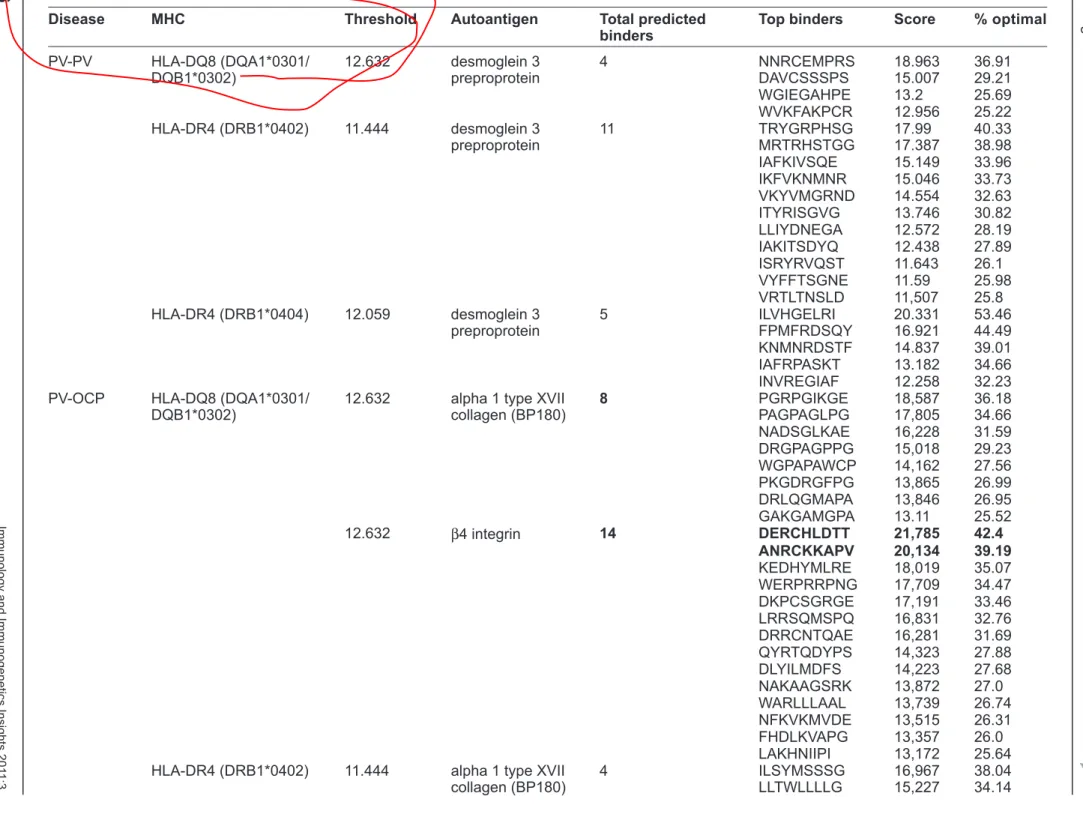
PV/OCP
: PV
-specific
desmoglein
3
preproprotein
peptide
binders
examined
for
the
OCP-associated
HLA-DQ7
(DQB1*0301)
revealed
four
binders
with
37%–29%
predicted
optimal
binding,
as
described
for
PV/MMP
model
(Supplemental
Table
1A).
The
bind
-ing
of
Dsg3
to
HLA-DR4
(DRB1*0401)
resulted
in
43
binders
with
46%–1
1%
predicted
optimal
values
(Supplemental
Table
3A).
In
the
case
of
OCP-related
autoantigen
association with PV
-specific MHC,
eight
binders
derived
from
alpha
1
type
XVII
collagen
(BP180)
exhibited
36%–25%
optimal
predicted
bind
-ing
to
HLA-DQ8
(DQA1*0301/DQB1*0302).
The
binding
to
HLA-DR4
(DRB1*0402)
was
between
38%–28%
optimal
values
for
four
predicted
binders,
while
the
binding
to
HLA-DR4
(DRB1*0404)
was
even
higher
(52%–34%
optimal
binding).
Another
potential
OCP-associated
autoantigen,
β
4
integrin,
bound
to
PV
-specific
HLA
molecules
with
dif
ferential
predicted
scores
as
shown
in
Supplemental
Table
3A.
For
HLA-DQ8
(DQA1*0301/DQB1*0302),
14
bind
-ers
with
42%–25%
optimal
binding
have
been
identi
-fied,
whereas
16
binders
were
detected
for
HLA-DR4
(DRB1*0402)
(37%
optimal
binding),
and
17
peptides
for
HLA-DR4
(DRB1*0404)
with
51%–34%
optimal
binding
(Supplemental
Table
3A).
Interestingly
, the
binding
of
β
4
integrin
to
PV
-associated
HLA-DR4
(DRB1*0404)
was
higher
than
to
OCP-associated
molecules
(51%
vs.
44%,
respectively).
Peptide
sequences are shown in Supplemental
Table
Peptide binding predictions of shared autoimmunity
Immunology and Immunogenetics Insights 201
1:3