An Interaction Analysis Support System for CSCL
An Ontological Approach to Support Instructional Design Process
Akiko Inaba, Ryoji Ohkubo, Mitsuru Ikeda and Riichiro Mizoguchi
I.S.I.R., Osaka University
Abstract
We can observe various kinds of interaction among members of a learning group during collaborative learning session. It is difficult for even human users to analyze them in order to clarify what types of collaboration have occurred in the session and what educational benefits have been expected for the members through the session. So, we propose an interaction analysis support system that helps users to abstract essence of interaction from raw protocol data, and to understand what types of collaboration have been occurred in the session, and then infers educational benefits expected to be gained by the members through the interaction process.
1: Introduction
Many of software designers of CSCL (Computer-Supported Collaborative Learning) environment have been suffering from complex and subtle educational requirements offered by clients. One of major causes of the problem they face is the lack of shared understanding of collaborative learning. We do not know what design rationale of CSCL environment is and even do not have common vocabulary to describe what the collaborative learning is. In this research, we are aiming at supporting such complex instructional design (ID) process of CSCL. To fulfill the aim we have been constructing an ontology to represent CSCL session [5,6,7,16]. The ontology will work as vocabulary to describe the session and provide design patterns referred to during the instructional design process. With the ontology, we can represent many kinds of CSCL sessions in terms of common vocabulary. It will facilitate users' shared understandings of CSCL sessions, and reuse of learning scenarios of the sessions [10,11]. It is important to store and provide effective learning scenarios as design patterns. As the first step to fulfill our aim, we adopt learning theories as foundation to analyze, design, and develop the learning sessions. The design patterns inspired by the theories provide design rationale for CSCL design.
Currently, laying the ontology and CSCL models formulated in terms of the ontology as basis, we have been conducting a project aiming at developing various kinds of ID support systems for CSCL. For example, we have been constructing a group formation support system (TGF support system) [8] for the design phase, a flexible learning environment with multi-agent system (FITS/CL based on OGF) [6] for design, development, and implementation phase, a learning materials authoring tool for development phase, and an interaction analysis support system (TIA support system) for the analyzing phase. In this paper, we introduce the “Theory-based Interaction Analysis (TIA)” support system. Because interaction processes
among learners are complex and the patterns of the interaction cannot be captured by a simple model, it is difficult for even human users to analyze the interaction processes in order to clarify what types of collaboration have occurred in the session and what educational benefits1 have been expected for the members through the session.[1,9,12,15] So, we propose an interaction analysis support system that helps users to abstract essence of interaction from raw protocol data, and to understand what types of collaboration have been occurred in the session, and then infers educational benefits expected to be gained by the members through the interaction process.
This paper is organized as follows; first, we describe what the interaction analysis is and why the interaction analysis is difficult for educational practitioners and CSCL designers. Next, we propose an interaction analysis support system to reduce the difficulties, and interaction patterns that are core parts of the system.
2: Interaction Analysis
The key to understanding CSCL lies in understanding the rich interaction between individuals [4]. So, interaction analysis has been gathering focuses from many researchers [1,9,12,13,15]. In this section, we describe a model of interaction analysis process that we consider, and then difficulties in the process.
2.1: What is Interaction Analysis?
Once a learning session is done, the designer of the session (e.g., an educational practitioner or a collaborative learning system designer) will want to know whether the session is effective or not for the learners, and what educational benefit the learners get through the session. Moreover, if it was not effective, then the designer will want to know reason why it was not. In collaborative learning session, analysis of interaction process among learners is quite important for assessment, because the learners get some educational benefits through the interaction: What benefit a learner can get depends on how the learner interacts with the others. To clarify the educational effects, the designer will collect protocol data of the session, abstract essences from the protocol data, and then estimate the effects based on the abstracted interaction data. We focus on verbal interaction among learners, and aim at supporting analysis of protocol data.
We consider human-user's analysis process of protocol data as Fig.1. First, the user will collect learners’ protocol data during
1 We mean educational benefits as each learner’s personal development like
collaborative learning session (Fig.1 a). The protocol data cover all messages exchanging among learners, but they are too complex to capture what types of interaction have occurred in the session. Next, the user will try to abstract essences characterizing the session from the protocol data (Fig.1 b). To tag each protocol datum is one of the most popular ways for it, and we adopt it. The user will characterize the session and capture what types of interaction have occurred in the session through analysis of the tagged protocol data (Fig.1 c). Finally, the user will estimate effectiveness of the session and educational benefits each learner will get through the session (Fig.1 d). If the user designed collaborative learning scenario before the session started, the user may want to know whether the session goes along with the scenario or not (Fig.1 e).
2.2: Why is the Interaction Analysis difficult?
We consider difficulties of interaction analysis as follows:
Tagging phase: The arrow-b in Fig.1 represents tagging phase.
User will use utterance-labels to tag each protocol datum. Although each utterance using natural language is concrete and informative, it is difficult to capture what roles the learners played and what types of interaction occurred in the session. By substituting utterance-labels for raw protocol data, it will become easier to grasp flow of interaction and each learner’s activities. There are different sets of utterance-labels and sentence-openers. There are several problems. (1) Difficulty in selecting a label set: Since it is not clear what set of labels represents what types of interaction, and supports what analysis, users cannot select a label-set easily. (2) Difficulty in tagging each protocol datum with a label: If a label means very abstract concept, it is not easy for users to tag protocol data with the labels, and almost protocol data will be tagged with the same label. Then, it will be difficult to distinguish the types of interaction. Conversely, if each label means very concrete concept, it will be easier for users to tag protocol data with the labels. However, the labels may not characterize the learning
session and a difficulty of analysis is much the same with analysis of raw protocol data. So, appropriate label-set should satisfy the following constraints: (1) it should be clear the range of analysis supporting with the label set: (2) each label should mean concrete and distinguishable concept for supporting user’s tagging activity, at the same time, labels should represent abstract concepts for characterizing learning sessions.
Characterizing phase: The arrow-c in Fig.1
represents characterizing phase. Skilled teachers will be able to extract essence of interaction, and capture what types of interaction have occurred Although it becomes easier to capture what tendency an interaction process has, from the sequence of utterance-labels rather than from the raw protocol data, it is still difficult for system designers and novice teachers.
Estimating phase: The arrow-d in Fig.1 shows
estimating phase. It is difficult to estimate educational benefits for each learner clearly from analysis of interaction process even if the user can characterize the session. Similar to the characterizing phase, skilled teachers will be able to do, but it is still difficult to explain clearly how to estimate them and reason why the benefit can be expected.
Comparing phase: The arrow-e in Fig.1 represents comparing
phase. It is difficult to assess if the interaction process goes along with the planned scenario. The scenario represents not specific interaction process which can be represented as a sequence of specific utterance-labels, but learning plan which includes roles for learners, learning materials, learning tasks, tools, and so on. The learning scenario is too abstract to compare with interaction process.
To reduce the difficulties, we apply ontological engineering to these problems and rely on existing learning theories as rationale. Concerning the difficulty in the tagging phase, we select utterance-labels through investigation. The label-set is prepared to represent several types of collaborative learning sessions. We cluster the utterance-labels to adjust the level of abstraction of the labels according to the purpose of using the labels. Concerning the difficulties in the characterizing phase,
estimating phase, and comparing phase, we construct
interaction patterns which are models of typical interaction processes among learners. The patterns are represented with utterance-labels at an abstract level (we call the labels of this level “utterance-types”). We construct several types of patterns relying on learning theories as rationale. Next section, we describe a system to support users’ interaction analysis, which we call “Theory-based Interaction Analysis Support System (in short, TIA support system)”, with the cluster of utterance-labels and the interaction patterns.
3: Theory-based Interaction Analysis Support
System
The CSCL designers or educational practitioners will have several learning goals for learners, plan learning scenario based
CSCL raw data (protocol) LA LC LB LA: proposition LB: question LC: question LA: answer... .
collect log data
characterize the session
estimate educational effect for each learner
a b
c
d
e tag each protocol
datum
LA
- provide new idea - work as a leader LB - not active LC - work as a helper for LB LA - metacognitive skill LB LC - new knowledge - ?
compare the data with planned learning scenario
learning scenario
educational benefits
characteristics of the group tagged protocol data
e
on the goals, and set up learning sessions with the scenario. However, collaborative learning process does not always progress in accordance with the scenario and it is difficult to know whether the learners attain the goal or not. Here, we propose a system which supports human user’s interaction analysis process. The system identifies whether the collaborative learning process is carried on in accordance with the scenario, and shows to the users its result as clues to judge whether the learning goals are attained or not. In this section, we describe the overview of the system, and then, we show utterance-labels, utterance-types and interaction patterns.
3.1: Overview of Theory-based Interaction Analysis
Support System
Fig.2 shows overview of the TIA support system. Before analyzing learning process, a user (e.g., a CSCL designer or an educational practitioner) inputs learning goals to the system, and assigns expected role to each learner. Next, the user loads protocol data into the system to
tag the data. Fig.3 shows the interface of the system in tagging phase. The left part of the window shows learners’ raw protocol data with speakers’ names in sequence. The user selects a protocol, and tags it with a label. The center part of the window shows utterance-labels. The utterance-labels are provided as
a drop-down menu in the combo-box. The user converts raw protocol data into a sequence of utterance-labels by
selecting appropriate
utterance-labels from the menu. The right part of the window shows the sequence of utterance-labels.
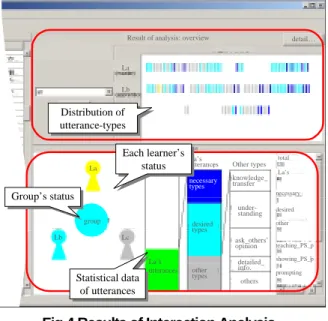
When the user finishes tagging the protocol, the system can begin analysis the learning session. The right half of the window in Fig.4 shows result of analysis (the left half of the window is cut off in the figure, because it still shows raw protocol data like fig. 3). The system searches an interaction pattern suitable to the learning goal which is given by the user to the system at the beginning of analysis. The interaction pattern means a typical interaction process to attain the goal. The utterance-labels tagged to protocol data are converted to utterance-types in order to abstract the interaction process, and the sequence of the utterance-types is compared with the interaction pattern. The top of the window in Fig.4 shows a distribution of utterance-types in the sequence. One box means an utterance, and the boxes are color-coded depending on the result of the comparison; navy-blue, sky-blue and gray. The navy-blue boxes mean the utterances are necessary to attain the learning goal, the sky-blue boxes mean the utterances are not always necessary but desired, and the gray boxes mean the utterances do not match the interaction pattern. The bottom of the window shows statistical data of learners’ interaction. In this type of interaction analysis, users designed a learning scenario before the learning session started, and the user would expect to each learner to play a specific role (e.g., tutor, apprentice) in the learning session. The system illustrates the results whether each learner plays the assigned role or not, and whether designed type of learning is accomplished or not. If the sequence of utterance-types matches with the interaction pattern, the circle, which means the group, appears as sky-blue. On the other hand, if the sequence does not match, gray circle appears. Similarly, if a learner plays assigned role well, the character, which means the learner, appears as sky-blue; if the learners does not behave well, the character appears as gray one. If the user selects one character in the window, then the character is colored as yellow and the proportion of the number of the learner’s utterance to total number of utterance is illustrated in the window as a bar graph. If the user clicks the bar graph, it is broken down into the proportions of the number of necessary utterance, desired utterance, and other utterance. The system can show more detailed information on the learner’s utterance according to the user’s requests; for example, if the user clicks the “desired
A G GA A G A G search A G A G user Protocol with labels A b st ract ed In te ra c tio n pr o c es s Interaction Patterns Cluster of utterance-labels advice In te ra ctio n pa tte rn re po si to ry compare design Learning scenario protocol learners 1 2 7 1 2 7 1 2 abstract tagging
Fig.2 Theory-based Interaction Analysis Support System speaker’s name speaker’s name utterance utterance selecting an utterance-label from the list selecting an
utterance-label from the list
sequence of utterance-labels sequence of utterance-labels speaker’s name speaker’s name utterance utterance selecting an utterance-label from the list selecting an
utterance-label from the list
sequence of utterance-labels
sequence of utterance-labels
utterance” in the bar graph, the system shows utterance-types classified into the “desired utterance” and their proportions to all “desired utterance”.
Fig.5 shows detailed information of the interaction. The user can see these results by selecting the item “detailed information” from the menu bar. The system shows the interaction pattern appropriate to the learning goal at the bottom part of the window (Fig.5-b), and flow of the interaction at the top of the window (Fig.5-a). The interaction pattern means a typical interaction process for the goal, and it is represented by utterance-types (as nodes) and possible transitions (as arrows) among the types. The flow of interaction is represented as a sequence of the utterance-types which are converted from utterance-labels tagged by the user in order to abstract the interaction process. The utterance-types are color-coded for three types; navy means necessary utterance-types for the goal (it appears in the interaction pattern), sky-blue means desired utterance-types (it
appears in the interaction pattern), and gray means the utterance-types not characterizing the interaction (it does not appear in the interaction pattern). If the user selects an utterance-type in Fig.5-a, the selected utterance-type is highlighted as yellow, and if the type appears in the interaction pattern, the type in the interaction pattern is also highlighted simultaneously (Fig.5-b).
3.2: Utterance-labels, Utterance-types, and
Interaction Patterns
We prepare two types of vocabularies to represent interaction process during collaborative learning; utterance-labels and utterance-types. Users use the utterance-labels to tag learners’ raw protocol data, and the utterance-types are used by the system to abstract the interaction process.
To prepare the two vocabularies, first, we collected protocol data during six types of typical collaborative learning. The six types of learning groups are formed inspired by learning theories; for example, Anchored Instruction [2], Cognitive Apprenticeship [3], Distributed Cognition [14], and so on. We have been constructing Collaborative Learning Ontology [5,6] which is the system of concepts to represent collaborative learning session. Especially, the Learning Goal Ontology, which is a part of the Collaborative Learning Ontology, clarifies learning goals, which are expected to learners get through a collaborative learning session, and relationships among a learner’s personal development and interaction process with the other learners. The ontologies rely on learning theories as the rationale. We formed the learning groups based on the ontology, and collected the protocol data during the session.
Next, we collected data via WWW to investigate what labels are needed to tag the protocols which represent six types of typical collaborative learning. We showed the protocol data on the web, and asked CSCL designers and educational practitioners to tag each protocol datum. We prepared prototype set of utterance-labels and asked them to select one from the prototype set or to input new labels into the input box for free words on the web. Next, we clusterized the labels with clustering analysis method, and then set a layer to define utterance-types. The utterance-labels, which are the most concrete level of the cluster, are provided to users to tag raw protocol data, and the utterance-types are used by the system to characterizing the learning session. The layer is defined as the utterance-types can represent and characterize each type of collaborative learning session. The utterance-types are used to represent interaction patterns which characterizing the collaborative learning session. So, it is important for the system to be distinguishable each interaction pattern.
Fig. 6 shows an example of the interaction patterns. The figure shows typical interaction process which is frequently observed in Cognitive Apprenticeship type of collaborative learning session. An interaction pattern is represented as utterance-types (represented as nodes) and possible transitions (represented as arrows) between the utterance-types. There are two types of arrows; the solid arrows mean necessary transitions for the learning session and the dotted arrows mean desired transitions. We have been constructing the interaction patterns like this for several types of collaborative learning session. To
Interaction Pattern Interaction Pattern Prompting Flow of the interaction Flow of the interaction
a
b
Detailed information Overview
La
Lb
Lc and
Interaction pattern Property
Teaching the way to solve a problem Showing the way to solve a problem
Prompting Showing the way to solve a problem Prompting Acceptance Showing problematic issues Request to show Acceptance Prompting Acceptance
Showing the way
to solve a problem Understanding
Interaction Pattern Interaction Pattern Prompting Flow of the interaction Flow of the interaction
a
b
Detailed information Overview
La
Lb
Lc and
Interaction pattern Property
Teaching the way to solve a problem Showing the way to solve a problem
Prompting Showing the way to solve a problem Prompting Acceptance Showing problematic issues Request to show Acceptance Prompting Acceptance
Showing the way
to solve a problem Understanding
Fig.5 Detailed Information of Results of Analysis
Distribution of utterance-types Distribution of utterance-types
detail… Result of analysis: overview
La Lb La’s utterances La Lb group Lc necessary types desired types other types Other types La’s utterances under-standing knowledge_ transfer total La’s necessary teaching_PS_p desired showing_PS_p prompting other ask_others’ opinion others detailed_ info. Statistical data of utterances Statistical data of utterances Group’s status Group’s status Each learner’s status Each learner’s status Distribution of utterance-types Distribution of utterance-types detail… Result of analysis: overview
La Lb La’s utterances La Lb group Lc necessary types desired types other types Other types La’s utterances under-standing knowledge_ transfer total La’s necessary teaching_PS_p desired showing_PS_p prompting other ask_others’ opinion others detailed_ info. Statistical data of utterances Statistical data of utterances Group’s status Group’s status Each learner’s status Each learner’s status
represent typical interaction process like this, it becomes possible to compare real interaction process with typical interaction process, and help users estimate educational benefits for the learners.
4: Summary
We describe Theory-based Interaction Analysis support system in this paper. The system provides users the way to abstract complex interaction process during collaborative learning session. Moreover, the system has typical interaction patterns, which can be expected learners to get educational benefits, based on learning theories, and compares learners’ interaction process with the typical interaction patterns.
At this stage, we rely on learning theories to construct interaction patterns and pick up utterance-labels. For future work, we will extend the system to embed a module that users can store new interaction patterns to the system. By this extension, the users use their best practice as typical collaborative learning patterns. Moreover, we will construct a collaborative learning support system in which learners select utterance-labels or use sentence-openers, and the system identifies the state of collaborative learning and advises the learners on their learning.
References
[1] Barros, B., & Verdejo, M.F. ``Analysing student interaction processes in order to improve collaboration. The DEGREE approach'', IJAIED, 11 (2000)
[2] Cognition and Technology Group at Vanderbilt. ``Anchored instruction in science education'', In: R. Duschl & R. Hamilton (Eds.), Philosophy of science, cognitive psychology, and educational theory and practice. Albany, NY: SUNY Press. 244-273 (1992)
[3] Collins,A. ``Cognitive apprenticeship and instructional technology'', In: Idol, L., & Jones,B.F. (Eds.) Educational values and cognitive instruction: Inplications for refoem., Hillsdale, N.J.: L. Erlbaum Associates, (1991)
[4] Dillenbourg, P. “What do you mean by “Collaborative Learning”.” In P. Dillenbourg (Ed.) Collaborative Learning: Cognitive and Computational Approaches (pp.1-19). Amsterdam: Elsevier Science. (1999).
[5] Inaba, A., Ikeda, M., Mizoguchi, R., & Toyoda, J. ``The Learning Goal Ontology for Collaborative Learning'', http://www.ai.sanken.osaka-u.ac.jp/~inaba/LGOntology/ (2000) [6] Inaba, A., Supnithi, T., Ikeda, M., Mizoguchi, R., & Toyoda, J.
``How Can We Form Effective Collaborative Learning Groups? -Theoretical justification of ``Opportunistic Group Formation'' with ontological engineering'', Proc. of ITS2000, 282-291 (2000) [7] Inaba, A., Supnithi, T., Ikeda, M., Mizoguchi, R., & Toyoda, J.
``An Overview of Collaborative Learning Ontology'', ECAI2000 Workshop on Analysis and Modelling of Collaborative Learning Interactions, 23-30 (2000)
[8] Inaba, A., Tamura, T., Ohkubo, R., Ikeda, M., Mizoguchi, R., and Toyoda, J. “Design and Analysis of Learners’ Interaction based on Collaborative Learning Ontology”, Proc. of Euro-CSCL2001 (2001)
[9] Katz, A., O'Donnell, G., & Kay, H. ``An Approach to Analyzing the Role and Structure of Reflective Dialogue'', IJAIED, 11, (2000)
[10] Mizoguchi, R., & Bourdeau, J. ``Using Ontological Engineering to Overcome Common AI-ED Problems'', IJAIED, 11 (2000) [11] Mizoguchi,R., Ikeda,M., & Sinitsa,K. ``Roles of Shared Ontology
in AI-ED Research'', Proc. of AIED97, 537-544 (1997)
[12] Muhlenbrock, M., & Hoppe, U. ``Computer Supported Interaction Analysis of Group Problem Solving'', Proc. of CSCL99, 398-405 (1999)
[13] Okamoto, T., Inaba, A., and Hasaba, Y. “Intelligent Discussion Support System in Distributed Cooperativ Learning Environment”, Proc. of AIED95, pp. 585 (1995)
[14] Salomon, G. ``Distributed cognitions'', Cambridge University Press (1993).
[15] Soller, A. ``Supporting Social Interaction in an Intelligent Collaborative Learning System'', IJAIED, 12, (2001)
[16] Supnithi, T., Inaba, A., Ikeda, M., Toyoda, J., & Mizoguchi, R. ``Learning Goal Ontology Supported by Learning Theories for Opportunistic Group Formation'', Proc. of AIED99 (1999)
prompting
prompting
acceptance showing the way
to solve a
problem understanding
request to show the way to solve a problem
showing problematic issues
teaching the way to solve a problem
showing the way to solve a problem
utterance-type expected to “master” role-player utterance-type expected to “apprentice” role-player necessary transition
desired transition start
end