Proceedings of the
International Workshop on
Software Quality and Maintainability
(SQM 2014)
The Implementation of the C
HA-Q Meta-Model: A Comprehensive,
Change-Centric Software Representation
Coen De Roover, Christophe Scholliers, Viviane Jonckers Javier P´erez, Alessandro Murgia, Serge Demeyer
15 pages
Guest Editors: Lodewijk Bergmans, Tom Mens, Steven Raemaekers Managing Editors: Tiziana Margaria, Julia Padberg, Gabriele Taentzer
The Implementation of the C
HA-Q Meta-Model: A Comprehensive,
Change-Centric Software Representation
Coen De Roover, Christophe Scholliers, Viviane Jonckers Javier P´erez, Alessandro Murgia, Serge Demeyer
Software Languages Lab, Vrije Universiteit Brussel Ansymo Group, Universiteit Antwerpen
Abstract:Although contemporary software development processes have embraced the need for continuous change, most development tools still assume that they act upon a single complete release of the system. The CHA-Q project (Change-centric
Quality Assurance) aims to strike a balance between agility and reliability through change-centric quality assurance tools. These tools are to share a first-class rep-resentation of changes to software artefacts. In this paper we present the CHA-Q
meta-model that defines this representation and highlight important characteristics of its implementation: an object-oriented API, persistency through a graph database, and a strategy for tracking the history of artefacts in a memory-efficient manner.
Keywords:Change-Centric, Meta Model, Quality Assurance
1
Introduction
In this paper, we introduce the CHA-Q meta-model that owes its name to the CHA-Q project (Change-centric Quality Assurance)1. This project aims to strike a balance between agility and reliability through change-centric quality assurance tools. These tools are to share a first-class representation of the artefacts that comprise a software system (source code, files, bugs, bug comments, mailing lists, . . . ), as well as the complete history of all individual changes to these artefacts —a representation defined by the CHA-Q meta-model. The main contributions of this
new meta-model are:
• A first-class representation for changes to various software artefacts.
• A uniform and extensible object-oriented API.
• An implementation that uses a graph database for persistency, while tracking the history of software artefacts in a memory-efficient manner.
The latter relieves developers from secondary concerns such as memory usage and storage re-quirements. In the remainder of this paper we present the related work that serves as background for our proposal inSection 2. We give an overview of our meta-mode inSection 3, introduce po-tential quality-related application scenarios for this metamodel inSection 4, highlight important properties of its implementation inSection 5and the underlying persistence strategy inSection 6. Subsequently we demonstrate the meta-model in Section 7 by creating models for a use case, and present the results of a preliminary performance evaluation inSection 8.
2
Related Work
Within the software engineering community, the use of meta-models to provide common rep-resentation frameworks that can be leveraged by various software engineering tools is not new. One example of such a generic meta-model to represent object-oriented systems is the FAMIX meta-model [TDDN00]. FAMIX offers a language-independent, first-class representation of object-oriented, class-based languages that has been used by a wide range of software engineer-ing tools such as the MOOSE reverse engineerengineer-ing tool suite. FAMIX3 [DAB+11] represents the most recent incarnation of this meta-model.
Next to such representations of object-oriented programs, a body of work exists with regard to modeling multiple versions of a system. A good overview of the early research in this area can be found in the book chapter by D’Ambros et al. [DGLP08]. HISMO [GD06] extends the FAMIX meta-model such that multiple versions of a software system can be represented. For each version in the history, a complete model of that version — along with information that relates source-code entities over various versions — is stored. The more recent Orion [LDDF11] meta-model also represents multiple versions of FAMIX entities, but does this in a manner that avoids copying entities that have not changed between versions. Its strategy has not only been observed to result in memory-efficient models, but these models can also be constructed faster as fewer allocations have to be performed.
Another body of work relies on meta-models that represent change operations to a system as first-class objects. The SpyWare tool suite by Robbes et al. [RL06,RL08], in contrast, records all changes that are made to a system using the integrated development environment (IDE). In-ternally, SpyWare provides a fine-grained model where each individual change to the system is stored. The ChEOPS [Ebr09] system by Ebraert et al. offers a similar meta-model for represent-ing and storrepresent-ing changes. Both approaches target Smalltalk. Another similar approach for the reification of changes is the one taken by Hattori [Hat12] in Syde, a tool that logs the changes made by several developers in parallel. Syde targets Java. The UniCase [KHS09,HK10] tool represents changes to EMF models as first-class entities to facilitate conflict detection and reso-lution. The tool suite around OperationRecorder [MKOH12] employs an extremely fine-grained representation of edit operations to text.
So far, we have only discussed meta-models that represent the state, history or individual changes to the source code of a system. The most influential meta-model for representing issue tracking information is the one used by the Evolizer [GFP09] tool suite. An earlier version is de-tailed along with a representative meta-model for versioning meta-data (e.g., commit messages) in [Mar06].
To conclude, while existing meta-models define a representation of source code or changes, we can observe that none provides a complete representation of both —let alone of the other artefacts of a software system (versions, issues, mailing lists, . . . ) and their changes.
3
Overview of the C
HA-Q Meta-Model
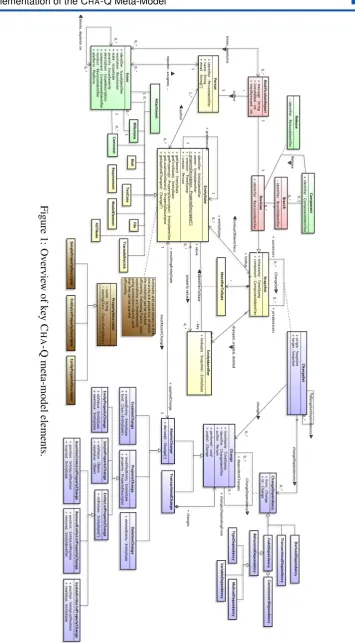
our experiences with the FAMIX [TDDN00], ChEOPS [Ebr09] and Ring [UG12] meta-models, we have opted for an object-oriented representation. Figure 1depicts its high-level UML class diagram.
Changes are modeled as first-class objects that can be analyzed, repeated and reverted (cf. Change). To this end, we provide a representation of the dependencies between two changes (cf. Change-Dependency). These imply a partial ordering within a given set of changes (cf.ChangeSet). The corresponding elements are depicted in blue. Similar meta-models have already proven themselves for representing changes to code (e.g., SpyWare [RL08], ChEOPS [Ebr09] and Syde [Hat12]) and to EMF models (e.g., UniCase [KHS09]). Our meta-model goes beyond the state of the art by representing changes to the properties of any system artefact (i.e., source code, files, commits, bugs, e-mails, . . . ) in a uniform manner. This uniform treatment of an artefact’s properties is inspired by the reflective API of the Eclipse JDT. The corresponding elements (cf.PropertyDescriptor) are depicted inbrown.
Applying a change results in a new state for its subject (cf.EntityState).Figure 1depicts the corresponding elements inyellow. Examples include abstract syntax trees (cf.ASTNode) and issues managed by an issue tracker (cf.Issue). The meta-model elements related to issue tracking and e-mail communication are inspired by the meta-model used by the Evolizer [GFP09] and STNACockpit [PG10] tools respectively.Figure 1depicts them ingreen.
Snapshots correspond to the state of all of a system’s artefacts at a particular point in time as seen by a particular developer (cf.Snapshot). The delta between two snapshots is a set of changes (cf.ChangeSet). Snapshots of the entire system can be inspected and compared. This connection is similar to the one between Ring’s history and change meta-model [UG12]. Revisions (cf. Revision) are snapshots placed under control of a version control system. Figure 1 depicts the corresponding elements, such as a modification reports and branches, in pink. These are inspired by the revision meta-model used by Evolizer [GFP09].
4
Potential Applications of the C
HA-Q Metamodel
The CHA-Q metamodel offers a series of opportunities to develop new techniques and tools in
the context of software quality evaluation and improvement.
The fine-grained combined record of source code changes and issue report evolution could help improving the bug triaging tasks. The change information can be used to identify misclas-sified bug reports more easily and to verify whether anomalies occur in the bug database (e.g.
wrong severity, assigned to the wrong component). A fine-grained change information can also be useful for estimation and recommendation purposes,e.g. once bugs get reported, determine who is the best person in the team to handle the request and make a reliable estimation for the time to fix the bug.
Figure
1:
Ov
ervie
w
of
k
ey
C
H
A
-Q
meta-model
The change information stored in our metamodel can also be used to support a variety of maintenance activities such us releasing a new version of an API together with an executable list of patches, that could be seamless applied in order to update all client code, or re-playing bug fixes, that were successful on a given release, on a variant release, thus avoiding tedious manual synchronisation of branches.
5
Implementation Highlights
The CHA-Q meta-model associates a unique identifier (cf.EntityIdentifier) with each change subject (cf. EntityState). This enables tracking the evolution of a single subject throughout the history of a system. For each subject, a history of previous states is kept in a memory-efficient manner; successive states share the values of properties that do not change. We deem this necessary as copying of entity states has been observed to consume 3GB of mem-ory for the Syde change-centric representation of a version repositmem-ory of 78MB [Hat12]. How-ever, a selective cloning approach would be impractical to implement as all entities are inter-connected transitively. We therefore follow the approach advocated by the Orion [LDDF11] and Ring [UG12] history meta-models. Property values are identifiers (cf.EntityIdentifier) that are looked up with respect to a particular snapshot.
To ensure that this additional level of indirection does not endanger type safety, our imple-mentation relies on Java generics and property annotations. The propertyinitializerof a VariableDeclaration, for instance, can only haveExpressionidentifiers as its value. As shown inSection 7, the programmer can easily enforce such constraints in the CHA-Q meta-model.
Despite this memory-efficient representation, the working memory of a typical development terminal is unlikely to suffice for the entire history of the industry-sized projects that we aim to support. Our implementation therefore persists instances of meta-model elements to a Neo4J2 graph database and retrieves them on a strict as-needed basis. Use of weak references ensures that instances that are no longer needed can be reclaimed by the garbage collector. Our two-way mapping is driven by run-time reflection about the aforementioned property annotations. This renders our implementation extensible. Extensive caching ensures that reflection does not come at the cost of a performance penalty.
5.1 Property Annotations
The CHA-Q meta-model ensures type safety of the fields of the EntityState by means of annotations. As shown in figure 2, there are three annotations defined in the be.ac.chaq.model.entitypackage.
• SimpleProperty: This annotation can adorn the fields of any class that extends EntityState. All fields annotated with the SimplePropertyannotation must be Serializable. When a field is annotated with aSimpleProperty access to this field is provided through the getProperty method provided by the EntityState
Figure 2: Cha-Q annotations
class. Note that adding the annotation to his class is the only thing the programmer has to do.
• EntityProperty:This annotation is used to flag that the annotated field is used in order to store anotherEntityStateobject. Again this property can be read by making use of thegetPropertymethod defined in the EntityState class.
• EntityListProperty: This annotation is very similar to theEntityProperty annota-tion but instead of indicating a single field that refers to anEntityStatethis annotation must be used to indicate a list of entity states.
InSection 7we give an overview of how the meta-programmer uses these annotations in order to create a customEntityState.
5.2 Memory-efficient State Tracking
As mentioned before, copying an entity each time its state changes (the approach taken by Syde [Hat12]) would be prohibitively expensive for large projects. To minimize memory con-sumption, successiveEntityStateinstances have to share the values of properties that do not change. As all entities are interconnected transitively and these connections can be navigated in multiple directions (e.g., from a method to its declaring class and from a class to its declared methods), consistency would be difficult to maintain using a selective shallow and deep cloning approach.
Following Orion [LDDF11] and Ring [UG12], we store the values of properties as EntityIdentifier instances that have to be looked up starting in a particular snapshot. Instances of class Snapshot correspond to the state of all of a system’s artefacts at a par-ticular point in time as seen by a parpar-ticular developer. To this end, each snapshot maintains IdentifierToState mappings from the unique identifier of an entity to its current state within the snapshot. Performing aPropertyChangetherefore amounts to making a shallow clone of the currentEntityState of the change subject, updating theSnapshot’s current mapping from the subject’sEntityIdentifierto the newEntityStateof the change subject, and updating the property’s value in the newly createdEntityState. Deleting an entity amounts to removing itsIdentifierToStatemapping, rendering the corresponding entity inaccessible in the current snapshot. Each snapshot does keep track of all changed, created and deleted entity identifiers for inspection purposes.
forward all requests to the corresponding entity state. Orion [LDDF11] and Ring [UG12] rely on a similar proxy to provide snapshot-unaware tools a view on a particular snapshot.
Note that our meta-model’s snapshots comprise a middle ground between a complete version-based and a complete change-version-based representation of a system’s evolution. Depending on their timespan, snapshots can accumulate the effect of a single or of several changes. As such, they can be used to represent eras of a system’s lifetime about which fine-grained change information is unavailable or not desired.
5.3 Reflection Cache
The annotations defined by the programmer are evaluated at runtime by making use of reflection. These reflection operations are relatively slow and therefore, the implementation of the meta-model makes use of a cache to avoid having to repeat the reflective operations over and over again.
In the implementation of theEntityStateclass getting and setting properties is done by making use of aPropertyDescriptorsMap. For every class this map contains a property descriptor for each of the fields of the entity state. The programmer does not need to built this map himself. Instead, whenever a property of a class is requested the property descriptor map is consulted to retrieve the map for this particular class. If there is no entry in the property descriptor map a new entry is built by using reflection. The constructed property descriptor map is then stored in the property descriptors map for later retrieval. Because this map is cashed in the entity state class the reflective operations are kept to a minimum.
5.4 Persistence Considerations
While the CHA-Q meta-model already provides a lot of beneficial measurements in order to make efficient use of memory, loading all revision of a large software artefact in memory is currently not possible. Therefore, the CHA-Q meta-model makes use of weak references to ensure that instances that are no longer needed can be reclaimed by the garbage collector. This does not mean that the garbage collected references are simply thrown away. The meta-model automatically persists the snapshots of the project that can not be fit into the memory and restores these snapshots when they are needed in order to perform an analysis. However, the programmer who makes use of the CHA-Q meta-model is not confronted with the way the meta-model is serialised or deserialised. Form the programmers point of view all the versions of the project can be consulted. In the next section we give a more in depth overview of the persistence model of the CHA-Q meta-model.
6
Persistence
S
I I I
ES C
S
I I
ES
S snapshot
Identifier I
ES Enitity State
Reference Property predecessor
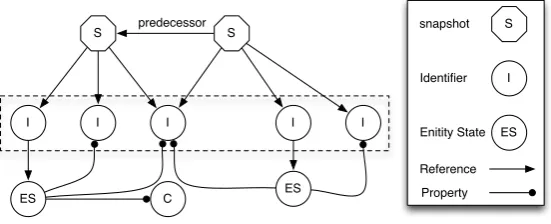
Figure 3: CHA-Q Graph Database Model
like in the object-oriented representation. Moreover, once a node in the graph database has been identified, retrieval of semantically close nodes can be done very fast as this is just a matter of following the outgoing edges.
6.1 Graph Representation
The size of the projects that we aim to support is much bigger than the memory size of a normal desktop computer. Therefore, the persistence of the meta-model is not only important for storage and retrieval, it is an essential part of the meta-model to deal with large projects.
There is a one-to-one mapping between how the graph database stores nodes and relationships and the Cha-Q meta-model classes.Figure 3shows a possible serialisation of the graph database. There are four types of nodes in the model, snapshot nodes, identifier nodes, entity state nodes and constant nodes. Each snapshot node has a set of edges pointing to the identifier nodes which are contain in the snapshots. All snapshots besides the root snapshot also have an outgoing edge to the predecessor snapshot. Identifier snapshots have a reference to their entity state nodes. For each propriety of the entity state, the entity state node has an outgoing property edge. These edges point either to identifier node or to a constant node. Entity state nodes keep state in order to identify from which class they were serialized in the database. As can be seen, the graph database model follows the memory model closely. By reusing the nodes in the graph the storage requirements are significantly reduced.
6.2 Example Serialization: Method Declaration
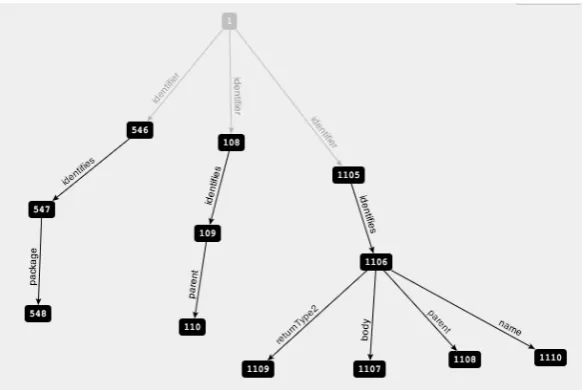
Figure 4: Graph View of a Stored Method Declaration
to a node with number1106, this node represents the method declaration. As expected this node has a number of fields that are represented again with outgoing edges. In the case of a method declaration a node has aReturnType2, abody, aparentand aname. Just as in the object model, the body declaration is not anEntityStatebut aEntityStateIdentifierthat can be use in order to retrieve theEntityStatefrom the snapshot.
7
Modeling Entities in the C
HA-Q Meta-Model
In this section, we given an overview of how to use the meta-model by showing the model-ing process for the definition of a custom EntityState. The entity state of our concrete use case is part of the Java AST-Node meta-model. We have implemented entity states for all Java AST-Nodes but here we limit ourselves to the implementation of a single AST-Node: VariableDeclaration. The implementation of the other Java AST-Nodes follows the same recipe.
7.1 Java AST Nodes
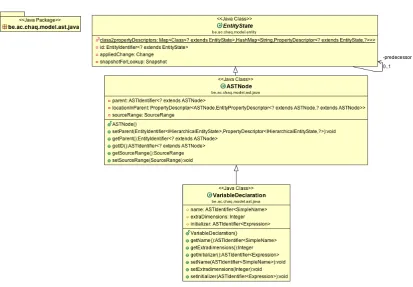
Figure 5 shows a part of the java classes that are involved with the definition of the VariableDeclaration class. As can be seen the AST node is an extension of the EntityState, this is a necessary prerequisite in order to make use of the annotations offered by the meta-model. TheVariableDeclarationclass has three fields,ASTIdentifier, extraDimensionsandinitializer.
Figure 5: Variable declaration ASTNode
classInteger. Similarly, thenamefield is annotated with anEntityPropertyannotation. This annotation also requires that the class of the field is specified as a value which must be serializable. In the case of thenamefield this is aSimpleNameclass.
public class VariableDeclaration extends ASTNode {
@EntityProperty(value = SimpleName.class)
protected ASTIdentifier<SimpleName> name;
@SimpleProperty(value = Integer.class)
protected Integer extraDimensions;
@EntityProperty(value = Expression.class)
protected ASTIdentifier<Expression> initializer;
//...
}
7.2 Applying Changes
In the previous section, we have shown how to implement a customEntityState. In this section, we show how the programmer benefits from using these annotations when applying changes in the model.
The CHA-Q meta-model defines a number of ways in which entity states can be changed. The implementation of these changes is completely defined in terms of entity states and property descriptors. Because changes are defined as a high-level abstraction all the predefined and future change classes can be applied over the custom made entity states as well. In this section we show how theVariableDeclarationdefined in the previous section can be created with a CreationChange and then modified withSimplePropertyChange. Note that these changes are predefined and offered to the programmer as part of the meta-model.
Figure 7shows the creation of the variable declaration. Note that the creation change c is instantiated at first but the variable declaration is only added to the snapshot when the method perform is executed on the change.
1 TestEntityState es = new TestEntityState();
2 CreationChange c = new VariableDeclaration(rootSnapshot, es); 3 c.perform();
Figure 7: Creating and adding entity states to a snapshot.
Figure 8shows how theextraDimensionsof the method declaration can be changed to the value12. Again the change is only executed after the perform method of the change has been invoked.
1 PropertyDescriptor<TestEntityState,Integer> pd = 2 es.getPropertyDescriptorNamed("extraDimensions"); 3 SimplePropertyChange spc =
4 new SimplePropertyChange(rootSnapshot, es, pd, 12); 5 EntityState newes = spc.perform();
Figure 8: Applying changes over the entity states.
As already discussed before the programmer does not need to be concerned with persistence while modelling custom entity states.
8
Evaluation
artefact a modified change is deduced between the two compilation units. As these changes are very coarse grained the potential reuse is much higher. When the CHA-Q meta-model is instrumented with a good change distiller it will become possible to record changes at the level of individual statements instead of on the file level. Therefore, the potential reuse will become much higher and consequently the memory and storage consumption will be reduced even farther. From experiments with such coarse changes it already became clear that the CHA-Q meta-model memory significantly reduces the memory footprint needed for storing the meta-model.
8.1 Test Data
We have evaluated the performance of the CHA-Q meta-model by applying our meta-model over a small web-application called Exapus3. Exapus is a web application for exploring the usage of APIs within a single project (i.e., project-centric exploration) and across a corpus of projects (i.e., api-centric exploration) along the dimensions of where, how much and in what manner [DLP13]. The project consists of 127 compilation units, 132 class declarations and 1173 method decla-rations. A quick measurement showed that the memory consumption a single revision with Java JDT nodes is about 122MB. The changes in this project are very coarse grained and on average 22,5 files are modified which constitutes about one sixth of the total files in each revision. This means that the potential reuse between every iteration consists of 5/6 of the total number of files.
8.2 Storage and Memory Performance
In order to prove our claims that the CHA-Q meta-model can drastically reduce the memory and storage requirements we have done a number of micro benchmarks. The serialisation of a single revision consists of about 194149 nodes, 223979 properties, and 194147 relationships divided over 32 distinct relationship types. By only storing the changes between each revision the storage requirements of the CHA-Q meta-model can be significantly reduced. We have implemented the importation and serialisation of the meta-model in two different ways. Thenaiveimplementation creates the meta-model as described but instead of reusing the different versions of a snapshot it creates a completely new snapshot for each revision. This implementation represent current practices which are readily available but do not optimise for storage and memory.
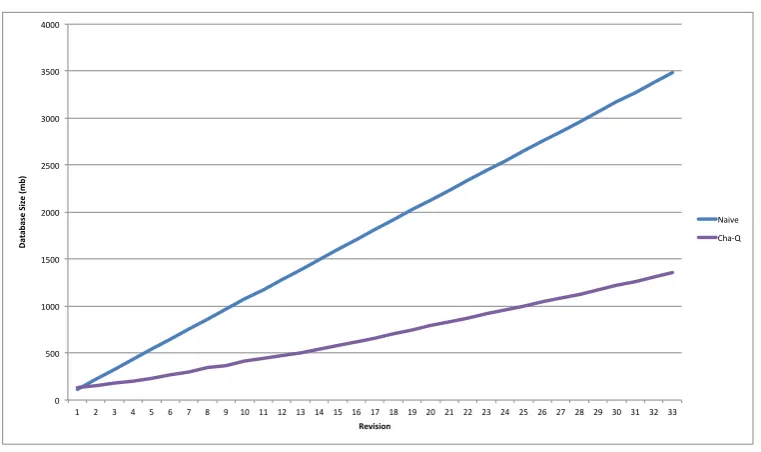
Because of the one-to-one mapping of the object-oriented representation to the graph database the figures for the memory requirements are very similar. The graph representation requires almost exactly the same amount of space when serialised as it requires memory in the Java VM. The performance evaluation with respect to the database storage overhead can be seen in Figure 9. A first observation is that our measurements are confirming the observations of prior work [Hat12]. The naive implementation requires already over 3.4 GB of storage space. In contrast after revision 33 the CHA-Q meta-model requires 2.5 times less storage space. While this seems far away from the 5/6 potential reuse we found that the larger files in the system were adjust more than the smaller files therefore the measurement based on file number do not give a complete image of the potential reuse. While 2.5 times less space is already a good number we are working to also feed the model with fine grained changes which should drastically increase the potential reuse and consequently decrease the storage footprint.
0" 500" 1000" 1500" 2000" 2500" 3000" 3500" 4000"
1" 2" 3" 4" 5" 6" 7" 8" 9" 10" 11" 12" 13" 14" 15" 16" 17" 18" 19" 20" 21" 22" 23" 24" 25" 26" 27" 28" 29" 30" 31" 32" 33"
Da
ta
ba
se'S
ize'(
mb
)'
'
Revision'
Naive" Cha3Q"
Figure 9: Storage overhead of the CHA-Q meta-model versus a naive implementation.
9
Conclusion and Future Work
We presented the CHA-Q meta-model, a novel meta-model that provides a detailed represen-tation of the artefacts that comprise a software system, as well as the complete history of all individual changes to these artefacts. These changes are modeled as first-class objects that can be analyzed, repeated and reverted. The Cha-Q meta-model is the first to do so for changes to artefacts other than a system’s source code (e.g., bugs, bug comments, project e-mails, . . . ).
The meta-model supports tracking the evolution of a single entity from its creation onwards, such as the traceability link between a test case and its corresponding requirement. As such an entity is subject to changes, a means is required to uniquely identify each entity. To this end, the meta-model provides a hierarchy of identifier classes.
Applying a change results in a new state for its subject. For efficiency reasons, successive states share the values of properties that do not change. The suggested implementation strat-egy addresses the problem of maintaining consistency in meta-models of which all entities are interconnected transitively.
Snapshots are our meta-model’s means to represent the collective state of all of a system’s artefacts as seen by a particular developer at a particular point in time. Snapshots can accumulate the effect of a single or of several changes as desired —thus providing a configurable compromise between the extremes of completely version-based and completely change-based representations of a system’s evolution. Revisions are modeled as snapshots that are placed under control of a version control system. The entities they are related to represent versioning information.
for Java and the VisualWorks refactoring browser for Smalltalk) as well as classes represent-ing object-oriented entities and their relations (modeled after the generic, language-independent FAMIX3 meta-model). Classes representing information about a system’s requirements, test cases and traceability links will be defined and added to the model in the near future.
In future work we will use the model over a wide range of application ranging from bug triaging to re-playing bug fixes as shown in sectionSection 4. In order to do that, some additional features need to be added to the infrastructure, such as a change distiller that can infer and extract the list of occurred changes between two versions of a system and a change logger that can record the changes while the developer interacts with the IDE. The benefits of this approach will be demonstrated in the future by performing several experiments with our industrial partners.
Bibliography
[DAB+11] S. Ducasse, N. Anquetil, U. Bhatti, A. C. Hora, J. Laval, T. Girba. MSE and FAMIX 3.0: an Interexchange Format and Source Code Model Family. Technical report, INRIA LNE-LIRMM, 2011.
[DGLP08] M. D’Ambros, H. Gall, M. Lanza, M. Pinzger. Analysing Software Repositories to Understand Software Evolution. In Mens and Demeyer (eds.),Software Evolution. Springer-Verlag, 2008.
[DLP13] C. De Roover, R. Lammel, E. Pek. Multi-dimensional exploration of API usage. In
21st International Conference on Program Comprehension (ICPC). Pp. 152–161. 2013.
[Ebr09] P. Ebraert.A bottom-up approach to program variation. PhD thesis, Vrije Univer-siteit Brussel, March 2009.
[GD06] T. Gˆırba, S. Ducasse. Modeling History to Analyze Software Evolution.Journal of Software Maintenance: Research and Practice (JSME)18:207–236, 2006.
[GFP09] H. Gall, B. Fluri, M. Pinzger. Change Analysis with Evolizer and ChangeDistiller.
IEEE Softw.26(1):26–33, 2009.
[Hat12] L. P. Hattori.Change-centric Improvement of Team Collaboration. PhD thesis, Uni-versit`a della Svizzera Italiana, 2012.
[HK10] M. Herrmannsdoerfer, M. Koegel. Towards a generic operation recorder for model evolution. InProceedings of the 1st International Workshop on Model Comparison in Practice (IWMCP10). Pp. 76–81. 2010.
[LDDF11] J. Laval, S. Denier, S. Ducasse, J.-R. Falleri. Supporting simultaneous versions for software evolution assessment.Science of Computer Programming 76(12):1177– 1193, Dec. 2011.
[Mar06] D. Marjanovic. Developing a Meta Model for Release History Systems. Master’s thesis, University of Zurich, 2006.
[MKOH12] K. Maruyama, E. Kitsu, T. Omori, S. Hayashi. Slicing and replaying code change history. InProceedings of the 27th nternational Conference on Automated Software Engineering (ASE12). Pp. 246–249. 2012.
[PG10] M. Pinzger, H. C. Gall. Dynamic Analysis of Communication and Collaboration in OSS Projects. InCollaborative Software Engineering. Pp. 265–284. Springer Berlin Heidelberg, 2010.
[RL06] R. Robbes, M. Lanza. Change-based software evolution. InEVOL ’06: Proceedings of the 1st International ERCIM Workshop on Challenges in Software Evolution. Pp. 159–164. 2006.
[RL08] R. Robbes, M. Lanza. SpyWare: a change-aware development toolset. In Pro-ceedings of the 30th international conference on Software engineering (ICSE ’08). Pp. 847–850. ACM, 2008.
[TDDN00] S. Tichelaar, S. Ducasse, S. Demeyer, O. Nierstrasz. A Meta-model for Language-Independent Refactoring. InProceedings of International Symposium on Principles of Software Evolution (ISPSE00). 2000.