An Adapted Search on Mobile Devices With Shielded Web
Tatikonda Venkata Jyothsna#1, Sk. Mowna #2#1Student of M.Tech (CSE) and #2 Asst. Prof, Department of Computer Science and Engineering, Chirala Engineering College,CHIRALA
Abstract:
Customized web pursuit could be customizing so as to promise because of enhance hunt quality indexed lists for people with individual information objectives. On the contrary hand, security isn't entirety, and occasionally will be traded off if there's an addition in commission or benefit to the client. Therefore, a parity ought to be stricken between hunt quality and security insurance. In this paper a climbable way for clients is shown to mechanically assemble client profiles. With this a client's advantage into a venture with particular hobbies. The parameters for formative protection needs help the client to resolve on the substance and level of point of interest of the profile data that is presented to the PC program. Trials demonstrated that the client profile enhanced hunt quality contrasted with plain MSN rankings. a great deal of altogether, results checked our theory that a noteworthy change on hunt quality will be accomplished by exclusively sharing some larger amount client profile information, that is most likely less touchy than intricate individual data. Index Terms − Personalized web seek, Privacy saving, personalisation utility, security hazard, client profile
I. INTRODUCTION:
Appearance of the information age, the net will change people to get to data a Considerable measure of just. On the inverse hand, with today's advanced time Data blast, the web indexes range unit a great deal of basic in our life. Since the PC system will get a ton of information from a few sources, there zone unit lovely of information that clients couldn't care less with respect to. This point of preference swings to hindrance. It makes client to utilize longer to annoy the information they're not curious about. Against the foundation, modified PC system is a procedure to determine the matter. The mean of personalization is PC project will encourage clients to channel the accommodating information for them by exploitation client's advantage. PC system can pick the clients' enthusiasm at the most noteworthy of results, in this way it's appallingly advantageous for clients to pick accommodating information. amid this paper we are going to present the arranging and
execution of redid PC program. we tend to demonstrate the outcomes and clients' enthusiasm for venture with the Vector region Model. The profile-based PWS has incontestable a considerable measure of adequacy in up the standard of web hunt with expanding use of non-open and conduct information to profile its client [1].
II. SYSTEM MODEL
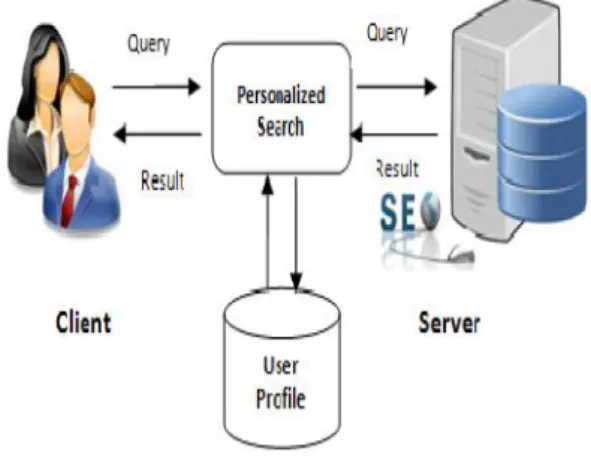
As we can see in this block diagram, there are 2 main components involved in the working of our personalized web search. The prior is the System which is further extended as the proposed system where the re-ranking of the pages obtained from the search engine i.e 2nd component is done. In the initial stage, the user is asked to log in into the system. The authentication is done and user can now fire a query. This query is forwarded to the search engine i.e Google Search in our model. Once the results are obtained from the search engine they are categorized using ODP operations, which help us to determine the user interests also. Once the results are obtained we re-rank the pages for the next session of the user. For re-ranking the pages we use the vector space model/algorithm.The Vector Space model will be discussed further in detail [2,3].
Fig. Architecture
objective. Such insignificance is generally because of the tremendous mixture of clients' conditions and environment and also the evasion of writings. Customized web hunt gives better indexed lists, which are utilized for individual client needs [4]. For this the client data must be gathered and broke down to make sense of the client expectation behind the issued question. The consequences of PWS can be assembled into two sorts, in particular snap log-based routines and profile-based ones. The clicklog-based strategy increases the predisposition of the clicked page in the history. This procedure lives up to expectations reliably and significantly well, however it obliges redundancy of the pursuit questions by the clients, which restricts its appropriateness. Be that as it may, profilebased high ground over snap log-based on account of the use of confounded client interest models produced from client profiling procedures. Profile based strategies are for the most part compelling however are accounted for to be precarious under a few circumstances. Both the two strategies have its own particular favorable circumstances and disservices, yet the profile based strategy has exhibited more viability in enhancing the web seek quality. It is accomplished by documenting the individual and behavioral subtle elements of the clients, which is typically accumulated from inquiry history, navigate information, skimming history, bookmarks, client archives etc. Tragically such client information uncovers a little photo of the client's close to home life. Numerous protection issues will ascend from such instability of private information. So the protection concerns have turn into the real boundaries for wide flourishment of PWS administrations [5].
III. RELATED WORK:
In data recovery, much research is centered around customized inquiry. Pertinence criticism and question refinement [3] [4] tackles a fleeting model of a client's advantage, and data around a client's expectation is gathered at inquiry time. Individual data has likewise been utilized as a part of the connection of Web inquiry to make a customized form of PageRank [5] [6]. There are still methodologies, including numerous monetarily accessible informationfiltering frameworks [9] [10], which oblige clients unequivocally determine their hobbies. Notwithstanding, as called attention to, clients are regularly unwilling to spend the additional exertion on determining their expectations. Regardless of the fact that they are spurred, they are not generally effective in doing as such. A dominant part of work spotlights on verifiably assembling client profiles to surmise a client's aim. An extensive variety of certain client exercises have been proposed as wellsprings of upgraded inquiry data. This incorporates a client's hunt history, perusing history
[7], navigate information, web group, and rich customer side data [8] as desktop lists. Our methodology is interested in a wide range of distinctive information hotspots for building client profiles, if the sources can be removed into content. In our tests information sources like IE histories, messages and late individual records were tried. Client profiles can be spoken to by a weighted term vector [7], weighted idea various leveled structures like ODP3 , or other certain client interest chain of importance. For the reasons of specifically presenting clients' hobbies to internet searchers, the client profile is a term based various leveled structure that is identified with continuous term based bunching calculations [6][7]. The distinction here is that the various leveled structure is certainly developed in a top-down design. Furthermore, the center is the connections among terms, not bunching the terms into gatherings. Security concerns are characteristic and critical particularly on the Internet. Some earlier studies on Private Information Retrieval (PIR) [4], concentrates on the issue of permitting the client to recover data while keeping the question private. Rather, this study targets safeguarding security of the client profile, while as yet profiting by specific access to general data that the client consents to discharge. As far as anyone is concerned, this issue has not been concentrated on in the setting of customized hunt. One conceivable explanation behind this is that individual data, i.e. perusing history and messages, is basically unstructured information, for which protection is hard to quantify and measure. A few deals with protection issues in the information mining group concentrate on ensuring individual information sections while permitting data outline. A well known method for measuring security in information mining is by looking at the distinction in former and back learning of a particular quality. This can be formalized as the contingent likelihood or Shannon's data hypothesis. Another approach to quantify protection is the idea of k-obscurity which advocates that specifically distinguishing qualities be summed up such that every individual is vague from in any event k-1 different persons. In this study the thought of protection does not hope to measure up data from diverse clients, yet rather the data gathered after some time for a solitary client. Moreover, this study addresses unstructured information. In this study the notion of privacy does not compare information from different users, but rather the information collected over time for a single user. In addition, this study addresses unstructured data.
IV.PRIVACY-ENHANCING PERSONALIZED SEARCH:
Any personal documents such as browsing history and emails on a user’s computer could be the data source for user profiles. Our hypothesis is that terms that frequently appear in such documents represent topics that interest users. This focus on frequent terms limits the dimensionality of the document set, which further provides a clear description of users’ interest. This approach proposes to build a hierarchical user profile based on frequent terms. In the hierarchy, general terms with higher frequency are placed at higher levels, and specific terms with lower frequency are placed at lower levels. D represents the collection of all personal documents and each document is treated as a list of terms. D(t) denotes all documents covered by term t, i.e., all documents in which t appears, and |D(t)| represents the number of documents covered by t. A term t is frequent if |D(t)| ≥ minsup, where minsup is a user-specified threshold,which represents the minimum number of documents in which a frequent term is required to occur. Each frequent term indicates a possible user interest. In order to organize all the frequent terms into a hierarchical structure, relationships between the frequent terms are defined below. Assuming two terms tA and tB., the two heuristic rules used in our approach are summarized as follows:
1. Similar terms: Two terms that cover the document sets with heavy overlaps might indicate the same interest. Here we use the Jaccard function [11] to calculate the similarity between two terms: Sim(tA, tB) = | D(tA)∩D(tB) | / | D(tA)∪D(tB) |. If Sim(tA , tB) > δ, where δ is another user-specified threshold, we take tA and tB as similar terms representing the same interest.
2. Parent-Child terms: Specific terms often appear together with general terms, but the reverse is not true. For example, “badminton” tends to occur together with “sports”, but “sports” might occur with “basketball” or “soccer”, not necessarily “badminton”. Thus, tB is taken as a child term of tA if the condition probability P(tA | tB )> δ, where δ is the same threshold in Rule 1. Rule 1 combines similar terms on the same interest and Rule 2 describes the parent-child relationship between terms. Since Sim(tA , tB) ≤ P(tA | tB ), Rule 1 has to be enforced earlier than Rule 2 to prevent similar terms to be misclassified as parent-child relationship. For a term tA, any document covered by tA is viewed as a natural evidence of users’ interests on tA. In addition, documents covered by term tB that either represents the same interest as tA or a child interest of tA can also be regarded as supporting documents of tA. Hence supporting documents on term tA, denoted as S(tA), are defined as the union of D(tA) and all D(tB), where either Sim(tA, tB) > δ or P(tA|tB
) > δ is satisfied. Using the above rules, our algorithm automatically builds a hierarchical profile in a top-down fashion. The profile is represented by a tree structure, where each node is labeled a term t, and associated with a set of supporting documents S(t), except that the root node is created without a label and attached with D, which represent all personal documents. Starting from the root, nodes are recursively split until no frequent terms exist on any leave nodes. Below is an example of the process. Before running the algorithm on the documents, pre-processing steps like stop words removal and stemming needs to be performed first. For simplification, each document is treated as a list of terms after pre-processing [12].
V. PROBLEM DEFINITION
Most of the existing works concentrate on server-side personalized search services in preserving privacy, it provide a less security to the user. To provide a security to the user from the profile-based PWS from the client side, many researchers have to deem two challenging effects during the search process of the user, (i) To increase the search quality by user profile and (ii) hide the privacy content to place the privacy risk under control. In many studies tells that user suggestions and their click based method is the helpful way to provide a personalized search and at the same time they have trouble with the loss of their privacy under their providing contents. Profile based method is an ideal case for providing the relevant search. Under this they were many drawbacks, it does not support on the runtime profiling, it can be based on the online and offline generalization, insufficiently protection of the data and require more iteration for obtaining relevant search [13].
VI. USER CUSTOMIZABLE PRIVACY-PRESERVING SEARCH (UPS) PROCEDURES:
The preference layer is computed online when a query q is issued. It contains for each H a value indicating the user’s query-relatednode t preference on topic t. These preference values are computed relying on a procedure called query topic mapping. Specifically, each user has to undertake the following procedures in our solution: 1. offline profile construction, 2. offline privacy requirement customization, 3. online query-topic mapping, and 4. online generalization. Offline-1. Profile Construction. The first step of the offline processing is to build the original user profile in a topic hierarchy H that reveals user interests. We assume that the user’s preferences are represented in a set of plain text documents, denoted by D. To construct the profile, we take the following steps: 1. Detect the respective topic in R for every D. Thus, the preference document setdocument d D is transformed into a topic set T. 2. Construct the profile H as a topic-path trie with T, i.e., H = trie(T). 3. Initialize the user support sup H (t) for each topic T with its document support from D, thent of other nodes of H with (4).tcompute sup H There is one open question in the above process— how to detect the respective topic for each document D. We present our solution to this problem in ourd implementation. Offline-2. Privacy Requirement Customization. This procedure first requests the user to specify a H, and the respectivesensitive-node set S sensitivity value sen(s) S.> 0 for each topic s Next, the cost layer of the profile is generated by H ascomputing the cost value of each node t follows: 1. For each sensitive-node, cost(t) = sen(t); 2. For each nonsensitive leaf node, cost(t) = 0; 3. For each nonsensitive internal node, cost(t) is recursively given by (1) in a bottom-up manner [14.:
VII. PROPOSED SCHEMA:
We propose a privacy-preserving personalized web search framework UPS, which can generalize profiles for each query according to userspecified privacy requirements. Relying on the definition of two conflicting metrics, namely personalization utility and privacy risk, for hierarchical user profile, we formulate the problem of privacy-preserving personalized search as Risk Profile Generalization, with itsNP-hardness proved. We develop two simple but effective generalization algorithms, GreedyDP and GreedyIL, to support runtime profiling. While the former tries to maximize the discriminating power (DP), the latter attempts to minimize the information loss (IL). By exploiting a number of heuristics, GreedyIL outperforms GreedyDP significantly. We provide an inexpensive mechanism for the client to decide whether to personalize a query in UPS. This decision can be made before each runtime profiling to enhance the stability of the
search results while avoid the unnecessary exposure of the profile.
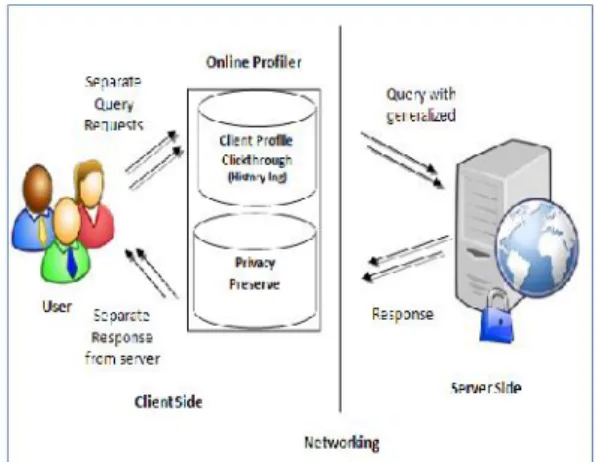
Fig. Proposed Architecture
Above figure shows our proposed architecture which is builds in the client side mechanism and here we protect the data from the server, so only we provides a privacy to the client user. Every query from the client user were provided by the separate requests to the server, this hides the frequent click through logs or content based mechanism, from this user can protect the data from the server. In the same case our mechanism maintains the online profiler about the user hence it hides the click logs and provides a safeguard to the user data. After that, online profiler query were processed in the manner of generalization process, it is used to meet the specific prerequisites to handle the user profile and it is based on the preprocessing the user profiles. Our architecture, not only the user’s search performance but also their background activities (e.g., viewed before) and personal information (e.g., emails, browser bookmarks) could be included into the user profile, permitting for the structure of a much richer user model for personalization. The sensitive contextual information is usually not a main aspect since it is strictly stored and used on the client side. A user’s personal information including user queries and click logs history resides on the user’s personal computer, and is exploited to better suppose the user’ information require and provide a relevant search results. Our proposed algorithm uses the greedy method based on the discriminating power and information loss protection to inherit the relations. Here it uses the inherited method to generalize the query. It allows performing the customization process to protect the data and use the User customizable Privacy-preserving Search framework addressed the privacy problems. This aims at protecting the privacy in individual user profiles[14].
The Personalized Web Search (PWS) scheme is enhanced to control topic relationship based expert attacks. The User customizable Privacypreserving Search (UPS) model is enhanced to resist query session based attacks. Query generalization is performed with query priority values. Anonymization and topic taxonomy models are used to improve the personalization process. The system is designed to protect the web personalization scheme with attack controlling mechanism. Privacy is ensured with anonymization methods. Query optimization process is use to improve the query values. The system is divided into six major modules. They are query log analyzer, user profile construction and query generalization using GreedyDP, query generalization using GreedyIL, personalized search process and attack controller. The query log analyzer module is designed to perform preprocess on user query logs. User query profiles are constructed using query keywords. Query values are generalized under the Query generalization with GreedyDP module. Query values are generalized under the Query generalization with GreedyIL module. Query optimization process is carried out under the personalized search process module. Query session attacks are handled in attack controller module [15].
I Query Log Analyzer
User query values are maintained under the query log files. User and query details are parsed from the query log data. Redundant log entries are removed from the log information. Optimized query data values are updated into the database.
II User Profile Construction
User profiles are constructed to manage the search behavior of the user. Search history is used in the user profile construction process. Query keywords are updated with the frequency values. Domain information are updated with the search query values.
III Query Generalization using GreedyDP
Anonymization methods are used to provide privacy for user query values. User query values are generalized for privacy preservation. Greedy discriminating power (GreedyDP) algorithm is used for the query generalization process. Generalized query values are updated in the user search history environment.
IV Query Generalization using GreedyIL
Query values are generalized with information lose factors. Greedy Information Loss (GreedyIL) algorithm is used for the generalization process. Data usage is considered in the generalization process.
Generalized query keywords are used in the search optimization process.
V Personalized Search Process
Privacy preserved web search is performed in the personalized search process. Query optimization is used to improve the query keywords. Generalized query keywords are used in the query optimization process. Query weight values are used for the query optimization process.
VI Attack Controller
The attack controller is used to control query attacks. Session information are protected to control session based attacks. Topic taxonomy is used for the query optimization and generalization process. Data utilization rate is considered in the attack controlling process.
IX. CONCLUSIONS AND FUTURE WORK:
and search quality can be achieved if web search are personalized by considering only exposing those information related to a specific query.
REFERENCES:
[1] Lidan Shou, He Bai, Ke Chen, and Gang Chen “Supporting Privacy Protection in Personalized Web Search,” IEEE Transactions On Knowledge And Data Engineering, Vol. 26, No. 2, Feb 2014.
[2] Z. Dou, R. Song, and J.-R. Wen, “A Large-Scale Evaluation and Analysis of Personalized Search Strategies,” Proc. Int’l Conf. World Wide Web (WWW), pp. 581-590, 2007.
[3] J. Teevan, S.T. Dumais, and E. Horvitz, “Personalizing Search via Automated Analysis of Interests and Activities,” Proc. 28th Ann. Int’l ACM SIGIR Conf. Research and Development in Information Retrieval (SIGIR), pp. 449-456, 2005. [4] M. Spertta and S. Gach, “Personalizing Search Based on User Search Histories,” Proc. IEEE/WIC/ACM Int’l Conf. Web Intelligence (WI), 2005.
[5] B. Tan, X. Shen, and C. Zhai, “Mining Long-Term Search History to Improve Search Accuracy,” Proc. ACM SIGKDD Int’l Conf. Knowledge Discovery and Data Mining (KDD), 2006.
[6] K. Sugiyama, K. Hatano, and M. Yoshikawa, “Adaptive Web Search Based on User Profile Constructed without any Effort from Users,” Proc. 13th Int’l Conf. World Wide Web (WWW), 2004.
[7] X. Shen, B. Tan, and C. Zhai, “Implicit User Modeling for Personalized Search,” Proc. 14th ACM Int’l Conf. Information and Knowledge Management (CIKM), 2005.
[8] X. Shen, B. Tan, and C. Zhai, “Context-Sensitive Information Retrieval Using Implicit Feedback,” Proc. 28th Ann. Int’l ACM SIGIR Conf. Research and Development Information Retrieval (SIGIR), 2005.
[9] F. Qiu and J. Cho, “Automatic Identification of User Interest for Personalized Search,” Proc. 15th Int’l Conf. World Wide Web (WWW), pp. 727-736, 2006.
[10] J. Pitkow, H. Schu¨ tze, T. Cass, R. Cooley, D. Turnbull, A. Edmonds, E. Adar, and T. Breuel, “Personalized Search,”.
[11] Xueming Qian, He Feng, Guoshuai Zhao, and Tao Mei, “Personalized Recommendation Combining User Interest and Social Circle”,IEEE Transactions
On Knowledge And Data Engineering, Vol. 26, No. 7, July 2014.
[12] Zheng Lu, Hongyuan Zha, Xiaokang Yang, Weiyao Lin, and Zhaohui Zheng, “A New Algorithm for Inferring User Search Goals with Feedback Sessions” , IEEE Transactions On Knowledge And Data Engineering, Vol. 25, No. 3, March 2013 [13] A. Krause and E. Horvitz, “A Utility- Theoretic Approach to Privacy in Online Services,” J. Artificial Intelligence Research,vol. 39, pp. 633-662, 2010. [14] P.Anick. Using terminological feed back for Web search refinement: a log-based study. In Proc. of the 13th International World Wide Web Conference (WWW), New York, New York, May 2004.
[15] K.R. McKeown, N. Elhadad, and V. Hatzivassiloglou. Leveraging a common representation for personalized search and summarization in a medical digital library. In Proc. of International Conference on Digital Library, 2003 Author’s Profile:
Tatikonda Venkata Jyothsna, Presently pursuing her M.Tech in Computer Science & Engineering from Chirala Engineering College, Chirala, Prakasam District, A.P, India. Affiliated to Jawaharlal Nehru Technological University, Kakinada. Approved by AICTE, New Delhi. Her B.Tech completed at Chirala Engineering College, Chirala, Prakasam District, A.P, India.