www.jyoungpharm.org | www.phcog.net
Quantitative Reverse-phase High-performance Liquid
Chromatographic Method for the Quantification of Raltegravir
Potassium in Bulk and Dosage Forms
Sonam Patel, Krishnaveni Nagappan*, Gouru Santhosh Reddy, Gullapalli Kowmudi
Department of Pharmaceutical Analysis, JSS College of Pharmacy, Ooty, [A Constituent College–JSS Academy of Higher Education and Research], The Nilgiris, Tamilnadu, INDIA.
ABSTRACT
Objectives: The aim of this present study is to develop an accurate, precise and linear Reverse-phase High-performance Liquid Chromatographic (RP-HPLC) method for the estimation of raltegravir potassium in the bulk and pharmaceutical dosage form. Methods: The chromatographic system em-ploys a reverse phase shim-pack C18 column, (150 x 4.6 mm; 5 μ) using the mobile phase acetonitrile: (0.05 M) ammonium acetate buffer, (pH -4 adjusted with glacial acetic acid) in the proportion of 50:50 v/v, delivered at a flow rate of 0.8 ml/min with the detection wavelength of 271 nm. Results: The devel-oped method resulted in the retention of raltegravir at 4.31 min. Raltegravir potassium exhibited linear relationship (r2> 0.9999) over the analytical range
10-50 μg/ml. The precision was exemplified by a relative standard deviation of 1.60 %. The percentage recovery was found to be in the range of 100-102 %, during accuracy studies. The Limit of Detection (LOD) and Limit of Quantita-tion (LOQ) was found to be 0.104 µg/ml and 0.315 µg/ml, respectively. Con-clusion: An accurate, precise and linear RP-HPLC method was developed
and validated for the quantitative estimation of raltegravir potassium in (20 mg, 50 mg) tablet as per ICH guidelines and hence it can be used for the routine analysis in various pharmaceutical industries.
Key words: RP-HPLC, Method Development, Method optimization, Valida-tion, Raltegravir potassium.
Correspondence Krishna Veni Nagappan,
Department of Pharmaceutical Analysis,JSS College of Pharmacy, Ooty, [A Con-stituent College – JSS Academy of Higher Education & Research], The Nilgiris, Tamilnadu, INDIA.
Phone: 9442083447 Email: [email protected] DOI: 10.5530/jyp.2019.11.55
This is an open access article distributed under the terms of the Creative Commons Attribution-NonCommercial-ShareAlike 4.0 License, which allows others to remix, tweak, and build upon the work non-commercially, as long as the author is credited and the new creations are licensed under the identical terms.
INTRODUCTION
Highly Active Antiretroviral Therapy (HAART) has brought new hope for those people who are suffering from HIV/AIDS by decreasing the death rate among people infected with HIV. HAART enhanced the qual-ity of life among the people who have HIV/AIDS.
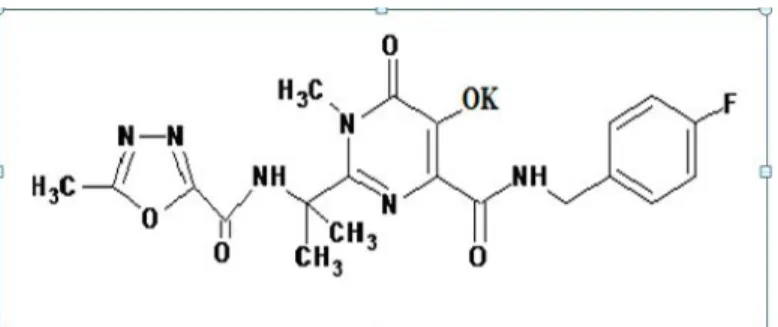
Raltegravir potassium is an HIV integrase strand transfer inhibitor, which prevents the insertion of viral DNA into the genome of the host cell and consequently viral replication. Raltegravir potassium, chemi-cally is a potassium salt of 4-[(4-fluorobenzyl)carbamoyl]-1-methyl-2- (1-methyl-1-{[(5-methyl-1,3,4-oxadiazol-2-yl)carbonyl]amino}ethyl]-6-oxo-1,6-dihydropyrimidine-5-olate. (Figure 1)1 A thorough review
of the literature was carried out to enumerate the reported analytical methods for the quantification of raltegravir potassium individually and incombination with other drugs using various analytical techniques. Girija B and co-worker have reported a simple spectrophotometric method for estimation of raltegravir potassium in bulk and tablet for-mulation. The method was validated as per ICH guidelines.2 Balaji M
and co-workers had reported an RP-HPLC method for estimation of related compounds (imp-I, imp-II, imp-III and imp-IV) in raltegravir potassium by using purosphere star RP C18 column. The separation was performed in gradient elution mode using 0.1% perchloric acid and ace-tonitrile at 30ºC and the eluents were detected at 300 nm with a flow rate 1 ml/min.3 Antonio DA and co-workers had reported an accurate,
sensitive, HPLC coupled with photodiode array detection method for the quantification of human immunodeficiency syndrome integrase in-hibitor Raltegravir (RGV), Etravirine (ETV) and 11 other antiretroviral agents in human plasma.4 Ajay G and co-workers had reported a novel
fast and simple method for the quantification of raltegravir with RP-HPLC-MS method. The chromatographic separation was achieved on a Chromolith RP-18e end capped (100 x 4.6 mm; 5 μm) column with a shorter runtime of 2.0 min. The mobile phase was ammonium formate buffer (pH 4.0): acetonitrile (30:70) in isocratic mode.5 Pardhi SS and
co-workers, in their review article, stated that Highly Active Antiretrovi-ral Therapy (HAART), a combination drug therapy is a topic of current interest in the treatment of HIV and AIDS. Techniques for the analysis and the quality control of antiretroviral drugs, particularly in the drug combinations are vital in achieving the quality of these drugs and the treatments involved. Integrase inhibitors are a class of antiretroviral drug designed to block the action of integrase, a viral enzyme that inserts a viral genome into the DNA of the host cell. Since integration is a vital step in retroviral replication, blocking it can halt further spread of the vi-rus. Integrase inhibitor was initially developed for the treatment of HIV infection. The HPLC, UV and HPTLC methods available for the analysis of raltegravir and Elvitegravir, the recently used drug for HIV and AIDS are reviewed in this article.6 Khagga BS and co-workers had reported a
validated simple, shorter and effective HPLC method with UV detec-tion (213 nm) for the quantificadetec-tion of raltegravir amidst its degradadetec-tion products using an Hypersil BDS, C18 (100 x 4.6 mm, 5 µm) column and water: methanol (20:80) as a mobile phase. The characterization of de-gradants were carried by LC-MS/MS.7 Juan PV and co-workers worked
a C18 column (125 x 4.6 mm; 5 μm).8 Rambabu K and co-worker had
reported a RP-HPLC method for the analysis of raltegravir. Chromato-graphic separation of raltegravir was performed by using a kromosil C18 column, a mobile phase comprising of 0.01 M Ammonium dihydrogen phosphate (pH 3.4): acetonitrile (50:50 v/v) at a flow rate of 1.0 ml/min and UV detection at 253 nm.9 Rami RBV and co-worker had reported a
Reverse-phase Ultra Performance Liquid Chromatographic (RP-UPLC) method for the assay of raltegravir Potassium. The chromatographic separation was achieved on UPLC with BEH Shield 100 x 2.1 mm, 1.7 µm column. The mobile phase employed for the assay was a mixture of Sodium perchlorate (pH 2.5±0.05 with perchloric acid) and acetonitrile in the ratio of 65:35 (v/v) and the detection wavelength was 240 nm.10
From the literature survey, it was evident that most of the methods were utilizing phosphate buffer for the quantification of raltegravir. Thus the present study aims to develop and validate a simple, rapid, precise, ac-curate, highly sensitive and selective RP HPLC method which is compat-ible for LC-MS/MS and can be routinely used for quality control stud-ies. The method showed a recovery of 100-102% with a simple mobile phase composition of ammonium acetate buffer (pH 4) and acetonitrile (50:50 v/v) in isocratic mode with shim pack C18 column. This developed method is robust enough to transfer into LC-MS/MS and HR/MS char-acterization for the determination of raltegravir potassium in bulk and pharmaceutical formulations.
This developed RP-HPLC method was validated as per the ICH guide-line.11,12
MATERIALS AND METHODS
Chemicals
Acetonitrile HPLC grade, methanol and ammonium acetate AR grade were procured from Merck (Mumbai, India). Milli Q water purifica-tion system (Bangalore, India) was used to generate Water HPLC grade. Reference substance of raltegravir potassium (API) was obtained from Mylan laboratory, Hyderabad, India as a gift sample. The raltegravir for-mulation was procured from the local market.
Instrumentation
HPLC experiments were performed on a Shimadzu LC-2010A Autos-ampler (Shimadzu Corporation, Kyoto, Japan). The system was equipped with a Liquid Chromatograph system comprising LC-2010A Quaternary low pressure mixing pump, Shimadzu SPD-20A UV-VISIBLE detector, a shim pack RP-C18 column (150 X 4.6 mm; 5 μ) and an autosampler with 20 μL aliquots sample loop volume. The software for data collection and analysis in the HPLC system used was Class VP data station. The UV spectra were recorded using Shimadzu 1700 (E) spectrometer.
Selection of Wavelength
A standard solution of 1 mg/ml raltegravir potassiumwas prepared in methanol. From the above stock solution, 10 μg/ml solution was pre-pared with the mobile phase and the UV spectra were recorded by scan-ning the standard solution between 200-400 nm. Raltegravir showed maximum absorbance at 271 nm (Figure 2). Thus it was selected for monitoring the chromatographic eluents using a UV detector.
Standard and sample solutions Preparation
Primary standards of raltegravir potassium was prepared by dissolving 10 mg of raltegravir potassium with mobile phase in a 10 ml volumetric flask (1 mg/ml). From the above standard stock solution, series of dilu-tions viz., 100 μg/ml, 10 μg/ml and 1 μg/ml were prepared in the mobile phase and was used as 100 % target concentration.
Assay of the marketed formulations
10 tablets of raltegravir potassium were weighed and the average weight was calculated and powdered. The tablet powder equivalent to 10 mg of raltegravir potassium was transferred to 10 ml volumetric flask. About 7 ml of mobile phase was added and sonicated to dissolve it completely. The volume was made up to the mark with the mobile phase. Then it was mixed well and filtered through 0.45 µm filter (1000 µg/ml). The above solution was suitably diluted with mobile phase to obtain the final concentration (10 µg/ml). This was analyzed in triplicate using the op-timized chromatographic condition. The chromatograms were recorded and the amount present, standard deviation and % RSD were calculated and reported.
Method validation
The developed RP-HPLC method for the quantification of raltegravir
potassium was validated as per the ICH Guidelines for the following pa-rameters: specificity, linearity, precision, accuracy, detection limit, quan-tification limits, Robustness and Ruggedness.
Specificity
Specificity is the ability of the method to measure the response of the analyte in the presence of other excipients and potential impurities. The specificity was demonstrated by comparing the chromatogram of drug extracted from the tablet with that of standard solution for the presence of excipients, potential impurities and other degradants. No interference was observed in the sample solution at the retention time of raltegravir
potassium.
Linearity and range
The linearity of an analytical method indicates the response obtained, which is linearly proportional to the concentration of the analytes in a definite range. The linearity of the proposed method was evaluated over
Figure 1: Structure of Raltegravir potassium.
a range of 10-50 µg/ml. These working standards were prepared in mo-bile phase from 1 mg/ml standard stock solution. The working standards for the linearity were injected in triplicate under the optimized chro-matographic conditions and the chromatograms were recorded. The linearity was established based on the correlation coefficient obtained by plotting a graph with concentration (µg/ml) in X-axis and Area of raltegravir potassium in Y-axis.
Precision and accuracy Studies
Interday and intraday precision studies evaluated the method precision. Six independent injections of three different concentrations viz., 10, 30, 50 µg/ml (LQC, MQC and HQC level) were used to study the method precision. Intraday precision/Repeatability was carried out by injecting the above samples on the same day and inter-day precision was carried out by injecting the same samples on three different days. The mean and values of % relative standard deviation were calculated.
The accuracy of the method was reported as recovery studies. It was car-ried out by standard addition method, i.e., by addition of known concen-tration of standard drug to the real sample and analysis by the optimized chromatographic condition. The recovery experiments were studied at three different levels (10, 30, 50 µg/ml) and the % mean recovery, stan-dard deviation and % relative stanstan-dard deviation were calculated.
Limit of detection and limit of quantification
A method is considered sensitive when it is capable of detecting a low concentration of the analyte. The Detection Limit (LOD) and Quantifi-cation Limit (LOQ) was determined by analyzing a low concentration of the standard solution using the developed RP-HPLC method. The LOD is the smallest concentration of the analyte that gives a measurable re-sponse (signal to noise ratio 3). The LOQ is the smallest concentration of the analyte, which gives a response that can be accurately quantified (signal to noise ratio 10). The following formula can measure LOD and LOQ value:
LOD = 3.3 σ/S and LOQ = 10 σ/S;
Where σ = Standard deviation of the response; S = Slope of the deviation curve.
Robustness and Ruggedness
The ruggedness and robustness of the methods were studied by making slight changes in the experimental conditions (Analyst, Reagent source and columns of various brands) and optimized chromatographic condi-tions (pH, mobile phase composition, mobile phase ratio and flow rate).
System suitability
System suitability parameters are considered as an essential part in an-alytical method development and validation. They ensure the optimal performance of the system. Chromatographic parameters Viz., Number of theoretical plates (N) Retention time (Rt), Resolution (Rs) and peak asymmetric factor (A) were monitored after six replicate injections of the standard raltegravir at a concentration of 100 µg/ml.
RESULTS AND DISCUSSION
Method development
The chromatographic conditions for the present method were optimized based on various trial experiments carried out by modifying the mo-bile phase composition, momo-bile phase ratio, pH and column utilized to achieve symmetric analyte peak and short run time. Acetonitrile was used as an organic modifier in the mobile phase.13,14 Initial separations
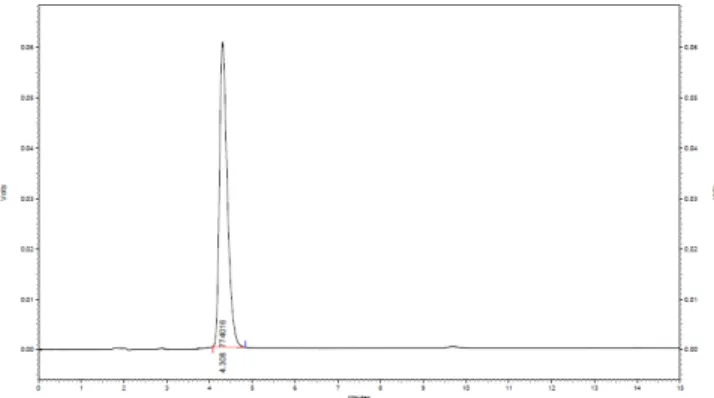
were carried out using acetonitrile and water as mobile phase at different ratios, which showed peak asymmetry. Then the aqueous phase was re-placed with LC-MS/MS compatible buffers. Finally, a symmetrical ana-lyte peak with short run time was achieved with acetonitrile and 0.05 M Ammonium acetate buffer (4 pH adjusted with glacial acetic acid) with a mobile phase ratio of 50: 50 v/v at a flow rate of 0.8 ml/min. The sta-tionary phase used was shim pack C18 column, (150 x 4.6 mm; 5 μ) and the eluents were monitored at 271 nm. The raltegravir potassiumeluted at 4.31±0.05 min. The solvents used for the preparation of the mobile phase were filtered using 0.45 µ PTFE membrane filter (Poly tetra fluoro ethylene) before delivering into the HPLC system. The chromatograms were recorded and processed using the class VP data station.
Method validation
Specificity/ Selectivity
The method specificity was demonstrated by injecting the diluents, stan-dard solution of raltegravir potassium and the sample solution extracted from the tablet formulation for any coeluting peaks at the retention time of the drug (4.31 ± 0.05 min). There were no coeluting peaks; the peak shape was symmetric and sharp, indicating the specificity of the opti-mized chromatographic method. The chromatograms of the sample so-lutions and standard are depicted in Figure 3 and 4.
Accuracy and Precision
The Accuracy of the method was expressed as % mean recovery for three different concentration levels (10, 30, 50 µg/ml) by the standard addition method. Triplicate analysis was performed at each level. Percent mean recovery was calculated.The accuracy of the developed method was
be-Figure 3: A typical chromatogram of the standard solution (Raltegravir
potassium – 10 µg/ml). Figure 4:
Table 4: Robustness Results of raltegravir potassium.
S. No. Parameters Retention time (min)
1.
Mobile phase ratio (Acetonitrile:
buffer)
60:40 4.31 ± 0.2
50:50 4.4 ± 0.2
65:45 6.2 ± 0.2
2. pH of buffer
3.5 4.7 ± 0.2
4 4.62 ± 0.2
4.5 5.1 ± 0.2
3.
Flow rate (ml/min)
0.8 4.6 ± 0.2
1 4.8 ± 0.2
1.2 4.92 ± 0.2
Table 5: Assay of marketed formulations of Raltegravir potassium.
S. No Sample Label claim Amount present(mg/vial)±SD; %RSD
1 Formulation –I 20 mg 19.89 ± 0.1520; 1.9832
2 Formulation –II 50 mg 59.89 ± 0.1482; 1.6871
tween 100–102% (Table 1). The developed method was also used for the assay of the marketed raltegravir potassiumtablet formulation. The % RSD for the assay studies carried out in the real samples were less than 2%, indicating the accuracy of the method(Table 5).
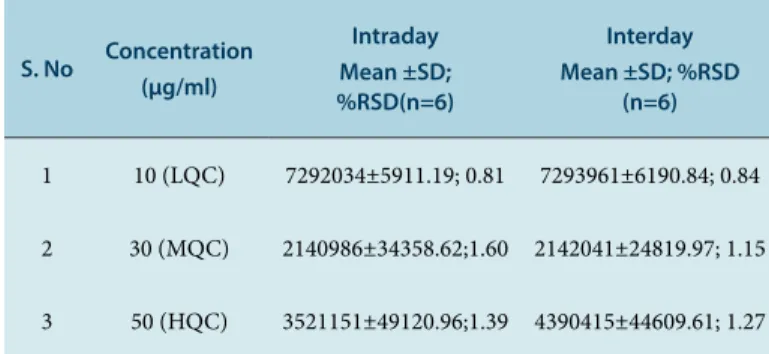
The intraday and inter day precision studies carried out showed a % RSD value less than 2 indicating the precision of the method. (Table 2)
Linearity
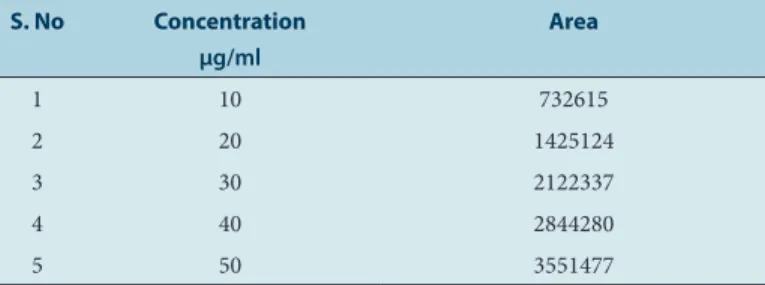
The calibration curve was plotted for five different concentrations of drug Vs. corresponding peak area. Excellent correlation between the concentrations and peak area were observed within the concentration range of (10-50 μg/ml) for the drug (Table 6). The correlation coefficient of raltegravir potassium is more significant with a value ≥0.9999, the slope and the intercept was found to be 70569 and 18103, respectively. The linearity graph is represented in Figure 5.
Detection Limit and Quantification Limit
The Detection and Quantification limit represents the sensitivity of the proposed method. The LOD and LOQ were found to be 0.104 and 0.315 µg/ml, respectively indicating the sensitivity of the method.
System suitability
The system suitability was carried out by performing the experiments and observing the changes in separation, retention time and asymmetry of the peaks with six replicate injections of the standard at the working concentration. The results of system suitability were found to be within the limits which are summarized in Table 3.
Robustness and Ruggedness
Robustness of the method was carried out by altering the flow rate (±0.1 ml/min), pH (± 0.2), column temperature (± 2°C) and organic phase composition (± 2%) variations (Table 4).
Table 1: Accuracy studies raltegravir potassium.
S.No Actual
concentration (µg/ml)
Recovered concentration (µg/
ml) ± SD; %RSD (n=3)
Percentage recovered
1 10 8.96±0.0264; 0.2656 100.8%
2 30 29.01±0.0964; 0.3224 101.4%
3 50 48.96±0.1850; 0.3709 99.6%
Table 2: Precision studies of raltegravir potassium.
S. No Concentration (µg/ml)
Intraday Mean ±SD; %RSD(n=6)
Interday Mean ±SD; %RSD
(n=6)
1 10 (LQC) 7292034±5911.19; 0.81 7293961±6190.84; 0.84
2 30 (MQC) 2140986±34358.62;1.60 2142041±24819.97; 1.15
3 50 (HQC) 3521151±49120.96;1.39 4390415±44609.61; 1.27
Table 3: System Suitability parameters of raltegravir potassium.
S. No Parameters Raltegravir potassium
1. Retention time (min) 4.31min
2. Theoretical plates (N) 2524
3 Tailing Factor 1.6
4 Asymmetry factor (A) 1
5 Regression coefficient (R2) 0.9999
6 Regression equation Y=70568x-68758
7 Linearity and Range 10-50μg/ml
8 Limit of Detection (LOD) 0.104 µg/ml
No significant changes in the chromatographic parameters were ob-served with change on the experimental conditions proving that the de-veloped method was robust (Table 4).
A rapid, simple and sensitive RP-HPLC method was developed for the quantification of raltegravir potassium utilizing LC-MS/MS compatible solvents with a short run time of 4.31 min.
CONCLUSION
A rapid, simple, sensitive, precise, accurate RP-HPLC method was devel-oped and validation was carried out as per ICH guidelines. The relative standard deviation was 0.709%, indicating the method precision. Ralte-gravir showed excellent linearity in the concentration range of 10 and 50 μg/ml. Recovery studies expressed the accuracy of the method. The mean recovery for the present validated method ranged between 100 – 102%. Thus it may be concluded that an accurate, precise and rapid RP HPLC method was developed and validated for the routine quantifica-tion of raltegravir potassium in bulk and pharmaceutical formulations.
ACKNOWLEDGEMENT
The authors are thankful to Mylan Laboratory, Hyderabad, India, for the gift sample of raltegravir potassium (API) and also thankful to DST- WOSA for their financial support.
CONFLICT OF INTEREST
The authors declare no conflict of interest.ABBREVIATIONS
RP-HPLC: Reverse-phase high-performance liquid chromatography,
LC-MS/MS: Liquid chromatography tandem mass spectrometry; ICH:
Article History: Submission Date : 06-05-2019; Revised Date : 26-06-2019; Acceptance Date : 28-06-2019.
Cite this article: Patel S, Nagappan KV, Reddy GS, Kowmudi G. Quantitative Reverse-Phase High-Performance Liquid Chromatographic method for the quan-tification of Raltegravir Potassium in bulk and dosage forms. J Young Pharm. 2019;11(3):274-8.
Table 6: Linearity of Raltegravir Potassium.
S. No Concentration
µg/ml
Area
1 10 732615
2 20 1425124
3 30 2122337
4 40 2844280
5 50 3551477
International Conference on Harmonization; API: Active Pharmaceu-tical Ingredient; HAART: Highly Active Antiretroviral Therapy; HIV/ AIDS: Human Immunodeficiency Virus/Acquired Immune Deficiency.
REFERENCES
1. UNAIDS. AIDS Epidemic Update. WHO Regional Office, Europe. 2009. 2. Girija B, Sanjay Sp, Kiran B, Sanjay RC. Simple spectrophotometric method for
estimation of raltegravir potassium in bulk and pharmaceutical formulations. J App Pharm Sci. 2013;3(10):147-50.
3. Balaji M, Apparao KMC, Ramakrishna K, Srinivasarao V. Development and vali-dation of RP- HPLC method for determination of raltegravir and its impurities in bulk drug and dosage forms. Int J Pharm Sci. 2014;5(3):187-96.
4. Antonio DA, Lorena B, Marco S, Mauro S, et al. HPLC-PDA method for the simultaneous quantification of the HIV integrase inhibitor raltegravir, the new nonnucleoside reverse transcriptase inhibitor Etravirine and 11 other antiret-roviral agents in the plasma of HIV-infected patients V. Therapeu Drug Monit. 2008;30(6):662-9.
5. Gupta A, Gutiikar S, Saha P, Solanki G, et al. Slective and rapid determination of raltegravir in human plasma by liquid chromatography-tandem mass spectrom-eter in the negative ionization mode. J Pharmaceu Ana. 2014;10:02-10. 6. Pardhi SS, Aher KB, Bhavar GB, Deshmukh MD, Chaudhari SR, et al. Recent
research on analytical methods of analysis of raltegravir and Elvitegravir: A re-view. Int J Pharma Sci Res. 2015;06(2):369-73.
7. Khagga B, Murali B, Nageswarao R, Rambabu D, Sasikiran E, Ajitha M. De-velopment and Validation of forced degradation studies of raltegravir using RP-HPLC and characterization of degradants by LC-MS/MS. J Pharm Sci Res. 2015;7(9):685-9.
8. Juan PV, Monica VT, Inmaculada CB, Samuel CB, Josep ER. A micellar liquid chromatography method for quantification of Abacavir, Lamivudine and ralte-gravir in plasma. J Pharm Biomed Ana. 2014;98:351-5.
9. Rambabu K, Balamurali KK, Sambasiva R. New RP - HPLC method develop-ment and validation for analysis of antiviral drug raltegravir. Int J Res Pharm Biomed Sci. 2011;2:132-6.
10. Rami RBV, Reddy BS, Raman NVVSS, Jyothi G, et al. Validated Stability-Indicat-ing UPLC assay method and degradation behavior of raltegravir Potassium. Int J PharmTech 2012;4(1):4045-59.
11. Bakshi M, Singh S. Development of validated stability indicating assay method- a critical review. J Pharmaceu Biomed Ana. 2002;28(6):1011-40.
12. International Conference on Harmonization of Technical Requirements for Registration of Pharmaceuticals for Human use. Validation of Analytical Proce-dures: Text and Methodology ICH Q2 (R1). 2005.
13. Tilly-Melin A, Askemark Y, Wahlund KG, Schill G. Retention behavior of carbox-ylic acids and their quaternary ammonium ion pairs in reversed phase chro-matography with acetonitrile as organic modifier in the mobile phase. Ana Chem.1979;51(7):976-82.