HAL Id: hal-02282082
https://hal.archives-ouvertes.fr/hal-02282082
Submitted on 9 Sep 2019
HAL
is a multi-disciplinary open access
archive for the deposit and dissemination of
sci-entific research documents, whether they are
pub-lished or not. The documents may come from
teaching and research institutions in France or
abroad, or from public or private research centers.
L’archive ouverte pluridisciplinaire
HAL
, est
destinée au dépôt et à la diffusion de documents
scientifiques de niveau recherche, publiés ou non,
émanant des établissements d’enseignement et de
recherche français ou étrangers, des laboratoires
publics ou privés.
SeqScout: Using a Bandit Model to Discover Interesting
Subgroups in Labeled Sequences
Romain Mathonat, Diana Nurbakova, Jean-François Boulicaut, Mehdi
Kaytoue
To cite this version:
Romain Mathonat, Diana Nurbakova, Jean-François Boulicaut, Mehdi Kaytoue. SeqScout: Using
a Bandit Model to Discover Interesting Subgroups in Labeled Sequences. IEEE International
Con-ference on Data Science and Advanced Analytics (DSAA), Oct 2019, Washington, United States.
�hal-02282082�
SeqScout: Using a Bandit Model to Discover Interesting Subgroups in Labeled
Sequences
Romain Mathonat 1. Universit´e de Lyon CNRS, INSA-Lyon, LIRIS UMR5205, F-69621 Villeurbanne, France 2. ATOS F-69100 Villeurbanne, France [email protected] Diana Nurbakova Universit´e de Lyon CNRS, INSA-Lyon, LIRIS UMR5205, F-69621 Villeurbanne, France [email protected] Jean-Francois Boulicaut Universit´e de Lyon CNRS, INSA-Lyon, LIRIS UMR5205, F-69621 Villeurbanne, France [email protected] Mehdi Kaytoue 1. Universit´e de Lyon CNRS, INSA-Lyon, LIRIS UMR5205, F-69621 Villeurbanne, France 2. Infologic F-69007 Lyon, France [email protected]Abstract—It is extremely useful to exploit labeled datasets not only to learn models but also to improve our understanding of a domain and its available targeted classes. The so-called subgroup discovery task has been considered for a long time. It concerns the discovery of patterns or descriptions, the set of supporting objects of which have interesting properties, e.g., they characterize or discriminate a given target class. Though many subgroup discovery algorithms have been proposed for transactional data, discovering subgroups within labeled se-quential data and thus searching for descriptions as sese-quential patterns has been much less studied. In that context, exhaustive exploration strategies can not be used for real-life applications and we have to look for heuristic approaches. We propose the algorithmSeqScoutto discover interesting subgroups (w.r.t. a chosen quality measure) from labeled sequences of itemsets. This is a new sampling algorithm that mines discriminant sequential patterns using a multi-armed bandit model. It is an anytime algorithm that, for a given budget, finds a collection of local optima in the search space of descriptions and thus subgroups. It requires a light configuration and it is independent from the quality measure used for pattern scoring. Furthermore, it is fairly simple to implement. We provide qualitative and quantitative experiments on several datasets to illustrate its added-value.
Keywords-Pattern Mining, Subgroup Discovery, Sequences, Upper Confidence Bound.
I. INTRODUCTION
In many data science projects we have to process la-beled data and it is often valuable to discover patterns that discriminate the class values. This can be used to support various machine learning techniques the goals of which are to predict class values for unseen objects. It is also interesting per se since the language for descriptions is, by design, readable and interpretable by analysts and data owners. Among others, it can support the construction of new relevant features. The search for such patterns has been given different names like subgroup discovery, emerging pattern or contrast set mining [1]. We use hereafter the terminology of the subgroup discovery framework [2].
Labeled sequential data are ubiquitous and subgroup discovery can be used throughout many application domains like, for instance, text or video data analysis, industrial process supervision, DNA sequence analysis, web usage mining, video game analytics, etc. Let us consider an exam-ple scenario about the maintenance of a cloud environment. Data generated from such a system are sequences of events. Applying classification techniques helps answering to “will
an event occur” (See, e.g., [3]), while applying sequential event prediction helps determining “whatevent will occur” (See, e.g., [4]). Nevertheless, another need is to explain, or at least, to provide hypotheses on thewhy. Addressing such adescriptive analyticsissue is the focus of our work. Given data sequences, labeled with classes, we aim at automatically finding discriminative patterns for these classes. Given our example, sequences of events could be labeled by breakdown presence or absence: the goal would be to compute patterns “obviously occurring with breakdowns”. Such patterns pro-vide valuable hypotheses for a better understanding of the targeted system and it can support its maintenance.
Let us now discuss research issues when considering subgroup discovery on labeled data. Given a dataset of object descriptions (e.g., objects described by discrete sequences), a sequential pattern is a generalization of a description that covers a set of objects. An unusual class distribution among the covered objects makes a pattern interesting. For exam-ple, when a dataset has a 99%-1% distribution of normal-abnormal objects, a pattern covering objects among which 50% are abnormal is highly relevant (w.r.t. a quality measure like the Weighted Relative Accuracy measure WRAcc [5]). However, such patterns cover generally a small number of objects. They are difficult to identify with most of the algorithms that exploit an exhaustive exploration of the search space with the help of a minimal frequency constraint (See, e.g., SD-MAP [6]). Therefore, heuristic approaches
that are often based onbeam searchorsamplingtechniques are used to find only subsets of the interesting patterns. An
open problem concerns the computation of non-redundant patterns, avoiding to return thousands of variations for Boolean and/or numerical patterns [7]. Heuristic methods for sequential data have not yet attracted much attention. [8] introduced a sampling approach that is dedicated to the frequency measure only. A promising recent proposal is [9]: the sampling method mis`erecan be used for any quality measure when exploiting sequences of events. Their key idea, is to draw patterns as strict generalizations of object descriptions while a time budget enables it, and to keep a pool of the best non redundant patterns found so far. Such a generic approach has been the starting point of our research though we were looking for further quality assessment of discovered subgroups.
Our contribution provides a search space exploration for labeled sequences of itemsets (and not just items) called SeqScout. It is based on sampling guided by a multi-armed bandit model followed by a generalization step, and a phase of local optimization. We show that it gives better results than a simple adaptation of mis`ere with the same budget when considering huge search spaces. Our algorithm has several advantages: it gives results anytime and it benefits from random search to limit redundancy of results and to increase subgroup diversity. It is rather easy to implement and can be parallelized. It is agnostic w.r.t. the used quality measure and it finds local optima only (w.r.t. the considered quality measure).
Section II discusses related work. We formally define the problem in Section III. Section IV describes SeqScout. Section V presents an empirical study on several datasets, including applications on Starcraft II data (game analytics) and abstracts of articles published in the Journal of Machine Learning and Research.
II. RELATEDWORK
Sequential pattern mining [10] is a classical data min-ing task. It remains a challengmin-ing task due to the size of the search space. For instance, Ra¨ıssi and Pei [11] have shown that the number of sequences of length k is
wk=P k−1 i=0 wi k|I|−i
, with|I|being the number of possible items. As an example, if we consider the datasetpromoters
[12], |I| = 4 and k = 57 (see Table II), the size of the search space is approximately 1041. Various methods have
been proposed to mine interesting sequential patterns. We review them briefly and we discuss their relevancy when considering our need for discriminative patterns.
A. Enumeration-based methods
Many enumeration techniques enable to mine patterns from Boolean, sequential and graph data [13]. They can be adapted for the case of discriminative pattern mining. For instance, the SPADE algorithm [14] has been adapted for sequence classification based on frequent patterns [15]. The main idea of such methods is to visit each candidate pattern
only once while pruning large parts of the search space. Indeed, we know how to exploit formal properties (e.g., monotonicity) of many user-defined constraints (and not only the minimal frequency constraint). The quality measure is thus computed either during or after the discovery of all frequent patterns [16]. This is inefficient for the discovery of the best discriminative patterns only. To overcome this lim-itation and to help pruning the search space, upper bounds on the quality measure can be used. However, they remain generally too optimistic and are specific to a particular measure (See, e.g., [17]). Moreover, enumeration techniques coupled to upper bounds aim at solving the problem of finding the best pattern in the search space, and not the best pattern set.
B. Heuristic methods
An interesting current trend to support pattern discovery is to avoid exhaustive search and to provide anytime sets of high quality patterns, ideally with some guarantees on their quality. Examples of such guarantees are the distance to the best solution pattern [18] or the guarantee that the best solution can be found given a sufficient budget [7]. Let us discuss some of the heuristic approaches that have been proposed so far.
Beam search is a widely used heuristic algorithm. It traverses the search space level-wise from the most general to the most specific patterns and it restricts each level to a subset of non redundant patterns of high quality [19]. The greedy nature of beam search is its major drawback. Boley
et al. proposed a two-step sampling approach giving the guarantee to sample patterns proportionally to different mea-sures: frequency, squared frequency, area, or discriminativity [20]. However this method only works on those measures. Diopet al.proposed an approach which guarantees that the probability of sampling a sequential pattern is proportional to its frequency [8]. It focuses on the frequency measure only. Eghoet al.have proposed the measure agnostic method mis`ere[9]. Given a time budget, their idea is to generate random sequential patterns covering at least one object while keeping a pool of the best patterns obtained so far. It provides a result anytime, empirically improving over time. Sequential pattern mining can be modeled as a multi-armed bandit problem enabling an exploitation/exploration trade-off [21]. Each candidate sequence is an “arm” of a bandit. For instance, Bosc et al. have developed such a game theory framework using Monte Carlo Tree Search to support subgroup discovery from labeled itemsets [7]. They proposed an approach based on sampling, where each draw improves the knowledge about the search space. Such a drawn object guides the search to achieve an exploita-tion/exploration trade-off.
To the best of our knowledge, the problem of mining dis-criminative sequences of itemsets with sampling approaches has not been addressed yet in the literature. We introduce our
SeqScoutmethod that computes top-knon-redundant dis-criminative patterns, i.e., tackling a NP-hard problem [22]. For that purpose, we want hereafter to maximize the well known quality measure called W RAcc [5]. Even though we focus on it, our method is generic enough for using any quality measure, without requiring specific properties. SeqScoutdoes not require parameter tuning, unlikeBeam Search. In contrast tomis`ere, we have the guarantee to find local optima thanks to a hill-climbing search.
III. NON-REDUNDANTSUBGROUPDISCOVERY: PRELIMINARIES ANDPROBLEMSTATEMENT Let I be a set of items. Each subset X ⊆ I is called an itemset. A sequence s = hX1...Xni is an ordered list of n >0 itemsets. Thesizeof a sequence sis denoted n, andl =Pn
i=1|Xi| is its length. A database D is a set of
|D| sequences (See an example in Table I). Given a set of classes C, we denote byDc⊆ D the set of sequences in D
that are labeled by c∈ C.
Definition 1 (Subsequence). A sequence s = hX1...Xnsi
is a subsequence of a sequence s0 = hX10...Xn00
si, denoted s v s0, iff there exists 1 ≤ j
1 < ... < jns ≤ n 0 s such that X1 ⊆Xj01...Xns ⊆X 0 jns. In Table I, h{a}{b, c}i is a subsequence ofs1 ands2.
Definition 2(Extent, support and frequency). Theextentof a sequencesisext(s) ={s0∈ D |svs0}. Thesupportof a sequencesissupp(s) =|ext(s)|. Itsfrequencyisf req(s) =
supp(s)/|D|. In Table I, ext(h{a}{b, c}i) ={s1, s2}.
Definition 3 (set-extension). A sequence sb is a set-extension of sa =hX1X2...Xniby xif ∃i,1≤i≤n+ 1
such thatsb =hX1...{x}i...Xn+1i. In other words, we have inserted an itemset Xi = {x} in the ith position of sa.
h{a}{c}{b}iis a set-extension of h{a}{b}i.
Definition 4 (item-extension). A sequence sb is an item-extension of sa = hX1X2...Xni by x if ∃i,1 ≤ i ≤ n
such thatsb=hX1...Xi∪ {x}, ..., Xn+1i.h{a, b}{b}i is an item-extension of h{a}{b}i.
Definition 5 (Reduction). A sequence sb is a reductionof
sa if sa is an set-extension or item-extension of sb.
Definition 6(Quality measure). LetSbe the set of all sub-sequences. Aquality measureϕis an applicationϕ:S → R
that maps every sequences∈ S with a real number to reflect
Table I: An example database D.
id s∈ D c
s1 h{a}{a, b, c}{a, c}{d}{c, f}i +
s2 h{a, d}{c}{b, c}{a, e}i +
s3 h{e, f}{a, b}{d, f}{c}{b}i −
s4 h{e}{g}{a, b, f}{c}{c}i −
its interestingness (quality score). For instance, Precision, defined byP(s→c) = supp(s,Dc)
supp(s,D), is a quality measure. Definition 7 (Local Optimum). Let N(s)be the neighbor-hood ofs, i.e., the set of all item-extensions, set-extensions and reductions of s. r? is a local optimum of S w.r.t. the
quality measureϕiff∀r∈N(r?),ϕ(r?)≥ϕ(r).
Definition 8(Nonθ-redundant patterns). A set of patterns, (also called subgroups or subsequences here), Sp ⊆ S is
nonθ-redundantif givenθ∈[0; 1]and∀s1, s2∈ Sp, where s1 6= s2, we have: sim(s1, s2) ≤ θ. In the following, we use the Jaccard index as a similarity measure:
sim(s1, s2) =|ext(s1)∩ext(s2)| |ext(s1)∪ext(s2)|.
Problem Statement (Non-redundant subgroup set discov-ery). For a database D, an integer k, a real number θ, a similarity measure sim, and a target class c ∈ C, the non redundant subgroup discovery task consists in computing the setSp of the best nonθ-redundant patterns of size|Sp| ≤k,
mined w.r.t the quality measureϕ.
IV. METHODDESCRIPTION
SeqScoutis a sampling approach that exploits general-izations of database sequences, and search for local optima w.r.t. the chosen quality measure. Fig. 1 provides a global illustration for the method1.
A. General overview
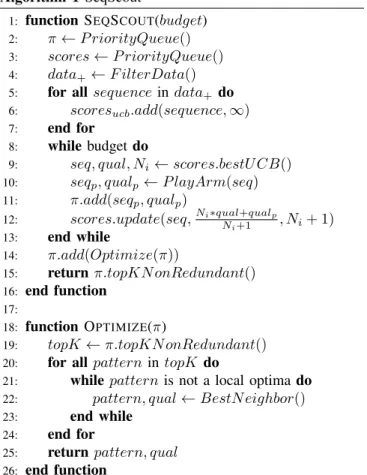
The main idea of the SeqScoutapproach is to consider each sequence of the labeled data as an arm of a multi-armed bandit when selecting the sequences for further generaliza-tion using the Upper Confidence Bound (UCB) principle (See Algorithm 1). The idea of the UCB is to give a score to each sequence that quantifies an exploitation/exploration trade-off, and to choose the sequence having the best one.
First (Lines 2-4), priority queues, π and scores, are created. π stores encountered patterns with their quality, and scores keeps in memory the list of U CB scores of each sequence of the dataset, computed by using Equation 1 (See Section IV-B).data+contains the list of all sequences of the data set labeled with the target class. Indeed, taking sequences having the target class will lead to generaliza-tions having at least one positive element. Then, the main procedure is launched as long as some computational budget is available. The best sequence w.r.tU CB is chosen (Line 9). This sequence is ‘played’ (Line 10), meaning that it is generalized (See Section IV-C) and its quality is computed (See Section IV-G). The created pattern is added to π
1In the context of sequential pattern mining, the search space is a priori infinite. However, we can define the border of the search space (the bottom border in Fig. 1) by excluding patterns having a null support. We can easily prove that each element of this border is a sequence within the database. Therefore, the search space shape depends on the data.
(Line 11). Finally, theU CBscore is updated (Line 12). As post processing steps, the top-kbest non-redundant patterns are extracted from scores using the filtering step (See Section IV-D). Finally, these patterns are processed by a local optimization procedure (See Section IV-E). Moreover, SeqScoutneeds other modules that concern the selection of the quality measure (See Section IV-F) and the quality score computation (See Section IV-G).
Figure 1: Illustration ofSeqScout.
B. Sequence selection
We propose to model each sequence of the dataset as an arm of a multi-armed bandit slot machine. The action of playing an arm corresponds to generalizing this sequence to obtain a pattern, and the reward then corresponds to the
qualityof this pattern. Following an exploitation/exploration trade-off, sequences leading to bad quality patterns will be avoided, leading to the discovery of better ones.
The problem of the multi-armed bandit is well known in the Game Theory literature [23]. We consider a multi-armed bandit slot machine with k arms, each arm having its own reward distribution. Our problem is then formulated as follows. Having a number N of plays, what is the best strategy to maximize the reward? The more an arm is played, the more information about its reward distribution we get. However, to what extent is it needed to exploit a promising arm, instead of trying others that could be more interesting in the long term (explore)? Auer et al.proposed a strategy calledUCB1[21]. The idea is to give each arm a score, and to choose the one that maximizes it:
U CB1(i) = ¯xi+
s
2ln(N)
Ni
, (1)
where xi¯ is the empirical mean of the ith arm, Ni is
the number of plays of the ith arm and N is the total
number of plays. The first term encourages the exploitation
Algorithm 1 SeqScout
1: function SEQSCOUT(budget) 2: π←P riorityQueue()
3: scores←P riorityQueue()
4: data+←F ilterData()
5: for all sequenceindata+ do
6: scoresucb.add(sequence,∞)
7: end for
8: while budgetdo
9: seq, qual, Ni←scores.bestU CB()
10: seqp, qualp←P layArm(seq)
11: π.add(seqp, qualp)
12: scores.update(seq,Ni∗qual+qualp
Ni+1 , Ni+ 1)
13: end while
14: π.add(Optimize(π))
15: return π.topKN onRedundant()
16: end function
17:
18: function OPTIMIZE(π)
19: topK←π.topKN onRedundant() 20: for all patternintopK do
21: whilepattern is not a local optimado
22: pattern, qual←BestN eighbor()
23: end while
24: end for
25: return pattern, qual
26: end function
of arms with good reward, while the second encourages the exploration of less played arms by giving less credit to the ones that have been frequently played.
Performing an exploitation/exploration trade-off for pat-tern mining has already been applied successfully to itemsets and numerical vectors by means of Monte Carlo Tree Search [7]. When dealing with a huge search space, using sampling guided by such a trade-off can give good results. However, contrary to [7], we consider the search space of extents, not intents. Exploring the extent search space guarantees to find patterns with non null support while exploring the intent search space leads towards multiple patterns with a null support. This is a crucial issue when dealing with sequences.
C. Pattern generalization
After the best sequence w.r.t. UCB1 is chosen, it is generalized, meaning that a new more general pattern is built. It enables to build a pattern with at least one positive element. Indeed, most of the patterns in the search space have a null support [11].SeqScoutgeneralizes a sequence
sin the following way. It iterates through each item within each itemsetXi∈s, and it removes it randomly according
to the following rule:
remain, if z <0.5
remove, if z≥0.5, where z∼ U(0,1).
D. Filtering Step
To limit the redundancy of found patterns, a filtering process is needed. We adopt a well-described set covering principle from the literature (See, e.g., [7], [24]), summa-rized as follows. First, we take the best element, and then we remove those that are similar within our priority queueπ. Then, we take the second best, and continue this procedure until thek best non-redundant elements are extracted.
E. Local optimum search
Finally, a local optimum search is launched w.r.t. Defi-nition 7. Various strategies can be used. The first possible strategy is the Steepest Ascend Hill Climbing. It computes the neighborhood of the generalized pattern, i.e., all its item-extensions, set-extensions and reductions. Then, it selects the pattern among those of the neighborhood maximizing the quality measure. This is repeated until there is no more patterns in the neighborhood having a better quality measure. Another possible strategy is the Stochastic Hill Climbing: a neighbor is selected at random if its difference with the current one is large “enough”. Notice however that it introduces a new parameter. Depending on the dataset, the branching factor can be very important. Indeed, for m
items and nitemsets in the sequence, there arem(2n+ 1)
patterns in its neighborhood (See Theorem 1). To tackle this issue, we use First-Choice Hill Climbing [25]. We compute the neighborhood until a better pattern is created, then we directly select it without enumerating all neighbors.
Theorem 1. For a sequence s, let n be its size, l its length, and m the number of possible items, the number of neighbors of s, denoted|N(s)|, ism(2n+ 1).
Proof:The number of item-extensions is given by:
|Iext|= n X i=1 |I| − |Xi|=nm− n X i=1 |Xi|=nm−l.
We have now to sum the number of reductions, set-extensions and item-set-extensions:
|N(s)|=l+m(n+ 1) +|Iext|=m(2n+ 1).
F. Quality measure selection
The choice of the quality measure ϕ is application de-pendent. Our approach can deal with any known measures that support class characterization, such as, e.g., the F1
score, informedness or the Weighted Relative Accuracy [5]. The later, the W RAcc, is commonly used for discriminant pattern mining and subgroup discovery. It compares the proportion of positive elements (i.e., sequences labeled with
the target class) to the proportion of positive elements in the whole database. Letc ∈C be a class value and s be a sequence: W RAcc(s, c) =f req(s)× supp(s,D c) supp(s,D) − |Dc| |D| .
It is a weighted difference between the precisionsP(s→c)
andP(hi →c). The weight is defined as f req(s)to avoid the extraction of infrequent subgroups. Indeed, finding very specific subgroups covering one positive element would re-sult in a perfect quality value but a useless pattern.W RAcc
value ranges in [-0.25, 0.25] in the case of a perfect balanced data set, i.e., containing 50% of positive elements.
We consider objective quality measures that are based on pattern support in databases (whole dataset, or restricted to a class). Using random draws makes it particularly difficult as each draw is independent: we cannot benefit from the data structures that are so efficient for classical exhaustive pattern mining algorithms do (See, e.g., [26]).
G. Efficient computation of quality scores
To improve the time efficiency of support computing, bitset representations have been proposed. For instance, SPAM [26] uses a bitset representation of a pattern when computing an item- or set-extension at the end of a sequence. In our case, we consider that an element can be inserted anywhere. Therefore, we propose a bitset representation that is independent from the insertion position. Its main idea lies in keeping all bitset representations of encountered itemsets in a hash table (memoization), and then combining them to create the representation of the desired sequence. The main idea is given in Fig. 2. Assume we are looking for the bitset representation of h{ab},{c}i. Let h{c}i be an already encountered pattern (i.e., its representation is known) while h{ab}i was not. This can not be handled by the SPAM technique as a new element has to be addedbefore
a known sequence. Our algorithm will first try to find the bitset representation ofh{ab}i. As it does not exist yet, it will be generated and added to the memoization structure. Then, position options for the next itemset are computed (Line 2 in Fig. 2). The latter is then combined with a bitset representation of h{c}i using bitwise AND (Line 4). The support of the generated sequence can then be computed.
V. EXPERIMENTS
We report an extensive empirical evaluation of SeqScout using multiple datasets. All the experiments were performed on a machine equipped with Intel Core i7-8750H CPU with 16GB RAM. Algorithms mentioned hereafter are implemented in Python 3.6.
Datasets: We perform the evaluation using some benchmark datasets that are well known in the pattern mining community, namely aslbu [27], promoters [12],
Figure 2: Bitset representation and support computing.
We also apply our algorithm on the real life dataset sc2
that has been used in [16]. It was extracted from Starcraft IIa famous Real Time Strategy (RTS) game. The goal of each Starcraft match is to destroy units and buildings of the opponent. Three different factions exist, each with its own features (i.e., combat units, buildings, strategies). Roughly speaking, there is a duality between economy and military forces. Investing in military forces is important to defend or attack an opponent, while building economy is important to have more resources to invest into military forces. Sequences in sc2 correspond to the buildings constructed during a game, and the class corresponds to the winner’s faction. Once the target class (i.e., the winning faction) has been chosen, our algorithm will look for patterns of construction that characterize the victory of this faction.
Moreover, we use jmlr, a dataset consisting of abstracts of articles published in the Journal of Machine Learning Research [29]. Table II summarizes the statistics of datasets.
Baselines: We are not aware of available algorithms that address the problem of discriminative pattern mining in sequences of itemsets but several exist for processing sequences of events. Therefore, we compareSeqScoutto two algorithms that we have modified to tackle sequences of itemsets, namely mis`ere [9] and BeamSearch [24]. First, we implemented a simple extension of mis`ere[9]. Second, we implemented a sequence-oriented version of a beam-search algorithm, denoted BeamSearch. To deal with sequences of itemsets, we consider item-extensions and set-extensions at each given depth. Moreover, for the sake of non-redundancy in the returned patterns, we modify its best-first search nature so that the expanded nodes get diverse, as defined in [24]. Indeed, without this modification, BeamSearchselects directly the best patterns at each level, that are often redundant. It may lead to a situation where almost all patterns are removed in the non-redundancy post-processing step, giving rise to solutions with less than k elements.
Settings: If not stated otherwise, we use the follow-ing settfollow-ings. Each algorithm has been launched 5 times, and the reported results are averaged over these runs. For BeamSearch, we empirically set the parameterwidth =
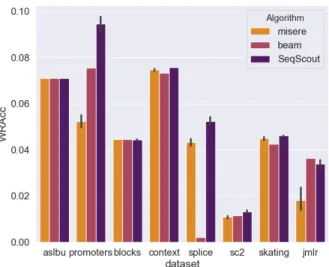
Figure 3:W RAccof top-5 best patterns (10K iterations)
50. For all algorithms, we set θ= 0.5,time budget=∞,
iteration num = 10,000, and top k = 5. Note that instead of giving a fixed time budget for running an al-gorithm on each dataset, we chose to limit the number of iterations iteration num, one iteration corresponding to a single computation of the quality measure. Indeed, this computation is the most time consuming one: it needs for computing the extent w.r.t. the whole dataset. Therefore, using the same time budget on different datasets would not provide a fair comparison: having 50,000 iterations on a small dataset versus 50 on a complex one with the same time budget is not interesting.
A. Performance evaluation usingW RAcc
To assess the performance of the algorithms, let us first use the mean of the W RAcc of the top-k non redundant patterns given by algorithms mis`ere, BeamSearchand SeqScout. Fig. 3 provides the comparative results. Our ap-proach gives better results on the majority of datasets. More-over, it remains quite stable, contrarily to BeamSearch which can be sometimes fairly inefficient (See on splice).
Table II: Datasets
Dataset |D| |I| lmax Search Space Size
aslbu [27] 441 124 27 4.45∗1060 promoters [12] 106 4 57 1.58∗1041 blocks [12] 210 8 12 2.74∗1012 context [12] 240 47 123 5.24∗10224 splice [12] 3,190 8 60 3.28∗1062 sc2 [16] 5,000 30 30 6.48∗1048 skating [28] 530 41 120 1.15∗10212 jmlr [29] 788 3,836 228 1.84∗10853
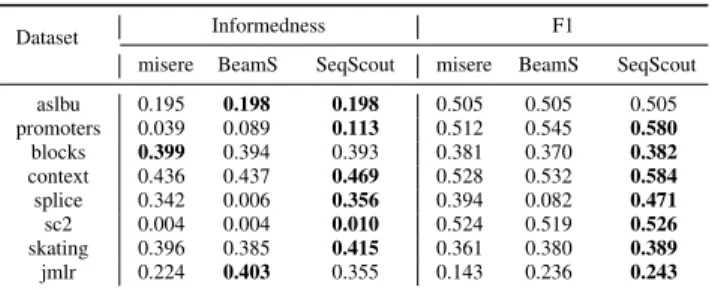
Table III: Mean values of measures for top-5 patterns.
Dataset Informedness F1
misere BeamS SeqScout misere BeamS SeqScout aslbu 0.195 0.198 0.198 0.505 0.505 0.505 promoters 0.039 0.089 0.113 0.512 0.545 0.580 blocks 0.399 0.394 0.393 0.381 0.370 0.382 context 0.436 0.437 0.469 0.528 0.532 0.584 splice 0.342 0.006 0.356 0.394 0.082 0.471 sc2 0.004 0.004 0.010 0.524 0.519 0.526 skating 0.396 0.385 0.415 0.361 0.380 0.389 jmlr 0.224 0.403 0.355 0.143 0.236 0.243
B. Quality with respect to the number of iterations
We discuss the result quality in terms of W RAcc over the number of iterations. Fig. 4, 5, 6 depict the results for the top-5 non-redundant patterns on datasets promoters,
skating and sc2. Note that for the same data, the results may vary from run to run, due to the random component of mis`ere andSeqScout. It explains some fluctuations of the quality. Nevertheless, for each iteration num setting, SeqScouthas shown better results.
C. Using other quality measures
To empirically illustrate the measure agnostic characteris-tic ofSeqScout, we have used other quality measures:F1 -score and Inf ormedness. The results are shown in Table III. Our algorithm gives generally better results.
D. Performance study under varyingθ
We evaluate the performance of the algorithms when vary-ing the similarity thresholdθ. Fig. 7 shows the performance on the datasetpromoters. We did not included the results for
θ = 0because it would mean finding patterns with totally disjoint extents. It results in finding a number of patterns lesser than k for all algorithms, such that the mean would be misleading. We can see from the plot that SeqScout outperforms other algorithms for allθ values.
E. Performance study under varyingk (top-k)
We investigate the performance of the search for top-k
patterns when changing the k parameter. Fig. 8 shows the results when considering the context dataset. SeqScout gives better results. Note that the mean W RAccdecreases for all algorithms, as increasing k leads to the selection of lower quality patterns.
F. Quality versus search space size
We evaluate the average W RAcc of the top-5 patterns w.r.t. the maximum length of sequences (See Fig. 9). To do so, we have truncated the dataset to control the maximum lengths of sequences. We demonstrate it on the skating
dataset. The plot shows thatSeqScoutgives better average
W RAccvalues whatever the search space size is. We also note a general decrease of quality when increasing the search space size. Indeed, some patterns that are good for a
Table IV: Number of found local optima - 10s budget Dataset Integer Set Bitset Variation(%)
aslbu 16,453 17,330 5 promoters 7,185 8,858 24 blocks 30,725 45,289 51 context 4,651 2,667 -47 splice 289 254 -12 sc2 943 605 -36 skating 4,001 1,283 -68 jmlr 704 31 -95
smaller maximum length can appear in negative elements for larger maximum lengths, resulting in a decreasing quality of patterns. Note that the opposite phenomenon can also appear.
G. Comparison to ground truth
We now compute the ratio of the W RAcc result quality of SeqScout to the one of the ground truth. Therefore, we have launched an exhaustive algorithm (Breadth-First-Search) on the datasetsc2. However, the search space size makes the problem intractable in a reasonable time. To tackle this issue, we truncate our dataset to have sequences with a length of 10. Note that even with this severe simplification, our exhaustive algorithm took 35 hours to conclude, and found more than 40 billions of patterns. As we can see in Fig. 10,SeqScoutimproves over time, and it reaches more than 90% of the best pattern set in less than 2,000 iterations (35 seconds on our machine).
H. Sequence length
The pattern lengths on all datasets are reported in Fig. 11. Let us consider thesplicedataset:BeamSearchgives short patterns (max 8), which is significantly less thanSeqScout and mis`ere. This may explain why the BeamSearch result quality is bad on this dataset (See Fig. 3). One hypothesis could be that it does not have enough iterations to go deep enough in the search space. Another hypothesis is that BeamSearchcannot find good patterns having bad parents w.r.t.W RAcc: its good patterns are short ones.
I. Bitset vs. Integer set representation
We investigate the usefulness of bitset representation by comparing it against an integer set representation where each item is represented by an integer. Therefore, we have compared the number of iterations SeqScoutmade for a fixed time budget on each dataset. We settime budget= 10
seconds. The results are summarized in Table IV. We can see that the bitset representation gives a performance gain for datasets with smaller search space size upper bound. Indeed,context,skating, and jmlrhave sequences of large lengths, leading to large bitset representations. Those bitsets are then split into different parts to be processed by the CPU. If the number of splits is too large, the bitset repre-sentation becomes inefficient, and using a classical integer set representation is a better option.
Figure 4:W RAccfor top-5 patterns w.r.t. iterations (skating)
Figure 5:W RAccfor top-5 patterns w.r.t. iterations (promoters)
Figure 6:W RAccfor top-5 patterns w.r.t. iterations (sc2)
Figure 7:W RAccof top-5 patterns versus similarity thresholdθ (promoters)
Figure 8:W RAccof top-kpatterns vs.k
(context)
Figure 9:W RAccof top-5 patterns versus max length on (skating)
Figure 10: Ratio ofW RAccof SeqScoutto ground truth (sc2)
Figure 11: Length of top-5 best patterns - 10K iterations
Figure 12: Additional cost of local optima search
J. Number of iterations during the local optima search
During the local optima search step, an additional number of iterations is made to improve the qualities of the best patterns. In Fig. 12, we plot the ratio of the additional iterations necessary for local optima search w.r.t. the number of iterations given in the main search. The more iterations we have, the more negligible the ratio is. Based on that analysis, we may infer that a rather fair number of iterations for our experiments is 10,000. However, note that we did not plot the additional cost ofjmlr. Indeed, in the particular case of text data, the number of possible items is quite large, leading to a fairly long local optima search. Consequently, we note that SeqScout may not be the relevant choice with this kind of dataset.
K. Quality evaluation on sc2
Given a faction, what are the best strategies to win? SeqScout will look for patterns of construc-tion which are characteristic to the victory of this fac-tion. Let us consider the “Terran” faction, as an exam-ple. For this faction, one of the best pattern found is:
h{Hatchery},{Supply},{F actory}, {Supply}i. We use the colors as indicators of fractions: blue for “Terran”and purple for “Zerg”. We can see that the “Terran” player is investing in military units ({Supply} and {F actory}). The “Zerg” player chooses to invest in its economy by creating a{Hatchery}: she fosters the so-called late game, sacrificing its military forces in the so-called early game. In such a scenario, the “Terran” strikes in early game, knowing its military advantage, and she tends to win the match. This example shows that our algorithm can provide relevant patterns that may be useful, e.g., to identify unbalanced strategies [16].
L. Quality evaluation onjmlr
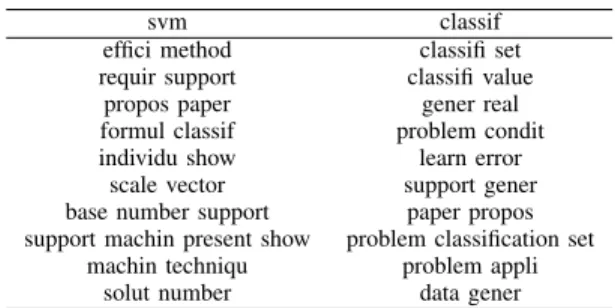
Let us now use a dataset consisting of abstracts of articles from JMLR journal [29]. Sentences have been tokenized and stemmed. Each sequence is then a sequence of items, where an item corresponds to a stemmed word. To label sequences, we chose to add a class ‘+’ to sequences containing a target word, and a class ‘-’ to others. We also removed the target word from the sequences, as it would lead to the discovery of patterns having the target word, which is not interesting. The goal is then to find sequences of items (words), characteristic for the target word. The results for two target words (svm
andclassif) are presented in Table V. As we can see, these patterns are indeed characteristics of the target words. Table V: Top-10 non-singleton patterns given bySeqScout onjmlrfor target words: “svm” and “classif”
svm classif
effici method classifi set requir support classifi value
propos paper gener real formul classif problem condit individu show learn error
scale vector support gener base number support paper propos support machin present show problem classification set
machin techniqu problem appli solut number data gener
VI. CONCLUSION
We presented the algorithm SeqScoutto discover rele-vant subgroups in sequences of itemsets. Though we are not aware of available algorithms to solve the same problem, we have implemented adaptations of two other algorithms when considering sequences of itemsets, namely mis`ere and BeamSearch. Our experiments showed that SeqScout gave better results, without the need for additional parameter tuning as in the case of Beam Search. However we can note that due to the nature of the bandit approach, this algorithm perfoms better on dataset of reasonnable size. Parallelizing the algorithm with an efficient program-ming language could be interesting to tackle this issue in future works. We plan to further improve our method
by incorporating the Monte Carlo Tree Search, a logical evolution of bandit based method to sample the search space. Indeed, instead of repeatedly generalizing promising dataset sequences, it could be more interesting to generalize promising patterns that occur in such promising sequences, identifying the best parts of the search space as the number of iterations increases.
Acknowledgment This research has been partially funded by the French National project FUI DUF 4.0 2017-2021.
REFERENCES
[1] P. K. Novak, N. Lavraˇc, and G. I. Webb, “Supervised de-scriptive rule discovery: A unifying survey of contrast set, emerging pattern and subgroup mining,” Journal Machine
Learning Research, vol. 10, pp. 377–403, Jun. 2009.
[2] S. Wrobel, “An algorithm for multi-relational discovery of subgroups,” inProceedings PKDD 1997, pp. 78–87. [3] Z. Xing, J. Pei, and E. Keogh, “A brief survey on sequence
classification,” SIGKDD Explor. Newsl., vol. 12, no. 1, pp. 40–48, Nov. 2010.
[4] B. Letham, C. Rudin, and D. Madigan, “Sequential event prediction,”Machine Learning, vol. 93, no. 2, pp. 357–380, Nov 2013.
[5] N. Lavrac, P. A. Flach, and B. Zupan, “Rule evaluation measures: A unifying view,” in Proceedings ILP 1999, pp. 174–185.
[6] M. Atzmller and F. Puppe, “SD-Map – a fast algorithm for exhaustive subgroup discovery,” inProceedings PKDD 2006, pp. 6–17.
[7] G. Bosc, J.-F. Boulicaut, C. Ra¨ıssi, and M. Kaytoue, “Anytime discovery of a diverse set of patterns with monte carlo tree search,”Data Min. Knowl. Discov., vol. 32, no. 3, pp. 604– 650, May 2018.
[8] L. Diop, C. T. Diop, A. Giacometti, D. Li Haoyuan, and A. Soulet, “Sequential Pattern Sampling with Norm Con-straints,” inProceedings IEEE ICDM 2018, pp. 89–98. [9] E. Egho, D. Gay, M. Boull´e, N. Voisine, and F. Cl´erot, “A
user parameter-free approach for mining robust sequential classification rules,”Knowl. Inf. Syst., vol. 52, no. 1, pp. 53– 81, Jul 2017.
[10] R. Agrawal and R. Srikant, “Mining sequential patterns,” in
Proceedings IEEE ICDE 1995, pp. 3–14.
[11] C. Ra¨ıssi and J. Pei, “Towards bounding sequential patterns,”
inProceedings ACM SIGKDD 2011, pp. 1379–1387.
[12] D. Dua and E. Karra Taniskidou, “UCI machine learning repository,” 2017. [Online]. Available: http://archive.ics.uci. edu/ml
[13] A. Giacometti, D. H. Li, P. Marcel, and A. Soulet, “20 years of pattern mining: a bibliometric survey,” SIGKDD Explor.
Newsl., vol. 15, no. 1, pp. 41–50, 2013.
[14] M. J. Zaki, “Spade: An efficient algorithm for mining frequent sequences,”Machine Learning, vol. 42, no. 1, pp. 31–60, Jan 2001.
[15] C. Zhou, B. Cule, and B. Goethals, “Pattern based sequence classification,” IEEE Trans. Knowl. Data Eng., vol. 28, pp. 1285–1298, 2016.
[16] G. Bosc, P. Tan, J.-F. Boulicaut, C. Ra¨ıssi, and M. Kaytoue, “A Pattern Mining Approach to Study Strategy Balance in RTS Games,”IEEE Trans. Comput. Intellig. and AI in Games, vol. 9, no. 2, pp. 123–132, Jun. 2017.
[17] S. Nowozin, G. Bakir, and K. Tsuda, “Discriminative subse-quence mining for action classification,” inProceedings IEEE
ICSV 2007, Oct, pp. 1–8.
[18] A. Belfodil, A. Belfodil, and M. Kaytoue, “Anytime subgroup discovery in numerical domains with guarantees,” in
Proceed-ings ECML/PKDD 2018 Part 2, pp. 500–516.
[19] W. Duivesteijn, A. J. Feelders, and A. Knobbe, “Exceptional model mining,”Data Min. Knowl. Discov., vol. 30, no. 1, pp. 47–98, Jan 2016.
[20] M. Boley, C. Lucchese, D. Paurat, and T. G¨artner, “Direct local pattern sampling by efficient two-step random proce-dures,” inProceedings ACM SIGKDD 2011, pp. 582–590. [21] P. Auer, N. Cesa-Bianchi, and P. Fischer, “Finite-time
anal-ysis of the multiarmed bandit problem,” Machine Learning, vol. 47, no. 2, pp. 235–256, May 2002.
[22] L. Qin, J. X. Yu, and L. Chang, “Diversifying top-k results,”
Proceedings VLDB Endow., vol. 5, no. 11, pp. 1124–1135,
Jul. 2012.
[23] S. Bubeck and N. Cesa-Bianchi, “Regret analysis of stochastic and nonstochastic multi-armed bandit problems,”CoRR, vol. abs/1204.5721, 2012.
[24] M. van Leeuwen and A. J. Knobbe, “Diverse subgroup set discovery,”Data Min. Knowl. Discov., vol. 25, no. 2, pp. 208– 242, 2012.
[25] S. Russell and P. Norvig, Artificial Intelligence: A Modern
Approach, 3rd ed. Upper Saddle River, NJ, USA: Prentice
Hall Press, 2009.
[26] J. Ayres, J. Flannick, J. Gehrke, and T. Yiu, “Sequential pattern mining using a bitmap representation,” inProceedings
ACM SIGKDD 2002, pp. 429–435.
[27] P. Papapetrou, G. Kollios, S. Sclaroff, and D. Gunopulos, “Discovering frequent arrangements of temporal intervals,”
in Proceedings IEEE ICDM 2005, pp. 354–361.
[28] F. M¨orchen and A. Ultsch, “Efficient mining of understand-able patterns from multivariate interval time series,” Data
Min. Knowl. Discov., vol. 15, no. 2, pp. 181–215, Oct 2007.
[29] N. Tatti and J. Vreeken, “The long and the short of it: Summarising event sequences with serial episodes,” CoRR, vol. abs/1902.02834, 2019.