Formation of low-mass helium white dwarfs
orbiting binary millisecond pulsars
Dissertation
zur
Erlangung des Doktorgrades (Dr. rer. nat.)
der
Mathematisch-Naturwissenschaftlichen Fakultät
der
Rheinischen Friedrich-Wilhelms-Universität Bonn
von
Alina G. Istrate
aus
Tecuci (Rumänien)
http://hss.ulb.uni-bonn.de/diss_onlineelektronisch publiziert.
1. Gutachter: PD. Dr. Thomas Tauris 2. Gutachter: Prof. Dr. Norbert Langer Tag der Promotion: 11.11.2016
The beginning of knowledge is the discovery of something we do not understand
Abstract
Millisecond pulsars (MSPs) belong to a class of radio pulsars characterized by high rotational spin rates and low magnetic fields. These neutron stars are believed to be the end-product of binary evolution, in which an old neutron star accretes matter and angular momentum from a close stellar companion for an extended period of time, while being observable as an X-ray binary. During this evolutionary phase, they acquire millisecond spin periods and, after the accretion episode ceases, they are reactivated as radio emitting pulsars. The majority of MSP companions are low-mass helium-core white dwarfs (He WDs). However, MSP systems harbouring carbon-oxygen white dwarfs (CO WD), neutron stars, or ultra light companions have also been found, suggesting a diversity in the nature of their progenitors. A handful of MSPs are observed in very compact orbits, Porb ' 2−9 hr, orbiting around low-mass He WDs with masses below 0.25 M and surface gravities 5 < logg < 7, the so-called extremely low-mass helium white dwarfs (ELM WDs).
Today we know of the existence of more than 80 ELM WDs. The increasing number of discovered ELM WDs reveals that they are formed in different environments, from the Galactic disk to open and globular clusters. ELM WDs are most likely the result of binary evolution as they cannot be formed from single stars within a Hubble time. Indeed, over 80% of the observed ELM WDs are found in binary systems, most commonly around a more massive CO WD. The new wealth of data raises questions regarding the puzzling presence of metals in the atmospheres of young bloated ELM proto-WDs and the newly discovered pulsations in three ELM proto-WDs. In this context, improved stellar evolutionary models in which binary evolution is fully accounted for are needed in order to explain the formation and the observed properties of these objects.
In this thesis, we investigate the formation of MSPs found in compact orbits with ELM WD compan-ions through numerical calculatcompan-ions using state-of-the-art stellar evolutionary codes. In particular, we examine if the observed systems can be reproduced by theoretical modelling using standard prescrip-tions of angular momentum loss with contribuprescrip-tions from gravitational wave radiation, magnetic braking and mass loss. We find that a severe fine-tuning in the initial orbital period is necessary to reproduce the observed number of MSPs with ELM WD companions suggesting that something needs to be modified or is missing in the standard input physics of their modelling.
Moreover, we explore the formation and cooling of ELM WDs through a large grid of computed models suited for environments with different metallicities, with emphasis on the proto-WD phase. Specifically, we analyse in detail the evolutionary times of these objects which are of great importance in providing an accurate independent age estimate for MSP systems. For the first time, we study the combined effects of element diffusion, i.e. gravitational settling, thermal and chemical diffusion, and rotational mixing on the evolution of these WDs. Our results show that rotational mixing plays a key role in determining the chemical composition of the surface layers of ELM proto-WDs, but it does not affect their internal structure. This finding has important implications for the asteroseismology studies of ELM proto-WDs which are currently pursued. Furthermore, we suggest that the spin frequencies of the resulting WDs are well above the orbital frequencies, a result which needs to be confirmed by further dedicated observations.
Contents
1 Introduction 1
1.1 Stellar evolution in a nutshell . . . 2
1.2 Binary evolution . . . 5
1.3 White dwarfs . . . 8
1.4 Neutron stars . . . 11
1.5 Pulsars. . . 13
1.5.1 Pulsar demography . . . 14
1.5.2 The population of binary millisecond pulsars . . . 15
1.6 This thesis . . . 17
1.6.1 Millisecond pulsars in very compact orbits . . . 17
1.6.2 Formation and evolution of extremely low-mass helium white dwarfs . . . 19
2 The formation of low-mass helium white dwarfs orbiting pulsars 21 2.1 Introduction . . . 21
2.2 Observational properties of MSPs with He WDs in tight orbits . . . 22
2.3 Numerical methods and physical assumptions . . . 25
2.3.1 Orbital angular momentum treatment . . . 25
2.3.2 Mass accretion rate and accretion efficiency . . . 27
2.4 Results. . . 28
2.4.1 Parameters of the model grid . . . 28
2.4.2 Orbital evolution, mass transfer and stellar structure . . . 29
2.4.3 Magnetic braking and the influence of theγ-index . . . 34
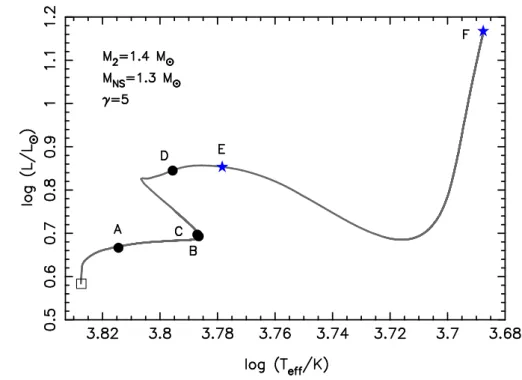
2.4.4 Evolution in the HR-diagram and hydrogen shell flashes . . . 35
2.4.5 The (MWD, Porb)–relation for tight orbits . . . 37
2.5 Discussion. . . 41
2.5.1 The magnetic braking law . . . 41
2.5.2 Further evidence of an orbital period fine-tuning problem. . . 41
2.5.3 Irradiation effects, accretion disk instabilities and circumbinary disks . . . 42
2.6 Conclusions . . . 43
3 The timescale of low-mass proto-helium white dwarf evolution 45 3.1 Introduction . . . 45
3.2 Numerical methods and physical assumptions . . . 46
3.3 Results. . . 46
3.4 Comparison with observational data of He WDs . . . 48
3.4.1 MSPs with low-mass (proto) He WDs in tight orbits . . . 48
3.4.2 NLTT 11748 and other low-mass (proto) He WD binaries . . . 49
3.4.3 Bloated, hot, low-mass He WDs detected byKepler . . . 50
4.2 Formation and evolution of ELM WDs . . . 55
4.2.1 Hydrogen shell flashes and proto-WDs . . . 55
4.2.2 Age dichotomy in helium WD cooling? . . . 57
4.2.3 Aims of this investigation of ELM WDs . . . 57
4.3 Numerical methods . . . 58
4.3.1 Grid of models . . . 59
4.4 Results. . . 60
4.4.1 General effects of element diffusion and rotational mixing . . . 60
4.4.2 Effect of metallicity . . . 67
4.4.3 Inheritance of proto-WDs: the hydrogen envelope mass. . . 69
4.4.4 ∆tproto: the contraction timescale for proto-WDs . . . 70
4.4.5 Dichotomy on ELM WD cooling tracks . . . 70
4.5 Discussion. . . 75
4.5.1 Rotational mixing: source of surface metals? . . . 75
4.5.2 Comparison with previous work . . . 77
4.5.3 Relation of mass to orbital period in WDs . . . 81
4.6 Conclusions . . . 81
5 Summary and conclusions 85 5.1 Millisecond pulsars in compact orbits . . . 85
5.2 Formation and evolution of extremely low-mass white dwarfs. . . 86
A Additional information regarding the proto-WD phase 91 A.1 Observational data and time evolution in the (Teff,logg)–diagram . . . 91
A.2 The (proto) WD contraction phase . . . 91
A.3 Nuclear burning during flashes . . . 91
B Properties of the computed models 97
Curriculum Vitae 111
List of publications 113
Acknowledgements 115
CHAPTER
1
Introduction
Astronomy, as nothing else can do, teaches men humility.
Arthur C. Clarke, The Challenge of the Spaceship, 1959
Astronomy is as old as mankind although the concepts tremendously evolved and changed with time. The last 100 years represents a huge step forward in scientific and technological development. For astronomy, the availability of more telescopes, bigger telescopes, space missions and ever increasing computing power provides new windows and methods to study the surrounding Universe.
Stars are fundamental objects in the Universe as they are the building blocks of larger structures such as clusters and galaxies. As an example, our own galaxy, the Milky Way, a typical spiral galaxy, contains between 1011to 1012stars. In the early Universe, the first generation of stars formed exclusively from the primordial gas which contained hydrogen, helium, and very small amounts of lithium and beryllium. It is the first stars that produced heavier elements which changed the dynamics and evolution of the Universe as we know it today. The history of a galaxy can be traced by statistically studying the properties of its stars. Thereby, stellar astrophysics, which studies the birth, the evolution and the death of the stars plays a central role in modern astrophysics.
Stars form inside very cold (∼10–20 K) clouds of gas which are composed mostly of molecular hydrogen and helium. In addition, they are seeded with heavier elements from stars that lived and died before them. These clouds extend across hundreds of light years and contain the raw material for thousands or even more stars. A nearby supernova, collisions with another gas cloud, or the pressure wave of a galaxy’s spiral arms passing through the region can disrupt the balance between the cloud’s gravity and the outward gas pressure of the molecules, causing the cloud to collapse. As the cloud collapses, it breaks into smaller and smaller increasingly compact clumps, until there are knots with roughly the mass of a star. These newly formed objects are the so-calledprotostars. The protostar is surrounded by a circumstellar disk from which it may still accrete material while the remaining matter eventually will form a planetary system. When the central temperature of the protostar reaches roughly 107K, hydrogen can fuse into helium. Once the nuclear fusion starts, a new star is born! Some objects don’t accumulate enough mass to be able to start nuclear fusion and become brown dwarfs, substellar objects, which slowly cool down over billions of years. A qualitative picture showing the formation process, the evolution and the type of remnant for different stellar masses is shown in Fig.1.1.
According to their observational properties, stars can be classified in various ways creating a true stellar zoo. However, the most important factor in determining the evolution of a star is its initial mass. From a theoretical point of view, stars can simply be classified according to their initial mass as low-mass stars, with 0.08 .M/M .2.0,intermediate-mass stars, with 2.0. M/M.8.0 andhigh-mass starsormassive starswith M&8.0 M.
Figure 1.1: Image depicting birth, evolution and death of stars. The mass of the star increases on they-axis and the time evolution is represented on thex-axis, from left to right. Credit: Jet Propulsion Laboratory.
The distribution of the initial masses in a population of stars is described by an empirical function, called theinitial mass function. The initial mass function of the local solar neighbourhood (Salpeter 1955;Kroupa 2002) indicates that the vast majority of stars (∼90%) are born with masses less than 0.8 M, while massive stars are very rare, less than 1% of all stars.
Stellar evolution can not be studied by continuously observing an individual star as most changes occur over millions or billions of years, but by observing numerous stars which are in various stages of their evolutionary history. Astronomers visualize the evolution of a star in a so-calledHertzsprung-Russell diagram(HRD). The most common used quantities plotted in this diagram are luminosity1and surface (effective) temperature.
1.1 Stellar evolution in a nutshell
Stars, much like humans, are born, evolve and eventually die. The evolution of a single star, its lifetime and the nature of its compact remnant are primarily determined by its initial mass. However, other
1.1 Stellar evolution in a nutshell
parameters, such as chemical composition, rotation and mass-loss by a stellar wind also play a crucial role. Things get much more complicated if the star, at some point in its life, interacts gravitationally with another star and experiences mass transfer from one to another. A complete introduction on stellar astrophysics is beyond the scope of this thesis, but the interested reader is referred to, for example, the textbook byKippenhahn et al.(2012).
A star can be approximated by a self-gravitating gas (plasma) in hydrostatic equilibrium that radiates energy into its surrounding space. The virial theoremstates that the radiative loss of energy for such a gas causes it to contract. During the contraction phase, the gas releases gravitational energy which translates into an increase in its temperature. Thus, while the star tries to cool itself by radiating away energy through the surface, instead gets hotter. The more it radiates, the hotter it gets and the more it has to radiate away. This is an unstable situation in the long run and explains why the star ends its life as a compact object. However, nuclear fusion provides the energy that is lost at the surface for most of the lifetime of a star leading to the stability we observe, for example, in our own Sun. The energy produced in the center of the star needs to be transported to the surface2, thus a temperature gradient is established which is coupled to the pressure gradient that provides the hydrostatic equilibrium.
Nuclear fusion occurs in regions of the star where the temperature is high enough that quantum mechanical effects lead to the fusion of some nuclei into heavier ones, with the release of their binding energy (the difference in the rest mass). Depending on the initial mass3, there are different nuclear fusion cycles that can occur in the core of a star through which the initial hydrogen is gradually converted to helium, helium to carbon and then further to heavier elements such as neon, oxygen and silicon in the case of the more massive stars. As the energy source changes, the star goes through different evolutionary stages characterized by changes in its observable properties such as surface temperature, luminosity, and radius.
In general, massive stars produce metals4up to iron during the core nuclear burning phases. However, through processes such as the s-process5, heavier elements than iron can be produced. During the final stages of their evolution, stars shed a fraction of their material into space through a stellar wind6, thus recycling interstellar material. The remnants of stellar evolution are white dwarfs for low- and intermediate-mass stars, and neutron stars and black holes for massive stars.
Low- and intermediate-mass stars
All stars initially convert hydrogen into helium. During this evolutionary phase, stars are found on the
main sequence which is the region in the HRD where stars spend most of their lives and, therefore, is also the most populated region of the diagram. At the end of this phase7, the star will have an inert helium core surrounded by a hydrogen envelope.
Alow-mass star, such as our own Sun, will spend about 1010years on the main sequence. Once the helium core is formed, the central temperature is not high enough for helium fusion to occur. As no nuclear energy source is available to balance the energy loss from the surface, the core slowly starts to contract. As the contracting core heats up, hydrogen will start burning in a shell surrounding the core, releasing more energy per unit time (i.e luminosity) than during the main sequence phase due to a higher core temperature.
2either through convection or radiative transport.
3The crucial difference between low, intermediate and high-mass stars stars is the core temperature.
4In astrophysics, metals denote all the chemical elements heavier than hydrogen and helium.
5 The s-process is a nucleosynthesis process that occurs at relatively low neutron density such that any unstable products
have time to decay before another neutron is captured.
6In general, the more massive the star, the stronger the wind-mass loss.
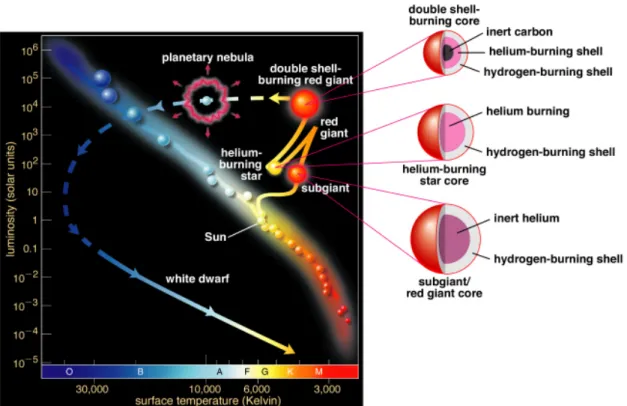
Figure 1.2: The evolution of a low-mass star in the Hertzsprung-Russell diagram (HR). Credit: Addison Wesley.
The pressure produced by the burning shell is transferred to the envelope causing it to expand and cool down. During this phase, the radius of the star expands 10 to 100 times its original size, while the surface temperature decreases – characteristics that give rise to the namered-giant phase. The evolution of a low-mass star in the HRD, as well as its internal structure, is schematically shown in Fig.1.2. The helium core contains a mixture of helium nuclei and electrons. According to the Pauli exclusion principle, two electrons cannot occupy the same energy level with identical quantum numbers simultaneously. As the core of the star contracts, it becomes denser and denser and therefore the lowest electron energy levels are filled and the electrons are forced into higher and higher energy levels. This gives rise to a pressure called theelectron degeneracy pressurewhich prevents further gravitational collapse. When degeneracy pressure is stronger than thermal pressure, the gas is said to bedegenerate. A degenerate gas behaves quite differently than an ideal gas. While for an ideal gas, the pressure depends on the density and the temperature, for the degenerate gas the pressure depends only on the density. In all low-mass stars, the helium core becomes degenerate during the red-giant phase.
Nuclear reactions that occur in a degenerate core tend to be explosive, generating a type of runaway process. An increase in the temperature in the degenerate gas does not increase the pressure, so the gas cannot expand and cool down. The temperature increase makes it easier for the nuclear reactions to occur, as they are very temperature dependent. The nuclear reactions occur more and more rapidly until the temperature of the core becomes so high that the degeneracy is lifted. The ignition of helium in low-mass stars is thus an explosive phenomenon calledhelium core flashin which a large amount of helium fuses to carbon in a matter of seconds. After the flash, the luminosity decreases and the outer layers of the star shrink. Low-mass stars ignite helium in their cores essentially at the same core mass of 0.45 M. As the core structure of all such stars is similar, during helium burning they are found on the horizontal branch, characterized by near constant luminosity. One of the main difference between
low-1.2 Binary evolution
and intermediate-mass stars ( 2.0. M/M .8.0) is that the latter, due to higher central temperatures, have non-degenerate cores when helium burning starts, and the core helium burning proceeds steadily.
After helium core burning, the evolution of low- and intermediate-mass stars is qualitatively alike. Over time, the core is depleted of helium leaving behind the ashes from the nuclear burning (carbon and oxygen). At this point, the star is made of a carbon-oxygen core, a helium shell surrounding the core and the outer part of the star forms a hydrogen shell. Following helium depletion, the star begins to contract and heat up. The nuclear burning proceeds into a helium shell surrounding the core, causing the star to expand again and go through a second red giant-like stage on the the asymptotic giant branch. This phase is relatively short compared to the previous ones, lasting about only one million years for a Solar-type star. During the red-giant and the asymptotic-giant phase, stars lose significant part of their envelopes due to a strong stellar wind. During this last phase, the core does not reach the temperature necessary for carbon burning to ignite. However, the helium shell burns in a series of helium shell flashes which causes the ejection of the outer helium and hydrogen layers. This outer hot ejected gas forms a so-called planetary nebula. The carbon-oxygen core left behind is supported by electron degeneracy pressure and this new object is called awhite dwarf, because it is hot and small in size.
Massive stars
A massive star continues nuclear burning beyond helium burning, such that, after several stages of nuclear fusion, the inner core will be made out of iron. The core nuclear burning cycle ends once the iron core is formed, as further fusion requires energy rather than releasing it.
Over time, the internal structure of a high-mass star resembles the structure of an onion, with concentric layers of different elements layered over each other, with highest mass element (iron) at the center. If the mass of the iron core exceeds the Chandrasekhar limit of ∼ 1.4 M, which is the maximum mass for an electron-degenerate configuration, the star will collapse to form either a neutron star or a stellar-mass black hole, depending on the mass of the remaining core. The gravitational energy released during the implosion is way larger than the binding energy of the envelope of the star. This will result in a supernova explosion in which the collapsing star ejects its envelope with a typical speed of about 104km s−1. These type of supernovae, calledcore-collapse supernovaeare some of the most energetic events in the Universe. For the few weeks that they are at peak brightness, their luminosities can compete with the luminosity of the entire galaxy in which they are born.
The last stages of a massive star, during and beyond carbon burning, are very short lasting compared to the lifetime of the star as the burning process becomes less and less efficient, i.e. progressively less energy is released. The evolution of the core is accelerated as the energy during these burning stages is mostly released as neutrinos, which can escape the star without interaction with the stellar matter. Massive stars are considered cosmic engines because they are responsible for a large fraction of the ionized gas and metals found in normal galaxies.
Table1.1lists the possible end-products as a function of the initial mass for single stars. These values and outcomes (e.g. the possibility of forming helium white dwarfs) will change if binary interactions are at work. The mass values are only indicative and depend on the metallicity and uncertainties in mass loss rates and assumed physics. Moreover, for binaries, the values depend on the initial orbital period and mass ratio.
1.2 Binary evolution
Stars, much like every living organisms, do not prefer life in isolation. Roughly two thirds of all stars are members of a binary or multiple systems with orbital periods ranging from∼10 min to∼106years.
Table 1.1: End products of single stellar evolution as function of initial mass (Tauris & van den Heuvel(2006)). Initial mass He-core mass Stellar remnant
<2.3 M <0.45 M CO white dwarf 2.3-6 M 0.5-1.9 M CO white dwarf 6-8 M 1.9- 2.1 M ONeMg white dwarf 8-12 M 2.1-2.8 M neutron star
12-25 M 2.8-8 M neutron star >25 M >8 M black hole
The majority of them are in wide systems in which both of the components are basically evolving as single stars. However, there is a fraction of binary systems close enough that the stellar companions will interact at some point in their lifetime. During this interaction, mass and angular momentum are transferred from the donor star to the accreting star which changes the structure of both stars and sub-sequently their evolution. Binary interactions give rise to numerous spectacular phenomena which are absent in single star evolution. Compact binaries, in which at least one of the components is a com-pact remnant of a star, host most of the observed high-energy phenomena: X-ray bursts, X-ray pulsars, novae, supernovae Type Ia, radio and X-ray jets, accretion disks and even gamma-ray bursts.
If two stars orbit each other, we define theRoche potentialas the effective potential describing their mutual attraction. It includes the gravitational potential of each individual star and the contribution from the centrifugal force. In a binary system8one can define fixed equipotential surfaces, of particular importance being the equipotential surface (pear-like shape) passing through the first Lagrangian point, known as the Roche-lobe (see Fig. 1.3). The Roche potential limits the expansion of a star in a binary to a maximum radius, theRoche-lobe radius. If a star expands to fill its Roche lobe, i.e. its radius is close to the Roche-lobe radius, material will be transferred to its companion star.
The Roche-lobe radius is approximated by the following expression (Eggleton 1983):
RL=
0.49q2/3
0.6q2/3+ln(1+q1/3)a, (1.1) whereais the orbital separation andq=Mdonor/Maccretor is the mass ratio between the two stars.
According to the Roche-lobe geometry, binary stars can be found in three states:
• detached binaries: both stars are confined within their Roche lobes. The only influence they have on each other is through gravitation, tidal interactions and stellar winds.
• semi-detached binaries: one of the stars fills its Roche lobe (the donor). Mass is being transferred from the envelope of the donor towards the accretor.
• contact binaries: both stars fill or overfill their Roche lobe. Both stars are gravitationally distorted and surrounded by a common photosphere through which the stars are in physical contact. Once a star fills its Roche lobe, i.e. the stellar radius is slightly larger than the Roche-lobe radius,
R & RL, matter starts being transferred towards the companion in a phase called Roche-lobe overflow
(RLO). A star can fill its Roche lobe due to either radial expansion as a result of nuclear evolution, or orbital shrinkage due to orbital angular momentum losses. When RLO is initiated, the stability of the mass transfer process depends on several factors.
1.2 Binary evolution
Figure 1.3: Simple representation of stable mass transfer (a) and unstable mass transfer through common envelope evolution (b). Credit: Philipp Podsiadlowski.
These factors include how the radius of the donor responds to the mass loss and how the orbit itself, and therefore also RL, responds to mass transfer. In addition, the dynamical stability also depends on the response of the companion star to the mass being transferred to it. Depending on the evolutionary state of the donor, RLO mass transfer can be classified into three cases:
• Case Amass transfer is initiated while the donor is still on the main sequence, i.e. undergoing core-hydrogen burning.
• Case Bmass transfer occurs when the donor left the main sequence but did not start yet helium core burning.
• Case Cmass transfer occurs when the donor overflows its Roche lobe during helium shell burning or beyond.
When considering binary evolution, three timescales associated with single stars evolution become im-portant:
• the dynamical timescaleis the timescale in which a star reacts to a perturbation on its hydrostatic equilibrium. It is given by the ratio of the stellar radius to the sound speed of the stellar matter:
τdyn= R cs ≈0.04 M M !1/2 R R !3/2 day (1.2)
• the thermal timescaleis the timescale in which a star reacts when energy loss and energy produc-tion are no longer in equilibrium. It can be expressed by the ratio of the thermal energy reservoir of the star,Ethand its luminosityL:
τKH= Eth L ≈ GM2 2RL ≈1.5×10 7 M M !2 R R L L yr (1.3)
• the nuclear timescaleis the timescale in which a star uses its nuclear fuel reservoir: τnuc =0.007 Mcorec2 L ≈10 10 M M L L yr (1.4)
wherecis the speed of light andMcoreis the mass of the stellar core.
The response of the stellar radius to mass loss depends critically on the structure of the envelope of the star and, in particular, whether the envelope is convective or radiative. Stars with radiative envelopes shrink in response to mass loss, while stars with convective envelopes tend to expand rapidly.
Depending on the reaction of the stellar radius to mass loss, RLO mass transfer can be classified as
stable mass transfer, thermal time-scale mass transfer anddynamically unstable mass transfer. The later often leads to acommon envelope(CE). Figure1.3shows the geometry for stable mass transfer as well as for a common envelope.
Dynamically unstable mass transfer occurs when the donor is a giant or supergiant with a convective envelope, because a star with a convective envelope tends to expand rather than shrink when it losses mass very rapidly (adiabatically). In this case, the radius of the star expands faster than its Roche-lobe radius causing a runaway mass transfer on a dynamical timescale. In the same time, the Roche-lobe radius shrinks when mass is transferred from a more massive to a less massive star, making the donor overfill its Roche lobe by an ever larger amount. Once a common envelope system is formed, friction between the immersed binary will make the two components spiral towards each other until enough orbital energy has been released to eject the envelope (Paczynski 1976), in a poorly understood process. This ends the spiral-in phase and leaves a much closer binary with an orbital period typically between
∼ 0.1 and∼10 d, consisting of the core of the giant and a normal secondary star. In contrast to the RLO channel, CE evolution tends to produce very short period systems. Since the spiral-in phase is very short lived, the companion star will not be able to accrete much matter and it will be mostly unchanged at the end of this phase. The conditions for the occurrence of dynamical mass transfer are not well determined. It is usually assumed that the mass transfer from a star with a convective envelope is dynamically unstable if the mass ratio of the donor to the mass accretor is larger than a critical value of∼1.3. The formation and evolution of compact binary stars is reviewed inTauris & van den Heuvel (2006) andPostnov & Yungelson(2014) and a complete review of the common envelope formalism can be found inIvanova et al.(2013).
1.3 White dwarfs
A white dwarf (WD) is the stellar remnant of low- and intermediate-mass stars, i.e. stars with mass smaller than 10±2 M. More than about 97% of all stars, including our own Sun, will end their life as a WD. Because many WDs are among the oldest objects in the Galaxy, they can be used to determine the age of the stellar population where they reside, such as the Galactic disk (e.g.Oswalt et al. 1996), indi-vidual open clusters (e.g.García-Berro et al. 2010), and the Galactic halo (e.g.Kalirai 2012). Moreover, studying the population of WDs in a given environment, reveals important information about the star formation process (Tremblay et al. 2014).
Because of their small radii, WDs are intrinsically faint, and therefore, from an observation point of view, they are hard to detect requiring moderately large telescope apertures. The Sloan Digital Sky Survey(SDSS) played a major role in the last decade by spectroscopically identifying roughly 30 000 WDs (Kepler et al. 2016) and this number will only increase to reach∼105with the new Gaia mission (Gaensicke et al. 2015).
1.3 White dwarfs
White dwarfs are supported against gravitational collapse by the electron degeneracy pressure. This provides a maximum limit for the mass of a WD, known as the Chandrasekhar mass limit that is roughly about 1.4 M. Any isolated WD with a mass below this critical mass will stay a WD forever, while a WD that exceeds this mass, for example, by accretion in a binary system, will collapse and possibly explode in a thermonuclear supernova.
White dwarfs have a relatively simple structure of an isothermal core surrounded by a non-degenerate envelope. The chemical composition of both the core and the envelope depends on the WD mass and are basically determined by the evolution of the WD progenitor. Most of them have a core composed of a mixture of carbon and oxygen with a thin helium mantle (containing∼1% of their mass) surrounded by a thinner hydrogen envelope (most 0.01% of the WD mass). The WDs with a mass smaller than about 0.4 Mhave helium cores and are produced in close binary systems, while those more massive than about 1.05 Mare probably made of oxygen, neon and magnesium.
Spectral types
White dwarfs can be classified according to their optical spectra, i.e the dominant spectral lines in their atmospheres as (i) DA: strong hydrogen lines, (ii) DB: strong He I lines, (iii) DO: strong He II lines, (iv) DC: no strong lines (continuous) spectrum, (v) DZ: strong metal lines (excluding carbon), (vi) DQ: strong carbon lines.
About 80% of the WDs enter the WD cooling domain with hydrogen-rich atmospheres. Gravitational settling (element sedimentation) is very efficient in the regime of high surface gravities exhibited by WDs (log g ∼ 8) leading to the formation of almost pure hydrogen atmospheres, the DA WDs. The mass distribution of DA WDs peaks at 0.59 M and also exhibits high- and low-mass components (Kepler et al. 2007;Kleinman et al. 2013;Kepler et al. 2015).
Some of the newly formed WDs may experience a very late helium flash, during which the WD under-goes violent mixing episodes. As a result, the atmospheres of these WDs contain a mixture of helium, carbon and oxygen. These are very hot objects, called the PG1159 stars, showing a very characteristic spectral signature. The interplay between stellar winds, gravitational settling, cooling evolution and possible pollution from an accretion disk leaves behind DO, DB, DQ, DZ, and DC stars.
Cooling evolution
The evolution of a WD can be treated as a simple cooling process in which the internal energy of the ions in the degenerate core act as a reservoir of energy and the outer non-degenerate layers control the energy outflow. Energy transport in the interior of the WD is dominated first by neutrinos and then by electron conduction. In the outer non-degenerate layers, radiation transports the energy to the surface but, at lower temperatures, convection associated with the partial ionization of the most abundant element at the surface becomes important.
The basic theory of WD cooling was developed more than 60 years ago byMestel(1952), who found a power-law relation between age and WD luminosity:
tcool∝L−5/7. (1.5)
The Mestel age-luminosity relation is in good agreement with detailed numerical evolutionary models, in particular in the regime −1 ≥ log(L/L) ≥ −3. However, important physical processes such as for example neutrino cooling, crystallization and surface convection can change the cooling time compared to the simple relationship above.
Figure 1.4: HR-diagram for the full evol-ution of a 3.5 M star from the
zero-age main sequence to the white dwarf do-main. Mass-loss episodes at the thermally pulsing AGB reduce the stellar mass to 0.66 M. The various physical processes
which occur as the WD cools, as well as the domain of the pulsating instability strips for the DOV, DBV and DAV, are in-dicated. The thin dashed line displays the neutrino luminosity. Figure fromAlthaus et al.(2010).
In the earliest stage, the cooling is a very complicated function of the initial status of the pre-white dwarf, such as the pulse-interpulse phase at which the WD is formed. The cooling also depends on the number of thermal pulses the star suffered before planetary nebula ejection, and the chemical stratifica-tion. The thermal evolution is affected by processes such as mass loss, radiative levitation of elements, gravitational settling and diffusion.
The ions inside the WD core behave initially as a gas, and, as the cooling evolution proceeds, as a fluid, and ultimately undergoes a first-order phase transition to the solid phase. A significant amount of energy is lost in the early phases of the WD cooling through neutrino processes. Consequently, the cooling process of a WD can be roughly divided in four stages (Isern & García–Berro 2004;Kawaler et al. 1996):
• Neutrino cooling occurs when log (L/L) > −1.5. Shortly after the planetary nebula phase, the core of the WD is still hot enough such that a large number of neutrinos are formed through processes involving the electroweak interaction. The vast majority of the neutrinos escape without interaction to outer space, thus contributing to an important stellar energy sink. The evolution of a very hot, young WD is thus dominated by neutrino cooling.
• Fluid coolingoccurs at−1.5 ≥ log (L/L) ≥ −3. This is the best understood phase in the WD cooling evolution. At this point, the ratio of Coulomb energy to thermal ion energy exceeds one and the WD core becomes a Coulomb liquid. At this stage, the fluid is only loosely coupled and the transfer of energy through the envelope is controlled by a large buffer of non-degenerate matter.
• Crystallizationsettles in when log (L/L)<−3 and leads to one of the largest sources of uncer-tainty in determining the ages of cool WDs (Segretain et al. 1994). When a typical WD with a mass of 0.6 Mcools down toTeff '6000−8000 K, the core will undergo a phase transition from liquid to solid, when the Coulomb energy exceeds the thermal energy of the ions by a factor of about 171. The phase transition releases latent heat which contributes as a new source of thermal
1.4 Neutron stars
energy that introduces a delay in the cooling of the WD. Its contribution to the total luminosity is between∼5 and 10%. Sedimentation of heavy ions upon crystallization, with subsequent release of gravitational binding energy, represents another major source of energy for cool WDs. Minor species are the main source of uncertainty since, for example, neon can introduce a delay in the range of 0.5−9 Gyr (Isern et al. 1991), while iron can introduce an additional delay of 1 Gyr. • Debye coolingtakes over as quantum effects become important after crystallization. During this
stage, the thermal content of the WD is progressively depleted as central temperature drops. After most of the star solidifies, the cooling curve begins to decline again, more steeply than before. The crystal lattice causes coherent vibrations and this actually promotes further energy loss. This is known as Debye cooling. The internal thermal content has been depleted and subsequent con-traction of the outer envelope contributes up to 30 percent of the luminosity output.
In the case of low-mass helium-core WDs, the mass of the hydrogen envelope plays an extremely important role in their cooling evolution, such that, the WDs that enter on the cooling track with a thick hydrogen envelope will cool much slower than those with a thin hydrogen envelope due to the residual burning of hydrogen. Therefore, the determination of the hydrogen envelope mass at the beginning of the cooling track for such objects is very important for an accurate determination of their age.
Detailed reviews of recent developments in the WD field can be found in Koester(2002);Hansen & Liebert(2003);Fontaine et al.(2001);Althaus et al.(2010);Kilic(2011), while an introduction to the basic theory of WD cooling can be found inD’Antona & Mazzitelli(1990).
1.4 Neutron stars
Unlike WDs, neutron stars (NSs) are born in a more violent fashion, as a result of a supernova explosion that occurs in the last few moments in the evolution of massive stars (M&8.0M). When all the nuclear fuel in the core of the massive star has been exhausted, the remaining iron core must be supported by degeneracy pressure alone. If the core mass exceeds the Chandrasekhar limit of about 1.4 M, the electron degenerate pressure cannot counteract the gravity anymore. The core thus becomes unstable and collapses.
Because of the extreme conditions available now in the core, i.e T ∼109−1010K, a process of photo-disintegration starts, in which the energetic photons destroy the iron nuclei into helium nuclei. The helium nuclei will further disintegrate into single protons and neutrons, thus reversing the result of the nuclear burning which have been taking place in the core of the star during its lifetime. The photo-disintegration is an endothermic process, which contributes to a faster contraction of the core. The newly formed protons mutate into neutrons by an inverseβ-decay processe−+ p → n+νe, which is
also an endothermic process. This phase is calledneutronization, because its effect is to destroy protons and electrons and create neutrons. The core collapses until the neutron degeneracy pressure is high enough to stop the collapse. During this quick implosion of the star, the core converts into a hot neutron sphere. The envelope of the massive star moves in free fall to the center and is reflected there because of the repulsive strong interaction force of supra-nuclear dense matter. As a result, an outward shock is launched from the surface region of the proto-neutron star. A stream of neutrinos helps to boost the unbound matter offin a powerful explosion. Immediately after the supernova event, the temperature of the newborn neutron star is about 1012K.
Neutron stars are some of the most extreme objects in the Universe. They are about 20 km in diameter and have a mass of about 1-2 times that of the Sun. Moreover, they posses magnetic fields millions of times stronger than the strongest magnetic field produced on Earth.
Figure 1.5: The internal structure of a neutron star. Credit: Alessandro Patruno.
Because NSs retain the angular momentum of the original larger core of their progenitor star, they usually rotate very fast – up to several hundred times per second for a newly born NS.
The structure of a NS is not yet fully understood. A simplified picture is shown in figure1.5where one can distinguish several regions:
• the atmosphere is thin (∼ a few cm thick) and consists of very hot plasma, on top of an iron envelope. The density here isρ.106g cm−3.
• the outer crust in only about 200 m thick and consists of a solid lattice (or a dense liquid at early stages) of heavy nuclei. The dominant pressure in this region is from electron degeneracy. The density is not high enough here to favor neutronization.
• the inner crust is from 0.5 to 1 km thick. The pressure is higher and the lattice of heavy nuclei is now permeated by free neutrons that begin to drip out of the nuclei whenρ ∼ 4×10¹¹ g cm−3. The pressure is still mostly from degenerate electrons.
• the outer core is composed primarily of superfluid neutrons and the neutrons supply most of the pressure through neutron degeneracy. Free superconducting protons are present too. This region of mainly neutrons is what gives the neutron star its name.
• the structure of the inner core is less certain than that of the outer layers of the NS because the equation-of-state for matter under super-dense conditions is not well understood.
A NS is an excellent object to test the physics of dense matter. Especially in the cores of the NSs, many exotic particles are expected to be formed, but the information from the central parts of the neutron star is hidden in the macroscopic properties such as neutron star masses and radii.
Masses of NSs at birth are tuned by the complex details of the astrophysical processes that drive core collapse and supernova explosions (Timmes et al. 1996). The maximum possible mass of a NS has attracted particular attention because it draws the boundary for the low-mass limit of stellar mass black holes (Rhoades & Ruffini 1974;Fryer & Kalogera 2001).
1.5 Pulsars
Figure 1.6: The pulsar lighthouse model. The rotating neutron star emits a beam of radio waves from above the polar regions. A periodic signal is intercepted on Earth revealing the spin period of the pulsar. Figure fromTauris
(2015).
1.5 Pulsars
Although NSs were theoretically predicted in 1933 (Baade & Zwicky 1934b,a), it was not until 1968 that the serendipitous discovery of radio pulsars (Hewish et al. 1968) pointed to rapidly rotating neut-ron stars as their most likely explanation. Since then, the number of known pulsars in the disk of our Galaxy increased to be more than 2600, with many applications in astrophysics. Some of these applic-ations include the first indirect observational evidence for gravitational waves in the first binary pulsar discovered (Hulse & Taylor 1975), for which the Nobel price was awarded in 1993, the first observed extra-solar planetary system (Wolszczan & Frail 1992) or the first detection of gas in a globular cluster (Freire et al. 2001). Using pulsar timing arrays, one interesting application of pulsars is their use as a cosmic global positioning system that is capable of detecting the effects of passing gravitational waves (e.g.Hobbs et al. 2010).
Pulsars, rapidly rotating, highly magnetized neutron stars, are concentrated in the Galactic plane in star-forming regions though they have a large spread in their distribution perpendicular to the disk caused by their high velocities resulting from the supernova explosions.
Figure 1.6 shows a simplified model of the beamed emission of a pulsar known as the light house model. The physics underlying the pulsar emission mechanism is very complicated and not yet fully understood. As the neutron star spins, charged particles are accelerated along magnetic field lines. Via a cascade of pair creation processes, the accelerated particles eventually emit coherent electromagnetic radiation through curvature radiation, in most cases detected at radio frequencies. Usually one pulse per rotation is observed as the rotating emission crosses the observer’s line of sight. The timing and pulse stability of some pulsars rivals terrestrial atomic clocks.
Figure 1.7: All currently known pulsars with measuredPand ˙P. Data from the ATFN Pulsar Catalogue - April 2014. Lines of constant characteristic age and constant B-field are marked (figure fromTauris et al.(2015))
Most neutron stars have been discovered as radio pulsars but the vast majority of the energy emitted is as magnetic dipole radiation, rather than radio waves. In addition, very high-energy photons such as X-rays andγ-rays are emitted. Typically only about 10−6of their radiated energy is in the radio-frequency spectrum.
The rotating neutron star model predicts a gradual slowdown and consequently an increase in the pulse period as the outgoing radiation carries away rotational kinetic energy.
1.5.1 Pulsar demography
Figure 1.7 shows all the radio pulsars known with measured values for spin period, P and its time derivative ˙P. This type of diagram is essential in understanding the formation and evolution of different observed types of pulsars. The different values ofPof ˙Pimply fundamentally different magnetic fields strengths and ages. Assuming a pulsar can be described as a rotating magnetic dipole, one can show that the surface magnetic field strength is given byB∝(PP˙)1/2and acharacteristic agecan be defined asτc =P/(2 ˙P). Three main populations of pulsars can be distinguished:
• classic radio pulsars(red dots) are concentrated in the region of the diagram withP' 0.2−2 s and ˙P ' 10−16−10−13 s s−1. They have magnetic fields of the order B' 1010−1013 G and a lifetime as a radio source of a few 107yr.
• millisecond pulsars(MSPs) represent a growing fraction of the discovered pulsars, around 10% of the pulsar population. With spin periods of 1.4 ms.P.30 ms and ˙P.10−19 s s−1and relatively
1.5 Pulsars
small magnetic field strengths, they represent the oldest population of neutron stars. The binary pulsars plotted in blue circles overlap with the millisecond pulsars, clearly indicating a connection between the two populations. As we will see, they have a different formation scenario from the normal pulsars.
• magnetars are found in the upper corner of the diagram and are characterized, as the name suggests, by huge magnetic fields even for pulsars standards. They are very young objects and currently 28 of them are known. They can occasionally have outbursts of X-rays and soft gamma−rays believed to originate from the decay of an intense internal magnetic field which causes stresses and fractures of the stellar crust (Thompson & Duncan 1995).
Millisecond pulsars are thought to be born in the region of the PP˙-diagram populated by the normal pulsars. After 10−100 Myr, the radio emission becomes so faint that is not detectable anymore and the pulsar now moves into a region of the diagram called "the graveyard", where no, or very few, pulsars are observed. But luckily some of these pulsars are part of a binary system. At some point, they will start feeding on their companions and, due to the accretion of matter and angular momentum they will be "born again" (recycled) as a MSP.
1.5.2 The population of binary millisecond pulsars
It is believed that all MSPs must form in binary systems, although isolated MSPs have been found. One idea is that the companions of the (later isolated) MSPs are ablated away by energetic particles andγ -rays produced by the pulsar wind. This idea was inspired by the discovery of the original black widow pulsar B1957+20 (Fruchter et al. 1988), an eclipsing 1.6 ms pulsar in a 9.1 hr orbit around a very low mass companion,∼0.02 M.
Shortly after the discovery of the first MSP, B1937+21,Alpar et al.(1982) proposed that radio MSPs are the end product of the accretion process we see today in X-ray binaries. Accreting X-ray binaries were discovered in the 1970’s (Giacconi et al. 1971) and are among the most luminous objects in the X-ray sky. In X-ray binaries, matter is accreted from a donor star onto a compact object (white dwarf, neutron star or black hole). X-ray emission originates as a result of the conversion of the gravitational binding energy of the accreted mater into kinetic energy. In this type of binary systems, the neutron star is spun-up to a high spin frequency via accretion of mass and angular momentum once the secondary star evolves (Alpar et al. 1982;Radhakrishnan & Srinivasan 1982;Bhattacharya & van den Heuvel 1991). During this recycling phase the system is observable as an X-ray binary (e.g.Nagase 1989;Bildsten et al. 1997) and towards the end of this phase as an X-ray millisecond pulsar (Wijnands & van der Klis 1998;Archibald et al. 2009). Although this scenario is now commonly accepted, there are many aspects that are not yet fully understood such as the mass-transfer process and the accretion physics.
All MSPs possess a low surface magnetic flux densityBof the order of 108 G, about 3−5 orders of magnitude less than theB-fields of the ordinary, non-recycled pulsars. Therefore, the recycled pulsars do not suffer as much from loss of rotational energy due to emission of magnetic dipole radiation. Hence, MSPs have small period derivatives ˙P<10−18 s/s and are capable to maintain the production of radio waves for billion of years.
Depending on the nature of the companion star, recycled pulsars are believed to form from low-mass X-ray binaries (LMXBs), where the donor is a low-low-mass star, intermediate-low-mass X-ray binaries (IMXBs), where the donor is a intermediate-mass star with a mass typically between 3−6 Mor high-mass X-ray binaries (HMXBs), where the donor is a high-high-mass star&8 M(Tauris & van den Heuvel 2006;Tauris 2011;Tauris et al. 2012). The total population of known X-ray binaries in our Galaxy exceeds over 300 sources (Liu et al. 2007;Chaty 2013).
0.001
0.01
0.1
1
10
Spin period, P (sec)
−
22
−
20
−
18
−
16
−
14
P
eriod
derivative,
log
˙ P
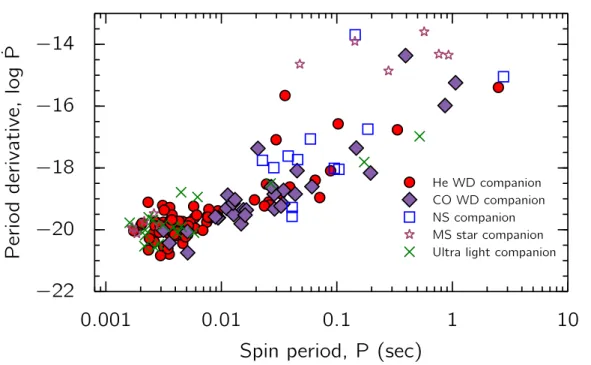
He WD companion CO WD companion NS companion MS star companion Ultra light companionFigure 1.8: Distribution of∼180 binary radio pulsars with measured values in theP−P˙ diagram (Tauris et al. 2012). The symbols indicate the nature of the companion star. Data taken from the ATNFPulsar Catalogue
(Manchester et al. 2005) in December 2015.
For each of these classes of X-ray binaries, the evolutionary status of the donor star, or equivalently the orbital period at the onset of the Roche-lobe overflow, is the determining factor for the outcome of the mass-transfer phase and thus the nature of the MSP formed (Tauris 2011). The discovery of several X-ray pulsars with millisecond periods in LMXBs and of IGR J18245-2452, an LMXB with a rotation period of 3.9 ms that alternates between a rotation-powered radio source and an accretion-powered X-ray source (Papitto et al. 2013), have provided strong evidence in support of the recycling scenario.
To understand the formation scenario of MSPs, one needs to analyze the properties of the observed companions of such systems and reconstruct the initial conditions of their progenitors. Binary pulsars in globular clusters are in general not suitable as tracers of their stellar evolution history because of the frequent encounters and exchanges of companion stars in the dense environments (Ransom et al. 2005). Figure1.8 shows the location of the radio binary pulsars in theP−P˙ diagram with various symbols denoting the type of companion star. The lower left corner of the diagram is populated with the so-called fully recycled MSPs, with spin periodsP<10 ms. The majority of them have He WDs companions, but some systems harbour ultra-light semi-degenerate companions in the so calledblack widowsystems as well as more massive CO white dwarfs. The mildly recycled MSPs, 10 ms<P<100 ms are dominated by CO (and ONeMg) WDs and NS companions.
In general, binary systems with WD companions have essentially circular orbits: 10−7 . e .0.01. Binary pulsars with NS or main-sequence companions tend to have more eccentric orbits, 0.10.e.0.9 (Phinney 1992;Tauris et al. 2011).
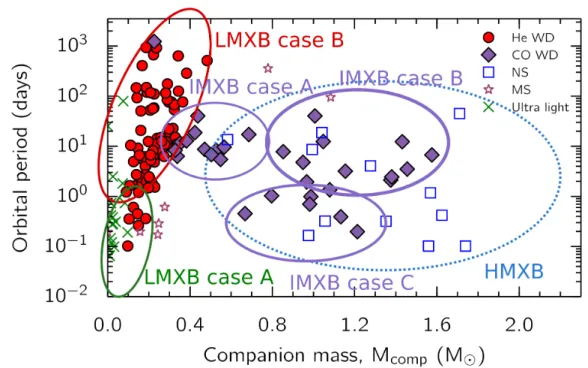
An important diagram in understanding the various progenitors of MSPs is shown in figure1.9, where one plots the binary orbital period as a function of the companion mass. A review discussing the characteristics and the formation classes of all MSPs can be found inTauris(2011).
1.6 This thesis
Figure 1.9: Distribution of∼180 binary radio pulsars with measured values in the companion mass-orbital period plane. The symbols indicate the nature of the companion star. Also shown are the types of progenitor binaries. Data taken from the ATNFPulsar Catalogue(Manchester et al. 2005) in December 2015. See alsoTauris(2011).
1.6 This thesis
In this thesis, we investigate two main problems: (i) the formation and evolution of MSPs in compact orbits with low-mass helium WD companions descending from LMXBs, see Chapter 2 and (ii) the thermal properties of the donor star in an LMXB system from the end of the mass transfer phase to the WD cooling track, as function of mass, metallicity and different input physics, see Chapter3and4.
1.6.1 Millisecond pulsars in very compact orbits
Figure1.10shows schematically an evolutionary sequence leading the formation of an MSP in a very compact orbit. In a binary with a massive star and a low-mass companion, mass transfer will become dynamically unstable leading to a common-envelope phase. After the common envelope, a naked helium star will be left behind that will eventually explode in a supernova event giving birth to a NS. If the supernova explosion did not disrupt the binary, a NS will be orbiting the low-mass star. The evolutionary phases until the formation of the NS are very fast compared to the further evolution (cf. Section1.4). The further evolution of the newly formed NS and the low-mass main sequence star depends very much on the orbital separation, which in turn dictates on which timescale the subsequent mass transfer will proceed, a nuclear timescale or a timescale defined by the loss of orbital angular momentum. If the orbital separation is small, the loss of orbital angular momentum will bring the stars closer together until the low-mass star fills its Roche-lobe and material is being transferred to the neutron star.
At the onset of the mass transfer phase, the donor star may be at the end of the main sequence or it just started hydrogen burning in a shell. In wider systems, the star will expand until it fills its Roche-lobe on the red-giant branch. If the orbital separation is very large (several years), the low-mass star basically evolves as a single star.
Figure 1.10: The evolution of a binary system which will lead to a LMXB and finally to the formation of a MSP with a WD companion. The evolution is governed by the specific orbital angular momentum treatment, the common envelope and spiral-in phase, the asymmetric supernova explosion and the stellar evolution of the helium star. The parameter shown on the right are rough predictions for the formation of PSR 1855+09. Cartoon adapted fromTauris & van den Heuvel(2006).
1.6 This thesis
For binaries with low-mass stars, there are several mechanisms responsible for the removal of the or-bital angular momentum:gravitational wave radiation,mass transferandmagnetic brakingby a stellar wind, cf. Chapter2. The low-mass donor is assumed to posses a magnetic stellar wind, similar to a solar wind which is forced to corotate to large distances. In this way, the wind removes angular momentum from the star by exerting a torque with a long lever arm. In a close binary system, the donor is assumed to be tidally locked and synchronously rotate with the orbital motion, and thus removal of spin orbital momentum from the star removes angular momentum from the orbit. This effect of a magnetic stellar wind was observed in low-mass stars bySkumanich(1972) which showed that low-mass main sequence stars are rotating slower with time,Ω∝t−12. The treatment of the loss of orbital angular momentum by
magnetic braking of such stars in a binary is one of the biggest uncertainties in the evolution of low-mass X-ray binaries, cf. Chapter2.
It has been shown byPylyser & Savonije(1988) that a critical initial orbital period exists at the onset of the Roche-lobe overflow, the so called bifurcation period, Pbif. This bifurcation period separates the formation of converging LMXBs, those with final orbital period smaller than initial orbital from
diverging LMXBs, which have a final orbital period much larger than the initial one. The theoretical estimated value of Pbif is ∼ 1 day, but it strongly depends on the treatment of tidal interactions and the assumed strength of magnetic braking which drains the system of orbital angular momentum (e.g. van der Sluys et al. 2005a;Ma & Li 2009). This distinction regarding the orbital period evolution is important as it determines the nature of the MSP companion. In converging systems, the remnant of the low-mass star will be a sub-stellar dwarf object which eventually might be completely destroyed leaving behind an isolated MSP. The diverging systems will produce He WDs with masses dependent on the final orbital separation.
Chapter 2is focused on the the formation scenario of MSPs in very tight orbits with extremely low-mass He white dwarfs, M.0.2M(those populating the lower left corner of the diagram in figure1.9) assuming different strengths of the magnetic braking law.
1.6.2 Formation and evolution of extremely low-mass helium white dwarfs
Extremely low-mass helium white dwarf (ELM WD) is a term recently used in the literature to denote a WD with surface gravity 5 <logg <7 and effective temperature 8,000 K. Teff . 22,000 K. This definition is based on the fact that WDs with these characteristics are nearly absent in major spectro-scopic WD catalogues (Brown et al. 2016). From a theoretical point of view, such objects are low-mass helium-core WDs with masses below roughly 0.3M. They are most likely the result of binary interac-tions (Marsh et al. 1995a), as the remnant of a single star evolution will be much older than the current age of the Universe, unless they are formed in very high metallicity environment (Kilic et al. 2007). After the mass-transfer process ends, the remnant of the donor star will go through a proto-WD phase in which hydrogen burning continues in a shell surrounding the helium core. Depending on the included physics and metallicity, there is a certain range of WDs masses for which the residual hydrogen burning in the envelope is unstable, giving rise to the so-called hydrogen shell flashes. The occurrence of these hydrogen shell flashes greatly reduces the hydrogen envelope mass such that, once on the cooling track, these objects will have an accelerated cooling compared to the proto-WDs which experienced stable hydrogen burning. However, many details of this proto-WD phase are unclear and these are investigated in Chapters3and4. An extended review of ELM WDs is given byHeber(2016).
In the last several years, the number of discovered ELM WDs increased drastically due to the ELM survey (Brown et al. 2010;Kilic et al. 2011;Brown et al. 2012;Kilic et al. 2012;Brown et al. 2013; Gianninas et al. 2015;Brown et al. 2016). The ELM survey is a dedicated survey of finding ELM WDs
through broadband color selection from the SDSS database. Once such candidates are found, they are confirmed through follow-up spectroscopy observations, as the hydrogen lines provide a sensitive meas-ure of surface gravity in this effective temperature range (Brown et al. 2016).
The population of companions found orbiting an ELM WD is a rather diverse one. The majority of com-panions are CO WDs, but ELM WDs have also been found in systems with MSPs (e.g.van Kerkwijk et al. 1996;Kaplan et al. 2013;Antoniadis et al. 2013), sdB stars as well as main-sequence stars, the so called EL CVn systems (e.g.Maxted et al. 2014b). Moreover, they are found in different environments, from the Galactic plane to globular and open clusters, implying that the metallicity of their progenitors spans a wide range.
Brown et al.(2016) showed that the sample of ELM WDs discovered by the ELM survey9 has a log-normal distribution of orbital periods with a median period of 5.4 hr and that the binary companions have a normal distribution of masses with a median of 0.76 M and a dispersion of 0.25 M. This indicates that 95% of the ELM WD systems have a total mass below the Chandrasekhar mass and most likely their evolution does not lead to a Type Ia supernova. As half of these systems will merge within 6 Gyr due to gravitational wave radiation, the probable outcome includes single massive white dwarfs and AM CVn binaries.
Due to their compact orbits, some of the ELM WDs are strong gravitational wave emitters. The most interesting system is the P=765 s detached eclipsing WD binary J0651, which is a gravitational wave source 10,000 times stronger than the Hulse-Taylor pulsar (Brown et al. 2011;Hermes et al. 2012a). Six of the observed ELM WDs show multiperiodic light variations with periodicities between 1300 s to 7000 s, associated with g-mode pulsations (Hermes et al. 2012c,2013c,a). Detailed theoretical studies (Steinfadt et al. 2010a;Córsico et al. 2012;Van Grootel et al. 2013a;Córsico & Althaus 2014a) showed that these ELM WD pulsators extend the ZZ Ceti instability strip to lower effective temperatures and higher luminosities. The discovery of these pulsators is important because they provide new constraints (especially for the hydrogen envelope mass on the cooling track) for theoretical models of ELM WDs. One puzzling question regarding the evolution of ELM WDs is the observed presence of metals in their spectra (Gianninas et al. 2014a). In these type of objects, surface gravity is strong enough such that the gravitational settling will produce pure hydrogen envelopes. The observed metals therefore suggest that another process acts on the surface layers of these objects, counteracting the settling of elements heavier than hydrogen. Another piece of evidence of such a process acting against the gravitational settling in ELM proto-WDs is the recent discovery of three ELM proto-WDs pulsators (Gianninas et al. 2016), which is the first empirical evidence that pulsations in ELM proto-WDs can only occur if these objects have a mixed H/He atmosphere. The current available theoretical models predict that ELM proto-WDs have pure hydrogen atmospheres, in contradiction with the recent observational data. In Chapter4we present new evolutionary models in which we take into account, for the first time, the effect of rotational mixing on the evolution of proto-WDs, in an effort of reconciling the observational data with theoretical models.
CHAPTER
2
The formation of low-mass helium
white dwarfs orbiting pulsars
Evolution of low-mass X-ray binaries below the bifurcation period
Alina G. Istrate, Thomas M. Tauris and Norbert Langer
Astronomy&Astrophysics, 2014, 571, 45
Abstract Millisecond pulsars (MSPs) are generally believed to be old neutron stars (NSs) that have been spun up to high rotation rates via accretion of matter from a companion star in a low-mass X-ray binary (LMXB). This scenario has been strongly supported by various pieces of observational evidence. However, many details of this recycling scenario remain to be understood. Here we investigate binary evolution in close LMXBs to study the formation of radio MSPs with low-mass helium white dwarf companions (He WDs) in tight binaries with orbital periodsPorb '2−9 hr. In particular, we examine i) if the observed systems can be reproduced by theoretical modelling using standard prescriptions of or-bital angular momentum losses (i.e. with respect to the nature and the strength of magnetic braking), ii) if our computations of the Roche-lobe detachments can match the observed orbital periods, and iii) if the correlation between WD mass and orbital period (MWD, Porb) is valid for systems withPorb < 2 days. Numerical calculations with 5 detailed stellar evolution code were used to trace the mass-transfer phase in∼400 close LMXB systems with different initial values of donor star mass, NS mass, orbital period, and the so-calledγ-index of magnetic braking. Subsequently, we followed the orbital and the interior evolution of the detached low-mass (proto) He WDs, including stages with residual shell hydrogen burning. We find that severe fine-tuning is necessary to reproduce the observed MSPs in tight binaries with He WD companions of mass < 0.20 M, which suggests that something needs to be modified or is missing in the standard input physics of LMXB modelling. Results from previous independent studies support this conclusion. We demonstrate that the theoretically calculated (MWD, Porb)–relation is in general also valid for systems with Porb< 2 days, although with a large scatter in He WD masses between 0.15−0.20 M. The results of the thermal evolution of the (proto) He WDs are reported in a follow-up paper (Paper II).
2.1 Introduction
Millisecond pulsars (MSPs) belong to a class of radio pulsars characterized with high rotational spin rates and low magnetic fields. Most of them are observed in binary systems and it is thought that they spin rapidly because of mass accretion from a companion star in a process known as recycling (Bhattacharya & van den Heuvel 1991;Tauris & van den Heuvel 2006). The first MSP was discovered
in 1982 (Alpar et al. 1982) and today 171 fully recycled MSPs1are known in our Galaxy, of which 60
are found inside globular clusters and 111 are in the Galactic field. The orbital periods of binary MSP systems in the Galactic field range fromPorb = 93 min to 175 days, while the companion masses can be as low as 0.02 M⊕(tiny planets) or as high as≈1.3 M(massive white dwarfs).
MSPs in binaries can be subdivided into several classes according to the nature of their companion which can be either a degenerate or a non-degenerate object. Degenerate companions include helium white dwarfs (He WDs) and carbon-oxygen white dwarfs (CO WDs), while the non-degenerate (or semi-degenerate) ones are often low-mass dwarf stars (or brown-dwarf like remnants) which have suffered from significant mass loss and ablation from the pulsar wind (cf. the so-called black widow and redback systems inRoberts 2013 andChen et al. 2013. The progenitors of most MSP systems are low-mass X-ray binaries (LMXBs), except for the MSPs with the more massive CO/ONeMg WDs which are produced from intermediate-mass X-ray binaries (IMXBs) – seeTauris(2011) for a review. Pulsars with another neutron star (NS) companion are produced in high-mass X-ray binaries. Most NSs in all flavours of binary pulsar systems are produced via supernovae (SNe) of Type Ib/c, given that their progenitors must have lost their hydrogen-rich envelopes via mass transfer in a relatively close orbit prior to the explosion.
It has been shown byPylyser & Savonije(1988,1989) that a critical initial orbital period (the so-called bifurcation period,Pbif) exists at the onset of Roche-lobe overflow (RLO), separating the formation of converging LMXBs from diverging LMXBs, which shorten and widen their orbits, respectively. The theoretical estimated value ofPRLObif is∼1 day, but depends strongly on the treatment of tidal interactions and the assumed strength of magnetic braking which drains the system of orbital angular momentum (e.g.van der Sluys et al. 2005a;Ma & Li 2009). The observed MSPs withPorb >1 day originate from relatively wide orbit LMXBs where the donor star did not fill its Roche lobe until it had evolved and expanded to become a (sub)giant, i.e. Case B RLO (e.g.Rappaport et al. 1995;Tauris & Savonije 1999; Podsiadlowski et al. 2002).
In this work, we concentrate on investigating the evolutionary path of MSPs with He WD companions in very narrow orbits. There are four such systems known which have orbital periods,Porb < 9 hr and WD masses of 0.13 < MWD/M . 0.21. Having low-mass companions and Porb < 1 day, these systems thus descend from LMXBs in tight orbits where the donor star already initiated RLO while it was still on the main sequence (Case A RLO). As a result of their compact nature, these systems emit gravitational wave radiation and eventually evolve to become primary candidates for strong gravitational wave sources to be detected by eLISA in the mHz frequency range (Nelemans 2009). In Section3.4we list the detailed observational properties of the investigated systems. Our binary stellar evolution code is introduced in Section2.3, and the results of the numerical calculations for the LMXBs systems are presented in Section2.4. In Section2.5we discuss our findings with an emphasis on magnetic braking and the (MWD,Porb)–relation. Our conclusions are given in Section5. In Paper II (Istrate et al. 2014b) we explore the early evolution of the detached (proto) He WDs.
2.2 Observational properties of MSPs with He WDs in tight orbits
The observed properties of the binary MSPs on which we focus our attention here are described below (see also Table2.1).PSR J0348+0432is an interesting recycled pulsar with a relatively slow spin period,P=39.1 ms in a binary system with an orbital period ofPorb = 2.46 hr. Recently,Antoniadis et al.(2013) found that
1According to the ATNF Pulsar Catalogue (Manchester et al. 2005), version 1.50 (June 2014). Here we define MSPs as
2.2 Observ ational properties of MSPs with He WDs in tight orbits
Table 2.1: Observed MSPs with He WD companions in tight circular orbits. The top four systems havePorb<9 hr (i.e. solutions) and are found in the Galactic field. The bottom six systems are intermediate systems withPorb=9−15 hr, of which five systems are located in globular clusters.
Pulsar name Porb MWD MNS eccentricity Pspin P˙ WD age Optical data (hr) (M) (M) (ms) (s s−1) (Gyr) reference
PSR J0348+0432 2.46 0.17 2.01 2.6×10⁻⁶ 39.1 2.41×10⁻¹⁹ 2.1±0.5 Antoniadis et al.(2013) PSR J0751+1807 6.31 0.14 1.34 7.1×10⁻⁷ 3.48 7.79×10⁻²¹ – Lundgren et al.(1995) PSR J1738+0333 8.52 0.18 1.47 4.0×10⁻⁶ 5.85 2.41×10⁻¹⁹ – Antoniadis et al.(2012) PSR J1816+4510 8.66 0.21a 2.0a 8×10⁻⁶ 3.19 4.31×10⁻²⁰ – Kaplan et al.(2013) PSR J0024−7204U 10.3 0.15b 1.5b <10−4 4.34 – 0.6 Edmonds et al.(2001) PSR J1748−2446M 10.6 0.17b 1.5b <10−4 3.57 – –
PSR J1748−2446V 12.1 0.15b 1.5b <10−4 2.07 – – PSR J0024−7204Y 12.5 0.17b 1.5b <10−4 2.20 – – PSR J1641+3627D 14.2 0.22b 1.5b <10−4 3.12 – –
PSR J1012+5307 14.5 0.16 1.64 <8.4×10⁻⁷ 5.26 1.71×10⁻²⁰ – Callanan et al.(1998)
aThis value is very uncertain.Kaplan et al.(2013) findM
WDsin3i=0.193±0.012MandMNSsin3i=1.84±0.11 M, whereiis the unknown orbital inclination angle. AssumingMNS≤2.0MyieldsMWD≤0.21 M. From pulsar timing (Stovall et al. 2014) a strict lower limit on the minimum companion mass is MWD=0.16M(assumingi=90◦andMNS =1.4 M).
bFor these systems we estimatedM