University of Oregon in partial fulfillment of the requirement for the degree of Master of Science CAPSTONE REPORT University of Oregon Applied Information Management Program 722 SW Second Avenue Suite 230 Portland, OR 97204 (800) 824-2714
Change Management and
Customer Relationship
Management (CRM)
Implementations:
Planning for Success
Nicholas Kanellakis
Systems Analyst
Sage Software
Approved by
_____________________________________ Dr. Linda F. Ettinger
Abstract
for
Change Management and Customer Relationship
Management (CRM) Implementations: Planning for Success
This paper identifies change management practices that facilitate Customer
Relationship Management (CRM) (Nykamp, 2001) implementations. Selected
literature published between 1994 and 2004 is subjected to grounded theory and
constant comparison analysis (Strauss and Corbin, 1990). Results are grouped
by four change management areas from Kale (2005): training, leadership,
infrastructure change, and performance metrics. The outcome is presented to
CIOs and CRM steering committee members, as a decision support tool in
planning a CRM implementation.
Abstract ...v
CHAPTER I – Purpose of Study...1
Brief Purpose ...1
Full Purpose...5
Defining CRM ...5
The CRM Implementation ...6
The Role of Change Management ...7
Limitations...14
Problem Area & Significance...17
Definitions ...20
CHAPTER II – Review of References ...23
Literature on Research Methodology ...23
Literature on CRM...27
Literature on Change Management as it Pertains to CRM Implementations...28
CHAPTER III – Method ...35
Data Collection...36
Online Databases/Library Catalogs...36
Information Technology Sites...37
Internet Search Engines ...38
Data Analysis ...40
Open Coding ...40
Axial Coding ...42
Data Presentation ...44
Selective Coding...44
CHAPTER IV – Analysis Of Data ...47
Open Coding...47
Axial Coding...56
Chapter V - Conclusions...67
Discussion of the Selective Coding Process ...67
Conclusions and Recommendations ...70
Change Management Area #1: Leadership Practices ...70
Change Management Area #3: Training Practices...74
APPENDIX B - Recommendations for Planning Successful CRM Implementations
...83
APPENDIX C – Decision Support Tool Annotations ...91
References...121
TABLE 1: Open Coding Template: Successful Change Management Initiatives....41 TABLE 2: Axial Coding Template: Practices that Facilitate Successful CRM...43 TABLE 3: Selective Coding Template: Recommendations for Planning Successful
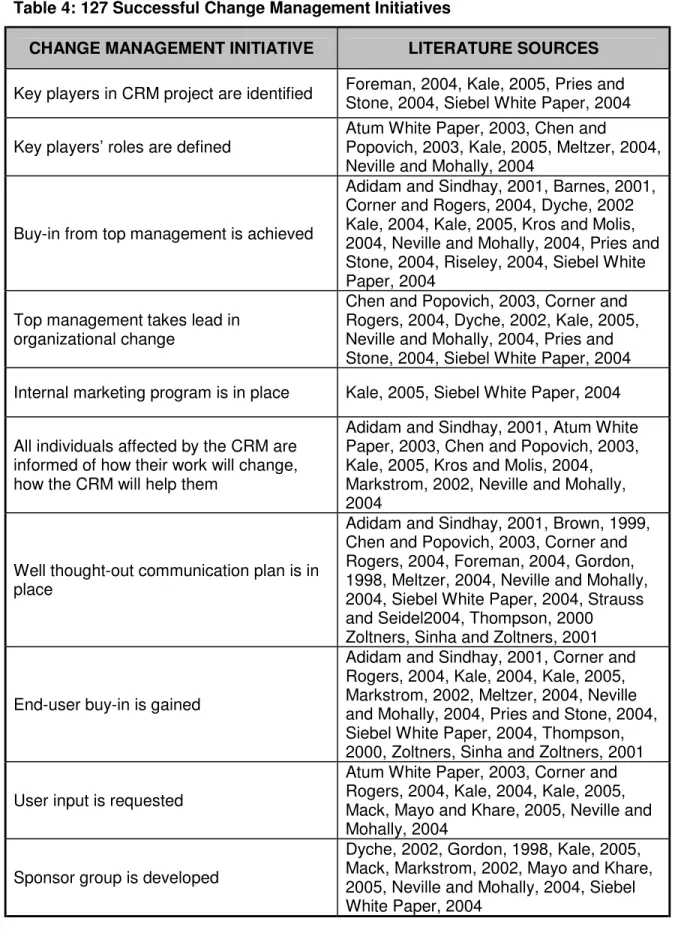
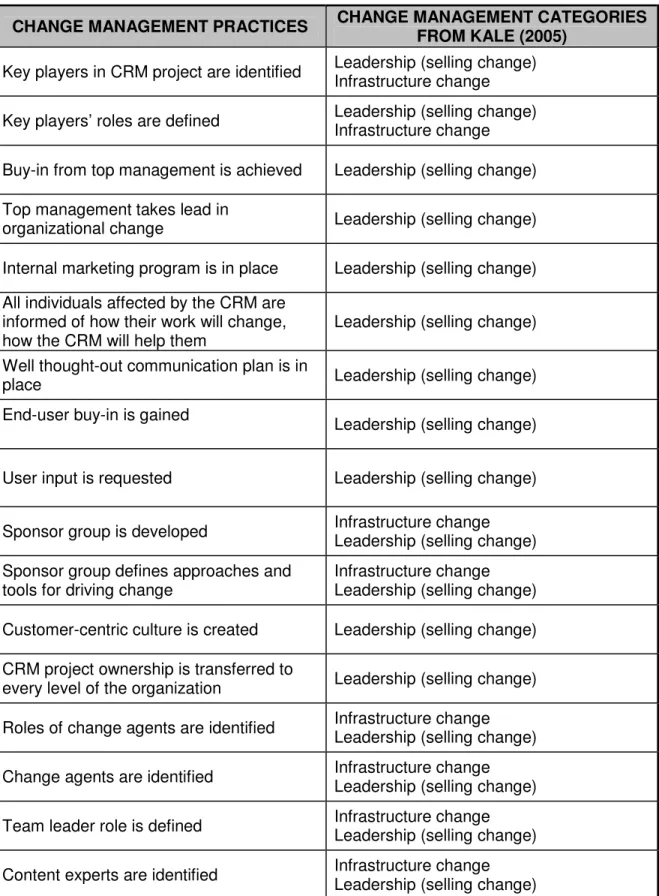
CRM Implementations ...45 TABLE 4: 127 Successful Change Management Initiatives...49 TABLE 5: 127 Practices that Facilitate Successful CRM ...59
BRIEF PURPOSE
Customer Relationship Management (CRM) is a combination of information systems and strategic management, aimed at providing better customer service (Chan, 2005). CRM facilitates collaboration among specific functional areas of the enterprise (Mack, Mayo & Khare, 2005). The areas of the enterprise most commonly affected by CRM are sales, marketing and customer service (Itkis, 2005). The ultimate goal of CRM is to align departmental capabilities - the core competencies of all departments affected by CRM (Brown, 1999) - in order to increase customer retention and loyalty, as well as revenues (Brown, 1999).
A CRM implementation consists of two primary components: the technology systems designed to support the CRM, and a strategy for business process
management (Corner & Rogers, 2004). Kale (2005) suggests that change management provides the most appropriate business process management strategy to guide planning of successful CRM implementations. Kostka and Mönch (cited in Pries & Stone, 2004) define change management as the "process of continuous planning and realization of profound changes" (p. 353).
In recent years, CRM implementations have become a major financial investment for many diverse industries (Kros & Molis, 2004). Almquist, (cited in Adidam & Sindhav, 2001), posits that Gartner, an information technology (I.T.) research and analysis firm, suggests that spending on CRM implementations has experienced a 20-25 percent annual compound growth in the past five years, and is slated to surpass $75 billion in
2005. However, research has shown that the majority of CRM implementations result in failure (Dragoon, cited in Adidam & Sindhav, 2001; Crosby & Johnson, cited in Adidam & Sindhav, 2001; Dyche, 2002), meaning that the implementation was not successful according to the conditions proposed by Brown (1999) (i.e., did not increase customer retention, loyalty and revenues) and did not achieve a predetermined return on
investment (ROI) (Corner & Rogers, 2004).
Newell (2003) posits that the majority of CRM projects fail because of internal (to the enterprise) causes. He also suggests that organizational change is responsible for 29 percent of such failures, making it the main cause of failed CRM projects. As a way to better interpret this suggestion by Newell (2003), the purpose of this study is to examine specific change management initiatives that have been demonstrated to result in
successful CRM implementations. In this study, a successful CRM implementation is proposed to be one that is framed within an adaptive organization that appropriately manages change (Arussy, 2004).
The primary method of study is literature review (Hewitt, 1998; Leedy & Ormrod, 2001). Selected relevant literature on CRM, primarily published between 1995 and 2005, is collected and reviewed. Literature in that time frame is considered relevant to the subject of CRM, since CRM evolved as a technology and a strategy in the late 1990's (Newell, 2003). The literature review process identifies select literature that meets specific criteria for inclusion in the annotated bibliography section, as well as inclusion in the analysis phases of this study. Selection criteria include discussion of CRM
implementations, as well as change management initiatives that resulted in successful CRM implementations, in the literature.
2001, Corbin & Srauss, 1990) is utilized as the data analysis method supporting the literature review. The selected literature is analyzed in two phases. In phase one, literature is coded to identify reported successful change management initiatives. In phase two, literature is analyzed again using the constant comparison process, in which the researcher seeks to identify emergent concepts related to change management practices that are demonstrated to facilitate successful CRM implementations. Instances are noted as they emerge relative to the generalized concepts of "change management" and "successful CRM implementations". The results of the data analysis are presented in two tables, one listing identified change management initiatives, and the second describing emergent practices that facilitate successful CRM implementations. Practices are categorized in a way the shows the interrelationships among these initiatives.
The outcome of this study is presented as an annotated table of
recommendations on emergent change management initiatives that facilitate CRM implementations. The resulting table is designed for use as a decision-support tool by CIOs (Johnson, 2005), and CRM steering committee members (Dyche, 2002), in the planning stages of a CRM implementation.
Customer Relationship Management (CRM) is a business strategy that focuses on optimizing customer experience and maximizing service or product value (Nykamp, 2001). CRM represents the idea that as customer satisfaction is increased, customer behavior changes, customer value is added, and ultimately, profit increases (Curry & Curry, 2000). Curry and Curry (2000) also explain that by increasing customer satisfaction, customer behavior changes in the forms of added sales and increased customer loyalty and retention.
Defining CRM
Bergeron (2002) provides the following definition of CRM:
"Customer relationship management (CRM) is the dynamic process of managing a customer-company relationship such that customers elect to continue mutually beneficial commercial exchanges and are dissuaded from participating in exchanges that are unprofitable to the company" (p. 3).
According to Brown (1999), CRM is based upon two essential building blocks: A clear and precise understanding of customer needs and values, and the alignment of organizational capabilities to better meet customers' needs and to provide maximized customer value. In these ways, CRM meets the goal proposed by Bergeron (2002) to improve upon the existing dynamics of the company-customer relationship.
Strauss and Seidel (2004) claim that some see CRM only as a process driven by information technology, designed to optimize customer contact and experience. Barnes
(2001) suggests that CRM is a data and product-driven process. He also suggests that companies sell more products through the data-mining capabilities of CRM. Others see CRM as a comprehensive business strategy, with ultimate goal a long-term relationship with the customer (Strauss & Seidel, 2004). Among all of these varied perspectives, there is a general agreement that CRM is a process of building strong relationships with the external customer (Barnes, 2004, Nykamp, 2001, Strauss & Seidel, 2004, Curry & Curry, 2000). Some of the relevant reported benefits of CRM include:
•
Added sales and marketing functionality, such as providing near real-time customer data and history to the sales and marketing departments (Barnes, 2004).•
Improved targeted marketing, by providing Sales with accurate customer profiles; this in turn increases up-selling and cross-selling capabilities (Barnes, 2004).•
Personalized customer service (Barnes, 2004).•
Better understanding of customer needs and segments (Thompson, 2000), as well as better grasp of customers' buying behaviors (Newell, 2003).•
Increased customer base (Bergeron, 2002).•
Creation of improved operational efficiencies (Newell, 2003).The CRM Implementation
A CRM implementation consists of two primary components: (1) the technology systems designed to support the CRM (Newell, 2003), and (2) an enterprise-wide strategy (Brown, 1999) for business process management (Corner & Rogers, 2004). CRM facilitates collaboration among specific functional areas of the enterprise (Mack,
encompass all customer-centric business functions, such as sales, marketing, customer service (Pries & Stone, 2004), quality assurance and field service (Brown, 1999). Back-office systems, such as human resources, manufacturing, and accounting, are often also affected by CRM (Brown, 1999).
The technology component of a CRM implementation is often centered on a customer relational database management system (RDBMS) (Webster, 2002). A
RDBMS is a method of managing data, such as customer data, by linking records via the use of indices, and by allowing structured searches or queries, to be performed on the data (PCMag.com, 2005). The RDBMS is shared among select functional areas of the enterprise, or in some cases the whole enterprise, facilitating sales force automation (Coker, Del Gaizo, Murray & Edwards, 2000) and customer relationship management (Simpkins, 2004). Such software systems are often called Contact Management
Software (CMS), or can also be referred to as simply CRM (Simpkins, 2004). The CRM technology enables efficiencies that ultimately provide increased customer value, including a sales force that is more reactive to customer needs and more specialized by product line, more intuitive interaction methods (between the company and the client), as well as improved market segmentation (Zoltners, Sinha & Zoltners, 2001).
The Role of Change Management
Petersen (2002) suggests that while the CRM technology component can be viewed as one facilitator of CRM implementation success, the second component of the CRM implementations, business strategy (and business process management), is the main enabler of CRM implementation success. According to Adidam and Sindhav (2001) people, culture, and business process are key focus areas of a CRM implementation.
Price (2002) posits that CRM implementation success involves "business process and change management more than the ability to hook up the boxes" (para. 9). Kale (2005) posits that change management provides the most appropriate business process management strategy to guide planning of a successful CRM implementation. Kale (2005) also calls change management the "defining factor between success and failure in CRM projects" (p 1).
According to Kostka and Mönch (cited in Pries and Stone, 2004), "change management is the process of continuous planning and the realization of profound changes" (p. 353). Zoltners et al. (2001) posit that markets constantly change, and product lines change to meet shifting market demands. It is essential that people also change, as management shifts strategy in search of differential advantage (Zoltners et al. 2001). Managing organizational change, while concurrently continuing to achieve the highest possible service levels, is the ultimate challenge of change management
(Holland, 2000).
Building on the notion from Kale (2005), that change management provides the most appropriate business process management strategy to guide planning of a successful CRM implementation, the purpose of this study is to examine specific change
management initiatives that have been demonstrated to result in successful CRM implementations. The goal of this study is to aid Chief Information Officers (CIOs) (Johnson, 2004) and CRM steering committee members (Dyche, 2002) in successfully planning the change management process at the onset of the CRM project planning development.
the success of a CRM implementation. The CIO manages the actual implementation of the CRM technology, as well as the integration of the CRM technology in the various cross-functional areas of the enterprise (Johnson, 2004). CIOs are essential in ensuring that business processes remain uninterrupted during the CRM implementation, and that change management takes place without major disruption to business stability (Johnson, 2004). "The CIO works in an environment where change is a way of life. Technology changes at a breathtaking pace and every new system introduces different ways of doing business" (Johnson, 2004, p. 3). The CIO is often the business sponsor of the CRM project (Dyche, 2002). Since CRM is an I.T.-driven project (Price, 2002), CIOs are crucial in the success of the CRM project implementation.
The CRM steering committee is a group “of decision-makers familiar with the ‘pain points’ CRM can address, (and) should convene on a regular basis to provide new requirements, prioritize proposed improvements, and communicate key corporate initiatives” (Dyche, 2002, p. 48). The committee is comprised of managers from cross-functional areas of the enterprise (Compton, 2004, Schick, 2001), and has “the authority and budget to make a real difference” (Schick, 2001, para. 5) in CRM project success.
Early involvement of the CIO and CRM steering committee can facilitate business process reorganization (Johnson, 2004). This study is an attempt to inform the intended audience of CIOs and CRM steering committee members of change management initiatives that, when followed, result in successful CRM implementations.
The overarching method of research of this study is literature review (Hewitt, 1998). Literature review is the process of visiting (or revisiting) previous literature in similar or
identical areas of study (Leedy & Ormrod, 2001). According to Hewitt (1998), benefits of literature review include:
•
Shows the depth of the material examined by the researcher.•
Aids in the analysis and interpretation of data.•
Frequently reveals additional references and citations.Literature published between 1995 and 2005 is collected and reviewed in the following content areas, based on a set of collection criteria fully described in the Method section of the paper:
•
Change management. Suresh (2001) suggests that “change management is a structured process that will cause proposed changes to be reviewed for technical and business readiness in a consistent manner that can be relaxed or tightened to adjust to business needs and experiences” (p. 4).•
CRM. CRM is the “integration of customer service quality and marketing, which has as its concern the dual focus of getting and keeping customers” (Christopher, Payne & Ballantyne, 1991, cited in Pries & Stone, 2004).•
CRM implementations. According to Schmidtmayer (2005), CRMimplementations consist of the technical implementation of the CRM, the strategy behind the CRM, as well as the successful cooperation between various
functional areas of the enterprise.
•
Change management as it pertains to CRM implementations. According to Kale (2005) “change management is often the deciding factor between success and failure in CRM projects” (p. 1).Over one hundred sources of literature are collected and reviewed. Sources include books, journal articles, and white papers published between 1995 and 2005. All
collected literature is tested against the following criteria:
•
CRM implementation relevance.•
Change management relevance.The literature collection and selection process is presented in detail in the Method chapter of this paper.
Grounded theory approach and constant comparative method (Strauss & Corbin, 1990) is the chosen data analysis method employed in this study. Grounded theory approach is a qualitative research method that attempts to build theory based on
discoveries made from within the data that are being analyzed (Strauss & Corbin, 1990). This researcher does not attempt to derive new theory, but rather to use grounded theory analysis to identify emerging themes, as well as relationships among such themes. Constant comparative method of analysis is also utilized for purposes of constantly categorizing, evaluating and comparing existing, as well as emerging data (Leedy & Ormrod, 2001).
In stage one of the constant comparative analysis process, selected literature is reviewed in order to identify change management initiatives that are reported to have resulted in successful CRM implementations. The results of this stage of the analysis are presented in the form of a table (see Table 4: Successful Change Management
Initiatives) identifying successful change management initiatives and their respective literary sources. The change management initiatives identified in this phase of the data analysis are discussed in the annotations of the outcome of the study, the decision support tool presented in Appendix B: Recommendations for Planning Successful CRM Implementations.
In stage two of the constant comparison analysis process, the same selected literature is scrutinized in order to identify emergent concepts relating to change management practices that are demonstrated to facilitate successful CRM
implementations. No particular set of predetermined terms or phrases are employed, beyond searching for general references to CRM and change management. Instead, relevant concepts are allowed to emerge from the data. Relevant emergent concepts are constantly compared (Leedy & Ormrod, 2001) to new concepts discovered during the grounded theory analysis process. By constantly comparing emergent data to existing concepts, the researcher looks for common themes and categories of ideas (Strauss & Corbin, 1990, Dey, 1993, cited in Dye, Schatz, Rosenberg & Coleman, 2000). The results of the second stage of constant comparative analysis are presented as a table (see Table 5: Practices that Facilitate Successful CRM) of emergent concepts related to change management practices that are demonstrated to facilitate successful CRM implementations.
Emergent concepts are then further categorized and listed in the final outcome of this study, Appendix B: Recommendations for Planning Successful CRM
Implementations. Recommendations are aligned with four specific change management criteria, selected from the work of Kale (2005). Criteria include training, leadership, infrastructure change, and performance measures (Kale, 2005). Kale (2005) suggests
Area #1: training, is necessary in order to successfully implement infrastructure change (Kale, 2005). Jacobs (1994), suggests that change management efforts are often hindered as a result of inadequate training. Area #2: leadership, is necessary to sell change to internal customers (Kale, 2005). Effective leaders take necessary actions to “affect strategy, process, and change implementation” (Bishop, 2001, p. 216) in ways that increase the probability of success of the organizational change efforts. Area #3: infrastructure change, is imperative in order to select the right people to lead the organizational change, as well as for delineating the roles that they will play in the change management efforts (Kale, 2005). Area #4: performance metrics, is essential in order to assess performance in the changed environment (Kale, 2005). Because of the cross-functional reach of a CRM project, new or improved performance measures are likely to be required (Kale, 2005).
Appendix B: Recommendations for Planning Successful CRM Implementations, is designed to present a set of recommendations for specific change management practices that facilitate successful CRM initiative implementation. Recommendations are based on information presented in the results of stages one and two of the content analysis process, and framed from the perspective of four imperative criteria, from Kale (2005). They address change management practices that should be followed before and during CRM implementations, in order to achieve the highest likelihood of success. Appendix B is designed as decision-support tool for use by CIOs and CRM steering committee members when planning a CRM implementation. According to the CRA Report (2005) a decision support tool is a “process that provides a consistent and reproducible basis for making decisions” (para. 7). The outcome of the study is presented to all executives and functional area managers involved in the planning
stages of a CRM implementation, as well as CIOs and CRM steering committee members, who are key agents of change and have the ability to influence change
management initiatives. The intended audience may use this study as a decision support tool, for guidance in addressing pertinent change management issues, when planning a CRM. Because of the high rate of failure of CRM implementations (Dragoon, cited in Adidam & Sindhav, 2001, Crosby and Johnson, cited in Adidam & Sindhav, 2001, Dyche, 2002), and the significance of change management initiatives in the success of CRM implementations (Kale, 2005, Adidam and Sindhav, 2001, Price, 2002), the outcome of this study is of utmost importance to the intended audience.
LIMITATIONS
Timeframe: CRM evolved from the Total Quality Management and
reengineering movements of the 1980's (Mack, Mayo, Khare, 2005, Scmitt, 2002), and the "customer-oriented and market-driven" movement of the 1990's (Schmitt, 2003, p. 10). Bergeron (2002) claims that CRM "was born around 1997" (p. 2). Selected relevant literature on CRM and change management, primarily published between 1995 and 2005, is collected and reviewed. Since CRM evolved as a strategy and technology in the late 1990's (Newell, 2003), literature in that time frame is considered relevant to the subject of CRM.
CRM: This study will not address the technology component of CRM implementations. Relevant research is readily available on the Web and in online databases, such as Business Source Premier. The study will also not address
management, or business process management unrelated to change management.
Literature collection: Since literature review (Hewitt, 1998) is the primary research method for this study, the data collected is the literature itself. In phase one of data collection, books, articles and white papers are selected based on the following key words:
•
CRM.•
Change management.•
I.T. implementations.•
Successful CRM implementations.An attempt is made to select literature from written works that have been cited in previous research or previous written work on the subject. Online bibliographies and citation indexes are consulted. Works are selected based on their perceived relevance to the subjects of information technology (I.T.) implementations, CRM implementations, organizational change management and change management as it pertains to I.T. and CRM implementations.
CRM success: This study focuses on identification of specific change
management initiatives (Gordon, 1998) that have resulted in successful I.T (including CRM project) implementations. According to Brown (1999), CRM success “lies in its ability to establish and effectively use enterprise customer care information systems” (p. 138). CRM implementations are considered successful when they have achieved a
predetermined level of return on investment (ROI) (Corner & Rogers, 2004). CRM implementations are considered failed when a certain percentage of end users boycotted or ignored the CRM, thus making ROI impossible to achieve (Wu & Wu, 2005).
Method: Leedy and Ormrod (2001) posit that qualitative research is used to describe and interpret phenomena in an open-ended approach. According to Leedy and Ormrod (2001) qualitative research is also known as "interpretive, constructivist, or positivist" (p. 101). Quantitative research on the other hand is typically used to measure data, and to attempt to predict or explain concrete phenomena (Leedy & Ormrod, 2001). A quantitative study tends to confirm or disconfirm the tested hypotheses (Leedy & Ormrod, 2001). Both research method approaches enjoy similarities such as literature review and data collection.
This study uses a qualitative research approach, known as Grounded Theory (Strauss & Corbin, 1990). Pertinent data are collected, analyzed and presented mostly in a narrative way, in hopes of examining existing theory, rather than testing existing
theory. The ultimate goal of this study is to provide CIOs and CRM project managers with an annotated table of recommendations of how select change management practices, reported in the literature, have facilitated successful CRM implementations.
Grounded theory and constant comparative method (Leedy & Ormrod, 2001, Strauss & Corbin, 1990) is utilized as the data analysis method of choice, since this study is not based on a specific theoretical framework. Rather, this study is an attempt to analyze collected data in order to identify common emergent themes that can be useful to practitioners, when presented as a set of recommendations. This researcher intends
recommendations as a decision-support tool, when planning CRM implementations. According to the CRA report (2004), a decision support tool is a “process that is sensitive to stakeholders' concerns and provides a means for prioritizing risk reduction activities, making risk reduction decisions, and measuring risk reduction progress” (para. 7), thus facilitating the success of an I.T. project.
Kale is the author of numerous studies on how sound change management practices facilitate CRM implementations, and an Internet search reveals that his work is frequently cited in relevant literature. Kale’s (2005) categories of change management initiatives are utilized in the Data Analysis section of this study, because of Kale’s stature on the subject. The specific initiatives: training, leadership, infrastructure change, and performance measures, are selected because of their frequency of appearance in the larger collection of literature that provides data for the Data Analysis phase of this study.
PROBLEM AREA & SIGNIFICANCE
A CRM implementation consists of the actual design and implementation of the CRM technologies (hardware and software), as well as the business strategy and organizational change management that supports the CRM (Newell, 2003). In recent years, CRM implementations have become a major financial investment for many diverse industries (Kros & Molis, 2004). Almquist (cited in Adidam & Sindhav, 2001) states that the Gartner Group, and information technology research and analysis firm,
reports that spending on CRM implementations has experienced a 20-25 percent annual compound growth in the past five years, and is slated to surpass $75 billion in 2005.
The financial risks involved in CRM implementation are worth noting. The average CRM implementation costs roughly $500,000 for a mid-size company, while a large company can expect to pay upwards of $3 million (Bergeron, 2002). While CRM technologies have approached maturity in the past few years (Chan, 2005), the Meta Group (Johnson, 2004) has reported that CRM implementations have failed at
alarmingly high rates, in the 55 to 75 percent range. Again, the Gartner Group predicted a 55 percent failure rate for CRM projects in 2002 (Dragoon, cited in Adidam & Sindhav, 2001), while Crosby and Johnson (cited in Adidam & Sindhav, 2001) put that figure at 69 percent, and Dyche (2002) estimated the failure rate at 70 percent.
By 2004, AMR Research (cited in Swartz, 2004) claimed that "12 percent of all CRM implementations are complete failures. That means the systems never even go live" (paragraph 3). After significant resource investment in CRM, some organizations never reap any return on investment (ROI) (Corner & Rogers, 2004).
However, this high rate of failure may not be a given, when success criteria are further defined. According to Compton (2004), early management of organizational change stimulates a successful CRM implementation. Successful CRM initiatives have yielded ROI between 16 and 1000 percent of the original investment (Stores Magazine, 2004). Mary Committee, president of Marketing Mastery (cited in Coker et al., 2000) states that technology ROI (ROTI) is also measured by the degree to which the success of the CRM increases each salesperson's effectiveness by 5 percent, through the power of technology-enabled sales (Coker, et al., 2000).
User acceptance and use of the CRM technologies is also a success criterion, and according to Wu and Wu (2005), is instrumental is achieving positive ROI (Wu & Wu, 2005). Zoltners et al. (2001) continue in this vein when they posit:
"the success of a CRM depends on its value to the users, which
comes from its usage and its integration into the work progress. A focused change management effort is essential when the system entails a significant change in work processes or necessary skills" (p. 412).
Cultural issues and resistance to use of the CRM technology by the end users has been identified as a major hurdle to CRM implementation success (Coker, et al., 2000). Atkinson (cited in Pries & Stone, 2004) claims that "a culture is a set of values, behaviors and norms which tell people what to do, how to do it and what is acceptable" (p. 351). In his study of I.T. projects, Zahrnt (cited in Pries & Stone, 2004) suggests that change management issues are one of two major reasons for I.T. project failure – the other being technical reasons, such as the size, scope and complexity of the project itself. This study attempts to identify change management approaches that resulted in successful CRM implementations, in order to specifically address this problem.
DEFINITIONS
Back-office – "Refers to systems that do not deal directly with the customer, such as inventory management and accounts payable" (PCMag.com, 2005, para. 1).
Business process management – "Business process management (BPM) is the ability to have end-to-end visibility and control over all parts of a long-lived, multi-step
information request or transaction that spans multiple applications and people in one or more companies. Business process management means harnessing and enhancing the value of business processes however large or small, wherever they reside within the extended enterprise, and whomever they involve" (Bitpipe, 2005, para. 1).
Change management – ". . . the making of changes in a planned and managed or systematic fashion. The aim is to more effectively implement new methods and systems in an ongoing organization. The changes to be managed lie within and are controlled by the organization" (Nichols, 2004, para. 5).
Contact Management Software (CMS) – "Contact management software is the key software offered directly to an agent or advisor. It can help you conduct marketing campaigns and provide support to prospects and clients. It coordinates personal, financial and agency data" (Kite, 2000, para. 9).
Core competencies – "Core Competencies (CC) are the set of the most strategically significant and value-creating skills within a discipline, a service, or an organization" (CAPC Manual, 2005, para. 1).
attempts to sell the consumer products related to a product the consumer already uses or which the marketer has available" (Marketing Power, 2005, para. 1).
Customer Relationship Management (CRM) – "A business strategy that focuses on optimizing the value an organization delivers to customers, and, as a result, the value an organization receives from customers. This strategy requires redirecting business focus, organizational structure, business metrics, customer interaction, business practices, and technology capabilities, to optimize the customer experience" (Nykamp, 2001, p. 200).
Data mining – "Extracting hidden predictive information from large databases and automatically detecting trends and associations hidden in data" (Coker, et al., 2000, p. 208).
Functional areas – "Most businesses consist of a number of different departments, each of which has a specific job or task to do - these are called functions" (BizEd, 2005, para. 1).
Sales Force Automation – "The process of using technology to automate certain functions of sales to better meet the demands of customers and to build revenue" (BitPipe, 2005, para. 1).
Up-selling - "Proactively increasing the size of a customer's purchase by encouraging the purchase of a more expensive item or the purchase of an accessory. In service industries, up-sell usually translates to an increase in the rate of usage...over a defined period of time" (Nykamp, 2001, p. 206).
Vendor - "The seller of software products. Vendors are typically value-added resellers of products that may be bundled with other products and services, such as training. In some cases, the vendor and developer are one company" (Bergeron, 2002, p. 215).
The Review of References section of this study provides an annotated listing of selected key references cited in the study. Key references are defined as references that are instrumental in framing the research subject of how successful change management practices facilitate CRM implementations, provide relevant data for analysis, or assist in the larger research method used in this study.
Selected references are presented in the categories of:
•
Research methodology•
CRM•
Change Management as it pertains to CRM implementationsCriteria for selection include significance of the literature to the content of the study, frequency of citation in the study, as well as the stature of the author/source of the literature.
Literature on Research Methodology
Hewitt, M. (1998). Carrying Out a Literature Review. Retrieved September 8, 2000, from http://www.trentfocus.org.uk/Resources/Literature Review.pdf
In this article, the author provides a definition of literature review as a research method in itself, rather than as part of a larger research method. Hewitt describes
literature as "all published work on a subject” (p. 1). In this work, he discusses the process of conducting a literature review, as well as the possible advantages of the literature review method. According to Hewitt (1998), "a literature review will:
•
provide an up-to-date picture of the research area of interest and shows which areas have been investigated and the results obtained.•
identify methods of investigation that could be used in further research•
give indications of problems that might be encountered and possible solutions•
reveal common findings among studies•
identify factors not previously considered•
provide suggestions for further research” (p. 3).This study is conducted as a literature review, and the structure of the study follows Hewitt's (1998) stages of literature review (p. 2). Numerous Internet and database searches fail to provide a more complete definition of literature review as a self-contained research methodology.
Leedy, P. D., Ormrod, J. E. (2001). Practical research planning and design. New Jersey: Merrill Prentice Hall.
In this reference, the authors discuss research and its methodology. In chapter 4, the authors provide a discussion of literature review as a section of a larger research report. They provide guidelines for using available resources, such as libraries,
paper is based on selected literature, collected through targeted search, as described by the authors.
The discussion of grounded theory analysis (pp. 154-157, 158), and constant comparative method (p. 154), provides the foundation of the data analysis section of this study. The authors describe grounded theory as beginning "with the data and (using) them to develop a theory" (p. 154). The author of this study does not attempt to develop new theory, but rather uses the grounded theory method discussed by the authors to categorize data and to discover connections between the data. The coding processes discussed by the authors (with the exception of development of theory, p. 155), are used in the Method and Data Analysis sections of this study.
This work by the authors is chosen for inclusion in this study because the authors are cited numerous times in the work of others, as discovered in an Internet search.
Strauss, A., Corbin, J. (1990). Basics of qualitative research: Grounded theory procedures and techniques. Newbury Park, CA: Sage Publications.
The authors provide a comprehensive discussion on the (qualitative) grounded theory method of analyzing data. In Chapter 1, the authors discuss how the grounded theory approach differs from other qualitative research methods. Chapters 5 and 7 provide a detailed discussion on the open and axial coding procedures, which are discussed in the Method section of this study, and are utilized in the Data Analysis section.
In Chapter 5, the authors explain the process known as Open Coding, or placing labels on discrete concepts that are discovered during the review of the data. The authors describe this process as "the naming and categorizing of phenomena through close examination of data" (p. 6). Open Coding is discussed in the Method section of this study, and is utilized as the analysis method in phase one of data analysis. In this phase, the authors comment, data is first broken down and conceptualized, then categorized. Categories emerge from the data. In this study, change management initiatives, as they pertain to CRM implementations, emerge during the Open Coding phase of the analysis.
In Chapter 7 the authors discuss the Axial Coding phase of data analysis. According to the authors, during this phase of the research study, the categorized data are now put back together by the specific emergent context discovered during the Open Coding phase of the study. In this phase, subcategories are linked to main categories, in an action/interaction process, one based on consequences or outcomes. In the Axial Coding phase of data analysis of this study, based on the Chapter 7 discussion of the authors' work, the emergent change management initiatives, identified in the Open Coding phase, are now categorized by four specific change management areas (as suggested by Kale, 2005), training, leadership, infrastructure change and performance metrics.
This work provides the foundation of the Method and Data Analysis sections of this study. The authors of this study are cited numerous times in works of others, and have co-authored numerous works on qualitative research methods and grounded theory analysis.
Literature on CRM
Bergeron, B. (2002). Essentials of CRM: A guide to customer service relationship management. New York: Wiley.
In his book, Bergeron provides an overview of CRM, including a history of CRM, as well as a set of limitations of what CRM is not. According to Bergeron (2002), CRM is a concept that evolved in the late 1990s, when the need arose to "proactively provide the best customer service possible, while creating a database of customer preferences that can be reviewed by sales, marketing, and management" (p. 2).
Bergeron discusses the increasing importance of the customer and the
significance of the company-customer relationship, to the sustainability and profitability of the enterprise, as well as how a CRM implementation can facilitate such a
relationship. Bergeron also discusses the dynamics between the company and its customers, and how a positive experience (by the customers) increases profitability.
In the later chapters of his book, the author discusses the technology behind CRM, including vendor and product evaluation and selection, and implementation. Possible implementation caveats are also discussed. This reference is used in the larger discussion of CRM, in the Brief and Full Purpose sections of the study. Bergeron's work provides necessary historical background on CRM.
Bergeron is currently a Harvard and M.I.T. professor, as well as editor of e.MD, and technical editor of Postgraduate Medicine. He is the author of several other works, and an Internet search reveals that his worked is cited numerous times in other
literature.
Literature on Change Management as it pertains to CRM implementations
Kale, S. (2005). Appreciating the role of change management in CRM. Retrieved September 9, 2005, from
http://crm.ittoolbox.com/browse.asp?c=CRMPeerPublishing&r=http%3A%2F%2Fhosted docs%2Eittoolbox%2Ecom%2FSK050605%2Epdf
Kale, S. (2005). Change management: antecedents and consequences in casino CRM. UNLV Gaming Research and Review Journal, 9, 55-67. Retrieved October 18, 2005, from Business Source Premier database.
Kale's work provides a holistic view of how change management issues affect CRM implementations. In his work "Appreciating the role of change management in CRM", Kale (2005) suggests that CRM implementation failure is attributed to several factors, including "inappropriate change management" (p. 1). He also posits that in a 2002 CRM-forum survey of 700 CRM practitioners, consultants and vendors, 29 percent of respondents selected change management issues as the leading cause of CRM implementation failure. This section of Kale's work was instrumental in the framing of this study, including the Purpose and Problem Area/Limitations section, as well as in Data Analysis section.
Kale suggests that change management is comprised at least four initiatives: training, leadership (selling change internally), actually implementing the infrastructure, and implementing performance measures. He suggests that these change management issues are universal to any large I.T. implementation, including CRM. Breaking down the four major change management initiatives, Kale offers the following advice:
•
Leadership - If a CRM implementation is to succeed, the end-users will have to be sold on it. End-users of a large-scale I.T. implementation, such as CRM, are found in various departments and corporate levels. End-users typically do not look forward to change. In fact, if users shy away from using the CRM, theimplementation may fail to achieve its stated goals. Senior management needs to sell change internally, through a top-down adoption scheme, by first
communicating the importance of the CRM implementation to the end-users. Empowerment is also used as a means of successfully managing change.
•
Training - A new CRM implementation will fail, unless there is a formal training program in place. Training does not only provide the end-users with thefundamental operational capacity to correctly use the CRM, but also with the mind-set change needed to alleviate fears of the new system.
•
Infrastructure change - Cross-departmental collaboration is necessary in order to achieve the larger infrastructure change that a CRM implementation requires. Individuals from various departments need to be recruited to play the roles ofchange agents and team leaders. Consideration needs to be given to the qualities of such individuals.
•
Performance measures - Continuous monitoring and assessment of the change process is essential for the success of the change management process.In his work "Change management: antecedents and consequences in casino CRM", Kale (2005) reiterates his change management initiatives, and provides further examples of how each initiative can successfully aid in the success of a CRM implementation. Kale (2005) provides real-world examples of CRM successes from the casino business. This paper is used in the data analysis section of the study.
Kale is the author of several works on change management and CRM implementations, and an Internet search reveals that his work has been cited in numerous other studies on CRM implementations.
Markstrom, K. (2002). Secrets of CRM success: Strategies for achieving the vision through end user adoption. Retrieved October 5, 2005, from
http://crm.ittoolbox.com/documents/Peer-Publishing/2591
The author of this reference posits that end-user acceptance is the key to successful CRM implementation. She suggests that managing organizational change early in a CRM project facilitates implementation success. In this article, the author addresses a plethora of change management issues that are known to enhance success rates in CRM implementations, including issues of end-user training, executive
managed organizational change.
This reference provides key data in the Data Analysis section of this study. The author has managed on numerous I.T. implementations since 1996 and at the time of publication was the Director of Client Services for Tech Resource Group (TRG), a provider of CRM implementation solutions.
Neville, K., Mohally, D. (2004). A case to examine organizational change. International Journal of Information Technology and Management, 3, 173-188. Retrieved October 5, 2005, from
http://www.inderscience.com/search/index.php?action=record&rec_id=5031&prevQuery =&ps=10&m=or
This article investigates the success of a CRM implementation across a multi-national corporation. The authors argue that successful change management is the reason behind the success of such large-scale project. The authors cite Clark and Garside's (1997) matrix of best practices in change management as: commitment, social and cultural issues, communication, tools/methodology, and interactions. They apply these practices to the study of Johnson and Johnson's two CRM implementations, the CRM and Dendrite projects. Johnson and Johnson is a multinational manufacturer of healthcare products.
The authors present a table of change management practices based on Clark and Garside's (1997) matrix, rated by how well they affected each of Johnson and
Johnson's CRM implementations. Change is closely managed during the CRM project implementation, while the Dendrite project is managed without much regard to
organizational change. The authors argue that the CRM project is more successful, because of the attention to change management issues.
This study is prominent in the Data Analysis phase of this study, providing relevant data for analysis and interpretation. Neville is a doctoral candidate at the University of Bath, UK, and is the author of numerous articles on CRM initiatives, published in information systems conferences and journals.
Pries, C., Stone, M. (2004). Managing CRM implementation with consultants - CRM or change management? Journal of Change Management, 4, 351-370. Retrieved
September 9, 2005, from Business Source Premier database.
The work of Pries and Stone provides an overview of CRM and the reasons behind the adoption of CRM. The authors discuss the high failure rates of CRM
implementations, as well as the critical reasons for such failures. The two main reasons behind CRM failure, according to the authors, are technical failures, such as project or technology failures, and change management failures.
The authors examine how specific change management practices facilitate or hinder CRM implementations, by interviewing CRM consultants that participated in CRM implementations in the financial sector. They elaborate on leadership and infrastructure change issues affecting CRM implementations. The work of the authors is used to frame
provides essential data in the Data Analysis section.
Professor Merlin Stone is a Business Research Leader at IBM and is the author of many articles and nearly thirty books on customer service and marketing.
Siebel White Paper (2004). Applied change management: A key ingredient for CRM success. Retrieved October 4, 2005, from
http://www.siebel.com/common/includes/pdf_frame.shtm?pdfUrl=/downloads/white_pape rs/applied_change_mgmt_whitepaper.pdf
This white paper examines the importance of change management initiatives in the success of CRM implementations. This article explains the connection between organizational change and CRM initiatives. According to this paper, internal and external business drivers - such as finances, competition, customers, and business partners - create the imperative of a CRM implementation. Besides an investment in technology, internal change is also an imperative in a CRM implementation. Since a CRM
implementation necessitates massive organizational change, it follows that effective change management creates a higher likelihood for CRM success.
This article claims that change management needs to happen at both a strategic and tactical level. They provide a list of key process steps of applied change
management that can facilitate success of a CRM implementation. The steps include change management initiatives in the areas of training, organizational and culture
change, leadership, and performance measures. The article also suggests that creating a need for organizational change is the first step in managing said change.
This white paper provides vital data in the Data Analysis chapter of this study. Siebel is regarded as a leading firm in CRM and other enterprise-wide implementations.
According to Leedy and Ormrod (2001), qualitative research is "used to answer questions about the complex nature of phenomena" (p. 101). This study employs a qualitative research method, because the researcher does not seek answers to
predetermined questions, based on measured variables (Leedy & Ormrod, 2001). This researcher attempts to examine and interpret change management initiatives that result in successful CRM implementations, without any notions or biases (at the onset of the research study) as to what these initiatives might be. Qualitative research often works with unknown variables, and builds theory based on inductive analysis (Leedy & Ormrod, 2001).
The overarching qualitative research method used in this study is literature review (Hewitt, 1998). "A literature review is a self-contained piece of written work that gives a concise summary of previous findings in an area of the research literature (Hewitt, 1998, p. 1). In literature review, the researcher formulates a research question and attempts to identify solutions based on the collection, review and interpretation of existing literature (Hewitt, 1998). Leedy and Ormrod (1999) claim that a literature review can also identify data sources that may have otherwise been overlooked, as well as provide new insights in various research methods.
The purpose of this study is to collect and analyze existing literature on the subject of change management, as it pertains to CRM implementations, and to extract relevant relationships among concepts examined during the analysis phase of the study. Grounded theory approach and constant comparative method (Strauss & Corbin, 1990) is the chosen data analysis method employed in this study, since this study seeks to
discover new theory grounded in the literature written on the subject at hand. According to Strauss and Corbin (1990), the "grounded theory approach is a qualitative research method that uses a systematic set of procedures to develop an inductively derived grounded theory about a phenomenon" (p. 24). While the researcher utilizes grounded theory analysis methods, it is not the purpose of this study to derive new theory, but to examine existing theory. To that end, focus in this study is on use of the constant comparative method as a way to generate new ways of viewing the selected materials.
Data Collection
Literature for this study is collected by searching online databases, library catalogs, Internet search engines, and information technology sites. Bibliographies and citation indexes are also searched (Leedy & Ormrod, 2001).
Online databases/Library catalogs
The University of Oregon Library's Janus Online Information system, Portland State University Library's Online Database system, and the Orbis Cascade Alliance, a library consortium of Pacific Northwest college and University libraries, provide the researcher access to multiple online databases. Relevant literature is obtained from the following online databases:
•
Business Source Premier•
Lexis-Nexis Academic•
Lexis-Nexis Statistical•
Inspec•
ArticleFirst•
Google Scholar (Beta)Business Source Premier database is the primary source of references for this study. It produces the majority of references relevant to change management, as it relates to CRM implementations. Lexis-Nexis Academic and Inspec databases also provide relevant sources, but many of the sources are duplicates of sources recovered from Business Source Premier.
Literature is also collected from the Multnomah and Washington County (OR) library shelves. Much of the literature obtained at these libraries pertains to the general subjects of change management, customer relationship management and various subsets. This literature provides the researcher with definitions and a broad understanding of the respective subjects.
Information technology sites
•
Bitpipe - http://www.bitpipe.com/•
eWeek - http://www.eweek.com/•
CIO Online - http://www.cio.com/•
ITtoolbox – http://www.ittoolbox.comThese information technology sites provide the researcher with relevant articles on CRM implementations, as well as change management initiatives, as they pertain to CRM implementations.
Internet search engines
•
Google - http://www.google.com/•
Metacrawler - http://www.metacrawler.com/Internet search engines provide the researcher with information technology literature sources, such as Bitpipe and iTtoolbox. These search engines are crucial in the data collection phase of this study.
Data is collected where full text of the literature is available based on searches for combinations of the following keywords:
•
Change management•
Organizational change•
CRM•
CRM implementation•
CRM project•
IT project•
IT implementation•
Customer relationship management•
Customer relationship management implementation•
Customer relationship management project•
Software implementation•
Success•
Case study•
CriteriaRelevant Boolean operators, such as 'AND', 'OR' and 'NOT' are used, where applicable. Relevance sampling (Krippendorff, 2004) is utilized when applicable. Krippendorff (2004) suggests that relevance sampling is the process of commencing searches with specific keywords and continually adjusting the keywords used, until a sample of literature of manageable size has been collected.
A body of literature including over one hundred full-text articles and books is recovered during the first phase of the literature collection. All full-text online articles are downloaded or printed. In phase two of the literature collection process, all full-text articles and books are further scrutinized to ensure that they meet the criteria set forth by the researcher, for admission to the data analysis stage, as well as the literature review section of the paper. The testing criteria to which all collected literature is subjected, to determine admissibility to the literature review and data analysis, are:
•
Is the literature relevant to CRM implementations?•
Is the literature relevant to change management, as it pertains to CRM implementations?All literature meeting both criteria relevant to this study are included, resulting in over 20 of the original one hundred collected references.
Data Analysis
During the literature selection process, 30 references are deemed relevant to the research subject at hand. Grounded theory approach and constant comparison
(comparative) (Strauss & Corbin, 1990, Leedy & Ormrod, 2001) method is used to analyze the material, as a way to identify: (1) reported successful change management initiatives (see Table 1: Open coding template: Successful Change Management
Initiatives) and (2) emergent concepts related to change management practices that are demonstrated to facilitate successful CRM implementations (see Table 2: Axial coding template: Practices that Facilitate Successful CRM).
Grounded theory analysis uses three coding procedures (Strauss & Corbin, 1990) in order to build on the original question at hand and identify related emergent information, in this order:
Open coding
During the open coding phase of the grounded theory analysis, the 30 articles of literature are examined, compared to each other, and analyzed, in order to produce a list of emerging phenomena pertinent to the research problem (Strauss & Corbin, 1990). Strauss and Corbin (1990) suggest that there are two analytic procedures that are essential for the open coding phase: the asking of questions and the making of comparisons.
In phase one of the constant comparative analysis process, selected literature is reviewed in order to identify change management initiatives that are reported to have resulted in successful CRM implementations. In this phase, the researcher examines
change management as an agent of successful CRM implementations"? If the answer is affirmative, then the entire document is scanned (Strauss & Corbin, 1990) for reports of specific change management initiatives that reportedly resulted in successful CRM implementations. This is stage one of the content analysis plan in this study. If such reports are found, they are added to the Open Coding table of reported successful change management initiatives (see Table 1: Open Coding Template: Successful Change Management Initiatives).
Table 1: Open coding template: Successful Change Management Initiatives CHANGE MANAGEMENT INITIATIVE LITERATURE SOURCES
At the end of the open coding process, instances of reported change
management initiatives are grouped by similar themes or phenomena and categorized by their respective characteristics. According to the Merriam Webster Online Dictionary (2005), a characteristic is defined as “a distinguishing trait, quality, or property” (para. 1). Then, categories are presented in Table 4: Successful Change Management Initiatives, including citations for each instance, from the original literature.
Axial coding
Strauss and Corbin (1990) call the axial coding phase of the grounded theory analysis "utilizing a coding paradigm involving conditions, context, action/interactional strategies and consequences (to)...put (data) back together in new ways...by making connections between categories" (p. 96). The original set of 30 references is scanned a second time via constant comparison (Strauss & Corbin, 1990) in order to identify emergent concepts related to change management practices that are demonstrated to facilitate successful CRM implementations (see Table 2: Practices that Facilitate Successful CRM). This is the second stage of the content analysis plan in this study.
According to Strauss & Corbin, (1990) subcategories are related to respective categories via the following paradigm model:
"(A) Causal conditions --> (B) Phenomenon --> (C) Context --> (D) Intervening conditions --> (E) Action/interaction strategies -->
(F) Consequences" (p. 99).
While examining the data in the axial coding process, the researcher looks for causal conditions (events) that lead to the occurrence of the phenomena at hand
(change management initiatives), in the specific context - or the set of properties specific to a phenomenon (Strauss & Corbin, 1990). Intervening conditions are broader context pertaining to the phenomenon (Strauss & Corbin, 1990). Action/interaction strategies are tactics to observe these phenomena, through the selected literature, under changing conditions, when applicable. Consequences are the observed outcome of the
implementation, as measured by the predefined criteria for "success".
The result of the axial coding phase is a list of emergent concepts related to change management practices that are demonstrated to facilitate successful CRM implementations. Emergent concepts are presented in a table (see Table 2: Practices that Facilitate Successful CRM).
Table 2: Axial coding template: Practices that Facilitate Successful CRM documents the categories selected for the final presentation of emergent practices. Emergent practices are categorized according to four major categories of change management initiatives provided by Kale (2005): training, leadership, infrastructure change, and performance measures (Kale, 2005). These categories are noted in Tables 2 and 3 according to the following categories:
•
Training•
Leadership (Selling change)•
Infrastructure change•
Performance measuresTable 2: Axial coding template: Practices that Facilitate Successful CRM
CHANGE MANAGEMENT PRACTICES CHANGE MANAGEMENT CATEGORIES FROM KALE (2005)
Training
Data presentation
The results of the data analysis process are described above, relative to each coding phase. The final outcome of the study is generated through the third coding phase of the grounded theory approach: selective coding process.
Selective coding
Selective coding is the process of integrating all categories coded in the first two phases, for purposes of forming grounded theory (Strauss & Corbin, 1990). This study is not an attempt at forming new theory, but selective coding is employed as a method of relating all major concepts identified during the axial coding phase of this study (i.e., emergent concepts related to change management practices that are demonstrated to facilitate successful CRM implementations), to the issue at hand, change management initiatives that facilitate successful CRM implementations.
As the final outcome of the study (see Appendix B: Recommendations for Planning Successful CRM Implementations), the researcher attempts to merge the information presented in Table 4: Practices that Facilitate Successful CRM, and Table 5: Practices that Facilitate Successful CRM into an annotated table of recommendations. Recommendations address change management practices that should be followed before and during CRM implementations, framed by the work of Kale (2005), in order to achieve the highest likelihood of success.
The table is designed to be used as a decision-support tool, by all executives and functional area managers involved in the planning stages of a CRM implementation, as
have the ability to influence change management initiatives. Each recommendation pertains to a distinct decision that must be made. Decisions are mapped to the results of phase one of the data analysis, the change management practices that facilitate CRM success, and the results of phase two of the data analysis, the change management practices identified in phase one, categorized by Kale’s (2005) four criteria of successful change management. In Appendix B: Recommendations for Planning Successful CRM Implementations, each successful change management initiative identified in phase one of the data analysis, is discussed in terms of any of Kale’s (2005) relevant four criteria of change management that pertain to it. The outcome of this study and the relevant discussion in the Conclusions section, are expected to provide the specific audience of this study with a list of all emergent change management initiatives and their relationship to Kale’s four criteria of change management, as a decision support tool to be used in the planning stages of a CRM implementation, for purposes of establishing lists of change management imperatives to be addressed.
Table 3: Selective coding template: Recommendations for Planning Successful CRM Implementations
A Decision-support to for planning successful CRM implementations
Four Imperative Criteria, from Kale, 2005 CRM Planning Recommendation
#1: Training
Rec #1: Discussion of how this change management initiative pertains to training issues and why it is essential to CRM implementation success.
Rec #2: Rec #3:
#2: Leadership
Rec #1: Discussion of how this change management initiative pertains to
leadership issues and why it is essential to CRM implementation success.
Rec #2: Rec #3:
This chapter presents the details of the grounded theory and constant
comparative analysis plan (Strauss & Corbin, 1990) described in the Method chapter. Grounded theory analysis and constant comparison are employed in three distinct phases: open coding, axial coding, and selective coding (Strauss & Corbin, 1990). The detailed procedures and results of the open and axial coding phases of this study are presented in the Analysis of Data chapter, while the results of the selective coding phase are presented in the Conclusions.
Open Coding
During the literature selection process, 30 references are deemed relevant to the constant comparative process. The selected references comprise the data set utilized in each reported phase of the Analysis of Data section of this study. The entire data set can be found in Appendix A: Data Set for Constant Comparison.
During the Open Coding phase of this study, the selected articles of literature are examined, compared to each other, and analyzed, in order to produce a list of emerging phenomena pertinent to the research problem (Strauss & Corbin, 1990). In specific, during the Open Coding phase of the constant comparative analysis process, selected literature is reviewed in order to identify change management initiatives that are reported to have resulted in successful CRM implementations. The literature is deemed relevant to change management practices as they pertain to successful CRM implementations. The researcher scans the literature, looking for phrases such as “best practices”,
terms such as “failure”, “unsuccessful” or “misstep”. If any of these terms are associated with a CRM implementation, the researcher then looks for reported change management initiatives that contributed to the success (or failure) of such implementation. Constant comparison is employed (Strauss & Corbin, 1990) in order to identify phenomena that may be related to one another (Strauss & Corbin, 1990).
During Open Coding, each identified change management initiative is compared to already identified initiatives, and is either added to an ongoing list of change
management initiatives, discarded, or added to the list under an existing initiative listing. By employing constant comparison (Strauss & Corbin, 1990), the researcher is able to catalog similar ideas under the same listing. For example, Kale’s (2005) view that “a well-thought out communications plan clearly demonstrating the benefits of CRM to the organization and employees alike, will…encourage (user) adoption” (p. 4) and the view from Meltzer (2004) that the “inability to clearly articulate the strategic importance of implementing CRM within an organization is what caused many of the early failures that we have read about…” (p. 5) are interpreted to have the same meaning and are listed only once in Table 4: Successful Change Management Initiatives. Table 4: Successful Change Management Initiatives presents a list of 127 change management initiatives identified in the literature, through the open coding process, as enabling successful CRM implementations.