Relationship between Interleukin-6 Expression with the
Progressive and Severity of Ulcerative
Arif Nur Widodo1, Neneng Ratnasari2, Siti Nurdjanah2
1Specialty Training Program in Internal Medicine, Faculty of Medicine, Public Health and Nursing, Universitas Gadjah Mada/Dr. Sardjito General Hospital
2Division of Gastro-entero Hepatology, Department of Internal Medicine, Faculty of Medicine, Public Health and Nursing, Universitas Gadjah Mada/Dr. Sardjito General Hospital
Abstract
Background. Based on international statistics, the incidence of Infl ammatory Bowel Disease (IBD) is about 2.2-14.3 cases per 100.000 people per year for Ulcerative Colitis (UC). In Indonesia there is no epidemiological study of IBD. To assess the degree of severity associated with the ulcerative colitis disease can be used a variety of tools, including the Truelove Witts score which has sensitivity and specifi city that high enough for UC in the phase of active disease. Interleukin-6 (IL-6) is a pro-infl ammatory cytokine that plays a very important role in self-defense mechanism and acts as an acute phase protein. Serum levels of IL-6 and increased expression in the colonic mucosa of active IBD patients indicate the level of IBD disease activity.
Aims. Th e aim of the study was to determine the relationship between Interleukin-6 expression (IL-6) and the severity of UC disease using Truelove Witts classifi cation.
Methods. Th is study used a cross sectional method that analyzed the relationship between IL-6 expression and UC weighing based on Truelove Witts classifi cation using colon tissue biopsy results from UC patients who met inclusion and exclusion criteria.
Results. Th ere were 26 subjects studied and performed an endoscopic analysis and anatomical pathology. Mean age of research subjects were 52.73 + 11.11 years with men's favored subjects (n = 15). Subjects were severe UC 16 (61.5%), moderate 7 (26.9%) and mild 3 (11.5%). More male subjects in mild UC, 12 vs. 3 and more female subjects in moderate-severe UC, 4 vs. 7 (p 0.032). Signifi cant diff erences in IL-6 expression in defecation were > 4 times/day, IL-6 300 (285-400) versus defecation < 4 times/day, IL-6 295 (212.1-340) p 0.039. Signifi cant diff erence in IL-6 expression between mild UC 295 (212.1-340) with moderate- severe UC 301.66 (235.57-400) with p value 0.032.
Conclusion. IL-6 expression in moderate-severe UC subjects were higher than mild UC subjects based on Truelove Witts criteria.
Keywords: Infl ammatory Bowel Disease, Ulcerative Colitis, Truelove Witts classifi cation, Interleukin-6.
Abstrak
Latar belakang. Berdasarkan statistik internasional, insiden Infl amatory Bowel Disease (IBD) sekitar 2,2-14,3 kasus per 100.000 orang per tahun untuk untuk kolitis ulseratif (KU). Di Indonesia belum ada studi epidemiologi tentang IBD. Untuk menilai derajat keparahan yang berhubungan dengan fase penyakit kolitis ulseratif dapat digunakan berbagai perasat, diantaranya adalah skor Truelove Witts yang memiliki sensitivitas dan spesifi sitas yang cukup tinggi untuk KU pada fase penyakit aktif. Interleukin-6 (IL-6) adalah sitokin pro-infl amasi yang berperan sangat penting pada mekanisme pertahanan diri dan berfungsi sebagai protein fase akut. Kadar serum IL-6 dan peningkatan ekspresinya pada mukosa kolon pasien IBD aktif menunjukkan tingkat aktivitas penyakit IBD.
Introduction
Infl ammatory Bowel Disease (IBD) is a chronic infl ammatory disease that involves the gastrointestinal tract, is remission and relapse with the exact cause so far not known clearly. Broadly speaking IBD consists of ulcerative colitis (UC), Crohn's disease (PC) and when it is diffi cult to distinguish both, it is included in the category of indeterminate colitis.1
Based on international statistics, IBD incidence is around 2.2-14.3 cases per 100.000 people per year for UC and 3.1 to 14.6 cases per 100.000 people per year for Crohn disease.2Th e
incidence of ulcerative colitis in the United States is about 15 per 100.000 people respectively and remains constant. This prevalence estimated at 200 per 100.000 population.3 Th ere are no
epidemiological study of IBD1 for UC incidence at Sardjito General Hospital in 2014 from medical record obtained 35 inpatients and 14 outpatients (Sardjito General Hospital medical records data, 2014).
Ulcerative colitis just like Crohn's disease has phases in the course of the illness that is the active phase or remission. In the active
phase, there is a decrease in oral nutrition intake due to abdominal pain and anorexia. Infl ammatory bowel mucosa may accompanied by diarrhea causing loss of protein, blood, minerals, electrolytes and various elements and nutrient mal-absorption. As a result, in this active phase patients are at risk for
malnutrition.4 Assessment of this degree
of severity especially in the active phase is important, as it will determine treatment considerations, counseling and prognosis in IBD patients.5
Practices for assessing the degree of severity associated with the ulcerative colitis phase can be used in various traps, including Truelove Witts score, Mayo score and the classifi cation of Montreal.6,7
Th e Truelove Witts classifi cation is one of the criteria that assess the degree of UC clinic based on frequency of diarrhea, presence/ absence of fever, degree of severity of anemia and rate of sedimentation or C-reactive protein (CRP).
The Truelove Witts classification compared to the Mayo and Montreal criteria
Tujuan Penelitian. Untuk mengetahui hubungan antara ekspresi IL-6 dengan keparahan penyakit KU menggunakan klasifi kasi Truelove Witts.
Metode. Penelitian ini menggunakan metode cross sectional yang menganalisa hubungan antara ekspresi IL-6 dengan beratnya KU berdasarkan klasifi kasi Truelove Witts menggunakan hasil pemeriksaan biopsi jaringan kolon dari pasien KU yang memenuhi kriteria inklusi dan eksklusi.
Hasil Penelitian. Sebanyak 26 subyek penelitian diteliti dan dilakukan analisa secara endoskopi serta patologi anatomi. Rerata usia subyek penalitian 52,73+11,11 tahun dengan subyek terbayak pria (n=15). Subyek dengan severitas KU 16 (61,5%), sedang 7 (26,9%) dan berat 3 (11,5%). Lebih banyak subyek pria pada KU derajat ringan 12 vs. 3 dan lebih banyak subyek wanita pada KU derajat sedang-berat 4 vs. 7 (p 0,032). Perbedaan bermakna pada kriteria BAB > 4 kali/hari, kadar IL-6 300 (285-400) berbanding dengan BAB < 4 kali/hari, IL-6 295 (212,1-340) p 0,039. Perbedaan bermakna ekspresi IL-6 antara KU derajat ringan 295 (212,1-340) dengan KU derajat sedang-berat 301,66 (235,57-400) dengan nilai p 0,032.
Kesimpulan. Ekspresi IL-6 pada subyek KU derajat sedang-berat lebih tinggi dibandingkan dengan KU derajat ringan berdasarkan kriteria Truelove Witts.
has considerable sensitivity and specifi city for in the active disease phase7. UC patients have an activated immune response, both the congenital immune system (macrophages, neutrophils) and the acquired immune (T cells and B cells), which lose tolerance to commensal bacteria in the intestinal mucosa. In the immune system, T cells play an important role in regulating the proliferation and diff erentiation of B cells into antibody-producing cells.
Further research by purification and cloning showed that BSF-2 consisted of 184 amino acids weighing 26 kDa, which based on agreement fi nally named interleukin 68. Interleukin 6 is a more prominent mediator than other cytokines for the systemic response of a localized infl ammation. Interleukin 6 is a pro-infl ammatory cytokine that plays a very important role in self-defense mechanism and acts as an acute phase protein that induces the diff erentiation of B cells and T cells so that it can be an indicator for the assessment of the diseases of UC9 disease. Levels of serum interleukin 6 and increased expression in colonic mucosa of active IBD patients indicate the level of IBD10 disease activity.
Th e purpose of this study was to determine the relationship between IL-6 expression and the severity of UC disease using Truelove Witts classifi cation.
Methods
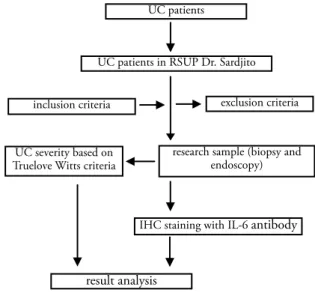
Th e subjects of this study were patients aged over 18 years who declared ulcerative colitis based on endoscopy results between December 2016 and July 2017 at Dr. Sardjito Hospital, PKU Muhammadiyah Bantul Hospital and willing to follow the research by signed informed consent. Exclusion criteria of
this study were patients who did not experience the disease of colorectal malignancy.
Th e gastro-entero hepatology polyclinic patients and Dr. Sardjito General Hospital ward that fulfi ll the inclusion and exclusion criteria got an explanation of the research. Patient data record included complaint manifestation of ulcerative colitis (frequency of diarrhea with or without blood), vital signs (blood pressure, pulse, and respiratory rate and body temperature), age, sex, weight, height, BMI. Patients also have taken blood samples to obtain Hb and LED values. Data obtained from the history, physical examination and laboratory examination were recorded in the study form. Degree classifi cation of Truelove Witts, interleukin 6 expressions and statistical analysis were assesed.
Statistical Analysis
Independent variables were the degree of severity of ulcerative colitis used the Truelove Witts classifi cation and dependent variables were IL-6 tissue expression based on immunohistochemistry. Univariate analysis of basic characteristic data was processed and exposed by descriptive method in mean ± standard deviation (SD), median or number (%) based on existed variables and categorical in terms of number and percentage. To determine the relationship between IL-6 expression and degree of ulcerative colitis by Truelove Witts classifi cation was excluded by Kruskall Wallis test, which was confi rmed by Mann Whitney test. Th e data was processed using the IBM Statistical Product and Service Solutions
(SPSS) version 22-computer program. Th e
p value <0.05 was considered statistically signifi cant.
Results
In this study, 27 research subjects checked into polyclinic in Dr. Sardjito General Hospital and PKU Muhammadiyah Bantul Hospital. After done the colonoscopy, a macroscopic ulcerative colitis image was confi rmed by biopsy examination. Th e 27 subjects were studied by data analysis and passed the assessment the severity of ulcerative colitis based on Truelove Witts criteria (mild, moderate and severe).
Th e mean age of the study subjects was 52.73+11.11 years with 15 subjects were men (57.7%). Most subjects did not smoke 21 subjects (80.8%), average body mass index of 22.18+4.97 kg / m2. Mean of hemoglobin level
12.77+1.71 g / dl; leukocyte 8.22+2.86 103/
mm3 and ESR 21.26 (4-63) mm/h. UC mild
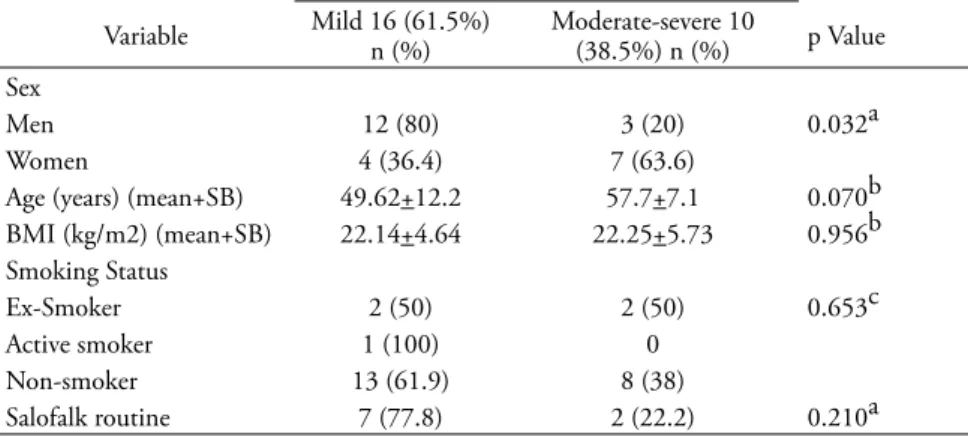
degree was obtained in 16 subjects (61.5%), moderate degree in 7 subjects (26.9%) and degree of weight in 3 subjects (11.5%). Th e median value of interleukin 6 in this study was 297.55 with the lowest score 212.1 and the highest value 400. Th e severity level of UC in male subjects was the highest with mild degree 13 subjects (81.25%) and moderate-severe 3 subjects (18.75%). The women subjects weighing 7 subjects (63.67%) and mild degree lightness 4 subjects (36.33%) with p value 0.032. While age, BMI, smoking status and Salofak therapy did not signifi cantly diff erent.
Discussion
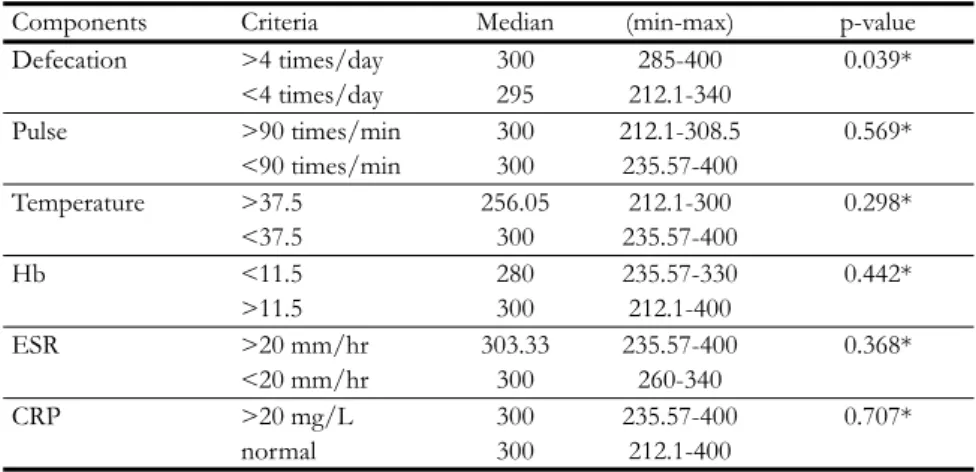
Th e signifi cant diff erences were seen in the defecation criteria> 4 times/day where the IL-6 300 (285-400) levels were compared with defecation <4 times/day, IL-6 295 (212.1-340) p 0.039. Other criteria components such as pulse frequency, body temperature, Hb, ESR and CRP levels found no signifi cant diff erences.
Based on table 4, we found that IL-6 levels were based on Truelove Witts criterion were 295 (212.1-340) for mild severity and 301.66 (235.57-400) for moderate-severe with a p value of 0.032, meaning that there was a signifi cant diff erence between the severity mild to moderate-severe ulcerative colitis.
In this study obtained the subject of 15 male and 11 female. Epidemiologically, the incidence of ulcerative colitis in males and females found no signifi cant diff erence with 5.7 point. Th e mean age of the entire study subjects was 52.73+11.11 years. According to research in the United Kingdom, UC 5 disease can aff ect any age but tend to be higher in the third or fourth decade.5 In Indonesia,
this epidemiological study has not yet been explored. Based on body mass index, the subject of study has not included the category of malnutrition. Underweight and nutrient status were commonly found in patients with Crohn disease and its lower in ulcerative colitis. One study suggested that body mass index was higher in ulcerative colitis (25.2 kg/m2) than
Chron disease (22.8 kg/m2) 11.
UC patients
inclusion criteria
UC patients in RSUP Dr. Sardjito
UC severity based on Truelove Witts criteria
exclusion criteria
research sample (biopsy and endoscopy)
IHC staining with IL-6 antibody
result analysis
In this study obtained the number of subjects only as many as 27 subjects. Although theoretically, ulcerative colitis may occur at any age, but the larger number of subjects according to the sample calculations will further refi ne the results of the study. Another limitation of the study is 5-ASA therapy in
subjects may decrease the expression of IL-6 in the mucosa due to the anti-infl ammatory potential of the drug.
Research limitations
Th is study conducted to determine the criteria using only restriction medical records. Th e subjects of the study were 110 subjects, but only 91 subjects joined the study because of the visibility time. To ensure the routinely of PLB does the research, in addition to assist the patient’s family also made regular home visits to the randomized subjects. However constraints to the distance some regular visits replaced by telephone contact.
Conclusion
Th e expression of IL-6 mucosal colonic tissue were higher on moderate-severe ulcerative colitis according to Truelove Witts criteria with p 0.032. Suggestion to the further study, might be continued with a larger sample size in each degree of ulcerative colitis.
Table 1. Baseline Characteristic
Baseline Characteristic n (%) Mean+SB / Media (min-max)
Age 52.73+11.11 Sex Men 15 (57.7) Women 11 (42.3) Smoking Status Non-smoker 21 (80.8) Active smoker 1 (3.8) Ex-smoker 4 (15.4) BMI (kg/m2) 22.18+4.97 Hemoglobin (g/dl) 12.77+1.71 Leukocyte (103/mm3) 8.22+2.86 ESR (mm/hour) 21.26 (4-63) Severity Mild 16 (61.5) Moderate 7 (26.9) Severe 3 (11.5) Salofalk routine 9 (34.6) Interleukin-6 297.55 (212.1-400)
Table 2 Baseline characteristic based on UC severity by Truelove Witts criteria UC Severity Variable Mild 16 (61.5%) n (%) Moderate-severe 10 (38.5%) n (%) p Value Sex Men 12 (80) 3 (20) 0.032a Women 4 (36.4) 7 (63.6)
Age (years) (mean+SB) 49.62+12.2 57.7+7.1 0.070b BMI (kg/m2) (mean+SB) 22.14+4.64 22.25+5.73 0.956b Smoking Status
Ex-Smoker 2 (50) 2 (50) 0.653c
Active smoker 1 (100) 0
Non-smoker 13 (61.9) 8 (38)
Salofalk routine 7 (77.8) 2 (22.2) 0.210a aFisher exact test; bNon-paired t test; cChi-square test
References
1. Djojoningrat D.,2014. Inflammatory bowel disease. Dalam: Sudoyo A.W.,
Setiyohadi, B (Ed.): BuUC Ajar Ilmu
Penyakit Dalam. Edisi ke-enam, hal 1814-1822. Interna Publishing, Jakarta.
2. Talley NJ, Abreu MT, Achkar JP, Bernstein CN, Dubinsky MC, Hanauer SB, Kane SV, 3. Sandborn WJ, Ullman TA, Moayyedi P.
2011. An Evidence-Based Systemic Review on Medical Th erapies for Infl ammatory Bowel Disease. Am J Gastroenterol; 106:S2 – S25.
4. Judge, TA., Lichtenstein, GR. 2003. Infl ammatory Bowel Disease in: Friedman SL, McQuaid, KR., Grendell, JH editors.
Current Diagnosis and Treatment in
Gastroenterology 2nd. McGraw-Hill. pp 108-30.
5. Barbara C., Taryn, D., Gioia, M.P., Yunsheng, M.A., Katherine, R., David, C., 2014. An anti-infl ammatory diet as treatment for infl ammatory bowel disease: a case series report. Nutritional journal
13:5.
6. Satsangi, Silverberg, Colombel, 2006. Th e Montreal classifi cation of infl ammatory bowel disease: controversies, consensus, and implications. Gut. 55(6): 749–753. 7. Yang, C.H., Chen, X., Dai J., Zhang,
Y., Ran, Z.H., Xiao, S.D., 2008. The Application of Montreal Classification in Infl ammatory Bowel Disease. Chinese Internal Medicine 47(1):7-10
Table 3 Difference of IL-6 expression between Truelove Witts Components
Components Criteria Median (min-max) p-value
Defecation >4 times/day 300 285-400 0.039* <4 times/day 295 212.1-340 Pulse >90 times/min 300 212.1-308.5 0.569* <90 times/min 300 235.57-400 Temperature >37.5 256.05 212.1-300 0.298* <37.5 300 235.57-400 Hb <11.5 280 235.57-330 0.442* >11.5 300 212.1-400 ESR >20 mm/hr 303.33 235.57-400 0.368* <20 mm/hr 300 260-340 CRP >20 mg/L 300 235.57-400 0.707* normal 300 212.1-400
*Kruskall Wallis test
Table 4 Diff erence of IL-6 expression on diff erent severity of UC according to Truelove Witts criteria
Severity (number) Interleukin 6 P value
Mild (n=16) 295 (212.1-340) 0.032a
Moderate-severe (n=10) 301.66 (235.77-400) aMann-Whitney test
8. Dignass, A., Eliakim, R., Magro, F., Maaser, C., Chowers, Y., Geboes, K., Van Assche, G. (2012). Second European evidence-based consensus on the diagnosis and management of ulcerative colitis Part 1: Defi nitions and diagnosis. Journal of Crohn’s and Colitis, 6(10), 965–990. 9. Ling J, Luo S, Lai J. 2015. Biological eff ects
of interleukin-6: Clinical applications in autoimmune diseases and cancers.
Biochemical Pharmacology. 97(1): 16-26
10. Alvarez, J.L.P., 2009. Interleukin 6 in the Physiopathology of Rheumatoid Arthritis.
Journal Reumatol Clin, 5 (1): 34-9.
11. Mitsuyama K, Sata M, Tanikawa K. 1991. Significance of interleukin 6 in patients with infl ammatory bowel disease.
Gastroenterol Jpn. 26;20-28.
12. Hébuterne, X. J. Filippi, R. Al-Jaouni, S. Schneider, 2009. Nutritional consequences and nutrition therapy in Crohn’s disease.
Gastroenté rologie clinique et biologique, 33 Suppl 3, pp.S235-44.