Copyright by Dan Li
The Thesis Committee for Dan Li
Certifies that this is the approved version of the following thesis:
The Influence of Live Customer Service on Consumers’ Likelihood of
Disclosing Personal Information
APPROVED BY
SUPERVISING COMMITTEE:
Matthew S. Eastin Vincent J. Cicchirillo Supervisor:
The Influence of Live Customer Service on Consumers’ Likelihood of
Disclosing Personal Information
by
Dan Li, B.A.
Thesis
Presented to the Faculty of the Graduate School of The University of Texas at Austin
in Partial Fulfillment of the Requirements
for the Degree of
Master of Arts
The University of Texas at Austin
May 2014
Abstract
The Influence of Live Customer Service on Consumers’ Likelihood of
Disclosing Personal Information
Dan Li, M.A.
The University of Texas at Austin, 2014
Supervisor: Matthew S. Eastin
Live customer service has been used by many e-commerce brands as a method to gain consumers personal information. Previous research has found that live service agents have a positive influence on consumer perceived service quality and trust. This research aims to examine if certain type of live customer service generate better website and brand perceptions from the consumer and ultimately help in gaining consumer personal information. Results of this experimental design show that avatar selection and exposure did not significantly differ for service quality, trust, attitudes, purchase intention, and likelihood of disclosing personal information. It was also found that customers have a significant likelihood of selecting agents of the same gender.
Table of Contents
List of Tables ... vi
List of Figures ... vii
Chapter 1: Introduction ...1
Chapter 2: Literature Review ...4
2.1 Live Customer Service Increases Perceived Service Quality and Trust ...4
2.2 Will User Control Make a Difference? ...6
2.2.1 Effect of Race in the Selection Process ...7
2.2.2 Effect of Gender in the Selection Process...8
2.3 Does Avatar Presence Matter? ...9
2.4 Attitude, Purchase Intension, and Behavior ...11
Chapter 3: Methodology ...16
3.1 Sample...16
3.2 Pre-test ...16
3.3 Procedure ...18
3.4 Measure and Variables ...21
Chapter 4: Result...23
Chapter 5: Conclusion...26
5.1 Summary of Findings ...26
5.2 Limitations and Future Research ...27
5.3 Conclusion ...28
Appendix ...29
List of Tables
Table 1: Sample Race Distribution ...16 Table 2: Pre-test Result ...17 Table 3: Summary of Hypotheses Testing Results ...25
List of Figures
Figure 1: Stimuli for Condition 1 ...19 Figure 2: Stimuli for Condition 2 ...20 Figure 3: Stimuli for Condition 3 ...20
Chapter 1: Introduction
As today‟s business environment becomes increasingly competitive, there is an inevitable trend for marketers to embrace a relationship marketing strategy, through which the seller aims to maintain a long-term relationship with the buyer instead of gaining one time transaction. With the fast diffusion of the Internet and personal computers around the world, many marketers, especially in the e-commerce industry, have begun to build consumer databases. Typically, a customer database records customers‟ personal information such as name, email, and home address. It serves as one of the sources for creating a dialogue and eventually developing relationships with customers (Schoenbachler & Gordon, 2002). In the last century, direct marketers were among the few businesses to track individual consumer purchases and characteristics using computer databases. Starting from the 21st century, retailers, manufacturers, service providers, and nonprofit organizations routinely collect and use consumer personal information (Phelps, Nowak, & Ferrell, 2000). Building the customer database helps marketers identify customers‟ needs, wants, and preferences that can be better served in the long term.
Obtaining consumer personal information is the essential practice of database marketing. Compared to „brick and mortar‟ retail stores, it is more difficult for online web-based retailers to build face-to-face relationships with customers. Fortunately, the inherent nature of the Internet enables e-commerce companies to readily request and collect customer personal information, and even record their on-site behaviors
information. For example, sensitive information like telephone numbers, credit card numbers, and birth date are collected during registration. However, the collection of personal information online for the purpose of personalization of services increases concerns about privacy infringement.
Consumers have stronger beliefs that they have lost control over how their personal information is used (Rust, Kannan, & Peng, 2002). For instance, as of 2007, 61% of American adults claimed that they were very or extremely concerned about the privacy of their personal information when purchasing online, with a significant increase from 47% in 2006 (Jesdanun, 2008). Further, a survey in 2010 showed that 87% of Americans are concerned about the security of their personal information on the Internet (Zogby International, 2010).
Paradoxically, the high level of consumer privacy concern appears to have little observable impact on consumers' purchasing behaviors. Most consumers are willing to provide some of their privacy to participate in commercial transactions (Phelps et al., 2000). For example, according to Goodwin (1991), many people would be upset if they were denied the marketing and credit opportunities made available through the use of personal information. Therefore, although some studies have identified privacy concern as an issue that threatens the foundations of direct marketing and retailing, there is uncertainty regarding the depth of privacy concerns as well as the utility of proposed solutions.
Recently, due to the increasing prevalence of online shopping, many companies (e.g. Lenovo.com) have provided “live help” functions. This service is typically delivered
between online consumers and customer service or sales representatives. Live help service is distinguished from other online consumer support functions in that consumers interact directly with human or computerized customer service representatives using an online medium (Aberg & Shahmehri, 2003). During the interactions, consumers are often requested to provide personal information during live chatting. Live customer service has become one method to collect consumer personal information in order to build company database.
As compared to self-service technologies (Meuter, Ostrom, Roundtree, & Bitner, 2000), live customer service is very expensive to implement because of the cost of the chatting software, the cost of training company staff to use it, and more importantly, the labor cost of hiring employees to attend the customers. However, little is known concerning the contributions of live help service to online consumers‟ willingness to disclose personal information. To this end, the current research will examine if certain type of live customer service generate better website or brand perceptions from the consumer and ultimately help in gaining consumer personal information. The objective of this paper is to shed some light on this question, and in particular, to investigate the effect of different types of live help service on consumer attitude towards the brand and the website, their purchase intentions, and the behavior of sharing personal information.
Chapter 2: Literature Review
2.1 LIVE CUSTOMER SERVICE INCREASES PERCEIVED SERVICE QUALITY AND TRUST
Parasuraman, Zeithaml, and Berry (1985) undertook an exploratory study to investigate the concept of service quality. They revealed that judgments of high and low service quality depended on how customers perceived the actual service performance compared to what they expected. In short, service quality as perceived by the customers could be defined as the extent of discrepancy between customers‟ expectations and their perceptions.
Studies have found that web sites with live customer service are more effective in improving system, information, and service quality as compared to sites that do not provide such service (Xu, Benbasat, & Cenfetelli, 2010). In the context of e-commerce, service quality comprises overall consumer evaluations and judgments made regarding the excellence of service provision in the virtual marketplace (Santos, 2003). The most widely applied service quality framework is SERVQUAL (Parasuraman et al., 1985/1988), which measures consumers‟ salient perceptions about a seller‟s service reliability, assurance, empathy, and responsiveness, as well as the tangible aspects of the seller‟s infrastructure. Compared to a purely technology derived service feature, for instance on-site search, human customer service representatives are in a much better position to interact with consumers and handle high-variance consumer concerns
(Sampson & Froehle, 2006). A representative can identify and accommodate the uniqueness of each consumer‟s demands, and express personal attention and care.
A customer‟s overall perceptions of the website service functionality will increase his or her perceptions of website service quality (Cenfetelli, Benbasat, & Al-Natour, 2008). A study by Xu et al. (2010) showed that live customer service has a strong positive effect on service quality. It provides answers and advice to help customers reach their buying goals, through which perceived service quality is influenced.
Besides service quality, live customer service is found to be effective in enhancing consumer trust in the website. Trust is an aspect of attitude that has received much attention in the literature. Research by Fogg et al. (2001), and Ratnasingham (1998) highlight the importance of trust for e-commerce. Here, Fogg et al. (2001) argue that trustworthiness is one of the five types of elements that increase website credibility. Ratnasingham (1998) develops a framework of trust and security for e-commerce, which provides a set of guidelines for secure e-commerce. More recently research suggests that integrating human assistance into a website makes it more fun to use, increases consumers‟ trust in the site, and improves the site‟s atmosphere (Aberg & Shahmehri, 2003). According to Aberg and Shahmehri (2003), most users have a high level of trust in the advice provided by human web assistants. In an analysis of interviews with participants, the following descriptive terms were associated with the influence in the research participants‟ explanations: a message of caring, helpfulness, and accountability. Thus, live help services has been found to be positively related to user trust in the website.
To this end, although the effect of live customer service on customer perception of service quality and trust has been studied, it is important to continue to examine how different types of live customer service affect users‟ perception of trust for a Web information system. Thus, this paper posits two aspects of live customer service that could be manipulated: user control, and representative avatar exposure.
2.2 WILL USER CONTROL MAKE A DIFFERENCE?
User control theory predicts that providing freedom in learning increases learning compared to traditional instruction (Eveland & Dunwoody, 2001). The theory has been applied to the context of e-commerce websites by many researchers (Liu & Schrum, 2002; Lowry et al., 2006; Häubl & Murray, 2011). User control covers the voluntary and instrumental actions of the website visitor (Liu & Schrum, 2002; Lowry et al., 2006). This is an important characteristic of a website that shapes the two-way online interaction and the exchange of information with website visitors resulting in a user experience (Van Oppen, 2007; Sundar, 2004). User experience refers to what a consumer thinks and feels during and after exposure to a website (Crutzen et al., 2009). User experience consists of cognitive and affective perceptions (Cyr, Head, & Ivanov, 2009). Key user perceptions are efficiency, effectiveness, enjoyment, and active trust (Cyr, Head, & Ivanov, 2009). This literature implies that user control plays an important role in affecting overall user experience including the perception of service quality and trust (Cyr, Head, & Ivanov, 2009). From the perspective, the aim of achieving a positive user experience is to increase website use. One of the most common issues for websites is the lack of user control (Srinivasan, Anderson, & Ponnavolu, 2002), which might lead to a reactance effect (S. S. Brehm & J. W. Brehm,
1981). Further, when freedom of control is constrained, a negative effect on preference for that website occurs (Häubl & Murray, 2011).
Regarding online shoppers, goal-focused shoppers frequently and explicitly associate goal-oriented attributes with increased freedom and control. In this sense, web customers are not passive recipients of marketing and are instead core players who experience increased control in the online environment (Hoffman & Novak, 1996). For instance, buying on the web gives consumers more perceived control over the interaction (Wolfinbarger & Gilly, 2001). E-commerce retailers can utilize their website to provide interactive services via live help. Users, however, want the choice of when and how they use the medium to interact with sales representatives to be firmly under their control (Wolfinbarger & Gilly, 2001).
Based on the effect of control, the current study proposes to examine the choices that users make when they are given the control and freedom to choose the live help agents on e-commerce websites. There are two factors that are believed to have an influence on users‟ choices – agent race and gender.
2.2.1 Effect of Race in the Selection Process
Identification theory (Kelman, 1961) suggests that people automatically assess their level of similarity with a source during an interaction. Individuals choose models to identify with according to their perceived similarities between themselves and the model (Kelman, 1961). Based on identification theory, Aaker, Brumbaugh, and Grier (1996) found that high levels of similarity between the information receiver and the information source in the context of advertising increase the receiver‟s belief that he or she is the
targeted audience for the information, which in turn leads to more positive attitudes about the source, most of the time a character in an advertisement. Race is a significant cue for similarity between a viewer and the character in an advertisement (Appiah, 2003). Research has shown that Black audiences rate ads featuring Black characters more favorably than ads featuring White characters (Greenberg & Atkin, 1982; Whittler, 1989). This is also true for other minorities. For instance, Hispanics are better persuaded by Hispanic models (Boone & Kurtz, 1992) and Asian Americans prefer ads that feature characters they identify with (Rossman, 1994). The identification theory has been applied to racially-targeted media studies especially in an online context (Appiah, 2003). It has been found that Black viewers spend more time browsing on and recall more information from a Black-targeted website than a White-targeted website (Appiah, 2003). When we apply identification theory to the consumer choice of live customer service representatives, we posit the following:
H1: When afforded selection control, participants are more likely to select a same race avatar.
2.2.2 Effect of Gender in the Selection Process
In addition to race-based selection, consumption behavior is assumed to be consistent with a person's gender identity. However, literature on gender has produces inconclusive results. For example, do men trust men or women more? The answer to this question is not clear. Past research within the game industry has found that gender pairing
are stronger interactions with regard to trustworthiness when the source and receiver are of the same gender (Bonein & Serra, 2009). Besides, past research indicates that youth have a subtle but significant preference to learn new information from a same-sex adult when both adults are equally reliable (Taylor, 2013). However, some contradictory results are reported for gender-based selection. Dovidio (1982) suggests that people seeking to help others give more to the opposite sex. Further, Slonim and Guillen (2010) research observe that participants playing a trust game select and send more money to partners of the opposite gender. Thus the effect of gender pairing bias remains unclear. Since the current study examines agent selection, where the customers are able to assess gender during the agent selection process, we therefore test the following research question based on possible gender pairing bias:
RQ1: When afforded the control and freedom of selecting a live customer service representative, will a customer select an agent with the same gender?
2.3 DOES AVATAR PRESENCE MATTER?
As mentioned, it is difficult for e-commerce companies to build face-to-face relationships with customers. Virtual communication usually lacks many of the trust-building cues which typically can be found in face-to-face communication. The lack of these cues creates a situation of incomplete information (Lipshitz & Strauss, 1997), consequently greater uncertainty and risk for online retailing. Offline customer– salesperson interactions often build trust and increase customer confidence, satisfaction and loyalty in retailing (Crosby, Evans, & Cowles, 1990). More importantly, face-to-face
interactions between salespersons and customers are important in increasing profit (Crosby et al., 1990). In the context of online shopping, instead of the interactions, features of e-commerce website interface influence customer judgments of trustworthiness (Kumar & Benbasat, 2002). Gefen and Straub (2004) came up with a solution to overcome this difficulty - “imbuing the medium of communication with a high social presence: the perception that there is personal, sociable, and sensitive human contact” (p. 410). One of the cues to the perception of social presence in computer mediated communication is interactivity, especially when this interactivity supports a social role, such as a program that works with the user in a problem-solving task (Keeling, McGoldrick, & Beatty, 2010).
In this context, an avatar which plays the social role of a live sales assistant is able to provide an effective source of social presence, and hence, build consumer trust (Holzwarth, Janiszewski, & Neumann, 2006). That is, the use of anthropomorphic avatars will increase the degree of perceived social presence as the communication becomes closer or more similar to face-to-face communication. People generally trust images more than they trust words (Rubin & McHugh, 1987). Virtual images, especially those closely representing human form, are more engaging, interesting, and attractive (Nowak, 2004). Here, it has been shown that the use of avatar sales agents leads to more satisfaction with the seller, more positive attitudes towards the product, and greater buying intention (Holzwarth et al., 2006).
Therefore, the use of anthropomorphic avatars is expected to positively influence trust in the online shopping environment. Adding the effect of user control on consumer
avatar presence through live customer service. Consequently the following hypotheses are generated:
H2: When consumers are given the control and freedom of selecting a live customer service agent with avatars, the live help service will have greater positive influence on customer perceived service quality of the website, compared to system assigned agent and text-only webpage.
H3: When consumers are given the control and freedom of selecting a live customer service agent with avatars, the live help service will have greater positive influence on customer trust in the website, compared to system assigned agent and text-only webpage.
2.4 ATTITUDE, PURCHASE INTENSION, AND BEHAVIOR
Enhancing consumer perception of service quality and trust in e-commerce websites is not the only goal of optimizing live customer service. A better designed live help service is expect to change people‟s attitude towards the website and the brand, increase purchase intention, and finally, increase the likelihood in gaining their personal information.
A number of studies have been conducted that relate to the antecedents, mediations, and consequences of service quality and attitude. According to Parasuraman, Zeithaml, and Malhotra (2005), service quality has been shown to invoke customer satisfaction, loyalty, and behavioral intentions. Spreng, Harrell, and Mackoy (1995)
indicated that perceived service quality plays the role of a forerunner to customer satisfaction.
In addition to service quality, trust has also been studied as one of the determinants to form and a popular antecedent to attitude in virtual commerce (Hassanein & Head, 2007). Jarvenpaa, Tractinsky, and Vitale (2000) found that consumers‟ trust in an Internet store affects their attitude. Since it has been proved that live help service increases user trust and perceived service quality, the following hypothesis was formulated for testing within an ecommerce context:
H4: When consumers are given the control and freedom of selecting a live customer service agent with avatars, the live help service will generate more positive user attitudes towards the websites, compared to system assigned agent and text-only webpage.
H5: When consumers are given the control and freedom of selecting a live customer service agent with avatars, the live help service will generate more positive user attitudes towards the brand, compared to system assigned agent and text-only webpage.
Research offers evidence that service quality perceptions positively affect certain types of consumer intentions. Zeithaml et al. (1996) developed a conceptual model that estimated the impact of overall service quality on particular behaviors such as word of
service quality performance, the higher is the likelihood to engage in positive WOM and higher is the purchase intention.
Besides, a great number of studies have been conducted to investigate the effects of online trust on purchase intentions (Gefen, 2000; Reichheld & Schefter, 2000). Results of these studies suggest that trust is a powerful predictor of intentions to purchase online (Yoon, 2002; Van der Heijden, Verhagen, & Creems, 2003; Zhu, O‟Neal, & Lee, 2009). Consumer trust in an online seller is crucial for its financial success because consumers will not use the seller‟s website if they lack trust (Reichheld & Schefter, 2000). In accordance with this observation, previous research has shown that consumer trust is positively and significantly related to both purchase intentions and window-shopping intentions of online consumers (Gefen, 2000) and that consumers without sufficient level of trust in a specific online retailer tend to refrain from engaging in e-commerce (Reichheld & Schefter, 2000). For instance, Yoon (2002) discovered that website trust, website satisfaction, and website awareness have a significant causal relationship with online purchase intention. Further, using the Technology Acceptance Model as their guide, Van der Heijden, Verhagen, and Creems (2003) demonstrated a negative relationships between trust and perceived risk and between perceived risk and attitude towards online purchasing, while a positive relationship between attitude towards purchasing and purchase intention was also detected. Zhu, O‟Neal, and Lee (2009), also used the TAM to develop a consumer trust model. Their conclusion is that trust significantly impacts consumers‟ purchase intention. Integrating these frameworks under the context of live help service, the following is hypothesized:
H6: When consumers are given the control and freedom of selecting a live customer service agent with avatars available, the live help service will generate greater purchase intention, compared to system assigned agent and text-only webpage.
Finally, when looking at gaining consumer personal information in order to build company database, Chellappa and Sin (2005) argue that even though sellers can improve web-based customer service quality with personalization, consumers may not be willing to share information about themselves due to the concern for privacy online. Though frustrating, they also found that when the value of personalization outweighs the loss of information privacy, consumers will share their personal information and preferences.
Moreover, trust has been identified as an important factor influencing consumers‟ decision in revealing personal information (Milne, Rohm, & Boza, 1998; Schoenbachler & Gordon, 2002). It is considered a potential driver of database-driven relationship marketing (Milne, Rohm, & Boza, 1998). Customers must have feelings of trust toward the marketer before revealing information (Schoenbachler & Gordon, 2002).
Within the database marketing literature specifically, trust has been found to be a potential mechanism to build relationships (Campbell, 1997). Milne and Boza (1999) provided support for this notion with their study in the database marketing context, in which they found that, across industries, building trust is a more effective marketing strategy than an effort to simply reduce customers‟ concerns.
In the recognition that individuals make choices in which they surrender a certain degree of privacy in exchange for outcomes perceived worthy of such disclosure, Dinev
transactions, the cumulative influence of Internet trust is an important factor that can outweigh privacy risk perceptions in the decision to disclose personal information. As mentioned, live help service is believed to have a positive impact on consumer trust, and trust in turn leads to reduced privacy concerns, thus we hypothesize the following:
H7: When consumers are given the control and freedom of selecting a live customer service agent with avatars, they are more likely to disclose personal information compared to a system assigned agent and text-only webpage.
Chapter 3: Methodology
3.1 SAMPLE
Undergraduate students at a large southwest university were recruited as study participants from a participant pool operated out of a College of Communication. According to Pew Research (2014), 97% American adults in the age group of 18-29 are Internet users. College students belong to the age group, thus an ideal sample for investigating online behaviors. Participants were informed of the opportunity to participate in this study, and were offered course credits for their participation. The total sample size comprised of 60 participants, 20 in each of the three conditions. The gender distribution is 63% female and 37% male. Their race distribution is as below: (Table 1)
Table 1: Sample Race Distribution
3.2 PRE-TEST
In order to test H1, the researcher selected males and females avatars in four different races – White, Black, Hispanic, Asian. Many studies have shown that physical attractiveness is the dominant factor in various human interactions (Adams & Crossman,
Race N % Asian 26 43% Hispanic 8 14% White 24 40% Mixed 2 3% Total 60 100%
make sure that their physical attractiveness did not significantly differ. For the pre-test, a convenient sample was recruited. Participants were 30 students from the same large southwest university as the primary study. They were asked to fill out an online survey. The survey presented eleven images with given names as selected for avatars of the e-commerce live help agents. Participants were then asked to give opinions on the avatars‟ attractiveness on a 10 point Likert scale ranging from Not Attractive=1 to Very Attractive=10.
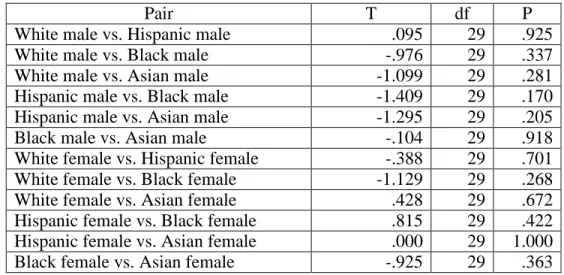
According to the result, eight avatars, one male and one female in each of the four races were selected. For each of these avatars, attractiveness levels did not significantly different. Take the white male and the Hispanic male avatars as an example, t(29)=.095, p>.05. (Table 2)
Pair T df P
White male vs. Hispanic male .095 29 .925
White male vs. Black male -.976 29 .337
White male vs. Asian male -1.099 29 .281
Hispanic male vs. Black male -1.409 29 .170
Hispanic male vs. Asian male -1.295 29 .205
Black male vs. Asian male -.104 29 .918
White female vs. Hispanic female -.388 29 .701
White female vs. Black female -1.129 29 .268
White female vs. Asian female .428 29 .672
Hispanic female vs. Black female .815 29 .422
Hispanic female vs. Asian female .000 29 1.000
Black female vs. Asian female -.925 29 .363
3.3 PROCEDURE
A website was built and used as the experimental stimulus. The website is designed for an e-commerce company selling television sets, with a fictitious brand name of SmarTV Online. The website has four web pages – Home, About us, Shop & Deals, and Contact Us. The last webpage “contact us” was modified according to the three different conditions. In the first condition, the webpage displayed eight images of the live customer service agents, male and female in four races (White, Black, Hispanic, Asian). The participants were able to choose one of the agents to start live chatting (Figure 1). In the second condition, the webpage shows only one avatar. Once the participants clicked on the avatar, the live chatting was triggered (Figure 2). In the third condition, there was no avatar on the webpage; instead, there was a “click here” button. In this condition, the participants were not provided with the opportunity to select an agent or see the agent’s avatar (Figure 3).
When the participants came to the lab, they were randomly assigned to one of the three conditions defined above. The study took place in an experimental lab setting. One participant at a time was allowed into the experimental room. There was an instruction sheet for the participants to follow. They were instructed to browse the website, and interact with a sales agent via the live chatting system. The researcher was able to observe the participants’ behavior on the computer in the control room. Further, the researcher in the control room played the role as the sales agent and interacted with the participants via the live chatting system. During the live chatting, the researcher used the same script, which gave consistent information to every participant and asked the same
one piece of information “we offer 10% off and free shipping for your purchase today”. Prior to ending the live chat, the live sales agent (i.e., researcher) question asked if they “could you please let me know your name and email”, which aimed to test the participants’ behavior of sharing personal information. All participants were offered the same information as requested. When the participants finished looking around website and interacting with the avatar agent, they were asked to take an online survey.
Figure 2: Stimuli for Condition 2
3.4 MEASURE AND VARIABLES
Survey questions examined participants’ perception of trust and service quality, attitudes towards the website and brand, purchase intentions, and behavior to disclose personal information.
Trust was measured with five likert-type items ranging from Strongly Agree = 1 to Strongly Disagree = 5 (M = 2.86, SD = .65, α = .83) (Erdem & Swait, 1998). Example items included “SmartTV Online delivers what it promises”.
The SERVQUAL scale was used to measure consumer perceived service quality (Parasuraman et al., 1988). It consisted of twelve likert-type items ranging from Strongly Agree =1 to Strongly Disagree = 5 (M = 2.21, SD = .44, α = .77). Example items included “customers should be able to trust agents of e-commerce websites”.
An attitude toward the website index was created by averaging the mean scores of three 5-point semantic differential scales: useful/useless, good/bad, likable/not likable (M = 2.91, SD = .91, α = .86) (Appiah, 2004).
An index that measured respondents’ attitude toward the brand was developed by averaging the mean scores of three 5-point semantic differential scales: favorable/not favorable, god/bad, likable/not likable (M = 2.86, SD = .93, α = .92) (Spears & Singh, 2004).
Consumer purchase intention was measured with two 5-point semantic items: definitely buy/definitely not buy, probably buy/probably not buy (M = 3.73, SD = .95, α = .79) (Spears & Singh, 2004).
Three variables were controlled across some of the analyses – Internet use frequency, frequency of Internet search prior to purchase, and Internet shopping frequency. Internet use was measured with one item asking respondents to estimate how often they use the internet daily with scores ranging from Less than 1 hour = 1 to More than 6 hours = 5 (M = 3.77, SD = .93). Frequency of Internet search prior to purchase was measured with one item asking respondents to estimate how often they use the Internet to search for information before they make purchase with scores ranging from Very often = 1 to Never = 5 (M = 1.52, SD = .77). Internet shopping frequency was measured with one item asking respondents to estimate how often they shop online with scores ranging from Very often = 1 to Never = 5 (M = 2.23, SD = .98).
Chapter 4: Result
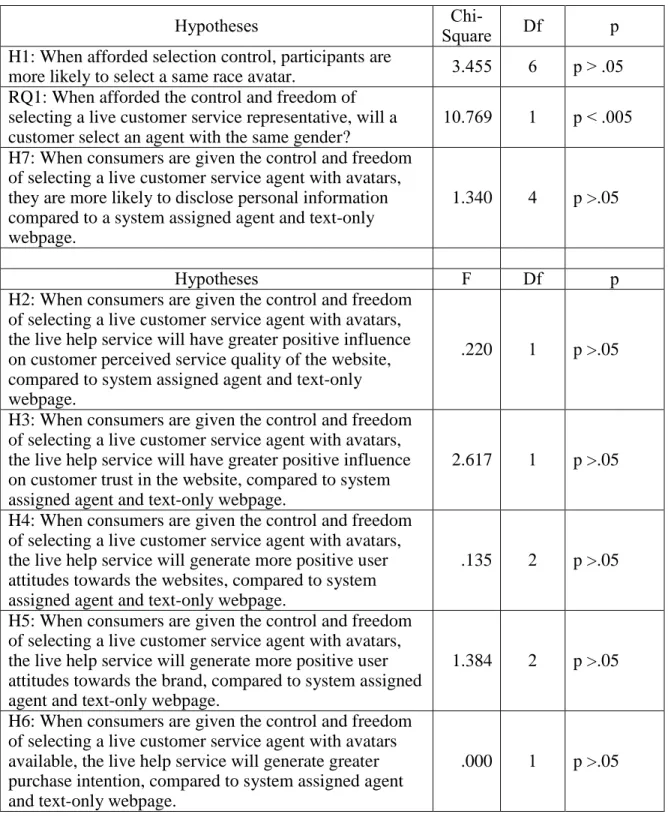
Regarding H1, data indicated no significant difference in terms of customer’s race and avatar race selection (χ2(6) = 3.455, p > .05).
To answer RQ1, data indicate relationship significant relationship between gender and agent gender selection (χ2(1) = 10.769, p < .005). Here, all male participants (N = 7) selected male agents. Further, 10 out of 13 female participants (76.9%) selected female agents. The data indicates that customers will choose agents with the same gender.
Looking at H2, after controlling for Internet use frequency (F(1,60) = .220, p > .05), the frequency of information search prior to purchase (F(1,60) = .659, p > .05), and Internet shopping frequency (F(1,60) = .002, p > .05), avatar selection and exposure did not significantly differ for trust (F(2,60) = .811, p > .05). Thus, H2 was not supported by the data.
Regarding H3, after controlling for Internet use frequency (F(1,60) = 2.617, p > .05), the frequency of information search prior to purchase (F(1,60) = .855, p > .05), and Internet shopping frequency (F(1,60) = .000, p > .05), avatar selection and exposure did not significantly differ for service quality (F(2,60) = .189, p > .05). Thus, H3 was not supported by the data.
Looking at H4, after controlling for Internet use frequency (F(1,60) = .752, p > .05), the frequency of information search prior to purchase (F(1,60) = .476, p > .05), and Internet shopping frequency (F(1,60) = .858, p > .05), avatar selection and exposure did not significantly differ for attitude towards the website (F(2,60) = .135, p > .05).
Regarding H5, after controlling for Internet use frequency (F(1,60) = .394, p > .05), the frequency of information search prior to purchase (F(1,60) = .191, p > .05), and Internet shopping frequency (F(1,60) = 1.256, p > .05), avatar selection and exposure did not significantly differ for attitude towards the brand (F(2,60) = 1.384, p > .05). Thus, H5 was not supported by the data.
In terms of H6, after controlling for Internet use frequency (F(1,60) = .000, p > .05), the frequency of information search prior to purchase (F(1,60) = .105, p > .05), and Internet shopping frequency (F(1,60) = .377, p > .05), avatar selection and exposure did not significantly differ for purchase intention (F(2,60) = 2.425, p > .05). Thus, H6 was not supported by the data.
Finally, data indicated no significant difference across the selection condition and personal information disclosure (χ2(4) = 1.340, p > .05). Here, 37 (62%) participants did not share personal information with the live help agents (12 in condition 1, 12 in condition 2, and 13 in condition 3). Further, 3% offered their emails while no one offered their name only to the agent. Lastly, 21 (35%) participants shared both their names and emails with the agents (8 in condition 1, 7 in condition 2, and 6 in condition 3).
Hypotheses Square Chi- Df p H1: When afforded selection control, participants are
more likely to select a same race avatar. 3.455 6 p > .05 RQ1: When afforded the control and freedom of
selecting a live customer service representative, will a
customer select an agent with the same gender? 10.769 1 p < .005 H7: When consumers are given the control and freedom
of selecting a live customer service agent with avatars, they are more likely to disclose personal information compared to a system assigned agent and text-only webpage.
1.340 4 p >.05
Hypotheses F Df p
H2: When consumers are given the control and freedom of selecting a live customer service agent with avatars, the live help service will have greater positive influence on customer perceived service quality of the website, compared to system assigned agent and text-only webpage.
.220 1 p >.05
H3: When consumers are given the control and freedom of selecting a live customer service agent with avatars, the live help service will have greater positive influence on customer trust in the website, compared to system assigned agent and text-only webpage.
2.617 1 p >.05
H4: When consumers are given the control and freedom of selecting a live customer service agent with avatars, the live help service will generate more positive user attitudes towards the websites, compared to system assigned agent and text-only webpage.
.135 2 p >.05
H5: When consumers are given the control and freedom of selecting a live customer service agent with avatars, the live help service will generate more positive user attitudes towards the brand, compared to system assigned agent and text-only webpage.
1.384 2 p >.05
H6: When consumers are given the control and freedom of selecting a live customer service agent with avatars available, the live help service will generate greater purchase intention, compared to system assigned agent and text-only webpage.
.000 1 p >.05
Chapter 5: Conclusion
5.1 SUMMARY OF FINDINGS
This paper sought to examine how live help customer service could be improved and subsequently generate more positive attitude and illicit behavior from consumers. Results indicate that, avatar selection and avatar exposure does not significantly influence consumer trust, perceived service quality, attitude towards the website and the brand, purchase intention, and likelihood of disclosing personal information. And, customers do not have a preference on the race of live help service agents.
Data did indicate that customers have a significant likelihood of selecting agents in the same gender. Gender pairing bias has been studied under the context of games in recent years. Some argue that subjects select and send more to partners of the opposite gender in games (Slonim & Guillen, 2010), while others (Bonein & Serra, 2009) suggest that when paired up with the partners in the same-gender in games, trustworthiness increases. The finding of this research is in line with the latter phenomenon. Moreover, this research helps to expand from the realm of games to e-commerce. Therefore, it contributes to the literature on gender pairing bias theory with strong evidence that supports the effect of same gender pairing in e-commerce industry, which is still a controversial issue (Bonein & Serra, 2009; Taylor, 2013; Dovidio, 1982; Slonim & Guillen, 2010).
According to the great likelihood of selecting and seeking help from the same-gender assistants, it is suggested that an e-commerce website have at least two agents of the opposite genders for consumers’ choices. When the finding is applied to advertising, we suggest advertisers use gender congruent characters in commercials if the brand image is focused on providing help and services to consumers. For example, if the target audience of a brand is mostly female, and the brand’s mission is to serve them, thus female figures should appear in advertisements to make the target audience feel comfortable.
5.2 LIMITATIONS AND FUTURE RESEARCH
A primary limitation of the current study was a small sample for analyses. The size and homogeneity of the sample limit the generalizability of this study. Therefore, future research on this topic should extend to include a larger size of sample with more diversified backgrounds.
One possible future research area is to investigate the differences between the effects of human agents and automated agents (AI). In practice, constrained by cost and human resources, many companies provide automated chat during non-business hours, in hope that consumers get the same level of satisfactory when visiting their websites. However, research has shown there is a gap between the effect of human live help service and automated chat services. Cole et al. (2003) indicates HCI development should be geared towards designing systems that enable interactions with the same characteristics found in “natural face-to-face conversations with lifelike characters that speak, emote, and gesture” (p. 1391). There could be differences in the degree of application of social rules when users know they are interacting with a machine agent rather than a human
agent (Mauldin, 1994). Sundar et al. (2012) demonstrated that online shoppers found the site to be most absorbing in the human agent condition. The online shoppers were also more willing to recommend the site to others and to know more about the site when it provided a human chat agent. Therefore, it is recommended that future research focus on inspecting the human chat agent condition versus robot condition, and their influence on consumer behavior of disclosing personal information.
5.3 CONCLUSION
The findings of this study answers the questions posed– how to optimize live help service on e-commerce websites with the goal of gaining consumer personal information in database marketing. Moreover, customers prefer being served by the assistants with the same gender. When given the freedom of selection, male (female) customers tend to select male (female) live help agents during their visit on e-commerce websites. These findings contribute to the existing literature on online avatar and gender pairing bias theories. They also provide consumer insights for marketers to adjust their strategies accordingly. E-commerce website optimization and user experience design has been a popular topic in recent years. This paper sheds light on the issue from the theoretical and practical perspectives. Based on the current study, related future research in this area is expected to make more contributions.
Appendix
Survey QuestionsPlease rate how strongly you agree or disagree with each of the following statements. Strongly Agree (1) Agree (2) Neither Agree nor Disagree (3) Disagree (4) Strongly Disagree (5) SmartTV Online delivers what it promises. (1) SmartTV Online‟s product claims are believable. (2) SmartTV Online is at the forefront of using technology to deliver a better product. (3) SmartTV Online is trustworthy. (4) I trust the information on SmartTV Online. (5)
Please rate how strongly you agree or disagree with each of the following statements. Strongly Agree (1) Agree (2) Neither Agree nor Disagree (3) Disagree (4) Strongly Disagree (5) Agents of e-commerce websites don't always have to be willing to help customers. (1) Customers should be able to trust agents of e-commerce websites. (2) Customers should be able to feel safe in their transactions with e-commerce websites' agents. (3) E-commerce websites' agents should be polite. (4) It is unrealistic to expect agents of e-commerce websites to know what the needs of their customers
It is unrealistic to expect e-commerce websites to have their customers' best interests at heart. (6)
Please rate how strongly you agree or disagree with each of the following statements. Strongly Agree (1) Agree (2) Neither Agree nor Disagree (3) Disagree (4) Strongly Disagree (5) Agents of SmarTV Online are not always willing to help customers. (1)
You can trust agents of SmarTV Online. (2)
You feel safe in your transactions with SmarTV Online's agents. (3) Agents of SmarTV Online are polite. (4) Agents of SmarTV Online do not know what your needs are. (5) SmarTV Online does not have your best interests at heart. (6)
Please rate your overall feelings about the website. 1 (1) 2 (2) 3 (3) 4 (4) 5 (5) Useful:Useless (1) Good:Bad (2) Likable:Not likable (3)
Please rate your overall feelings about the brand SmarTV Online.
1 (1) 2 (2) 3 (3) 4 (4) 5 (5) Favorable:Not favorable (1) Good:Bad (2) Likable:Not likable (3)
Please rate your intention in purchasing from SmarTV Online.
1 (1) 2 (2) 3 (3) 4 (4) 5 (5) Definitely buy:Definitely not buy (1) Probably buy:Probably not buy (2)
How often do you use the Internet every day? Less than 1 hour (1)
1-2 hours (2) 3-4 hours (3) 5-6 hours (4)
More than 6 hours (5)
How often do you use Internet for information prior to a purchase? Very often (1)
Often (2) Sometimes (3) Rarely (4) Never (5)
How often do you use Internet for shopping? Very often (1) Often (2) Sometimes (3) Rarely (4) Never (5)
References
Aaker, J., Brumbaugh, A., & Grier, S. (1996). The non-target and viewer distinctiveness:
The impact of target marketing on processing and attitudes (Research Paper No.
1391). Palo Alto, CA: Stanford University, Graduate School of Business.
Aberg, J., & Shahmehri, N. (2003). Live Help Systems, In Human Factors and Web
Development. In J. Ratner (Ed.), Mahwah, NJ: Lawrence Erlbaum Associates.
287-309.
Adams. G. R., & Crossman, S. M. (1978). Physical attractiveness: a cultural imperative. New York: Libra.
Appiah, O. (2003). Americans Online: Differences in Surfing and Evaluating Race-Targeted Web Sites by Black and White Users. Jouranl of Broadcasting &
Electronic Media, 47(4), 537-555.
Bonein, A., & Serra, D. (2009). Gender pairing bias in trustworthiness. The Journal of
Socio-Economics, 38(5), 779-789.
Boone, L. E., & Kurtz, D. L. (1992). Contemporary Marketing (7th ed.). Fort Worth, TX: Dryden.
Brehm, S. S., & Brehm, J. W. (1981). Psychological Reactance: A Theory of Freedom and Control. New York, NY: Academic Press.
Bull, R., & Rumsey, N. (1988). The social psychology of facial appearance. New York: Springer·Verlag.
Campbell, A. (1997). Relationship Marketing in Consumer Markets: A Comparison of Managerial and Consumer Attitudes about Informational Privacy. Journal of
Direct Marketing, 11(3), 44-57.
Cenfetelli, R., Benbasat, I., & Al-Natour, S. (2008). Addressing the What and How of Online Services: Comparing Service Content and Service Quality for E-Business Success. Information Systems Research, 19(2), 161-181.
Chellappa, R. K., & Sin, R. G. (2005). Personalization versus privacy: an empirical examination of the online consumer‟s dilemma. Information Technology and
Management, 6(2), 181–202.
Cole, R., van Vuuren, S., Pellom, B., Hacioglu, K., Ma, J., Movellan, J., et al. (2003). Perceptive animated interfaces: First steps toward a new paradigm for human-computer interaction. Proceedings of the IEEE, 91(9), 1391-1405.
Crosby, L., Evans, K., & Cowles, D. (1990). Relationship quality in services selling: an interpersonal influence perspective. Journal of Marketing, 54(3), 68-81.
Crutzen, R., de Nooijer, J., Brouwer, W., Oenema, A., Brug, J., & de Vries, N. K. (2009). A conceptual framework for understanding and improving adolescents' exposure to Internet-delivered interventions. Health Promotion International, 24(3), 277-284. Cyr, D., Head, M., & Ivanov, A. (2009). Perceived interactivity leading to e-loyalty:
development of a model for cognitive-affective user responses. International Journal of Human-Computer Studies, 67(10), 850-869.
Dinev, T., & Hart, P. (2006) An extended privacy calculus model for e-commerce transactions. Information Systems Research, 17(1), 61-80.
Dovidio, J. (1982). Sex, costs and helping behavior. Journal of Psychology, 112(2), 231– 236.
Erdem, T., & Swait, J. (1998). Brand Equity as a Signaling Phenomenon. Journal of
Consumer Psychology, 7(2), 131-157.
Eveland, W. P., & Dunwoody, S. (2001). User Control and Structural Isomorphism or Disorientation and Cognitive Load?: Learning From the Web Versus Print. Communication Research, 28(1), 48-78.
Fogg, B.J., Marshall, J., Laraki, O., Osipovich, A., Varma, C., Fang, N., Paul, J., Rangnekar, A., Shon, J., Swani, P., & Treinen, M. (2001). What Makes Web Sites Credible? A Report on a Large Scale Quantitative Study. In J. A. Jacko, A. Sears, M. Beaudouin-Lafon, & R. J. K. Jacob (Eds.), Proceedings of the CHI
Conference on Human Factors in Computing Systems (pp. 61–68). Seattle, WA:
Association for Computing Machinery.
Gefen, D. (2000). E-Commerce: The Role of Familiarity and Trust. Omega, 28(6), 725-737.
Gefen, D., & Straub, D. (2004). Consumer trust in B2C e-commerce and the importance of social presence: experiments in e-products and e-services. Omega, 32(6), 407-424.
Goodwin, C. (1991). Privacy: Recognition of a Consumer Right. Journal of Public Policy
& Marketing, 10 (1), 149-166.
Greenberg, B. S., & Atkin, C. (1982). Learning about minorities from television: A research agenda. In G. Berry & C. Mitchell-Kernan (Eds.), Television and the
Hassanein, K., & Head, M. (2007). Manipulating perceived social presence through the web interface and its impact on attitude towards online shopping. International
Journal of Human-Computer Studies, 65(8), 689-708.
Häubl, G., & Murray, K. B. (2011). Freedom of choice, ease of use, and the formation of interface preferences. Management Information Systems, 35(4), 955-976.
Hoffman, D. L., & Novak, T. P. (1996). Marketing in Hypermedia Computer-Mediated Environments: Conceptual Foundations. Journal of Marketing, 60(3), 50-68. Holzwarth, M., Janiszewski, C., Neumann, M. M. (2006). The influence of avatars on
online consumer shopping behavior. Journal of Marketing, 70(4), 19-36.
Jarvenpaa, S. L., Tractinsky, N., & Vitale, M. (2000). Consumer trust in an internet store.
Information Technology and Management, 1(1–2), 45–71.
Jesdanun, A. (2008, January 16). Study: Online privacy concerns increase. Associated Press. Retrieved from http://www.usatoday.com/tech/news/internetprivacy/2008-01-16-onlineprivacy-concerns_N.htm
Keeling, K., McGoldrick, P., & Beatty, S. (2010). Avatars as salespeople Communication style, trust, and intentions. Journal of Business Research, 63(8), 793-800.
Kelman, H. C. (1961). Process of opinion change. Public Opinion Quarterly, 25(1), 57-78.
Kumar, N., & Benbasat, I. (2002). Para-social presence and communication capabilities of a website: a theoretical perspective. e-Service Journal, 1(3), 5-24.
Lipshitz, R., & Strauss, O. (1997). Coping with uncertainty: a naturalistic decision-making analysis. Org Behav Human Decis Process, 69(2), 149-163.
Liu, Y., & Schrum, L. J. (2002). What is interactivity and is it always such a good thing? Implications of definition, person, and situation for the influence of interactivity on advertising effectiveness. Journal of Advertising, 31(4), 53-64.
Lowry, P. B., Spaulding, T., Wells, T., Moody, G., Moffit, K., & Madariaga, S. (2006) A theoretical model and empirical results linking website interactivity and usability satisfaction. Proceedings of the 39th Annual Hawaii International Conference on System Sciences (pp. 123a-).
Mauldin, M. L. (1994). ChatterBots, TinyMuds, and the Turing test: Entering the Loebner prize competition. Proceedings of the Twelfth National Conference on
Meuter, M. L., Ostrom, A. L., Roundtree, R. I., & Bitner, M. J. Self-Service Technologies: Understanding Customer Satisfaction with Technology-Based Service Encounters. Journal of Marketing, 64(3), 50-64.
Milne, G. R., & Boza, M-E. (1999). Trust and Concern in Consumers‟ Perceptions of Marketing Information Management Practices. Journal of Interactive Marketing, 13(1), 5-24.
Milne, G.R., Rohm, A.J., & Boza, M-E. (1998). Trust Has to be Earned: An Exploration into the Antecedents of Trust in Database Marketing. In J.E. Phelps (Ed.),
Proceedings of DMEF Educators’ Conference (pp. 31-41). New York: Wiley.
Nowak, K. (2004). The influence of anthropomorphism and agency on social judgment in virtual environments. Journal of Computer-Mediated Communication, 9(2), 0. O‟Connor, P. (2007). Online consumer privacy: An analysis of hotel company behavior.
Cornell Hotel and Restaurant Administration Quarterly, 48(2), 183-200.
Parasuraman, A., Zeithaml, V. A., & Malhotra, A. (2005). E-S-Qual: A multiple-item scale for assessing electronic service quality. Journal of Service Research, 7(3), 213-233.
Parasuraman, A., Zeithaml, V.A., & Berry, L.L. (1985). A conceptual model of service quality and its implication for future research. Journal of Marketing, 49(4), 41-50. Parasuraman, A., Zeithaml, V.A., & Berry, L.L. (1988). SERVQUAL: A Multiple-Item Scale for Measuring Customer Perceptions of Service Quality. Journal of Retailing, 64(1), 1988, 12-40.
Patzer, G. L. (1985). The physical attractiveness phenomena. New York: Plenum.
Pew Research. (2014). Internet User Demographics. Retrieved from http://www.pewinternet.org/data-trend/internet-use/latest-stats/
Phelps, J., Nowak, G., & Ferrell, E. (2000). Privacy Concerns and Consumer Willingness to Provide Personal Information. Journal of Public Policy & Marketing, 19(1), 27-41.
Ratnasingham, P. (1998). The importance of trust in electronic commerce. Internet
Research: Electronic Networking Applications and Policy, 8(4), 313-321.
Reichheld, F. F., & Schefter, P. (2000). E-Loyalty: Your Secret Weapon on the Web.
Harvard Business Review, 78(4), 105-113.
Rubin, B., & McHugh, M. P. (1987). Development of parasocial interaction relationships.
Journal of Broadcasting and Electronic Media, 31(3), 279–292.
Rust, R., Kannan, P., & Peng, N. (2002). The customer economics of Internet privacy.
Journal of the Academy of Marketing Science, 30(4), 455-464.
Sampson, S. E., & Froehle, C. M. (2006). Foundations and Implications of a Proposed Unified Services Theory. Production and Operations Management, 15(2), 329-343.
Santos, J. (2003). E-Service Quality: A Model of Virtual Service Quality Dimensions.
Management Service Quality, 13(3), 233-246.
Schoenbachler, D. D., & Gordon, G. L. (2002). Trust and customer willingness to provide information in database-driven relationship marketing. Journal of
Interactive Marketing, 16(3), 2-16.
Slonim, R., & Guillen, P. (2010). Gender selection discrimination: Evidence from a Trust game. Journal of Economic Behavior & Organization, 76(2), 385–405.
Slonim, R., & Guillen, P. (2010). Gender selection discrimination: Evidence from a Trust game. Journal of Economic Behavior and Organization, 76(2), 385-405.
Spears, N., & Singh, S. N. (2004). Measuring Attitude toward the Brand and Purchase Intentions. Journal of Current Issues & Research in Advertising, 26(2), 53-66. Spreng, R. A., Harrell, G. D., & Mackoy, D. (1995). Service recovery: Impact on
satisfaction and intentions. Journal of Services Marketing, 9(1), 15-23.
Srinivasan, S. S., Anderson, R., & Ponnavolu, K. (2002). Customer loyalty in e-commerce: an exploration of its antecedents and consequences. Journal of Retailing, 78(1), 41-50.
Sundar, S. S. (2004). Theorizing interactivity's effects. Information Society, 20(5), 387-391.
Sundar, S. S., Bellur, S., Oh, J., Jia, H., & Kim, H. (2012). The Importance of Message Contingency: An Experimental Investigation of Interactivity in an Online Search Site. Paper presented at the annual meeting of the International Communication Association.
Taylor, M. G. (2013). Gender influences on children‟s selective trust of adult testimony.
Journal of Experimental Child Psychology, 115(4), 672-690.
Van der Heijden, H., Verhagen, T., & Creems, M. (2003). Understanding online purchase intention: Contribution from technology and trust perspectives. European Journal
Van Oppen, C.A.M.L. (2007). From Rags to Richness. Maastricht: Maastricht University.
Whittler, T. E. (1989). Viewers‟ processing of actor‟s race and message claims in advertising stimuli. Psychology of Marketing, 6(4), 287-309.
Wolfinbarger, M., & Gilly, M. (2001). Shopping Online for Freedom, Control, and Fun.
California Management Review, 43(2), 34-55.
Xu, J., Benbasat, I,. & Cenfetelli, R. T. (2010). Does Live Help Service Matter? A Empirical Test of the DeLone and McLean‟s Extended Model in the E-Service Context. Proceedings of the 43rd Hawaii International Conference on System
Sciences (pp. 1-10).
Yoon, S. J. (2002). The antecedents and consequences of trust in online-purchase decision. Journal of Interactive Marketing, 16(2), 47–63.
Zeithaml, V. A., Berry, L. L., & Parasuraman, A. (1996). The behavioural consequences of service quality. Journal of Marketing, 60(2), 31-46.
Zhu, D. S., O‟Neal, G. S., & Lee, Z. C. (2009). The effect of trust and perceived risk on consumers‟ online purchase intention. Proceedings of the 9th international
conference on computational science and engineering.
Zogby International. (2010, June 7). Results from June 4-7 nationwide poll. Retrieved from http://www.precursorblog.com/files/pdf/topline-report-key-findings.pdf