Understanding the System Context of Alternative Food Supply Chains
Anne Vuylsteke and Guido van Huylenbroeck Ghent University, Department of Agricultural Economics;
Coupure Links 653, B – 9000 GHENT
[email protected]; [email protected]
Paper prepared for presentation at the 1st International European Forum on Innovation and System Dynamics in Food Networks
Officially endorsed by the European Association of Agricultural Economists (EAAE), Innsbruck-Igls, Austria
February 15-17, 2007
Copyright 2007 by[ Vuylsteke, van Huylenbroeck]. All rights reserved. Readers may make verbatim copies of this document for non-commercial purposes by any means, provided that this copyright notice appears on all such copies.
Understanding the System Context of Alternative Food Supply Chains
Anne Vuylsteke and Guido van Huylenbroeck Ghent University, Department of Agricultural Economics;
Coupure Links 653, B – 9000 GHENT Tel: +32 9 264 59 28Fax: +32 9 264 62 46
[email protected]; [email protected]
Abstract
This paper focuses upon the case of alternative food supply chains (AFSCs) as a “laboratory” for the implementation of sustainability concepts on a larger scale. To realize this type of up-scaling, two important conditions should be fulfilled: the initiatives have to combine a perfor-ming internal organisation with the ability to understand and interact with the larger food sy-stem. To explore these concepts, the theory of hybrid organisations and the system innovation policy approach are discussed. Theory and empirical evidence learns that both concepts are complementary, as they both stress the importance of networking with actors that can be situa-ted within or outside the supply chain.
1. Introduction
In recent years, an impressing number of alternative supply chains (AFSCs) have been estab-lished in order to meet the increasing consumer demand for safe and high quality food products, but also a means to increase the generate extra added-value. This evolution has been studied by a wide field of authors, who have focused on different dimensions of AFSCs such as their role in rural development (Marsden et al., 2000; van der Ploeg et al., 2000), their ability their guar-antee a specific product quality (Henson & Reardon, 2005; Ilbery & Kneafsey, 2000) and their governance structures (Ménard, 2004; Ménard & Valceschini, 2005; Raynaud et al., 2002). In this paper, we work on a conceptual framework that allows to study the up-scaling of AFSCs that market products with a sustainability claim and the crucial factors that determine the suc-cess of this prosuc-cess. Up-scaling has hereby to be distinguished from growth. An initiative grows when partners do not change their strategies and the existing resources are used more intensive-ly, while scaling up implies a major change in the strategic vision because of new outlets and/ or new investments, new partners, but also a different organisations of resources. Examples of scaling up are the exploration of new markets with new products, the establishment of new spin offs by an initiative and the replication of the model of an initiative in another region (Jahn et al., 2006).
In this paper, we argue that it is not sufficient that an AFSC optimizes its internal functioning to be successful, but it should also be able to take the context of the system into account and to interact with different actors, organisations and institutions. We will therefore use insights of the economics of hybrid organisations and the SI policy approach to identify key success fac-tors. We consider both concepts to be extremely complementary, as they both stress the impor-tance of networking with other chain actors, organisations and institutions, which can be within or outside the supply chain. The challenge is of this paper is to come to an integrative analysis that describes the networking and collaboration between firms and the central authority of the AFSC on the one hand and with actors in the wider network on the other. We will therefore con-front the internal functioning and external networking to study an initiative’s performance.
Before addressing the performance, we will first describe the main characteristics of the theo-retical concepts and the possibility to use them. Consequently, we explore the coherence bet-ween both concepts through empirical evidence of 14 European AFSCs. The final section then discusses the conclusions and gives some first indications on how to study the relationship bet-ween the commercial performance and sustainability of an AFSC, internal organisation and ex-ternal networking.
2. Assessing the internal performance of AFSCs – the economy of hybrid organisations 2.1 Theoretical context of hybrid organisations
The theory of hybrid organisations, which is situated in the field of New Institutional Economics (NIE), is used to analyse the internal organisation of initiatives. The NIE theory focuses on the organisation of economic activities and institutional structures, with the basic assumptions that governance structures have an important impact on the economic performance of the stakehold-ers involved, and that governance structures can be analysed using rigorous theoretical and em-pirical methods (Arrow, 1974).
An important tool hereby are transaction costs, or the costs that are associated with carrying out a transaction or the costs of organising a transaction with information costs, negotiation costs and monitoring and enforcement costs as the most important examples. Transaction cost eco-nomics then focuses on how transactions are organised in order to minimise transaction costs and three critical dimensions are hereby identified: uncertainty, frequency and asset specificity (Coase, 1937; Hubbard, 1997; Verhaegen & Van Huylenbroeck, 2002) A comprehensive dis-cussion of transaction costs and the characteristics of transactions in the context of AFSCs can be found in Réviron et al. (forthcoming).
2.2 The governance of hybrid organizations
Good governance of supply chains makes it possible for transaction partners to realise and share the mutual gains of an exchange or cooperation. A governance structure is hereby defined as the set of institutional arrangements within which a transaction is organised (McFetridge, 1994; Ménard, forthcoming; Williamson, 1985, 1991). Hybrid organisations, as a specific governance structure between markets and hierarchies, can then be defined as arrangements that involve de-liberate coordination of a subset of activities among partners who maintain autonomous proper-ty rights and who remain independent as decision makers in last resort (Ménard, 2004). A plenitude of organisational forms comply with this definition and joint ventures, franchising, commercial networks, subcontracting, cooperatives are only a handful of examples (Ménard, 2004; Ménard & Valceschini, 2005). Within this diversity, Ménard distinguishes four categories of hybrid organisations based on their asset specificity and the transaction costs: (i) trust is the closest to market arrangements as decisions are decentralised and loose coordination is imple-mented through mutual influence and reciprocity; (ii) relational networks have formal rules and conventions that frame relationships among agents and restrict the risk of opportunism; (iii) lea-dership emerges when a firm establishes its authority over the partners, because it holds specific competencies or occupies a key position in the chain and (iv) formal governments function as a private bureau with some attributes of hierarchy as a significant subset of the partners’ decisions is coordinated through a quasi-autonomous entity. In all cases, the partners remain independent and may even compete on segments of their activities (Ménard, 2004).
Another classification was proposed by Verhaegen and Van Huylenbroeck (2002), and these authors consider the partial transfer of decision power, especially concerning quality control is-sues, as the key factor to distinguish hybrid forms. Three categories of hybrids can then be di-stinguished: (i) framework governance, whereby quality implies non-observable and non– standardised attributes but their is no strive for quality increase nor product standardisation; (ii) coordinating governance, the intended quality is developed by one level of actors in the chain and (iii) participating governance implies that quality requires deployment of uniform re-sources and/or uniform production processes.
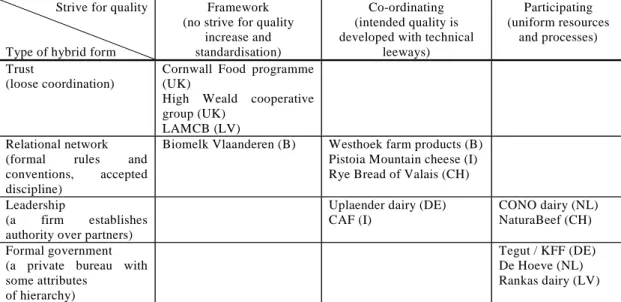
The confrontation of both classifications for a set of AFSCs studied within the SUS-CHAIN project learns that there is a positive correlation between a strive for common quality and dele-gation of authority to the centre of co-ordination (see Figure 1. Classification of SUS-CHAIN case studies according to their internal organisational form and their strive for quality 1). This correlation is evaluated to be logic and natural, as any initiative needs an effective and efficient decision mechanism to realize and coordinate its promise (Réviron et al., forthcoming). The placement of an initiative on this grid is however dynamic and can change in the initiatives’ li-fecycle. When an initiative for example decides to create a private brand next to the general or-ganic label it was already using, the organisation is likely to evolve from a framework governance with trust to a co-ordinating governance in a relational network.
Figure 1. Classification of SUS-CHAIN case studies according to their internal organisational form and their strive for quality
3. Analysis of AFSCs in the context of a system – SI policy approach 3.1 Theoretical context of system innovation
This paper aims to study the potential of AFSCs to scale up, or in terms of transition theory (Rot-mans et al., 2001), the potential of innovative niches to penetrate the regime and possibly the transformation of the entire agri-food sector. But, as Green and Foster (2005) state, transfor-ming human activities with respect to food requires a focus on the whole system of agricultural, industrial, retailing and household activities and their interrelationships. This complexity of in-novation is also reflected by the system definition of inin-novation as proposed by Klein Woolthuis et al. (2005): “Innovation is an interactive, non-linear process in which actors (e.g. firms)
in-Strive for quality
Type of hybrid form
Framework (no strive for quality
increase and standardisation)
Co-ordinating (intended quality is developed with technical
leeways) Participating (uniform resources and processes) Trust (loose coordination)
Cornwall Food programme (UK)
High Weald cooperative group (UK)
LAMCB (LV) Relational network
(formal rules and conventions, accepted discipline)
Biomelk Vlaanderen (B) Westhoek farm products (B) Pistoia Mountain cheese (I) Rye Bread of Valais (CH)
Leadership
(a firm establishes authority over partners)
Uplaender dairy (DE)
CAF (I)
CONO dairy (NL) NaturaBeef (CH)
Formal government (a private bureau with some attributes
of hierarchy)
Tegut / KFF (DE) De Hoeve (NL) Rankas dairy (LV)
teract with a manifold of other organisations (e.g. research institutes, customers, authorities, financial organisations) and institutions (e.g. regulations, culture)”.
The concept of system innovation emphasises on the fact that the innovation process is charac-terised by reciprocity and feedback mechanisms and three core issues are hereby identified: (i) innovation does not take place in isolation and interaction is central to the process of innovation; (ii) institutions are crucial to economic behaviour and performance as they form the ‘rules of the game’ that reduce uncertainty in the economic system and (iii) evolutionary processes play an important role by generating variety, by selecting among that variety and by producing feed-back from the selection process to the variation creation (Klein Woolthuis et al., 2005).
3.2 SI policy approach
A system failure will occur when these elements are not properly aligned and four types of sys-tem failures can be distinguished: (i) infrastructural failures refer to the need for a reliable in-frastructure; (ii) institutional failures consign to the institutional context as a defining and structuring element in the system, whereby a distinction is made between failures of the hard (formal, written) or the soft (informal, rules of the game) institutions; (iii) interaction failures involve the interaction between stakeholders within and outside an initiative, which can be too weak or too strong and (iv) capabilities’ failure concern the initiative’s competences to go from one paradigm to another. The system innovation policy approach then confronts the different actors (demand, companies, knowledge institutes and third parties) with the system failures as they were identified above, to analyze the initiative’s link with the system and the way in which support should be targeted (Klein Woolthuis et al., 2005).
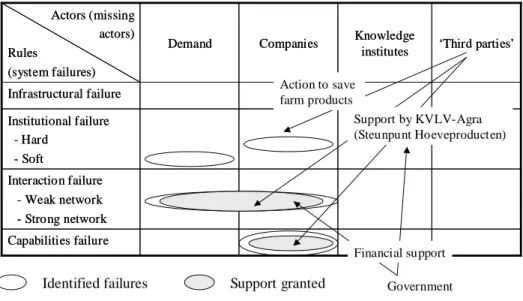
The visual output of the evaluation of system failures and support granted to the initiative “De Westhoek Hoeveproducten”, small non-profit making organisation which brings producers of farm products together who will join forces to enhance the quality and the acknowledgement of farm produce in the region and who will jointly promote these products, is shown Figure 2. Adapted SI-policy framework for the “De Westhoek Hoeveproducten” case (Source: Vuylsteke & Van Huylenbroeck, 2005)1(2005), while Vuylsteke and Van Huylenbroeck (forthcoming) elaborately discuss the concept of system innovation and the analysis of the relationship be-tween AFSC and their context through the SI policy approach.
Figure 2. Adapted SI-policy framework for the “De Westhoek Hoeveproducten” case (Source: Vuylsteke & Van Huylenbroeck, 2005)
Capabilities failure Interaction failure - Weak network - Strong network Institutional failure - Hard - Soft Infrastructural failure ‘Third parties’ Knowledge institutes Companies Demand Actors (missing actors) Rules (system failures) Capabilities failure Interaction failure - Weak network - Strong network Institutional failure - Hard - Soft Infrastructural failure ‘Third parties’ Knowledge institutes Companies Demand Actors (missing actors) Rules (system failures) Support by KVLV-Agra (Steunpunt Hoeveproducten) Action to save farm products
Identified failures Support granted Government Financial support
After this discussion of the two theoretical frameworks that are used in this paper, we will now focus upon the empirical evidence of examples of AFSCs that were studied within the SUS-CHAIN project.
4. Methodology
4.1 SUS-CHAIN research project
This empirical part builds upon the outcomes of the EU 5th Framework project “Marketing sus-tainable agriculture: an analysis of the potential role of new food supply chains in sussus-tainable rural development”. SUS-CHAIN has been carried out by a consortium of academic institutes and NGOs in seven European countries (The Netherlands, United Kingdom, Switzerland, Italy, Belgium, Latvia and Germany. The aim of the project was to assess the potential role of food supply chains in the enhancement of sustainable food production and rural development by identifying critical points in food supply chains which currently constrain the further dissemi-nation of sustainable production and recommend actions that are likely to enhance the prospects for sustainable food markets. Specific attention was hereby given to factors related to the orga-nisational structure of food supply chains and interactions between stages of the chain (www.sus-chain.org).
The core part of SUS-CHAIN consisted of an elaborated analysis of 14 case studies, based on a wide variety of information sources (documentation, archival records, direct observations, participant observation, physical artefacts and individual interviews to informants or to spondents (Brunori & Wiskerke, 2004). The outcomes of each case studies are reflected in re-ports and a set of indicators on the following core themes: (i) commercial performance and distribution of value added along FSCs, (ii) marketing conception, marketing measures and communication, (iii) public support, (iv) nature of organisation, self-governance and changes during scaling up, (v) impact on rural economies and rural assets and (vi) embeddedness, local networks and locality.
4.2 Method
In order to search the link between the internal organisation of an initiative, its external network-ing and the eventual performance and scalnetwork-ing up, the data were encoded in the statistical pro-gram SPSS 12 to perform a homogeneity analysis. This technique is used to get a better visualisation of the link between different types of initiatives and the characteristics of farmers and exploitations. This technique describes the relation between characteristics and aims to group several similar cases. The result is a two or three dimensional figure that visualised the relation between the categories of the variables and the cases. Homogeneity analysis is a tech-nique for data-reduction that plots cases of the same category near to each other. In a two-di-mensional figure, two sets of values are calculated to reach a maximal spreading of the categories. Homogeneity analysis with SPSS allows the use of more than two variables, contra-ry to correspondence analysis, but has the disadvantage that the interpretation is mainly visual and there are no indicators for the quality and the accuracy of the result. Only eigen values are calculated (SPSS, 1999; Vuylsteke et al., 2003).
4.3 Data
A set of relevant variables was selected based on the theoretical discussions of paragraphs 2 and 3, together with some general descriptive variables. The information on this variables was avail-able through the SUS-CHAIN comparative analysis (Jahn et al., 2006) or was gathered based on the individual case study reports. 1 gives an overview of the variables that included in the analysis and the distribution of the AFSCs over the categories.
Table 1. Variables included in the analysis with their categories and respective frequencies
Variable Categories
Freq.
Initiatives Code for the 14 case studies Number of producers
in-volved
Less then 100 producers
Between 100 and 1000 producers More then 1000 producers
8 5 1 Market share in relevant
market
Low market share Medium market share High market share
7 4 3 Commercial performance Poor performance
Medium performance Good performance 5 1 8 Scaling up No scaling up Scaling up 9 5
Hybrid form Trust
Relational network Leadership Formal government 3 4 4 3 Strive for quality Framework governance
Coordinating governance Participating governance
4 5 5 Market differentiation Very competitive market
Medium competitive market (branding) Low competitive market (certification)
7 5 2 Networking Initiative with low networking profile
Initiative with medium networking profile Initiative with high networking profile
4 8 2 Infrastructural failures No infrastructural failure identified
Infrastructural failure still present (IFF -) Infrastructural failure overcome (IFF +)
10 1 3 Hard institutional failures No hard institutional failure identified
Hard institutional failure still present (HIF -) Hard institutional failure overcome (HIF +)
8 0 6 Soft institutional failures No soft institutional failure identified
Soft institutional failure still present (SIF -) Soft institutional failure overcome (SIF +)
8 3 3 Weak network failures No weak network failure identified
Weak network failure still present (WNF -) Weak network failure overcome (WNF +)
9 4 1 Capabilities failures No infrastructural failure identified
Infrastructural failure still present (CF -) Infrastructural failure overcome (CF +)
5 3 6
5. Performance of AFSCs and their potential to scale up
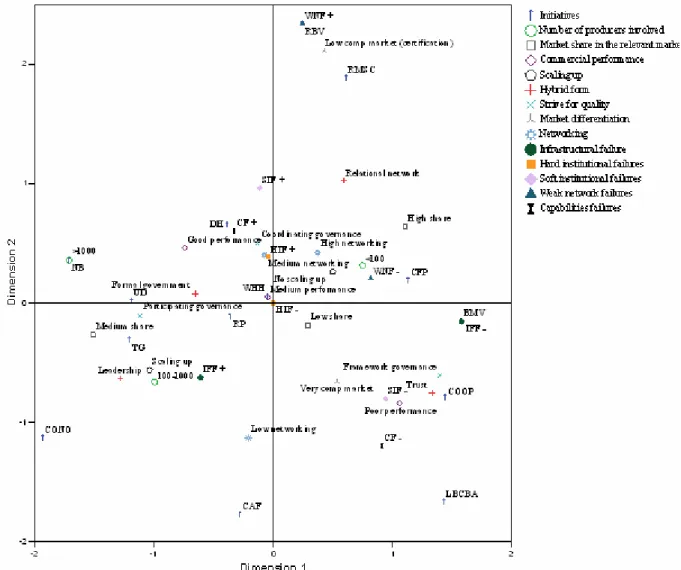
The aim of this paragraph is to explore, through homogeneity analysis, the performance of AF-SCs and their potential to scale up in relation with their internal organisation and their external networking. The analysis results in two dimensions with eigenvalues 0,571 (dimension 1) and 0,396 (dimension 2) and a graphical output, which is shown in 2.
The characteristics concerning the AFSCs’ commercial performance (indicated by the three el-lipses) are situated on a line through the origin, whereby the ‘poor commercial performance’-cluster combines a positive score for dimension 1 with a negative score for dimension 2 and ‘good commercial performance’ is situated in the quadrant with negative and positive values for respectively dimension 1 and 2.
A closer look learns that poor performance is more often linked with framework governance, very competitive markets (without product differentiation), the presence of soft institutional failures and trust as hybrid form. The presence of trust and framework governance in the same cluster was expected based on the findings of Réviron et al. (forthcoming). The same holds for initiatives trying to position a rather generic product in a very competitive market. The homo-geneity analysis furthermore illustrates that initiatives with an organisation close to spot mar-kets seem to struggle more often to overcome soft institutional failures. Further, it can be concluded from this analysis that such initiatives also face capabilities failures and have not in-vested in external networking activities.
Figure 3. Output of the homogeneity analysis that links performance with internal organisation and external networking
On the other hand, good performance is associated with stronger internal structures (coordina-ting governance), a medium degree of networking, but also hard institutional and capabilities’ failures that have been overcome. There is thus an indication that good economic performance is related to a more formal degree of collaboration and the ability to overcome system failures through interaction with external organisations.
The presence or not of a scaling up attempt is indicated by dotted line in the graph and learns that scaling up is done by initiatives with a medium market share, a participating internal gov-ernance structure, organisational forms characterised by leadership, medium sized initiatives (100 to 1000 producers involved) and after having solved existing infrastructural failures.. The presence of the hybrid forms leadership and formal government and the strive for quality through participating governance in this cluster suggests that scaling an initiative up requires a further specification of the collaboration and a more centralized decision structure. These tight-er forms of organisation togethtight-er with a significant numbtight-er of farmtight-ers involved or benefiting from the initiative are also logic in a perspective of the investments required for the scaling up and to overcome the infrastructural failures.
The absence of scaling up, on the contrary, is characterised by small initiatives (less then 100 producers), a high networking profile, an important share in the relevant market and weak net-work failures that are still present. It could be expected that scaling up is not relevant for initi-atives that already have an important market share and that have problems of internal organisation of the network.
6. Conclusion
In this paper, we have analysed the internal organisation and external networking of alternative food chains through the lens of the theory of hybrid organisations and the SI policy approach. Based on these theories, we have identified a set of variables that characterise the performance of AFSCs, their internal organisation and their external networking. Data on 14 initiatives stud-ied within the SUS-CHAIN project were then used to perform a homogeneity analysis. The re-sults learn that there is indeed a relationship between the performance, internal organisation and external networking. Because of the low number of cases, these results are only indicative and need to be further confirmed by other case studies. But in any case they confirm our hypothesis that for successful initiatives both a good internal organisation as a strong external network to overcome system failures are important. We therefore think that our lens to look at emerging food chains is promising and can help to learn why initiatives are able to survive, grow or even to scale-up. .
7. References
Arrow, K. (1974). The Limits of Organisation. New York: W. W. Norton & Cie.
Brunori, G., & Wiskerke, J.S.C. (2004). Marketing sustainable agriculture: an analysis of the potential role of new food supply chains in sustainable rural development. Case study methodology - workpackage 4. Working document. 29 p.
Coase, R.H. (1937). The nature of the firm. Economica, 4, 386-405.
Green, K., & Foster, C. (2005). Give peas a chance: transformations in food consumptioin and production systems. Technological forecasting and social change, 72, 663-679.
Henson, S., & Reardon, T. (2005). Private agri-food standards: implications for food policy and the agri-food system. Food policy, 30, 241-253.
Hubbard, M. (1997). The 'New Institutional economics' in agricultural development: insights and challenges. Journal of Agricultural Economics, 48(2), 239-249.
Ilbery, B., & Kneafsey, M. (2000). Producer constructions of quality in regional speciality food production: a case study from south west England. Journal of Rural Studies, 16, 217-230. Jahn, G., Peter, S., & Knickel, K. (2006). Comperative case study analysis. SUS-CHAIN WP
6. 100 p. www.sus-chain.org
Klein Woolthuis, R., Lankhuizen, M., & Gilsing, V. (2005). A system failure framework for in-novation policy design. Techin-novation, 25, 609-619.
Marsden, T., Banks, J., & Bristow, G. (2000). Food supply chain approaches: exploring their role in rural development. Sociologia ruralis, 40(4), 424-438.
McFetridge, D.G. (1994). The economics of vertical integration. Canadian Journal of Agricul-tural Economics, 42, 525-531.
Ménard, C. (2004). The economics of hybrid organizations. Journal of Institutional and Theo-retical Economics, 160(3).
Ménard, C. (forthcoming). Oliver Williamson and the economics of hybrid organizations. In M. Augier, J. March, & D. Teece (Eds.), xxx. Oxford: Oxford University Press.
Ménard, C., & Valceschini, E. (2005). New institutions for governing the agri-food industry. European Review of Agricultural Economics, 32(3), 421-440.
Raynaud, E., Sauvée, L., & Valceschini, E. (2002). In Governance of the agri-food chains as a vector of credibility for quality signalization in Europe. Paper presented at the 10th EAAE Congress: Exploring diversity in the European agri-food system, Zaragoza, Spain. Réviron, S., Vuylsteke, A., & Van Huylenbroeck, G. (forthcoming). Hybrid firms ans decision
power distribution within sustainable food supply chain initiatives. In J.S.C. Wiskerke, G. Van Huylenbroeck, & J. Kirwan (Eds.), Sustaining food supply chains: grounded perspec-tives on the dynamics and impact of new modes of food provision. Aldershot: Ashgate. Rotmans, J., Kemp, R., & van Asselt, M. (2001). More evolution than revolution. Transition
management in public policy. Foresight, 3(1), 1-17. SPSS. (1999). SPSS Categories 10.0. Chicago: SPSS Inc.
van der Ploeg, J.D., Renting, H., Brunori, G., Knickel, K., Mannion, J., Marsden, T., et al. (2000). Rural development: from practices and policies towards theory. Sociologia rura-lis, 40(4), 392-408.
Verhaegen, I., & Van Huylenbroeck, G. (2002). Hybrid governance structures for quality farm products: a transaction cost perspective. Aachen: Shaker Verlag.
Vuylsteke, A., Collet, E., Van Huylenbroeck, G., & Mormont, M. (2003). Exclusion of farmers as a consequence of quality certification and standardisation. Cahiers Options Méditer-ranéennes : Food Quality Products in the Advent of the 21st Century: Production, De-mand and Public Policy, 64, 291-306.
Vuylsteke, A., & Van Huylenbroeck, G. (2005). In A. Blogowski, L. Lagrange, & E. Valces-chini (Eds.), Policy actions to support system innovation: the case of alternative food sup-ply chains. Paper presented at the Colloque SFER. Au nom de la qualité: quelle(s) qualité(s) demain pour quelle(s) demande(s), Clermont-Ferrand.
Vuylsteke, A., & Van Huylenbroeck, G. (forthcoming). System failures and the targeting of support to innovative food supply chains. In J.S.C. Wiskerke, G. Van Huylenbroeck, & J. Kirwan (Eds.), Sustaining food supply chains: grounded perspectives on the dynamics and impact of new modes of food provision. Aldershot: Ashgate.
Williamson, O.E. (1985). The Economic Institutions of Capitalism: Firms, Markets and Rela-tional Contracting. New York: Free Press.
Williamson, O.E. (1991). Comparative economic organization: the analysis of discrete structur-al structur-alternatives. Administrative Science Quarterly, 36, 269-296.