Research in Ecology
https://ojs.bilpublishing.com/index.php/re
ARTICLE
The Application of Dead Trees or Dying Trees in Landscape Design
Jiaxin Guo
*University of Sheffield, Sheffield, S10 2TN , England
ARTICLE INFO ABSTRACT
Article history
Received: 29 July 2019 Accepted: 30 July 2019
Published Online: 30 August 2019
In the development of landscape design, plants have always been one of the important elements in the landscape design, and play a very important role in the landscape. In the selection and application of landscape plants, living plants have always occupied a dominant position, but the research and application of dead trees are few. People tend to think that dead plants are no longer valuable, and all dead trees should be removed or re-placed. In a sense, this is a waste of resources, and also increases the cost of landscape. In fact, the proper use of dead trees in landscapes design is more likely to display the artistic conception and theme of the landscape. In many natural landscapes, large trees, ancient trees and precious tree die because of natural laws or natural disasters, forming withered trees. This kind of withered tree endows the site with certain historical conno-tation, which could narrate the history and ecological change of site to people and evoke the imagination of people to the past. In addition, these dead wood still have high economic, ornamental, ecological and cultural values.This study focused on dead trees and dying trees as its subject, an-alyzing the outstanding dead trees application cases in natural landscape, and discusses the different functions of dead tree, such as ecological function, ornamental function, cultural function and others. In addition, the Beijing Wild Duck Lake National Wetland Park will serve as a special experimental site, dead tree will be designed and applied in the lake of park. And based on these data analyses, the final chapter will return to ad -dress the research questions and offer advice on how to apply dead tree to urban landscape and further enhance the value of dead trees in landscape design. Keywords: Dead wood Natural landscape Historical connotation Ornamental values Ecological function *Corresponding Author: Jiaxin Guo,
University of Sheffield, Sheffield, S10 2TN , England;
Email: [email protected]
1. Introduction
1.1 Background of the Research
T
he types of dead trees are varied, including coarse woody debris, large woody debris and snag (Nils-son et al., 2002). [11] In the meantime, the distri-bution of dead trees is also extensive, they can be often seen on rivers, forests, wetlands and even both sides of the streets, gardens or centre parks. In general, these deadtrees should be removed. But since 1970s forest managers around the world have found that the dead trees still con-tain a lot of nutrients and provide food and habitat for a variety of organisms, dead trees and wood residues were encouraged to stay in the woodland/ forests. As Keddy and Drummond (1996) points out these dead trees play an significant role in the protection of biodiversity, par-ticularly in wetlands and deltas. [9] Such as bats in forests rely far more on dead wood than people know about it.
For instance, animals such as bats in the forest rely far more on dead wood than people know about it. In recent years, people have gradually realized that dead and dying trees play an important role not only in forests, but also in oceans and lakes. Some of the dead wood in the water can provide enough nutrients for bacteria, worms,
shell-fish and even shell-fish sold on the market. Salmon and other
animals in rivers also rely on dead wood for their habi-tats (Ren, 2002). [12] In addition, in some mountainous areas or forests, due to the crustal movement or climate change, the growth environment of trees has changed greatly, forming a number of unique dead tree groves, such as Namibian Deadvalley, China ShuangQiao Gou natural protection area, Kazakhstan Kaindy Lake. They have produced a strong contrast with the surrounding en-vironment, forming unique landscape ornamental value, which attracts tens of thousands of visitors every year. These unique natural landscapes with dead trees generate considerable income for local residents and further boost local economic development.
However, in the urban landscape, the function of dead tree is often overlooked. Generally, most of the dead trees result from improper later-period management (Huang & Zhu, 2014). [6] These dead trees caused by human fac-tors lead to incompatibility with the preset landscape. Therefore, they have to be removed. In addition, the reuse of dead trees is very limited. Most of the dead trees can only be burned or made into handicrafts. As for active-ly planting dead wood, designing the dead wood as a landscape element is even more rare. In fact, the proper application of dead trees will play a key role in landscape design (Zhang, 2009). [18] Filpo (2008) pointed that in the landscape construction, while meeting the reasonable functions and formal aesthetic perception, using some drying or dead trees will bring great benefit to forming the time and space dialogues of ancient and modern. [3] In 2011, World Horticultural Exposition, Xi'an, China, dead wood was placed as decoration on the lakeside, showing a unique history of plants.
Dead tree has a strong symbolic significance in differ
-ent regional cultures (Gough, 2011). [5] In Western culture, dead wood is mainly a symbol of destruction and death. It often used to express the cruelty of war, reminding people to cherish peace, and it is often applied in memorial parks or cemeteries. Besides, the dead tree is also an important part of Oriental traditional culture (Wang, Peng & Li, 2003). [16] Due to its unique shape and texture, deadwood art, endowed with natural, primitive and naive charm, was deeply loved by Chinese artists. As early as the Tang Dynasty (AD 8 century), dead wood as the main element, appeared in a large number of Chinese traditional
poet-ry sculpture and painting works. In these works of art, dead wood shows the characteristics of human simplicity, which is consistent with the aesthetic philosophy of re-specting the nature in traditional Chinese Taoist culture. Therefore, dead wood art and landscape occupy a special
position in the fields of Chinese traditional aesthetics.
1.2 Research Aims and Objectives
This research aims to evaluate the art quality and function of dead tree in urban landscape design, to identify the problem of the application of dead trees in the urban land-scape and thus achieve the maximum value of the dead tree.
This aim is addressed through four objectives
(1) To review and analyse the representative cases of the performance of dead trees in landscape design.
(2) To investigate the texture color structure and time change of different dead tree species.
(3) To find and reveal the symbolic meaning of dead tree in Chinese traditional art.
(4) Taking Beijing wild duck lake wetland park as the art experimental project site, to test and evaluate the func-tion of the dead tree by combining the natural dead wood landscape and the unique Chinese traditional withered wood aesthetics.
2. Literature Review
2.1 Introduction
The value of the dead tree was first recognised by people
in 1970s, and has become an indispensable part of the ecological balance in nature (Keddy & Drummond, 1996). [9] Throughout history, people are afraid of the death of trees, as far as possible to cure and prevent dead trees. Therefore, a large number of academic literature are dedi-cated to the topic of the cause and prevention of dead tree, ranging from academic journal to monograph book. In the meantime, the way of dead trees as a landscape element to design has constantly been a topic of low attention and exposure. In fact, dead tree is an essential link in the landscape design, considering whether from the aspect of art and culture, visual appeal, or the function of ecology (Huang & Zhu, 2014). [6] This literature review primarily bases on three basic threads to establish the theory and underpinning of dead tree (Gough, 2011; Huang & Zhu, 2014; Ehnström, 2001). [2,5, 6] It is necessary to begin by illustrating the characteristics and meaning of withered tree art aesthetics in different regional culture and histor-ical dimension. Subsequently, starting from the ornamen-tal value of dead wood, this literature review continues to discuss how to use the dead wood to form a unity or
contrast landscape with the surrounding environment, creating strong visual appeal. Whilst recognising the im-portance of dead trees in ecological balance, the following section further examines how to maximise the ecological value of dead tree through the reasonable layout of dead wood. Finally, this chapter concludes with the view that in the actual application of dead trees, the proper integration of different functions can form a high-quality landscape, which is also the core theory of this dissertation and the gap of current research.
2.2 The Art and Culture of Dead Wood
In terms of culture, in the creation process of western artists, the means of expressing the meaning of life with a dead tree as a carrier is very popular (Gough, 2011). [5] It is seen in 'Cultivating dead trees': The legacy of Paul Nash as an artist of trauma by Gough; Frozen Flame and Slain Tree: The Dead Tree Theme in New Zealand Art of the Thirties and Forties by Dunn and Paul Nash's paintings (Dunn,1979). [1]
In the meantime, such artistic techniques in Eastern culture are also common. Take Japan as an example, Japanese artists prefer to use mountains, white sand, and dead trees to design the courtyard landscape, which pro-vides citizens with quiet enjoyment. And it is such a life-free expression that formed Japan the "Karesansui" (dry landscape) culture (Van Tonder, Lyons and Ejima., 2002). [14] While for the specific application of dead trees in landscape, according to Application of tree in landscape garden by Huang & Zhu and Landscape Application of Withered, Older Dead Trees by Zhang, by recycling the dead trees, dead branches, fallen leaves, bark and so on, and combining with the processing techniques of art, many different landscapes have been created. For exam-ple, Hainan Jianfengling Park, Hangzhou Taizi Lake Park, these parks reuse dead wood to build wooden houses, grass pavilions, simple wooden bridges, guardrails, sign-boards, etc (Zhang, 2009). [18]
Given the above, dead wood in the aspect of artistic
value and symbolic meaning may play a more significant
role than has previously been proved. Therefore, more
at-tention should be paid in regards of dead trees in specific
landscape.
2.3 The Attraction of Dead Wood Landscape
From ancient private gardens to modern landscape de-signs, the shapes and colors of common tree species have formed deep stereotypes in people minds. However, the unique posture and color composition of the dead trees can not only change people’s thinking patterns on the
aesthetic, but also give people a bright sense of surprise, achieving a focused and eye-catching landscape effect (Huang & Zhu, 2014). [6]
In the application of landscape plants, plants with col-orful leaves often play a striking and prominent role. As an alternative colorful leaves tree, dead trees also play a role as well as colorful leaves tree in the landscape ap-plication (Kingsbury & P, 2016). [10] Drivers are prone to drowsiness when driving on expressways because the landscape and vegetation on both sides of the expressway remain unchanged. Today, trees on both sides of the high-way have begun to wither, and dead trees produced con-trast in color with normal trees, alleviating visual fatigue caused by long driving hours (Zhang, 2009). [18]
As Zhu (2016) has indicated, the branches of dead trees of dead plants often attract people's attention in an instant. And it can often form an independent landscape and be-come a unique dry tree landscape. [19] In addition, a large
number of dead tree groups can better reflect the breath of
nature. And the dead grove of Shuangqiao Valley Nature Reserve in Sichuan, China provides a good example of this. The dead tree and the lake have the static and dynam-ic comparison and the black tree trunk is also contrasted with the background color, forming a unique and interest-ing landscape.
2.4 The Impact of Dead Wood on Ecology
With the continuous improvement of people's eco-aware-ness, the ecological function of dead wood has been grad-ually recognised by the public (Franklin, 1987). [4] This part will explore the ecological function of dead wood from two different site types (forests and lakes).
2.4.1 Dead Wood in the Forest
In order to maintain the diversity of insects, flowers and
fungi in northern forests, the dead wood as substrate is probably the best choice (Samuelsson et al, 1994). [13] The U.S. Forest Service statistics shows that in the virgin for-est, there are up to 70-100 dead trees in per hectare, which have been standing for 40 years or more. When they fall down, dead trees become logs and large volumes of logs can usually be kept for 300 years.
Fungi are the first to enjoy the dead or diseased trees,
which begin to grow outward from the inside, followed by bacteria, yeasts and small arthropods. Then life chains are
extended. For example, in the Pacific, about 80 species of
animals depend on dead trees, such as woodpeckers and owls (Humphrey and Bailey, 2012). [7]
Humphrey and Bailey (2012) also pointed out that dead trees provide nests for certain forest animals. If the
remains of many ancient forests are removed, then a large number of wild animals will be trapped in the plight of survival, especially birds. [7]
2.4.2 Dead Wood in the Water
It is generally believed that the dead wood that blocks streams or rivers not only interferes with human
naviga-tion, but also affects the lives of fish. But according to the
latest research, the benefits of dead wood to fish far out
-weigh the disadvantages (Ren, 2002). [12] In 2000, a sym-posium on "Wood in Global Rivers" was held in Corvalis, Oregon, USA, where many scholars fully articulated the ecological role of dead wood in water. North American spruce, for example, has been present for more than 1500 years in Cutis, Washington, where these spruces provide
more than 50% of food for fish in rivers. The increasing number of fish has also attracted a large number of hawks
and other predatory birds, contributing to the local ecolog-ical diversity.
Robert Reiman (1997), a marine biologist at the Uni-versity of Washington in Seattle, pointed out that without piles of dead trees along the river, the forests on the banks of the river would be impossible to exist because they can
store sediment and protect the forests from flooding, while new plants can grow again where floods wash away.
Over the past century, wood from rivers has been cleaned up, but now the U.S. government has to spend huge amounts of money placing man-made piles in parts
of the Pacific Northwest.
2.5 Summary
Many researchers have done lots of elaborated studies on the application of dead wood. Although a large number of literatures have provided us with much enlightenment, they always only focus on one certain aspect of the func-tion of dead wood and yet not closely to the combinafunc-tion of all the functions. Furthermore, up to now, there have been not many studies on how to reuse and plant dead trees with artistic technique in landscape design. Under these circumstances, there is still some space for further probe in this field. On the basis of previous studies, my research seeks to discuss the following questions:
(1) Which kind of dead tree is more popular? (Take Chinese as an example)
(2) What are the application scopes and ways of dead trees in landscape design?
(3) What problems should be noticed in the application of dead trees in urban landscape?
The purpose of my research is to identify the common art method of the application of dead tree in urban
land-scape, maximising the value of dead wood.
3. Methods
3.1 Case Study
In order to comprehensively understand the role of dead trees in different landscape and scenes, this part mainly analyses two representative natural dead tree landscape cases: Dead-Valley in Namibia and Kaindy Lake in Ka-zakhstan. In addition, combined with Beijing Olympic forest park case study, this chapter attempts to research how the dead trees are transformed and reused. Finally, this part will also explore all kinds of art forms based on dead wood and exploration of reuse of dead trees will also be included.
3.1.1 Dead-Valley in Namibia
Dead Valley Deadvlei is one of the main natural attrac-tions in the Namibian National Park Namib-Naukluft (Fig-ure 1&2). It was a lake thousands of years ago, but with the movement of the earth's crust and changes in nature, the lake has dried up. Moreover, because of the severe
wa-ter shortage, it is difficult for any plant to grow here, and
only dead trees are still standing on the land. The climate of Dead Valley is hot and dry, and even in summer there is no any wind. Because of this, the withered trees do not de-compose and are well stored under the scorching sun for so many centuries. It has been more than 900 years now. In addition, these black withered trees with red sand and blue sky, produce a powerful colour contrast and roaming in the valley, this mesmerizing beauty of nature makes people feel as if they were in a picturesque oil painting. During sunrise and sunset, visitors are enchanted by the incredible scenery (Figure 3&4).
Figure 1&2. Dead Valley Deadvlei. Namibia
Figure 3&4. Sunrise and Sunset in Dead Valley. Namibia Dead wood, as a product of nature, plays a key role in Namibia's natural parks. On the one hand, it records the
changes of natural history, and provides an important ref-erence for botanists to study the earth's changes. In addi-tion, it forms incredible landscape value and even tourists regard it as "the place where everything ends" and endow it with the meaning of life thinking. Hence, dead wood or withered tree is an indispensable part in certain landscape space.
3.1.2 Kaindy Lake in Kazakhstan
The unique lake called Kaindy is located in the mountain range of Tian Shan at an altitude of about 1900 meters above sea level, Kazakhstan. This natural attraction was formed by a strong earthquake in 1911. Mountain collapse
blocked the river and the valley became filled with water
(Figure 5).
Figure 5. Kaindy Lake. Kazakhstan
Perennial spruces (Picea schrenkiana trees), growing along the river, suddenly became flooded. However, the mighty tree trunks haven’t rotted and instead remained standing over time. . Although these spruces vary in length, there is vertically upward growth pattern that echoes the living spruces around the lake, forming the unique natural landscape of Kaindy Lake. And now, they rise majestically above the water surface of the lake. The tops of the spruce trees, sticking out of the surface of the lake, seem lifeless, but in the turquoise water, it is easy to see the branches and needles which are perfectly pre-served (Figure 6 & 7). The spruce above the water with strong life force contrasts sharply with its lifeless counter-part underwater,exuding unique charisma (Figure 8).
Figure 6 & 7.Above and below lake. Kaindy Lake. Ka-zakhstan
Figure 8. Kaindy Lake landscape with people. Kazakh-stan.
After long-term soak in water, a large number of fungi and microorganisms attach to the trunk surface, and
be-come an important food source of fish. Furthermore, some
of the dead trees that sank to the bottom of lake became vital habitats for aquatic organisms to spawn and grow, ensuring local biodiversity.
3.1.3 Beijing Olympic Forest Park
Populus euphratica is one of the oldest poplar in the world. According to a saying that populus euphratica can survive through millennia and stand upright after withering. Even it fall down, it will keep unrotten as least thousand years. It is deeply rooted in Gobi and enjoys a world-renowned reputation for its tolerance to drought, waterlogging and
vitality. This artificially transplanted dead Populus euphra
-tica grove is located in the Beijing Olympic Park (Figure 9). The unique texture and shape of Populus euphratica makes visitors feel the illusion of returning to the Gobi Desert, giving them a sense of period and vicissitudes.
Figure 9. North Garden of Beijing Olympic Forest Park. China
Due to the unique growth environment and vitality of the dead poplar, people endowed it with the humanistic spirit of challenging fate and nature. It brings people not
only the enlightenment of life, but also a kind of spirit symbol and always keep an uncompromising attitude
to-wards life. In this case, the symbolic significance of dead
wood in landscape remains unsurpassed (Figure 10).
Figure 10. North Garden of Beijing Olympic Forest Park
3.1.4 Dead Wood in Daily Life
Dead wood is closely related to people's daily life, it is not hard to find it whether in large indoor furniture, or small clothes rack. For example, Silver birch is highly decorative because of its white branches and trunk. Many stores tend to use dead birch as an important collocation of window display, which could better highlight the show subjects (Figure 11&12).
Figure 11&12. Harrods' shop window display For some thinner dead branches, after simple collection and trim, people could create many interesting
handi-crafts, such as coaster, hanger, flowerpot and others (Figure
13&14).
Figure 13&14. Handicrafts by dead wood
3.1.5 Summary
In fact, the function of dead wood is particularly diverse, and different functions interact with each other, which cannot be separated, but focuses in different scenes vary a lot. Therefore, the range of practical application of dead wood is much larger than people imagine. Dead wood could form a new landscape through permutation and combination, and can also be an individual landscape or temporary art sculpture, which makes itself an indispens-able part of landscape design elements.
3.2 Materials Research
There are tens of thousands of species of trees, and any kind of trees may wither or die However, different types of dead wood will have different shapes, colours and textures, creating a large number of diverse landscapes. This part of the study attempts to classify and compare the shape, colour and texture of dead wood, exploring the landscape collocation of dead wood.
3.2.1 The Shape of Dead Tree
One of the prerequisites for creating high-quality land-scapes is to choose the right tree species. Theoretically, any tree species can be used as garden seedlings, but not all tree species have decorative or ornamental function in landscape. In order to satisfy some special requirements,
ornamental landscape trees must be flexibly used on the
basis of artificial pruning or layout changes, which will
be beneficial to achieving the people envisaged image of
plant art (Joyce & Stoddart, 1999). [8]
If only from the appearance and shape of trees, the dif-ferent age and species of trees will affect the size of trees, resulting in different visual effects, such as birch, camel thorn trees, pine trees (Figure 15).
Figure 15. Tree Size. Source from: author's own photo-graph
Thin trunks always give people a sense of freedom and easiness. In landscape design, these trees are often displayed in groups, forming a unique atmosphere (Fig-ure 16). Moderately thick trunks give people a strong and powerful impression. In addition, some old trees, such as pine trees with twisted roots and gnarled branches, are suitable for created independent landscape (Figure 17).
Figure 16. Dead birch tree in Manasquan Reservoir
Figure 17. Dead pine tree
Besides, different kinds of trees also have diverse ap-pearance branches. Although a large number of trees keep upwardly diagonal branches, branches could be horizon-tal, vertical, or diagonal (Figure 18). The dead tree forests
of the suburbs of Beijing clearly reflect this feature (Figure
19).
Figure 18. The different structure of the tree branches.
Figure 19. Withered trees in winter. Yanqing. Beijing
3.2.2 The Colour and Texture of Dead Tree
The nursery stock of colourful branches not only enriches
the landscape colour, but also reflects the strong aesthetic
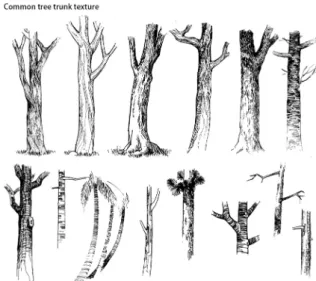
feeling of form and visual impact, which could make peo-ple directly experience the dual aesthetic sense of colour and form. And it contributes to improving the attraction and cultural connotation of the site (Wang, 2016). [15] Since dead trees cannot rely on colourful leaves,the co-lour and texture changes of trunk and branches are more important in regards of aesthetic expression (Figure 20).
Figure 20. Common tree trunk texture
Sliver birch is widely used in landscape design. Being all white and endowed with a smooth surface all around trunk, silver birch could be integrated with the surround-ing environment when it's snowy (Figure 21). In other sea-sons, even if the dead birch has no leaves, but the shape of tall and thin with white colour can still play a very-well decorative role. In addition, combination of dead birch and various colourful leaf trees could constitute an
inter-esting scenic spot, conveying a diverse image of warmth, tranquillity or playful youthfulness (Figure 22).
Figure 21. Sliver birch landscape in winter. Figure 22: Sliver birch with colourful leaf trees
As far as pine trees are concerned, their surface is rough with dark red colour, giving people a sense of ag-ing. For hundreds of years of withered pine, they are easy to grow moss on the surface with dark green colour, which seems to blend in with nature (Figure 23). It is completely different from birch landscape, each has its own charac-teristics.
Figure 23. Pine tree surface texture
Generally, since color is the most important factor of catching tourists’ eyes, top priority to reuse a characterless withered tress is to paint if a bright color (Figure 24). But the truth is landscape effect of high quality would not be achieved by changing the color only.
Figure 24. Dead Wood with bright colour
3.2.3 Summary
Research of this part has shown that the species, the
co-lour and texture of trees cannot be separated from each other, otherwise there will be a tendency to generalise the visual effect of dead trees in landscape design. Only when the landscape designers select the appropriate species and
structure of dead wood and place it in the specific place,
can the landscape effect with rich artistic characteristics be created.
3.3 The Individual Art Practice Experimental Project
In this part, I will choose Beijing Wild Duck Lake Nation-al Wetland Park as my art project site to design the
land-scape of withered trees, and then make a critical reflection
on dead trees landscape from various aspects, including ornamental, ecological, economic and cultural aspects.
3.3.1 Site Location and Introduction
The Wild Duck Lake National Wetland Park is located in the northwestern Beijing city of Xia Du - Yanqing. It is a natural artificial compound wetland consisting of tidal
flat, rivers, reservoirs, and marshes. It is an important bird
habitat in the Beijing area, and it is also the international transfer station of the East Asia to Australia route. The birds like to take a rest here in the annual migration sea-son, with the largest number of wild geese and ducks, and the wild duck lake was named after that (Wild Duck Lake
Park Office, 2012). [17] As the largest natural wetland
eco-system in Beijing, wild duck lake has important protection
significance and wetland ecotourism potential, at the same
time, it also faces a severe test of water resources reduc-tion and biodiversity degradareduc-tion (Figure 25).
Figure 25. Wild Duck Lake National Wetland Park
Wild Duck Lake Bio-diversity
The site has a high diversity of wetland plants and up-land species. Among 31 species of higher plants, 357 are wetland species. This includes families of shallow water vegetation and 20 within the marshes (Wild Duck Lake
Park Office, 2012). [17] In addition, the site has a high
di-versity of insects. Most species live in the croplands and meadows, some of which are pest species. There are 21
-ian areas as habitat, which indicates good water quality in some areas of the site (Figure 26).
Figure 26. Wild Duck Lake Bio-diversity. Source from: author's own photograph
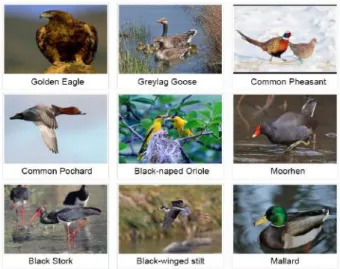
Wild Duck Lake is an important spot for migratory birds, especially in winter (Figure 27). The meadows and shrubs are important habitats for birds as well. The site has a high diversity of raptors, indicating a diverse food pyramid on the site. Raptor species include: Accipitridae 16, and Falconidae 7. But birds in the wild duck lake are being threatened: increasing freeze of rivers in winter;
hu-man disturbances such as fishing, farming and noise; and decreasing numbers of fish. All these factors above affect
the survival of birds.
Figure 27. Bird species diversity
3.3.2 Withered or Dead Tree Landscape Design
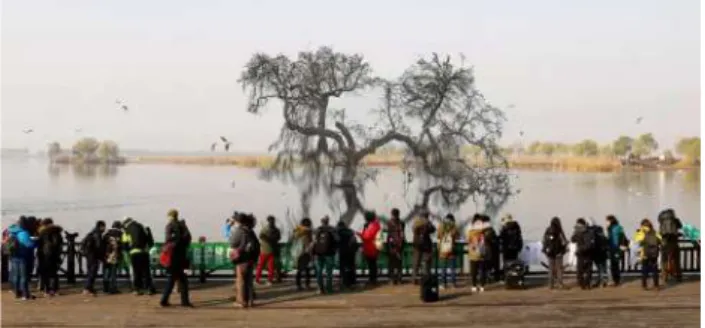
The project site is located in the center of the lake and its northwest side is the viewing platform. When birds need
to migrate (late October to early November), park man-agers will hold an annual bird-watching cultural festival and many visitors and photographers will gather here. But there are not trees for birds to stay, and visitors cannot ob-serve and photograph birds carefully. The planting of dead trees could solve this problem very well (Figure 28&29). In addition, planting dead trees in the water is conducive to the survival and reproduction of fish, providing food source for birds, and ensures biological diversity of wet-land.
Figure 28. Analysis of landscape site. Source from: au-thor's own photograph
Figure 29. Viewing platform in project site. Source from: author's own photograph
(1) Three Different Landscape Schemes A. Individual Dead Pine Tree (Figure 30)
Figure 30. Individual dead pine tree. Source from: au-thor's own photograph
Chinese people have a special emotion for pine and cypress since ancient times, because pine trees grow in barren land and have strong vitality. And people often use pine and cypress to symbolise the character of strong and unyielding. As early as the Song dynasty (AD 960), the great writer Su Dongpo said:“ the pine could make people
tenacious when your life is difficult, the pine also could
make people excited when your life is going well ”. He also had a large number of poems and paintings to express his fondess for pine (Figure 31). Today, pine trees are still recognised and loved by the Chinese people. Wu Guan-zhong, a master of contemporary painting, creates a large number of works of pine (Figure 32). Selecting dead pine as the main landscape is in line with the Chinese people's aesthetic standards, which achieves the purpose of attract-ing tourists.
Figure 31. Su, D.P. (11C). Grotesque Stone and Dead Wood. [Ink painting]
Figure 32. Wu, G.Z. (1980). The soul of pine tree. [Oil on canvas]
As a kind of great arbor, the branches of most pine trees are straight or curved, with different forms and rough wrinkles, symbolizing the passing of time. As one kind of great arbor, the branches of most pine trees are straight or curved and combined with their different forms and rough wrinkles, all these characteristics remind people of the passing of time. The pine tree selected by the project extends naturally in different directions and it looks like peacock spreading its tail, which provides tourists with high visual enjoyment. Moreover, due to the particularity of the shape and texture of the dead pine tree, it will con-trast sharply with the surrounding scenery and a popular landscape project will thus be formed. In addition, as time goes on, there may be new shoots on dead branches, gen-erating a contrast between life and death, expressing the cultural spirit of survival in harshest environments (Figure 33).
Figure 33. Analysis of dead pine landscape. Source from: author's own photograph
In terms of ecological effect, planting withered pine
could create a small ecological cycle, which is beneficial
to biological diversity (Figure 34).
Figure 34. Bio-diversity Analysis. Source from: author's own photograph
Figure 35. Three stumps with branches. Source from: author's own photograph
The combination of Stumps and branches can create a quiet and peaceful atmosphere, bringing people more of the thinking of time, rather than the understanding of life and death. In addition, due to the fact that thick short stumps and thin branches are similar in height, a
com-parative and unified effect is achieved,which rarely can
be seen in landscape design. In terms of stumps, they all have obvious bend, like three dancing fat girls, with dif-ferent poses, forming a eye-catching view. At the same time, the three stumps as the main body of the landscape, gathered in the center of the sightline, also conforms to the aesthetics of layout. However, a large number of branches may affect the line of sight in people and waste the scenery on the opposite bank of the river, which makes it not conducive to take photos of distant view on this viewing platform (Figure 36)
Figure 36. Analysis of stumps with branches design. Source from: author's own photograph
As for ecology, it is similar to the first design. More
-over, due to the application of branch elements, more microorganisms and aquatic plants may be bred, which is conducive to the diversity of underwater plants. Howev-er, stumps are not suitable for birds nesting, and instead it functions more as a temporary resting place for birds.
C. Dead Birch Tree Grove (Figure 37)
Figure 37. Dead birch tree grove. Source from: author's own photograph
The slender, long birch trunks with reflections in the
river could blend perfectly with the park environment, creating beautiful scenery in the morning and at sunset. Manasquan reservoir is a good example in Monmouth County, New Jersey, United States, and "Dead tree for-est" is a part of park, playing the role of attracting tour-ists (Figure 38).
Figure 38. Landscape changes of Dead birch tree grove in the morning and evening
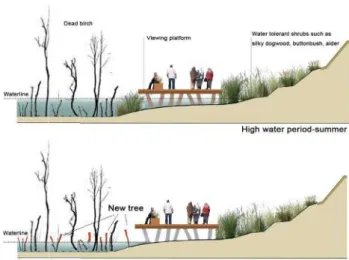
As for their own shapes, slender trunks with a smooth white skin, after layout and design, are like a perfor-mance team on stage, and let people unconsciously stop and enjoy. In addition, considering the lake water level changes in winter and summer, planting different height of birch can create different landscape in dry season and
flood season (Figure 39). Most importantly, this design
hardly blocks the sightline of visitors. People can see the overall view of the lake through gaps between dead trees (Figure 40).
Figure 39. variation in water level. Source from: author's own photograph
Figure 40. Analysis of sightline. Source from: author's own photograph
The function of wetlands in ecological conservation is self-evident, and this design is also beneficial for biodi-versity conservation. The dead birch grove has provided excellent habitats for the eagles and for ospreys. It also provides microhabitats that protect fish and invertebrate water species for predators.
(2) Comparison and Choice
Although Chinese have a special feeling for pine trees, the birch group is obviously better considering the unity of environment. With the change of season and time, third plan uses a concise style, showing different visual beauty, which is the most varied of the three plans. Besides, the second design has a more serious problem of sightline, but the birch grove minimises the impact on the sightline of tourists. At the same time, compared with other plans, numerous trees inserted into the bottom of the lake could reduce soil erosion in wetlands. The most important point is that there has been a good example of application of large-scale dead birch grove in Manasquan Reservoir (U.S). The result shows that the birch grove works well both ecolog-ical function and ornamental function. Therefore, in my
opinion, the bitch grove is better than the other two.
4. Findings and Conclusions
This paper is based on the comprehensive analysis of dead trees and the art practice project of Wild Duck Lake Nation-al Wetland Park, trying to change people's inherent impres-sion of dead trees and improves the secondary utilisation rate of dead trees, which provides valuable reference for the landscape application of dead trees in the future.
4.1 Research Conclusions
At present, protecting nature and building an environ-ment-friendly society has become the core objective of urban landscape construction. And using dead trees to create landscapes not only has ornamental and cultural
values, but also has significant ecological function, which
is an important medium to achieve the goal of landscape construction. It is worth spreading and applying widely.
The study found that dead wood has different charac-teristics in colour, texture, form and symbolism aspects. Therefore, in regards of the reuse of withered trees, using the root, stem and branch of different withered trees as the material to design, will form a landscape that combines natural beauty with artistic beauty. In terms of landscape design, designers should combine the characteristics of withered trees with artistic methods to create a unique dead tree landscape. For example, in the art project of Wild Duck Lake Park, stumps and twigs can be combined to create a dead tree landscape through the various shapes of change; an individual pine tree could also create a unique landscape
through appropriate artificial pruning for crown; the birch
grove, after artificial arrangement and layout, has also formed a high quality dead wood landscape.
In addition, in human civilization, people would like to add a large number of symbolic meanings to dead wood. In Asian culture, the dead wood often appears as a stubborn image in poems and paintings, which inspires people to
struggle in difficult environment. In many memorial parks
in Europe, the dead wood is often used to express respect and remembrance to dead soldiers. Using dead trees could create unexpected landscape when landscape architects combine the natural and cultural attributes of dead wood, which cannot be replaced by ordinary living trees.
In terms of ecological attributes of dead wood, a large number of literature and experimental results have shown that dead wood is an essential element to ensure ecolog-ical diversity, because it provides nest spaces and food
sources for birds and fish. Therefore, for the disposal of
dead wood in nature, these dead trees cannot simply be re-move. Even in some ecologically fragile nature reserves,
managers need to cultivate dead wood to repair the local ecological environment.
4.2 Research Limitation
Compared with living trees, the dead trees will lose their ecological functions of absorbing carbon and releasing oxygen, cooling, humidifying, and so on. Therefore, the dead trees should not be widely used in landscape applica-tions. Only under some special landscape conditions and needs, can dead tree achieve its greatest value.
On the one hand, it is best to use the dead tree on the spot so as to avoid the secondary environment damage which occurs in the transit process; On the other hand, in the garden landscape design, the dead tree is preferably adapted to local conditions, and is used for environmen-tal characteristics so as to be coordinated with the sur-rounding buildings and the environment, and we should not apply dead trees mechanically without considering the specific conditions. For example, in Wild Duck lake Park, dead wood could play a very good ecological role no matter using which design plan. However, if the site is changed into a residential park, these dead trees without anti-septic treatment may have a negative impact on the surrounding trees and local residents. With the change of site, the landscape effect of dead trees may be the oppo-site. The art experimental project of Wild Duck lake Park could only prove the effect of dead wood in wetland and lake landscape, and the function of dead wood in forest; urban centre park and other sites require further study and discussion.
4.3 Dead Trees and Contemporary Art
As a special plant form, dead wood has a high artistic quality, and its application is far beyond the scope of land-scape design. Just like the love of ancient artists to dead tree, the dead tree is still an important material of contem-porary art.
Due to the randomness of the shape, color and texture of dead wood, a large number of artists are fascinated by it, such as Bennett Ewing. He could feel and design differ-ent kinds of dead trees with the artistic technique of carv-ing and collage, endows the dead wood with new form and meaning, and also forms the artist's own language (Figure 41). Besides, some new media or installation art-ists would like to utilise the special meaning of dead wood "inanimate", combined with music, lighting and other media, to create new experiential landscape, which brings people sensory stimulation, such as Dead Garden by Car-los Teixeira (Figure 42). Dead wood can also be used as a medium for movies or optic artistry. In the TV series
《Deadwood》, dead wood is used to allude to the chaos of the American West Development. But as time goes on, there will always be new life (buds, microbes) coming out of dead wood, expressing the end of the chaotic era and the beginning of a new era (Figure 43).
Figure 41. Bennett, E. (2018) Eyevan Tumbleweed. Sculpture by dead wood
Figure 42. Carlos, T. (2012) Dead Garden. Rio De Janei-ro, Brazil
Figure 43. Deadwood (2004) Directed by Walter Hill
Nowadays, the dead wood art has already had both ap-preciation value and practical value, and does not destroy the environment, which is in line with the direction of social development. In my opinion, with the improvement of people's awareness of environmental protection, wheth-er in landscape architecture or in contemporary art, dead wood will be more and more appreciated and accepted by people all around the world.
References
[1] Dunn, M.. Frozen Flame and Slain Tree: The Dead Tree Theme in New Zealand Art of the Thirties and Forties. Art New Zealand, 1979, 13: 41-51.
[2] Ehnström, B.. Leaving dead wood for insects in bo-real forests suggestions for the future. Scandinavian Journal of Forest Research, 2001, 16(S3): 91-98. [3] Filpo, S.. Study on Building Landscape with
Region-al Characters. JournRegion-al of Southwest Forestry College, 2008, 3: 59-62.
[4] Franklin, J.F., Shugart, H.H., & Harmon, M.E.. Tree death as an ecological process. BioScience, 1987, 37(8): 550-556.
[5] Gough, P.. 'Cultivating dead trees': The legacy of Paul Nash as an artist of trauma, wilderness and re-covery. Journal of War & Culture Studies, 2011, 4(3): 323-340.
[6] Huang, A., & Zhu, Z. Y.. Application of tree in land-scape garden. China Forest. 2014, 2014 (8): 77-80. [7] Humphrey, J.W. and Bailey, S.. Managing deadwood
in forests and woodlands. Forestry Commission, 2012.
[8] Joyce, D. and Stoddart, L.. Topiary and the art of training plants. London: Frances Lincoln, 1999. [9] Keddy, P.A., & Drummond, C.G.. Ecological
proper-ties for the evaluation, management, and restoration
of temperate deciduous forest ecosystems. Ecological Applications, 1996, 6(3): 748-762.
[10] Kingsbury, N. and Oudolf, P.. Planting: a new per-spective. Timber Press, 2016.
[11] Nilsson, S.G., Niklasson, M., Hedin, J., Aronsson, G., Gutowski, J.M., Linder, P., Ljungberg, H., Mi-kusinski, G., & Ranius, T.. Densities of large living and dead trees in old-growth temperate and boreal forests. Forest Ecology and Management, 2002, 161: 189-204.
[12] Ren, Z.. Dead wood in different waters and forests. Journal of Planting, 2002 , (3): 46-47.
[13] Samuelsson, J., Gustafsson, L., & Ingelög, T.. Dying and dead trees review of their importance for biodi-versity. Swedish Threatened Species Unit, Swedish Univ, Agricultural Science, 1994: 109
[14] Van Tonder, G.J., Lyons, M.J., & Ejima, Y.. Percep-tion psychology: Visual structure of a Japanese Zen garden. Nature, 2002, 419(6905): 359.
[15] Wang, D.F.. Evaluation and screening on tree species of garden art modeling. Hunan forestry science and technology, 2016, 43(6): 69-73.
[16] Wang, P., Peng, C.S., & Li, L.. A Pioneering Study of Withered Art Aesthetics. Journal of Beijing Forestry University (Social Sciences), 2003, 2(1): 9-13. [17] Wild Duck Lake Park Office.. General situation of
Wetland, 2012. [online]. Available at:
http://www.yeyahu.com/index.php (Accessed: 05 Septem-ber 2018)
[18] Zhang, J.C.. Landscape Application of Withered, Older Dead Trees. Chinese gardens, 2009 , (11): 97-99.
[19] Zhu, Z.P., Li, J.Y., Fu, W.C., Chen, X.R., Wu, Q.N., Di, G.C., & Dong, J.W.. Landscape evaluation of secondary water surface in Bohai, Yunnan. Journal of Jiangsu Agricultural Sciences, 2016, 44(3): 236-239.