AN98031
Wideband 300 W push-pull FM
amplifier using BLV25
transistors
1998 Mar 23 2
Philips Semiconductors
Wideband 300 W push-pull FM amplifier
using BLV25 transistors
Application Note
AN98031
CONTENTS
1 INTRODUCTION
2 AMPLIFIER DESIGN THEORY
2.1 The output network
2.2 The input network
2.3 Bias components
3 PRACTICAL 300 W PUSH-PULL AMPLIFIER
WITH 2×BLV25 3.1 General remarks 3.2 Alignment 3.3 Performance 4 BLW86 DRIVER AMPLIFIER 4.1 Amplifier Design 4.2 Alignment 4.3 Performance
5 COMBINATION OF DRIVER AND FINAL
AMPLIFIER
6 STABILITY AND EFFICIENCY
IMPROVEMENT
7 CONCLUSION
1998 Mar 23 3 Philips Semiconductors
Wideband 300 W push-pull FM amplifier
using BLV25 transistors
Application Note
AN98031
SUMMARY
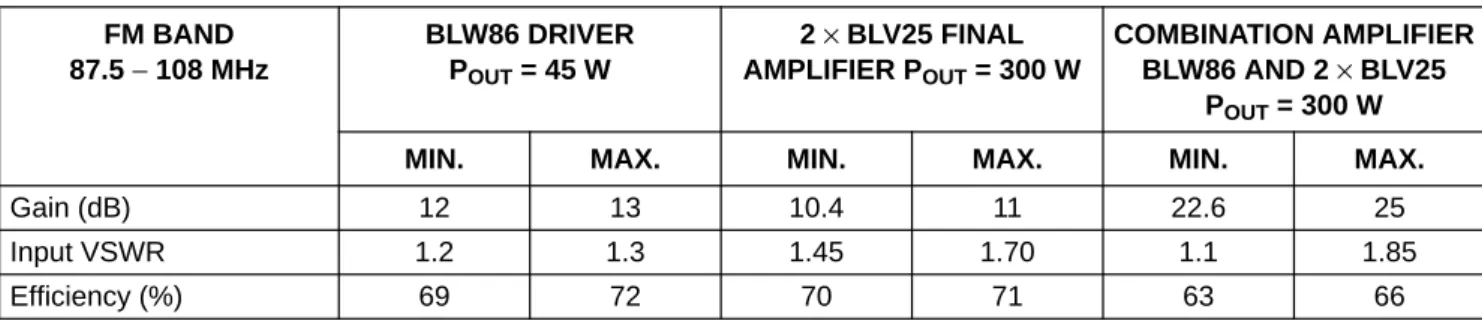
For transmitters and transposers for the FM broadcast band (87.5−108 MHz), a 300 W push-pull amplifier using two BLV25 transistors has been designed and built. The transistors operate in class-B from a 28 V supply. In addition, a suitable single-stage driver amplifier using a BLW86 transistor also operating in class-B from a 28 V supply has been designed and built.
Table 1 shows the main properties of each amplifier and of the driver/final-amplifier combination. The driver and final amplifier have been aligned at output powers of 45 W and 300 W respectively.
The 2×BLV25 amplifier has a heatsink with forced air cooling and a 10 mm copper plate heat-spreader.
Table 1 Amplifier performance overview; note 1
Note
1. Circuit board: double copper-clad epoxy fibre glass (εr= 4.5), thickness1⁄16-inch.
1 INTRODUCTION
The BLV25 power transistor is intended for use in FM broadcast transmitters and transposers. This transistor which is in a 6-lead flanged package with1⁄
2-inch ceramic cap (SOT119) can deliver 175 W output power at 108 MHz. This report describes the design and practical implementation of a 300 W wideband push-pull amplifier for the FM broadcast band using two BLV25 transistors operating in class-B from a 28 V supply voltage. In addition, a suitable driver amplifier is described. The driver is a single-stage amplifier designed for an output power of 45 W using a BLW86 transistor which also operates in class-B from a 28 V supply. The BLW86 is in a3⁄
8-inch, 4-lead flanged package with a ceramic cap (SOT123).
2 AMPLIFIER DESIGN THEORY
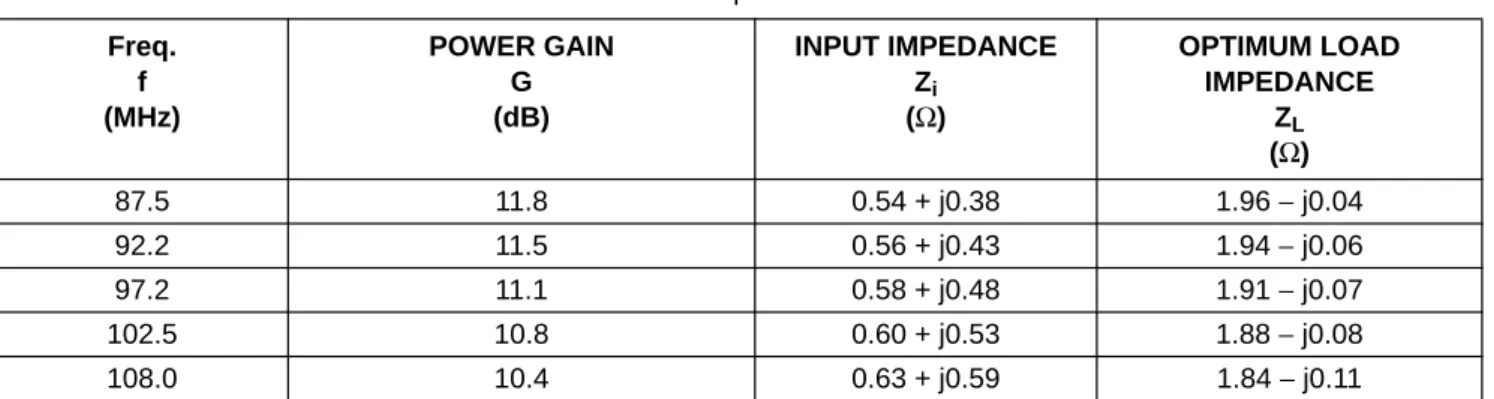
First, consider the BLV25 transistor. Table 2 gives some of its characteristics at an output power of 160 W and a supply voltage of 28 V.
The output of a BLV25 can be accurately represented by the equivalent circuit of Fig.1. In Section 3.2, it will be explained how the information in Table 2 and Fig.1 are used to align the amplifier.
Figure 2 shows a schematic of the amplifier; Fig.3 shows the complete circuit.
FM BAND 87.5−108 MHz BLW86 DRIVER POUT= 45 W 2×BLV25 FINAL AMPLIFIER POUT= 300 W COMBINATION AMPLIFIER BLW86 AND 2×BLV25 POUT= 300 W
MIN. MAX. MIN. MAX. MIN. MAX.
Gain (dB) 12 13 10.4 11 22.6 25
Input VSWR 1.2 1.3 1.45 1.70 1.1 1.85
1998 Mar 23 4 Philips Semiconductors
Wideband 300 W push-pull FM amplifier
using BLV25 transistors
Application Note
AN98031
Table 2 Some characteristics of the BLV25 at several frequencies in the FM broadcast band
2.1 The output network
The output network consists of three parts:
1. The combination of L9, L10and C8 which transforms the output impedance of the transistors to a resistance of 12.5Ω (balanced).
2. The transmission lines L11and L12 which are connected such that they perform a 1:4 impedance transformation, making the output impedance of this part 50Ω (balanced).
3. The transmission lines L13and L14 which function as a balanced-to-unbalanced transformer (balun), so their output impedance is 50Ω (unbalanced).
Note on 1:
The matching section L9, L10and C8 is rather conventional except that the inductors have been replaced by striplines. Note on 2:
Lines L11 and L12 are transmission lines with a characteristic resistance of 25Ω. They are soldered to a copper track on the p.c. board. This track is 2.8 mm wide, so its characteristic impedance with reference to the ground plane of the p.c. board is 50Ω.
Theoretically, their lengths should be1⁄
4wavelength for the centre of the frequency band, namely 42 cm. As this is rather impractical, we must find a way to use shorter lines. Two possibilities exist:
Lines L11and L12 are not soldered to tracks on the p.c. board but are surrounded by ferrite tubes of suitable dimensions and material. Finding the correct combination is however somewhat involved.
The lengths of lines L11and L12 are reduced significantly and the parallel inductance introduced is compensated by increasing the value of C8. As this method provides good results, it has been adopted.
Note on 3:
The line L14 is a transmission line with a characteristic resistance of 50Ω. It is also soldered to a 2.8 mm wide track on the p.c. board. For the length of this line, the story is similar to that of the 1:4 impedance transformer. By making the line shorter than a1⁄
4wavelength, an inductance is introduced from point B (Fig.2) to ground. To restore the symmetry, an equal inductance must be introduced between point A and ground. This is done by means of line L13 which is a 2.8 mm wide track on the p.c. board of the same length as L14. Finally, the parallel inductances (from point A to ground, and from point B to ground) are compensated by the series capacitors C9and C10.
After initial calculation of the separate sections and their compensation, the network was optimized using a computer optimization program. The final dimensions of the components can be found in Fig.3.
The maximum VSWR of this network is <1.05.
A remark must be made about the reactive loading of C8 which is nearly 900 VA at 108 MHz, so a high-quality capacitor must be used. Two or three capacitors in parallel can also be considered.
Freq. f (MHz) POWER GAIN G (dB) INPUT IMPEDANCE Zi (Ω) OPTIMUM LOAD IMPEDANCE ZL (Ω) 87.5 11.8 0.54 + j0.38 1.96−j0.04 92.2 11.5 0.56 + j0.43 1.94−j0.06 97.2 11.1 0.58 + j0.48 1.91−j0.07 102.5 10.8 0.60 + j0.53 1.88−j0.08 108.0 10.4 0.63 + j0.59 1.84−j0.11
1998 Mar 23 5 Philips Semiconductors
Wideband 300 W push-pull FM amplifier
using BLV25 transistors
Application Note
AN98031
2.2 The input network
This network is very similar to the output network and, like it, consists of three parts:
1. The combination of L1and L2 forms an unbalanced-to-balanced transformer whose output impedance is 50Ω (balanced)
2. The combination L3and L4 forms a 4:1 impedance transformer whose output impedance is 12.5Ω (balanced) 3. The components L5to L8and C3to C7 form a two-section matching network to match the input impedances of the
transistors to 12.5Ω (balanced).
All the remarks made for the output network also apply to the input network, though several values are different. The calculation of the input network was made in the same way as that for the output network. However, the total length of the lines L1to L4 became too long for practical use. After dividing the lengths of these lines by 1.6, the other
components were re-optimized, raising the input VSWR from 1.20 to 1.27. All component values are given in Table 5. A consequence of this way of designing is that the power gain at 87.5 MHz is approximately 1.4 dB higher than that at 108 MHz. This variation must be compensated in one of the driver stages.
An alternative design with a nearly flat power gain of about 10 dB can be made, however, the input matching is only good at the high end of the frequency band; at 87.5 MHz, the input VSWR rises to about 3.2. Further details of this alternative are not given here.
2.3 Bias components
Theoretically, point VB can be grounded directly. However, it may be better to ground it via an RF choke shunted by a 12Ω resistor as shown in Fig.4 because of:
• Small asymmetries in the transistors and circuit, and
• Possible parasitic oscillation when the transistors operate in parallel rather than push-pull.
Resistors R1and R2 have been added to improve stability during mismatch. For point VC, the same holds as for point VB, except that the supply voltage must be connected to the former. In the simplest configuration, point VC is decoupled for RF frequencies. A better proposition is probably the circuit shown in Fig.5.
3 PRACTICAL 300 W PUSH-PULL AMPLIFIER WITH 2×BLV25 3.1 General remarks
Having established a theoretical design, let us now look at a practical implementation.
The amplifier has been designed on a double copper-clad epoxy fibre glass (εr= 4.5) board, thickness1⁄16-inch. Figure 6 shows the print board and Fig.7 the layout of the amplifier. Rivets and, at the board edges, soldered copper straps have been used to provide good contact between both sides of the board. Where the emitters are grounded, contact is made with the lower side of the board.
The print board and transistors are attached to a 10 mm thick copper plate which acts as a heat-spreader. This plate is screwed to a standard heatsink with forced air cooling. At an ambient temperature of 25°C, and with the amplifier operating at 300 W output power, the heatsink temperature is below 55°C.
3.2 Alignment
The first alignment was done with small signals, starting with the output circuit. The BLV25 transistors were replaced by dummy loads, representing the complex conjugate of the optimum load impedance. The dummy consists of a 2.22Ω resistance and a 300 pF capacitance.
To reduce parasitic inductance and to maintain the best possible symmetry, we used several components in parallel. These components were soldered to an empty SOT119 header.
1998 Mar 23 6 Philips Semiconductors
Wideband 300 W push-pull FM amplifier
using BLV25 transistors
Application Note
AN98031
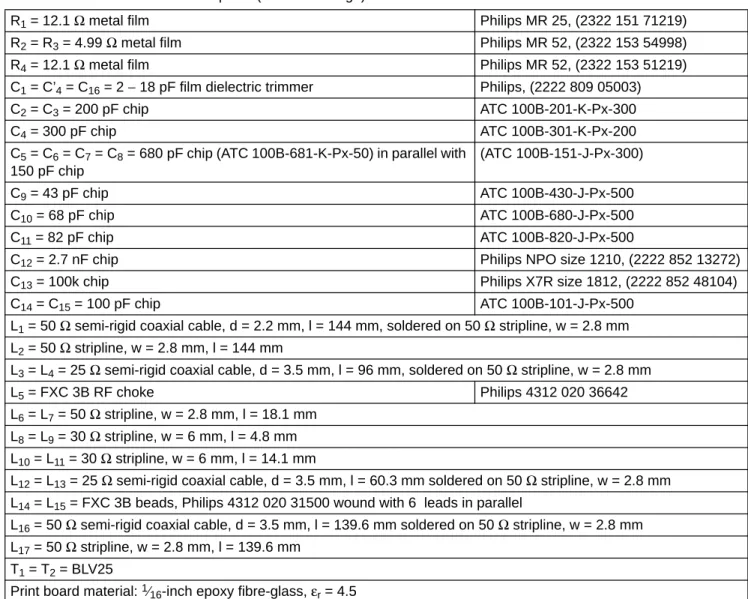
The reflection versus frequency was measured at the output terminal and minimized by adjusting the capacitors C16, C14, C15and C9. Figure 8 shows the schematic diagram and Fig.9 the return losses; the VSWR remains below 1.13. The alignment of the input network was done with the transistors in circuit and with the supply voltage and load connected. First, alignment was made with the transistors in class-A (IC= 1.7 A and VCE= 25 V). The reflection versus frequency was then minimized at small-signal levels. Then the operation was altered to class-B, and the amplifier realigned at an output power of 300 W. The required circuit modifications were rather small. Figure 10 shows the final circuit. Resistances R2and R3 are necessary to prevent parallel oscillations. The inductance of these resistors is very important (see Table 6).In spite of the dummy adjustment of the output circuit, the capacitance of C9 had to be reduced to improve the collector efficiency,η, of the amplifier. In addition, three capacitors in parallel have been used because of the very high reactive loading at that point.
3.3 Performance
The amplifier has been aligned at an output power of 300 W. Figures 11 to 13 show the gain, input VSWR and collector efficiency as functions of frequency at 300 W output power. Figure 14 shows the variation of efficiency with output power, both measured at 108 MHz.
4 BLW86 DRIVER AMPLIFIER 4.1 Amplifier Design
The required drive power for the 2×BLV25 amplifier described in Section 3 is about 30 W. The input VSWR of this final amplifier varies between 1.45 and 1.7 (see Fig.12), so the load impedance of the driver amplifier differs from 50Ω and varies with frequency. As the effect of this on the performance of the driver cannot be predicted, some reserve output power was built in and a 45 W driver was designed. The driver is a single-stage class-B amplifier using a BLW86 transistor.
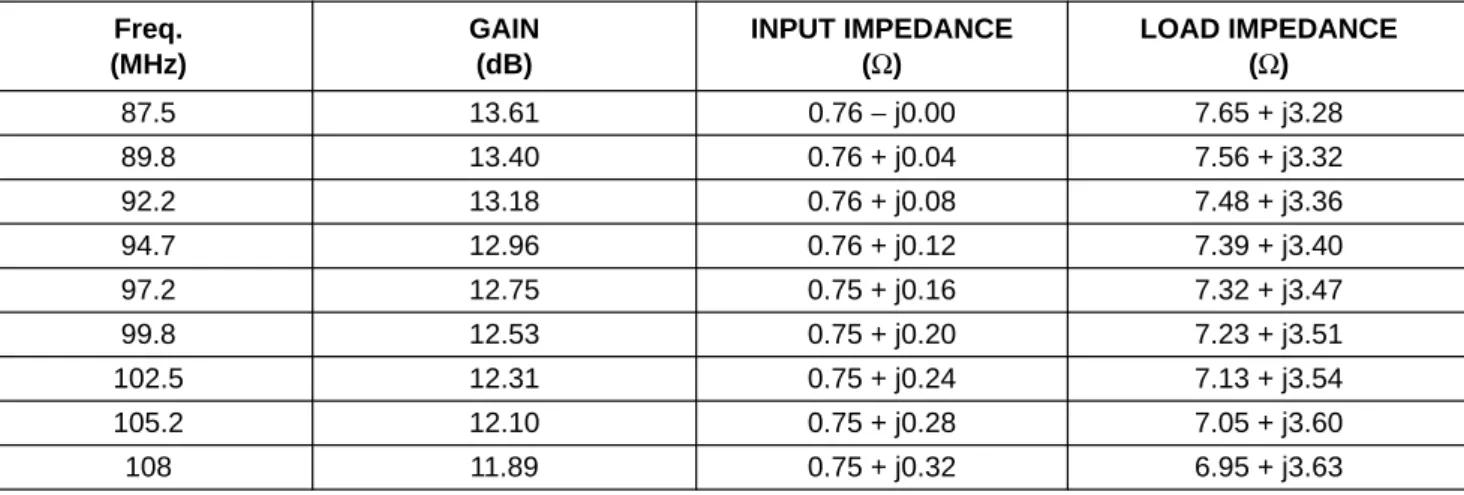
Table 3 shows some properties of the BLW86 from 87.5 to 108 MHz, valid for class-B operation and an output power of 45 W.
Table 3 Some characteristics of the BLW86 at several frequencies in the FM broadcast band
The input impedance has to be matched to the 50Ω source impedance to obtain a good input VSWR and the 50Ω load impedance has to be transformed into the optimum load impedance, which is given in Table 2. This has been done using Chebychev low-pass LC filter techniques (see Chapter “Reference”).
Freq. (MHz) GAIN (dB) INPUT IMPEDANCE (Ω) LOAD IMPEDANCE (Ω) 87.5 13.61 0.76−j0.00 7.65 + j3.28 89.8 13.40 0.76 + j0.04 7.56 + j3.32 92.2 13.18 0.76 + j0.08 7.48 + j3.36 94.7 12.96 0.76 + j0.12 7.39 + j3.40 97.2 12.75 0.75 + j0.16 7.32 + j3.47 99.8 12.53 0.75 + j0.20 7.23 + j3.51 102.5 12.31 0.75 + j0.24 7.13 + j3.54 105.2 12.10 0.75 + j0.28 7.05 + j3.60 108 11.89 0.75 + j0.32 6.95 + j3.63
1998 Mar 23 7 Philips Semiconductors
Wideband 300 W push-pull FM amplifier
using BLV25 transistors
Application Note
AN98031
The driver amplifier was designed on double-clad epoxy glass fibre board (εr= 4.5),1⁄16-inch thick. Figure 16 shows the board and layout of the amplifier. Rivets and straps were again used and the emitter connected to the underside of the board.4.2 Alignment
The alignment procedure was as described in Section 3.2. The optimal load impedance given in Table 2 suggested a dummy load of 10Ω resistance in parallel with a 91 pF capacitance. Alignment with this dummy load resulted in a collector efficiency of about 60%. Later, it was found that lowering the dummy capacitance to 56 pF raised the efficiency to about 70%. Figure 17 shows the alignment circuit and Fig.18 the VSWR at the output terminal measured with the 10Ω// 56 pF dummy load.
The input circuit has been aligned with the transistor in the circuit and the supply voltage connected. Again, alignment was started with the transistor operating in class-A (IC= 1 A and VCE= 25 V). The small-signal input VSWR has been minimized.
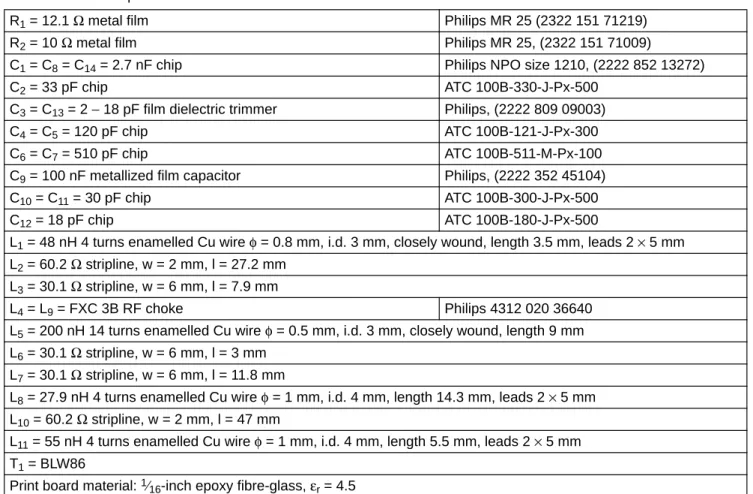
Then, the transistor was set to class-B operation, and the amplifier realigned at an output power of 45 W. Figure 19 shows the final circuit and Table 7 shows the part list. The collector DC biasing coil, L8, plays an active role in the impedance transformation.
4.3 Performance
Figs 20 and 21 show the gain and input VSWR as functions of frequency. The gain is 12.5±0.5 dB and the VSWR remains below 1.3:1 throughout the band.
Figure 21 shows that the collector efficiency is better than 69%. The measurements were taken at 45 W output power. Figures 23 and 24 show collector efficiency and amplifier gain versus output power at 108 MHz. Note, the amplifier was only aligned at 45 W output power.
5 COMBINATION OF DRIVER AND FINAL AMPLIFIER
Figs 25 and 26 show the gain and input VSWR of the combination of driver and final amplifier at 300 W output power. This gives an indication of the effect of the fluctuating input VSWR of the final amplifier on the performance of the driver amplifier. The efficiency of the combination is more than 63%, as Fig.27 shows.
No additional alignment was made. The required input drive power for 300 W output is less than 1.7 W.
6 STABILITY AND EFFICIENCY IMPROVEMENT
It is recommended to add an inductance LCC between the collectors of the two BLV25 transistors, see Fig.28 (c.f. Fig.10) to improve stability at low output powers. An additional advantage of this modification is that it raises collector efficiency while hardly affecting the input VSWR (which remains below 1.75). Figures 29 to 31 show the results measured on a water-cooled amplifier for three conditions: without LCC, with LCC= 41 nH, and with LCC= 29 nH.
7 CONCLUSION
A 300 W push-pull amplifier using two BLV25 transistors driven by a single-stage amplifier using a BLW86 have been designed. Table 4 shows the main performance parameters of the individual amplifiers and of their combination
.
1998 Mar 23 8 Philips Semiconductors
Wideband 300 W push-pull FM amplifier
using BLV25 transistors
Application Note
AN98031
Table 4 Performance overview (basic amplifier without the modification for higher efficiency)
8 REFERENCE
G.L. Matthaei, Tables of Chebychev impedance transforming networks of low-pass filter form. Proc. of the IEEE, Aug. 1964, pp. 939-963. FM BAND 87.5−108 MHz BLW86 DRIVER POUT= 45 W 2×BLV25 FINAL AMPLIFIER POUT= 300 W COMBINATION AMPLIFIER BLW86 AND 2×BLV25 POUT= 300 W
MIN. MAX. MIN. MAX. MIN. MAX.
Gain (dB) 12 13 10.4 11 22.6 25
Input VSWR 1.2 1.3 1.45 1.70 1.1 1.85
Efficiency (%) 69 72 70 71 63 66
Fig.1 Equivalent circuit of BLV25 output.
handbook, halfpage 1.46 nH
C
E 2.26 Ω 313 pF
MGP999
Fig.2 Main amplifier schematic. handbook, full pagewidth
MGH965 4 : 1 TRANS-FORMER 50 Ω 25 Ω 25 Ω 6.25 Ω 6.25 Ω BLV25 BRANCH 50 Ω 50 Ω semi-rigid coaxial cable 4 : 1 TRANS-FORMER BLV25 BRANCH
1998 Mar 23 9 Philips Semiconductors
Wideband 300
W push-pull FM amplifier
using BL
V25 transistors
Application Note
AN98031
This text is here in white to force landscape pages to be rotated correctly when browsing through the pdf in the Acrobat reader.This text is here in _white to force landscape pages to be rotated correctly when browsing through the pdf in the Acrobat reader.This text is here inThis text is here in white to force landscape pages to be rotated correctly when browsing through the pdf in the Acrobat reader. white to force landscape pages to be ...
k , full pagewidth C4 R1 C7 R2 ,,, ,,, L1 L2 ,,,, ,, ,, ,,, ,,, , , , input 50 Ω VB C3 C5 C6 C1 C2 L4 L3 L6 L5 L9 ,, ,, L10 L8 TR1 TR2 L7 L13 L14 ,,, ,,, output 50 Ω VC C9 C8 C10 A B L12 L11 , , , , MGM624
Fig.3 300 W push-pull amplifier for the FM broadcast band (Theoretical design).
1998 Mar 23 10 Philips Semiconductors
Wideband 300 W push-pull FM amplifier
using BLV25 transistors
Application Note
AN98031
Table 5 Parts list of the main amplifier (Theoretical design) R1= R2= 22Ω,carbon
C1= C2= 200 pF chip (ATC 100B) C3= 330 pF chip (ATC 100B)
C4= C5= C6= C7= 620 pF chip (ATC 100B) C8= 240 pF, 500 V chip (ATC 100B or ATC 175) C9= C10= 100 pF, 500 V chip (ATC 100B) L1= 50Ω stripline, w = 2.8 mm, l = 144 mm
L2= 50Ω semi-rigid coaxial cable, d = 2.2 mm, l = 144 mm soldered on 50Ω stripline, w = 2.8 mm L3= L4= 25Ω semi-rigid coaxial cable, d = 2.2 mm, l = 96 mm; soldered on 50Ω stripline, w = 2.8 mm L5= L6= 50Ω stripline, w = 2.8 mm, l = 18.1 mm
L7= L8= 30Ω stripline, w = 6 mm, l = 4.8 mm L9= L10= 30Ω stripline, w = 6 mm, l = 14.1 mm
L11= L12= 25Ω semi-rigid coaxial cable, d = 3.5 mm, l = 60.3 mm soldered on 50Ω stripline, w = 2.8 mm L13= 50Ω stripline, w = 2.8 mm, l = 139.6 mm
L14= 50Ω semi-rigid coaxial cable, d = 3.5 mm, l = 139.6 mm soldered on 50Ω stripline, w = 2.8 mm T1= T2= BLV25
Print board material:1⁄
16-inch epoxy fibre-glass,εr= 4.5
Fig.4 Vb bias, components: R = 12Ω, carbon; L = Fxc 3B RF choke, part no. 4312 020 36640.
handbook, halfpage VB
L R
MGM622
Fig.5 Vc bias. Components: R = 12Ω, carbon; C1= 2.7 nF, chip (NP0 type); C2= 100 nF, chip (X7R type); L = FXC3B bead, part no. 4312 020 31500 wound with 3 to 6 wires in parallel.
handbook, halfpage L R C1 C2 +28 V MGM623 L VC
1998 Mar 23 11 Philips Semiconductors
Wideband 300
W push-pull FM amplifier
using BL
V25 transistors
Application Note
AN98031
This text is here in white to force landscape pages to be rotated correctly when browsing through the pdf in the Acrobat reader.This text is here in _white to force landscape pages to be rotated correctly when browsing through the pdf in the Acrobat reader.This text is here inThis text is here in white to force landscape pages to be rotated correctly when browsing through the pdf in the Acrobat reader. white to force landscape pages to be ...
Fig.6 Printed-circuit board.
o
ok, full pagewidth
MGH966
235
1998 Mar 23 12 Philips Semiconductors
Wideband 300
W push-pull FM amplifier
using BL
V25 transistors
Application Note
AN98031
This text is here in white to force landscape pages to be rotated correctly when browsing through the pdf in the Acrobat reader.This text is here in _white to force landscape pages to be rotated correctly when browsing through the pdf in the Acrobat reader.This text is here inThis text is here in white to force landscape pages to be rotated correctly when browsing through the pdf in the Acrobat reader. white to force landscape pages to be ...
Fig.7 Amplifier lay out.
o
ok, full pagewidth
MGH967 out in rivet L1 L2 L3 L4 L6 L12 L13 L15 L14 R4 L17 L16 C5 C6 C7 C2 C3 C8 C12 C13 C15 C14 L7 L8 L9 L10 L11 C1 C16 C4/4' C9 C10 C11 +28 V R1 L5 R3 TR2 R2 TR1
1998 Mar 23 13 Philips Semiconductors
Wideband 300 W push-pull FM amplifier
using BLV25 transistors
Application Note
AN98031
Fig.8 Output alignment circuit. handbook, full pagewidth
2.22 Ω 300pF 2.22 Ω 300pF MGH968 C14 C15 C16 out VSWR C9 L16 L17 R4 L14 L15 L12 L13 L11 L10 dummy dummy C13 C12 Vs = +28 V
Fig.9 Return loss in circuit of Fig.8. handbook, full pagewidth
frequency (MHz) 2 VSWR 0.5 90 86 94 98 102 106 110 1 1.5 MGH969
1998 Mar 23 14 Philips Semiconductors
Wideband 300
W push-pull FM amplifier
using BL
V25 transistors
Application Note
AN98031
This text is here in white to force landscape pages to be rotated correctly when browsing through the pdf in the Acrobat reader.This text is here in _white to force landscape pages to be rotated correctly when browsing through the pdf in the Acrobat reader.This text is here inThis text is here in white to force landscape pages to be rotated correctly when browsing through the pdf in the Acrobat reader. white to force landscape pages to be ...
Fig.10 Practical amplifier circuit diagram.
o
ok, full pagewidth
MGH970 C2 C3 C14 C15 C7 C6 C8 C5 C1 input 50 Ω C16 output 50 Ω C4 C4' C9 C10 C11 L1 L2 R1 L5 L3 L4 L16 L17 R4 L14 L15 L12 L13 R2 R3 L7 L6 L9 L8 L11 L10 TR1 TR2 BLV25 BLV25 C13 C12 Vs = +28 V
1998 Mar 23 15 Philips Semiconductors
Wideband 300 W push-pull FM amplifier
using BLV25 transistors
Application Note
AN98031
Table 6 Parts list of the main amplifier (Practical design)
R1= 12.1Ω metal film Philips MR 25, (2322 151 71219)
R2= R3= 4.99Ω metal film Philips MR 52, (2322 153 54998)
R4= 12.1Ω metal film Philips MR 52, (2322 153 51219)
C1= C’4= C16= 2−18 pF film dielectric trimmer Philips, (2222 809 05003)
C2= C3= 200 pF chip ATC 100B-201-K-Px-300
C4= 300 pF chip ATC 100B-301-K-Px-200
C5= C6= C7= C8= 680 pF chip (ATC 100B-681-K-Px-50) in parallel with 150 pF chip
(ATC 100B-151-J-Px-300)
C9= 43 pF chip ATC 100B-430-J-Px-500
C10= 68 pF chip ATC 100B-680-J-Px-500
C11= 82 pF chip ATC 100B-820-J-Px-500
C12= 2.7 nF chip Philips NPO size 1210, (2222 852 13272)
C13= 100k chip Philips X7R size 1812, (2222 852 48104)
C14= C15= 100 pF chip ATC 100B-101-J-Px-500
L1= 50Ω semi-rigid coaxial cable, d = 2.2 mm, l = 144 mm, soldered on 50Ω stripline, w = 2.8 mm L2= 50Ω stripline, w = 2.8 mm, l = 144 mm
L3= L4= 25Ω semi-rigid coaxial cable, d = 3.5 mm, l = 96 mm, soldered on 50Ω stripline, w = 2.8 mm
L5= FXC 3B RF choke Philips 4312 020 36642
L6= L7= 50Ω stripline, w = 2.8 mm, l = 18.1 mm L8= L9= 30Ω stripline, w = 6 mm, l = 4.8 mm L10= L11= 30Ω stripline, w = 6 mm, l = 14.1 mm
L12= L13= 25Ω semi-rigid coaxial cable, d = 3.5 mm, l = 60.3 mm soldered on 50Ω stripline, w = 2.8 mm L14= L15= FXC 3B beads, Philips 4312 020 31500 wound with 6 leads in parallel
L16= 50Ω semi-rigid coaxial cable, d = 3.5 mm, l = 139.6 mm soldered on 50Ω stripline, w = 2.8 mm L17= 50Ω stripline, w = 2.8 mm, l = 139.6 mm
T1= T2= BLV25 Print board material:1⁄
1998 Mar 23 16 Philips Semiconductors
Wideband 300 W push-pull FM amplifier
using BLV25 transistors
Application Note
AN98031
Fig.11 Gain versus frequency (main amplifier). handbook, full pagewidth
frequency (MHz) 14 gain (dB) 8 90 86 94 98 102 106 110 10 12 MGH971 Pout = 300 W
1998 Mar 23 17 Philips Semiconductors
Wideband 300 W push-pull FM amplifier
using BLV25 transistors
Application Note
AN98031
Fig.12 Input VSWR versus frequency (main amplifier). handbook, full pagewidth
frequency (MHz) 2.5 VSWR input 1 90 86 94 98 102 106 110 1.5 2 fMGH972 Pout = 300 W
Fig.13 Collector efficiency versus frequency (main amplifier). handbook, full pagewidth
frequency (MHz) 100 η (%) 40 90 86 94 98 102 106 110 60 80 MGH973 Pout = 300 W
1998 Mar 23 18 Philips Semiconductors
Wideband 300 W push-pull FM amplifier
using BLV25 transistors
Application Note
AN98031
Fig.14 Efficiency,η, versus output power (main amplifier). handbook, full pagewidth
Pout (W) 80 20 100 50 150 200 250 300 350 40 60 MGH974 f = 108 MHz η (%)
Fig.15 Gain versus output power (main amplifier). handbook, full pagewidth
Pout (W) 14 gain (dB) 8 100 50 150 200 250 300 350 10 12 MGH975 f = 108 MHz
1998 Mar 23 19 Philips Semiconductors
Wideband 300 W push-pull FM amplifier
using BLV25 transistors
Application Note
AN98031
Fig.16 Printed circuit board and lay out of the driver.
handbook, full pagewidth 154
50 MGH976 rivet L11 L10 L2 L7 L6 L8 C8 L9 L4 L5 R2 R1 C9 C13 C14 C12 C10 C11 C6 C7 out L1 C3 C1 C4 C5 C2 in L3 BLW86
1998 Mar 23 20 Philips Semiconductors
Wideband 300 W push-pull FM amplifier
using BLV25 transistors
Application Note
AN98031
Fig.17 Output alignment circuit (driver). handbook, full pagewidth
MGH977 C8 C9 C14 C12 C13 L11 L8 R2 L9 Vs = +28 V L10 L7 L6 C11 C10 10.4 Ω 56pF VSWR dummy
1998 Mar 23 21 Philips Semiconductors
Wideband 300 W push-pull FM amplifier
using BLV25 transistors
Application Note
AN98031
Fig.18 Output VSWR in circuit of Fig.17. handbook, full pagewidth
frequency (MHz) 2 VSWR 0.5 90 86 94 98 102 106 110 1 1.5 MGH978
Fig.19 Driver amplifier circuit. handbook, full pagewidth
MGH979 C1 C2 C4 C5 C8 C9 C6 C7 C3 L1 input 50 Ω C14 C12 C13 L11 output 50 Ω TR1 BLW86 L2 L3 L5 R1 L4 L8 R2 L9 Vs = +28 V L10 L7 L6 C11 C10
1998 Mar 23 22 Philips Semiconductors
Wideband 300 W push-pull FM amplifier
using BLV25 transistors
Application Note
AN98031
Table 7 Driver amplifier
R1= 12.1Ω metal film Philips MR 25 (2322 151 71219)
R2= 10Ω metal film Philips MR 25, (2322 151 71009)
C1= C8= C14= 2.7 nF chip Philips NPO size 1210, (2222 852 13272)
C2= 33 pF chip ATC 100B-330-J-Px-500
C3= C13= 2−18 pF film dielectric trimmer Philips, (2222 809 09003)
C4= C5= 120 pF chip ATC 100B-121-J-Px-300
C6= C7= 510 pF chip ATC 100B-511-M-Px-100
C9= 100 nF metallized film capacitor Philips, (2222 352 45104)
C10= C11= 30 pF chip ATC 100B-300-J-Px-500
C12= 18 pF chip ATC 100B-180-J-Px-500
L1= 48 nH 4 turns enamelled Cu wireφ= 0.8 mm, i.d. 3 mm, closely wound, length 3.5 mm, leads 2×5 mm L2= 60.2Ω stripline, w = 2 mm, l = 27.2 mm
L3= 30.1Ω stripline, w = 6 mm, l = 7.9 mm
L4= L9= FXC 3B RF choke Philips 4312 020 36640
L5= 200 nH 14 turns enamelled Cu wireφ= 0.5 mm, i.d. 3 mm, closely wound, length 9 mm L6= 30.1Ω stripline, w = 6 mm, l = 3 mm
L7= 30.1Ω stripline, w = 6 mm, l = 11.8 mm
L8= 27.9 nH 4 turns enamelled Cu wireφ= 1 mm, i.d. 4 mm, length 14.3 mm, leads 2×5 mm L10= 60.2Ω stripline, w = 2 mm, l = 47 mm
L11= 55 nH 4 turns enamelled Cu wireφ= 1 mm, i.d. 4 mm, length 5.5 mm, leads 2×5 mm T1= BLW86
Print board material:1⁄
1998 Mar 23 23 Philips Semiconductors
Wideband 300 W push-pull FM amplifier
using BLV25 transistors
Application Note
AN98031
Fig.20 Gain versus frequency (driver). handbook, full pagewidth
frequency (MHz) 16 gain (dB) 10 90 86 94 98 102 106 110 12 14 MGH980 Pout = 45 W
1998 Mar 23 24 Philips Semiconductors
Wideband 300 W push-pull FM amplifier
using BLV25 transistors
Application Note
AN98031
Fig.21 Input VSWR versus frequency (driver). handbook, full pagewidth
frequency (MHz) 2. VSWR input 0.5 90 86 94 98 102 106 110 1 1.5 MGH981 Pout = 45 W
Fig.22 Collector efficiency versus frequency (driver). handbook, full pagewidth
frequency (MHz) 100 η (%) 40 90 86 94 98 102 106 110 60 80 MGH982 Pout = 45 W
1998 Mar 23 25 Philips Semiconductors
Wideband 300 W push-pull FM amplifier
using BLV25 transistors
Application Note
AN98031
Fig.23 Collector efficiency,η, versus output power (driver). handbook, full pagewidth
Pout (W) 80 20 10 0 20 30 40 50 60 40 60 MGH983 f = 108 MHz η (%)
Fig.24 Gain versus output power (driver). handbook, full pagewidth
Pout (W) 14 gain (dB) 8 10 0 20 30 40 50 60 10 12 MGH984 f = 108 MHz
1998 Mar 23 26 Philips Semiconductors
Wideband 300 W push-pull FM amplifier
using BLV25 transistors
Application Note
AN98031
Fig.25 Gain versus frequency (combination amplifier). handbook, full pagewidth
frequency (MHz) 28 gain (dB) 16 90 86 94 98 102 106 110 20 24 MGH985 Pout = 300 W
Fig.26 Input VSWR versus frequency (combination amplifier). handbook, full pagewidth
frequency (MHz) 2.5 VSWR input 1 90 86 94 98 102 106 110 1.5 2 MGH986 Pout = 300 W
1998 Mar 23 27 Philips Semiconductors
Wideband 300 W push-pull FM amplifier
using BLV25 transistors
Application Note
AN98031
Fig.27 Efficiency versus frequency (combination amplifier). handbook, full pagewidth
frequency (MHz) 100 η (%) 40 90 86 94 98 102 106 110 60 80 MGH987 Pout = 300 W
Fig.28 Adding inductance LCC improves stability at low output powers and raises efficiency. Compare this with the relevant part of the circuit shown in Fig.10.
handbook, halfpage MGH961 TR1 LCC L10 L11 TR2 C9 C10 C11 ,,, ,,, ,,,
1998 Mar 23 28 Philips Semiconductors
Wideband 300 W push-pull FM amplifier
using BLV25 transistors
Application Note
AN98031
Fig.29 Gain versus frequency. Legend:
(1) no LCC.
(2) LCC= 41 nH; 2 turns enamelled Cu wireφ= 1.7 mm, i.d. D = 8 mm, length 6 mm, leads 2×10 mm. (3) LCC= 29 nH 1 turn enamelled Cu wireφ= 1.7 mm, i.d. D = 10 mm, leads 2×12 mm.
handbook, full pagewidth
114 frequency (MHz) 13 gain (dB) 8 82 86 90 94 98 102 106 110 9 10 11 12 MGH962 Pout = 300 W (1) (2) (3)
1998 Mar 23 29 Philips Semiconductors
Wideband 300 W push-pull FM amplifier
using BLV25 transistors
Application Note
AN98031
Fig.30 Input VSWR versus frequency. handbook, full pagewidth
114 frequency (MHz) 2.2 VSWR 1.2 82 86 90 94 98 102 106 110 1.4 1.6 1.8 2.0 MGH964 INPUT (1) (2) (3) Legend: (1) no LCC.
(2) LCC= 41 nH; 2 turns enamelled Cu wireφ= 1.7 mm, i.d. D = 8 mm, length 6 mm, leads 2×10 mm. (3) LCC= 29 nH 1 turn enamelled Cu wireφ= 1.7 mm, i.d. D = 10 mm, leads 2×12 mm.
1998 Mar 23 30 Philips Semiconductors
Wideband 300 W push-pull FM amplifier
using BLV25 transistors
Application Note
AN98031
Fig.31 Efficiency versus frequency. Legend: as Fig.29.
handbook, full pagewidth
114 frequency (MHz) 90 η (%) 100 82 86 90 94 98 102 106 110 50 60 70 80 MGH963 Pout = 300 W (1) (2) (3)
Internet: http://www.semiconductors.philips.com
Philips Semiconductors – a worldwide company
© Philips Electronics N.V. 1998 SCA57
All rights are reserved. Reproduction in whole or in part is prohibited without the prior written consent of the copyright owner.
The information presented in this document does not form part of any quotation or contract, is believed to be accurate and reliable and may be changed without notice. No liability will be accepted by the publisher for any consequence of its use. Publication thereof does not convey nor imply any license under patent- or other industrial or intellectual property rights.
Netherlands: Postbus 90050, 5600 PB EINDHOVEN, Bldg. VB, Tel. +31 40 27 82785, Fax. +31 40 27 88399
New Zealand: 2 Wagener Place, C.P.O. Box 1041, AUCKLAND, Tel. +64 9 849 4160, Fax. +64 9 849 7811
Norway: Box 1, Manglerud 0612, OSLO, Tel. +47 22 74 8000, Fax. +47 22 74 8341
Philippines: Philips Semiconductors Philippines Inc., 106 Valero St. Salcedo Village, P.O. Box 2108 MCC, MAKATI, Metro MANILA, Tel. +63 2 816 6380, Fax. +63 2 817 3474 Poland: Ul. Lukiska 10, PL 04-123 WARSZAWA, Tel. +48 22 612 2831, Fax. +48 22 612 2327 Portugal: see Spain
Romania: see Italy
Russia: Philips Russia, Ul. Usatcheva 35A, 119048 MOSCOW, Tel. +7 095 755 6918, Fax. +7 095 755 6919
Singapore: Lorong 1, Toa Payoh, SINGAPORE 1231, Tel. +65 350 2538, Fax. +65 251 6500
Slovakia: see Austria Slovenia: see Italy
South Africa: S.A. PHILIPS Pty Ltd., 195-215 Main Road Martindale, 2092 JOHANNESBURG, P.O. Box 7430 Johannesburg 2000, Tel. +27 11 470 5911, Fax. +27 11 470 5494
South America: Al. Vicente Pinzon, 173, 6th floor, 04547-130 SÃO PAULO, SP, Brazil,
Tel. +55 11 821 2333, Fax. +55 11 821 2382 Spain: Balmes 22, 08007 BARCELONA, Tel. +34 3 301 6312, Fax. +34 3 301 4107
Sweden: Kottbygatan 7, Akalla, S-16485 STOCKHOLM, Tel. +46 8 632 2000, Fax. +46 8 632 2745
Switzerland: Allmendstrasse 140, CH-8027 ZÜRICH, Tel. +41 1 488 2686, Fax. +41 1 488 3263
Taiwan: Philips Semiconductors, 6F, No. 96, Chien Kuo N. Rd., Sec. 1, TAIPEI, Taiwan Tel. +886 2 2134 2865, Fax. +886 2 2134 2874 Thailand: PHILIPS ELECTRONICS (THAILAND) Ltd., 209/2 Sanpavuth-Bangna Road Prakanong, BANGKOK 10260, Tel. +66 2 745 4090, Fax. +66 2 398 0793
Turkey: Talatpasa Cad. No. 5, 80640 GÜLTEPE/ISTANBUL, Tel. +90 212 279 2770, Fax. +90 212 282 6707
Ukraine: PHILIPS UKRAINE, 4 Patrice Lumumba str., Building B, Floor 7, 252042 KIEV, Tel. +380 44 264 2776, Fax. +380 44 268 0461
United Kingdom: Philips Semiconductors Ltd., 276 Bath Road, Hayes, MIDDLESEX UB3 5BX, Tel. +44 181 730 5000, Fax. +44 181 754 8421 United States: 811 East Arques Avenue, SUNNYVALE, CA 94088-3409, Tel. +1 800 234 7381
Uruguay: see South America Vietnam: see Singapore
Yugoslavia: PHILIPS, Trg N. Pasica 5/v, 11000 BEOGRAD, Tel. +381 11 625 344, Fax.+381 11 635 777
For all other countries apply to: Philips Semiconductors,
International Marketing & Sales Communications, Building BE-p, P.O. Box 218, 5600 MD EINDHOVEN, The Netherlands, Fax. +31 40 27 24825
Argentina: see South America
Australia: 34 Waterloo Road, NORTH RYDE, NSW 2113, Tel. +61 2 9805 4455, Fax. +61 2 9805 4466
Austria: Computerstr. 6, A-1101 WIEN, P.O. Box 213, Tel. +43 160 1010, Fax. +43 160 101 1210
Belarus: Hotel Minsk Business Center, Bld. 3, r. 1211, Volodarski Str. 6, 220050 MINSK, Tel. +375 172 200 733, Fax. +375 172 200 773 Belgium: see The Netherlands
Brazil: see South America
Bulgaria: Philips Bulgaria Ltd., Energoproject, 15th floor, 51 James Bourchier Blvd., 1407 SOFIA,
Tel. +359 2 689 211, Fax. +359 2 689 102
Canada: PHILIPS SEMICONDUCTORS/COMPONENTS, Tel. +1 800 234 7381
China/Hong Kong: 501 Hong Kong Industrial Technology Centre, 72 Tat Chee Avenue, Kowloon Tong, HONG KONG,
Tel. +852 2319 7888, Fax. +852 2319 7700 Colombia: see South America
Czech Republic: see Austria
Denmark: Prags Boulevard 80, PB 1919, DK-2300 COPENHAGEN S, Tel. +45 32 88 2636, Fax. +45 31 57 0044
Finland: Sinikalliontie 3, FIN-02630 ESPOO, Tel. +358 9 615800, Fax. +358 9 61580920
France: 51 Rue Carnot, BP317, 92156 SURESNES Cedex, Tel. +33 1 40 99 6161, Fax. +33 1 40 99 6427
Germany: Hammerbrookstraße 69, D-20097 HAMBURG, Tel. +49 40 23 53 60, Fax. +49 40 23 536 300
Greece: No. 15, 25th March Street, GR 17778 TAVROS/ATHENS, Tel. +30 1 4894 339/239, Fax. +30 1 4814 240
Hungary: see Austria
India: Philips INDIA Ltd, Band Box Building, 2nd floor, 254-D, Dr. Annie Besant Road, Worli, MUMBAI 400 025, Tel. +91 22 493 8541, Fax. +91 22 493 0966
Indonesia: see Singapore
Ireland: Newstead, Clonskeagh, DUBLIN 14, Tel. +353 1 7640 000, Fax. +353 1 7640 200
Israel: RAPAC Electronics, 7 Kehilat Saloniki St, PO Box 18053, TEL AVIV 61180, Tel. +972 3 645 0444, Fax. +972 3 649 1007 Italy: PHILIPS SEMICONDUCTORS, Piazza IV Novembre 3, 20124 MILANO, Tel. +39 2 6752 2531, Fax. +39 2 6752 2557 Japan: Philips Bldg 13-37, Kohnan 2-chome, Minato-ku, TOKYO 108, Tel. +81 3 3740 5130, Fax. +81 3 3740 5077
Korea: Philips House, 260-199 Itaewon-dong, Yongsan-ku, SEOUL, Tel. +82 2 709 1412, Fax. +82 2 709 1415
Malaysia: No. 76 Jalan Universiti, 46200 PETALING JAYA, SELANGOR, Tel. +60 3 750 5214, Fax. +60 3 757 4880
Mexico: 5900 Gateway East, Suite 200, EL PASO, TEXAS 79905, Tel. +9-5 800 234 7381
Middle East: see Italy