INSTRUCTIONAL DESIGN AND ASSESSMENT
Malaysian Pharmacy Students’ Assessment of an Objective Structured
Clinical Examination (OSCE)
Ahmed Awaisu, PhD, MPharm,aNorny Syafinaz Abd Rahman, MPharm, BPharm,b
Mohamad Haniki Nik Mohamed, PharmD, BPharm,bSiti Halimah Bux Rahman Bux, BPharm,b and Nor Ilyani Mohamed Nazar, MPharm, BPharmb
a
Department of Clinical Pharmacy, School of Pharmaceutical Sciences, Universiti Sains Malaysia
bDepartment of Pharmacy Practice, Kulliyyah of Pharmacy, International Islamic University Malaysia
Submitted May 23, 2009; accepted July 26, 2009; published March 10, 2010.
Objective.To implement and determine the effectiveness of an objective structured clinical exami-nation (OSCE) to assess fourth-year pharmacy students’ skills in a clinical pharmacy course.
Design.A 13-station OSCE was designed and implemented in the 2007-2008 academic year as part of the assessment methods for a clinical pharmacy course. The broad competencies tested in the OSCE included: patient counseling and communication, clinical pharmacokinetics (CPK), identification and resolution of drug-related problems (DRPs), and literature evaluation/drug information provision.
Assessment.Immediately after all students completed the OSCE, a questionnaire containing items on the clarity of written instructions, difficulty of the tasks, perceived degree of learning gained and needed, and the suitability of the references or literature resources provided was administered. More than 70% of the students felt that a higher degree of learning was needed to accomplish the tasks at the 2 DRP stations and 2 CPK stations and the majority felt the written instructions provided at the phenytoin CPK station were difficult to understand. Although about 60% of the students rated OSCE as a difficult form of assessment, 75% said it should be used more and 81% perceived they learned a lot from it.
Conclusion.Although most students felt that the OSCE accurately assessed their skills, a majority felt the tasks required in some stations required a higher degree of learning than they had achieved. This may indicate deficiencies in the students’ learning abilities, the course curriculum, or the OSCE station design. Future efforts should include providing clearer instructions at OSCE stations and balancing the com-plexity of the competencies assessed.
Keywords:clinical competencies, objective structured clinical examination, bachelor of pharmacy, Malaysia
INTRODUCTION
Colleges and schools of pharmacy traditionally have assessed students’ performance using multiple-choice and essay questions. However, these methods of assess-ment may not adequately evaluate mastery of essential skills and measure cognitive learning in clinical set-tings.1,2 Furthermore, clinical faculty members often see a disparity between performance of high achievers in the classroom and in clinical settings.3This inconsis-tency may stem from differences in testing for memori-zation of information and clinical application of knowledge. Therefore, the use of performance-based as-sessment methods, such as the objective structured
clini-cal examination (OSCE), in undergraduate pharmacy education is of fundamental importance.1,4-7OSCE has been used in evaluating clinical competence in health professions education around the world. Since the role of pharmacists has expanded beyond compounding and dispensing drugs, strategies for teaching and evaluation in pharmacy education must change as well.1,8-10 This is also in tandem with the philosophy and practice of phar-maceutical care, with more emphasis on experiential training than didactic learning. Because more emphasis is being placed on the experiential aspect of training, more emphasis must be placed on effective and accurate eval-uation of students’ performance in practice settings.1,11 OSCE has been an instrumental part of clinical compe-tence assessment in the Faculty of Pharmacy at the In-ternational Islamic University Malaysia (IIUM) since 2006.4The complexities of competencies tested at differ-ent OSCE stations may vary significantly. Further, the
Corresponding Author:Ahmed Awaisu, PhD, Department of Clinical Pharmacy, School of Pharmaceutical Sciences, Universiti Sains Malaysia, 11800 Penang, Malaysia. Tel:1604-6533888 ext. 2793. Fax:1604-6570017. E-mail: [email protected]
clarity of instructions given to examinees, as well as the perceived degree of learning needed to achieve the com-petency being tested/evaluated, may also differ from one OSCE station to another. Such wide variations may influ-ence the validity and reliability of the overall examination. Thus, the current study focused on examinees’ perceptions of the OSCE stations’ effectiveness in accurately evaluat-ing competencies. We believe that examinees perceived that the clarity of instructions and level of complexity of tasks varied from one OSCE station to the next and that affected their performance. In this paper, we describe the pharmacy students’ perceptions regarding the assessment of different competencies at OSCE stations and how OSCEs compare with other assessment methods.
DESIGN
A 13-station OSCE (7 active, 3 preparatory, and 3 rest stations) was designed and implemented as part of the assessment methods for the Clinical Pharmacy III course in the bachelor of pharmacy (BPharm) curriculum at IIUM during the 2007-2008 academic session. The course was offered in the second semester to fourth-year BPharm students who had fulfilled the prerequisite for the course (ie, Clinical Pharmacy I). Clinical Pharmacy III was a 3-credit-hour required course with 40 contact hours. Instructional strategies for the course included didactic lectures, hospital ward attachments (clerkships), and tutorials. The course was designed to provide students with an understanding on the various factors that deter-mine the choice of drugs for individual patients. The course exposed students to the practical aspects of phar-macy with regard to patient care and drug therapy. Stu-dents were given the opportunity to put their knowledge of clinical pharmacy and therapeutics into practice. They also had the opportunity to observe and participate in ward rounds with other caregivers. Emphasis was placed on the role of pharmacists in patient care. Students were also expected to understand the clinical pharmacokinetics of drugs and their relationship to patients’ treatment. The key learning outcomes of the course included integration of the concepts of pharmaceutical care, pharmacothera-peutics, and clinical pharmacokinetics in the identifica-tion and resoluidentifica-tion of drug-related problems and the application of an evidence-based approach. The course assessment methods included clerkship (ie, clinical at-tachment) rating, long and short essays (via examination), and the OSCE. Fifty-two students who registered for the Clinical Pharmacy III course during the second semester of the 2007-2008 academic session were examined via OSCE in addition to other assessment methods.
OSCE was the ‘‘gold standard’’ used to evaluate the clinical competency of undergraduate pharmacy students
at IIUM. The general objective of the OSCE was to assess the students’ competency in various aspects of therapeu-tics, clinical pharmacokinetherapeu-tics, drug information, and pharmaceutical care in general. In addition, the method aimed to effectively assess communication skills, drug therapy, and other clinical problems identification and resolution skills. The specific objectives of individual competencies are presented in Appendix 1. The language used for instruction and communication during the OSCE was either English or Bahasa Malay (Malaysia’s national language). All the patients and actors recruited for partic-ipation in the OSCE were able to understand and fluently speak English and/or Bahasa Malay.
Prior to the OSCE, standardized patient and actor training was conducted for individual stations to mini-mize intra- and inter-actor bias and avoid inconsistency in the tasks given to examinees. Four patient actors (2 active and 2 reserves) were recruited and specially trained as standardized patients or clients to portray a scenario, such as specific medical or drug-related problems, at each station. The training comprised of role-playing for possi-ble interactions with the student pharmacist during the OSCE. The simulated patients and actors followed scrip-ted scenarios at all stations in order to standardize the examination and ensure parity.
The standardized simulated patients and actors played a relatively passive role in the OSCE, answering questions only if they were asked but not volunteering information. They were instructed to give only a negative response such as ‘‘No,’’ ‘‘I don’t know,’’ or ‘‘Sorry, I am not sure’’ to any questions asked by the examinees that deviated from the case scenario. Most of the patients and actors were accustomed to the processes and nature of the OSCE since they had participated previously.
Fourth-year BPharm students were assessed through the OSCE, which contributed 25% to the course exami-nation at the end of the second semester. The examinees were required to perform specific functions to complete the task or address the problem in each station. They were given 15 minutes at each station and assessed using a structured and standardized checklist. Two OSCEs (ie, 2 identical but separate sets of stations) were run simul-taneously in parallel for 2 groups of 26 students each. The processes and mechanics of OSCE development and ap-plication were described in a previous study.4A summary of the workstations is provided in Appendix 1. Detailed samples on how the workstations were developed are available from the authors on request.
EVALUATION AND ASSESSMENT
A 46-item questionnaire was administered to students immediately after the entire class had completed the
examination. The questionnaire was developed based on a comprehensive literature review and modified from a pre-viously validated instrument used to evaluate a similar group of students. To ensure content and construct validity, a senior faculty member with experience in pharmacy ed-ucation, curriculum design, and evaluation, and another academic expert in pharmacy practice survey research methodology and psychometrics, reviewed the instrument. Modifications were made to better fit the study objectives and ambiguous items were clarified. The instrument then was reviewed again and further refined for use in the study. The questionnaire was comprised of items to gather demographic data from the respondents and questions evaluating the OSCE stations in terms of ease of under-standing the written instructions; difficulty of the tasks; perceived degree of learning gained and needed; and the appropriateness and usefulness of the references or liter-ature resources provided. Examinees were also asked to rate the OSCE in relation to other assessment methods using a 3-point Likert scale. Three open-ended questions also were asked to generate additional qualitative data on the strengths and weaknesses of the examination and stu-dents’ recommendations for improvement.
Examinees were asked to complete the questionnaire on a voluntary basis immediately after the OSCE. No disclosure of identity was required on the questionnaire and participants were ensured of confidentiality. The data were analyzed using SPSS, version 12, (SPSS, Inc, Chi-cago, IL). Most of the data were analyzed using des-criptive statistics. For the open-ended questions, the qualitative data generated were analyzed manually using thematic content analysis. Interpretable responses were summarized and categorized into themes.
Students’ Rating of the OSCE Stations
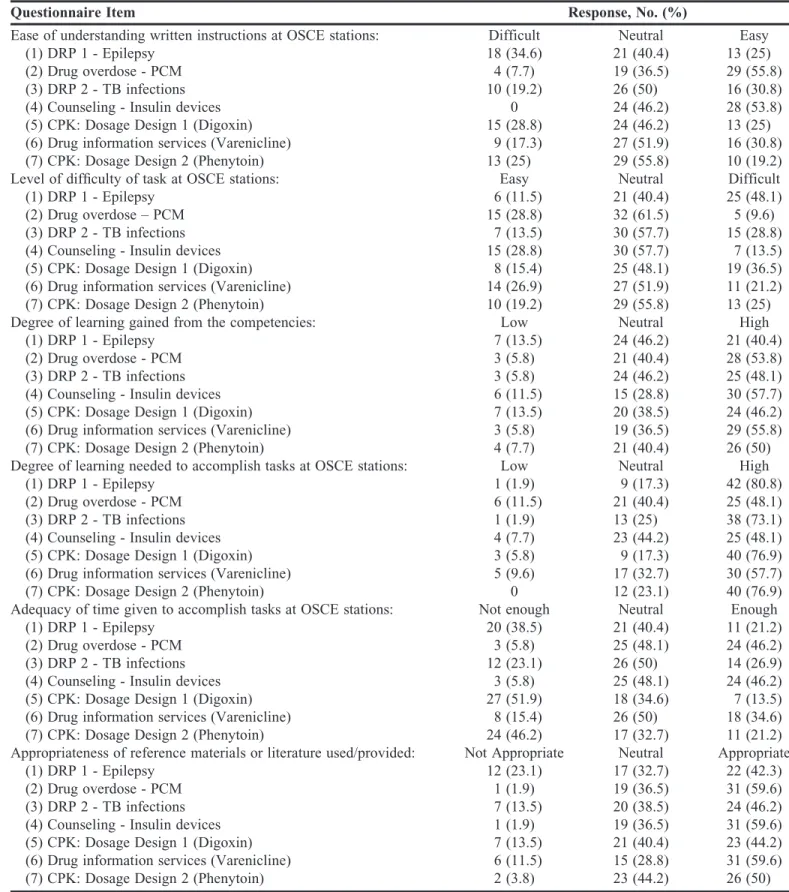
The 52 students examined via the OSCE during 2007-2008 academic session all completed the questionnaire (Table 1). The majority (76.9%) of the students were female. Students were asked to assess the comparative ease or difficulty associated with understanding instruc-tions and performing tasks at the 7 OSCE stainstruc-tions evalu-ating competence in DRPs, drug information and literature evaluation, clinical pharmacokinetics, and pa-tient education on the use of insulin delivery devices. More than 50% of the students agreed that it was easy to comprehend the written instructions provided at the station assessing their ability to counsel patients concern-ing insulin delivery devices and the station assessconcern-ing their ability to manage a paracetamol overdose, but less than 20% felt the instructions provided at the station assessing their ability to use CPK in dosing regimen design for phenytoin were clear (Table 2).
At least half of the students were neutral about the level of difficulty of the tasks at most of the stations (Table 2). More examinees (25%-48%) felt that the tasks performed at the 2 DRPs stations for tuberculosis (TB) and epilepsy competencies as well as the 2 CPK stations for digoxin and phenytoin competencies were difficult. In addition, not less than half of the students believed that a high degree of learning was gained from the following stations: paracetamol overdose management (53.8%), in-sulin delivery devices counseling (57.7%), drug informa-tion (55.8%), and phenytoin CPK (50%). Over 70% of the respondents felt that a high degree of learning was needed to accomplish the tasks at the 2 DRPs stations and the 2 CPK stations (Table 2).
Almost 50% of the students reported that the 15 min-utes allocated for completing each task was inadequate, especially for the 2 CPK stations (Table 2), whereas 46% of the students were satisfied with the amount of time given for completing the tasks at the paracetamol over-dose management station and insulin delivery devices counseling station. Table 2 shows how the respondents rated the appropriateness of the reference materials and literature resources provided at the various stations. Nearly two-thirds of the students agreed that the refer-ences and literature resources provided at the drug infor-mation station, insulin delivery devices counseling station, and paracetamol overdose station were appropriate.
Students’ Rating of Assessment Methods
Students were also asked to rate various assessment instruments in terms of difficulty, fairness, degree of learning, and their preferences on the frequency they felt the instruments should be used for assessing competen-cies. The majority of the students did not take a stance about the difficulty and fairness of all the assessment Table 1. Demographic Characteristics of Undergraduate Pharmacy Students’ Who Completed a Questionnaire Regarding an Objective Structured Clinical Examination
Characteristics No. (%)
Age, mean 23.8 years
Gender Male 12 (23.1) Female 40 (76.9) Ethnicity Malay 50 (96.2) Indian 1 (1.9) Other 1 (1.9) Examination Venue Wing A 26 (50) Wing B 26 (50)
Table 2. Students’ Rating of Competencies at Objective Structured Clinical Examination Stations (N552)
Questionnaire Item Response, No. (%)
Ease of understanding written instructions at OSCE stations: Difficult Neutral Easy
(1) DRP 1 - Epilepsy 18 (34.6) 21 (40.4) 13 (25)
(2) Drug overdose - PCM 4 (7.7) 19 (36.5) 29 (55.8)
(3) DRP 2 - TB infections 10 (19.2) 26 (50) 16 (30.8)
(4) Counseling - Insulin devices 0 24 (46.2) 28 (53.8)
(5) CPK: Dosage Design 1 (Digoxin) 15 (28.8) 24 (46.2) 13 (25)
(6) Drug information services (Varenicline) 9 (17.3) 27 (51.9) 16 (30.8)
(7) CPK: Dosage Design 2 (Phenytoin) 13 (25) 29 (55.8) 10 (19.2)
Level of difficulty of task at OSCE stations: Easy Neutral Difficult
(1) DRP 1 - Epilepsy 6 (11.5) 21 (40.4) 25 (48.1)
(2) Drug overdose – PCM 15 (28.8) 32 (61.5) 5 (9.6)
(3) DRP 2 - TB infections 7 (13.5) 30 (57.7) 15 (28.8)
(4) Counseling - Insulin devices 15 (28.8) 30 (57.7) 7 (13.5)
(5) CPK: Dosage Design 1 (Digoxin) 8 (15.4) 25 (48.1) 19 (36.5)
(6) Drug information services (Varenicline) 14 (26.9) 27 (51.9) 11 (21.2)
(7) CPK: Dosage Design 2 (Phenytoin) 10 (19.2) 29 (55.8) 13 (25)
Degree of learning gained from the competencies: Low Neutral High
(1) DRP 1 - Epilepsy 7 (13.5) 24 (46.2) 21 (40.4)
(2) Drug overdose - PCM 3 (5.8) 21 (40.4) 28 (53.8)
(3) DRP 2 - TB infections 3 (5.8) 24 (46.2) 25 (48.1)
(4) Counseling - Insulin devices 6 (11.5) 15 (28.8) 30 (57.7)
(5) CPK: Dosage Design 1 (Digoxin) 7 (13.5) 20 (38.5) 24 (46.2)
(6) Drug information services (Varenicline) 3 (5.8) 19 (36.5) 29 (55.8)
(7) CPK: Dosage Design 2 (Phenytoin) 4 (7.7) 21 (40.4) 26 (50)
Degree of learning needed to accomplish tasks at OSCE stations: Low Neutral High
(1) DRP 1 - Epilepsy 1 (1.9) 9 (17.3) 42 (80.8)
(2) Drug overdose - PCM 6 (11.5) 21 (40.4) 25 (48.1)
(3) DRP 2 - TB infections 1 (1.9) 13 (25) 38 (73.1)
(4) Counseling - Insulin devices 4 (7.7) 23 (44.2) 25 (48.1)
(5) CPK: Dosage Design 1 (Digoxin) 3 (5.8) 9 (17.3) 40 (76.9)
(6) Drug information services (Varenicline) 5 (9.6) 17 (32.7) 30 (57.7)
(7) CPK: Dosage Design 2 (Phenytoin) 0 12 (23.1) 40 (76.9)
Adequacy of time given to accomplish tasks at OSCE stations: Not enough Neutral Enough
(1) DRP 1 - Epilepsy 20 (38.5) 21 (40.4) 11 (21.2)
(2) Drug overdose - PCM 3 (5.8) 25 (48.1) 24 (46.2)
(3) DRP 2 - TB infections 12 (23.1) 26 (50) 14 (26.9)
(4) Counseling - Insulin devices 3 (5.8) 25 (48.1) 24 (46.2)
(5) CPK: Dosage Design 1 (Digoxin) 27 (51.9) 18 (34.6) 7 (13.5)
(6) Drug information services (Varenicline) 8 (15.4) 26 (50) 18 (34.6)
(7) CPK: Dosage Design 2 (Phenytoin) 24 (46.2) 17 (32.7) 11 (21.2)
Appropriateness of reference materials or literature used/provided: Not Appropriate Neutral Appropriate
(1) DRP 1 - Epilepsy 12 (23.1) 17 (32.7) 22 (42.3)
(2) Drug overdose - PCM 1 (1.9) 19 (36.5) 31 (59.6)
(3) DRP 2 - TB infections 7 (13.5) 20 (38.5) 24 (46.2)
(4) Counseling - Insulin devices 1 (1.9) 19 (36.5) 31 (59.6)
(5) CPK: Dosage Design 1 (Digoxin) 7 (13.5) 21 (40.4) 23 (44.2)
(6) Drug information services (Varenicline) 6 (11.5) 15 (28.8) 31 (59.6)
(7) CPK: Dosage Design 2 (Phenytoin) 2 (3.8) 23 (44.2) 26 (50)
CPK5clinical pharmacokinetics; DRP5drug-related problem; OSCE5Objective Structured Clinical Examination; PCM5paracetamol; TB5tuberculosis
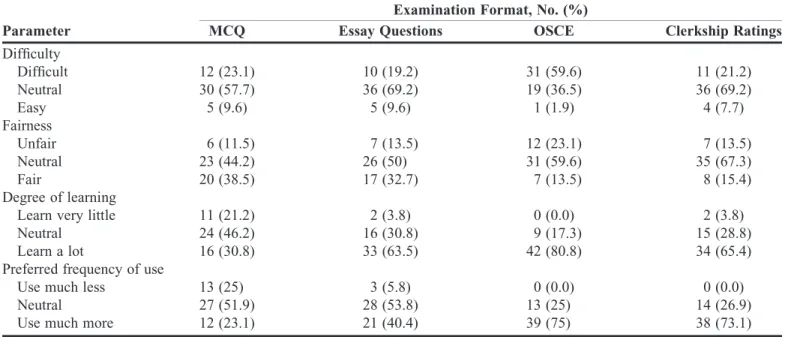
methods and remained neutral. The relative comparison of OSCE with other assessment methods in terms of dif-ficulty, fairness, degree of learning, and preferred fre-quency of use is presented in Table 3. Only 13.5% of the students felt that the OSCE was fair and nearly 60% did not take a stance. Although about two-thirds of the students rated the OSCE as a difficult form of assessment, yet about 81% perceived that they have learned a lot from it.
Multiple-choice questions were rated as the fairest (38.5%) among all assessment methods. Furthermore, students indicated that OSCEs and clerkship ratings (per-formance on clerkship assignments, presentations, and written reports) were the methods that imparted the high-est degree of learning/knowledge. In addition, over 70% of the examinees agreed that OSCE and clerkship ratings should be used much more (Table 3).
Examinees Responses to Open-Ended Questions
Several themes were identified among students’ re-sponses to each of the 3 open-ended questions. Sixteen respondents commented that the OSCE has exposed them to what seemed like ‘‘real life’’ cases and accurately mea-sured their knowledge and skills (13 comments). Other themes that emerged included: the OSCE highlighted areas of weaknesses in my skills and knowledge (8 com-ments); the OSCE enhanced my communication skills (7 comments); the OSCE was a true reflection of the skills learned from the curriculum (4 comments); I obtained additional experience and learned a lot from the OSCE (3 comments).
Fifteen of the students stated that the 15-minute limit allocated for each station (especially the CPK station) was inadequate. Students indicated that the OSCE caused them to be nervous (12 comments). Some students also felt there was inter-evaluator variability in the OSCE (9 comments). Moreover, 6 students indicated that the OSCE was an anxiety-producing and stress-inducing ex-amination. Some students also stated that instructions at some stations were ambiguous (5 comments).
Examinees recommended that the time allocated at each station be increased for future OSCEs, especially stations that involved calculations (14 comments), with 3 students stating that different tasks needed different lengths of time to complete. Other suggestions for im-provement were that the OSCE be introduced earlier in the pharmacy curriculum rather than in the final year (6 comments); that students be familiarized with the OSCE system (5 comments); and that the clarity of instructions be ensured (5 comments). Examinees also suggested that competencies receive broader coverage in the pharmacy curriculum and that additional appropriate references be provided at each station (4 comments each); that much easier questions be used (3 comments); that more empha-sis be placed on experiential training rather than theoret-ical teaching (2 comments); that staff members be more efficient and supportive (2 comments); that an activity be added to the resting station (2 comments); that other venues be used in the future; that equations be provided at each station that requires calculation; that an external evaluator be used; and that the examination be stress free.
Table 3. Bachelor of Pharmacy Students’ Rating of OSCE in Relation to Other Assessment Methods Used in Clinical Pharmacy and Therapeutics
Examination Format, No. (%)
Parameter MCQ Essay Questions OSCE Clerkship Ratings
Difficulty Difficult 12 (23.1) 10 (19.2) 31 (59.6) 11 (21.2) Neutral 30 (57.7) 36 (69.2) 19 (36.5) 36 (69.2) Easy 5 (9.6) 5 (9.6) 1 (1.9) 4 (7.7) Fairness Unfair 6 (11.5) 7 (13.5) 12 (23.1) 7 (13.5) Neutral 23 (44.2) 26 (50) 31 (59.6) 35 (67.3) Fair 20 (38.5) 17 (32.7) 7 (13.5) 8 (15.4) Degree of learning
Learn very little 11 (21.2) 2 (3.8) 0 (0.0) 2 (3.8)
Neutral 24 (46.2) 16 (30.8) 9 (17.3) 15 (28.8)
Learn a lot 16 (30.8) 33 (63.5) 42 (80.8) 34 (65.4)
Preferred frequency of use
Use much less 13 (25) 3 (5.8) 0 (0.0) 0 (0.0)
Neutral 27 (51.9) 28 (53.8) 13 (25) 14 (26.9)
Use much more 12 (23.1) 21 (40.4) 39 (75) 38 (73.1)
DISCUSSION
We believed that the characteristics of the clinical competencies assessed and/or tasks required at OSCE stations would have profound effects on examinees’ per-formance. Pharmacy students generally perceived that the tasks given at the stations assessing CPK skills and identi-fication of DRPs were difficult. There were obvious vari-ations in the students’ perceptions of OSCE stvari-ations, depending on the types of tasks they were asked to perform. This finding is in agreement with other reports and obser-vations. While the dependability of a well-constructed OSCE as an assessment tool is generally quite good, it varies significantly among stations, suggesting that the quality of students’ performance is task specific.11,12
Newble and Swanson suggested that low reliabilities of OSCEs are more likely attributed to the variability among stations due to the unique nature of the individual competency being assessed rather than to poor interrater reliability.12As a result, longer OSCE instruments, com-prised of more stations, may be required to obtain more acceptable (ie, higher) dependability coefficients and, consequently, lower standard errors of measurement.11 Similarly, the findings that the tasks performed at DRP identification/resolution stations and CPK stations were difficult were consistent, with an overwhelming propor-tion of students (over 70%) feeling that a high degree of learning was needed to accomplish the tasks at these sta-tions. The examinees felt that the DRP station regarding epilepsy was the most difficult station in terms of the tasks they were required to perform (48% believed it was dif-ficult). Furthermore, they pointed at the same station as the most difficult in terms of instructions comprehension (about 35% perceived that the instructions for this station were difficult to comprehend). These perceptions may be consistent with how the students performed at the indi-vidual OSCE stations.
Our observations are consistent with those reported in a similar setting by Corbo and colleagues from Brighton University who found that final-year undergraduate phar-macy students performed poorly in activities that de-manded an element of clinical problem identification and resolution or when performing a clinical calculation in an OSCE.5This may be partly explained by students’ nervousness whenever a task involved calculations or problem-solving skills. Clearly, different clinical compe-tencies or tasks at OSCE stations may have different de-grees of complexities and this in turn may have profound effects on the examinees performance. However, other covariates such as clarity of instructions, validity of as-sessment tools, and time allocation should be carefully controlled. These findings point to the possibilities of
students’ deficiencies, and/or clinical training deficits, and/or inadequacies in the design of some stations. In this study, about half of the students felt that the written in-structions at the drug overdose station and patient coun-seling station were easier to understand than instructions at the other stations. Those particular stations also were pointed out by the students as having ‘‘easy tasks to be completed.’’
Although we have taken steps to improve several aspects of the OSCE over the last 3 years, some issues remain unresolved. For instance, students’ criticisms that the OSCE is bias due to different examiners at parallel stations remained virtually unchanged. This was due to a shortage of resources and organizational difficulties as-sociated with conducting the OSCE, and we are working on an acceptable solution to this problem.
Despite, all the concerns raised, the OSCE has re-ceived considerable support from examinees. A substan-tial proportion of the students agreed that they gained a high degree of knowledge in all the stations of the OSCE, but felt that the OSCE format should be intro-duced earlier in the curriculum. In essence, OSCEs allow students to integrate pharmacotherapeutic knowledge, problem-solving skills, and communication and interper-sonal skills into each exercise.13The method permits par-ticipants to learn from potentially dangerous mistakes prior to an actual patient encounter. Students agreed that the time allocated in completing each task was inade-quate, especially in CPK stations. Substantial proportions of students reported difficulties with both time manage-ment and stress control. However, many examinees felt that reference materials or resources prepared in individ-ual OSCE stations were suitable and relevant.
The use of OSCE is thought to be more objective, more valid, and more reliable than most other assessment methods.14-16In order to evaluate the validity of an OSCE as an effective battery to assess clinical competence, ev-idence concerning construct validity should be gathered as described widely in the medical literature.17-19Content evidence, clarity of instructions, station developer exper-tise, and adequacy of OSCE content in relation to curric-ulum objectives should be critically examined by an appropriate panel of experts.17-19The clarity of instruc-tions could be verified further by surveying examinees.19-20 To lend additional support to the validity of an OSCE station, the majority of examinees should agree that the instructions provided are clear.
The pharmacy students in this study perceived that tasks given at clinical problem identification and resolu-tion staresolu-tions or those related to clinical pharmacokinetics calculations were difficult and a high degree of learning was needed to achieve the competencies at those stations.
These findings have highlighted possible areas of deficits in students’ knowledge and skills, and/or deficiencies in clinical training, as well as in the design of the OSCE. Future efforts should be geared towards creating clear instructions at OSCE stations and the complexity of the competencies needs to be balanced. More emphasis should be placed on clinical problem solving and identi-fication skills, as well as clinical calculations during ex-periential training. The findings from this study have important implications on students’ preparedness for ef-fective delivery of pharmaceutical care, especially as it relates to problem-solving skills and therapeutic drug-monitoring services.
Limitations
Our findings should be interpreted in the light of ma-jor limitations. First, the mama-jority of the respondents remained neutral on many questions, thereby limiting the generalizabilty of the results. Candidates’ perfor-mance was assessed by trained examiners (faculty mem-bers) using standardized checklists in each of the OSCE stations in order to achieve high interrater reliability. Since 2 parallel OSCEs were conducted, the training em-phasized consistency in grading between each pair of examiners to ensure the same scores were achieved by a student regardless of which OSCE arm he/she com-pleted. However, no data were generated to support the sufficiency of this in ensuring the validity and reliability of the examination and to determine whether high inter-rater reliability of scores was achieved. We believe that a certain degree of interrater variability may have under-mined the validity and reliability of the OSCE. In the future, an OSCE’s validity and reliability in this type of setting should be tested by using procedures such as in-ternal structure evaluation (ie, interrater reliability assess-ment) and RASCH measurements.15,17,18,21
ACKNOWLEDGEMENTS
We acknowledge with thanks the support of all fac-ulty members who were involved in the OSCE and those who provided continued support for its success.
REFERENCES
1. Monaghan MS, Vanderbush RE, McKay AB. Evaluation of clinical skills in pharmaceutical education: past, present and future.Am J Pharm Educ.1995;59(4):354-358.
2. Stowe CD, Gardner SF. Real-time standardized participant grading of an objective structured clinical examination.Am J Pharm Educ. 2005;69(3):272-276.
3. Gardner SF, Stowe CD, Hopkins DD. Comparison of traditional testing methods and standardized patient examinations for therapeutics.Am J Pharm Educ.2001;65(3):236-240.
4. Awaisu A, Nik Mohamed MH, Al-Efan QAM. Perception of pharmacy students in Malaysia on the use of objective structured clinical examinations to evaluate competence.Am J Pharm Educ. 2007;71(6):Article 118.
5. Corbo M, Patel JP, Abdel Tawab R, Davies JG. Evaluating clinical skills of undergraduate pharmacy students using objective structured clinical examinations (OSCEs).Pharm Educ.2006;6(1):53-58. 6. Rutter PM. The introduction of observed structured clinical examinations (OSCEs) to the MPharm degree pathway.Pharm Educ. 2002;1(2):173-180.
7. Rees JA, Collett JH, Crowther I, Mylrea S. Assessment of competence using a structured objective examination approach.Pharm J Supp.1991;247(Supp. Oct. 12):R32. 8. Commission to implement change in pharmaceutical education. Background paper II: Entry-level, curricular outcomes, curricular content and educational process.Am J Pharm Educ.1993;57:377-385. 9. Brandt BF. Effective teaching and learning
strategies.Pharmacother.2000;20(10 Pt 2):307S-316S.
10. Bruce SP, Bower A, Hak E, Schwartz AH. Utilization of the Center for the Advancement of Pharmaceutical Education Educational Outcomes, Revised Version 2004: Report of the 2005 American College of Clinical Pharmacy Educational Affairs Committee.Pharmacother.2006;26(8):1193-1200.
11. Fielding DW, Page GG, Rogers WT, O’Byrne CC, Schulzer M, Moody KG, Dyer S. Application of objective structured clinical examinations in an assessment of pharmacists’ continuing competency.Am J Pharm Educ.1997;61(2):117-125. 12. Newble DI, Swanson DB. Psychometric characteristics of objective structured clinical examinations.Med Educ. 1988;22(4):325-334.
13. Cerveny JD, Knapp R, DelSignore M, Carson DS. Experience with objective structured clinical examinations as a participant evaluation instrument in disease management certificate programs.Am J Pharm Educ.1999;63(4):377-381.
14. Harden RM, Gleeson FA. Assessment of clinical competence using an objective structured clinical examination (OSCE).Med Educ.1979;13(1):41-54.
15. van der Vleuten CPM, Norman GR, de Graaff E. Pitfalls in the pursuit of objectivity: issues of reliability.Med Educ. 1991;25(2):110-118.
16. Cunnington JPW, Neville AJ, Norman GR. The risks of thoroughness: reliability and validity of global ratings and checklists in an OSCE.Adv Health Sci Educ.1996;1(3):227-233.
17. Downing SM. Validity: on meaningful interpretation of assessment data.Med Educ.2003;37(9):830-837.
18. Downing SM, Haladyna TM. Validity threats: overcoming interference with proposed interpretations of assessment data.Med Educ.2004;38(3):327-333.
19. Varkey P, Natt N, Lesnick T, Downing S, Yudkowsky R. Validity evidence for an OSCE to assess competency in system-based practice and practice-based learning and improvement: a preliminary investigation.Acad Med.2008;83(8):775-780.
20. Taghva A, Mir-Sepassi GR, Zarghami M. A brief report on the implementation of an objective structured clinical examination (OSCE) in the 2006 Iranian board of psychiatry examination.Iranian Journal of Psychiatry and Behavioral Sciences (IJPBS).
2007;1(1):39-40.
21. Iramaneerat C, Yudkowsky R, Myford CM, Downing SM. Quality control of an OSCE using generalizability theory and many-faceted Rasch measurement.Adv Health Sci Educ.2008;13(4):479-493.
Appendix 1. OSCE Stations Summary
Station Competency Task/Objectives Participant/Actor and Case Description
1 DRPs Identification and Resolution (1)
To evaluate the student’s ability to assess a patient’s drug related needs in order to identify DRPs using a standard taxonomy and give evidence-based
recommendations for a
pharmacist’s care plan to resolve and/or prevent the problems.
SP: 45 y.o. male with history of
long-standing hypertension and epilepsy; receiving medications on outpatient basis. He presented with untreated anemia and PUD, hypokalemia, non-compliance, signs/symptoms of phenytoin toxicity.
2 REST STATION 1 3 Management of
Acetaminophen Overdose
To assess the student’s ability to identify a patient at the risk of liver damage due to acetaminophen toxicity; use serum drug concentration and Rumack-Matthew nomogram to predict severity of hepatotoxicity; and to recommend whether or not to give a specific antidote via N-acetylcysteine (NAC) treatment protocol.
A physician actor seeks the pharmacist’s opinion on the management of this case: A 30-year old male presented to the ED after intentional acetaminophen overdose. Decontamination was done upon patient’s arrival at the ED. Serum acetaminophen concentration was obtained.
4 PREPARATION STATION 1 To give the examinee an opportunity to review pertinent patient’s medical records related to DRPs Station 5. 5 DRPs Identification and
Resolution (2)
To evaluate the student’s ability to assess a patient’s drug related needs in order to identify and
prioritize DRPs, give recommendations to resolve and/or prevent the identified problems and determine how to monitor the therapeutic regimens.
SP: 43-year-old male diagnosed with PTB and started on DOTS 3 months prior. Now complained of increase in cough intensity along with blood-stained sputum, fever, and night sweat for the
past 1 week. Liver enzymes are elevated, red cell indices are low, and DM is uncontrolled.
6 REST STATION 2 7 Counseling on the Use of
Insulin Delivery Devices
To evaluate the student’s competence and skills to counsel and educate a patient with diabetes on the use of NovoMixÒ30FlexPenÒ
(preparation before injection, injection techniques, injection sites, and care of insulin).
SP: A 50-year old female with type 2 DM for 8 years. On a follow-up visit, her FBS was 12mmol/L, HbA1C was 10%, and her creatinine levels were rising (Clcr538mL/min). Physician decided to discontinue her OHA and prescribed inj. NovoMixÒ30 FlexPenÒ6 units to be injected two times daily. 8 CPK: Dosage Regimen
Design (1)
To assess the student’s ability to interpret therapeutic drug monitoring (TDM) results; estimate the patient’s
pharmacokinetic parameters; and provide an individualized maintenance dosing regimen recommendations.
Non-interactive: A 60 y.o. patient diagnosed with CHF was started on 0.5 mg digoxin LD PO. A cardiologist requests for TDM analysis, 24 hours after the LD (result: digoxin level50.7 mcg/L). He asks for a recommendation on the maintenance dose. 9 REST STATION 3
Appendix 1. (Continued) OSCE Stations Summary
Station Competency Task/Objectives Participant/Actor and Case Description
10 PREPARATION STATION 2 Two articles regarding a new drug for smoking cessation provided. After 15 minutes, the candidate enters the next station where a physician will make a drug information inquiry.
The same articles will be made available in Station 11.
11 Drug Information Enquiry To test the student’s ability to handle and formulate a response to a drug information enquiry in a timely manner through evaluation of relevant literature.
A physician actor (faculty member) makes an enquiry about a new drug for smoking cessation via phone.‘‘I am Dr. . .. I have heard of varenicline, the new drug for smoking cessation. I am thinking of using it for one patient of mine. Could you urgently tell me the safety, efficacy, and suitability of the drug for
the patient?’’ 12 CPK: Dosage Regimen
Design (2)
To evaluate the candidate’s ability to interpret serum drug concentration measurements; design an
individualized dosing regimen for the patient receiving phenytoin; and provide an appropriate dosing regimen recommendations to a physician.
A 42-year-old man with a history of GTC seizures and hepatic cirrhosis has been taking oral phenytoin sodium 100 mg tds for 2 weeks. He presents with the symptoms of nystagmus, ataxia, slurred speech and bradycardia. The doctor suspects that the patient experiences phenytoin toxicity and requests for TDM of the drug as well as pharmacist’s recommendations.
13 PREPARATION STATION 3 To give the examinee an opportunity to review pertinent patient’s medical records related to DRPs Station 1.
DRPs5drug-related problems; SP5standardized patient or actor; PUD5peptic ulcer disease; ED5Emergency Department; DOTS5directly observed therapy short-course; FBS5fasting blood sugar; OHA5oral hypoglycemic agent(s); LD5loading dose; PO5per oral; TDM5 therapeutic drug monitoring; GTC5generalized tonic clonic