I
AN IMPLEMENTATION OF PEAK TO AVERAGE POWER RATIO REDUCTION FOR MULTICARRIER SYSTEM
(ORTHOGONAL FREQUENCY DIVISION MULTIPLEXING)
YASIR AMER ABDUL-JABBAR
A thesis submitted in fulfillment of the requirement for the award of the Degree Masters in Electrical and Electronic Engineering
Faculty of Electrical and Electronic Engineering University Tun Hussein Onn Malaysia
V
ABSTRACT
Orthogonal frequency division multiplexing (OFDM) has been becoming more popular modulation technique in the high-speed wireless communication system. It is used especially in Large Term Evaluation technique (LTE) which depended from the fourth-generation (4G) of wireless communication system. OFDM proves high efficiency to transmit data rate as high as 100 Mbps, the capability to combat multipath fading channel and utilization the whole bandwidth. Although, OFDM technology has more advantages, the same time has some obstacles also.
The highest Peak to average power ratio (PAPR) considers the main restrict which cause non-linearity at receiving end. Coding, clipping and phase rotation among many PAPR reduction techniques are proposed to overcome this problem. In this project, we investigated the PAPR reduction performance with two PAPR reduction techniques selective mapping (SLM) and partial transmit sequence (PTS). These two PAPR reduction methods consider sub-parts of signal scrambling technique that depend on phase rotation technique in its operation.
VI
ABSTRAK
Frekuensi Ortogon Bahagian Pemultipleksan ( OFDM) merupakan teknik modulasi yang semakin popular dalam sistem komunikasi pantas tanpa wayar terutamanya teknik Large Term Evaluation ( LTE) yang berasaskan kepada sistem komunikasi tanpa wayar 4G. OFDM terbukti mempunyai keberkesanan yang tinggi untuk menghantar data dengan kadar sehingga 100 Mbps, keupayaan untuk melalui saluran pudar pelbagai arah dan penggunaan kesemua lebar jalur. Walaupun teknologi OFDM mempunyai banyak kelebihan, tetapi pada masa yang sama ia juga mempunyai banyak kekangan.
Nisbah Kuasa Puncak ke Kuasa Purata ( PAPR) merupakan kekangan utama yang menyebabkan keadaan tak linear pada bahagian penerima. Pengkodan, keratan dan putaran fasa diantara kebanyakan teknik pengurangan PAPR diutarakan untuk mengatasi masalah tersebut. Dalam projek ini, prestasi pengurangan PAPR telah dikaji dengan dua teknik PAPR iaitu selective mapping (SLM) dan Partial Transmit
Sequence (PTS). Kedua- dua teknik pengurangan PAPR ini boleh dikatakan pecahan
dari teknik gegasan isyarat yang berdasarkan kepada teknik putaran fasa dalam operasinya.
VII
CONTENTS
TITLE I DECLARATION II
DEDICATION III ACKNOWLEDGEMENT IV
ABSTRACT V
CONTENTS VII
LIST OF FIGURES XII LIST OF ABBREVIATION AND SYMBOLS XV
CHAPTER 1 INTRODUCTION 1
1.1 Introduction
1
1.2 Problem Statement 3
1.3 Objectives 4
1.4 Project Scope
4
CHAPTER 2 LITERATURE REVIEW
6
2.1 Introduction 6
2.2 OFDM System
6
VIII
2.4 Operation of OFDM 9
2.4.1 Multicarrier System and Single Carrier 12
2.4.1.1 Single carrier system basic structure 12
2.4.1.2 Multicarrier system basic structure 13
2.4.2 Cyclic Prefix of OFDM System
14
2.4.3 OFDM Advantage and Disadvantage 15
2.5 Peak-to-Average Power Ratio in OFDM
16
2.5.1 PAPR Definition 17
2.5.2 Criteria for PAPR Reduction 19
2.5.2.1 Capability of PAPR Reduction 20
2.5.2.2 Low Average Power 20
2.5.2.3 Low Complexity
20
2.5.2.4 Less Bandwidth Expansion 21
2.5.2.5 Less BER Performance Degradation 21
2.5.2.6 Less Additional Power Need 21
2.5.2.7 Good Spectral Efficiency 21
2.6 Probability Distribution Function of PAPR 22
2.7 Studying of PAPR Reduction Techniques 23
2.7.1 Signal Scrambling Methods 23
2.7.1.1 SLM Selective Mapping 23
2.7.1.2 PTS Partial Transmit Sequence 24
2.7.2 Coding Techniques 25
IX
CHAPTE 3 METHODOLOGY 27
3.1 Introduction
27
3.3.1 Flow chart Methodology 27
3.2 Peak-to-Average Power Ratio (PAPR) 29
3.3 Overall Research Work and Methodologies for Signal 30
Scrambling techniques 3.3.1 Selected Mapping Method (SLM) 31
3.3.2 Simulation of Original OFDM Signal 34
3.3.3 Simulation of SLM Scheme 35
3.3.3.1 Comparison the PAPR performance 35
of original OFDM signal and SLM reduction method. 3.3.3.2 Comparison the PAPR reduction
35
. performance for different values of M while N is fixed at 128 3.3.3.3 Comparison the PAPR reduction 36
performance for different N values while M is fixed at 8 3.4 Partial Transmit Sequence (PTS) 36
3.4.1 Proposed Techniques 39
3.4.1.1 Sub-block partition scheme 39
3.4.1.2 Suboptimal iterative algorithm 40
3.4.1.3 The proposed algorithm steps 41
3.4.2 PTS Scheme Simulation
41
X
3.4.2.1 Comparison the PAPR performance 42
original OFDM signal and PTS reduction method 3.4.2.2 PAPR reduction performance effect
42
by number of sub-blocks V 3.4.2.3 PAPR reduction performance effect
42
by different value range W 3.4.2.4 PAPR reduction performance effect 42
by different sub block partition scheme 3.4.2.5 PAPR reduction performance using 43
sub-optimal iteration algorithm 3.4.3 Comparison SLM and PTS Algorithm 43
CHAPTER 4 RESULT AND DISCUSSION 44
4.1 Introduction 44
4.2 PAPR of OFDM Multicarrier Signals 45
4.3 The influential Parameters on PAPR Performance 46
4.3.1 Number of Sub-carriers (N) 48
4.3.2 Modulation Schemes 51
4.3.3 Oversampling Rate Factor (L) 52
4.4 Selected Mapping Technique (SLM) 53
4.4.1 Influence Route Number on SLM Method 54
4.4.2 Influence Sub-carrier Number on SLM Method 55
4.5 Partial Transmit Sequences (PTS) 57
XI
4.5.2 Influence Number of Weighting Factor (W) 59
on PTS Technique 4.5.3 Influence Sub-block Partition Schemes 60
4.5.3.1 Adjacent Partition Sachem 61
4.5.3.2 Pseudo-random Partition Schemes 62
4.4.3.3 Interleaved Partition Schemes 63
4.5.3.4 Comparison The Three Types 64
of Partition Schemes 4.5.4 Sub-optimal Iterative Algorithm 65
4.6 Comparison SLM and PTS Methods 66
CHAPTER 5 CONCLUSION AND FUTURE WORKS 68
5.1 Introduction 68
5.2 Conclusion 68
5.3 Suggestions for Future Work 70
REFERENCES 72
XII
LIST OF FIGURES
NO. FIGURES PAGES
2.1 Concept of OFDM signal orthogonal multicarrier technique and 8
versus conventional multicarrier technique 2.2 Multi-carriers of OFDM signal 10
2.3 OFDM system block diagram 11
2.4 Single carrier system basic structure. 12
2.5 Multicarrier system basic structure 13
2.6 OFDM symbols with added cyclic prefix 15
2.7 An OFDM signal waveform in time domain 18
2.8 OFDM when sub-carriers are modulated by same symbols 19
2.9 SLM technique for PAPR reduction 24
2.10 Block diagram of PTS based OFDM system 25
3.1 Block diagram of PTS based OFDM system 28
3.2 Block diagram of basic principle of selected mapping 32
3.3 Block diagram of PTS algorithm 36
4.1 Normal OFDM signal power in time domain 46
4.2 OFDM signal power when modulated by same phase 46
4.3 Comparison PAPR of the normal OFDM signal and PAPR 47
XIII
4.5 Peak power values with different numbers of sub-carriers N 50
4.6 Mean power values with different numbers of sub-carriers N 50
4.7 CCDF of the PAPR performance with different modulation schemes 51
4.8 CCDF of the PAPR performance with different numbers of oversampling 52 factor L
4.9 Comparison SLM reduction method and the PAPR of original 53 OFDM signal
4.10 Comparison PAPR of original OFDM signal and SLM reduction method 54 with different route number M
4.11 Comparison PAPR of original OFDM signal and SLM reduction method 55 with different sub-carrier number (N= 256)
4.12 Comparison PAPR of original OFDM signal and SLM reduction method 56 with different sub-carrier number (N= 1024)
4.13 Comparison PAPR of original OFDM signal and PTS reduction method 57
4.14 Comparison PAPR of original OFDM signal and PTS reduction 59 method with different number of sub-block (V)
4.15 Comparison PAPR of original OFDM signal and PTS reduction method 60 with different number of sub-weighting factor (W)
4.16 Comparison PAPR of original and PTS reduction method with different 61 number of sub-block (V) using the adjacent partition scheme
XIV
4.18 Comparison PAPR of original and PTS reduction method with different 63 number of sub-block (V) using interleaving scheme
4.19 Comparison PAPR of original and PTS reduction method with different 64 number of sub-block (V) using three types of partition schemes:
interleaving, pseudo-random and adjacent partition schemes
4.20 Comparison PAPR of original and PTS reduction method with two 65 algorithms: optimal and sub-optimal algorithm
4.21 Comparison SLM method and PTS method with V and M= 4 66
4.22 Comparison SLM method and PTS method with different values 67 of V and M
XV
LIST OF ABBREVIATION AND SYMBOLS
2G Second Generation
3G Third Generations
4G Fourth Generation
IP Internet Protocol
OFDM Orthogonal Frequency Division Multiplexing
WLAN Wireless Local Area Network
WMAN Wireless Metropolitan Area Network
DVB-T Digital Video Broadcasting — Terrestrial
PAPR Peak-to-Average Power Ratio
SLM Selective Mapping Technique
PTS Partial Transmit Sequence Technique
U Correlation Detectors Factor
DFT Discrete Fourier Transforms
FFT Fast Fourier Transforms
IFFT Inverse Fast Fourier Transforms
DSP Digital Signal Processing
CP Cyclic Prefix
S/P Serial to Parallel
XVI
ADC Analog to Digital Convertor
HPA High Power Amplifier
SNR Signal-to-Noise Ratio
R Transmission Rate
Tmc Time Multichannel
N Number of sub-carrier
ISI Inter-sample interference
MCM Multi carrier modulation
di Complex Modulation Symbols
CCDF Complementary Cumulative Distribution Function
BER Bit Error Rate
M Statistical Independent Sequences (route number) in SLM technique
Pm Rotation factor or weighting factor in SLM technique
16-QAM 4-Bits (Quadrature Amplitude Modulation)
V Non-overlapping sub-block in PTS technique
bv Weighting Factor in PTS Technique
CHAPTER 1
INTRODUCTION
1.1 Introduction
2
Since bandwidth resource in 4G mobile communications is still scarce, in order to improve spectrum efficiency and achieve as high as 100Mbps wireless transmission rate, it requires more advanced techniques to be employed. The limitation of modulation schemes in existing communication systems has become an obstruction in further increasing the data rate. Hence, next generation mobile communication systems need more sophisticated modulation scheme and information transmission structure.
Orthogonal frequency division multiplexing (OFDM) has therefore been adopted due to their superior performance. It promises to become key high-speed wireless communication technologies and can provide wireless industry evolution from 3G to 4G system.
The growth of mobile wireless communications has been producing the demand for high-speed, efficient and reliable communication over the hostile wireless medium. As a modulation scheme for such applications, Orthogonal Frequency Division Multiplexing (OFDM) possesses several desirable attributes, such as immunity to the inter-symbol interference, robustness with respect to multi-path fading, and ability for high data rates. Thus, OFDM has been proposed in various wireless communication standards such as IEEE802.11a standard for wireless Local Area Networks (WLAN), IEEE802.16a standard for Wireless Metropolitan Area Networks (WMAN), digital audio/video broadcasting, Terrestrial Digital Video Broadcasting (DVB-T), the ETS1 HIPERLAN/2 standard and high-speed cellular data [3]. However, one of the major drawbacks of OFDM system has been its high Peak-to-Average Power Ratio (PAPR).
3
1.2 Problem Statement
In OFDM system, its output produces a superposition of multiple sub-carriers. In this situation, some instantaneous power outputs may increase greatly and become so far greater than the mean power of the system with the condition the phases of these carriers are same. This is defined large Peak-to-Average Power Ratio (PAPR). High PAPR is one of the biggest problems in OFDM system. To transmit signals with high PAPR, it requires power amplifiers with very high power scope. These kinds of amplifiers are very expensive and have low efficiency-cost. If the peak power is too high, it could be out of the scope of the linear region of a power amplifier. This gives an increase to non-linear region distortion which that affects and changes the superposition of the signal spectrum resulting degeneration in performance. OFDM system has encountered many restrictions in practical applications if there is no arrangement to PAPR reduction.
4
1.3 Objective
Although OFDM has some advantages that make it suitable for fading channels, it presents a high peak-to-average power ratio (PAPR), which is one of the main drawbacks of OFDM systems. The goal of this project is to analysis and investigates the PAPR reduction performance as the following:
I. To investigate the PAPR reduction performance with two different PAPR reduction techniques: partial transmit sequence (PTS) and selective mapping (SLM).
II. To study corresponding modified algorithms with consideration to balance between the performance and the applicability.
III. To analyze the comparison between two methods (SLM and PTS) and indicate the best method leading to PAPR reduction performance and less computational complexity.
1.4 Project Scope
The scopes of this project will use two techniques based on scrambling i.e. Selected Mapping (SLM) and Partial Transmit Sequence (PTS). Many scopes should be bound in order to make this project achieve the objectives:
I. In SLM method, the input data block is subjected to scramble or (rotation in phase) by U different phase sequence. The resulting data sequence generates a new sequence, among which the one with the lowest PAPR is selected for transmission.
5
III. The PAPR of the original OFDM signal is used as a reference for each comparison.
IV. The complementary cumulative distribution function (CCDF) is employed for comparison the PAPR values with different parameters.
V. 1000 samples of the OFDM signal are conducted for each process compared. VI. Simulate PAPR reduction performance and compare SLM and PTS by applying
CHAPTER 2
LITERATURE REVIEW
2.1 Introduction
In this chapter, the peak-to-average power ratio (PAPR) reduction for an orthogonal frequency-division multiplexing (OFDM) is presented. It is a method of digital modulation in which a signal is split into several narrowband channels at different frequencies. The technology was first conceived in the 1960s and 1970s, during research into minimizing interference between channels near each other in frequency.
2.2 OFDM System
The descents of OFDM development started in the late 1950‟s with the introduction of
7
implementation of the generation and reception of OFDM signals, eliminating the requirement for banks of analog subcarrier oscillators. This presented an opportunity for an easy implementation of OFDM, especially with the use of Fast Fourier Transforms (FFT), which are an efficient implementation of the DFT. This suggested that the easiest implementation of OFDM is with the use of Digital Signal Processing (DSP), which can implement FFT algorithms [13]. It is only recently that the advances in integrated circuit technology have made the implementation of OFDM cost effective. The reliance on DSP prevented the wide spread use of OFDM during the early development of OFDM. It wasn‟t until the late 1980‟s that work began on the
development of OFDM for commercial use [14], with the introduction of the Digital Audio Broadcasting (DAB) system. Cyclic prefix (CP) or cyclic extension was also first introduced by Peled and Ruiz in 1980 [15] for OFDM systems. In 1985, Cimini introduced a pilot-based method to reduce the interference emanating from the multipath and co-channels [16]. In the 1990s, OFDM was exploited for wideband data communications over mobile radio FM channels, high-bit-rate digital subscriber lines (HDSL; 1.6 Mbps), asymmetric digital subscriber lines (ADSL; up to 6 Mbps), very-high-speed digital subscriber lines (VDSL; 100 Mbps), digital audio broadcasting (DAB), and high definition television (HDTV) terrestrial broadcasting [17].
2.3 Principle of OFDM
8
[image:21.612.124.520.205.666.2]conventional non-overlapping multicarrier technique and overlapping multicarrier modulation technique. As shown in Figure 2.1, by using the overlapping multicarrier modulation technique, we save almost 50% of the bandwidth. To realize the overlapping multicarrier technique. However, we need to reduce crosstalk between subcarriers, which means that we want orthogonally between the differently modulated carriers.
9
The orthogonally of the carriers means each carrier has an integer number of cycles over a symbol period. Due to this, the spectrum of each carrier has a null at the center frequency of each of the other carriers in the system. This results in no interference between the carriers, allowing them to be spaced as close as theoretically possible. This overcomes the problem of overhead carrier spacing required in FDMA. Each carrier in an OFDM signal has a very narrow bandwidth (i.e.1 kHz), thus the resulting symbol rate is low. This results in the signal having a high tolerance to multipath delay spread, as the delay spread must be very long to cause significant inter-symbol interference (e.g. > 500 μsec).
2.4 Operation of OFDM
As stated above OFDM is a multi-carrier modulation technology where every sub-carrier is orthogonal to each other. The "orthogonal" part of the OFDM name indicates that there is a precise mathematical relationship between the frequencies of the carriers in the system. It is possible to arrange the carriers in an OFDM signal so that the sidebands of the individual carriers overlap and the signals can still be received without adjacent carrier‟s interference. In order to do this the carriers must be mathematically
orthogonal. If the integral of the product of two signals is zero over a time period, then these signals are orthogonal to each other, since the carriers are all sine/cosine wave which satisfy this criterion. If a sine wave of frequency (m) is multiplied by a sinusoid (sine or cosine) of a frequency (n), then the product is given as:
nwt
mwt
t
f
(
)
sin
*
sin
(2.1)10
wt n m n
m t
f cos( )
2 1 ) cos( 2
0 2
1 )
(
(2.2)
So when a sinusoid of frequency n multiplied by a sinusoid of frequency m, the area under the product is zero. In general, for all integers n and m, sin mx, cos nx, sin nx are all orthogonal to each other.
[image:23.612.179.464.405.631.2]These frequencies are called harmonics. As the sub-carriers are orthogonal, the spectrum of each carrier has a null at the center frequency of each of the other carriers in the system. This results in no interference between the carriers, allowing them to be spaced as close as theoretically possible. The orthogonality allows simultaneous transmission on a lot of sub-carriers in a tight frequency space without interference from each other. So on the receiver side easily we can extract the individual sub-carriers. But in traditional FDM systems overlapping of carriers are not possible, rather a guard band is provided between each carrier to avoid inter-carrier interference.
11
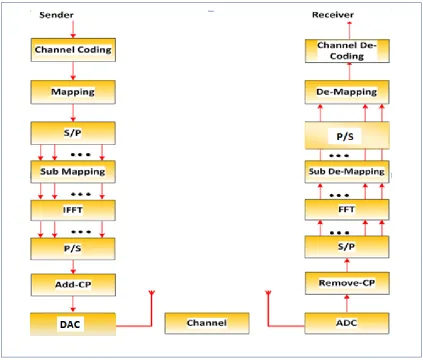
Figure 2.3 shown typical OFDM systems. At a sender, first of all, input binary serial data stream is first processed by channel encoder, constellation mapping and serial to parallel (S/P) conversion. A single signal is divided into N parallel routes after
[image:24.612.117.540.289.649.2]N-point inverse fast Fourier transform (IFFT). Each orthogonal sub-carrier is modulated by one of the N data routes independently. By the mean, the N parallel points constitute one OFDM symbol. Next, convert parallel data sequence to serial sequence and then applying cyclic prefix (CP) by copy the last samples of one symbol to the front as. Finally, processing, digital to analog (D/A) conversion and radio frequency (RF) modulation then transmit the signal.
12
At the receiver end, firstly, demodulate received signals then demodulated signals are converted from analog to digital (A/D) converter, sample output and take time estimation to find an initial position of OFDM symbol. The CP added in transmission process is removed and N-Points fast Fourier transforms (FFT) transformation will be conducted on the sample points to recover the data in the frequency domain. Finally, the output of baseband demodulation is passed to the channel decoder to recover the original data.
2.4.1 Multicarrier System and Single Carrier
2.4.1.1 Single Carrier System Basic Structure
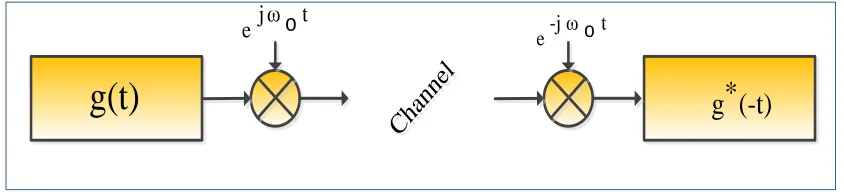
In the single carrier system, the signals are pulse-formed through transmitter filter g (t) before being applied for the multi-path channel. The incoming signal at the receiver is passed over receiving match filter g*(-t) to make as large the signal-to-noise ratio (SNR). Figure 2.4 shows the single carrier system basic structure diagram.
Cha
nnel
Cha nnel
t j ω
e o e-j ωot
[image:25.612.129.551.500.596.2]g(t)
g
*
(-t)
13
2.4.1.2 Multicarrier System Basic Structure
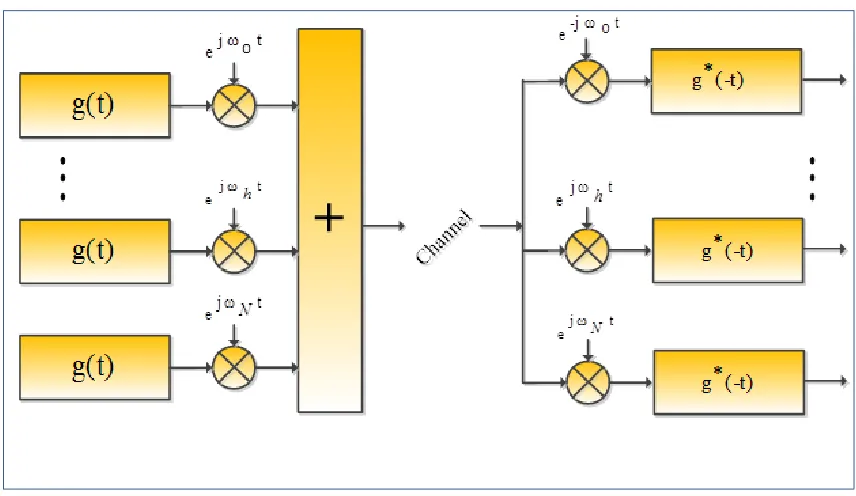
[image:26.612.113.541.368.616.2]In a multicarrier system, input signals which are divided by a multiplexer are applied to pulse-formed g(t) filters before being transmitted through multipath environment. Correspondingly, the receiving ends consist of N parallel paths. Each one is passed through a respective match filter g*(-t) to realize maximum SNR. The basic structure diagram of a single the multi-carrier system is shown in Figure 2.5. In a classical wireless communication model, the transmitted signal arrives at the receiver via various paths. Thus, extracting the original signal at the receiving end becomes extremely difficult. If the signal is transmitted at time intervals T, then the parameter concerning the multipath channel is the delay 𝜏𝑚𝑎𝑥 of the longest path with respect to the earliest path. The received signal can be theoretically influenced by 𝜏𝑚𝑎𝑥 / 𝑇 previous signals, which must be considered seriously by receiver [20].
Figure 2.5: Multicarrier system basic structure.
14
rate R is multiplexed into N parallel data streams with rate 𝑅𝑚𝑐=1/𝑇𝑚𝑐=R/N. Each of the sub streams is modulated with a different sub-carriers frequency and all the data streams are transmitted in the same band. In this case, the ISI of each sub-system reduces to 𝜏𝑚𝑎𝑥/𝑇𝑚𝑐 =𝜏𝑚𝑎𝑥/𝑁∙𝑇. As the value of N increases, inter-symbol interference (ISI) becoming decreases.
In a single carrier system, fading or interference can make the entire link fail. However, in the multi-carrier system, only a small part of sub-carriers will be affected. Error correction coding methods can be employed to correct the errors which were happening in sub-carriers. OFDM is a special form of multicarrier modulation (MCM), in which a signal is transmitted over a number of lower rate sub-carriers.
2.4.2 Cyclic Prefix of OFDM System
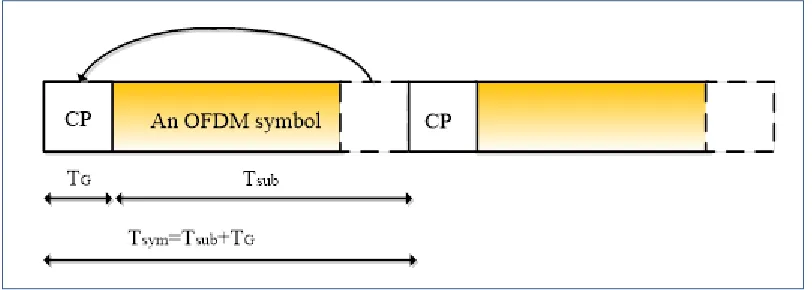
In OFDM system, the use of Cyclic Prefix (CP), can ensure signals Orthogonality even when they travel multi-path channels [21]. To avoid ISI, the case; 𝑇𝐺>𝑇𝑚𝑎𝑥 should be satisfied, where the 𝑇𝐺 is the CP length, while the maximum delay spread is 𝑇𝑚𝑎𝑥 [22].
Figure 2.6 shown, the copy of the later part is CP for OFDM symbol moved into the front of the symbol. On the assumption that, 𝑁𝐺 is an extended OFDM symbol number, consequently the T+𝑇𝐺, is practical OFDM symbol period, where FFT transform cycle is T, and the guard interval length is 𝑇𝐺, while inserting toward suppress ISI through multipath distortion. Can be included CP into OFDM symbol showing in below equation:
1
0
1
2
1
0
,
,
,
,
,N
G
N
,n
N
tn
π
j
e
n
i
i
d
x
nt
t
(t)
'
S
n
'
15
[image:28.612.124.530.193.338.2]Where di is the complex modulation symbols, the process between the channel and signal changes from linear convolution to cyclic convolution when is used the CP in OFDM system. The linear weighing will be used in the frequency domain. These one changes sidestep inter-symbol interference when guarantee orthogonality between the sub-carriers in all time.
Figure 2.6: OFDM symbols with added cyclic prefix.
2.4.3 OFDM Advantage and Disadvantage
OFDM is vastly used for communication method working within combating multi-path distortion. The OFDM applications have been extended from high radio frequency (HF) of communication to telephone networks, digital audio broadcasting and digital television terrestrial broadcasting. The OFDM method of multi-carrier modulation has several advantages compared with single carrier modulation.
I. Advantages:
1. Makes efficient use of the spectrum by allowing overlap.
2. By dividing the channel into the narrowband flat fading sub channels, OFDM is more resistant to frequency selective fading than single carrier systems are.
16
4. Using proper channel coding and interleaving one can recover symbols lost due to the frequency selectivity of the channel.
5. Channel equalization becomes simpler than by using adaptive equalization techniques with single carrier systems.
6. It is possible to use maximum likelihood decoding with reasonable complexity.
7. OFDM is computationally efficient by using FFT techniques to implement the modulation and demodulation functions.
8. Is less sensitive to sample timing offsets than single carrier systems are.
9. Provides good protection against co-channel interference and impulsive parasitic noise channel equalization becomes simpler than by using adaptive equalization techniques with single carrier systems.
II. Disadvantages:
1. The OFDM signal has a noise like amplitude with a very large dynamic range. Therefore, it requires RF power amplifiers with a high peak to average power ratio.
2. It is more sensitive to carrier frequency offset and drift than single carrier systems.
2.5 Peaks-to-Average Power Ratio in OFDM System
17
2.5.1 PAPR Definition
Theoretically, large peaks in OFDM system can be expressed as Peak-to-Average Power Ratio, or referred to as PAPR, in some literatures, also written as PAR. It is usually defined as [24]:
2
n
x
E
2
n
x
max
10
10log
average
P
peak
P
PAPR
(2.4)
Where 𝐸 [∙] denotes the expected value, 𝑥𝑛 represents the transmitted OFDM signals which are obtained by taking IFFT operation on modulated input symbols 𝑋𝑘.
Mathematical, 𝑥𝑛is expressed as:
nk
N
w
N
k
x
k
N
n
x
1
0
1
(2.5)
In an OFDM system when the carriers are divided into N sub-carriers, the peak power at the received signal equal N times of the average power with respect to the same phase values. Theoretically the PAPR of received signal will be maximum at PAPR (dB) = 10log 𝑁. For example, if we have 16 sub-carriers in the system, the PAPR will reach a maximum value 12 dB, the value considers the theoretical hypothesis. However, in reality the probability of PAPR to reach this maximum is very low.
18
Figure 2.7: An OFDM signal waveform in the time domain [20].
The special case happens when signal subcarriers are modulated by symbols which have the same initial phase. For example, we have an input binary sequence contains „1‟ for the whole sequence. After PSK constellation mapping (modulation) and
IFFT operation, the instant power reaches its theoretical maximum. Figure 2.8 shows the result when input binary sequence contains 16 „1‟, denoted by
[1111111111111111].
19
Figure 2.8: OFDM when subcarriers are modulated by the same phases [20].
From Figure 2.8, we can conclude the amplitude (dB) of OFDM signal reaches the peak value when the input sequence has very large of consistency. At the same time, the maximum PAPR value will be reached as well as the same condition.
2.5.2 Criteria for PAPR Reduction
20
acceptable technique, that technique must reduce the PAPR and BER largely plus the following performance factors must be considered for OFDM based system.
2.5.2.1 Capability of PAPR Reduction
The primary factor of selecting PAPR reduction technique is the capability of PAPR reduction. A technique is considered best if it reduces PAPR largely. Out Of Band radiation (OOB) and In Band (IB) distortion are few considerable factors for selecting a technique
2.5.2.2 Low Average Power
A technique must reduce PAPR as well as the average power of the signal not increased from an acceptable region. If so it will require a large linear region for operation in High Power Amplifier (HPA), which will increase the BER rate of the OFDM system.
2.5.2.3 Low Complexity
21
2.5.2.4 Less Bandwidth Expansion
Some techniques such as scrambling techniques need side information, which increase the bandwidth usage. Some coding techniques also expand the bandwidth due to code rate generation. A technique must not increase the bandwidth in value which causes degradation in the throughput.
2.5.2.5 Less BER Performance Degradation
The main goal of the PAPR reduction technique is to gain better performance, including BER as compared to the conventional OFDM system.
2.5.2.6 Less Additional Power Need
The technique required no additional power for PAPR reduction, as it will degrade the BER performance of the system plus power efficiency is the main goal of wireless based systems.
2.5.2.7Good Spectral Efficiency
22
2.6 Probability Distribution Function of PAPR
In accordance to the centric limit theorem, for sub-carriers great number in multi-carrier signal, the sample values real and imaginary part in time-domain will obey Gaussian distribution with mean 0 and variance of 0.5 average values. For that, the multi-carrier signals amplitude follows Rayleigh distribution with zero average and N times difference, and the one complex sinusoid difference [25]. Its power value comply the
𝜒2
distribution with zero average and freedom 2 degrees. The Cumulative Distribution Function (CDF) written as follows:
)
exp(
1
)
(
z
z
F
(2-6)On the assumption that the different sub-channels, sampling values are reciprocally freelance, and free for oversampling operation, the PAPR probability distribution function less than the confirmed threshold value, then equation written as follows:
N
z
N
z
F
z
PAPR
P
(
<
)
(
)
(
1
exp(
))
(2-7)PAPR in reality it favored to take into account the probability exceeding and the index measuring the threshold for a representation of the distribution of PAPR. Thus, it can be called as a “Complementary Cumulative Distribution Function” (CCDF), and is
written as:
N
z
N
z
F
z
PAPR
P
z
PAPR
23
2.7 Studying of PAPR Reduction Techniques
There are many different algorithms that have been proposed to solve the high PAPR problem of OFDM system. These reduction solutions can be roughly divided into three categories:
2.7.1 Signal Scrambling Methods
The essential precept of this method is to scramble every OFDM signal with various scrambling sequences while it‟s smallest for transmission of PAPR value. Obviously,
this method does not ensure that to decrease the value of PAPR lower to a certain threshold, but it can decrease the high PAPR appearance probability to a great range. Thus, this approach type implicates, firstly the Selective Mapping SLM and then the Partial Transmit Sequences PTS. Appling scrambling rotation of SLM technique to all carriers autonomously, but scrambling of PTS technique applied to the part of sub-carriers. The two techniques can be considered to apply each scenario without constraint within sub-carriers number and modulation type. Nevertheless, in order to indicate the successful recovery at the receiver, additional information is needed. That leads to the use of low-bandwidth and high-complexity hardware implementation.
2.7.1.1 SLM Selective Mapping
24
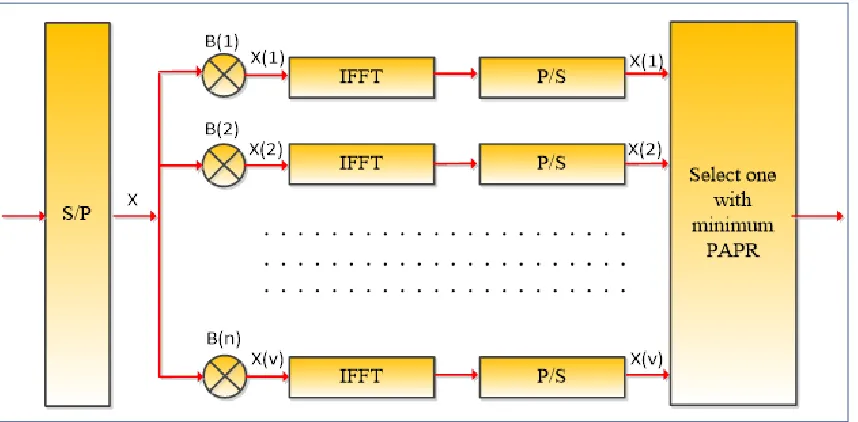
[image:37.612.122.551.173.384.2]altered data block for vth phase, where v = 1, 2… V with all data blocks, the data block with minimum PAPR should be selected for transmission. Side information about the selected phase (Vth phase) must be sent to the receiver for decoding the received signal.
Figure 2.9: SLM technique for PAPR reduction.
2.7.1.2 PTS (Partial Transmit Sequence)
In the literature PTS is another popular PAPR reduction technique. It partitioned the input data blocks into dissimilar data blocks of N symbols, then weighted these subcarriers dissimilar blocks with phase sequence. The block diagram of thePTS based
27
REFERENCES
[1] K. Srinivasarao, B. Prabhakararao, and M. Sairam, "PEAK-TO-AVERAGE POWER REDUCTION IN MIMO-OFDM SYSTEMS USING SUB-OPTIMAL ALGORITHM," International Journal of Distributed & Parallel
Systems, vol. 3, 2012.
[2] K. Young Kyun and R. Prasad, "4G Roadmap and Emerging Communication Technologies. Artech House," ISBN 1-58053-931-9.
[3] J. Hou, J. Ge, D. Zhai, and J. Li, "Peak-to-average power ratio reduction of OFDM signals with nonlinear companding scheme," Broadcasting, IEEE
Transactions on, vol. 56, pp. 259-263, 2010.
[4] I. Baig and V. Jeoti, "DCT precoded Selective Mapping technique for PAPR reduction in OFDM systems," in Intelligent and Advanced Systems (ICIAS),
2010 International Conference on, 2010, pp. 1-6.
[5] C.-P. Li, S.-H. Wang, and C.-L. Wang, "Novel low-complexity SLM schemes for PAPR reduction in OFDM systems," Signal Processing, IEEE
Transactions on, vol. 58, pp. 2916-2921, 2010.
[6] X. Ouyang, J. Jin, and Z. Wang, "A low complexity peak-to-average power ratio reduction method for OFDM systems," in Communications and Networking in China (CHINACOM), 2011 6th International ICST Conference
on, 2011, pp. 114-117.
[7] M. Naeiny and F. Marvasti, "Selected Mapping Algorithm for PAPR reduction of space-frequency coded OFDM systems without side information,"
Vehicular Technology, IEEE Transactions on, vol. 60, pp. 1211-1216, 2011.
[8] I. Baig and V. Jeoti, "On the PAPR reduction in OFDM systems: a novel ZCT precoding based SLM technique," Journal of Engineering Science and
27
[9] J. Hou, J. Ge, and J. Li, "Peak-to-average power ratio reduction of OFDM signals using PTS scheme with low computational complexity," Broadcasting,
IEEE Transactions on, vol. 57, pp. 143-148, 2011.
[10] D. Guel and J. Palicot, "FFT/IFFT pair based digital filtering for the transformation of adding signal PAPR reduction techniques in tone reservation techniques," in Wireless and Mobile Communications, 2009. ICWMC'09. Fifth
International Conference on, 2009, pp. 200-204.
[11] D.Guel, J. Palicot, and Y. Louët, "Tone reservation technique based on geometric method for orthogonal frequency division multiplexing peak-to-average power ratio reduction," IET communications, vol. 4, pp. 2065-2073, 2010.
[12] S. B. Weinstein, "The history of orthogonal frequency-division multiplexing [History of Communications]," Communications Magazine, IEEE, vol. 47, pp. 26-35, 2009.
[13] N. J. LaSorte, W. J. Barnes, and H. H. Refai, "The History of Orthogonal Frequency Division Multiplexing," in GLOBECOM, 2008, pp. 3592-3596.
[14] C. Ciochina and H. Sari, "A review of OFDMA and single-carrier FDMA," in
Wireless Conference (EW), 2010 European, 2010, pp. 706-710.
[15] A. Peled and A. Ruiz, "Frequency domain data transmission using reduced computational complexity algorithms," in Acoustics, Speech, and Signal
Processing, IEEE International Conference on ICASSP'80., 1980, pp.
964-967.
[16] L. J. Cimini, "Analysis and simulation of a digital mobile channel using orthogonal frequency division multiplexing," Communications, IEEE
Transactions on, vol. 33, pp. 665-675, 1985.
[17] E. Panayirci, H. Senol, and H. V. Poor, "Joint channel estimation, equalization, and data detection for OFDM systems in the presence of very high mobility,"
27
[18] M. Ergen, "Principles of OFDM," in Mobile Broadband, ed: Springer, 2009, pp. 109-175.
[19] U. S. Jha and R. Prasad, OFDM towards fixed and mobile broadband wireless
access: Artech House, Inc., 2007.
[20] N. Kaneda, Q. Yang, X. Liu, S. Chandrasekhar, W. Shieh, and Y.-K. Chen, "Real-time 2.5 GS/s coherent optical receiver for 53.3-Gb/s sub-banded OFDM," Journal of lightwave technology, vol. 28, pp. 494-501, 2010.
[21] D. Qu, Z. Wang, and T. Jiang, "Extended active interference cancellation for sidelobe suppression in cognitive radio OFDM systems with cyclic prefix,"
Vehicular Technology, IEEE Transactions on, vol. 59, pp. 1689-1695, 2010.
[22] K. Nagatomi, H. Kawai, and K. Higuchi, "Complexity-reduced MLD based on QR decomposition in OFDM MIMO multiplexing with frequency domain spreading and code multiplexing," EURASIP Journal on Advances in Signal
Processing, vol. 2011, p. 5, 2011.
[23] P. Variorum, W. F. Al-Azzo, and B. M. Ali, "A low complexity partial transmit sequence scheme by use of dummy signals for PAPR reduction in OFDM systems," Consumer Electronics, IEEE Transactions on, vol. 56, pp. 2416-2420, 2010.
[24] Y. Wang, W. Chen, and C. Tellambura, "A PAPR reduction method based on artificial bee colony algorithm for OFDM signals," Wireless Communications,
IEEE Transactions on, vol. 9, pp. 2994-2999, 2010.
[25] B. Farhang-Boroujeny and C. H. Yuen, "Cosine modulated and offset QAM filter bank multicarrier techniques: a continuous-time prospect," EURASIP
Journal on Advances in Signal Processing, vol. 2010, p. 6, 2010.
[26] J. Hou, J. Ge, D. Zhai, and J. Li, "Peak-to-average power ratio reduction of OFDM signals with nonlinear companding scheme," Broadcasting, IEEE
27
[27] M. Sabbaghian, Y. Kwak, B. Smida, and V. Tarokh, "Near Shannon limit and low peak to average power ratio turbo block coded OFDM," Communications,
IEEE Transactions on, vol. 59, pp. 2042-2045, 2011.
[28] J. Hou, J. Ge, and J. Li, "Peak-to-average power ratio reduction of OFDM signals using PTS scheme with low computational complexity," Broadcasting,
IEEE Transactions on, vol. 57, pp. 145-149, 2011.
[29] C.-P.Li, S.-H.Wang, and C.-L. Wang, "Novel low-complexity Selective mapping schemes for PAPR reduction in OFDM systems," Signal Processing,
IEEE Transactions on, vol. 58, pp. 2916-2921, 2010.
[30] I. Baig and V. Jeoti, "PAPR reduction in OFDM systems: Zadoff-Chu matrix transform based pre/post-coding techniques," in Computational Intelligence, Communication Systems and Networks (CICSyN), 2010 Second International
Conference on, 2010, pp. 373-377.
[31] H.-L. Hung, "Using evolutionary computation technique for trade-off between performance peak-to average power ration reduction and computational complexity in OFDM systems," Computers & Electrical Engineering, vol. 37, pp. 57-70, 2011.
[32] H.-L. Hung and Y.-F. Huang, "Peak-to-average power ratio reduction in orthogonal frequency division multiplexing system using differential evolution-based partial transmit sequences scheme," Communications, IET,
vol. 6, pp. 1483-1488, 2012.
[33] J.-C. Chen, "Partial transmit sequences for PAPR reduction of OFDM signals with stochastic optimization techniques," Consumer Electronics, IEEE
Transactions on, vol. 56, pp. 1229-1234, 2010.
[34] N. Taspinar, A. Kalinli, and M. Yildirim, "Partial transmit sequences for PAPR reduction using parallel tabu search algorithm in OFDM systems,"
Communications Letters, IEEE, vol. 15, pp. 974-976, 2011.
27
[36] Hyun-Seung Joo, Jong-Seon No," A New Subblock Partitioning Scheme Using Sub block Partition Matrix for PTS", Broadcasting, IEEE Transactionson ,
International Conference on, 2011, pp. 127 – 128.
[37] J.-C. Chen, "Application of quantum-inspired evolutionary algorithm to reduce PAPR of an OFDM signal using partial transmit sequences technique,"
Broadcasting, IEEE Transactions on, vol. 56, pp. 110-113, 2010.
[38] L. Hsinying,C. Houshou and W. Chao-Ming. 2009. A modified partial transmit sequence with PAPR reduction and error correction in 16-QA OFDM systems. In: Intelligent Signal Processing and Communications Systems, 2008. ISPACS2008, International Symposium on. pp. 1-4.
[39] L. Wang and J. Liu, "PAPR reduction of OFDM signals by Partial transmit sequance with grouping and recursive phase weighting methods,"
Broadcasting, IEEE Transactions on, vol. 57, pp. 299-306, 2011.
[40] A. Goel, P. Gupta and M. Agrawal. 2012. SER analysis of Partial transmit sequance based techniques for PAPR reduction in OFDM systems. Digital Signal Processing.

![Figure 2.2: Multi-carriers of OFDM signal [20].](https://thumb-us.123doks.com/thumbv2/123dok_us/8762121.894515/23.612.179.464.405.631/figure-multi-carriers-of-ofdm-signal.webp)
![Figure 2.7: An OFDM signal waveform in the time domain [20].](https://thumb-us.123doks.com/thumbv2/123dok_us/8762121.894515/31.612.142.505.92.397/figure-ofdm-signal-waveform-time-domain.webp)
![Figure 2.8: OFDM when subcarriers are modulated by the same phases [20].](https://thumb-us.123doks.com/thumbv2/123dok_us/8762121.894515/32.612.146.505.91.393/figure-ofdm-subcarriers-modulated-phases.webp)