IMPROVEMENT OF FUZZY NEURAL NETWORK USING MINE BLAST ALGORITHM FOR CLASSIFICATION OF MALAYSIAN SMALL MEDIUM
ENTERPRISES BASED ON STRENGTH
KASHIF HUSSAIN TALPUR
A thesis submitted in
fulfillment of the requirement for the award of the Degree of Masters of Information Technology
Faculty of Computer Science and Information Technology Universiti Tun Hussein Onn Malaysia
v
ABSTRACT
ABSTRAK
Rangkaian Neural Kabur dengan integrasi Logik Kabur, Rangkaian Neural dan teknik pengoptimuman bukan sahaja menyelesaikan isu “Black Box” di dalam Kecerdasan Rangkaian Neural tetapi juga berkesan dalam pelbagai aplikasi dunia sebenar. Walaupun iany menarik penyelidik dalam tahun-tahun kebelakangan ini dan mengatasi sistem inferens kabur lain, Sistem Inferens Adaptive Neuro-Fuzzy
TABLE OF CONTENTS
DEDICATION iii
ACKNOWLEDGEMENT iv
ABSTRACT v
ABSTRAK vi
TABLE OF CONTENTS vii LIST OF TABLES x
LIST OF FIGURES xii LIST OF ALGORITHMS xiv
LIST OF SYMBOLS AND ABBREVIATIONS xv
LIST OF APPENDICES xix
LIST OF PUBLICATIONS xix
CHAPTER 1 INTRODUCTION ... 1
1.1 Research Background 1 1.2 Problem Statement 5 1.3 Aims of Study 6 1.4 Objective of Study 6 1.5 Scope of Study 7 1.6 Significance of Study 7 1.7 Project Schedule 8 1.8 Outline of the Thesis 8 CHAPTER 2 LITERATURE REVIEW ... 10
2.1 Introduction 10
2.2 Applications of ANN, FNN, and ANFIS in Business
and Economics 11
2.3 Comparative Study of ANFIS 14
ix 2.4.1.1 Initialize Population and Algorithm
Parameters 18
2.4.1.2 Evaluate Fitness of Population Individuals 19 2.4.1.3 Generate New Population 19 2.4.2 Decision Parameters of Population-based
Algorithms 21
2.5 Fuzzy Neural Network – FNN 21
2.6 Adaptive Neuro-Fuzzy Inference Systems – ANFIS 22
2.6.1 ANFIS Structure 23
2.6.2 ANFIS Learning 26
2.7 Mine Blast Algorithm – MBA 27
2.7.1 Basic Concepts 27
2.7.2 How MBA Works 28
2.7.3 Setting the User Parameters 33
2.7.4 Steps of MBA 33
2.8 Improved Mine Blast Algorithm – IMBA 34
2.9 Summary of the Chapter 35
CHAPTER 3 RESEARCH METHODOLOGY ... 37
3.1 Introduction 37
3.2 Research Framework 38
3.3 The Proposed Accelerated Mine Blast Algorithm
(AMBA) 40
3.4 The Proposed ANFIS Optimization 41
3.4.1 The Proposed Two Pass Algorithm 44
3.5 Summary of the Chapter 46
CHAPTER 4 RESULTS AND ANALYSIS ... 47
4.1 Introduction 47
4.2 Performance Validation on Industry and Benchmark
Problems 48
4.3 Data for Experiments 49
4.3.1 Collecting Datasets 50
4.3.1.1 Industry Data 50
4.3.1.2 University of California Irvine Machine
4.3.2 Data Preprocessing 52
4.3.3 Data Partitioning 52
4.4 The Iris Classification Problem 52
4.5 The Breast Cancer Classification Problem 54
4.6 The Glass Classification Problem 56
4.7 Construction of Malaysian SME Classification Model 58
4.8 The SME Classification Problem 59
4.9 Analysis and Discussion 61
4.10 Summary of Chapter 64
CHAPTER 5 CONCLUSIONS AND FUTURE WORK ... 65
5.1 Introduction 65
5.2 Contribution of the Research 66
5.3 Recommendations for Future Work 67
REFERENCES 68
APPENDIX A 74
APPENDIX B 75
xi
LIST OF TABLES
2.1 ANFIS optimization and training approaches 16 2.2 Decision parameters of GA, PSO, MBA, and
IMBA 21
2.3 ANFIS Two-Pass Learning Algorithm (Cruz et
al., 2009) 26
2.4 Glossary of terms and parameters used in MBA
(Sadollah et al., 2012) 28
3.1 Proposed two pass learning algorithm for
ANFIS 43
4.1 Dataset instances for classification problems 52 4.2 Common parameters of ANFIS and
optimization algorithms in Iris Classification
problem 53
4.3 Distinguishing parameters of optimization
algorithms in Iris Classification problem 54 4.4 Summary of optimization algorithms’
performances in Iris Classification problem 54 4.5 Common parameters of ANFIS and
optimization algorithms in Breast Cancer
classification problem 55
4.6 Distinguishing parameters of optimization algorithms in Breast Cancer classification
problem 55
4.7 Summary of optimization algorithms’ performances in Breast Cancer classification
4.8 Common parameters of ANFIS and
optimization algorithms in Glass classification
problem 57
4.9 Distinguishing parameters of optimization
algorithms in Glass classification problem 57 4.10 Summary of optimization algorithms’
performances in Glass classification problem 58 4.11 Common parameters of ANFIS and
optimization algorithms in SME classification
problem 60
4.12 Distinguishing parameters of optimization
algorithms in SME classification problem 60 4.13 Summary of optimization algorithms’
performances in SME classification problem 61
xiii
LIST OF FIGURES
2.1 Flow of population-based algorithms 18 2.2 Layered Architecture of FNN (Kruse, 2008) 22 2.3 Adaptive Neuro-Fuzzy Inference System
(Rutkowski et al., 2012) 23
2.4 ANFIS architecture (Shoorehdeli, Teshnehlab,
& Sedigh, 2009) 24
2.5 Schematic view of the mine blast algorithm including exploration (color lines) and
exploitation (black lines) processes (Sadollah et
al., 2012) 32
2.6 Schematic of the MBA optimization process including the exploration phase (concentric lines) and the exploitation phase (solid lines)
(Sadollah et al., 2012) 32
3.1 Step by Step Process 38
3.2 Research Framework 39
3.3 The Proposed ANFIS Training and
Optimization Process 44
3.4 Forward pass of the proposed ANFIS
optimization algorithm 45
3.5 Backward pass of the proposed ANFIS
LIST OF ALGORITHMS
2.4.4 Mine Blast Algorithm 26
3.5.1 The Proposed Two Pass ANFIS Learning
xv
LIST OF SYMBOLS AND ABBREVIATIONS
𝑎 - Reduction constant in MBA
𝐴𝑖 - ith fuzzy set of input variable 𝐴 for ANFIS
𝐵𝑖 - ith fuzzy set of input variable 𝐵 for ANFIS
𝑐 - Center parameter of Gaussian type membership
function
𝑐1, 𝑐2 - Acceleration coefficients in PSO
cos(𝜃) - Represents calculation of direction of shrapnel
pieces in MBA
𝑑𝑛+1𝑓 - Distance of shrapnel pieces in MBA
𝐹𝑛+1𝑓 - Function value of currently exploding landmine in MBA
𝐹𝑛𝑓 - Function value of best landmine in MBA
4𝑓𝑖 - Node function for ith rule
𝑓(𝑥) Fitness function
𝜎 - Width parameter of Gaussian type membership
function
∏ - Product operator to calculate firing strength of ith rule in ANFIS
𝜃 - Direction
𝑘 - Iteration number index of MBA
𝑚𝑛+1𝑓 - Direction of shrapnel pieces in MBA
𝑁𝑑 - Search dimension
𝑁𝑝𝑜𝑝 - Population of MBA
𝑁𝑠 - Number of shrapnel pieces in an individual of population in MBA
𝑂2,𝑖 - Output of ith node in layer 2 of ANFIS 𝑂3,𝑖 - Output of ith node in layer 3 of ANFIS 𝑂4,𝑖 - Output of ith node in layer 4 of ANFIS 𝑂5,𝑖 - Output of ith node in layer 5 of ANFIS 𝑂𝑎𝑣𝑔 - Average of selected rules’ output
𝑂𝑡 - Target output in training pair
𝑂𝑚𝑡 - Target output of mth training pair
𝑂𝑟 - Rule output
𝑝𝑖 - Consequent parameter of ith rule, Personal best location of particle in PSO
𝑝𝑔 - Global best location in PSO
𝑞𝑖 - Consequent parameter of ith rule
𝑟𝑖 - Consequent parameter of ith rule
𝑟𝑎𝑛𝑑 - generates uniformly distributed random numbers
between 0 and 1
𝑟𝑎𝑛𝑑𝑛 - Normally distributed pseudorandom number
𝜇 - Exploration factor
𝜇𝐴𝑖(𝑥) - ith membership function of input variable 𝐴 𝜇𝐵𝑖(𝑥) - ith membership function of input variable 𝐵 𝑣𝑖 - Velocity of ith particle in PSO
𝑣𝑚𝑎𝑥 - Maximum velocity in PSO
𝑤𝑖 - Firing strength of ith rule in ANFIS
𝑤̅𝑖 - Normalized firing strength of ith rule in ANFIS
𝑤(𝑘) - Inertia weight in PSO
𝑥𝑖 - Position of particle in PSO
𝑋𝐵𝑒𝑠𝑡 - Current best exploding landmine in IMBA
𝑋𝑏𝑒𝑠𝑡−1 - Previous best exploding landmine in IMBA
𝑋𝑒(𝑛+1)𝑓 - Location of exploding landmine in MBA
𝑋𝑛+1𝑓 - Location of next landmine to be exploded in MBA
𝑋0𝑓 - First shot point in MBA
𝑋𝑛𝑓 - Location of best landmine in MBA
xvii 𝐷 - Euclidean distances between current best point
solution and current point of explosion in IMBA.
𝐿𝐵 - Lower bound
𝑆𝐸 - Squared Error
𝑈𝐵 - Upper bound
AMBA - Accelerated Mine Blast Algorithm
ANFIS - Adaptive Neuro-Fuzzy Inference System
AWPSO - Adaptive Weighted Particle Swarm Optimization
ACO - Ant Colony Optimization
ABC - Artificial Bee Colony
ANN - Artificial Neural Network
BP - Backpropagation
CBR - Case Based Reasoning
CSO - Cat Swarm Optimization
CRM - Customer Relationship Management
DE - Differential Equation
DEACS - Differential Evolution with Ant Colony Search
DTW - Dynamic Time Warping
EKF - Extended Kalman Filter
FA - Firefly Algorithm
FFRLS - Forgetting Factor Recursive Least Square
FIS - Fuzzy Inference System
FNN - Fuzzy Neural Network
GA - Genetic Algorithm
GD - Gradient Descent
IMBA - Improved Mine Blast Algorithm
IQPSO - Improved Quantum behaved Particle Swarm
Optimization
ISO - International Organization for Standardization
LSE - Least Square Estimation
MRS - Manufacturing and Manufacturing Related
Industries
MF - Membership Function
MBA - Mine Blast Algorithm
NN - Neural Network
PSO - Particle Swarm Optimization
QPSO - Quantum behaved Particle Swarm Optimization
SVD - Singular Value Decomposition
SME - Small Medium Enterprises
SCORE - SME Competitiveness Rating For Enhancement
SE - Squared Error
SOP - Standard Operating Procesure
UCI - University of California Irvine
UCIMLR - University of California Irvine Machine Learning Repository
xix
LIST OF APPENDICES
A Table A.1: Gantt Chart of Research Activities 74 B Table B.1: SME Definition by Size of
Operation (SME Corporation Malaysia, 2014) 75
LIST OF PUBLICATIONS
Journal Articles
(i) Kashif Hussain, Mohd. Najib Mohd. Salleh. “Optimization of Fuzzy Neural Network using APSO for Predicting Strength of Malaysian SMEs”, Asian Journal of Control. (In Press)
(ii) Kashif Hussain, Mohd. Najib Mohd. Salleh, Abdul Mutalib Leman. “Optimization of ANFIS using Mine Blast Algorithm for Predicting Strength of Malaysian Small Medium Enterprises”, Journal of Intelligent & Fuzzy Systems. (In Press)
(iii) Kashif Hussain, Mohd. Najib Mohd. Salleh. “Analysis of Techniques for ANFIS Rule-Base Minimization and Accuracy Maximization”, ARPN Journal of Engineering and Applied Sciences. (In Press)
(iv) Khalid Hasnan, Aftab Ahmed, Badrul-Aisham, Qadir Bukhsh, Kashif Hussain. “A Novel Optimal RFID Network Planning by MC-GPSO”, International Journal of Control and Automation. (In Press)
Conference Presentations
(i) 10th Asian Control Conference 2015 (ASCC'15). Kota Kinabalu, Sabah, Malaysia. 31st May – 3rd June 2015
(ii) The International Conference on Electrical and Electronic Engineering 2015 (IC3E'15). Melaka, Malaysia. 10-11 August 2015
(iii) 12th International Conference on Fuzzy Systems and Knowledge Discovery (FSKD'15). Zhangjiajie, China. 15-17 August 2015
CHAPTER 1
INTRODUCTION
Artificial Neural Networks (ANNs) suffer from the difficulty of explaining their decisions (black box) which confines their applicability in practice. Fuzzy Neural Networks (FNNs) solve this by adding rules to neural networks but they lack effective learning capability. The adaptive nature of Adaptive Neuro-Fuzzy Inference System (ANFIS) has not only outperformed ANNs and other types of fuzzy expert systems, but also has proved its applicability in a wide variety of areas including business and finance. However, most of the applications of soft computing techniques including ANFIS have been proposed for large firms using financial information. But, in small business sector which contributes to employment generation, gross domestic product (GDP) and sustainable economic growth of a country has been ignored. In rapidly changing global business environment, Malaysian small and medium enterprises (SMEs) are facing new challenges and also the fear of failing has increased. Thus, forecasting the strength of an SME and its ability to repay over the period of loan have been major concerns of lending institutions.
1.1 Research Background
syndrome that more or less has limited their applications in practice (Fu-yuan, 2008). The “black box” refers to an issue of inability of NN to show how it made up to an output. Once a decision is made then it is very difficult to explain the reason behind it (Pradhan et al., 2011). To overcome this drawback, NNs are integrated with fuzzy inference to form Fuzzy Neural Networks (FNNs). Such hybrid systems combining fuzzy logic, neural networks, optimization techniques, and expert systems are proving their effectiveness in a wide variety of real-world problems (Fuller, 1995).
Various optimization techniques/learning algorithms have been used with NNs to reduce the cost of learning. These algorithms search through solution space to find a function that has the smallest possible cost. Most of these algorithms are based on numerical linear and nonlinear programming methods that require substantial gradient information and usually seek to improve the solution in the neighborhood of a starting point. The gradient search may become difficult and unstable when the objective function and the constraints have multiple or sharp peaks. To improve learning capability of FNN, many researchers have optimized the training process by various metaheuristic algorithms like Genetic Algorithm (GA) which is based on the genetic process of biological organisms, and Particle Swarm Optimization (PSO) or Ant Colonies which are modeled on swarm intelligence (Liu
et al., 2013; Pousinho et al., 2011). Recently, Sadollah et al. (2012) have introduced metaheuristic algorithm Mine Blast Algorithm (MBA) which has outperformed GA, PSO, and their variants in terms of convergence speed and better optimal solutions. The improved variant of MBA has been introduced by Sadollah et al. (2014). This research further accelerates its convergence speed by modifying exploitation phase and calling the new variant as Accelerated MBA (AMBA).
3 in ANFIS architecture and effective ANFIS parameter training using AMBA. It reduces fuzzy rules in ANFIS structure to obtain optimized rule-set so that acceptable accuracy could be achieved.
Many statistical and artificial intelligence (AI) techniques (Bakar et al., 2012; Liu et al., 2010; Pederzoli et al., 2010; Zhou et al., 2010) have been proposed for finding strength of a business in the form of bankruptcy/default/distress prediction and credit risk assessment, like Altman Z-Score, linear regression, logistic regression, classification trees, logit model, ANN, FNN, but mostly they have trended towards financial statements or financial ratios. These financial factors have been useful for determining financial crisis of a large firm. However, SMEs have their special features which make them distinct from larger ones in operating style, firm structure and decision making procedure (Wang et al., 2011). Moreover, unlike larger firms, they are not equipped with dedicated resources to manage risks therefore they sometimes fail to ensure sustainability (Clusel et al., 2013). These small firms are very centered on the entrepreneurs and their skills in areas like management, marketing and production etc. These non-financial factors, in globally challenging environment, play more important role for the success of an SME (Zulkifli-Muhammad et al., 2009).
i. Business Performance
There are different indicators which gage performance of a business. These include revenue, marketing, and client satisfaction. The sales revenue is further divided into revenue of the current year, average percentage of growth in last 3 years’ revenue, average percentage of the export services derived from the last 3 years. The other component of gaging business performance is marketing which is observed in terms of medium of marketing used and amount served for this purpose. The third and last area of evaluating business performance is customer satisfaction which is further evaluated by answering 3 questions. These questions are related to importance of the customer feedback, how feedback is utilized to improve business, and whether or not the SME has dedicated staff for Client Relationship Management (CRM).
ii. Financial Capability
Lending organizations always look for great financial capabilities of SMEs in order to smoothly receive repayments. SME’s financial capability imitates ability to manage day-to-day financial operations. The financial capability of an SME is assessed by the value of 7 head in the financial statements for the current year. These variables include the amount of current assets, current liabilities, stakeholder equity, total assets, gross profit, net profit, and retained earnings.
iii. Technical Capability
SME’s technical capabilities are firmly founded on a competent, capable and talented team of professionals. Technically strong SMEs are more capable of generating sales because they are equipped with technical resources which include men, machines, processes and materials that are used in the industry. There are 3 different sub-factors which are considered in this area. These include percentage of both technical and management staff, number of qualified staff (both technical and management), and type of process technology utilized.
iv. Production Capability
5 v. Innovation
Doing the same business in the same old way and expecting different results is not going to work for any business today. In globally challenging business environment, innovation in SMEs means doing business with creativity and diversity; i.e. by making use of social media, internet business and website etc.
vi. Quality System
Quality is not just about reliability of product or service that is offered by a business, but it involves quality checks in each step from production process to delivery to customer. Here, the standard operation procedures (SOPs) of various activities, at different levels, performed in SME are evaluated. The quality system certifications (i.e. ISO, Halal etc.) and other awards, if achieved by the SME, are also verified. vii. Management Capability
Unlike larger firms, SMEs fail due to incapable owner-managers. Management capability leads an SME to sustainable growth and survival in difficult times. This variable of SCORE system gages high-level strategic and management functions in a company. The vision and mission statements, company organogram, employee training and appraisal system are sought. In addition, strategy for encouraging innovation and use of information technology is also assessed.
1.2 Problem Statement
SMEs are integral part of Malaysian economic growth. Malaysian SMEs contribute not only to domestic economic sustainability but also to export demands significantly. Thus, the government organizations need to identify the needy SMEs for their support by classifying SMEs based on their strength. On the other hand, before extending a loan, financing institutions need to determine the strength of a potential counterparty in order to expect smooth repayments and reduce non-performing loans. In case of SMEs, non-financial factors play more important role as they mostly rely on skills and capabilities of entrepreneurs.
ANFIS network using metaheuristic algorithms but very few have considered optimizing its rule-base. Thus, there is a need of effective training and rule-base optimization technique for ANFIS which may help reduce its computational time. So far, many optimization and learning algorithms have been developed, hybridized, and improved by modifying one or the other parameters they accept; like in case of Improved GA, Hybrid GA, and Quantum Behaved PSO etc. An efficient evolutionary algorithm should take less processing time and achieve higher accuracy. A newly developed Mine Blast Algorithm (MBA), when compared with several well-known metaheuristic algorithms (i.e. GA, PSO, DE etc.) while solving unconstrained and constrained engineering problems, has shown faster convergence and better optimal solutions. MBA is improved by Improved MBA (IMBA) but it can be further improved by modifying its exploitation phase. To accelerate convergence of IMBA, the previous best solution can be replaced by the current available solution.
This research proposes an effective technique for training ANFIS parameters and optimizing its rule-base. This technique is then integrated with Mine Blast Algorithm after improving its convergence. The optimized ANFIS is then employed to classify Malaysian SMEs based on their strength.
1.3 Aims of Study
The aim of this research project is to accelerate the convergence speed of Mine Blast Algorithm (MBA) by modifying its exploitation phase; calling it Accelerated MBA (AMBA). This research also aims at reducing fuzzy rule-base of ANFIS architecture by proposing optimization technique to achieve optimized rule-set with better accuracy. For effective training and optimization of ANFIS network, AMBA is used. This optimized ANFIS network is employed to model classification of Malaysian SMEs based on strength using non-financial factors as its inputs.
1.4 Objective of Study
7 (i) To accelerate the convergence speed of Mine Blast Algorithm (MBA) by
modifying its exploitation phase; calling it Accelerated MBA (AMBA); (ii) To apply AMBA to optimize fuzzy rule-base in Adaptive Neuro-Fuzzy
Inference System (ANFIS) architecture and effectively train ANFIS parameters to achieve better accuracy for modeling classification of Malaysian SMEs based on strength.
(iii) To evaluate Objective II, compare the results with the ANFIS optimized by Genetic Algorithm (GA), Particle Swarm Optimization (PSO), MBA and Improved MBA (IMBA), respectively, in terms of optimized rule-set, accuracy, and number of iterations.
1.5 Scope of Study
This research was focused on the following solutions to the problem:
Classifying Malaysian SMEs based on strength. Only the small and medium sized firms that come under the definition provided by SME Corporation Malaysia (see Appendix B for SME definition) were part of this research. The firms that did not fulfill the definition were not considered in this research.
The SME classification model used 7 non-financial factors as inputs and each input is limited to two membership functions: “Low” and “High”.
Optimization of ANFIS, using AMBA, to classify Malaysian SMEs based on strength.
The performance of the proposed method was compared with the ANFIS networks optimized by Genetic Algorithm (GA), Particle Swarm Optimization (PSO), MBA and Improved MBA (IMBA), respectively. The results were compared and analyzed in terms of optimized rule-set, accuracy, and number of iterations.
1.6 Significance of Study
SME Corporation Malaysia and other lending organizations will be able to forecast firm’s ability to repay over the life of the loan. The management of SMEs will know the problems they are about to face and, where appropriate, take corrective actions.
1.7 Project Schedule
This project was carried out in one and a half year. The summary of activities during the research process has been stated in APPENDIX A.
1.8 Outline of the Thesis
This thesis comprises of five chapters including Introduction and Conclusion chapters. The followings are synopsis of each chapter.
Chapter 1: Introduction. Apart from providing an outline of the thesis, this chapter contains an overview of the research background, problem to be solved, objectives to achieve, scope, aim, and significance of the study.
Chapter 2: Literature Review. This chapter reviews some of the work on soft-computing techniques that has already been applied by researchers while solving problems related to finance and economics. After reviewing existing research, fundamental theory of fuzzy neural network and ANFIS along with their architecture, learning mechanism and applications has been presented. This is followed by introducing the targeted optimization algorithm for ANFIS learning that is MBA. Its improved version that already exists has also been presented in the end of this chapter. This chapter lays the foundation for introducing the proposed method for ANFIS optimization and its efficient learning through modified MBA – as described in Chapter 3.
9
Chapter 4: Results and Analysis. The new rule-base optimization algorithm for ANFIS, in integration the proposed AMBA, is further validated for its efficiency and accuracy on industry and benchmark problems. The performance of the proposed algorithm was tested in comparison with GA, PSO, and standard MBA and its variant IMBA. The performance evaluation was carried out based on optimized rule-set, accuracy, and number of iterations to converge.
CHAPTER 2
LITERATURE REVIEW
2.1 Introduction
Fuzzy Neural Networks (FNNs) have been widely applied in business and economics like supply chain management, stock market, price prediction, gas condensate, energy consumption, electric load forecasting etc. (Kar et al., 2014). Practically, there exist three types of fuzzy systems: pure fuzzy systems, Mamdani type and Sugeno type fuzzy inference systems (Liu et al., 2004). But, the most commonly used is Sugeno model since it is computationally less expensive and more transparent than other counterpart models (Awadallah et al., 2009). Adaptive Neuro-Fuzzy Inference System (ANFIS) is the first order Sugeno-type FNN which uses derivative based learning which has high probability of falling in local minima. The derivative-free techniques using metaheuristic algorithms are more powerful for ANFIS learning (Shoorehdeli et al., 2009). Thus, this research improves the newly developed metaheuristic algorithm Mine Blast Algorithm (MBA) by modifying its exploitation phase. The modified MBA is then used for training parameters of ANFIS and optimizing its rule-set.
11 Blast Algorithm (MBA) and its variant Improved MBA (IMBA) are presented in the Sections 2.7 and 2.8, respectively. The chapter is summarized in Section 2.9.
2.2 Applications of ANN, FNN, and ANFIS in Business and Economics
Many have contributed to research in the financial areas such as predicting financial crisis, bankruptcy and credit risk. Additionally, soft computing techniques have also been employed for currency, stock, and gold price forecast. But, no significant research is found on modeling small and medium enterprises (SMEs) strength/failure/distress or credit rating prediction using fuzzy neural networks – ANFIS specifically. Artificial Neural Networks (ANNs) have been widely used in business and finance because they have outperformed traditional statistical models in terms of accuracy (Chen, 2013). FNN, particularly ANFIS, has not only solved the “Black Box” issue of ANN but also achieved more accuracy than ANN models (Fang, 2012; Huang, 2008; Rui, 2010). Moreover, ANFIS models have gained more popularity than FNNs due to the advantage of computationally efficient, well-adaptable with optimization and adaptive techniques (Neshat et al., 2011; Petković et al., 2014).
Rui (2010) used FNN trained by improved PSO to present bankruptcy prediction and risk evaluation model for corporate firms listed in China stock market. The presented model utilized financial ratios. The results obtained indicate that the predictive accuracies of improved PSO trained FNN are much higher than the one trained by standard PSO. The research concluded that both ANN and PSO more or less suffer from slow convergence and also involve in local optimum solution.
Recently, Bagheri et al. (2014) proposed a hybrid artificial intelligence technique for foreign exchange trading advice. They implemented a hybrid of ANFIS, Quantum behaved PSO (QPSO), Dynamic Time Warping (DTW), and Wavelet Transform (WT). In this research, QPSO was used to tune membership functions of ANFIS while WT method was employed for automatic extraction of patterns from a financial time series. Instead of just predicting the price of stock, the proposed model could help traders by making correct trading signals based on both chart patterns and past exchange rate values. Chen (2013) also used PSO for ANFIS structure learning through subtractive clustering. He presented a model for predicting business failure, using 13 financial ratios, targeting electronics companies listed on Taiwan Stock Exchange Corporation. Chen found that neural network models are not suitable for adaptive learning because they face the issues of choosing optimal initial structure, inability to arriving at local minimum, and incapability of explaining their decisions. The same year, Nhu et al. (2013) trained ANFIS parameters by Firefly Algorithm (FA) to propose stock price prediction model for Vietnam Stock Market. They stated in their research that obtaining optimum parameters of ANFIS is the main problem in its implementation. Their proposed ANFIS with FA outdid the performance of models trained by PSO, back-propagation and the standard Hybrid learning in Matlab Tool Box. For the forecast of financial crisis, Fang (2012) proposed ANFIS based model which performed better than ANN. Like other authors mentioned above, Fang also focused corporate firms as well as financial information as input to the proposed model.
13 systems is quite tedious job. Thus, they suggested putting more emphasis on the training algorithms to properly select optimum parameters. For future work, the authors foresee more innovation in ANFIS learning mechanisms as well as huge scope of ANFIS applications in economics.
For optimizing fuzzy rule-base in ANFIS architecture, Rini et al. (2014) integrated PSO with ANFIS. They reduced the number of rules by placing threshold value on rule’s firing strength. The research found acceptable accuracy with optimal number of rules while testing their proposed approach on six benchmark classification problems. On the other hand, Gorzalczany (2001) also suggests in his book “Computational intelligence systems and applications: neuro-fuzzy and fuzzy neural synergisms” that pruning weaker rules from the fuzzy rule-base of ANFIS improves interoperability of the system.
As Shoorehdeli et al. (2009) suggest that metaheuristic algorithms are more useful than derivative based training of ANFIS architecture, so MBA can be applied for ANFIS training and optimization. MBA was introduced by Sadollah et al. (2012) which outperformed GA, PSO and their variants in terms of convergence speed and optimal solutions while solving several truss structure optimization problems. The improved version of MBA, namely Improved MBA (IMBA), was also proposed by Sadollah et al. (2014). This time, they replaced the aspect of direction by distance between the current best solution and the previous one; in exploitation phase of MBA. Even though, MBA was improved by modifying its exploitation phase, it can still be improved by focusing just on the distance between current best exploding point and the point of current explosion.
A review of literature in this section and a comparative analysis in Section 2.3 show three major gaps to be filled in research: (1) Despite of outperforming other metaheuristic algorithm, in terms of convergence speed and optimal solutions, MBA can still be improved by modifying its exploitation phase; (2) Effective training and optimization methods of ANFIS architecture are still required in order to achieve more accuracy with optimum rule-set in less computational cost; (3) Most of the research, related to business and finance with applicability of FNNs and ANFIS, has been trended towards large firms and financial information – ignoring SMEs and their important non-financial factors.
focused on the distance between current best exploding point and the point of current explosion, instead of considering both the current best and previous best points of explosion. This way it further improved the speed of convergence. For optimizing ANFIS rule-base and effectively training its parameters, this research proposed a modified two-pass learning algorithm for ANFIS using AMBA. The ANFIS optimized by AMBA was then employed to model classification of Malaysian SMEs based on strength using non-financial factors as inputs.
2.3 Comparative Study of ANFIS
Significant research has been carried and various hybrid methods have been developed by researchers for optimizing ANFIS structure and training its parameters. Structure learning and parameters identification are the two dimensions of ANFIS training. Some have focused on either of the two dimensions while some have tried to work on both of the issues. But, keeping balance between reducing the complexity of the ANFIS structure and increasing its accuracy by parameter tuning is often a challenge.
The original ANFIS proposed by Jang (1993) uses hybrid learning mechanism; a combination of gradient descent (GD) for tuning antecedent parameters and least square estimation (LSE) for consequent parameters identification. But, the drawbacks of GD, including complexity and tendency to trap in local minima, have opted the researchers to different alternatives. These alternatives comprise of metaheuristic optimization algorithms. The basic idea behind these population based optimization algorithms is to create a population of solution candidates. These solution candidates iteratively explore the search space and exchange information, thus chances of converging on the global minima are significantly increased.
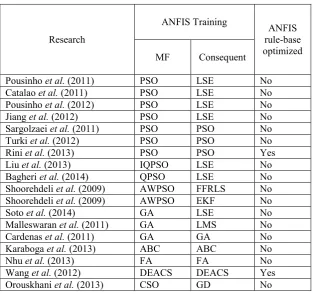
15 As literature shows, (Catalao et al., 2011; Jiang et al., 2012; Pousinho et al., 2011, 2012) have used PSO in combination with LSE to train antecedent and consequent parameters of their ANFIS models, respectively. They just focused on parameter learning, did not optimize fuzzy rule-set in their ANFIS architecture. They developed their ANFIS based prediction models for predicting electricity prices, wind power and customer satisfaction for a new product. Turki et al. (2012) and Rini et al. (2013) applied PSO alone for training both the premise and consequent parameters of their ANFIS based models. Rini et al. (2013) also used PSO for ANFIS training. In addition to parameter identification, they also optimized fuzzy rule-base by applying threshold value on the rules’ firing strength.
Other than standard PSO, variants of this optimizer have also been employed to ANFIS learning. Bagheri et al. (2014) proposed Foreign Exchange Market trend forecasting system using ANFIS tuned by Quantum-behaved PSO (QPSO). Whereas, Liu et al. (2013) improved QPSO for tuning membership functions (MFs) of ANFIS, and identified consequent parameters by LSE. Another variant Adaptive Weighted PSO (AWPSO) with, one of least square methods, Forgetting Factor Recursive Least Square (FFRLS) was proposed by Shoorehdeli et al. (2009) for identification of premise and consequent parameters, respectively. The same authors Shoorehdeli et al. (2009) improved their previous research by employing Extended Kalman Filter (EKF), another form of least square methods, with AWPSO.
Other than PSO, as empirical study suggests, GA is the second most common approach to ANFIS identification. Soleimani et al. (2012) deployed GA and Singular Value Decomposition (SVD) for the optimum design of both Gaussian MFs and linear coefficients of the network, respectively. GA in combination with least square methods is implemented by Soto et al. (2014) and Malleswaran et al. (2011) to acquire optimum ANFIS network. The prior research used ANFIS for solving classification problem while the later one chose ANFIS to predict the values of Longitude and Altitude. Cardenas et al. (2011) trained all the parameters of ANFIS using GA alone for energy load forecast.
(2012) were among others who, together with parameter identification, also optimized the rule-base by pruning redundant rules through threshold value on rules’ firing strength. Cat Swarm Optimization (CSO) algorithm has also been proposed by Orouskhani et al. (2013) in conjunction with GD to train MFs and linear coefficients, respectively. Table 2.1 lists ANFIS training and optimization approaches discussed above.
Table 2.1: ANFIS optimization and training approaches
Research
ANFIS Training ANFIS
rule-base optimized
MF Consequent
Pousinho et al. (2011) PSO LSE No
Catalao et al. (2011) PSO LSE No
Pousinho et al. (2012) PSO LSE No
Jiang et al. (2012) PSO LSE No
Sargolzaei et al. (2011) PSO PSO No
Turki et al. (2012) PSO PSO No
Rini et al. (2013) PSO PSO Yes
Liu et al. (2013) IQPSO LSE No
Bagheri et al. (2014) QPSO LSE No
Shoorehdeli et al. (2009) AWPSO FFRLS No
Shoorehdeli et al. (2009) AWPSO EKF No
Soto et al. (2014) GA LSE No
Malleswaran et al. (2011) GA LMS No
Cardenas et al. (2011) GA GA No
Karaboga et al. (2013) ABC ABC No
Nhu et al. (2013) FA FA No
Wang et al. (2012) DEACS DEACS Yes
Orouskhani et al. (2013) CSO GD No
17 and Wang et al. (2012) are among other researchers, mentioned in Table 2.1, have tried obtaining useful rule-set by pruning less-important rules. They tried to perform accuracy maximization and complexity minimization simultaneously in order to achieve ANFIS systems with acceptable accuracy and high interpretability. But, Rini
et al. (2014) also observed that optimizing the network with respect to one criterion, may poorly satisfy the other. Thus, choosing the right optimization method and training algorithm is crucial to efficient design of ANFIS network.
For the purpose of reducing complexity or, in other words, reducing the number rules, this research proposed optimization technique for obtaining optimum rule-set. To efficiently optimize and train ANFIS network, a newly developed optimization algorithm Mine Blast Algorithm (MBA) was employed for the first time with ANFIS. Before doing this, the research first modified MBA, calling it Accelerated MBA (AMBA), to improve its efficiency of finding optimum solution in less number of iterations. According to the scope of this study, performance of AMBA was compared with GA, PSO, and original MBA and IMBA; in integration with ANFIS. To better explore the possibility of improvement in these optimizers, below is the differences highlighted.
2.4 Difference between GA, PSO, MBA and IMBA
Nature-inspired optimization algorithms have become increasingly popular in recent years. Even though, they are widely accepted, it does not mean that we keep developing new algorithms of such kind. This will only lead to distraction from finding solutions of genuine challenges and problems in optimization. Instead, there is an immense need of digging in into the nature of these algorithms and solve key problems to make them more efficient (Yang, 2010).
2.4.1 Three Steps of Population-based Algorithms
[image:35.595.153.479.236.526.2]There are three steps each population-based algorithm goes through: initializing population, evaluating fitness of the individuals in a population, generating new population. These steps are performed until any of the two stopping criteria have reached: optimal or acceptable solution found or maximum number of generations produced as shown in Figure 2.1.
Figure 2.1: Flow of population-based algorithms
2.4.1.1 Initialize Population and Algorithm Parameters
All specified algorithms initialize their parameters and population in this step i.e. population size, maximum number of iterations and other performance related parameters. These parameters are influential to solution quality and cost in term of computational time. Poor choice of these parameters may result in low convergence, getting stuck to local minima and undesirable solutions (Sadollah et al., 2014). Since, new population initialization may produce infeasible candidate solutions, it is
Start
Initialize Algorithm parameters Initialize Population
Evaluate fitness of individuals
Stopping Criteria Met?
Generate new population
Stop Yes
19 important to choose right population representation. This is common for all optimization algorithms (Kachitvichyanukul, 2012).
GA, PSO, and MBA produce chromosomes, particles and shrapnel pieces as population individuals, respectively. GA calls it generation of chromosomes, PSO terms it as swarm of particles, while MBA refers to landmines in a minefield. MBA starts with an initial point(s) called first shot point(s) and generates initial population with first shot point(s). The choice of first shot point(s) may lead the search to different locations. MBA sets its initial parameters like reduction factor (𝛼), exploration factor (𝜇), and maximum number of iterations (for detail refer to Section 2.7). All these algorithms initialize their population with random values.
2.4.1.2 Evaluate Fitness of Population Individuals
After a population is available, the main task is to find the optimal solution among solution candidates. The fitness function, which evaluates individuals, is defined by the user. It gives score to each individual based on how well it performed on a given task i.e. the value of difference between actual and desired output. Optimization algorithms select the individual from a population based on score it holds – potential solution. GA evaluates fitness of chromosomes and ranks them accordingly. PSO assesses the swarm of particles and records the historical best location of each particle, referred to as personal best location. PSO also updates overall best location thus far in the swarm, called global best location. The goal of MBA, in this process, is to explode the mines and find the most explosive mine with shrapnel pieces causing most casualties.
2.4.1.3 Generate New Population
In GA, after fitness evaluation, some individuals go through stochastic transformation by means of genetic operations (selection, crossover and mutation) to form new individuals. There are many crossover and mutation methods which are chosen in accordance to the problem being solved. In selection, two best chromosomes or solutions are selected and then the operation of crossover is performed to generate new chromosomes or generation. This new generation is injected some diversity by mutation function.
Just like GA, PSO also generates new population based on the optimum solutions found so far. Two key operations of PSO are the update of velocity and update of the position of particles. The velocity is updated with respect to inertia weight, experience of the particle and experience of the whole swarm as follows:
𝑣𝑖(𝑘 + 1)
= 𝑤(𝑘)𝑣𝑗(𝑘) + 𝑐1𝑟𝑎𝑛𝑑1(𝑝𝑖 − 𝑥𝑖(𝑘)) + 𝑐2𝑟𝑎𝑛𝑑2(𝑝𝑔− 𝑥𝑖(𝑘)) (2.1)
where 𝑣𝑖 is 𝑖th velocity element in the vector 𝑣 in iteration 𝑘. 𝑤(𝑘) is inertia weight, 𝑟𝑎𝑛𝑑𝑖 and 𝑟𝑎𝑛𝑑2~𝑈(0,1) are random variables, whereas 𝑐1> 0 and 𝑐2 > 0 are acceleration coefficients influencing particle’s personal best location 𝑝𝑖 and global
best location 𝑝𝑔, respectively. Then particles move to new location 𝑥𝑖(𝑘 + 1) as
follows:
𝑥𝑖(𝑘 + 1) = 𝑥𝑖(𝑘) + 𝑣𝑖(𝑘 + 1) (2.2)
where 𝑥𝑖(𝑘) is the current position of the 𝑖th particle.
Unlike GA, PSO does not require ranking of particles based on their fitness values. Thus, saving computing cost over GA. Also, update of velocity and position for generating new swarm does not need multiple operations, as in case of GA. This is done by simple arithmetic equations.
21 2.4.2 Decision Parameters of Population-based Algorithms
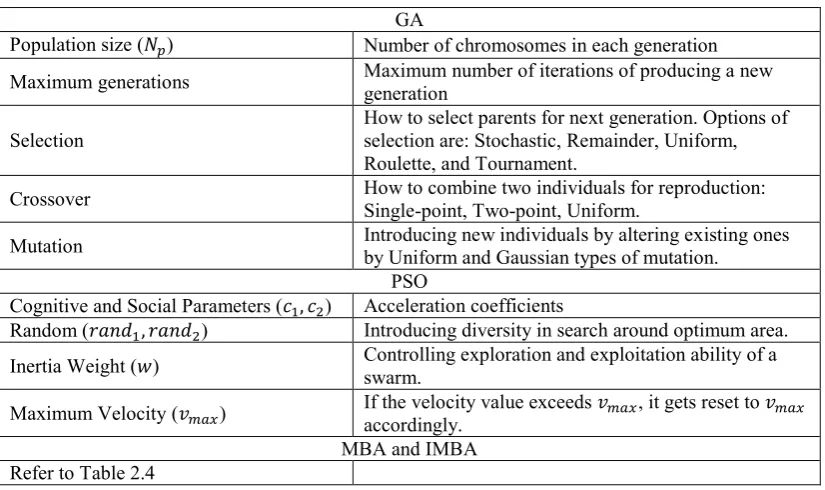
[image:38.595.114.527.218.463.2]Table 2.2 lists parameters which need to be predefined by the user. These parameters influence the performance of below mentioned metaheuristic algorithms in finding optimum solutions with efficient convergence.
Table 2.2: Decision parameters of GA, PSO, MBA, and IMBA GA
Population size (𝑁𝑝) Number of chromosomes in each generation
Maximum generations Maximum number of iterations of producing a new generation
Selection How to select parents for next generation. Options of selection are: Stochastic, Remainder, Uniform, Roulette, and Tournament.
Crossover How to combine two individuals for reproduction: Single-point, Two-point, Uniform.
Mutation Introducing new individuals by altering existing ones by Uniform and Gaussian types of mutation. PSO
Cognitive and Social Parameters (𝑐1, 𝑐2) Acceleration coefficients
Random (𝑟𝑎𝑛𝑑1, 𝑟𝑎𝑛𝑑2) Introducing diversity in search around optimum area.
Inertia Weight (𝑤) Controlling exploration and exploitation ability of a swarm.
Maximum Velocity (𝑣𝑚𝑎𝑥) If the velocity value exceeds accordingly. 𝑣𝑚𝑎𝑥, it gets reset to 𝑣𝑚𝑎𝑥
MBA and IMBA Refer to Table 2.4
2.5 Fuzzy Neural Network – FNN
Neural networks are good at recognizing patterns, but are not good at explaining how they reach their decisions. Fuzzy logic systems, which can reason with imprecise information, are good at explaining their decisions but they cannot automatically acquire the rules they use to make those decisions. Therefore, both are combined to form Fuzzy Neural Network (FNN) to overcome the difficulties and limitations of each other (Alhanafy et al., 2010).
in the form of membership functions to express inputs in a human manner. These terms are used to define fuzzy rules consisting of two parts: antecedent – the condition part, and consequent – rule’s result art. The output of FNN is the logical sum of all the rules obtained by defuzzifying the results’ output (Issac et al., 2014).
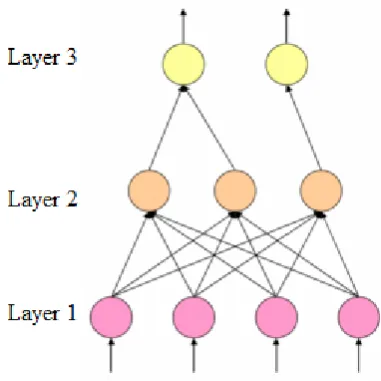
[image:39.595.223.414.238.429.2]A simple example of FNN is illustrated by Figure 2.2. It is a three-layer architecture where first layer contains input variable, second layer holds fuzzy rules, while third layer represents output variables.
Figure 2.2: Layered Architecture of FNN (Kruse, 2008)
2.6 Adaptive Neuro-Fuzzy Inference Systems – ANFIS
23 2.6.1 ANFIS Structure
Jang (1993) introduced ANFIS architecture, a universal approximator based on adaptive technique to assist learning and adaptation, has been attractive research area in recent years (Ananda et al., 2011). A number of researchers have developed neuro-fuzzy systems based on motivation to predict and solve economic crisis of various fields (Kar et al., 2014).
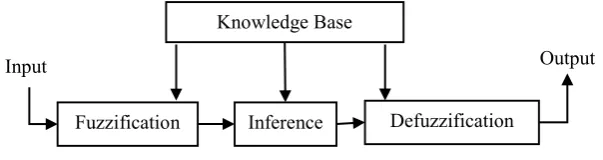
[image:40.595.167.469.283.363.2]The ANFIS model gets input as crisp numerical values and also generates crisp values in output with the help of following features illustrated in Figure 2.3:
Figure 2.3: Adaptive Neuro-Fuzzy Inference System (Rutkowski et al., 2012) (i) Knowledge base contains database and rules-base. The prior comprises of
membership functions (MFs) of fuzzy sets used in fuzzy rules, while the later contains fuzzy if-then rules.
(ii) Fuzzification converts crisp input variables into a membership degree based on MF defined.
(iii) Inference engine combines fuzzy rules using appropriate fuzzy operator for obtaining accumulated results of fuzzy sets.
(iv) Defuzzification transforms fuzzy output into crisp output value through defuzzification method.
ANFIS is a framework of neuro-fuzzy model that can integrate human expertise as well as adapt itself through learning. It has two types of nodes in this architecture; fixed and adaptable. Nodes of MFs (layer 1) and consequent part (layer 4) are trainable, while nodes for product (layer 2) and normalization (layer 3) are fixed. The network applies least square method to train consequent parameters in forward pass, and uses gradient descent for tuning MF parameters in backward pass of network training. The computational cost of training process depends on the total
Knowledge Base
Defuzzification Inference
Fuzzification
number of modifiable parameters so Gaussian MF, which uses two parameters (width and center) only, is more preferable than other types of MFs (Awadallah et al., 2009).
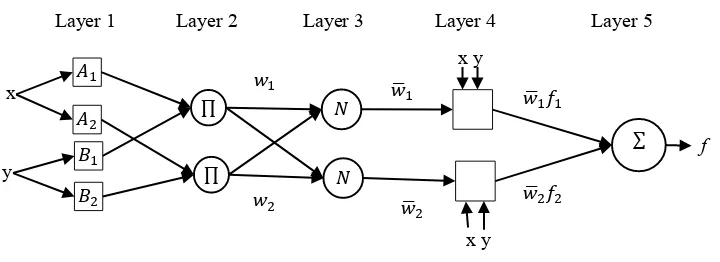
Figure 2.4 illustrates ANFIS architecture. For the first order Sugeno model, two fuzzy if-then rules are considered here.
𝑅𝑢𝑙𝑒1: 𝐼𝑓 𝑥 𝑖𝑠 𝐴1 𝑎𝑛𝑑 𝑦 𝑖𝑠 𝐵1 𝑡ℎ𝑒𝑛 𝑓 = 𝑝1𝑥 + 𝑞1𝑦 + 𝑟1
𝑅𝑢𝑙𝑒2: 𝐼𝑓 𝑥 𝑖𝑠 𝐴2 𝑎𝑛𝑑 𝑦 𝑖𝑠 𝐵2 𝑡ℎ𝑒𝑛 𝑓 = 𝑝2𝑥 + 𝑞2𝑦 + 𝑟2
Or in terms of membership degrees, the above rules can be rewritten as:
𝑅𝑢𝑙𝑒1: 𝐼𝑓 𝜇𝐴1(𝑥) 𝑎𝑛𝑑 𝜇𝐵1(𝑦) 𝑡ℎ𝑒𝑛 𝑓 = 𝑝1𝑥 + 𝑞1𝑦 + 𝑟1 𝑅𝑢𝑙𝑒1: 𝐼𝑓 𝜇𝐴2(𝑥) 𝑎𝑛𝑑 𝜇𝐵2(𝑦) 𝑡ℎ𝑒𝑛 𝑓 = 𝑝2𝑥 + 𝑞2𝑦 + 𝑟2
where 𝐴𝑖 and 𝐵𝑖 are fuzzy sets, or 𝜇𝐴𝑖(𝑥) and 𝜇𝐵𝑖(𝑥) are MFs in the antecedent, and
[image:41.595.141.501.471.602.2]𝑝𝑖, 𝑞𝑖 and 𝑟𝑖 are the consequent parameters that are identified during training process. The five layer architecture of ANFIS shown in Figure 2.4 illustrates the execution of the above two rules.
Figure 2.4: ANFIS architecture (Shoorehdeli et al., 2009)
Here, first layer represents inputs, fuzzification is done in second layer, the third and fourth layers represent fuzzy rule evaluation, and defuzzification of the results of the rules is performed in last layer.
Layer 1: Every node 𝑖 in this layer is an adaptive MF.
x 𝐴1
𝐴2 𝐵1 𝐵2 y ∏ 𝑁 ∏ 𝑁 ∑ 𝑤1 𝑤2
𝑤̅1
𝑤̅2
x y
x y
𝑤̅1𝑓1
𝑤̅2𝑓2
f Layer 1 Layer 2 Layer 3 Layer 4 Layer 5
68
REFERENCES
Alhanafy, Tharwat E, Zaghlool, Fareed, & Moustafa, Abdou Saad El Din. (2010). Neuro fuzzy modeling scheme for the prediction of air pollution. Journal of American Science, 6(12), 605-616.
Ananda, K., & Punithavalli, M. (2011). Efficient cancer classification using fast adaptive neuro-fuzzy inference system (FANFIS) based on statistical techniques. IJACSA) International Journal of Advanced Computer Science and Applications, Special Issue on Artificial Intelligence, 132-137.
Awadallah, M. A., Bayoumi, E. H. E, & Soliman, H. M. (2009). Adaptive deadbeat controllers for brushless DC drives using PSO and ANFIS techniques.
Journal of Electrical Engineering, 60(1), 3-11.
Bache, Kevin, & Lichman, Moshe. (2013). UCI machine learning repository.
Bagheri, A., Mohammadi Peyhani, H., & Akbari, M. (2014). Financial forecasting using ANFIS networks with Quantum-behaved Particle Swarm Optimization.
Expert Systems with Applications, 41(14), 6235-6250.
Bakar, S., Kiong, I. T. W., & Nassir, A. M. (2012). Examining and validating a bankruptcy prediction models in Malaysia. Paper presented at the Statistics in Science, Business, and Engineering (ICSSBE), 2012 International Conference on.
Cardenas, J. J., Garcia, A., Romeral, J. L., & Kampouropoulos, K. (2011). Evolutive ANFIS training for energy load profile forecast for an IEMS in an automated factory. Paper presented at the Emerging Technologies & Factory Automation (ETFA), 2011 IEEE 16th Conference on.
Castellano, Giovanna, Castiello, Ciro, Fanelli, Anna Maria, & Jain, Lakhmi. (2007).
Evolutionary neuro-fuzzy systems and applications: Springer.
Chen, M. Y. (2013). A hybrid ANFIS model for business failure prediction utilizing particle swarm optimization and subtractive clustering. Information Sciences, 220, 180-195.
Clusel, S., Guarnieri, F., Martin, C., & Lagarde, D. (2013). Assessing the vulnerability of SMEs: a qualitative analysis. Safety, Reliability and Risk Analysis: Beyond the Horizon.
Cruz, A., & Mestrado, N. C. E. (2009). ANFIS: Adaptive neuro-fuzzy inference systems. IM, UFRJ, Mestrado NCE.
Fang, H. (2012). Adaptive neurofuzzy inference system in the application of the financial crisis forecast. International Journal of Innovation, Management and Technology. v3 i3, 250-254.
Fu-yuan, H. (2008). A genetic fuzzy neural network for bankruptcy prediction in chinese corporations. Paper presented at the Risk Management & Engineering Management, 2008. ICRMEM'08. International Conference on. Fuller, R. (1995). Neural Fuzzy Systems: Donner Visiting Professor Abo Akademi
University: ISBN 951-650-624-0, ISSN 0358-5654, Abo.
Gorzalczany, Marian B. (2001). Computational intelligence systems and applications: neuro-fuzzy and fuzzy neural synergisms (Vol. 86): Springer. Huang, F. (2008). A Particle Swarm Optimized Fuzzy Neural Network for Credit
Risk Evaluation. Paper presented at the Genetic and Evolutionary Computing, 2008. WGEC'08. Second International Conference on.
Issac, Biju, & Israr, Nauman. (2014). Case Studies in Secure Computing: Achievements and Trends: CRC Press.
Jang, J. S. R. (1993). ANFIS: adaptive-network-based fuzzy inference system.
Systems, Man and Cybernetics, IEEE Transactions on, 23(3), 665-685. Jayawardena, A. W., Perera, E. D. P., Zhu, B., Amarasekara, J. D., & Vereivalu, V.
(2014). A comparative study of fuzzy logic systems approach for river discharge prediction. Journal of Hydrology, 514, 85-101.
Jiang, H., Kwong, C. K., Ip, W. H., & Wong, T. C. (2012). Modeling customer satisfaction for new product development using a PSO-based ANFIS approach. Applied Soft Computing, 12(2), 726-734.
70 Kar, S., Das, S., & Ghosh, P. K. (2014). Applications of neuro fuzzy systems: A brief
review and future outline. Applied Soft Computing, 15, 243-259.
Karaboga, D., & Kaya, E. (2013). Training ANFIS using artificial bee colony algorithm. Paper presented at the Innovations in Intelligent Systems and Applications (INISTA), 2013 IEEE International Symposium on.
Kothandaraman, R., & Ponnusamy, L. (2012). PSO tuned adaptive neuro-fuzzy controller for vehicle suspension systems. Journal of Advances in Information Technology, 3(1), 57-63.
Kruse, R. (2008). Fuzzy neural network. Scholarpedia, 3, 6043.
Liu, C., & Xia, X. (2010). The Credit Rating of Small and Medium Enterprises Based on Neural Network. Paper presented at the 2nd International Symposium on Information Engineering and Electronic Commerce (IEEC), Ternopil, Ukraine.
Liu, P., Leng, W., & Fang, W. (2013). Training anfis model with an improved quantum-behaved particle swarm optimization algorithm. Mathematical Problems in Engineering, 2013.
Liu, P., & Li, H. X. (2004). Fuzzy neural network theory and application (Vol. 59): World Scientific.
Malaysia, SME Corp. (2014). SME Competitiveness Rating For Enhancement
(SCORE). Retrieved 17/12/2014, 2014, from
http://www.smecorp.gov.my/vn2/node/48
Malleswaran, M., Vaidehi, V., & Joseph, R. A. (2011). Genetically optimized ANFIS based Intelligent Navigation System. Paper presented at the Advanced Computing (ICoAC), 2011 Third International Conference on.
Neshat, M., Adeli, A., Masoumi, A., & Sargolzae, M. (2011). A Comparative Study on ANFIS and Fuzzy Expert System Models for Concrete Mix Design. Nhu, H. N., Nitsuwat, S., & Sodanil, M. (2013). Prediction of stock price using an
adaptive Neuro-Fuzzy Inference System trained by Firefly Algorithm. Paper presented at the Computer Science and Engineering Conference (ICSEC), 2013 International.
Pederzoli, C., & Torricelli, C. (2010). A parsimonious default prediction model for Italian SMEs. Banks Bank Syst, 5(4), 5-9.
Petković, D., Shamshirband, S., Iqbal, J., Anuar, N. B., Pavlović, N. D., & Mat Kiah, M. L. (2014). Adaptive neuro-fuzzy prediction of grasping object weight for passively compliant gripper. Applied Soft Computing.
Pousinho, H. M. I., Mendes, V. M. F., & Catalão, J. P. S. (2011). A hybrid PSO– ANFIS approach for short-term wind power prediction in Portugal. Energy Conversion and Management, 52(1), 397-402.
Pousinho, H. M. I., Mendes, V. M. F., & Catalão, J. P. S. (2012). Short-term electricity prices forecasting in a competitive market by a hybrid PSO– ANFIS approach. International Journal of Electrical Power & Energy Systems, 39(1), 29-35.
Pradhan, R., Pathak, K. K., & Singh, V. P. (2011). Application of neural network in prediction financial viability. International Journal of Soft Computing and Engineering (IJSCE) ISSN, 2231-2307.
Rini, D. P., Shamsuddin, S. M., & Yuhaniz, S. S. (2013). Balanced the Trade-offs problem of ANFIS Using Particle Swarm Optimisation. TELKOMNIKA Telecommunication, Computing, Electronics and Control, 11(3), 611-616. Rini, D. P., Shamsuddin, S. M., & Yuhaniz, S. S. (2014). Particle swarm
optimization for ANFIS interpretability and accuracy. Soft Computing
Rui, L. (2010). A particle swarm optimized Fuzzy Neural Network for bankruptcy prediction. Paper presented at the Future Information Technology and Management Engineering (FITME), 2010 International Conference on. Rutkowski, L., Cpałka, K., Nowicki, R., Pokropińska, A., & Scherer, R. (2012).
Neuro-fuzzy SystemsNeuro-fuzzy systems (NFS). In R. A. Meyers (Ed.),
Computational Complexity (pp. 2069-2081): Springer New York.
Sadollah, A., Bahreininejad, A., Eskandar, H., & Hamdi, M. (2012). Mine blast algorithm for optimization of truss structures with discrete variables.
Computers & Structures, 102, 49-63.
Sadollah, A., Yoo, D. G., & Kim, J. H. (2014). Improved mine blast algorithm for optimal cost design of water distribution systems. Engineering Optimization(ahead-of-print), 1-17.
72
System trained with PSO algorithm. Paper presented at the Electro/Information Technology (EIT), 2011 IEEE International Conference on.
Shoorehdeli, M. A. , Teshnehlab, M., & Sedigh, A. K. (2009). Training ANFIS as an identifier with intelligent hybrid stable learning algorithm based on particle swarm optimization and extended Kalman filter. Fuzzy Sets and Systems, 160(7), 922-948.
Shoorehdeli, M. A., Teshnehlab, M., Sedigh, A. K., & Khanesar, M A. (2009). Identification using ANFIS with intelligent hybrid stable learning algorithm approaches and stability analysis of training methods. Applied Soft Computing, 9(2), 833-850.
Siraj, F., Yusoff, M. H., Haris, M. F., Salahuddin, M. A., Yusof, S. R. M., & Hasan, M. R. (2011). i-SME: Loan Decision Support System Using Neuro-CBR Approach. Paper presented at the Computational Intelligence, Modelling and Simulation (CIMSiM), 2011 Third International Conference on.
Soleimani, M., & Salmalian, K. (2012). Genetic algorithm optimized ANFIS networks for modeling and reduction of energy absorption rate of brass energy absorbers. J Appl Math Is Az Un La, 8, 29-45.
Soto, Jesus, Melin, Patricia, & Castillo, Oscar. (2014). Optimization of interval type-2 fuzzy integrators in ensembles of ANFIS models for prediction of the Mackey-Glass time series. Paper presented at the Norbert Wiener in the 21st Century (21CW), 2014 IEEE Conference on.
Taylan, O., & Karagözoğlu, B. (2009). An adaptive neuro-fuzzy model for prediction of student’s academic performance. Computers & Industrial Engineering, 57(3), 732-741.
Turki, M., Bouzaida, S., Sakly, A., & M'Sahli, F. (2012). Adaptive control of nonlinear system using neuro-fuzzy learning by PSO algorithm. Paper presented at the Electrotechnical Conference (MELECON), 2012 16th IEEE Mediterranean.
Wang, W. T., & Zhou, X. (2011). Could traditional financial indicators predict the default of small and medium-sized enterprises? Paper presented at the International Conference on Economics and Finance Research, IPEDR. Yang, X. S. (2010). Nature-inspired metaheuristic algorithms: Luniver press.
Yang, X. S., Cui, Z., Xiao, R., Gandomi, A. H., & Karamanoglu, M. (2013). Swarm intelligence and bio-inspired computation: theory and applications: Newnes. Zhou, L., Lai, K. K., & Yen, J. (2010). Bankruptcy Prediction Incorporating
Macroeconomic Variables Using Neural Network. Paper presented at the 2012 Conference on Technologies and Applications of Artificial Intelligence. Zulkifli-Muhammad, M., Char, A. K., bin Yasoa, M. R., & Hassan, Zakiah. (2009).