University of Huddersfield Repository
Velardo, Valerio and Vallati, Mauro
On the Stylistic Evolution of a Society of Virtual Melody Composers
Original Citation
Velardo, Valerio and Vallati, Mauro (2015) On the Stylistic Evolution of a Society of Virtual
Melody Composers. In: Evolutionary and Biologically Inspired Music, Sound, Art and Design: 4th
International Conference, EvoMUSART 2015. Springer, pp. 249260. ISBN 9783319164977
This version is available at http://eprints.hud.ac.uk/id/eprint/23110/
The University Repository is a digital collection of the research output of the
University, available on Open Access. Copyright and Moral Rights for the items
on this site are retained by the individual author and/or other copyright owners.
Users may access full items free of charge; copies of full text items generally
can be reproduced, displayed or performed and given to third parties in any
format or medium for personal research or study, educational or notforprofit
purposes without prior permission or charge, provided:
•
The authors, title and full bibliographic details is credited in any copy;
•
A hyperlink and/or URL is included for the original metadata page; and
•
The content is not changed in any way.
For more information, including our policy and submission procedure, please
contact the Repository Team at: [email protected].
On the Stylistic Evolution of a Society of Virtual
Melody Composers
Valerio Velardo1and Mauro Vallati2
1
School of Music, Humanities and Media, University of Huddersfield, UK
2 School of Computing and Engineering, University of Huddersfield, UK
Abstract. In the field of computational creativity, the area of automatic music generation deals with techniques that are able to automatically compose human-enjoyable music. Although investigations in the area started recently, numerous techniques based on artificial intelligence have been proposed. Some of them produce pleasant results, but none is able to effectively evolve the style of the musical pieces generated.
In this paper, we fill this gap by proposing an evolutionary memetic sys-tem that composes melodies, exploiting a society of virtual composers. An extensive validation, performed by using both quantitative and qual-itative analyses, confirms that the system is able to evolve its composi-tional style over time.
Keywords: stylistic evolution, melody generation, memetic approach, computational creativity
1
Introduction
In this paper, we introduce an evolutionary memetic system, which generates melodies and is capable of evolving its compositional style over time. To obtain that, we developed a mixed approach, which simulates both the psychological and the social levels of human composers [22]. The system is the result of a num-ber of virtual composers connected together, which generate melodies, exchange them with their fellow composers, and evolve their compositional style, thanks to the influence of other agents.
The method has been extensively validated using quantitative analysis and music experts. Results suggest that the system effectively evolve its own com-positional style. This not only is the first case of stylistic evolution we are aware of, but it also demonstrates that computers are potentially capable of evolving the style of the creative artifacts they generate. In this regard, the system is one of the first computational techniques characterised by a primitive form of transformational creativity [1], i.e., the ability to generate artifacts that com-pletely transcend a given conceptual space. Moreover, some of the findings that emerge from the experiments can be easily extended to the real-world musical environment. This is the case of musical attractors, which are specific stylistic configurations shaped by cultural and cognitive constraints, likely to be posi-tively assessed by human listeners.
The remaining paper is organised as follows. First, we provide the musical background and describe the system. Then, we discuss the experimental setup, report results and interpret them. Finally, we give conclusions.
2
Musical background
This section provides introductory information about memes, musical memes (i.e.,musemes), and musical style; necessary to understand the system.
Memes and musemes. Memes are cultural replicators that spread from person to person within a society [5]. Examples of these are ideas, fashion and technologies. Each meme carries a unit of cultural information, that can be passed from person to person by the means of writing, speech, gestures and rituals. Memes can be regarded as sociocultural analogues to genes [12]. In-deed, just like genetic information undergoes a continuous process of evolution, so memetic information does. In particular, the memetic evolutionary process is characterised by three distinct steps: variation, replication and selection [7]. Random variation introduces novelty within a meme pool. Replication allows a single element to be copied and spread within a population. Selection guarantees that only the fittest memes survive within a specific cultural environment. Since music is a subset of human culture, it is possible to extend the concept of meme to the musical domain. As Jan suggests [15], a musical meme or museme is:
For the purpose of this paper, we consider melodic musemes as small mono-phonic phrases containing 5 to 9 notes. The length of musemes has been chosen accordingly to short-term memory constraints [19]. Musemes are stored within the brain and are actively used for processing/composing music [14]. Consider-ing the finite memory capacity of human brain, a continuous fight for survival happens among musemes. Each person unconsciously selects musemes, based on a personal musical fitness function, influenced both by musical universals [2], and by the musical environment she happens to live in.
Musical style. Musical style is a very loose concept, which has no single agreed definition among academics. Indeed, there are many - sometimes contra-dictory - theoretical definitions of musical style. For Fabbri [8], musical style is the recurring presence of specific musical events, which is typical of a composer, a place, or a period of time. This definition does not explain how/why stylistic change happens, as well as how/why a composer internalises specific musical events. Meyer solves the issue, by proposing an interdisciplinary definition of style, at the intersection of information theory, cognitive science and music the-ory [18]. For Meyer, style emerges from the replication of specific musical patterns chosen from a potentially infinite repertoire of musical constructs. The choice of specific patterns over others results from the combination of composer temper-ament, cognitive constraints and cultural constraints Stylistic change happens thanks to the tension between composer temperament and the cultural environ-ment, which leads to instability, and therefore to the invention of new composi-tional strategies. Even though the definition proposed by Meyer is powerful, it is difficult to implement into a computational system, in order to extract useful stylistic information from musical pieces. For this reason, numerous operational definitions of musical style have been developed by researchers interested in classifying pieces, based on their style [3, 4, 17, 13, 6]. These definitions consider style as a synthetic metric, which is the combined result of a number of musical features, such as pitch distribution, types of intervals and rhythmic structure.
3
Framework
The system we propose in this paper simulates the compositional process of human composers at two different levels, i.e., psychological and social [22]. The former encompasses all those processes and musical elements that univocally identify the generation process of a single composer. Compositional rules, style and aesthetic judgement are all instances of the psychological level, which differ from musician to musician. The social level considers a composer as a node within a network of composers. This level analyses the way composers change their psychological elements while interacting with each other, thanks to a constant exchange of musical information. The psychological level of the system models how composers generate music, while the social level simulates how composers influence and are influenced by the musical environment.
Initial Configuration
Melody generation
Melody distribution
Melody evaluation
Influencer selection
[image:5.595.259.365.122.264.2]Composers update
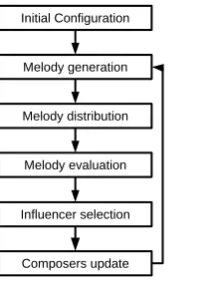
Fig. 1.Steps followed by the system to generate melodies and to evolve its own com-positional style.
a coherent hierarchical musical structure for a melody, which is then filled by a bottom-up technique. To emulate the behaviour of a human composer, virtual composers are characterised by three elements:musical content, musical gram-mar andevaluation function. Musical content is provided under the form of a set of musemes, generated using Markov Chains, trained on 5000 German folksongs of the Essen database. The musical grammar is based on a generative gram-mar, which is responsible for the development of the musical structure, as well as for the variation of musemes. The evaluation function assesses the quality of a melody according to a linear combination of three musical parameters: pitch range,rhythmic homogeneityandstep ratio. Pitch range indicates the difference between the highest and the lowest pitch of a melody. Rhythmic homogeneity measures the overall rhythmic coherence of a melody on a note-by-note basis. Step ratio returns the percentage of steps within a melody. The process of gen-eration of a melody consists of four steps: initiating musical content, generating musical structure, filling the structure, evaluating a melody. After the generation of a symbolic hierarchical structure, a number of musemes are chosen to fill the backbone. These musical phrases can either be left unchanged or modified, de-pending on the structure. If the quality of the melody is not satisfying, according to the evaluation function, the algorithm goes back to step two and generates a new structure.
agents “listen” to melodies created by other agents, and are usually influenced by the music of the composer they think is best. The social level is implemented through a multi-step algorithm (Figure 1). The specific steps are: configuration of composers, generation of melodies, melodies distribution, evaluation of melodies, choice of influencer, update of composers’ style.
During the initial configuration, the value of some parameters of the musi-cal grammar and the evaluation function of a composer are randomly seeded. For the evaluation function, the weights of all three parameters of the function (i.e., pitch range, rhythmic homogeneity, step ratio) are randomly chosen. The same happens for the value of three parameters of the musical grammar called pitch change ratio,duration change ratio anddelete ratio. These parameters are responsible for the variation of a museme during the bottom-up filling process. Specifically, they indicate the probability that a note contained in a museme can change pitch/duration or can be deleted, when modifying a museme. Fur-thermore, a set of 500 musemes is generated for each composer, using Markov chains. These musical phrases are the actual musical content composers will use to fill the musical structure of their melodies.
After configuration is completed, each composer generates a melody accord-ing to the mixed top-down bottom-up approach described above. Melodies are then distributed across the network, and “heard” by composers. This means that the values of pitch range, rhythmic homogeneity and step ratio are re-trieved from each melody. During the evaluation phase, each composer judges all melodies according to its specific configuration of the evaluation function, and stores the melody with the best score. Afterwards, agents choose another agent as a source of influence. The likelihood of the composer of the best melody to be chosen is by far higher than that of other agents. This procedure guarantees that composers are generally influenced by those nodes, whose music they like best.
The final step of the algorithm is the update phase. This process involves both musical content and musical grammar. Each composer randomly picks a museme from the melody it likes best, and substitutes it to one of its own musemes. This ensures a steady change in the musical content, while respecting memory constraints of human composers. In order to guarantee a clear influence in the compositional process, the musical grammar is modified as well. One parameter is randomly chosen among pitch change ratio, duration change ratio and delete ratio. The value of the chosen parameter is changed, and gets closer to the value of the same parameter of the influencer. After completion of the first iteration, the algorithm goes back to step two, in which all composers generate new melodies.
4
Methods
experiments were run. The initial configuration of the parameters of the musical grammar and the evaluation function for each composer was derived randomly. When updating the compositional grammar, the value of parameters can be modified up to 30% of their current value, in order to avoid radical changes in compositional style, which are uncommon in the real world.
All experiments aimed to measure the average stylistic evolution of the sys-tem over time. However, evaluating stylistic evolution of a composer is a chal-lenging task, since in the first place, there is no agreement on the definition of musical style among scholars. To avoid this issue, we considered two approaches: a quantitative-based analysis, and an expert-based analysis. The latter relies on judgement of music experts, while the former processes large amount of musical data. In particular, we used quantitative-based analysis to track style from three different perspectives, i.e., the evolution of melodic output, musical content and musical grammar.
Style is considered as an emergent quality of a melody, which can be reduced to a handful of musical features. To track the stylistic evolution of melodies over time, we introduce themelodic style phase space, which is a 3-dimensional space, whose axes are pitch range, rhythmic homogeneity and step ratio. Specifically, pitch range carries timbral information, rhythmic homogeneity is a synthetic measure for the duration of notes at a local level, and step ratio provides a synthetic information about the intervallic content of a melody. A single point within the melodic style phase space corresponds to a specific melodic style, and conversely, a specific melodic style corresponds to a single point within this space. Of course, musical style cannot be reduced to three musical features. However, working with only three features facilitates the visual representation of stylistic evolution, otherwise impossible, as well as it provides an effective method to reduce/manage the complexity of musical style. To have a dynamic view of the stylistic evolution of the melodies over time, we introduce themelodic style event space. In this space, all axes are the same as those of the phase space, except for the pitch range, which is replaced by the number of iterations of the algorithm. The same spaces - event and phase - are used for visualising the evolution of musemes. While melodic spaces consider the actual melodies produced by composers, museme spaces consider musemes stored by composers.
Consequently, a trajectory within any of the event spaces expresses the average value of the system considered as a whole, and each point represents a picture of the system at a specific point in time.
5
Results
A relevant aspect that emerges from the experiments is the limited impact of dif-ferently sized networks of composers. The system with 10, 30 and 100 composers behave the same way.
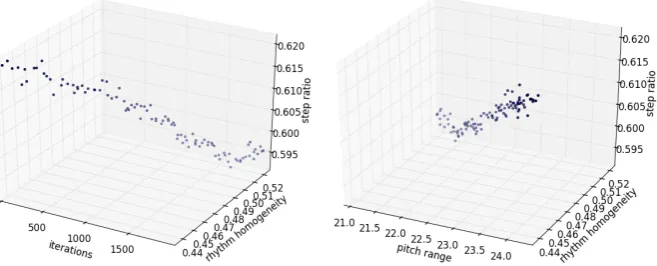
A quantitative analysis of the style of the melodies generated by the system reveals that there is a continuous coherent change in style after each iteration. A typical example of melodic evolution can be seen in Figure 2. No large jumps have been noticed within the melodic phase space and within the melodic event space. Melodies seems to change a little at each iteration, causing style to evolve slowly over time. Over 60% of the experiments have the stle of melodies converg-ing towards a precise point of the melodic style phase space. However, before converging melodies visit small regions of the phase space. Different runs of the algorithm always visit different regions of the phase space, even though overlaps are frequent. Also, some regions of the phase space are clearly preferred over others, while others have never been visited. This is the case of regions that lie at the extremes of the domain of the musical features considered.
A similar result is obtained by analysing the style of musemes stored by composers. Stylistic evolution of musemes is a slow coherent process, which never shows large jumps (Figure 2). Less than 40% of the experiments converge towards a single point in the museme style phase space. Another major difference with the case of melodies, is that musemes usually anticipate the points of the phase space, that are visited by melodies after a number of iterations. Musemes visit small regions of the phase space, as melodies do. Also, no two different runs of the system visit the same regions of the phase space, and some subspaces such as the extreme of the axes have never been visited.
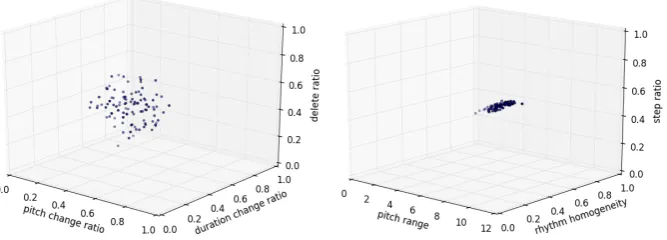
Results are different with regards to the evolution of the musical grammar. As can be seen in Figure 2, the configuration of the features of the grammar tends to change conspicuously over time, until it converges towards a precise point of the space. Large jumps are always present during initial iterations. These tends to get smaller over time, until the system falls in a certain configuration. After the system converges towards a point in the space, it stays stable for the remaining iterations. Different runs of the algorithm explore different regions of the phase space, and again there are some subspaces which are never visited.
Melodic style event space (left) and phase space (right).
Musemes style event space (left) and phase space (right).
[image:9.595.146.475.121.254.2]Grammar event space (left) and phase space (right).
Fig. 3.Regions of convergence for grammar (left) and musemes (right), obtained by plotting the last configuration of the system for 100 experiments with 30 composers.
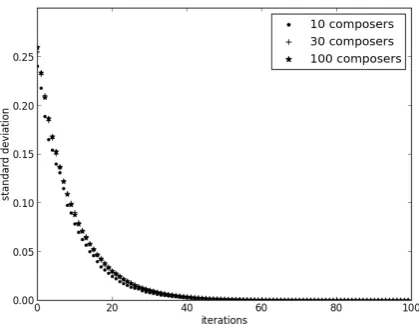
Since all the metrics we are using are based on the mean of values calculated over the entire population of composers, we have no information about possible local variations of the values for single agents. To have an idea of the dispersion from the average, we calculated the mean of the standard deviations of all nine musical features used to build all three style phase spaces. Figure 4 clearly shows that the standard deviation tends to approach zero after 50 iterations. Moreover, there is no clear difference between the systems with 10, 30 and 100 composers, since they always drop to zero following the same curve.
To assess whether or not the system evolves its compositional style, we also used an expert-based analytic approach. Four music experts (i.e., two composers, one music theorist and one musicologist) assessed ten pairs of melodies produced by the system during ten different runs.3 Each pair of melodies consists of a melody randomly chosen between those generated at the beginning of a run, and another picked among those composed during the last iteration of a run. Music experts had to evaluate both the aesthetic quality of the melodies and the stylistic difference between members of the same pair. To do that, they used two scales ranged from 1 to 5, where 1 respectively means ”no aesthetic value” / ”absolute no stylistic difference”, and 5 stands for ”very high aesthetic values” / ”melodies completely different”. Stylistic difference obtained a score of 3.25, while aesthetic scored 2.78. Experts said that some melodies are musically interesting, presenting an overall good directionality with nice distributions of pitches and rhythms; while others sound uncreative or even ”dull”. We used Fleiss Kappa to evaluate inter-rater reliability among experts. Indeed, if experts agree on an assessment, it is likely that their evaluation might be valid. We obtained Fleiss Kappa [10] values of 0.26 for stylistic difference and of 0.32 for aesthetic quality. According to the classical interpretation of Fleiss Kappa, both values indicate a fair agreements among raters [16].
3
Fig. 4.The mean of the standard deviations of all nine musical features used to build the style phase spaces, for experiments with 10, 30 and 100 composers.
6
Discussion
reproduced by a single agent. Indeed, the value of a many-composers approach lies in the musical journey, not in the single stages. The social level of the system adds an extra layer of complexity that cannot be reduced.
As experimental analysis suggests, the systems tends to converge rapidly. The plot of the standard deviation highlights that after 50 iterations all composers have only small differences in all their parameters. The fast convergence rate as well the fact that there is no difference in the way the system with different num-bers of composers behaves, are probably due to the fully connected network used to model the musical environment. To provide unpredictability and instability, which are necessary elements of creativity, a scale-free network is needed.
However, since all experiments of the system converge within specific regions of the three phase spaces, it is probable that those regions are attractors for the system. In other words, not all regions of the phase spaces are equally likely to be visited. Even considering all the simplifications made to develop the system, we can extend this idea to the real world, since the system is based on sound cognitive elements. Our hypothesis is that the real-world musical style phase space is divided into a number of attractorsThese regions are privileged portions of the phase space, whose shape depends on a number of cognitive and social factors such as musical universals, exposure to music, and cognitive constraints. The system we proposed has two main limitations. First, only three param-eters of the musical grammar change over time. As a consequence, composers can hardly completely revolutionise their musical style, since they are severely constrained by many other parameters that do not evolve. However, if many parameters could be modified, then the musical results of the system would be completely unpredictable, and it would be really difficult to trace the contribu-tion of one parameter to a specific composicontribu-tional behaviour. Also, the complexity of the system would increase a lot, making the system less manageable. Second, the evaluation function is simple and its parameters are stationary. This implies that composers cannot have sophisticated aesthetic judgement on melodies they “listen to”. However, a complex evaluation function for simulating the aesthetic preferences of human composers, would be extremely difficult to develop.
7
Conclusion
Future work includes the improvement of the evaluation function of com-posers, the exploitation of a scale-free network for simulating the society, and the generation of small polyphonic pieces rather than simple monophonic lines.
References
1. Boden, M.A.: The creative mind: Myths and mechanisms. Psychology Press (2004) 2. Brown, S., Jordania, J.: Universals in the world’s musics. Psychology of Music 41,
229–248 (2013)
3. Cope, D.: Computers and musical style (1991)
4. Dannenberg, R.B., Thom, B., Watson, D.: A machine learning approach to musical style recognition (1997)
5. Dawkins, R.: The selfish gene (1976)
6. De Leon, P.J.P., Inesta, J.M.: Musical style classification from symbolic data: A two-styles case study. In: Computer Music Modeling and Retrieval, pp. 167–178. Springer (2004)
7. Dennett, D.C., Mittwoch, U.: Darwin’s dangerous idea: Evolution and the mean-ings of life. Annals of Human Genetics 60(3), 267–267 (1996)
8. Fabbri, F.: Browsing music spaces: Categories and the musical mind (1999) 9. Fern´andez, J.D., Vico, F.J.: AI methods in algorithmic composition: A
compre-hensive survey. J. Artif. Intell. Res. (JAIR) 48, 513–582 (2013)
10. Fleiss, J.L.: Measuring nominal scale agreement among many raters. Psychological bulletin 76(5), 378 (1971)
11. Gimenes, M., Miranda, E.R., Johnson, C.: A memetic approach to the evolution of rhythms in a society of software agents. In: Proceedings of the 10th Brazilian Symposium on Computer Music (SBCM). vol. 16 (2005)
12. Graham, G.: Genes: a philosophical inquiry. Psychology Press (2002)
13. Hontanilla, M., P´erez-Sancho, C., I˜nesta, J.M.: Modeling musical style with lan-guage models for composer recognition. In: Pattern Recognition and Image Anal-ysis, pp. 740–748. Springer (2013)
14. Jan, S.: Music, memory, and memes in the light of calvinian neuroscience. Music Theory Online 17(2), 3–50 (2011)
15. Jan, S.B.: The memetics of music: A neo-Darwinian view of musical structure and culture (2007)
16. Landis, J.R., Koch, G.G.: The measurement of observer agreement for categorical data. biometrics pp. 159–174 (1977)
17. Lartillot, O., Dubnov, S., Assayag, G., Bejerano, G.: Automatic modeling of mu-sical style. In: Proceedings of the 2001 International Computer Music Conference. pp. 447–454 (2001)
18. Meyer, L.B.: Style and music: Theory, history, and ideology. University of Chicago Press (1989)
19. Miller, G.A.: The magical number seven, plus or minus two: some limits on our capacity for processing information. Psychological review 63
20. Miranda, E.R.: On the evolution of music in a society of self-taught digital crea-tures. Digital Creativity 14(1), 29–42 (2003)
21. Pachet, F.: Rhythms as emerging structures. In: Proceedings of 2000 International Computer Music Conference, Berlin, ICMA (2000)