© 2017, IRJET | Impact Factor value: 6.171 | ISO 9001:2008 Certified Journal | Page 735
A Study on Cement Stabilized Conventional Waste and Marginal
Material for Pavement Layer Construction
Sarita Sharma
1, Devesh Jayaswal
21
M.Tech student, Dept. of Civil Engineering, IEC Group of Institutions, U.P, INDIA
2Assistant Professor, Dept. of Civil Engineering, IEC Group of Institutions, U.P, INDIA
---***---Abstract -
Road connectivity is one of the important components for urban and rural connection, as it develops economy, services, productivity and employment .But it requires large amount of natural, financial resources and this amount increase with the inappropriate condition present at the site of the pavement construction. To overcome these problems conventional waste and marginal material can be used as it is or can be after cement stabilization. This study is aimed to use the cement stabilized conventional waste and marginal material collected from different places like mine waste of Jabalpur, river borne material and hard shoulder material for base and sub base construction for low traffic load roads in rural and urban area. Then the strength tests like California bearing ratio, unconfined compressive strength and durability test with cement content 3%, 6% and 9% were performed. These conventional waste and marginal materialshowed positive results to some extent.
Key Words: CBR, MORTH, unconfined compressive strength and durability.
1. INTRODUCTION
To become a part of developed country India have taken many strong and important steps. One of them is forming adequate networks of road form boarded roads to rural roads and to east remote areas, as it is important for socio-economic development and the security of our country. But development of a large network of road by traditional practices and techniques requires heavy financial investment. This investment amount more increases with the unsuitable site condition for pavement construction. The commonly phased problem is the soil engineering properties which don’t satisfy the standard values given by the IS Codes for pavement construction. To overcome these problem several investigation have been done like use of lime for soil stabilization for sub grade material, use of silica and cement and Study of Soil Cement Stabilization for Pavement Base Course and Sub grade many others which gave positive results[2] . Pavement construction cost can be reduce to some extent by using conventional waste and marginal
materialpresent near to the construction sites . Like there
are numbers of mine present in India and the waste produced by them is also very high and of different types. The one form of waste is overburden material it consist of soil and less amount of rock can be used as base and sub base material, similarly the river borne material and hard
shoulder material can be used in sub grade, base and sub base part of pavement .These material can be used as it is and can be used in stabilized form to satisfy the standard. Stabilization is the process whereby soils and related materials are made stronger and more durable by mixing with stabilizing agents. Cement stabilization is one of the commonly and widely use method because of its standard quality, economical, easy to use, easily available in every part of our country and give positive results and long term performance .
2. RESEARCH SIGNIFICANCE
The study of strength and durability of cement stabilization of conventional and marginal material will help in using them in pavement layer construction of low traffic load roads that can reduce cost of construction ,transportation cost and limited use of recourse like stones, fuel and pollution can be reduces. Cement stabilization have shown positive results already done by NIT Trichirappalli, on engineering properties of cement stabilized seashore soil in which silted clay soil collected form coastal region area was stabilized with cement for road construction .In our study all sample properties and engineering properties was studied and compared with the standard criteria given by MoRTH and IRC SP:89 by which they can be used in the rural road construction.
3. METHODOLOGY
3.1
Material Used
3.1.1 Cement
Cements used in construction are usually inorganic, often lime or calcium silicate based, and can be characterized as being either hydraulic or non-hydraulic, depending upon the ability of the cement to set in the presence of water.
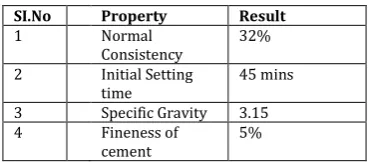
© 2017, IRJET | Impact Factor value: 6.171 | ISO 9001:2008 Certified Journal | Page 736 Table 1 Properties Of Cement Used
SI.No Property Result
1 Normal
Consistency 32%
2 Initial Setting
time 45 mins
3 Specific Gravity 3.15
4 Fineness of
cement 5%
3.1.2 Conventional waste and marginal material
Overburden waste form SGMM mines (SAMPLE 1), Jakhodia mines(SAMPLE 2), River Borne Material(SAMPLE 3) and Hard Shoulder Material (laterites –low grade iron ore )(SAMPLE 4).
3.2 Experiments Performed
[image:2.595.307.561.160.274.2]Physical properties of four samples were carried out by following their respective IS Codes. Firstly grain size distribution test was performed according to IS 2720-Part 4 1985.Table 2 shows the sample gradation.
Table 2 Samples Gradation
Gradation Sample 1 Sample
2 Sample 3 Sample 4
Gravel 20 % 47% 15% 64%
Sand 11% 28% 75% 20%
Silt 58% 10% 6% 8%
Clay 11% 15% 4% 8%
[image:2.595.36.287.393.466.2]Then Atterberg limits was following IS 2720-Part 5 1985. The liquid limit test of sample 1 was done by grooving method and rest of the sample by cone penetration method. Plastic limit was calculated by forming 3mm diameter thread from all the sample material. The process of making the thread was repeated till it started crumbling. Table 3 shows the Atterberg limits.
Table 3 Atterberg Limits of Samples
Properties Sample 1 Sample 2 Sample 3 Sample4 Specific
gravity 2.95 2.75 2.61 3.04
Liquid limit
(%) 44 39 26 42
Plastic index 17 17 N.P 10
The compaction test was performed by taking 6 kg of dry sample to perform test with variation in the percentage of the moisture as per the IS 2720 part 8 -1983.In this project we have used both the method of compaction , standard proctor test(SPT) and modified proctor test (MPT). Then the CBR specimens were prepared using water same as quantity of optimum moisture content. These samples then were cured in atmospheric temperature in the range of 27 – 37ºC
for seven days and then soaked in water for four days before testing. Table 4 represents the CBR values for standard and modified proctor test.
Table 4 Proctor Test and CBR Value
Type of proctor test
Sample Optimum moisture content (%) Maximum dry density KN/m3 CBR (%)
SPT Sample 1 16.3 18.5 15
Sample 2 13.4 20.0 23
Sample 3 11 20.3 31
Sample 4 14.2 20.8 8
MPT Sample 1 15 19.3 21
Sample 2 10 21.4 39
Sample 3 7.50 21.5 49
Sample 4 8.9 24.2 14
To check the cement stabilized material strength and durability .All the sample were test for the unconfined compressive strength for 3, 7 and 14 days with the 3% ,6% and 9% cement stabilization by casting specimens and then curing them in desiccators for respective days as per IS 2720 Part 10 -1973. The durability for these sample found by preparing two identical set containing 3 specimens each of unconfined compressive strength specimen which are cured in a normal manner at constant moisture content for 7 days. At the end of 7days period one set is immersed in water while the other continues to cure at constant moisture content.
When both sets are 14 days old they are tested for UCS. The strength of the set immersed in water as A% age of the strength of set cured at constant moisture content is calculated. This index is a measure of the resistance to the effect of water on strength .If this value is lower than 80% it is considered that the stabilization content is low and its value should be increased .Table 5 show the value of UCS and Table 6 represent the durability results.
Table 5 Unconfined compressive strength results
Ty Types of material Sample
1 MPa Sample 2 MPa Sample 3 MPa Sample 4 MPa UCS
after 3 days curing
3%
Cement 0.53 1.13 1.20 1.21
6%
Cement 0.75 1.69 1.70 2.25
9%
Cement 0.96 2.33 1.87 2.55
UCS after 7 days curing
3%
Cement 0.698 1.42 2.55 1.56
6%
Cement 0.91 2.16 3.10 2.51
9%
Cement 1.15 2.72 3.80 3.05
UCS after 14 days curing 3% Cement
0.827 1.71 2.98 1.94
6%
Cement 1.091 2.97 3.30 2.84
9%
Cement 1.251 3.36 4.10 3.43
[image:2.595.308.561.564.780.2]© 2017, IRJET | Impact Factor value: 6.171 | ISO 9001:2008 Certified Journal | Page 737 Table 6 Durability Results
Type of
Material Durability (% of UCS Strength - Immersed sample/moist cured sample)
3% Cement 6% Cement 9% Cement
Sample 1 56% 64% 78%
Sample 2 70% 80% 85.5%
Sample 3 68% 72% 81.5%
Sample 4 23% 44% 75%
4. RESULTS
The above results were compared with the standard criteria for cement stabilization of conventional waste and marginal material which was soil in this study, as per IRC SP 89 and MoRTH for using then as base and sub base material in rural road construction. Firstly the soil should satisfy the gradation given by MoRTH that is shown in table 7.
Table 7 Standard Gradation Of Soil For Cement Stabilization
IS Sieve % by weight passing % by weight passing
Sub – base Base
53 mm - 100
37.5 mm 95 – 100 -
19 mm 45 – 100 -
9.5 mm - 35 – 100
4.75 mm - 25 – 100
600 micron 8 – 65 -
300 micron 5 – 40 -
75 micron 0-10 -
From graph 1 and 2 represent the gradation comparing of samples with the standard gradation required for soil cement stabilization so that they can be used in base and sub base layers of low traffic road like rural roads. The sample 1,2 and 4 does not satisfy criteria of gradation for sub base. But for the base they can be used . Sample 3 gradation lies in the standard gradation for both base and sub base
.
Chart -1 : Gradation of samples for cement stabilized base materials.
Chart -2 : gradation of samples for cement stabilized sub base.
According to section 404 (MoRTH) cement stabilization sub base and base minimum cement content was 2 % to the maximum 15% for black cotton soil. In this study we have used the 3%, 6 % and 9% cement content. The liquid limit should be less than 45% and plastic index should also be less then 20.the pie chart below show that the all are sample satisfy the above condition expect river borne material is non plastic soil.
Chart- 3: liquid limit of samples
[image:3.595.42.278.589.727.2]© 2017, IRJET | Impact Factor value: 6.171 | ISO 9001:2008 Certified Journal | Page 738 As per standard the California bearing ratio of soil sample
should be equal and more than 15% . Graph below show the CBR value of four samples were more and equal to minimum value required.
Chart – 5 : CBR value for standard proctor and modified proctor test
IRC SP 89 stated that for cement stabilized samples should check for unconfined compressive strength and durability .The minimum required 7 days compressive strength should be 3 MPa for cement stabilized samples and for sub base it should be 1.70 MPa.
Sample 1 have not shown desirable strength even at the 9% cement content whereas sample 3and 4 show the strength more than 3MPa having 9% and 6%, 9%cement for 7 days curing respectively .Strength more than 1.70 MPa was obtain for sample 2,4 having cement content more than 6% and more than 3% for sample 3.So the sample 1 is not suitable for both base and sub base.
Chart – 6: UCS value after 7 days curing sample for different cement percentage
Durability of the sample was checked and required durability index should be not less than 80%. Graph below show variation of durability with cement content and its reaction with four samples.
Chart – 7: Durability percentage of samples with increasing percentage of cement content.
5. CONCLUSION
All the samples have satisfied the soil gradation, liquid limit and plastic index properties so that they can be cement stabilized .CBR % Value for sample 1, 2, 3 and 4 were higher than the minimum required CBR value for cement stabilisation .
Unconfined compressive strength of sample 1 having cement content 3%, 6% and 9% for seven days shown the lowest values therefore this sample cannot be used as the base and sub base material at above defined cement content.
Sample 2 with 6% and 9% cement can be used as the sub base material. Sample 3 with 3%, 6% and 9% cement can be used for both base and sub base construction and sample 4 with 6% cement can be used as sub base material and with 9% cement content it can be used as base material for pavement construction.
These conventional waste and marginal material have shown satisfying durability results with 9% cement stabilisation.
So these materials can be used as sub base and base material for construction of rural road and in urban area where low traffic load condition are present.
ACKNOWLEDGEMENT
© 2017, IRJET | Impact Factor value: 6.171 | ISO 9001:2008 Certified Journal | Page 739
REFERENCES
[1] Abu siddique and Bipradas rajbongshi, “Mechanical
properties of a cement stabilized coastal soil for use in road construction”, Journal of civil engineering The institution of Engineers” Vol. CE 30, NO. 1, 2002.
[2] G.R.Shiromani,Basit Riyaz,Muneeb Hilal,Mujtaba Mir
andMuneeb Bashir “Study of Soil Cement Stabilization for Pavement Base Course and Sub grade”,International Journal of Engineering Research and Management Technology,ISSN :2348 -4039 march 2015 vol 2 issue 2.
[3] IRC SP:20-2002 "Guidelines for the design of flexible
pavement for low volume roads" published by Indian road congress-New Delhi.-2002.
[4] IRC SP 89 “Soil stabilisation” published by Indian road
congress New Delhi.
[5] Azm S. Al-Homoud, Taisir Khedaywi and Abdullah M. Al.
Ajlouni (1999), “Comparison of effectiveness and economic feasibility of bitumen, lime and cement as stabilizing agents for reduction of swell potential of a clayey soil,” Indian Highways, January 1999, pp.51–58.
[6] I.S. : 2720 ( Part 1 to 41) "Various Method of Test for
Soil."