(
MANUFACTURER & MODEL
MAIN STORAGE
Min.lMax. capacity, words or bytes NO. WORKSTATIONS CONNECTABLE COMMUNICATIONS
Maximum no. of lines Synchronous Asynchronous Protocols supported
Network architecture supported RJE terminals emulated IBM 3270 emulation PRICING & AVAlLA81L1TY
Purchase price of basic system, $
Purchase price of memory module, $
Monthly maint. price of basic system, $
Discounts available Date of first U.S. delivery Number installed to date COMMENTS
MANUFACTURER & MODEL
MAIN STORAGE
Min.lMax. capacity, words or bytes NO. WORKSTATIONS CONNECTABLE COMMUNICATIONS
Maximum no. of lines Synchronous Asynchronous Protocols supported
Network architecture supported RJE terminals emulated IBM 3270 emulation PRICING & AVAILABILITY
Purchase price of basic system, $
Purchase price of memory module, $
Monthly maint. price of basic system, $
Discounts available Date of first U.S. delivery Number installed to date COMMENTS
FEBRUARY 1983
Communications Capabilities of
Minicomputers and Small Business Computers
Industrial Infomark Infomark Inforex
Micro Systems OMS-II OMS-III 9000
5000SX
512K 256K 512K 256K
16 16 24 24
24 16 24
-Optional Opt.; 19.2K bps Opt.; 19.2K bps Std.; 9600 bps Std.; 9600-19.2K bps Std.; 19.2K bps Std.; 19.2K bps Optional
Async 2780/3780 2780/3780 2780/3780, HASP,
Turbodos (opt.)
-
-
ULTRANET, ARCNET- 2780/3780 2780/3780 See Comments
No -
-
Yes3,000-12,000 67,000 113,300 44,630
-
- ---
- - 800Dealer, OEM - -
-May 1979 1976 1976 July 1981
500 110 40 Contact vendor
New table-top pack- 8asic system price 8asic system price RJE terminals age; 5.5M-byte includes hardware, includes hardware, emulated include Winchester drive application software application software, 2770, 2780, 3770, available installation, and train- installation, and 3780, RES; System ing; *600- and 900- training 9000 is a distributed Ipm printers are information processing
optional system, specifically
addressing distributed data entry and file management solutions for business
MAli Basic Four MAl/Basic Four MAl/Basic Four MAli Basic Four
System 210 System 310 System 510 System 610
64K 256K 256K 192K
16 16 16 16
16 16 16 16
Opt.; 9600 bps Opt.; 9600 bps Opt.; 9600 bps Opt.; 9600 bps Std.; 9600 bps Std.; 9600 bps Std.; 9600 bps Std.; 9600 bps
Bisync Bisync Bisync Bisync
BFBIN BFBIN BFBIN BFBIN
2780/3780 2780/3780 2780/3780 278013780
Yes Yes Yes Yes
25,740 (64K bytes) 55,885 (96K bytes) 50,360 (64K bytes) 51,400 (64K bytes) 2,375 (32K bytes) 2,375 (32K bytes) 2,375 (32K bytes) 2,240 (32K bytes)
270 504 437 424
- -
-
-1981 1982 1980 1978
14,500 (all models) 14,500 (all models) 14,500 (all models) 14,500 (all models) Price includes 64KB Price includes 96KB Price includes 64KB Price includes 64KB memory, 10MB fixed memory, 40MB fixed memory, 20MB disk memory, 35MB disk disk, 8O-cps printer, disk, 150-lpm printer, drive & pack, op- drive & pack. w/op. 9.2MB magnetic tape reel-to-reel tape drive, erating system, 120- sys., 1 60 cps pr inter, cartridge drive, and and 2 VDTs cps printer, 1 VOT, and one VDT
one VDT & 9.2MB magnetic
tape unit
© 1983 DATAPRO RESEARCH CORPORATION, DELRAN, NJ 08075 USA REPRODUCTION PROHIBITED
C13-010-221 Processors
Infotecs Control Center
II
1M 16
16
Std.; 300-19,200 bps Std.; 300-19,200 bps
-6,995
-April 1980 Over 1000 Programs compatible with DEC PDP-8; complete systems and software sold & ser-viced nationwide by Infotecs' dealers
MAl/Basic Four System 710
256K 32 32
Opt.; 9600 bps Std.; 9600 bps Bisync BFBIN. 2780/3780 Yes
69,100 (96K bytes) 2,375 (32K bytes) 593.50 -1982
C13-01 0~222 Proc~ssors
MANUFACTURER & MODEL
MAIN STORAGE
Min.lMax. capacity, words or bytes NO. WORKSTATIONS CONNECTABLE COMMUNICATIONS
Maximum no. of lines SynChronous Asynchronous Protocols supported
Network architecture supported RJE terminals emulated IBM 3270 emulation PRICING & AVAILABILITY
Purchase price of basic system, $ Purchase price of memory module, $ Monthly maint. price of basic system, $ Discounts available
Date of first U.S. delivery Number installed to date COMMENTS
MANUFACTURER
&
MODELMAIN STORAGE
Min.lMax. capacity, words or bytes NO. WORKSTATIONS CONNECTABLE COMMUNICATIONS
Maximum no. of lines Synchronous Asynchronous Protocols supported
Network architecture supported RJE terminals emulated IBM 3270 emulation PRICING & AVAILABILITY
Purchase price of basic system. $ Purchase price of memory module, $ Monthly maint. price of basic system, $ Discounts available
Date of first U.S. delivery Number installed to date COMMENTS
Communications Capabilities of
Minicomputers and Small Business Computers
MCM M~rcator Microdata
MAl/Basic Four Computers Business Reality Series
System 730 Systems
MCM/POWER System 5000 2000
256K 64K 1M 64K
32 8 16 8
32 199 16 8
Opt.; 9600 bps Opt.; 19.2K bps Optional Opt.; to 9600 bps Std.; 9600 bps Opt.; to 19.2K bps Optional No
Bisync Various Bisync Async, bisync
8FBIN None
-
-2780/3780 Various 2780/3780 See Comments
Yes No Optional No
95,000 (96K bytes) Contact vendor 35,000 34,500-36,200 2,240 (32K bytes) Contact vendor
-
2,100 (16K bytes)766 Contact vendor
-
350-340-
Contact vendor-
-1978 September 1980 January 1982 December 1977 14,500 (all models)
-
- 4000 (all mod.) Price includes 96KB MCM/POWER is a Packaged system in-memory, two 75MB multi-user, hard-disk, cludes 32KB MOS disk drives & packs upgradeable and up- memoiy, magneticw/op. sys., 300 Ipm ward compatible tape, 10MB disk drive, printer, and four VDTs version of the MCMI 165 cps printer, and
900 1 CRT; RJE terminals
emulated inelude HASP, 2780/3780,
2770,3741; 'SCREENPRO
Microdata Microdata Microtech Microtech
Reality Series Reality Series Business Systems Business Systems
6000 8000 300 Series 400 Series
256K 512K 1M 1M
32 48 8to 56 16
32 48 56 56
Opt.; to 9600 bps Opt.; to 9600 bps
-
-No No Std.; 30-9600 bps Std.; 30-9600 bps Async. bisync Async, bisync Async Async
- - None None
See Comments See Comments None None
No No No No
52,800-67,600 64,975-99,975 11,000 (64K) 11,000 (64K) 2,950 (32K bytes) 4,900 (128K bytes) 3,000 (64K), 6,300 3,000 (64K), 6,300 395-515 595-715 Contact vendor Contact vendor
-
- Contact vendor Contact vendorNovember 1973 October 1 979 October 1979 May 1979 4000 (all mod.) 4000 (all mod.) 100 NA
Packaged system in- Packaged system in- System 300 W34S, System 400 W158S eludes 64KB MOS cludes 256KB MOS for $23,650, in- includes 158MB memory, magnetic memory, magnetic cludes 34MB Win- Winchester, 'A-in. tape, 48MB disk tape, 128MB disk chester, 'A-in. tape tape drive in 29-in. drive. 165 cps drive, 300 Ipm printer, drive in 29-in. enclosure with printer, and 1 CRT; and 2 CRTs; RJE ter- enclosure with operating system RJE terminals minals emulated in- operating system;
emulated include clude HASP, 27801 up to four 34MB HASP. 2780/3780. 3780,2770.3741; or 68MB drives can 2770,3741; PEP (Performance be attached to sys-'SCREENPRO Enhanced Processor) tem; $26,650 for
provides improved Sys. 300 W68S CPU time;
'SCREEN-PRO
© 1983 DATAPRO RESEARCH CORPORATION, DELRAN, NJ 08075 USA REPRODUCTION PROHIBITED
Microdata Reality Series
4000
128K 32
32
Opt.; to 9600 bps No
Async, bisync
-See Comments No
42,700 2,950 (32K bytes) 350
-November 1973 4000 (all mod.) Packaged system in-cludes 64KB MOS memory, magnetic tape, 30MB disk drive, 165 cps printer, and 1 CRT; RJE terminals emulated include HASP, 2780/3780,
2770,3741; 'SCREENPRO
,
Mitsubishi Electronics America. Inc.
8028
256K 4 32
Opt.; 1200-9600 bps Opt.; 300-9600 bps BSC, BC-l
-No 38,000
3,800 (128K bytes) 268
-August 1980 NA
If
1"<
~
(
',-In this report:
Technology
Basics ... -202
Products ... -204
Selection
Guidelines ... -206
cDlapn)-
Datapro Reports onData Communications
C13-010-201
Processors
Communications
Processors:
Technology Overview
Synopsis
Editor's Note
This report examines the technology
of communications processors. For
information on the market, see
"Communications Processors:
Mar-ket Overview"; for comparison
col-umns detailing the features of key
products, see "Communications
Pro-cessors: Comparison Columns."
Report Highlights
The term "communications
processor" describes not only a
spe-cific category of equipment but also
systems that perform
communica-tions processing funccommunica-tions and other
services. Datapro's definition of
communications processors covers
multifunctional, intelligent systems
dedicated to communications and
serving as nodes in a network. These
systems generally include three basic
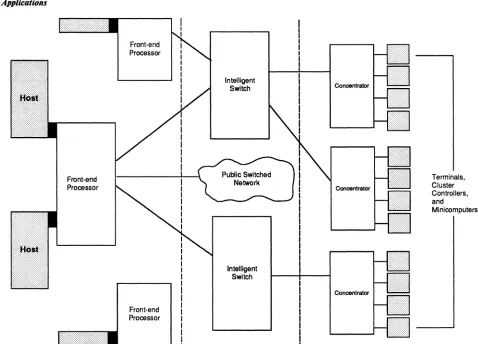
types of products: front-end
proces-sors, intelligent switches, and remote
concentrators.
In the late 1970s, IBM's SNA and
the ISO's OSI model advanced data
communications as a function
sepa-rate from applications processing.
SNA and OSI defined a network as a
-By Barbara Rinehart
Associate Editor/Analyst
physical entity, separate from its
par-ticipating hosts and terminals. The
implementation of a physically
sepa-rate communications function
oc-curred through a system of small
dedicated computers. Users placed
these communications processors at
the front end of a mainframe or
al-lowed them to function
indepen-dently as concentrators and switches
within their architectures.
In most communications processors,
under the direction of the CPU,
some components perform functions
for the whole communications
pro-cessor, while others perform
func-tions for specific groups of lines.
Among the former are host
inter-faces, input/output
(110)
processors,
reference clocks, and operator
inter-faces. Among the latter are the
pro-cessor's line bases and line sets.
There are two kinds of network
ar-chitectures: those for
communica-tions among computers and
terminals from a specific vendor,
and those for open communications
regardless of the vendor of the
com-municating devices.
This report discusses
communica-tions processor design, evolution,
and position in modern network
ar-chitectures.
It
concludes with
Selec-tion Guidelines for users.
@ 1991 McGraw·Hill, Incorporated, Reproduction Prohibited, Datapro Research Group. Delran NJ 08075 USA
C13-010-202
Processors
Analysis
Technology Basics
The definition of a communications processor
var-ies greatly. Network designers hold one view of
what a communications processor does, but
equip-ment manufacturers hold another. The term
"com-munications processor" has covered equipment
ranging from an IBM 3745 to a four-port packet
assembler/disassembler (PAD).
A network designer believes that a
communi-cations processor should set up connections to
transmit and receive data, mUltiplex and
demulti-plex data, frame and unframe messages, perform
error correction and protocol conversion, choose
transmission routes, and collect performance and
traffic statistics. Unfortunately, this definition has
led many manufacturers to classify their protocol
converters, PADs, terminal controllers, and
multi-plexers as communications processors.
Manufac-turers consider communications processors as
devices that connect terminals to networks and
maintain control through changing network
condi-tions. This concept clouds the definition of the
equipment-an IBM 3745 and a protocol
con-verter do not belong in the same category.
Datapro defines a communications processor
as a multifunctional, intelligent device dedicated to
communications and serving as a control point, or
node, in a data communications network.
It
func-tions as a front end to a mainframe, as an
intelli-gent switch, or as a remote concentrator. As a
front-end processor (FEP),
the communications
processor acts as a peripheral device locally
at-tached to one or more large computers, relieving
them of the overhead involved in message
han-dling and network control. An
intelligent switch
routes messages among the network's various end
points and participates in the network's control
and management, either under the control of a
master (usually front-end) processor oras a peer of
other intelligent switches. A
concentrator
controls a,
community of terminals, clusters of terminals, or
MAY 1991
Communications Processors:
Technology Overview
Datapro Reports on Data Communications
distributed applications processors; gathers,
queues, and multiplexes their transmissions onto
one or more high-speed network trunks; and
partic-ipates in the network's control and management,
either under the direction of a master processor or
as a peer of other concentrators and switches.
Network Architectures
In general, there are two kinds of network
architec-tures: those designed to provide communications
among computers and terminals from a specific
vendor, and those designed to provide open
munications regardless of the vendor of the
com-municating devices.
Mainframe vendor architectures include
IBM's SNA, Bull's DSA, and Unisys' BNA and
DCA. Open architectures include the CCITT X.25
packet-switching specification and several
"transparent" network schemes marketed by
com-munications vendors. The comcom-munications
proces-sor plays an important part in vendor-specific and
open architectures. The International Organization
for Standardization (ISO) reference model for
Open Systems Interconnection (OSI) provides a
framework in which to examine the functions
per-formed by communications processors in different
kinds of network architectures.
Mainframe Architectures
In network architectures designed by mainframe
vendors, the communications processor functions
most often as a front end and controls
communica-tions in conjunction with one or more software
systems in the host computer. In general, the
front-end processor handles the Data Link through
Ses-sion layers of the ISO model, with host software
implementing the Presentation and Application
layers. The activity in the layers varies, depending
on the architecture. In Unisys' DCA, the
DCP-Series front end controls many Presentation layer
functions, while in IBM's SNA, the host's access
method (along with software residing in the
termi-nal controllers) handles communications down to
the Session layer, with the 37XX front end acting
almost as a channel-attached packet switch. The
range of control assigned to front-end processors in
other mainframe architectures varies between
those extremes.
In all mainframe architectures, the same
com-munications processor models that serve as front
ends also function as intelligent switches and as
(
(
[image:5.612.105.583.91.435.2]Datapro Reports on Data Communications
Figure 1.
Applications
Communications Processors:
Technology Overvle.
Front-end Processor
C13-010-203
ProcessorsIntelligent
Switch Concentrator
Front-end
Processor Concentrator
Terminals, Cluster Controllers, and
Minicomputers
Intelligent Switch
Front-end Processor
Concentrator
A communications processor can function as a front end for one or more host computers, as an intelligent
switching node not attached directly to any applications equipment, or as a remote terminal concentrator.
remote concentrators. In these functions, the
com-munications processors usually appear in smaller
configurations than they do as front ends.
Commu-nications processors working in mainframe
archi-tectures also perform intelligent gateway functions.
In this application, the communications processor
provides the interface between the mainframe
net-work and communications facilities outside the
architecture, particularly public, packet switched
data networks using X.25 protocols.
Open
Architectures
In an open architecture, such as X.25, the
commu-nications processor serves as an intelligent packet
switch, implementing the Data Link through
Transport layers via a uniform set of
complemen-tary protocols. Designed specifically for public
data networks, X.25 protocols establish virtual
cir-cuits, or logical paths through the network, for
de-vices from any vendor. Communicating dede-vices at
@ 1991 McGraw-Hili, Incorporated. Reproduction Prohibited. Datapro Research Group. Delran NJ 08075 USA
either end of the virtual circuit must handle the
Session, Presentation, and Application layers
ac-cording to their own protocols.
In a public network, the network provider is
responsible for network management. The X.25
communications processors in such a network,
therefore, carry a heavy load of access, error, and
class-of-service control, along with provisions for
statistically recording traffic and usage data for
individual users.
Communications processors operating in
full-scale X.25 configurations seldom perform gateway
functions. The user must comply with the
net-work's protocols, either through X.25 software
re-siding in a participating host or its front-end
processor, or through a packet assembler/
disassembler (PAD) that handles the Physical and
Data Link layers of the architecture.
Vendors offer transparent architectures as
low-cost alternatives to mainframe architectures
C13-010-204
Processors
and X.25 implementations. These architectures are
usually stripped-down versions ofX.25 without the
network administration and class-of-service
over-head necessary to operate a public or large private
network. In these architectures, the
communica-tions processor funccommunica-tions primarily as a switching
concentrator, providing services at the Data Link,
Network, and Transport layers. Most of these
con-centrators evolved at the high ends oflines of
sta-tistical multiplexers, adding the crucial routing and
flow control features that qualify them as
commu-nications processors. Some of these products offer
integrated network management functions, such as
error logging and performance statistics, but most
rely on separate, complementary network
manage-ment systems for these functions.
Evolution of the Communications Processor
Two developments in the late 1960s provided the
technical base for the modern communications
processor: the minicomputer and ARPAnet. The
minicomputer performed a number of functions
more efficiently than a mainframe and supplied
the bus architecture that gave communications
processors modularity and flexibility. ARPAnet,
the first large-scale packet switched data network,
produced the fundamental design principles for
current data communications architectures. From
these principles originated the intelligent virtual
circuit switch, the first functional communications
processor.
A later development in minicomputer
appli-cations created the distributed processor, a small
computer dedicated to part of a larger application
that performed communications with its peers in a
distributed network. Distributed processing
con-tributed the idea of intelligent communications
handling under software control.
The lower cost of dedicated processing in
small computers made feasible the idea of
dedicat-ing a small computer to off-load intelligent
com-munications handling from the mainframe. The
first intelligent front ends, such as IBM's 3704,
predate modern network architectures and, to a
large extent, made such architectures possible.
The microprocessor also contributed to the
development of the communications processor.
The advent of inexpensive silicon intelligence
en-abled designers to implement the hierarchical
scheme of the typical communications architecture
MAY 1991
Communications Proce ... 1
Technology Overview
Datapro Reports on Data Communications
in hardware, with dedicated microprocessors
per-forming low-level functions and reporting to larger,
more complex processors at higher levels. Indeed,
some line bases in present-day communications
processors are programmable, receiving downloads
from the units' CPU s that describe protocol and
synchronization. Some systems comprise entirely
redundant, microprocessor-controlled modules
that perform the functions of other modules, using
the proper software load.
Products
Front-end processing
is the most difficult task
per-formed by a communications processor. In a large,
complex network governed by one or more
main-frame hosts, a front end must perform the follow- ..
ing: physical transmission and reception of data;
data buffering and queuing; multiplexing; message
framing and unframing; control transmission
er-rors; message sequencing; protocol conversion;
message pacing and flow control; message or
packet assembly and disassembly; route selection;
session establishment and disconnection; and data
formatting.
Intelligent switching
is slightly less complex.
When acting as a dedicated switch, the
communi-cations processor does not carry on a running
dia-log with a host computer and is not responsible for
end-to-end establishment and disconnection of
ses-sions. Still, an intelligent switch in normal
opera-tion must perform several basic funcopera-tions.
Since
concentration
is the simplest task
per-formed by a communications processor, it can be
confused with less sophisticated, single-function
devices like statistical multiplexers, protocol
con-verters, PADs, and terminal cluster controllers.
Indeed, the widespread use of microprocessors and
the declining cost of silicon intelligence, have
en-abled many devices at the high ends of these lines
to approach the functions of true communications
processors. In true communications processing like
concentration, however, a dynamic process occurs
that involves feedback from other intelligent
de-vices in the network. Statistical multiplexing,
pro-tocol conversion, and packet assembly/disassembly
are basically static processes that do not change as
conditions change in the network.
An intelligent concentrator participates in the
control of the network, either under the direction
(
(
[image:7.612.101.579.83.340.2]Datapro Reports on
Data Communications
Figure 2.
Hierarchical Architecture
HostllO )
Channel
Common Control {
Components
Line Bases
{
Line Sets
{
CommunlceUona Proce . .
oral
Technology Overview
Host
Computer
C13-010-205
Processors
Control and
Maintenance
Panel or
Console
Communications Lines
The diagram shows the hierarchical, bus-based architecture of a typical communications processor. Such a
pro-cessor can contain more than one host interface, several lIO propro-cessors, and many line bases. Each line base
serves communications lines of a specific synchronization, speed, and protocol. Each line set serves lines with a
specific, physical interface. The modular arrangement of line bases and line sets on the processor bus allows
easy configuration and reconfiguration.
of a master processor or as a peer of other
concen-trators and switches, receiving status information
from the network and changing its behavior
ac-cordingly. These changes include accelerating or
withholding transmissions, initiating diagnostic
procedures for pathways and devices in its local
domain, and controlling access to the network
from its locally attached devices. Some
sophisti-cated terminal controllers, notably IBM's 317 4s,
perform some or all of these functions.
,)
Design
The basic design of almost all communications
processors follows a three-tiered, hierarchical
plan-a plan that they share in common with
digi-tal PBXs and with a number of other data
commu-nications components.
The device's central processing unit (CPU)
with its main memory sits at the top of the
hierar-chy. The CPU controls the communications
pro-cessor's operation according to the rules and
parameters of its operating software and, in
front-end configurations, in conjunction with
instruc-tions from the host computer. In general, the CPU
performs addressing, route selection, protocol
con-version, access control, session establishment,
@ 1991 McGraw-Hili. Incorporated. Reproduction Prohibited. Oatepro Research Group. Delran NJ 08075 USA
application-level formatting, and error logging. It
also delegates rote operations to subsidiary
compo-nents.
Front-End Processors (FEPs):
Communications
processors configured as front ends must have at
least one host interface, which handles
communi-cations between the front-end processor and the
host's byte or block mUltiplexer, or selector
chan-nel. The host interface buffers data from the
front-end's CPU, assembles it into parallel bit streams of
a format specific to the attached host channel, and
transmits it up the channel to the host. For data
from the host, it performs the same process in
re-verse. The host interface converts data from the
communications processor's internal word size to
that of the host computer.
Input/Output Processors:
Some communications
processors contain one or more input/output
pro-cessors that transfer data between the CPU and
attached storage peripherals. In some cases, the I/O
processors arbitrate among the various line bases
for access to main memory and to the CPU,
han-dling interrupts generated by the line bases or host
C13-010-208
Processorsinterfaces to gain the attention of the CPU, or
con-trolling the line bases' and host interfaces' access to
main memory. In communications processors with
more than one
1/0
processor, each
1/0
processor
usually controls a set complement of storage units
or communications lines.
Reference Clock:
The reference clock generates a
timing signal for other components of the
commu-nications processor. In many systems, the CPU
performs reference timing. Some systems have
sep-arate reference clocks for timing signals at different
data rates.
Operator Interface:
The operator interface allows
an operator to monitor and control the
communi-cations processor and to run diagnostic tests. In
newer and more sophisticated systems, the
opera-tor interface works under software control from a
dedicated console, which usually contains a display
unit and a printer for logging. In older
communica-tions processors, the operator interface works
through a front panel equipped with manual
switches and indicator lights ..
Line Bases and Line Sets:
All of the
aforemen-tioned devices perform functions that are shared
among all communications lines; they sit just
be-low the CPU in the communications processor's
internal hierarchy. On the network side, the
"busi-ness end" of a communications processor, the line
bases and line sets complete the hierarchy.
A line base, sometimes called an attachment
base, interface base, or interface module, handles
communications atthe Data Link layer between
the communications processor and a group of
at-tached communications lines that share a common
synchronization pattern, line speed, and
(some-times) protocol. Each line base usually contains a
dedicated microprocessor that performs framing
and stripping, message buffering, message
sequenc-ing, synchronization, and error detection under the
direction of the CPU. Most current
communica-tions processors accommodate from 8 to 32 line
bases, each of which handles from two to eight line
sets.
A line set handles communications at the
Physical layer between its attached line base and
from one to eight communications lines. All the
communications lines attached to a line set must
use the same physical interface at approximately
MAY 1991
Communications Proceasor ••
Technology Overview
Datapro Reports on Data Communications
the same data tate. The line set handles
serializa-tion of data and interface-level control signaling.
Parallel Data Bus:
All components of the
commu-nications processor communicate with one another
over a parallel data bus, usually located along the
backplane or a side plane of the processor's
cabi-net. The physical bus architecture, popularized by
minicomputer design, supports easy installation
and replacement of parts. In a hierarchical
archi-tecture, the bus also accommodates easy
reconfigu-ration. To replace asynchronous communications
over voice grade lines with HDLC
communica-tions over wideband or satellite circuits for a
16-line segment of a network, a user might need only
to replace one line base and eight line sets, rather
than swapping out an entire front-end processor.
The hierarchical design extends the
communica-tions processor's functionality over time and helps.
to protect the user's investment. Figure 2 shows the
hierarchical configuration of a generalized
commu-nications processor.
Selection Guidelines
The principal advantage of a communications
pro-cessor as a networking tool is the physical and
logi-cal separation of the networking function from the
applications of its end users. Whatever its
architec-ture, such a network functions for any application,
grows in size without qualitative change to
accom-modate new applications, and runs new
applica-tions through the installation of relatively
standard, intelligent components. The user need
not redesign and rebuild a modular network to
change the network's ultimate purpose.
Programmable, software-controlled
commu-nications processors are especially useful tools in
standalone networks because they accommodate
not only changes in application but also the effects
of technical progress. A software-controlled
com-munications processor with a good design can
sur-vive breakthroughs in networking techniques
through relatively simple upgrades. The
microprocessor-controlled line bases, and even line
sets, provide an even more flexible buffer against
obsolescence.
In operation, a network controlled by
com-munications processors survives the total failure of
one or more of its host processors. In a multihost
network, front-end processors switch users from
@ 1991 McGraw-HiII,lncorporated: Reproduction Prohibited. Datapro Research Group. Delran NJ 08075 USA
-'
-"'
(
Datapro Reports on Data Communications
Communication. Proce . . or.:
Technolog, Overview
applications in a failed host to similar or identical
applications in a backup host, perhaps elsewhere
on the network. In a single-host network, a
func-tioning front end allows service to degrade
grace-fully in the event of a host failure, sometimes
allowing users to terminate their tasks before total
system failure or allowing communications among
distributed application processors in the absence of
the controlling host.
The communications processor still fulfills its
original purpose: relieving the host of the overhead
generated by keeping track of a network. Today's
networks are orders of magnitude more complex
than those of the mid-1970s when the first
commu-nications processors appeared. Thanks to the
de-clining costs of memory and processing power,
@ 1991 McGraw·HiII, Inccrporated. Reproduction Prohibited. Datapro Research Group. Delran NJ 08075 USA
C13-010-207
Processors
many oftoday's communications processors are
faster and more powerful than mainframes of that
era.
The complexity of communications
proces-sors, however, poses problems. In an era of
user-friendly hardware and software, the
communications processor remains a device
hospi-table only to trained engineers. Most require
pro-grams written in an arcane, Assembler-level
language, sometimes (but not always) with the
ben-efit of pregenerated macros in the host access
method . •
In this report:
Technology
Basics ... -202
Products ... -204
Selection
Guidelines ... -207
dallCllNQ"
Datapro Reports onData Communications
C13-010-201
Processors
Communications
Processors: Technology
Overview
Synopsis
Editor's Note
This report examines the technology
of communications processors. For
information on the market, see
Re-port C13-010-101; for comparison
columns detailing the features of key
products, see C13-01O-301.
Report Highlights
The term "communications
processor" describes not only a
spe-cific category of equipment, but also
systems that perform
communica-tions processing funccommunica-tions and other
services. Datapro's definition of
communications processors covers
multifunctional, intelligent systems
dedicated to communications and
serving as nodes in a network. These
systems generally include three basic
types of products: front-end
proces-sors, intelligent switches, and remote
concentrators.
In the late 1970s, IBM's SNA and
the ISO's OSI model advanced data
communications as a function
sepa-rate from applications processing.
SNA and OSI defined a network as a
physical entity separate from its
par-ticipating hosts and terminals. The
implementation of a physically
sepa-rate communications function
oc-curred through a system of small
dedicated computers. Users placed
these communications processors at
the front end of a mainframe, or
al-lowed them to function
indepen-dently as concentrators and switches
within their architectures.
In most communications processors,
under the direction of the CPU,
some components perform functions
for the whole communications
pro-cessor, while others perform
func-tions for specific groups of lines.
Among the former are host
inter-faces, input/output
(110)
processors,
reference clock, and operator
inter-face. Among the latter are the
proces-sor's line bases and line sets.
There are two kinds of network
ar-chitectures: those for
communica-tions among computers and
terminals from a specific vendor,
and those for open communications
regardless of the vendor of the
com-municating devices.
This report discusses
communica-tions processor design, evolution,
and position in modern network
ar-chitectures.
It
concludes with
Selec-tion Guidelines for users.
@ 1990 McGraw-Hili, Incorporated. Reproduction Prohibited. Datapro Research. Delran NJ 08075 USA
C13-010-202
ProcessorsAnalysis
Technology Basics
The definition of a communications processor
var-ies greatly. Network designers hold one view of
what a communications processor does, but
equip-ment manufacturers hold another. The term
"com-munications processor" has covered equipment
ranging from an IBM 3745 to a four-port packet
assembler/disassembler (PAD).
A network designer believes that a
communi-cations processor should set up connections to
transmit and receive data, multiplex and
demulti-plex data, frame and unframe messages, perform
error correction and protocol conversion, choose
transmission routes, and collect performance and
traffic statistics. Unfortunately, this definition has
led many manufacturers to classify their protocol
con verters, PADs, terminal controllers, and
statis-tical multiplexers as communications processors.
Manufacturers consider communications
proces-sors as devices that connect terminals to networks
and maintain control through changing network
conditions. This concept clouds the definition of
the equipment: an IBM 3745 and a protocol
con-verter do not belong in the same category.
Datapro defines a communications processor
as a multifunctional, intelligent device dedicated to
communications and serving as a control point, or
node, in a data communications network.
It
func-tions as a front end to a mainframe, as an
intelli-gent switch, or as a remote concentrator. As a
front-end processor (FEP),
the communications
processor acts as a peripheral device locally
at-tached to one or more large computers, relieving
them of the overhead involved in message
han-dling and network control. An
intelligent switch
routes messages among the network's various end
points and participates in the network's control
and management, either under the control of a
master (usually front-end) processor or as a peer of
other intelligent switches. A
concentrator
controls a
community of terminals, clusters of terminals, or
MAY 1990
Communications Processors: Technology Overview
Datapro Reports on Data Communications
distributed applications processors; gathers,
queues, and multiplexes their transmissions onto
one or more high-speed network trunks; and
partic-ipates in the network's control and management,
either under the direction of a master processor or
as a peer of other concentrators and switches.
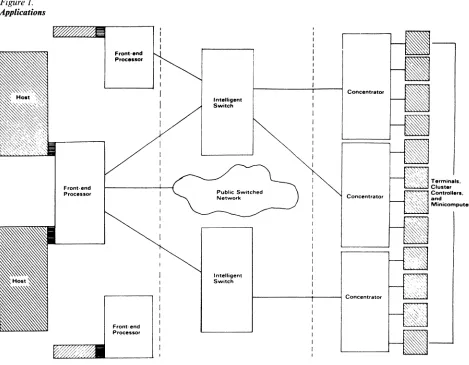
Table 1 lists the major functions of a
commu-nications processor in a typical network.
Network Architectures
In general, there are two kinds of network
architec-tures: those designed to provide communications
among computers and terminals from a specific
vendor, and those designed to provide open
munications regardless of the vendor of the
com-municating devices.
Mainframe vendor architectures include
IBM's SNA, Bull's DSA, and Unisys' BNA and
DCA. Open architectures include the CCITT X.25
packet-switching specification and several
"transparent" network schemes marketed by
com-munications vendors. The comcom-munications
proces-sor plays an important part in vendor-specific and
open architectures. The International Organization
for Standardization (ISO) reference model for
Table 1. Communications Processors
Functions
Physical transmission and reception of
data
Data buffering and queuing
Multiplexing
Message framing and unframing
Control of transmission errors
Message sequencing
Protocol conversion
Message pacing and flow control
Message or packet assembly and
disassembly
Route selection
Session establishment and
disconnection
Formatting of data for use by specific
host or terminal applications
Reporting and logging of device or
transmission errors or failures
Fallback switching in case of host,
de-vice, or transmission line failure
Gather and record network
perfor-mance and traffic statistics
@ 1990 McGraw-Hili, Incorporated. Reproduction Prohibited. Datapro Research. Delran NJ 08075 USA
/
(
(
[image:13.612.75.544.86.451.2]Datapro Reports on Data Communications
Figure 1.
Applications
Front-end
Processor
Communications Processorsl Technology Overview
Front-end Processor
front-end
Processor
Intelligent Switch
Intelligent Switch
Concentrator
Concentrator
1 - - - t " - - - 1 Concentrator
C13-010-203
Processors
A communications processor can/unction as afront end/or one or more host computers, as an intelligent
switching node not attached directly to any applications equipment, or as a remote terminal concentrator.
Open Systems Interconnection (OSI) provides a
framework in which to examine the functions
per-formed by communications processors in different
kinds of network architectures.
Mainframe Architectures
In network architectures designed by mainframe
vendors, the communications processor functions
most often as a front end and controls
communica-tions in conjunction with one or more software
systems in the host computer. In general, the
front-end processor handles the Data Link through
Ses-sion layers of the ISO model, with host software
implementing the Presentation and Application
layers. The activity in the layers varies, depending
on the architecture. In Unisys' DCA, the
DCP-Series front end controls many Presentation layer
functions, while in IBM's SNA, the host's access
@ 1990 McGraw-Hili. Incorporated. Reproduction Prohibited. Datapro Research.
Delran NJ 08075 USA
method (along with software residing in the
termi-nal controllers) handles communications down to
the Session layer, with the 37XX front end acting
almost as a channel-attached packet switch. The
range of control assigned to front-end processors in
other mainframe architectures varies between
those extremes.
In all mainframe architectures, the same
com-munications processor models that serve as front
ends also function as intelligent switches and as
remote concentrators. In these functions, the
com-munications processors usually appear in smaller
configurations than they do as front-ends.
Commu-nications processors working in mainframe
archi-tectures also perform intelligent gateway functions.
In this application, the communications processor
provides the interface between the mainframe
net-work and communications facilities outside the
C13-010-204
Processors
architecture, particularly public, packet-switched
data networks using X.25 protocols.
Open Architectures
In an open architecture, such as X.25, the
commu-nications processor serves as an intelligent packet
switch, implementing the Data Link through
Transport layers via a uniform set of
complemen-tary protocols. Designed specifically for public
data networks, X.25 protocols establish virtual
cir-cuits, or logical paths through the network, for
de-vices from any vendor. Communicating dede-vices at
either end of the virtual circuit must handle the
Session, Presentation, and Application layers
ac-cording to their own protocols.
In a public network, the network provider is
responsible for network management. The X.25
communications processors in such a network,
therefore, carry a heavy load of access, error, and
class-of-service control, along with provisions for
statistically recording traffic and usage data for
individual users.
Communications processors operating in
full-scale X.25 configurations seldom perform gateway
functions. The user must comply with the
net-work's protocols, either through X.25 software
re-siding in a participating host or its front-end
processor, or through a packet assemblerl
disassembler (PAD) that handles the Physical and
Data Link layers of the architecture. Table 2 shows
the protocols supported by various vendors'
com-munications processors.
Vendors offer transparent architectures as
low-cost alternatives to mainframe architectures
and X.25 implementations. These architectures are
usually stripped-down versions of X.25 without the
network administration and class-of-service
over-head necessary to operate a public or large private
network. In these architectures, the
communica-tions processor funccommunica-tions primarily as a switching
concentrator, providing services at the Data Link,
Network, and Transport layers. Most of these
con-centrators evolved at the high ends oflines of
sta-tistical multiplexers, adding the crucial routing and
flow control features that qualify them as
commu-nications processors. Some of these products offer
integrated network management functions, such as
error logging and performance statistics, but most
rely on separate, complementary network
manage-ment systems for these functions.
MAY 1990
Communications Processors: Technology Overview
Datapro Reports on Data Communications
Evolution of the Communications Processor
Two developments in the late 1960s provided the
technical base for the modern communications
processor: the minicomputer and ARPAnet. The
minicomputer performed a number of functions
more efficiently than a mainframe and supplied
the bus architecture that gave communications
processors modularity and flexibility. ARPAnet,
the first large-scale packet switched data network,
produced the fundamental design principles for
current data communications architectures. From
these principles originated the intelligent virtual
circuit switch, the first functional communications
processor.
A later development in minicomputer
appli-cations created the distributed processor, a small
computer dedicated to part of a larger application
that performed communications with its peers in a
distributed network. Distributed processing
con-tributed the idea of intelligent
communications-handling under software control.
The lower cost of dedicated processing in
small computers made feasible the idea of
dedicat-ing a small computer to off-load intelligent
communications-handling from the mainframe.
The first intelligent front ends, such as IBM's 3704,
predate modern network architectures and, to a
large extent, made such architectures possible.
The microprocessor also contributed to the
development of the communications processor.
The advent of inexpensive silicon intelligence
en-abled designers to implement the hierarchical
scheme of the typical communications architecture
in hardware, with dedicated microprocessors
per-forming low-level functions and reporting to larger,
more complex processors at higher levels. Indeed,
some line bases in present-day communications
processors are programmable, receiving downloads
from the units' CPUs that describe protocol and
synchronization. Some systems comprise entirely
redundant, microprocessor-controlled modules
that perform the functions of other modules, using
the proper software load.
Products
Front-end processing
is the most difficult task
per-formed by a communications processor. In a large,
complex network governed by one or more
main-frame hosts, a front end must perform the
follow-ing: physical transmission and reception of data;
(
[image:15.612.68.535.86.379.2](-Datapro Reports on Data Communications
Figure 2.
Hierarchical Architecture
Host I/O} Channal
Common Control
~
Components1
Line aases
~
Line Seta
1
Communications Processors: Technology Overview
Host Computer
C13-010-205
Processors
Control and Maintenanca Panel or
L.-_~ Console
Communications Lines
The diagram shows the hierarchical, bus-based architecture of a typical communications processor. Such a
pro-cessor can contain more than one host interface, several I/O propro-cessors, and many line bases. Each line base
serves communications lines of a specific synchronization, speed, and protocol. Each line set serves lines with a
specific, physical interface. The modular arrangement of line bases and line sets on the processor bus allows
easy configuration and reconfiguration.
data buffering and queuing; multiplexing; message
framing and unframing; control transmission
er-rors; message sequencing; protocol conversion;
message pacing and flow control; message or
packet assembly and disassembly; route selection;
session establishment and disconnection; and data
formatting.
Intelligent switching
is slightly less complex.
When acting as a dedicated switch, the
communi-cations processor does not carryon a running
dia-log with a host computer and is not responsible for
end-to-end establishment and disconnection of
ses-sions. Still, an intelligent switch in normal
opera-tion must perform several basic funcopera-tions.
Since concentration is the simplest task
per-formed by a communications processor, it can be
confused with less sophisticated, single-function
devices like statistical multiplexers, protocol
con-verters, PADs, and terminal cluster controllers.
Indeed, the widespread use of microprocessors and
the declining cost of silicon intelligence, has
en-abled many devices at the high ends of these lines
@ 1990 McGraw-Hili, Incorporated. Reproduction Prohibited. Dalapro Research. Delran NJ 08075 USA
to approach the functions of true communications
processors. In true communications processing,
like concentration, however, a dynamic process
occurs that involves feedback from other
intelli-gent devices in the network. Statistical
multiplex-ing, protocol conversion, and packet assembly/
disassembly are basically static processes that do
not change as conditions change in the network.
An intelligent concentrator participates in the
control of the network, either under the direction
of a master processor or as a peer of other
concen-trators and switches, receiving status information
from the network and changing its behavior
ac-cordingly. These changes include accelerating or
withholding transmissions, initiating diagnostic
procedures for pathways and devices in its local
domain, and controlling access to the network
from its locally attached devices. Some
sophisti-cated terminal controllers, notably IBM's 317 4s,
perform some or all of these functions.
C13-010-206
Processors
Design
The basic design of almost all communications
processors follows a three-tiered, hierarchical
plan-a plan that they share in common with
digi-tal PBXs and with a number of other data
commu-nications components.
The device's central processing unit (CPU)
with its main memory sits at the top of the
hierar-chy. The CPU controls the communications
pro-cessor's operation according to the rules and
parameters of its operating software and, in
front-end configurations, in conjunction with
instruc-tions from the host computer. In general, the CPU
performs addressing, route selection, protocol
con-version, access control, session establishment,
application-level formatting, and error logging.
It
also delegates rote operations to subsidiary
compo-nents.
Front-End Processors (FEPs): Communications
processors configured as front ends must have at
least one host interface, which handles
communi-cations between the front-end processor and the
host's byte or block multiplexer, or selector
chan-nel. The host interface buffers data from the front
end's CPU, assembles it into parallel bit streams of
a format specific to the attached host channel, and
transmits it up the channel to the host. For data
from the host, it performs the same process in
re-verse. The host interface converts data from the
communications processor's internal word size to
that of the host computer.
Input/Output Processors: Some communications
processors contain one or more input/output
pro-cessors that transfer data between the CPU and
attached storage peripherals. In some cases, the I/O
processors arbitrate among the various line bases
for access to main memory and to the CPU,
han-dling interrupts generated by the line bases or host
interfaces to gain the attention of the CPU, or
con-trolling the line bases' and host interfaces' access to
main memory. In communications processors with
more than one I/O processor, each 110 processor
usually controls a set complement of storage units
or communications lines.
Reference Clock: The reference clock generates a
timing signal for other components of the
commu-nications processor. In many systems, the CPU
MAY 1990
Communications Processors: Technology Overview
Datapro Reports on Data Communications
performs reference timing. Some systems have
sep-arate reference clocks for timing signals at different
data rates.
Operator Interface: The operator interface allows
an operator to monitor and control the
communi-cations processor and to run diagnostic tests. In
newer and more sophisticated systems, the
opera-tor interface works under software control from a
dedicated console, which usually contains a display
unit and a printer for logging. In older
communica-tions processors, the operator interface works
through a front panel equipped with manual
switches and indicator lights.
Line Bases and Line Sets: AU of the
aforemen-tioned devices perform functions that are shared
among all communications lines; they sit just
be-low the CPU in the communications processor's
internal hierarchy. On the network side, the
"busi-ness end" of a communications processor, the line
bases and line sets complete the hierarchy.
A line base, sometimes called an attachment
base, interface base, or interface module, handles
communications at the Data Link layer between
the communications processor and a group of
at-tached communications lines that share a common
synchronization pattern, line speed, and
(some-times) protocol. Each line base usually contains a
dedicated microprocessor that performs framing
and stripping, message buffering, message
sequenc-ing, synchronization, and error detection under the
direction of the CPU. Most current
communica-tions processors accommodate from 8 to 32 line
bases, each of which handles from 2 to 8 line sets.
A line set handles communications at the
Physical layer between its attached line base and
from one to eight communications lines. All the
communications lines attached to a line set must
use the same physical interface at approximately
the same data rate. The line set handles
serializa-tion of data and interface-level control signaling.
Parallel Data Bus: All components of the
commu-nications processor communicate with one another
over a parallel data bus, usually located along the
backplane or a side plane of the processor's
cabi-net. The physical bus architecture, popularized by
minicomputer design, supports easy installation
@ 1990 McGraw-Hili, Incorporated. Reproduction Prohibited. Datapro Research.
Delran NJ 08075 USA
(
'\(
(
Datapro Reports on Data Communications
Communications Processors: Technology Overview
and replacement of parts. In a hierarchical
archi-tecture, the bus also accommodates easy
reconfigu-ration. To replace asynchronous communications
over voice grade lines with HDLC
communica-tions over wideband or satellite circuits for a
16-line segment of a network, a user might need only
to replace one line base and eight line sets, rather
than swapping out an entire front-end processor.
The hierarchical design extends the
communica-tions processor's functionality over time and helps
to protect the user's investment. Figure 2 shows the
hierarchical configuration of a generalized
commu-nications processor.
Selection Guidelines
The principal advantage of a communications
pro-cessor as a networking tool is the physical and
logi-cal separation of the networking function from the
applications of its end users. Whatever its
architec-ture, such a network functions for any application;
grows in size without qualitative change to
accom-modate new applications; and runs new
applica-tions through the installation of relatively
standard, intelligent components. The user need
not redesign and rebuild a modular network to
change the network's ultimate purpose.
Programmable, software-controlled
commu-nications processors are especially useful tools in
standalone networks because they accommodate
not only changes in application but also the effects
of technical progress. A software-controlled
com-munications processor with a good design can
sur-vive breakthroughs in networking techniques
through relatively simple upgrades. The
© 1990 McGraw-Hili, Incorporated. Reproduction Prohibited. Datapro Research. Delran NJ 08075 USA