SECURE EMBEDDED WEBSERVER WITH INTERNET
CONTROL MESSAGE PROTOCOL
1J.JAYACHANDRA BENSAM, 2Dr.T.JAYASINGH, 3Dr.S.RAVI
1Research Scholar, Department of Electronics & Communication Engineering,
Dr. M.G.R. Educational and Research Institute University, Chennai, Tamil Nadu, India
2Supervisior,
Dr. M.G.R. Educational and Research Institute University, Chennai, Tamil Nadu, India
3Professor & Head, Department of Electronics & Communication Engineering,
Dr. M.G.R. Educational and Research Institute University, Chennai, Tamil Nadu, India
E-mail: [email protected], [email protected], [email protected]
ABSTRACT
Embedded system based real time process control and monitoring requires several critical issues to be intrinsically taken care to avoid fatal error. Issues of concern include avoiding OS crash, avoiding fragmented frames, place proper section of code in critical section, implement the different activities as tasks, etc. In this paper, an embedded webserver using LPC1768 is implemented using Internet Control Message Protocol (ICMP) and the algorithms are written such that, OS crash due to ICMP echo message limit violation, is avoided. The ICMP frame length is monitored and only unfragmented frames are received.
Keywords: ICMP, Secure Transmission, Network Speed, Error Reduction, Ping of Death
1. INTRODUCTION
The network forms an essential component in computer generation and it is imperative to create a technique to monitor and manage a computer network for available resources in a network. A network system is basically a map in which various network devices are interconnected and communicate with each other. The interconnection among devices can be based on any of the network topologies. To monitor these devices by manually pinging the information in console window is a tedious process particularly if the network devices are many and the polling interval is small. The research on ICMP and SNMP protocols helps in automating the desired task assumptions such as, (i) A tool that allows user to either create the desired network topology based on the prevalent network infrastructure and enter network devices configuration details or (ii) Allow the network monitoring tool to self discover the underlying network topology is essential. Monitoring process is then started which takes the IP list and sends ICMP echo request packets and accepts ICMP echo reply to determine the device status. ICMP is an integral part of any IP implementation. ICMP messages are sent in IP packets and it uses IP as a higher-level protocol and is implemented in every
IP module. ICMP messages are classified into two main categories,
(i) ICMP Error Messages
(ii) ICMP Query Messages
To provide / send error messages for non-transient error conditions, and to provide a way to probe the network in order to determine general characteristics about the network. A number code, also known as the “message type”, is assigned to each ICMP message; it specifies the type of the message. Another number code represents a “code” for the specified ICMP type and acts as a sub-type and interpretation is dependent upon the message type.
1.1.
Objective Of The WorkThe main objective of this work is to implement an embedded system based webserver, make it secure and prevent OS crash due to long echo message in ICMP. Eliminating the fragmented frames at regular intervals intrinsically in the algorithm is done to achieve the objective.
2. ICMP MESSAGE ENCAPSULATION
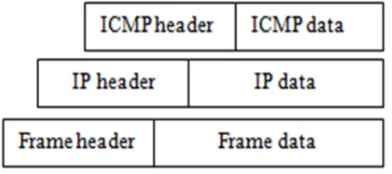
separate protocol that sits on IP and uses IP to transport messages. It is considered the part of the IP layer that communicates error message and other conditions that require attention. The ICMP messages are acted on by either the IP layer or the higher layer protocol and messages cause error to be returned to user processes that are transmitted within IP datagrams as shown in Figure 1.
Figure 1: ICMP messages encapsulated within an IP datagrams
ICMP messages are encapsulated in IP datagrams, as is shown in Figure 2.
Figure 2: ICMP messages encapsulation
ICMP frames are identified by IP Protocol field value and used by IP to send error and control messages. The ICMP message format is shown in Figure 3.
Figure 3: ICMP message format
It is used to communicate IP status and error messages between hosts and routers and implemented with IP as just a packet delivery
system. It transmits and routes datagrams from sources to destinations through a series of interconnected networks. It has a checksum in the IP header to detect lost bits and no error detection on the datagram payload, but has no native mechanism for source host notification, where ICMP comes in used to report IP errors to the source host and ICMP data is carried as the payload of an IP datagram that specifies additional message formats.
3. TYPES OF ICMP MESSAGES
There are different types of ICMP messages, which suits unique purposes. They are briefed below and the types are given below in Table 1.
3.1 Information Messages
The sender sends a query to another machine
(either host or router) and expects an answer. For e.g. a host might want to know if a router is alive.
3.2 Error Indication Messages
[image:2.595.91.287.391.478.2]The IP software on a host or router has encountered a problem processing an IP datagram. For e.g. it may be unable to route the datagram to its destination.
Table 1: ICMP Message Types
Category Information
Error Reporting Messages
Destination unreachable Source quench
Parameter problem
Redirection
Query Messages
Echo request/reply Timestamp request
Address mask
Router solicitation
4. ICMP ERROR REPORTING
Figure 4: ICMP Error Message
4.1 Features of ICMP
The following points are,
(i) No ICMP error message will be
generated in response to a datagram carrying an ICMP error message
(ii) No ICMP error message will be
generated for a fragmented datagram that is not the first fragment
(iii) No ICMP error message will be
generated for a datagram having a multicast address
(iv) No ICMP error message will be
generated for a datagram having a special address such as 127.0.0.0 or 0.0.0.0.
(v) Echo messages are limited 216
i.e.65536bytes data in the data part of the packet
(vi) Prominent information is in the
header
4.2 ICMP Data for Error Messages
[image:3.595.87.518.78.273.2]When a gateway cannot route a datagram (e.g., an appropriate route in its local table and bit is set) it discards the message and returns an ICMP destination unreachable message to the sending host (refer Figure 5).
Figure 5: ICMP destination message to sending host
When a gateway becomes congested and runs out of a buffer space, it may discard a datagram and return a source quench message. It requests to the sender to reduce the rate of sending datagram.
4.2.1 Time exceeded
The routers decrement its time-to-live (TTL) field. If the TTL value reaches 0, the gateway discards the datagram and sends a time exceeded message to the sender. It is used by a destination host to show that not all fragments have arrived within a set time.
4.2.2 Parameter problem
When a host encounters problem with an IP datagram, it returns a parameter problem message to the datagram's sender and sent from a router to a local host on the same network. It informs the source of a better route to the destination. A host usually starts with a small routing table that is gradually augmented and updated.
5. ICMP QUERY MESSAGES
This is used to diagnose network problems, this type of ICMP message is answered in a specific format by the destination node. The query message process is shown in Figure 6.
Error Reporting
Destination unreachable
Source quench
Time exceeded
Parameter problem
Figure 6: ICMP Query Messages
5.1 Echo Request / Reply
If a network system sends an ICMP echo request message to another node network, then another node in the system is required to respond with an ICMP echo reply. The program ping allows a user to check whether a machine is reachable and functioning. The identifier and sequence number are used by the echo sender to aid in matching the replies with the echo requests.
5.2 ICMP Attacks
ICMP is a protocol used in internet layer of TCP/IP protocol suite to send error messages and carryout network management tasks. It is a ‘Ping’ tool which is used to send echo message to know the live status of the destination. The ICMP protocol does not have any authentication built-in and attacker can intercept ICMP packets. ‘Ping’ is used to launch denoal of service attacks to defenses against ICMP attacks may include the following key points are,
(i) Checking if the packet belongs to the
same connection or not.
(ii) Changes in routes should be
authorized to a particular connection.
(iii) Reply packet should be accepted at a
particular time.
6. LIMITATIONS OF ICMP BASED
EMBEDDED SYSTEM INTERFACE
Operating systems running on embedded target board can get crashed if echo messages
exceeding 216 bytes is specified. This ICMP echo
message of gargantuan size will crash the code running in embedded target. To overcome this problem in ICMP based embedded system
interface the incoming ICMP frame length needs to be checked and only unfragmented frames need to handled by the embedded system. The code development should be done to avoid this limitation.
In this paper, an existing embedded system (LPC1768) based webserver to display the process value from a plant using ICMP protocol is used for experimentation. The existing code was not optimized with respect to ICMP problem and the code crashed. The code is optimized to handle
(i) Fragmented frames
(ii) To take only 36 bytes even if echo message
exceeds 216 bytes.
This is done by including the following in the code.
a. if(!(val&(IP_FLAG_NOREFRAG|
IP_FRAGOFS_MASK)))
The above line of code checks for
unfragmented frames and whenever
fragmented frames are sent, it will be discarded. This, however, does not alter the protocol type, source ip and destination IP address.
b. if(RecdIPFrameLength>MAX_ETH_TX_D
ATA_SIZE)
ICMP Data count = MAX_ETH_
TX_DATA_SIZE-IP_HEADER_SIZE_ICMP_HEADER_SIZ E;
else
ICMP Data count = RecdIPFrameLength- IP_HEADER_SIZE_ICMP_HEADER_SIZ E;
The above line of code ensures that if more than the maximum Ethernet data size (i.e. 60 bytes) is received then only 36 bytes are assigned
to the ICMP Data Count. Thus
IP_HEADER_SIZE of 20 bytes and
ICMP_HEADER_SIZE of 4 bytes along with the accepted 36 bytes will not violate the maximum Ethernet data size. Thus, buffer overflow is avoided and the code will not crash.
Query
Echo request and reply
Timestamp request and reply
Address-mask request and reply
7. IMPLEMENTATION DETAILS / RESEARCH METHODOLOGY
The research methodology details are shown in the block diagram in Figure 7. It consists of the embedded target using LPC1768, the webserver lunched by 1768 in host and the Linux kernel port exploiting the ICMP limitation.
[image:5.595.310.528.387.593.2]
Figure 7: Block Diagram of Embedded System based Webserver using ICMP
The embedded system based webserver interface for monitoring the process includes the following steps:
1) Get the IP address
2) Initialize buffer size (Ex:1500) for storing the
message i.e. IP header and ICMP data. This is done using code line.
Char buf[1500]; bzero(buf, sizeof buf);
3) Create a socket for communication. This
should include domain name, type and protocol. In this work AF_NET is set to IPv4 Internet Protocol, SOCK__RAW provides
raw network protocol access and
IPPROTO_ICMP selects the ICMP protocol
4) Manipulate the option for socket. This
contains the IP header i.e. IP_HDRINCL
5) Extract the structure of the given IP address
and copy the number of bytes
6) Represent the IP Header and ICMP payload.
This needs the declaration of following information;
(a) IP Version (b) Header length (c) Types of service
(d) Length (e) Identification (f) Flags
(g) Offset (h) Time to live (i) Protocol (j) Checksum (k) Source IP Address (l) Destination IP Address
ICMP also requisites the following order (i) Types of message
(ii) Code (iii) Checksum
7) After declaring IP header, the packets are sent
to destination IP Address.
The code details are listed in Appendix -I
8. RESULT AND DISCUSSION
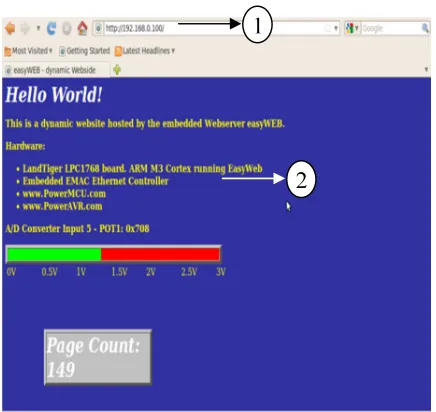
(1) Webserver IP Address (2) Process value displayed in the webserver (Both in value and Bar graph)
Figure 8: Embedded Web Server restored with code optimization to prevent code crash
LPC 1768 Embedded Webserver
Webserver
Linux Kernel
Plant
LAN Port ICMP
Ping of Death Attack
Process Value
1
(1) Experimenting with Ping of Death Attack from Linux kernel
Figure 9: Embedded Web Server with Ping of Death Attack
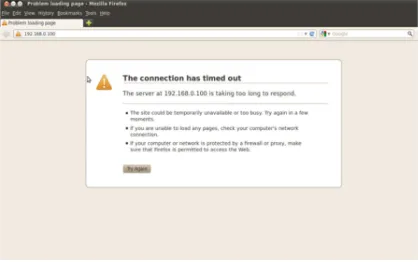
Figure 10: Embedded Web Server crashed due to Ping of Death Attack in ICMP
8.1.LIMITATIONS OF THIS WORK
The embedded webserver is implemented in keil environment on LPC1768 ARM processor. In this experimented work, whenever the code is changed, it needs to be compiled in Keil and converted to a hex file and then downloaded into target. However, a more dynamic implementation, that permits on-the-fly code changes, could be using a userspace llike python under linux. This eliminates the need for compiing the changes in code everytime.
9. CONCLUSION
In this work, a secure webserver algorithm is embedded with the hardware core (ARM processor) to prevent code crash. Additionally, node can be protected in conjunction with security control (such as physical access, authentication, authorization or network controls) to adequately
ensure the confidentiality, integrity and
availability of the node link.
REFERENCES:
[1] Aman Mahajan ,Haresh Joshi ,Sahil Khajuria
, Anil k Verma, “ICMP, SNMP: Collaborative
Approach to Network Discovery and
Monitoring”, International Journal of Smart
Sensors and Ad Hoc Networks (IJSSAN) ISSN
No. 2248-9738 Vol.1, Issue-3, 2012, pp.8-12.
[2] HE Li-juan, WANG Dong-hong, "Topology
discovery algorithm of the SNMP-based
network--layer protocol”, Journal of
Shijiazhuang Vocational Technology Institute,
Vol.21 No.6, 2009.
[3] Li, Yanbing; Ma, Yue; Wang, Wei; Wan,
Xiaoqiang, “A link layer topology discovery
algorithm based on STP”, Jisuanji
Gongcheng/Computer Engineering, Vol.32,
No.18, Sep 20,2006 , pp.109-110+113.
[4] Yang Qiuxiang; “ Algorithm Research of
Topology Discovery on SNMP”,
International Conference on Computer
Application and System Modeling (ICCASM
2010),Vol.12, pp. 496-497.
[5] J. Wei-hua, Du jun "The application of ICMP
protocol in network scanning", Proceedings
of International Conference on PDCAT, Aug
2003, pp.904- 906.
[6] Madalina Baltatu, Antonio Lioy, Fabio
Maino, Daniele Mazzocchi. “Security Issues in Control, Management and Routing
Protocols”. 22-25 May 2000. URL :
http://www.terena.nl/tnc2000/proceedings/3A
/3a2.pdf (10 Dec 2001).
[7] Alex Peeters. “ICMP Header Format”. 4
October, 1999. URL :
http://citap.freeservers.com/publications/tcp-ip/tcpip012.htm (10 Dec 2001).
[8] Lindsay van Eden. “The Truth About ICMP”.
17 May 2001 URL : http:// www.sans.org
/infosecFAQ/threats/ICMP.htm (10 Dec
2001).
[9] Abdullah H. Alqahtani, Mohsin Iftikhar, “
TCP/IP Attacks, Defenses and Security
Tools”, International Journal of Science and
[image:6.595.89.298.432.563.2]Modern Engineering (IJISME) ISSN:
2319-6386, Vol.1, Issue-10, September 2013,
pp:42-47.
[10] “Wireshark”, online, www.wireshark.org.
(last accessed on 25 May 2013)
[11]Bellovin, Steven M. “A look back at.”
Computer Security Applications Conference,
2004. 20th Annual. IEEE, 2004.
[12]Trabelsi, Zouheir, and Khaled Shuaib,
“NIS04-4: Man in the Middle Intrusion
Detection.” Global Telecommunications
Conference, 2006. GLOBECOM'06. IEEE.
IEEE, 2006.
[13]Yan, Boru, et al, “Detection and defence of
DNS spoofing attack,” Jisuanji Gongcheng/
Computer Engineering 32.21 (2006),
pp.130-132
[14]Zaraska, Krzysztof, “Prelude IDS: current
state and development perspectives,” URL
http://www. prelude-ids. org/ download / misc
/ pingwinaria/2003/paper. pdf(2003)
[15]Yao, Xiaoyu, and Chen ZHAO, “Research on
Implementation and Application of Linux
Kernel Firewall Netfilter [J],” Computer
APPENDIX –I
Step Code Remarks
1 int main(int argc, char *argv[]) -
2
Char buf[1500]; bzero(buf, sizeof buf);
Making zero valued bytes by using bzero() function
3 s=socket(AF_INET,SOCK_RAW,IPPROTO_ICMP -
4
setsockops(s,IPPROTO_IP, IP_HDRINCL,
&on, sizeof(on) -
5
bcopy(hp->h_addr_list[0], &ip->ip_dst.s_addr,
hp->h_lenght; -
7
sendto(s, buf, sizeof buf, 0, (struct sockaddr *) & dst, sizeof dst)