ISSN: 1992-8645 www.jatit.org E-ISSN: 1817-3195
316
MULTI-CRITERIA DECISION MAKING FOR
SELECTING SEMANTIC WEB SERVICE CONSIDERING
VARIABILITY AND COMPLEXITY TRADE-OFF
1NANANG YUDI SETIAWAN, 2RIYANARTO SARNO
1
Universitas Brawijaya, Jalan Veteran, Malang 65145, Indonesia 2
Institut Teknologi Sepuluh Nopember, Jalan Keputih, Surabaya 60111, Indonesia
E-mail: [email protected], [email protected]
ABSTRACT
Business process decomposition helps to focus on the base business process rather than the whole business processes with a higher complexity. Variability of business process decomposition taken into a different complexity level within common business process. By considering business process variability and complexity trade-off, we selected the best solution for semantic web service alternatives with different service quality. The selected web service should be fulfilled most of service quality capability defined in user’s preferences. For our case study we had chosen the Penerimaan Peserta Didik Baru, an online student submission system consists the registration procedure for multi-degree of school, multi-selection (regular, inclusion, pre-welfare), and multi-phase for every educational level. The base process is selected from four basic models, and we identified the variant models that representing the behavior of all possible requirements. In this paper, semantic service selection is used by discovering semantic web services through their service registry. Web services was annotated with its business process formalization and quality attributes. However, the variability and complexity in business process decomposition are contradictory, thus, constitute a trade-off. We interpreted it as the multi-criteria decision problem and proposed Fuzzy AHP+TOPSIS method to bring the best optimum solution that reflect the needs and preferences of the decision maker. This approach proved to solve the multi-criteria decision problem for selecting the best options of semantic web services considering the trade-off among variability and complexity of business process. In our study, we had tested 153 service requests and gained a precision of 91.3%, and a recall or sensitivity of 89.4% that result the harmonic mean of precision and recall of 0.903. Our approach is success to deliver the most preferred number of business process variant with minimum complexity level in accordance with the acceptable service quality (service cost, capacity, and latency) delivered by service providers.
Keywords: Business Process, Variability, Complexity, Semantic Web Service, Multi-Criteria Decision Making
1. INTRODUCTION
As part of the business process design, business process model has been a concept to identify and specify a business process itself [1]. We have limitations in understanding an excessive and complex process. Therefore, by dividing it into groups, a smaller business process model can be more easily translated and learned. Business process decomposition provides reuse and lower manageability by delivering services in a much simpler function [2].
PPDB decomposition construct process fragments representing the functional characteristics of each part. The fragment became a
diagram having commonality and variability [3]. In reference process model, features of the same behavior can refer to a common business processes. However, when the scope of business functionality raised, its reuse has become diminished [4]. In order to reach its optimal complexity, business process should be composed with a lowest granularity level. We used several configuration based on the four models that extending the student selection submission.
ISSN: 1992-8645 www.jatit.org E-ISSN: 1817-3195
317 office of education that involve students, parents, and school officers. Every city had their registration steps and requirements with degree, multi-selection (regular, inclusion, domicile), and obtained the process repeatedly. There are four main process, namely the student collection, the pre-registration, the registration and the student sorting (selection). Each process accommodates different amount of variants according to its base business process composition. Simplified common process should generates more variants than the complex ones, thus, contradictory to the complexity of its composition constituting a trade-off. The trade-off can be interpreted as a decision-making problem that involves managing compromises among a number of criteria [5]. Therefore, to determine these trade-offs, we proposed a ranking mechanism based on the combination of Fuzzy Analytic Hierarchy Process (Fuzzy AHP) and Technique for Order of Preference by Similarity to Ideal Solution (TOPSIS).
Fuzzy number is often used instead of crisp numbers for taking uncertainties criteria [6]. It able to adequately handle the inherent uncertainty and imprecision associated with the metric of business process complexity. The fuzzy pairwise comparison can tolerate vagueness in business process quality and complexity metric. Then by implementing TOPSIS algorithm, assessment of service provider has been done. The trade-off between business process variability and complexity associated with selected services,
2. LITERATURE REVIEW
Web service selection has been defined in various ways, and its meaning closed to service discovery as well as service matching. As the purpose for selecting better services, it involves the discovery of services to be matched each other and takes the similar one. Web service selection is the process, which the service requester seek the location of corresponding services from its provider based on service’s description that meet the specific requirement [7] [8].
The requirements of interroperability between heterogenous systems has became a necessity to integrate different platforms and solve the communication problem. Using semantic web services, we obtain knowledge through a computer interpretable languange that implicate service interrogation, discovery, selection and composition and let different plaform to cooperate smoothly [9]. When selecting web services, it is important to take into account not only their functional but also
non-functional properties. Web service qualities rely on their non-functional attributes that represent the quality offered and guaranteed by the service provider. Most researcher used QoS for semantic web service selection [10] [11] [12] [13], by matching and comparing QoS attributes annotated in the web service description with the help of ontology using OWL-S or SAWSDL. So far, no effort has been made toward the web service discovery and selection that considering the business process where the web service executed. Specifically, comparing the variability and complexity of business process that represented by each web service to be part of its functional properties.
In overcoming the service selection problem, leads to Multi Criteria Decision Making (MCDM) to deal with the trade-off between service criteria [14] [15] [16]. Tran et al [14] proposed an AHP-based ranking algorithm for web service selection with QoS expressed in OWL. VIKOR method was proposed by Khezrian et al [15] to decide the appropriate web service that match with the user preferences. Both of them used AHP to evaluate the weighting criteria. While Lo et al [16] used fuzzy TOPSIS method as the technique to evaluate web services for selection.
3. METHODOLOGY
We intended to select business process service by considering the complexity of base process to deliver the best-suited composition of business process variants. We proposed multi-criteria decision method in semantic service selection to solve business process variability and complexity trade-off problem. As well as document content, service description can be searched using ontology approach [17].
ISSN: 1992-8645 www.jatit.org E-ISSN: 1817-3195
318 service priority that suitable with the user’s preferences.
3.1 Modeling Business Process
PPDB has business processes associated with the pre-registration and registration process for new students, either through regular and non-regular selection with multi registration phase in the order-preferred school. PPDB can be categorized as Enterprise Resource Planning (ERP) for education, which the composition is searched through its process workflow [18]. Although various business process models can be analyzed with Petri Net [19], we use Business Process Modeling Notation (BPMN) for process modelling. There are four main model of PPDB system, they are:
• Model A, where student registration is completed by the operator. Student receive a registration number to identify the result. • Model B, where student registration is
completed by student itself. They select their school, and receive a registration number to verify by the operator.
• Model C, where student verify his/her identity by the operator and receive account login. Student select their school and print the registration number.
• Model D, where student create a login account then verified by the operator. Student select their school and print the registration number.
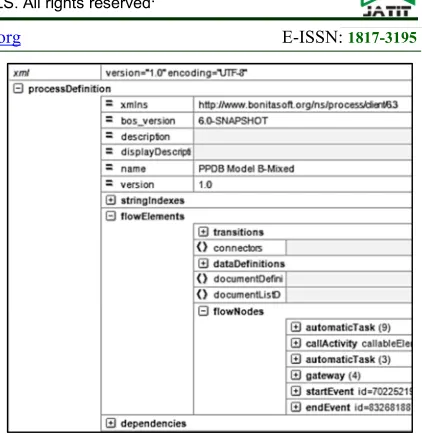
[image:3.612.313.524.63.280.2]For modelling PPDB business process, we use Bonita. It is a Business Process Management Suite (BPMS) with a technology platform to identify, design, execute, document, measure, monitor, and control both automated and non-automated process. Bonita deployed BPMN as a process definition file in XML, which can be stored in a database repository for integration purpose. Process model repository also used to manage process variant, where PPDB variants are represented in sub process to share among models. The process meta-model can reduce the storage redundancy [20]. Figure 1 shows BPMN objects definition in XML scheme using Bonita.
Figure 1: Process Definition File in XML Scheme
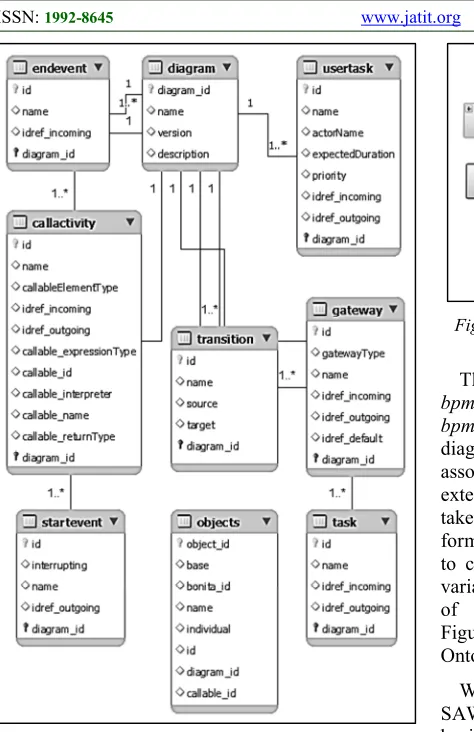
Next, we transform XML-formatted BPMN model into MySQL database to create a PPDB process model repository. The repository also used to simplify PPDB model formalization into BPMN ontology. These models represent PPDB business process offered by service provider, and PPDB business process requested by user.
ISSN: 1992-8645 www.jatit.org E-ISSN: 1817-3195
319
Figure 2: Entity Relationship of BPMN Repository
3.2 Building Semantic Business Process
[image:4.612.83.536.44.435.2]Semantic web service research brought formal logic-based semantics in a way where a service can be described in an unambiguous yet computer-interpretable capability for automation of activities, discovery, composition, execution and mediation. With taking into account the wide application of semantic web service, we developed the PPDB semantic web service using SAWSDL. These web services annotated with business process model composed from it. PPDB models should be formed into ontological formalization in order to client requester could discover their web services according to the business process model similarity. For this reason, we applied BPMN 2.0 Ontology to develop PPDB knowledge base by describing BPMN elements and their relationships in an ontological formalization.
Figure 3: Some Objects from PPDB Business Process Model in A BPMN Ontology Formalization.
The BPMN 2.0 Ontology is divided in bpmn2base and bpmn20 sub-ontology. The bpmn2base ontology only includes all class diagrams to specify the attributes and model associations, while the bpmn20 provides a model extension and contains syntactical specification taken from the natural text of BPMN [21]. We formalized PPDB workflow in ontology language to construct the knowledge base of PPDB model variants. These knowledge base used in the context of semantically annotated business processes. Figure 3 shows a business process in a BPMN Ontology formalization.
We constructed PPDB web services in SAWSDL, and annotated BPMN ontology for its business process model. Business process annotation placed in the PPDB SAWSDL description under wsdl:portType -
[image:4.612.93.330.73.439.2]sawsdl:modelReference element. Figure 4 shows a PPDB ontology fragment (student selection) being annotated in SAWSDL.
Figure 4: PPDB Ontology Annotated In SAWSDL
3.3 Business Process Ontology Matching
Beside annotated in SAWSDL, BPMN Ontology should be formed as business process request along with required quality of services. For simpliest semantic search in service registry, we established the ontology matching between the request models to the business process repository in order to get the closest taxonomy. Together with input and output
<wsdl:portType name="StudentCollection" sawsdl:modelReference=
"http://uddi.semantic-ppdb.org/owl/FragmentStudentCollection0.1.owl#"> <wsdl:operation name="studentcollection">
<wsdl:input
message="StudentCollectionRequestMessage"/> <wsdl:output
message="StudentCollectionResponseMessage"/> </wsdl:operation>
[image:4.612.318.519.512.624.2]ISSN: 1992-8645 www.jatit.org E-ISSN: 1817-3195
320 data class, taxonomy class is used to search the service alternatives according to SAWSDL-based service descriptions in FUSION Semantic Service Registry.
Ontology matching may be achieved by comparing two ontologies and returned their alignment with a reference alignment [22]. For measuring the alignment, we used Procalign API developed by Euzenat [23]. It provided an alignment format through Java API with function to parse/serialize, compute, threshold, compare, and a particular format output.
3.4 Semantic Service Registry Implementation
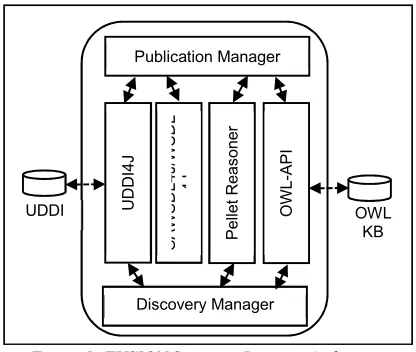
[image:5.612.88.296.500.676.2]FUSION semantic service registry combines SAWSDL-based service descriptions as an extended of UDDI registry. With service capability profiling based on OWL-DL, the semantic matchmaking of service annotation is solved through description logic (DL) reasoning [24]. For semantic discovery, service providers must extend their WSDL interfaces into SAWSDL to construct the Advertisement Functional Profiles (AFPs), while service requestor prepare its query with Request Functional Profiles (RFPs). Then, FUSION captured the semantics annotation defined in SAWSDL input and output data. It read modelReference annotated in <xs:element> entities under <wsdl:types>. FUSION also gained service functionality through semantics categorization defined in <wsdl:portType>. Figure 5 shows FUSION Semantic Registry Architecture, consist the feature of knowledge base in OWL ontology, service publication and discovery, Pellet DL reasoner, Java library, and UDDI server.
Figure 5: FUSION Semantic Registry Architecture
Service publication comprises a number of phase, as follows:
a. Parse semantic annotation from the SAWSDL document specified in URI.
b. Map the service name, description, and provider information as part of the publication query.
c. Generate the AFP from semantic extraction and add it to OWL knowledge base using OWL API. Then, Pellet reasoner perform semantic classification to identify RFP that match with the newly service.
d. Perform indexing of semantic matching for every RFP with the advertised services.
To meet the AFP construction, service providers augment its SAWSDL interface with two elementary annotations: (i) the semantic of PPDB data structures, and (ii) the semantic of PPDB business process for service functionality taxonomy.
3.5 QoS Criteria in Web Service Selection
Quality of services in our SOA implementation, adopted from the standard service quality attributes released by Software Engineering Institute (SEI) [25]. For our research, we focused on most service qualities being used and adopted business process qualities. There are:
• Cost: is the cost of each service request, • Variability: is measured from the number of
variants can be composed, and
• Complexity: is measured from the complexity of business process composed from web services. Complexity metric can be used to evaluate service modifiability.
• Capacity: is the number of concurrent requests that can be handled by a service in a set period of time,
• Latency: is measured from the maximum amount of time between the arrival of a request and the completion of that request,
Service provider assured its qualities to consumers by mean of service contract namely Service Level Agreement (SLA). We placed SLA information as a part of service description and published it through semantic annotation in WDSL. Service qualities in user’s demand become the preference criteria to evaluate alternative service solutions based on provider’s SLA respectively.
3.6 Multi Criteria Decision-Making Method using Fuzzy AHP+TOPSIS
Researcher often combines data mining concepts in business process analysis especially in process mining. In process conformance, association rule is used to detect fraud [26] while multi criteria
UDDI U
D
D
I4
J
S
A
W
S
D
L
4
J
/W
S
D
L
4
J
P
e
lle
t
R
e
a
s
o
n
e
r
O
W
L
-A
P
I
OWL KB Publication Manager
ISSN: 1992-8645 www.jatit.org E-ISSN: 1817-3195
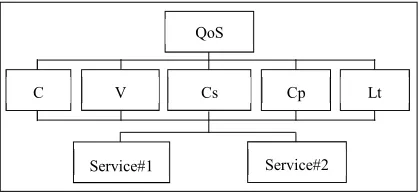
321 decision-making enables decision makers to deal with the problem of service or system selection [27], [28], [29], [30]. In our study, we combine Fuzzy AHP and TOPSIS as MCDM method to solve service selection problem. PPDB QoS attribute has become decision criteria in order to select the best offer from service provider. The decision criteria covers the complexity(C) and variability(V) value of selected business process, and value of cost(Cs), capacity(Cp), and latency(Lt) depending on service provider capability.
[image:6.612.90.300.317.413.2]Figure 6 shows AHP structure for evaluating PPDB service offer with respect to QoS. In our study, we use 5-scale of linguistic value to indicate relative importance between criteria as shows in Table 1. Depending on their importance between others, we construct the triangular fuzzy numbers for PPDB service criteria as shows in Table 2.
Figure 6: AHP Structure for Service Provider Evaluation
Table 1: The Linguistic Scale with Corresponding Triangular Fuzzy Number
Linguistic Scale Value TFN Inverse TFN
Equally important
(EI) 1 0.5,1,1.5 0.667,1,2
Weakly more
important (WMI) 3 1,1.5,2 0.5,0.667,1 Strongly more
important (SMI) 5 1.5,2,2.5 0.4,0.5,0.667 Very strongly
more important (VSMI)
7 2,2.5,3 0.33,0.4,0.5
Absolutely more
important (AMI) 9 2.5,3,3.5 0.286,0.33,0.4
Table 2: The TFN Pair-Wise Comparison Matrix of Service Criteria
C V Cs Cp Lt
C 1,1,1 0.5,0.667,1 0.667,1,2 0.5,1,1.5 1,1.5,2
V 1,1.5,
2 1,1,1 0.5,1,1.5
1.5,2, 2.5
2.5,3, 3.5
Cs 0.5,1,
1.5 0.667,1,2 1,1,1
1,1.5, 2
1.5,2, 2.5
Cp 0.667, 1,2
0.4,0.5,0.6 67
0.5,0.667
,1 1,1,1
0.5,1, 1.5
Lt 0.5,0. 667,1
0.286,0.33 3,0.4
0.4,0.5,0. 667
0.667, 1,2 1,1,1
For Fuzzy AHP method, we used Chang’s extend analysis where each object is taken and extent analysis should perform to each goal, respectively [31]. The steps of the Fuzzy AHP are given as follows [29]:
Step 1: Calculate the value of fuzzy synthetic extent with respect to the ith object is defined as
∑ ⨂ ∑ ∑ (1)
Where all the 1,2, … are triangular fuzzy number for service criteria.
Step 2: As , , and
, , are two TFN, the degree of possibility
of , , , , is defined
as
! sup%&'( )* +,-. / , ,-0 1 23 (2)
Moreover, can be equivalently as follows:
! 456 ∩ ! ,-0 8 (3)
9
1, ): 0, ): =. >0
0 >0 . =. , ?64@AB)C@
(4)
Step 3: The degree possibility for a convex fuzzy number should be greater than k convex fuzzy, where ) 1,2, D criteria fuzzy numbers can be defined by:
, , … E min
, ) 1,2, … , D (5)
The weight vector defined as follow:
IJ 8J , 8J , … , 8J K (6)
With service fuzzy number ) 1,2, … , * are n elements.
Step 4: The normalized weight vectors can be defined by:
I 8 , 8 , … , 8 K (7)
Where W is non-fuzzy number.
Then, calculate the consistency ratio (CR) to ensure the consistency property of criteria comparison matrix defined by [32]:
L M/LM (8)
With CI is level of consistency, and RI is random index. CI is defined by:
M O 8O P%Q * / * Q 1 (9)
V Cs
C Cp Lt
QoS
ISSN: 1992-8645 www.jatit.org E-ISSN: 1817-3195
322 The comparison matrix should be maintained to be consistent with CR<0.1.
Later, TOPSIS method is used to decide services ranking based on service provider advertisements. The TOPSIS is described by:
Step 1: Normalized the decision matrix of service provider QoS using equation defined as follows:
A RS
T∑U R0S
SV.
j=1, 2, …, m i=1, 2, …, n (10)
Step 2: The decision matrix is normalized using formulae given by:
O B A j=1, 2, …, m i=1, 2, …, n (11) Step 3: Calculate Positive Ideal Solution (PIS) and negative Ideal Solution (NIS) using equation:
W∗ YO∗, O∗, … , O∗} Maximum values (12)
W YO , O , … , O } Minimum values (13)
Step 4: Calculate the distance of each solution from PIS and NIS value using formulae given by:
8∗ T∑ Z Q Z∗! i = 1, 2, ..., m (14)
8 T∑ Z Q Z ! i = 1, 2, ..., m (15)
Step 5: Calculate the closeness coefficient of each service provider is given below:
[\
[∗][\ i = 1, 2, ..., m (16)
The larger the value, the better the performance of the alternatives. Thus by comparing its values, the service providers ranking are determined.
4. RESULTS AND DISCUSSION
4.1 Process Complexity Measurement
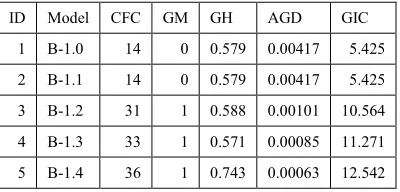
[image:7.612.315.518.341.504.2]Along with number of process variant to be added, total cost of process complexity increase. Table 3 shows the cost of complexity in several variants of PPDB Model B measured with gateway complexity perspective.
Table 3: Complexity Metric Values Among Variants In PPDB Model B
ID Model CFC GM GH AGD GIC
1 B-1.0 14 0 0.579 0.00417 5.425
2 B-1.1 14 0 0.579 0.00417 5.425
3 B-1.2 31 1 0.588 0.00101 10.564
4 B-1.3 33 1 0.571 0.00085 11.271
5 B-1.4 36 1 0.743 0.00063 12.542
4.2 Annotate BPMN Ontology in SAWSDL
BPMN model should be formalized to OWL language to be matched semantically. Using a mapping tool that we developed, PPDB models stored in the repository are mapped to OWL. Then, published the PPDB ontology in a web server for more convenient access to FUSION semantic service registry. PPDB process model already formalized into BPMN ontology can annotate directly to WSDL description. Later, PPDB SAWSDL is published to FUSION semantic service registry to be discovered by semantic matchmaking. PPDB SAWSDL interface consists the annotation of input and output message data and the annotation of service functionality taxonomy with PPDB business process ontology. Table 4 shows model reference semantic annotation in SAWSDL structure for PPDB business process fragment (student collection process).
Table 4: Model Reference for Service Operation, Input, and Output Message In Student Collection Service.
Operation StudentCollection
Reference FragmentStudentCollection0.1.owl#
Type Message Reference
Input StudentCollection Request
ppdb_datafacet.owl# StudentNumber ppdb_datafacet.owl# StudentName ppdb_datafacet.owl# SchoolName ppdb_datafacet.owl# AverageGrade ppdb_datafacet.owl# CourseGrade
Output StudentCollection Response
ppdb_datafacet.owl# RegistrationID
4.3 FUSION Service Registry Publication
[image:7.612.96.296.632.728.2]ISSN: 1992-8645 www.jatit.org E-ISSN: 1817-3195
[image:8.612.91.299.76.487.2]323
Figure 2: Add Service Request Using FUSION API
Figure 3: Semantic Discovery Request Using FUSION API
Figure 4: List of UUID Key of the Corresponding Service with the RFP Defined
4.4 Performing Fuzzy AHP
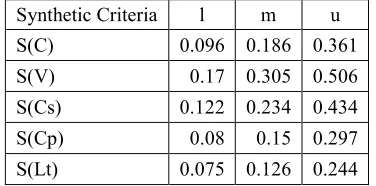
[image:8.612.101.289.633.726.2]A pairwise comparison metric is used for service selection criteria build upon the decision maker’s preferences as shown in Table 2. The weights of service criteria are determined using Fuzzy AHP. Start with calculating the synthesis value using Eq. (1). Table 5 shows synthetic extend values of the service criteria, respectively.
Table 5: Synthetic Extend Values of the Service Criteria
Synthetic Criteria l m u S(C) 0.096 0.186 0.361 S(V) 0.17 0.305 0.506 S(Cs) 0.122 0.234 0.434 S(Cp) 0.08 0.15 0.297
S(Lt) 0.075 0.126 0.244
These synthetic values are compared by using Eq. (4) to obtain the priority weights between criteria. Then, the weight vector is calculated from Table 5 using Eq. (6, 7) as:
IJ 0.615,1.000,0.786,0.45,0.292 K
I 0.196,0.318,0.25,0.143,0.093K
The consistency of our judgments in the service pair-wise comparison is ensured with consistency ratio. The result is 0.014, shows that our service judgment is consistent.
4.5 Performing TOPSIS
TOPSIS is performed for determining final ranking of the service offers consist: complexity, variability, cost, capacity, and latency. The complexity and variability values are obtained from the fragment, while the others defined by its provider. According to TOPSIS algorithm’s activities, the maximum and minimum values for each service criterion is calculated to construct positive and negative solutions. Table 6 shows the separation measure 8∗ of each alternative from the PIS.
Table 6: Separation Measure from the PIS
8
∗0.005
8
∗0.116
8
E∗0.024
8
f∗0.03
8
g∗0.017
Table 7 shows 8 of each alternative from the NIS. Both represent the separation measure of cost, variability, complexity, capacity, and latency.
Table 7: Separation Measure from the NIS
8
0.077
8
0.01
8
E0.061
8
f0.021
8
g0.017
4.6 Variability and Complexity trade-off
Our study use 157 publication services that provided by two service providers. Each of the provider can advertise services with different business process variant (different complexity and variability level). We observe that service provider with more variants and lower complexity tend to get highest priority rank in the service selection. Provider with the simplest common process should accommodate a lower complexity than any other provider get with the same amount of process variants.
<soapenv:Envelope
xmlns:soapenv="http://schemas.xmlsoap.org/soap/envelope /">
<soapenv:Body>
<ns1:doSemanticSearchForServicesResponse xmlns:ns1="http://api.sr.fusion.seerc.org/xsd">
C8596FE0-5574-11E5-AD82-F53860AC0281
</ns1:doSemanticSearchForServicesResponse >
ISSN: 1992-8645 www.jatit.org E-ISSN: 1817-3195
324
Table 8: Service Rank Priority for PPDB Student Collection Using Fuzzy AHP+TOPSIS Model Rank Provider C A Cs Cp Lt
frag3 1 SP#1 13 7 15000 200 15
frag1 2 SP#1 18 9 15000 200 15
frag1 3 SP#2 18 9 20000 250 20
frag3 4 SP#2 13 7 20000 250 20
frag2 5 SP#1 6 4 15000 200 15
frag2 6 SP#2 6 4 20000 250 20
frag4 7 SP#1 15 7 15000 200 15
frag4 8 SP#2 15 7 20000 250 20
Table 8 shows service rank priority using Fuzzy AHP+TOPSIS algorithm for student collection request. Both provider had business process of student collection with four different attributes. The best offer delivered by Provider 1 (frag3) with complexity, variability, cost, capacity, and latency better than others. Although Provider 1 had another fragments to offer, but it was more complex or less variants. The same fragment proposed by Provider 2, but not good enough to overcome the fragment
frag1 from Provider 1 with lower cost and latency
quality. Thus, the provider should prioritize to provide service with higher variability (more business process variant in their composite service), while keep the complexity of entire business process to be delivered as lower as possible. To compete with other providers with common business process, they should increase the QoS with lower cost, higher capacity, and faster service latency.
4.7 Performance Evaluation
We evaluate the system performance using precision, recall, and f-measure as metrics. We assign the precision value by the number of correctly selected web service of a given request divided by the total number of services retrieved by the system. The recall value calculated by the number of correctly selected web service divided by the total number of services belonging to this request. At the same time, we also compute the f-measure, the harmonic mean of precision and recall.
The evaluation result is provided in Table 9 with 153 service requests. We compared the predicted result from the system and the actual result from our expert. We categorized it to form the confusion matrix in order to evaluate the performance of our system using Receiver Operating Characteristics
(ROC) analysis. We calculate the precision, sensitivity/recall, and harmonic mean (f-measure).
Table 9 The confussion matrix of system evalution for some condition
PREDICTED ACTUAL TOTAL
TRUE TRUE 84
FALSE 8
TRUE Total 92
FALSE TRUE 10
FALSE 51
FALSE Total 61
Grand Total 153
As shown, we gained a precision of 91.3%, and a sensitivity or recall of 89.4%. Thus, the harmonic mean of precision and recall is 0.903. From the ROC, we also get an accuracy of 88.2%.
5. CONCLUSION
We discovered that, under some cases and circumstances it is possible to develop a multi-criteria decision making system using Fuzzy AHP+TOPSIS to determine variability and complexity trade-off in semantic service selection. Service providers should have a guidance how to advertise their services to meet most user’s requirement. Service provider should refers to the complexity of their common business process model before delivering number of variants based on these common models. If they have common model with higher complexity level, it is not easy for users to understand or modify (by adding variants). Service provider should decide to limit their variants, modify common business process model, and offer more valuable services quality. Such as, reduce service cost, or raise their capacity. If providers use complex common process, they should consider limiting the number of process variants to gain a lower complexity.
REFERENCES:
[1] M. Weske, W. van der Aalst and H. Verbeek, "Advances in business process management," Data & Knowledge Engineering 50, p. 1–8, 2004.
[image:9.612.323.516.151.277.2]ISSN: 1992-8645 www.jatit.org E-ISSN: 1817-3195
325 [3] P.-Y. Schobbens, P. Heymans and J.-C.
Trigaux, "Feature Diagrams: A Survey and a Formal Semantics," 14th IEEE International Requirements Engineering Conference, 2006. [4] G. Feuerlicht and J. Lozina, "Understanding
Service Reusability," 15th International Conference Systems Integration, pp. 144-150, 2007.
[5] S. K. Garg, S. Versteeg and R. Buyya, "A framework for ranking of cloud computing services," Future Generation Computer Systems, pp. 1012-1023, 2013.
[6] J. Buckley, "Fuzzy hierarchical analysis," Fuzzy Sets and Systems, vol. 17, no. 3, pp. 233-247, 1985.
[7] K. Decker, K. Sycara and M. Williamson, "Middle-agents for the Internet," IJCAI, vol. 15, pp. 578-583, 1997.
[8] D. Booth, H. Haas, F. McCabe, E. Newcomer, M. Champion, C. Ferris and D. Orchard, "Web Services Architecture," W3C Working Group, 2004.
[9] H. Nacer and D. Aissani, "Semantic web services: Standards, applications, challenges and solutions," Journal of Network and Computer Applications, vol. 44, p. 134–151, 2014.
[10] D. A. D’Mello, V. Ananthanarayana, I. Kaur and N. Ram, "Semantic Web Service Selection Based on Service Provider’s Business Offerings," IJSSST, vol. 10, no. 2, pp. 25-37, 2008.
[11] R. Iordache and F. Moldoveanu, "QoS-Aware Web Service Semantic Selection Based on Preferences," Procedia Engineering, vol. 69, p. 1152 – 1161, 2014.
[12] X. Wang, T. Vitvar, M. Kerrigan and I. Toma, "A QoS-aware Selection Model for Semantic Web Services," in ICSOC'06 Proceedings of the 4th international conference on Service-Oriented Computing, Heidelberg, 2006. [13] A. Hijriani, Seleksi SAAS ERP Berdasarkan
Kebutuhan Non-Fungsional Dengan Ontologi Service Level Agreement (SLA), Surabaya: Master Thesis, Institut Teknologi Sepuluh Nopember, 2013.
[14] V. X. Tran, H. Tsuji and R. Masuda, "A new QoS ontology and its QoS-based ranking algorithm for Web services," Simulation Modelling Practice and Theory, vol. 17, p. 1378–1398, 2009.
[15] M. Khezrian, W. M. N. W. Kadir, S. Ibrahim and A. Kalantari, "A Hybrid Approach for Web Service Selection," International Journal Of Computational Engineering Research, vol. 2, no. 1, pp. 2250-3005, 2012.
[16] L. Chi-Chun, C. Ding-Yuan, T. Chen-Fang and C. Kuo-Ming, "Service Selection Based on Fuzzy TOPSIS Method," in Advanced Information Networking and Applications Workshops (WAINA), 2010.
[17] Y. Anistyasari and R. Sarno, "Weighted ontology for subject search in Learning Content Management System," in International Conference on Electrical Engineering and Informatics (ICEEI), 2011. DOI: 10.1109/ ICEEI.2011.6021646.
[18] R. Sarno, C. A. Djeni, I. Mukhlash and D. Sunaryono, "Developing A Workflow Management System For Enterprise Resource Planning," Journal of Theoretical and Applied Information Technology, 2015.
[19] R. Sarno, B. A. Sanjoyo, I. Mukhlash and H. M. Astuti, "Petri Net Model Of ERP Business Process Variation For Small And Medium Enterprises," Journal of Theoretical and Applied Information Technology, 2013. [20] R. Sarno, E. Pamungkas, D. Sunaryono and
Sarwosri, "Business process composition based on meta models," in International Seminar on Intelligent Technology and Its Applications (ISITIA), 2015. DOI: 10.1109/ISITIA.2015.7219998.
[21] C. Natschläger, "Towards a BPMN 2.0 ontology," Lecture Notes in Business Information Processing, pp. 1-15, 2011. [22] J. Euzenat, C. Meilicke, P. Shvaiko, H.
Stuckenschmidt and T. d. C. Santos, "Ontology Alignment Evaluation Initiative: six years of experience," Journal on Data Semantics, pp. 158-192, 2011.
[23] J. Euzenat, "An API for Ontology Alignment," in The Semantic Web – ISWC 2004, Springer Berlin Heidelberg, 2004, pp. 698-712.
[24] D. Kourtesis and I. Paraskakis, "Web Service Discovery in the FUSION Semantic Registry," Information Systems Journal, pp. 285-296, 2008.
ISSN: 1992-8645 www.jatit.org E-ISSN: 1817-3195
326 [26] R. Sarno, R. D. Dewandono, A. Tohari, M. F.
Naufal and F. Sinaga, "Hybrid Association Rule Learning and Process Mining for Fraud Detection," IAENG International Journal of Computer Science, pp. 59-72, 2015.
[27] A. Gani, N. B. Anuar, M. Shiraz, M. N. Haque and I. T. Haque, "Cloud Service Selection Using Multicriteria Decision Analysis," The Scientific World Journal, pp. 1-10, 2014. [28] M. Khezrian, W. M. N. W. Kadir, S. Ibrahim
and A. Kalantari, "A Hybrid Approach for Web Service Selection," International Journal Of Computational Engineering Research, pp. 2250-3005, 2012.
[29] S. Balli and S. Korukoğlu, "Operating System Selection Using Fuzzy Ahp and Topsis Methods," Mathematical Computational Applications, pp. 119-130, 2009.
[30] K. Yuen and H. Lau, "Evaluating software quality of vendors using fuzzy analytic hierarchy process," in Proceedings of the International MultiConference of Engineers and Computer Scientists, 2008.
[31] D.-Y. Chang, "Applications of the extent analysis method on fuzzy AHP," European Journal of Operational Research, p. 649–655, 1996.
[32] T. Saaty, The analytic hierarchy process, McGraw-Hill, 1980.
[33] Y. Baocai, Y. Huirong, F. Pengbin, G. Liheng and L. Mingli, "A framework and QoS based web services discovery," in Software Engineering and Service Sciences (ICSESS), 2010.