TOPIC BASED QUERY SUGGESTION USING HIDDEN
TOPIC MODEL FOR EFFECTIVE WEB SEARCH
1M.BARATHI , 2 S.VALLI
1
Anna University, Department of Computer Science and Engineering, SMK Fomra Institute of Technology, Chennai-603103
2 Anna University,Department of Computer Science and Engineering, Chennai-600025
E-mail: [email protected], [email protected]
1Corresponding author: [email protected]
ABSTRACT
Keyword-based web search is widely used for locating information on the web. But, web users lack sufficient domain knowledge and find it difficult to organize and formulate input queries which affect search performance. Existing method suggests terms using the statistics in the documents, query logs and external dictionaries. This novel query suggestion method suggests terms related to topics present in the input query and re-rank the retrieved documents. A generative model, Latent Dirichlet Allocation (LDA) is used to learn the topics from the underlying documents. The high probability words in a topic are selected using the Kullback liebler(KL) divergence measure and presented to the user for suggestion, to enrich the user query and to narrow the search. The re-ranking technique of this approach uses the initial retrieval position of the document to re-rank the documents. The suggested queries by the hidden topic approach and by keyword search are analysed.
Keywords: Latent Dirichlet Allocation, Kullback-Liebler Divergence, Query Suggestion, Web Search,
1. INTRODUCTION
The increasing information on the web creates many challenges for the web search. Most commercial search engine returns the same results for the different queries regardless of the users’ interest. The search engines suffer from word mismatch problem, since the query and the documents terms are compared on a logical level instead of the semantic level.
Many works such as query suggestion,
collaborative search, contextual search,
personalized search, query expansion, have been studied and these works use technique such as clustering, classification, semantics and ontology to improve the quality of the web search. However, users face problems when using a search engine to formulate an accurate input query. If a user is not familiar with some domain, they might fail to choose appropriate keywords in formulating the query. Furthermore, queries submitted by the users are usually short and ambiguous [1]. These short queries do not express the user needs. As a result, lots of irrelevant pages are retrieved. A synonym is a word having the same meaning as another word. For instance the word animal is a synonym of a
living organism. A polysemy is a word with multiple meanings. For example, the word cell can be used to refer to a small room in one context and the basic structural and functional unit of an organism in another context which create term mismatch problem and force the user to refine their input queries. Sometime ambiguous queries lead to non-relevant results [2, 3]. Many current studies focus on improving the performance of suggestion strategy for finding queries related to the topics.
However, existing studies neglect the topic information which is important for specifying the user’s information needs [9]. A document contains more than one topic and a user is generally interested in a single or a few topics. Thus, queries that reflect the user’s intention on a topic perform well in retrieving high quality documents with relevant topics.
Many works have been carried out based on the latent topic information to analyze the queries in the field of information retrieval. Huang et al. [22] used clicked documents as training data and topic information to compute the similarity between the input query and the candidate query. He et al. [23] utilized the interaction information to detect topics of queries. Carman et al. [39] applied LDA based personalized ranking formulas to a query log dataset. The disambiguated queries are computed using the terms in the titles and snippets of documents present in the cluster [38]. The query expansion technique uses document clustering technique and ontology concepts to disambiguate user queries [42]. Cao et al [41] combined error correction, topic-based query suggestion and query expansion to find the relevant patents and also improved the user search.
This topic based approach is compared with the existing keyword and cluster based approach with respect to the topic model to analyze the retrieval performance.
The main objective of this topic based approach is to improve the search results. In this work a topic based query suggestion (LDA) disambiguate the query and re-rank the retrieved documents. The main contributions of this work are as follows.
1. The topic based query suggestion refine
and formulates the queries.
2. To select high probability words in a
topic to form suggestion.
3. Development of a novel candidate term
ranking technique.
4. A novel method to re-rank the
documents.
5. Evaluation of the proposed approach
using classic 3 benchmark datasets. Based on these observations, the novel query suggestion technique suggest query terms related to the topics and re-rank the documents.
The structural re-ranking algorithm treats the query and the content individually when computing the re-ranking scores. HITS [14] and Page Rank [15] are the widely used
approach for ranking documents. However, approaches depend only on the structure of the global graph or sub-graph, which could ignore the important information content of a document. The re-ranking algorithm [13] uses only the structure of the global graph which leads to the problem of topic drift.
A novel document re-ranking method based on Latent Dirichlet Allocation (LDA) [16] is used in this topic based query suggestion. Instead of relying on graph based techniques, this topic based approach try to identify the latent structure of “Topic” in the initial retrieval set. Then the similarity between the query and the initial retrieval results based on latent
semantic information is computed. The
probability of a document is grouped over from all the generated topics. Re-ranking is done by combining the initial retrieval scores and the latent information of the grouped documents.
The rest of the paper is organized as follows; in section 2, the related works are presented. Section 3 describes the query suggestion process. Section 4 explains how the candidate terms are selected. Sections 5 discuss the ranking method. Sections 6 illustrate the LDA model. Section 7 presents the experimental result. Section 8 conclude the work and suggest future enhancement.
2. RELATED WORKS
A lot of research exists for
disambiguating the user query based on interactive query suggestion technique. Most
modern search engine uses auto-query
completion to suggest possible complete queries [40]. But, it has a critical drawback. If the input query is totally new to the current web logs, its click information is not accessible from the web query logs for query similarity computation. Some works select the candidate terms for suggestion by using lexicographical matches and then rank based on their frequencies. The resulting suggestions are disorganized. Also clustering technique is used to obtain terms. Cluster labels are the candidate term for query suggestion [10]. Z Liu et al [48] proposed an algorithm to improve the retrieved result based on clustered result. Li et al [45] used topically
related queries to improve the quality of the
suggestions.
the documents. Interactive query expansion is based on document, terms and concepts.
Document based method uses statistics
information namely, co-occurrence [18, 19] to suggest the relevant terms in the documents. Term based methods try to discover the relation of term from manually constructed thesaurus [4], relevance feedback [4, 5], external dictionaries (e.g.) word net [6] and query logs [8]. Concept based methods use knowledge bases namely, Wikipedia and web directory [7, 20] and query logs [21] to map query terms to a number of concepts. Huang et al [22] used clicked document sets and LDA to analyze the topic information and to measure the similarity of the two queries. The original queries are substituted with the queries detected by the topics [23]. These try to discover the topics based on the query for capturing the user search intention.
Recent studies [24-28] focus on web logs where the click information provides available implicit feedback. If the input query is totally new to current web logs, its click information is not accessible from the web query logs for query similarity computation. Some cluster related queries based on the common clicked URLs [29].
In traditional IR system, in response to the query, the system determine the best result between the query and the documents and return the list of retrieval results in decreasing order of their relevance. Recently, some research has been carried out to re-rank the results. Some of the approaches represent the document entities as a connected graph using the content information. Zhang et al [11] re-rank the search results by optimizing diversity and information richness with the use of affinity ranking graph. Kurland and Lee [12] introduced a structural re-ranking approach by exploiting asymmetric relationship among documents induced by language models. Deng et al. [13] applied a family of
semi-supervised machine learning method to
document graph constructed by incorporating different evidences.
Many works have been carried out in the area of document retrieval and re-ranking. Lee et al. [30] re-ranked by using inter-document relationship. Xu and croft, [31] used local context analysis to re-rank based on the document distances [32]. Kurlamd and Lee [12]
re-ranked by generating links using language model scores, through a weighted version of Page Rank algorithm. Kurland and Lee [33] used HITS style cluster-based approach. Zhang et al. [11] proposed a similarity method based on authority ranking for text to improve the web search. Diaz [34] adopted a semi-supervised learning technique for score regularization to adjust document retrieval ranking from an initial retrieval result. Deng et al.[13] use latent space graph, based on content and explicit links information.
3. THE QUERY SUGGESTION PROCESS 3.1 Process Overview
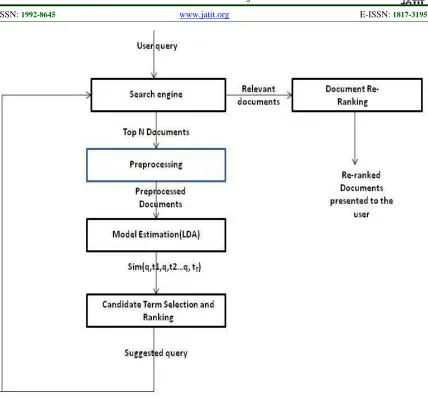
The block diagram of the topic based query suggestion process is shown in Figure 1. The user submits the initial query to the search engine and retrieves the top N ranked documents. These set of documents are preprocessed by removing stop words and Porter,M.F (1980)[35] suffix stripping algorithm stem each word by transforming the word to their root form. For example the words “compute”, “computing”, and “computed” are stemmed to “compute” and “dogs” as dog”. The preprocessed documents are given as input to the LDA for the generation of topics. The generated topics are compared with the user query to select the high probability words that are meaningful to
the queries using kullback-liebler(KL)
divergence measure. The selected terms are sorted in descending order according to their relevance. The ranked terms are provided as suggestion to the user to enrich the user query and to focus their search. The retrieved relevant documents are re-ranked based on their content similarity and this process is iterated until user expected documents are retrieved.
4. CANDIDATE TERM SELECTION FROM THE TOPICS
Figure 2 Topics With Related Words
The list of 20 related terms under this topic are patients, treatment, disease, drug, cancer, etc. A candidate term C is associated with a multinomial distribution of words given by P(C|Q), where Q is a user query context for retrieval from the set of documents. Using KL divergence [44] measure, the C high probable words are determined and sorted. The KL divergence of Q from P is defined as
DKL(P||Q) = ∑p(x).log p(x) ( 1) q(x)
DKL (C||Tk) = ∑ p(w| Tk ) log p(w|Tk) (2) p(w|C,Q)
= ∑p(w|Tk)log p(w,C|Q) (3) p(C|Q) p(w|Tk)
∞∑p(w|Tk)PMI(w,C|Q) (4)
Tk in Equation (2) is the set of Ktopics
C in Equation (2), (3) and (4) is the candidate term to be identified from each topic
Q in Equation (2), (3) and (4) is the user query context
w in Equation (2), (3) and (4) is the word in the topic
The candidate term C and the terms in the topic model over the query represent the Point wise Mutual Information (PMI) in Equation (4).
The PMI of two words measure the semantic relationship between them. Equation (4) assigns greater weights to a candidate term if it has a stronger semantic relationship to the topic words. Hence, selected candidate terms are better representative of the entire topic Tk. The selected terms are sorted in decreasing order according to their relevance. The ranked candidate terms that are above the threshold value of 0.5 are considered as suggestion terms. These suggestion terms are
x
w
w
presented to the user to disambiguate the queries and to focus their search on user interest.
5. DOCUMENT RE-RANKING
The rank assigned by the search engine seems to be imperfect. The topic based approach re-ranks the documents by boosting the initial weight of the documents. The low ranked documents may be more relevant to the user. Therefore, the rank of such documents is boosted to a higher value. This is achieved by adding the initial position of the document with the highest score of the content similarity of the group of documents. Latent Dirichlet Allocation [36] is used in this topic based approach for document re-ranking. For a given query q, set of initial results of top N documents are retrieved from the search engine. The similarity between the query and the document are computed based on the latent semantic information. The group of documents dealing with the same topic shares a strong similarity with the query. Such kind of documents are grouped together using cosine similarity measure [46] using Equation (5)
sd =Σcos(q,d) = (5)
sd in Equation (5) is the similarity score of each document. N in Equation (5) is the number of documents in the cluster and cos(q, d) is the cosine similarity of query q and document d. The rank of
the document Rd is computed from the position of
the document in the list which is returned by the search engine to achieve independence of the actual ranking score computed by the search engine using equation (6).
Rd = (6) (6)
Pos (d) in Equation (6) is the position of document d in the query result list returned by the search engine and N is the size of the list. This way, the first document gets a rank Rd = 1, while the last
document is assigned 1/N as the rank, Rd. The rank
of each cluster Rc is computed as the average of the
rank of all its documents as given in Equation (7).
Rc =
(7)
Rd in Equation (7) is the rank of the document d, N
is the number of documents in the cluster and Rc is
the score of each cluster. Each document is re-
ranked usingEquation(8).
RRd = ΣRd + Rc (8)
The re-ranking RRSd is done based on the initial
rank of the document represented by Rd and the
latent document re-ranking RRd, using Equation
(9).
RRSd = (1-λ)Rd + λRRd (9)
The parameter λ determines when re-ranking
process should be done. λ takes either 0 or 1. If λ=
0 the initial rank of the documents is returned; which means no re-ranking is performed. Table 1 illustrate
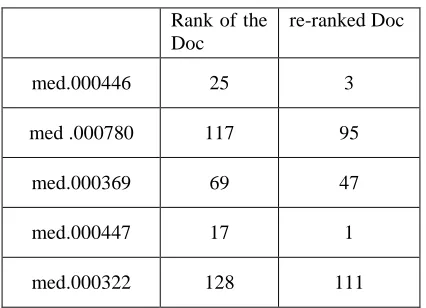
the document re-ranking process. To understand how re-ranking is done, top 5 documents are considered. The rank returned by the search engine for the top 5 documents d1 to d5 are 1,2,3,4 and 5. The rank assigned using this method to the documents d1 to d5 is 0.80, 0.40, 1.0, 0.6 and 0.2. This topic based approach compute the rank using Equation (6). The documents are clustered using the cosine similarity measure. The documents d2, d4, d5 are placed in one cluster and the average score of the cluster is 0.40 and documents d1 and d3 are placed in another cluster and their average score is computed using Equation (7) and it is 0.90. The average score of each cluster is added with the initial rank of the documents in each cluster. The documents having low rank in the first retrieval may get high rank in the second retrieval and so on as shown in Table 1. Finally the re-ranked documents are presented to the user as shown in Table 2.
d=1
d=1
d=1
d . q
ǁdǁ . ǁqǁ
N-Pos (d) + 1
N
Σ
R
dN
Table 1 A Sample Of Document Re-Ranking N
N
N
Re-ranking could aid query expansion, question-answering system and other applications that use IR engines.
6. LDA MODEL
LDA model, an unsupervised machine learning technique is used in identifying the latent topic information from the large document collection
Rank of the Doc
re-ranked Doc
med.000446 25 3
med .000780 117 95
med.000369 69 47
med.000447 17 1
med.000322 128 111
[16, 37]. LDA is based on bag-of-words
assumption, where each document is represented as a vector of word count. Based on this assumption, each document is represented as probability distribution over a set of topics, while each topic is represented as probability distribution over a set of words. A generative process generates the documents as follows.
• For each document, a topic is chosen from
its distribution over topics.
• A word is sampled from the distribution
over the words associated with the chosen topic.
• The process is repeated for all the words
in the documents.
A collection of D documents is associated with a multinomial distribution over T topics, denoted as Ө . Each topic is defined to be a discrete distribution over words from finite
lexicon Φ. For each word in a document d, a
topic Z is sampled from the multinominal
distribution Ө associated with the document,
and a word w from the multinominal
distribution Φ associated with topic Z is
sampled consequently. This generation process is repeated N times, where N is the total
number of words in the document d. Ө and Φ
have Dirichet prior parameters α and β
respectively. The graphical representation of LDA model is shown in Figure 2. An arrow represents conditional dependency between variables and the boxes represent repeated sampling with the number of repetitions given by the variables in the bottom of the corresponding
box. The two parameters of the model are
document-topic distributions Ө, and T the
topic-word distribution Φ. Based on these two
parameters, word belonging to topic and topic belonging to documents are found. In this study Gibbs sampling has been applied for model parameter estimation and parameter values are chosen as 0.5 for α and 0.1 for β. JAVA API is used to generate latent topic information from the given text corpus. The result is represented as three matrices DT, WT, Z.
DT, is a matrix, where D is the number of documents in the text corpus and T is the number
of topics. Matrix DTij contain the number of times
a word in document Di has been assigned to topic
Tj. Each row represent the number of documents
and each column represent the number of topics. Documents
Initial Rank of Doc (search engine)
Rank computed
by this Approach
Re-ranked Doc
med.000148 2 0.80 0.80 + 0.90
= 1.70 med
.000066 4 0.40
0.40+0.40 = 0.80
med.000998 1 1.00 1.00+0.90
=1.90
med.000141 3 0.60 0.60+ 0.40
=1.00
med.000229 5 0.20 0.20+0.40
[image:6.612.315.487.354.491.2]=0.60
[image:6.612.88.301.417.571.2]Figure 2 The Graphical Representation Of LDA Model Table 2 The Re-Ranked Results For The Query “Cancer
The matrix WT contains W unique words used in the text corpus and T is the number of topics. The
matrix WTij represent the count of how many
times word Wi is assigned to topic Tj. Each row represent the number of topics and each column represent the number of words. Z is a 1*N vector, where N is the total number of words in the text
corpus, Zi is the topic assignment for word wi.
Thus, the likelihood of generating a corpus is given by Equation (10)
(10)
7. EXPERIMENTAL RESULTS
Classic 3 benchmark dataset has been used for analysis. This dataset consists of four different collections of documents namely, CACM, CISI, CRAN and MED. There are 7095 documents. The statistics of the dataset is given in Table 3. LDA is conditioned on three parameters i.e., Dirichlet
hyper-parameter α, β and topic T. The best
suggestion results were obtained at 1000th topic run
for T=100, α=0.5 and β=0.1. For topic model at
1000th topic run, best suggestion results were
obtained. The performance of the information retrieval system is evaluated using precision, recall and F-measure as given by equation (11), (12) and (13). Precision measures the exactness of the search, (i.e.), the percentage accuracy of the
retrieved documents. Recall measures the
completeness of the search,(i.e.), the percentage of the relevant documents retrieved. When designing a web search engine to compete with Google or any other search engine, the precision at low recall is far more important than the precision at high recall since most people will only look at the first
page or two of search results, not the 1000th page.
So Precision at low recall is well suited for any search engine.
Precision = Retrieved relevant documents / Retrieved documents (11)
Recall = Retrieved relevant documents /All
relevant documents (12)
F=2*Precision*Recall/(Precision+Recall) (13)
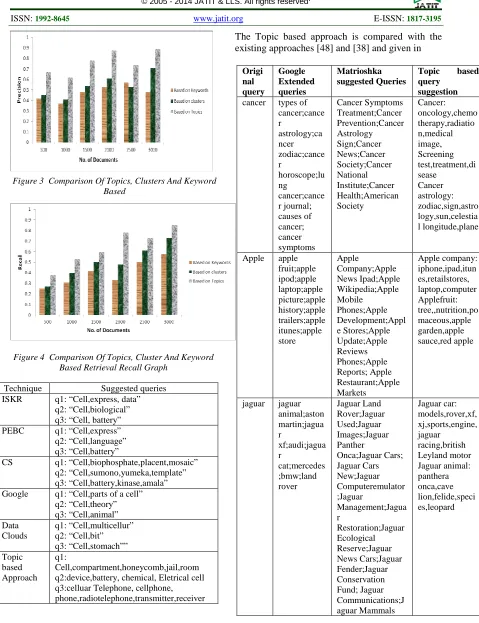
The precision and recall graph based on Topic, Cluster and Keyword based approach is given in Figures 3 and 4 and shows the results for different values of N, ranging from 500 to 3000, where N is the number of documents.
Liu Z (2011) [48] developed iterative single-keyword refinement (ISKR) and partial elimination based convergence(PEBC)algorithm. The algorithm generated expanded queries from the clustered results which showed significant improvement as given in Figure 5.The topic based approach suggest terms related to only particular topic. For instance in Figure 5, q1, q2, q3 are the terms that are related to three topic namely, cell is a small compartment, cell is an electrical cell and cell is a mobile phone. This improves the precision of the results when expanding the query with these terms. Glori B et al (2012)[38] claims that their approach generate a greater number of suggested queries with respect to Google and achieved better disambiguated suggested queries as given in Figure 6.
Figure 4 Comparison Of Topics, Cluster And Keyword Based Retrieval Recall Graph
Technique Suggested queries
ISKR q1: “Cell,express, data” q2: “Cell,biological” q3: “Cell, battery” PEBC q1: “Cell,express” q2: “Cell,language” q3: “Cell,battery”
CS q1: “Cell,biophosphate,placent,mosaic” q2: “Cell,sumono,yumeka,template” q3: “Cell,battery,kinase,amala” Google q1: “Cell,parts of a cell”
q2: “Cell,theory” q3: “Cell,animal” Data Clouds q1: “Cell,multicellur” q2: “Cell,bit” q3: “Cell,stomach”” Topic based Approach q1: Cell,compartment,honeycomb,jail,room q2:device,battery, chemical, Eletrical cell q3:celluar Telephone, cellphone, phone,radiotelephone,transmitter,receiver
The Topic based approach is compared with the existing approaches [48] and [38] and given in
Figure 6 Comparison Of Extended Queries Generated By Google, Matrioshka Suggested Queries By Glori B Et
Al (2012) And Topic Based Query Suggestion Origi nal query Google Extended queries Matrioshka suggested Queries
Topic based
query suggestion cancer types of
cancer;cance r astrology;ca ncer zodiac;cance r horoscope;lu ng cancer;cance r journal; causes of cancer; cancer symptoms Cancer Symptoms Treatment;Cancer Prevention;Cancer Astrology Sign;Cancer News;Cancer Society;Cancer National Institute;Cancer Health;American Society Cancer: oncology,chemo therapy,radiatio n,medical image, Screening test,treatment,di sease Cancer astrology: zodiac,sign,astro logy,sun,celestia l longitude,plane
Apple apple fruit;apple ipod;apple laptop;apple picture;apple history;apple trailers;apple itunes;apple store Apple Company;Apple News Ipad;Apple Wikipedia;Apple Mobile Phones;Apple Development;Appl e Stores;Apple Update;Apple Reviews Phones;Apple Reports; Apple Restaurant;Apple Markets Apple company: iphone,ipad,itun es,retailstores, laptop,computer Applefruit: tree,,nutrition,po maceous,apple garden,apple sauce,red apple
[image:8.612.80.559.63.686.2]jaguar jaguar animal;aston martin;jagua r xf;audi;jagua r cat;mercedes ;bmw;land rover Jaguar Land Rover;Jaguar Used;Jaguar Images;Jaguar Panther Onca;Jaguar Cars; Jaguar Cars New;Jaguar Computeremulator ;Jaguar Management;Jagua r Restoration;Jaguar Ecological Reserve;Jaguar News Cars;Jaguar Fender;Jaguar Conservation Fund; Jaguar Communications;J aguar Mammals Jaguar car: models,rover,xf, xj,sports,engine, jaguar racing,british Leyland motor Jaguar animal: panthera onca,cave lion,felide,speci es,leopard Figure 3 Comparison Of Topics, Clusters And Keyword
Based
Retrieval Precision Graph
Figure 5 Comparison Of Liu Z (2011) Suggested Queries And Topic Based Approach For The Query
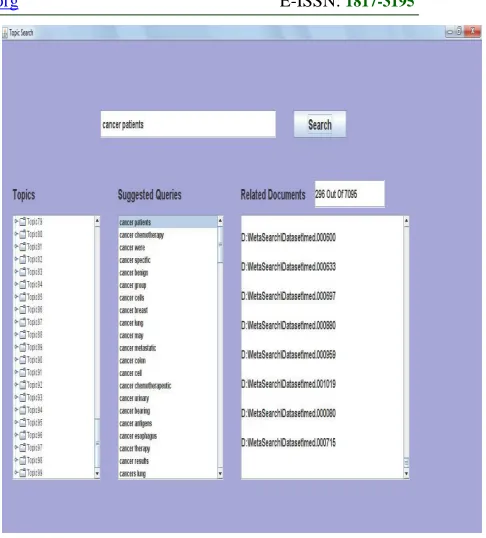
Figures 5 And 6. Topic Based Approach Generate Better Disambiguated Suggested Queries Related
To Each Topic And Is Given In Figure 7.The Topic
based approach improves precision by 20% than the cluster based approach as in Table 4. The comparison of the result for the query “cancer” from Figure 6 show that the topic based method generate queries related to only cancer topic. But, cluster based method generates both more general and specific queries also. The cluster based approach produce the cluster label, whereas, the topic based approach give terms related to that topic for query suggestion. For example, for the original query ‘‘cancer’’ the cluster based approach of Glori B et al (2012) suggests the extended query as cancer symptoms treatment ,cancer prevention and general query as cancer astrology signs and cancer news. The Topic based approach helps in narrowing the web search.
8. CONCLUSIONS AND FUTURE ENHANCEMENT
This work is a novel approach to build disambiguated queries using topic model for web search. This approach provides suggested list of meaningful queries for expansion and to make the user search more focused. The contribution of this work is in identifying the high probable words from each topic and re-ranking the documents. The topic distribution model using LDA gives accurate and fast suggestion for short queries irrespective of whether the input query appear in the query log or not. In future this work can be easily extended to the Question and Answer system to match the question issued by the user.
REFERENCES:
[1]. M.Jansen , A.Spink, J. Bateman, and
T.Saracevic, “Real life information retrieval: a study of user queries on the Web”, Proc. ACM SIGIR Forum, Vol.32, pp.5-17, 1998.
[2]. S.Cronen-Townsend, Y.Zhou, and W.B.Croft,
“Predicting query performance’’, SIGIR, 2002, pp. 299-306.
[3]. Y.Zhou and W.B.Croft, “Query performance
prediction in web search environments”, SIGIR, 2007, PP. 543-550.
[4]. D.Harman, “Towards interactive query
expansion”, SIGIR, 1998, pp.321-331.
[5]. D.Harman, “ Relevance feedback revisted”,
SIGIR, 1992, pp.1-10.
[6]. Z.Gong, C.W.Cheang, and L.H.V, “Web query
expansion by wordnet”, DEXA, 2005, pp.166-175.
[7]. H.Bast, D.Majumdar, and I. Weber, “Efficient
interaction query expansion with complete search”, in CIKM, 2007, pp.857-860.
[8]. Q.He, D.Jiang, Z.Liao, S.C.H. Hoi, K.Chang,
E.P.Lim, and H.Li, “Web query
recommendation via sequential query
prediction”, ICDE, 2009, pp.1443-1454.
[9]. D.Kelly , K.Gyllstrom and E.W.Bailey, “ A
comparison of query and term suggestion Keyword Cluster Topic
AveragePrecision 0.43 0.52 0.70
Average F-Measure
[image:9.612.314.557.81.350.2]0.40 0.48 0.62
Figure 7 Suggested Queries And Retrieved Relevant Documents For The Topic Cancer Generated By The Topic Based
Approach Table 4 Comparison Of Keyword, Cluster And Topic
[image:9.612.85.289.355.406.2]features for interactive searching”, SGIR, 2009, pp. 371-378.
[10]. Osi’nski, S. and Weiss, D., “A
concept-driven algorithm for clustering search results. IEEE intelligent systems”, pp.48-54, 2005.
[11]. Complete search. Max-Planck-Institute
for informatics (online) available:
http://dblp.mpi-inf.mpg.de/dblp-mirror/index.php
[12]. Zhang, B., Li, H., Liu, Y., Ji, L., Xi, W.,
Fan, W., Chen Z and Ma, W-Y., “Improving web search results using affinity graph”, In
proceedings of the 28th annual international
ACM SIGIR conference on research and development in information retrieval, Salvador, Brazil, 2005, ACM.
[13]. Kurland, O and Lee, L., “PageRank
without hyperlinks: structural re-ranking using links induced by language models”, In Proceedings of the 28th annual international ACM SIGIR conference on Research and development in information retrieval, Salvador, Brazil, ACM, 2005, pp. 306-313.
[14]. Deng, H., Lyu M.R and King I.,
“Effective latent space graph-based re-ranking model with global consistency”, In Proceedings of the Second ACM International Conference on Web Search and Data Mining, Barcelona, Spain, ACM. 2009 p. 212-221.
[15]. Jon M. Kleinberg., “Authoritative sources
in a hyperlinked environment”, J. ACM (1999), pp. 604-632.
[16]. Brin S and Page L ., “The anatomy of a
large-scale hyper textual Web search engine”, Computer Network ISDN System, 1998, pp.107-117.
[17]. Blei, D.M. , Ng, A. Y and Jordan , M.I.,
“Latent dirichlet allocation.”, J. Mach. Learn. Res. 2003, pp. 993-1022.
[18]. J.Xu and W.B.Croft, “Query expansion
using local and global document analysis”, SIGIR, 1996, pp 4-11.
[19]. R.Kraft and J.Y.Zien, “Miming anchor
text for query refinement”, www, 2004, pp.666-674.
[20]. Y.Chen, G.R.Yue, and Y.Yu,
“Advertising keyword suggestion based on concept hierarchy”, WSDM, 2008, pp.251-260.
[21]. B.M.Fonseca, P.B. Golbhev, B.A,
Ribeiro-Nelo and N.Ziviani, “Concept – based interactive query expansion”, CIKM, 2005, pp. 696-703.
[22]. S.Huang, Q.Zhao, P.Mitra, and C.L.Gules,
“Hierarchial location and topic based query expansion”, AAAI, 2008, pp.1150-1155.
[23]. X.He.J.Yan, J.Ma, N.Liu, and Z.Chen,
“Query topic detection for reformulation”, www, 2007, pp.1187-1188.
[24]. Baeza-yates, R.A., Hurtado, C.A,
Mendoza, M, “Improving search engines by query clustering”, J. Am. Soc. Inf.Sci. Technology, Vol.58, pp.1783-1804, 2007.
[25]. Beeferman, D., Berger, A.L,
“Agglomerative clustering of a search engine query log”, Proc. of the 6th ACM SIGKDD
International conference on knowledge
discovery and data mining(KDD’00), pp.407-416, Boston, MA (2000).
[26]. Cao. H., Jiang, D.Pei, J. He, Q., Liao, Z.,
Chen, E., Li. H, “Context-aware query suggestion by mining click-through and session
data”, Pro. of the 14th ACM SIGKDD
International conference on knowledge
Discovery and Data mining (KDD’08), pp.875-883, Las Vegas, Nevada(2008)
[27]. Li, L., Otsuka, S.Kitsuregawa, M, “Query
recommendation using large scale- web access
logs and web page archive”, Proceedings of 19th
International conf. on Database and Expert Systems Applications (DEXA’08), pp.134-141. Turin, Italy (2008).
[28]. Li, L., Otsuka, S., Kitsuregawa, M,
“Finding relared search engine queries by web community based query enrichment”, World Wide Web (1-2), pp.121-142, 2010.
[29]. Wen, J.R., Nie, J.Y.Zhang, H, “Query
clustering using user logs”, ACM Trans. Inf. Sys, Vol.20, pp.59-81, 2002.
[30]. Lee, K.S., Park, Y.C. and Choi, K. S,
“Re-ranking model based on document
clusters”, Inf. Process. Manage., pp.1-14, 2001.
[31]. Xu, J. and Croft , W.B., “Improving the
effectiveness of information retrieval with local context analysis”, ACM Trans. Inf. Syst., pp. 79-112, 2000.
[32]. Balinski , J. and Daniowicz, C.,
“Re-ranking method based on inter-document distances”, Inf. Process. Manage., pp. 759-775, 2005.
[33]. Kurland, O and Lee, L, “Respect my
authority!: HITS without hyperlinks, utilizing cluster-based language models”, In Proceedings of the 29th annual international ACM SIGIR conference on Research and development in information retrieval, Seattle, Washington, USA, ACM. 2006, pp. 83-90.
[34]. Diaz, F, “Regularizing ad hoc retrieval
knowledge management, Bremen, Germany, ACM. 2005, pp. 672-679.
[35]. Porter,M.F., “An algorithm for suffix
stripping”, Vol. 14, pp. 130-137, 1980.
[36]. Zhou, D and Wade, V, “Latent Document
re-ranking”, proceedings of the 2009
conference on empirical methods in natural language processing, Singapore, 2009, ACL.
[37]. Weng, J., Lim, E.P., Jiang, J and He, Q,
“TwitterRank: Finding Topic-sensitive
Influential Twitterers”, in Proceedings of WSDM’10, NY, USA, 2010.
[38]. Glori, B., Alessandro, C., Giuseppe, P.,
Stefnia, R., “Disambiguated query suggestions and personalized content—similarity and novelty ranking of clustered results to optimize web searches”,Information Processing and Management,Vol.48, pp.419-437, 2012.
[39]. Carman, M.J., Crestani, F., Harvey, M.,
Baillie, M, “Towards query log based
personalization using topic models”, In
Proceeding of the 19th ACM Conference on
Information and Knowledge
Management(CIKM’’10), pp. 1849-1852, 2010.
[40]. Ju Fan, Hao Wu, Guoliang Li, Lizhu
Zhou, “Suggesting Topic Based query Terms as You Type”, IEEE International Asia-Pacific Web conference(APWEB), pp. 61-67, 2010.
[41]. Cao, Yang, Fan, Ju, Li, Guoliang , “A
User Friendly Patent Search Paradigm”, IEEE
Transaction on Knowledge and Data
Engineering, Vol.25, pp. 1439-1443, 2013.
[42]. M.Barathi and S.Valli, “Query
Disambiguation Using Clustering and Concept Based Semantic Web Search For efficient Information Retrieval”, Life Science Journal , Vol. 10, pp.147-155, 2013.
[43]. Li, X. and Croft, W. B., “Cluster-based
retrieval using language models”, proceedings of SIGIR’04, pp. 186-193, 2004.
[44]. S. Kullback , “ Information theory and
statistics”, John Wiley and Sons, NY,1959.
[45]. Lin Li, Guandong Xu, Zhenglu Yang, Peter Dolog, Yanchun Zhang and Masaru Kitsuregawa, “An efficient approach to suggesting topically related web queries using hidden topic model”, World Wide Web, Springer, 2012.
[46]. Manning,C.D.,Raghavan,P.,Schutze,H., “Introduction to Information Retrieval”, Cambridge University Press, 2008.
[47]. M.Barathi and S.Valli, “Ontology based
Query Expansion Using Word Sense Disambiguation”, International Journal of
Computer Science and Information Security, Vol.7, pp. 22-27, 2010.
[48]. Liu Z, Natarajan S and Chen Y, “Query
Expansion Based on Clustered Results”, Proceedings of the VLDB Endowment, pp. 350-61,2011.
[49]. M.Barathi and S.Valli, “Context