A FLEXIBLE WEB SERVICE ENVIRONMENT WITH HIGH
RANGE OF SECURITY AND QoS MECHANISMS
1 CHAKARAVARTHI.S , 2 SELVAMANI.K
1Research Scholar, Department of Computer Science and Engineering, Anna University, Chennai
2
Assistant Professor, Department of Computer Science and Engineering, Anna University, Chennai,
E-Mail: [email protected],
ABSTRACT
Providing information with Quality of Service (QoS) through Web services is essential to QoS-aware service management and composition. Delivering QoS on the Internet is a critical and significant challenge due to its dynamic and unpredictable nature. Even though the UDDI registry has all the details of WSDL documents provided by the service provider, it does not suggest the client to have a service with QoS parameters. In this proposed model, the UDDI extension is suggest to provide the Quality of Service information the customers. Moreover, the user affords the self encrypted data (privacy preserving) to the requester agent. The requester agent again encrypts the data by providing and considering the important QoS requirement for security. With the process of privacy preserving, the HTTPI protocol having the more secure capability like HTTPs. Thus the property of the HTTPs is integrated with HTTPI protocol and satisfies the QoS requirements for mechanisms, such as authentication, authorization, integrity and confidentiality in various level like Application level, Message Level and Transport level. QoS also covers non functional characteristics like performance (throughput), response time, security, reliability and capacity. This paper also analysis with non functional QoS parameters. Experimental results shows that our proposed work has excellent throughput, good response time and reply size in various configurations.
Keywords: Quality of Services, UDDI, Web Services, Privacy Preserving
1. INTRODUCTION
A Web Service (WS) is the technology to swap the self defined messages between two web applications or between two end users. After a great effort for
standardization web service applications are
discovered and used for execute SOA (Service Oriented Architecture). Web services having various standards defined by W3C and projected by various market giants like Sun Micro Systems, Microsoft, IBM and BEA Systems. In general, WS is a technology to overcome the interoperability problem for an end to end communication over a network. The Web Services standard describes an Extensible Mark up Language (XML) messaging scheme. So that, the end user or the service requester to analyse the exact web application as a web service through the transfer protocol HTTP (Hyper Text Transfer Protocol). The HTTP protocol is very flexible but the security of the protocol is not guaranteed. HTTPS protocol is proposed for security transaction but again getting is more secure and less flexibility. In this paper, the experiments are handled for the analysing the properties of HTTP and HTTPS protocols. In the HTTPI protocol confidentiality is
and the communication process between service provider and service requestor.
Figure 1 specifies the interaction between the service provider and service requestor, In this UDDI registry has the entire details of the service provider, but still it will not suggest the client for particular service with QoS.
Figure1: UDDI Registry and the Communication Process Between service provider and service requestor
2. RECENT WORKS
NK Prasanna Anjaneyulu Anna proposed his work for an introduction to policy-based security and privacy protection for analyzing several existing policy languages. Also, it shows how these languages can be used in a number of Semantic Web scenarios[1]. Author Jian presented web services security based on water-making techniques through SOAP service. The service suppliers and service recipients are exchanging the information with digital signature and XML encryption technology to secure the message. The way the author has taken to provide security in web services water mark technology [2].
Author Zhuo Hao has proposed remote data integrity checking protocol in a cloud computing for isolated data reliability In addition he has provided feasibility for avoiding third party verification. i.e. un-trusted server for own self verification is provided with reliability [8]. TAO Chun-hua says that Service functions were confused with the concept of QoS, and the functional attributes and non-functional attributes could not be distinguished [3]. Ping Wang discussed the statement, that there is no truly effective extension to the functionality and quality of service. The users ‘demand for services had been
transformed from a traditional single way for the form of a combination of web services and entity services [4].
3. QOS PARAMETERS FOR WEB
SERVICES
3.1 Performance
The performance of web service is an important QoS parameter and is calculated with two aspects namely throughput and latency (response time). The throughput is measured by the equation.
Throughput = No. of Web Services Request / Given Period of Time.
---- ( 1 )
3.2 Response Time
The response time is the time between service requester and service provider which is termed as round trip time. The throughput is directionally proportional to QoS rank and latency is in directionally proportional to QoS rank.
Response time = Time taken by client +Time taken by server + time taken by Network + time taken to Load
--- ( 2 )
3.3 Security
The security is very important to all categories especially in web based applications like web services. Even though, there are many benefits from the provider and if we do not provide the security it is more waste. The security of the web services is measured in four categories such as authentication, authorization, integrity and confidentiality. This Paper focus all four categories in our proposed work and analyses the same with QoS parameters. The complete discussion of proposal is in the proposed scheme section.
3.4 Reliability
Reliability = No. of Positive Response / Given Period of Time.
--- ( 3 )
3.5 Capacity
The capacity of the service provider or the server is measured by the maximum size of the data replied in the single transaction. Sometimes the provider can reply for more requests if they are having more capacity.
Capacity= Maximum Size of Reply Data / Single Transaction.
--- ( 4 )
4. PROPOSED SCHEME
4.1 An Extension Of Uddi
[image:3.612.302.547.67.394.2]The UDDI registry doesn’t provide any QoS support for the client. It’s not necessary when the client need a web service and it will be provide by a single provider but the confusion occurs when the client going to pick a particular requirement which was provided by several providers. To overcome this issue the UDDI shows QoS enabled web services. To attain this data structure of the UDDI registry should be changed as shown in the Fig 2. The example describes in the Fig 2 shows QoS Info which defined as business service sub element.
Fig 2: An Extension of UDDI
Figure 3 Proposed Web Service Process
4.2 Privacy Preserving
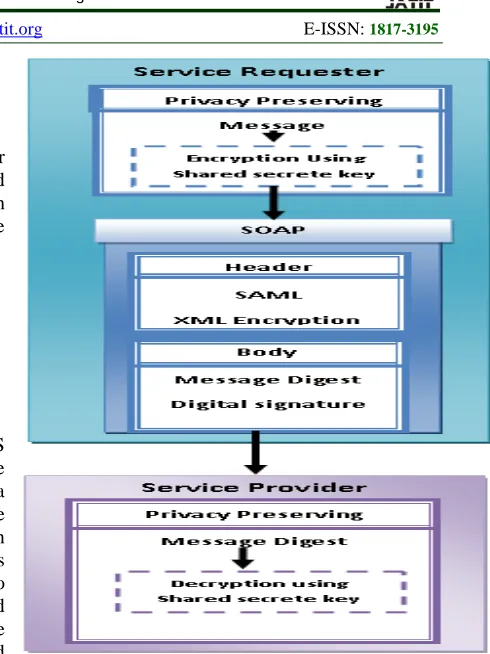
In this proposed model, the user affords the self encrypted data to the requester agent. The requester agent again encrypts the data with QoS requirements for security. With the process of privacy preserving, the HTTPI protocol having the more secure capability like HTTPs.
Thus the property of the HTTPs is integrated with HTTPI protocol and satisfies the QoS requirement of
four mechanisms such as authentication,
5. IMPLEMENTATION
Our implementation focus on improving the QoS in web service. The secure web service has been implemented using the asp.Net, c# and WSE3.0.The QoS is achieved by implementing the privacy preserving concept in which the requested message is Encrypted, then the message digest is parameterized to the soap creation this process provides confidentiality, then while creating the soap envelope we add the digital certificate like X509 for the authentication and authorization purpose.
Then the XML encryption take place in which
Encryption Extension, Encryption Extension
Attribute, Encryption Extension Enum, Encryption Extension Message, Tracing Extension, Tracing Extension Attribute and Tracing Extension Enum sample screen is shown in Figure 4 this feature provides extra security to the data then the envelope created and sends to the web service. In the XML encryption both the request and response are encrypted by tracing it. The implementation of web service method is shown in Figure 5.
The below tables shows that WS scenarios Vs average response time, average throughput and reply size per request and protocols HTTP, HTTPs Vs Response time, reply Size. It’s clearly explains combinations of HTTPs and HTTPi provides more secure and most cache accessibility in the WS.
[image:4.612.303.547.74.400.2]In another experimental setup we maintain the configuration as I3 Processor with 4 GB memory, we conducted the performance test to analyze the HTTP protocol in various browsers such as Internet Explorer, Mozilla Firefox, Google Chrome for throughput (transaction/seconds), average response time (milliseconds) and response size (KB) and the values are tabulated and the results are shown as graph.
Figure 4: Encryption Extension Attributes
[image:4.612.312.548.430.699.2]6. RESULTS AND ANALYSIS
The web service provider provides the account check, Hello (welcome) service shown in Figure 6 by publishing his web service that can be accessed through the client side.
Figure 6: Web Service Provided By Service Provider
The encryption method is implemented in every input, so that even the man in middle attack can be avoided easily. Then in the soap creation the xml encryption and in SAML part Digital signature addition take place which can provide the security, authentication and authorization.
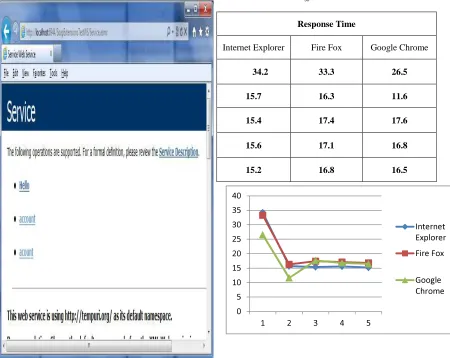
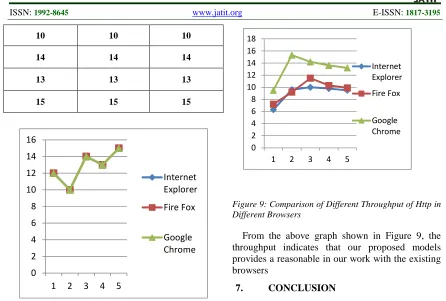
In our experiment we have calculated the response time, reply size and throughput for various browsers which has resulted in different scenarios. Thus for different browsers there will be change in response time, through put and reply size .Table 1 shows the compression of response time of different browsers and are plotted in Figure 7. Table 2 shows the
[image:5.612.91.541.185.543.2]compression of Reply size of different browsers and are plotted in Figure 8. Table 3 shows the compression of throughput between different browsers and are plotted in Figure 9.
Table 1: Comparison of Different Response Time of Http in Different Browsers
Response Time
Internet Explorer Fire Fox Google Chrome
34.2 33.3 26.5
15.7 16.3 11.6
15.4 17.4 17.6
15.6 17.1 16.8
15.2 16.8 16.5
0 5 10 15 20 25 30 35 40
1 2 3 4 5
Internet Explorer
Fire Fox
Google Chrome
Figure 7: Comparison of different Response time of HTTP in different browsers
From the above graph shown in Figure 7, the response time indicates that our proposed models provides better results with the existing browsers
Table 2: Comparison of Different Reply size of HTTP in Different Browsers
Reply Size
Internet Explorer Fire Fox Google Chrome
10 10 10
14 14 14
13 13 13
15 15 15
0 2 4 6 8 10 12 14 16
1 2 3 4 5
Internet Explorer
Fire Fox
Google Chrome
Figure 8: Comparison of Different Reply Size of HTTP in Different Browsers
From the above graph shown in Figure 8, the reply size indicates that our proposed models provides good results with the existing browsers
Table 3: Comparison of Different Through Put of Http in Different Browsers
Throughput
Internet Explorer Fire Fox Google Chrome
6.3 7.2 9.5
9.6 9.2 15.3
10.0 11.5 14.2
9.8 10.3 13.6
9.5 9.9 13.2
0 2 4 6 8 10 12 14 16 18
1 2 3 4 5
Internet Explorer
Fire Fox
[image:6.612.81.527.69.370.2]Google Chrome
Figure 9: Comparison of Different Throughput of Http in Different Browsers
From the above graph shown in Figure 9, the throughput indicates that our proposed models provides a reasonable in our work with the existing browsers
7. CONCLUSION
The important aspect of end to end business transaction is Quality of Service, which is more important part in web services. The typical QoS
mechanisms having various parameters like
scalability, robustness, exception handling, accuracy, integrity, accessibility, interoperability, and network-related QoS requirements. QoS also covers non
functional characteristics like performance
REFERENCES:
[1] N K Prasanna Anjaneyulu Anna and Shaik Nazeer, “Semantic Web Security and Privacy”, Journal of Theoretical & Applied Information Technology; 2010, Vol. 22 Issue 1, pp.9-18 [2] Jian Zhang, “A Web Services-based Security
Model for Digital Watermarking”, Multimedia
Technology (ICMT), 2011 International
Conference on, 26-28 July 2011.Page:4805 – 4808.
[3] TAO Chun-hua and FENG Zhi-yong, “Novel
QoS-aware Web service recommendation
model”, Application Research of Computers, Vol. 27, No. 10, 2010, pp. 3902-3905,3914. [4] Ping Wang, Kuo-Ming Cha and, Chi-Chun Lo,
“On Optimal Decision for QoS-aware
Composite Service Selection”, Expert Systems with Applications, Vol. 37, No. 1, 2010, pp. 440-449.
[5] Pankaj Choudhary, Rajendra Aaseri and Nirmal Roberts, “HTTPI based Web Service Security over SOAP”, International Journal of Network Security & Its Applications (IJNSA), Vol.5, No.3, May 2013, pp. 55-66.
[6] Adam, C., From Web Services to SOA and Everything in Between: The Journey Begins, Webservices.org, May 2005.
[7] Bian WU and Xincai WU, “A QoS-aware Method for Web Services Discovery”, Journal of Geographic Information System, 2010, 2, pp. 40-44.